Hispanopedia Wiki
Plutón ( designación de planeta menor : 134340 Pluto ) es un planeta enano en el cinturón de Kuiper , un anillo de cuerpos más allá de la órbita de Neptuno . Es el noveno objeto más grande y el décimo más masivo conocido que orbita directamente el Sol . Es el objeto transneptuniano conocido más grande por volumen, por un pequeño margen, pero es menos masivo que Eris . Al igual que otros objetos del cinturón de Kuiper, Plutón está hecho principalmente de hielo y roca y es mucho más pequeño que los planetas interiores . Plutón tiene aproximadamente una sexta parte de la masa de la Luna y un tercio de su volumen.
Plutón tiene una órbita moderadamente excéntrica e inclinada , que va de 30 a 49 unidades astronómicas (4,5 a 7,3 mil millones de kilómetros ; 2,8 a 4,6 mil millones de millas ) del Sol. La luz del Sol tarda 5,5 horas en llegar a Plutón a su distancia orbital de 39,5 UA (5,91 mil millones de km; 3,67 mil millones de millas). La órbita excéntrica de Plutón lo acerca periódicamente al Sol más que Neptuno , pero una resonancia orbital estable evita que colisionen.
Plutón tiene cinco lunas conocidas : Caronte , la más grande, cuyo diámetro es un poco más de la mitad del de Plutón; Estigia ; Nix ; Cerbero ; e Hidra . Plutón y Caronte a veces se consideran un sistema binario porque el baricentro de sus órbitas no se encuentra dentro de ninguno de los cuerpos, y están bloqueados por mareas . New Horizons fue la primera nave espacial en visitar Plutón y sus lunas, haciendo un sobrevuelo el 14 de julio de 2015, y tomando mediciones y observaciones detalladas.
Plutón fue descubierto en 1930 por Clyde W. Tombaugh , lo que lo convirtió en el primer objeto conocido en el cinturón de Kuiper. Fue aclamado inmediatamente como el noveno planeta , pero siempre fue el objeto extraño, [15] : 27 y su estatus planetario fue cuestionado cuando se descubrió que era mucho más pequeño de lo esperado. Estas dudas aumentaron después del descubrimiento de objetos adicionales en el cinturón de Kuiper a partir de la década de 1990, y particularmente el objeto de disco disperso más masivo Eris en 2005. En 2006, la Unión Astronómica Internacional (UAI) redefinió formalmente el término planeta para excluir planetas enanos como Plutón. Sin embargo, muchos astrónomos planetarios continúan considerando a Plutón y otros planetas enanos como planetas.
Historia
Descubrimiento

En la década de 1840, Urbain Le Verrier utilizó la mecánica newtoniana para predecir la posición del planeta Neptuno , entonces desconocido, tras analizar las perturbaciones en la órbita de Urano . Las observaciones posteriores de Neptuno a finales del siglo XIX llevaron a los astrónomos a especular que la órbita de Urano estaba siendo perturbada por otro planeta además de Neptuno. [16]
En 1906, Percival Lowell —un rico bostoniano que había fundado el Observatorio Lowell en Flagstaff, Arizona , en 1894— inició un extenso proyecto en busca de un posible noveno planeta, al que denominó « Planeta X ». [17] En 1909, Lowell y William H. Pickering habían sugerido varias posibles coordenadas celestes para dicho planeta. [18] Lowell y su observatorio llevaron a cabo su búsqueda, utilizando cálculos matemáticos realizados por Elizabeth Williams , hasta su muerte en 1916, pero sin éxito. Sin que Lowell lo supiera, sus estudios habían capturado dos imágenes débiles de Plutón el 19 de marzo y el 7 de abril de 1915, pero no fueron reconocidos por lo que eran. [18] [19] Hay otras catorce observaciones previas conocidas , siendo la más antigua realizada por el Observatorio Yerkes el 20 de agosto de 1909. [20]

La viuda de Percival, Constance Lowell, entró en una batalla legal de diez años con el Observatorio Lowell por el legado de su marido, y la búsqueda del Planeta X no se reanudó hasta 1929. [21] Vesto Melvin Slipher , el director del observatorio, le dio el trabajo de localizar el Planeta X a Clyde Tombaugh , de 23 años , que acababa de llegar al observatorio después de que Slipher quedara impresionado por una muestra de sus dibujos astronómicos. [21]
La tarea de Tombaugh era tomar imágenes sistemáticas del cielo nocturno en pares de fotografías, luego examinar cada par y determinar si algún objeto había cambiado de posición. Utilizando un comparador de parpadeo , cambió rápidamente de una vista a otra de cada una de las placas para crear la ilusión de movimiento de cualquier objeto que hubiera cambiado de posición o apariencia entre fotografías. El 18 de febrero de 1930, después de casi un año de búsqueda, Tombaugh descubrió un posible objeto en movimiento en placas fotográficas tomadas el 23 y el 29 de enero. Una fotografía de menor calidad tomada el 21 de enero ayudó a confirmar el movimiento. [22] Después de que el observatorio obtuvo más fotografías de confirmación, la noticia del descubrimiento fue telegrafiada al Observatorio de la Universidad de Harvard el 13 de marzo de 1930. [18]
Un año plutoniano corresponde a 247,94 años terrestres; [3] por lo tanto, en 2178, Plutón completará su primera órbita desde su descubrimiento.
Nombre y símbolo
El nombre Plutón proviene del dios romano del inframundo ; y también es un epíteto de Hades (el equivalente griego de Plutón).
Tras el anuncio del descubrimiento, el Observatorio Lowell recibió más de mil sugerencias de nombres. [23] Tres nombres encabezaron la lista: Minerva , Plutón y Cronos . «Minerva» fue la primera opción del personal de Lowell [24], pero fue rechazada porque ya se había utilizado para un asteroide ; Cronos fue desfavorecido porque fue promovido por un astrónomo impopular y egocéntrico, Thomas Jefferson Jackson See . Luego se realizó una votación y «Plutón» fue la elección unánime. Para asegurarse de que el nombre se mantuviera y de que el planeta no sufriera cambios en su nombre como había sucedido con Urano, el Observatorio Lowell propuso el nombre a la Sociedad Astronómica Estadounidense y a la Sociedad Astronómica Real ; ambas lo aprobaron por unanimidad. [15] : 136 [25] El nombre se publicó el 1 de mayo de 1930. [26] [27]
El nombre Plutón había recibido unas 150 nominaciones entre las cartas y telegramas enviados a Lowell. La primera [h] había sido de Venetia Burney (1918-2009), una colegiala de once años de Oxford , Inglaterra, que estaba interesada en la mitología clásica . [15] [26] Se lo había sugerido a su abuelo Falconer Madan cuando leyó la noticia del descubrimiento de Plutón a su familia durante el desayuno; Madan le pasó la sugerencia al profesor de astronomía Herbert Hall Turner , quien la envió por cable a sus colegas en Lowell el 16 de marzo, tres días después del anuncio. [24] [26]
El nombre «Plutón» era mitológicamente apropiado: el dios Plutón era uno de los seis hijos supervivientes de Saturno , y los demás ya habían sido elegidos como nombres de planetas mayores o menores (sus hermanos Júpiter y Neptuno , y sus hermanas Ceres , Juno y Vesta ). Tanto el dios como el planeta habitaban regiones «sombrías», y el dios era capaz de hacerse invisible, como lo había sido el planeta durante tanto tiempo. [29] La elección se vio ayudada además por el hecho de que las dos primeras letras de Plutón eran las iniciales de Percival Lowell; de hecho, «Percival» había sido una de las sugerencias más populares para un nombre para el nuevo planeta. [24] [30] Símbolo planetario de Plutón ⟨⟩ fue creado entonces como un monograma de las letras "PL". [31] Este símbolo rara vez se utiliza en astronomía, [i] aunque todavía es común en astrología. Sin embargo, el símbolo astrológico más común para Plutón, que también se utiliza ocasionalmente en astronomía, es un orbe (que posiblemente representa el gorro de invisibilidad de Plutón) sobre el bidente de Plutón ⟨⟩ , que data de principios de la década de 1930. [35] [j]
El nombre "Plutón" fue rápidamente adoptado por la cultura en general. En 1930, Walt Disney aparentemente se inspiró en él cuando presentó a Mickey Mouse un compañero canino llamado Pluto , aunque el animador de Disney Ben Sharpsteen no pudo confirmar por qué se le dio el nombre. [39] En 1941, Glenn T. Seaborg nombró al elemento recién creado plutonio en honor a Plutón, de acuerdo con la tradición de nombrar elementos en honor a planetas recién descubiertos, después del uranio , que recibió el nombre de Urano, y el neptunio , que recibió el nombre de Neptuno. [40]
La mayoría de los idiomas utilizan el nombre "Plutón" en varias transliteraciones. [k] En japonés, Houei Nojiri sugirió el calco Meiōsei (冥王星, "Estrella del Rey (Dios) del Inframundo") , y esto fue tomado prestado al chino y al coreano. Algunos idiomas de la India usan el nombre Plutón, pero otros, como el hindi , usan el nombre de Yama , el dios de la muerte en el hinduismo. [41] Las lenguas polinesias también tienden a usar el dios indígena del inframundo, como en el whiro maorí . [41] Se podría esperar que el vietnamita siguiera al chino, pero no lo hace porque la palabra chino-vietnamita冥minh "oscuro" es homófona con 明minh "brillante". En cambio, los vietnamitas utilizan a Yama, que también es una deidad budista, en la forma de Sao Diêm Vương星閻王 "Estrella de Yama", derivada del chino 閻王Yán Wáng / Yìhm Wòhng "Rey Yama". [41] [42] [43]
Desmentido el Planeta X
Una vez que se descubrió Plutón, su debilidad y la falta de un disco visible pusieron en duda la idea de que fuera el Planeta X de Lowell . [17] Las estimaciones de la masa de Plutón se revisaron a la baja a lo largo del siglo XX. [44]
Los astrónomos calcularon inicialmente su masa basándose en su presunto efecto sobre Neptuno y Urano. En 1931, se calculó que Plutón tenía aproximadamente la masa de la Tierra , con cálculos posteriores en 1948 que redujeron la masa a aproximadamente la de Marte . [46] [48] En 1976, Dale Cruikshank, Carl Pilcher y David Morrison de la Universidad de Hawái calcularon el albedo de Plutón por primera vez, encontrando que coincidía con el del hielo de metano; esto significaba que Plutón tenía que ser excepcionalmente luminoso para su tamaño y, por lo tanto, no podía tener más del 1 por ciento de la masa de la Tierra. [49] (El albedo de Plutón es 1,4-1,9 veces el de la Tierra. [3] )
En 1978, el descubrimiento de la luna de Plutón, Caronte, permitió medir por primera vez la masa de Plutón: aproximadamente el 0,2% de la de la Tierra, y demasiado pequeña para explicar las discrepancias en la órbita de Urano. Las búsquedas posteriores de un Planeta X alternativo, en particular las de Robert Sutton Harrington , [52] fracasaron. En 1992, Myles Standish utilizó datos del sobrevuelo de Neptuno de la Voyager 2 en 1989, que habían revisado las estimaciones de la masa de Neptuno a la baja en un 0,5% (una cantidad comparable a la masa de Marte) para recalcular su efecto gravitatorio sobre Urano. Con las nuevas cifras añadidas, las discrepancias, y con ellas la necesidad de un Planeta X, desaparecieron. [53] A partir de 2000, [update]la mayoría de los científicos están de acuerdo en que el Planeta X, como lo definió Lowell, no existe. [54] Lowell había hecho una predicción de la órbita y posición del Planeta X en 1915 que era bastante cercana a la órbita real de Plutón y su posición en ese momento; Ernest W. Brown concluyó poco después del descubrimiento de Plutón que esto era una coincidencia. [55]
Clasificación
A partir de 1992, se descubrieron muchos cuerpos orbitando en el mismo volumen que Plutón, lo que demuestra que Plutón es parte de una población de objetos llamada cinturón de Kuiper . Esto hizo que su estatus oficial como planeta fuera controvertido, y muchos cuestionaron si Plutón debería considerarse junto con su población circundante o por separado. Los directores de museos y planetarios ocasionalmente crearon controversia al omitir a Plutón de los modelos planetarios del Sistema Solar . En febrero de 2000, el Planetario Hayden de la ciudad de Nueva York exhibió un modelo del Sistema Solar de solo ocho planetas, que fue noticia casi un año después. [56]
Ceres , Pallas , Juno y Vesta perdieron su estatus de planeta entre la mayoría de los astrónomos después del descubrimiento de muchos otros asteroides en la década de 1840. Por otro lado, los geólogos planetarios a menudo consideraban a Ceres, y con menos frecuencia a Pallas y Vesta, como diferentes de los asteroides más pequeños porque eran lo suficientemente grandes como para haber experimentado una evolución geológica. [57] Aunque los primeros objetos del cinturón de Kuiper descubiertos eran bastante pequeños, pronto se descubrieron objetos cada vez más cercanos en tamaño a Plutón, algunos lo suficientemente grandes (como el propio Plutón) como para satisfacer las ideas geológicas pero no dinámicas de la condición de planeta. [58] El 29 de julio de 2005, el debate se volvió inevitable cuando los astrónomos de Caltech anunciaron el descubrimiento de un nuevo objeto transneptuniano , Eris , que era sustancialmente más masivo que Plutón y el objeto más masivo descubierto en el Sistema Solar desde Tritón en 1846. Sus descubridores y la prensa inicialmente lo llamaron el décimo planeta , aunque no hubo un consenso oficial en ese momento sobre si llamarlo planeta. [59] Otros en la comunidad astronómica consideraron que el descubrimiento era el argumento más fuerte para reclasificar a Plutón como un planeta menor. [60]
Clasificación de la UAI
El debate llegó a su punto álgido en agosto de 2006, con una resolución de la UAI que creó una definición oficial del término "planeta". Según esta resolución, hay tres condiciones para que un objeto del Sistema Solar sea considerado un planeta:
- El objeto debe estar en órbita alrededor del Sol .
- El objeto debe ser lo suficientemente masivo como para que su propia gravedad lo redondee. Más específicamente, su propia gravedad debería atraerlo hacia una forma definida por el equilibrio hidrostático .
- Debe haber despejado el vecindario alrededor de su órbita. [61] [62]
Plutón no cumple la tercera condición. [63] Su masa es sustancialmente menor que la masa combinada de los otros objetos en su órbita: 0,07 veces, en contraste con la Tierra, que es 1,7 millones de veces la masa restante en su órbita (excluyendo la luna). [64] [62] La UAI decidió además que los cuerpos que, como Plutón, cumplen los criterios 1 y 2, pero no cumplen el criterio 3 se denominarían planetas enanos . En septiembre de 2006, la UAI incluyó a Plutón, y a Eris y su luna Dysnomia , en su Catálogo de Planetas Menores , dándoles las designaciones oficiales de planetas menores "(134340) Plutón", "(136199) Eris" y "(136199) Eris I Dysnomia". [65] Si Plutón hubiera sido incluido en el momento de su descubrimiento en 1930, probablemente habría sido designado como 1164, siguiendo a 1163 Saga , que fue descubierto un mes antes. [66]
Ha habido cierta resistencia dentro de la comunidad astronómica hacia la reclasificación, y en particular los científicos planetarios a menudo continúan rechazándola, considerando a Plutón, Caronte y Eris como planetas por la misma razón que lo hacen con Ceres. En efecto, esto equivale a aceptar solo la segunda cláusula de la definición de la IAU. [67] [68] [69] Alan Stern , investigador principal de la misión New Horizons de la NASA a Plutón, ridiculizó la resolución de la IAU. [70] [71] También afirmó que debido a que menos del cinco por ciento de los astrónomos votaron a favor, la decisión no era representativa de toda la comunidad astronómica. [71] Marc W. Buie , entonces en el Observatorio Lowell, presentó una petición contra la definición. [72] Otros han apoyado a la IAU, por ejemplo Mike Brown , el astrónomo que descubrió a Eris. [73]
La recepción pública de la decisión de la UAI fue mixta. Una resolución presentada en la Asamblea del Estado de California calificó jocosamente la decisión de la UAI como una "herejía científica". [74] La Cámara de Representantes de Nuevo México aprobó una resolución en honor a Clyde Tombaugh, el descubridor de Plutón y residente de ese estado durante mucho tiempo, que declaraba que Plutón siempre será considerado un planeta mientras se encuentre en los cielos de Nuevo México y que el 13 de marzo de 2007 fue el Día del Planeta Plutón. [75] [76] El Senado de Illinois aprobó una resolución similar en 2009 sobre la base de que Tombaugh nació en Illinois. La resolución afirmaba que Plutón había sido "injustamente degradado a planeta 'enano'" por la UAI. [77] Algunos miembros del público también han rechazado el cambio, citando el desacuerdo dentro de la comunidad científica sobre el tema, o por razones sentimentales, manteniendo que siempre han conocido a Plutón como un planeta y seguirán haciéndolo independientemente de la decisión de la UAI. [78] En 2006, en su 17.ª votación anual de palabras del año, la Sociedad Americana del Dialecto votó plutoed como la palabra del año. "Plutón" significa "degradar o devaluar a alguien o algo". [79]
En agosto de 2008, investigadores de ambos bandos se reunieron en el Laboratorio de Física Aplicada de la Universidad Johns Hopkins para una conferencia que incluyó charlas consecutivas sobre la definición de planeta de la UAI. [80] Titulada "El gran debate sobre los planetas", [81] la conferencia publicó un comunicado de prensa posterior a la conferencia indicando que los científicos no pudieron llegar a un consenso sobre la definición de planeta. [82] En junio de 2008, la UAI había anunciado en un comunicado de prensa que el término " plutoide " se utilizaría de ahora en adelante para referirse a Plutón y otros objetos de masa planetaria que tienen un semieje mayor orbital mayor que el de Neptuno, aunque el término no ha tenido un uso significativo. [83] [84] [85]
En abril de 2024, Arizona (donde se descubrió Plutón por primera vez en 1930) aprobó una ley que nombra a Plutón como el planeta oficial del estado. [86]
Órbita

Sol · Saturno · Urano · Neptuno · Plutón
El período orbital de Plutón es de unos 248 años. Sus características orbitales son sustancialmente diferentes de las de los planetas, que siguen órbitas casi circulares alrededor del Sol cerca de un plano de referencia llamado eclíptica . En contraste, la órbita de Plutón está moderadamente inclinada con respecto a la eclíptica (más de 17°) y es moderadamente excéntrica (elíptica). Esta excentricidad significa que una pequeña región de la órbita de Plutón se encuentra más cerca del Sol que la de Neptuno. El baricentro Plutón-Caronte llegó al perihelio el 5 de septiembre de 1989, [4] [l] y estuvo más cerca del Sol que Neptuno por última vez entre el 7 de febrero de 1979 y el 11 de febrero de 1999. [87]
Aunque se mantiene la resonancia 3:2 con Neptuno (ver más abajo), la inclinación y la excentricidad de Plutón se comportan de manera caótica . Se pueden utilizar simulaciones por computadora para predecir su posición durante varios millones de años (tanto hacia adelante como hacia atrás en el tiempo), pero después de intervalos mucho más largos que el tiempo de Lyapunov de 10 a 20 millones de años, los cálculos se vuelven poco confiables: Plutón es sensible a detalles inconmensurablemente pequeños del Sistema Solar, factores difíciles de predecir que cambiarán gradualmente la posición de Plutón en su órbita. [88] [89]
El semieje mayor de la órbita de Plutón varía entre aproximadamente 39,3 y 39,6 UA con un período de aproximadamente 19.951 años, lo que corresponde a un período orbital que varía entre 246 y 249 años. El semieje mayor y el período están alargandose en la actualidad. [90]
Relación con Neptuno

A pesar de que la órbita de Plutón parece cruzar la de Neptuno cuando se observa desde el norte o el sur del Sistema Solar, las órbitas de los dos objetos no se cruzan. Cuando Plutón está más cerca del Sol, y cerca de la órbita de Neptuno visto desde esa posición, también es el más al norte de la trayectoria de Neptuno. La órbita de Plutón pasa aproximadamente a 8 UA al norte de la de Neptuno, lo que evita una colisión. [91] [92] [93] [m]
Esto por sí solo no es suficiente para proteger a Plutón; las perturbaciones de los planetas (especialmente Neptuno) podrían alterar la órbita de Plutón (como su precesión orbital ) durante millones de años de modo que podría ocurrir una colisión. Sin embargo, Plutón también está protegido por su resonancia orbital 2:3 con Neptuno : por cada dos órbitas que Plutón hace alrededor del Sol, Neptuno hace tres, en un marco de referencia que gira a la velocidad de precesión del perihelio de Plutón (aproximadamente0,97 × 10 −4 grados por año [90] ). Cada ciclo dura unos 495 años. (Hay muchos otros objetos en esta misma resonancia, llamados plutinos .) En la actualidad, en cada ciclo de 495 años, la primera vez que Plutón está en el perihelio (como en 1989), Neptuno está 57° por delante de Plutón. Para el segundo paso de Plutón por el perihelio, Neptuno habrá completado una y media más de sus propias órbitas, y estará 123° detrás de Plutón. [95] La separación mínima entre Plutón y Neptuno es de más de 17 UA, que es mayor que la separación mínima de Plutón con Urano (11 UA). [93] La separación mínima entre Plutón y Neptuno ocurre en realidad cerca del momento del afelio de Plutón. [90]

La resonancia 2:3 entre los dos cuerpos es muy estable y se ha conservado durante millones de años. [96] Esto evita que sus órbitas cambien entre sí, por lo que los dos cuerpos nunca pueden pasar cerca uno del otro. Incluso si la órbita de Plutón no estuviera inclinada, los dos cuerpos nunca podrían colisionar. [93] Cuando el período de Plutón es ligeramente diferente de 3/2 del de Neptuno, el patrón de su distancia a Neptuno se desviará. Cerca del perihelio, Plutón se mueve hacia el interior de la órbita de Neptuno y, por lo tanto, se mueve más rápido, por lo que durante la primera de las dos órbitas en el ciclo de 495 años, se está aproximando a Neptuno por detrás. En la actualidad permanece entre 50° y 65° detrás de Neptuno durante 100 años (por ejemplo, 1937-2036). [95] La atracción gravitatoria entre los dos hace que el momento angular se transfiera a Plutón. Esta situación hace que Plutón pase a una órbita ligeramente más grande, donde tiene un período ligeramente más largo, según la tercera ley de Kepler . Después de varias repeticiones de este tipo, Plutón se retrasa lo suficiente como para que en el segundo perihelio de cada ciclo no esté muy por delante de Neptuno, que viene detrás de él, y Neptuno comience a disminuir el período de Plutón nuevamente. El ciclo completo tarda unos 20.000 años en completarse. [93] [96] [97]
Otros factores
Los estudios numéricos han demostrado que, a lo largo de millones de años, la naturaleza general de la alineación entre las órbitas de Plutón y Neptuno no cambia. [91] [90] Existen otras resonancias e interacciones que mejoran la estabilidad de Plutón. Estas surgen principalmente de dos mecanismos adicionales (además de la resonancia de movimiento medio 2:3).
En primer lugar, el argumento del perihelio de Plutón , el ángulo entre el punto en el que cruza la eclíptica (o el plano invariante ) y el punto en el que está más cerca del Sol, libra alrededor de 90°. [90] Esto significa que cuando Plutón está más cerca del Sol, está en su punto más al norte del plano del Sistema Solar, lo que evita encuentros con Neptuno. Esto es una consecuencia del mecanismo de Kozai , [91] que relaciona la excentricidad de una órbita con su inclinación con respecto a un cuerpo perturbador más grande, en este caso, Neptuno. En relación con Neptuno, la amplitud de la libración es de 38°, por lo que la separación angular del perihelio de Plutón con la órbita de Neptuno es siempre mayor que 52° (90°–38°) . La separación angular más cercana ocurre cada 10.000 años. [96]
En segundo lugar, las longitudes de los nodos ascendentes de los dos cuerpos (los puntos donde cruzan el plano invariante ) están casi en resonancia con la libración anterior. Cuando las dos longitudes son iguales (es decir, cuando se puede trazar una línea recta a través de ambos nodos y el Sol), el perihelio de Plutón se encuentra exactamente a 90° y, por lo tanto, se acerca más al Sol cuando está más al norte de la órbita de Neptuno. Esto se conoce como la superresonancia 1:1 . Todos los planetas joviales (Júpiter, Saturno, Urano y Neptuno) desempeñan un papel en la creación de la superresonancia. [91]
Orco
El segundo plutón más grande conocido , Orcus , tiene un diámetro de unos 900 km y se encuentra en una órbita muy similar a la de Plutón. Sin embargo, las órbitas de Plutón y Orcus están desfasadas, por lo que nunca se aproximan. Se lo ha denominado el "anti-Plutón" y recibe su nombre del equivalente etrusco del dios Plutón .
Rotación

El período de rotación de Plutón , su día, es igual a 6,387 días terrestres . [3] [98] Al igual que Urano y 2 Palas , Plutón gira sobre su "lado" en su plano orbital, con una inclinación axial de 120°, por lo que su variación estacional es extrema; en sus solsticios , una cuarta parte de su superficie está en luz diurna continua, mientras que otra cuarta parte está en oscuridad continua. [99] La razón de esta orientación inusual ha sido debatida. La investigación de la Universidad de Arizona ha sugerido que puede deberse a la forma en que el giro de un cuerpo siempre se ajustará para minimizar la energía. Esto podría significar que un cuerpo se reorienta para poner masa extraña cerca del ecuador y las regiones que carecen de masa tienden hacia los polos. Esto se llama vaivén polar . [100] Según un artículo publicado por la Universidad de Arizona, esto podría deberse a masas de nitrógeno congelado que se acumulan en áreas sombreadas del planeta enano. Estas masas harían que el cuerpo se reorientara, lo que daría lugar a su inusual inclinación axial de 120°. La acumulación de nitrógeno se debe a la enorme distancia de Plutón respecto del Sol. En el ecuador, las temperaturas pueden descender hasta los -240 °C (-400,0 °F; 33,1 K), lo que hace que el nitrógeno se congele como se congelaría el agua en la Tierra. El mismo efecto de desplazamiento polar observado en Plutón se observaría en la Tierra si la capa de hielo antártica fuera varias veces más grande. [101]
Geología
Superficie

Las llanuras de la superficie de Plutón están compuestas por más del 98 por ciento de hielo de nitrógeno , con trazas de metano y monóxido de carbono . [102] El nitrógeno y el monóxido de carbono son más abundantes en la cara anti-Caronte de Plutón (alrededor de 180° de longitud, donde se encuentra el lóbulo occidental de Tombaugh Regio , Sputnik Planitia ), mientras que el metano es más abundante cerca de los 300° este. [103] Las montañas están hechas de hielo de agua. [104] La superficie de Plutón es bastante variada, con grandes diferencias tanto en brillo como en color. [105] Plutón es uno de los cuerpos más contrastantes del Sistema Solar, con tanto contraste como la luna de Saturno , Jápeto . [106] El color varía desde el negro carbón hasta el naranja oscuro y el blanco. [107] El color de Plutón es más similar al de Ío con un poco más de naranja y significativamente menos rojo que Marte . [108] Entre las características geográficas notables se incluyen Tombaugh Regio, o el "Corazón" (una gran área brillante en el lado opuesto a Caronte), Belton Regio , [6] o la "Ballena" (una gran área oscura en el hemisferio posterior) y los " Nudillos de Bronce " (una serie de áreas oscuras ecuatoriales en el hemisferio anterior).
Sputnik Planitia, el lóbulo occidental del "Corazón", es una cuenca de 1.000 km de ancho de hielos congelados de nitrógeno y monóxido de carbono, dividida en celdas poligonales, que se interpretan como celdas de convección que llevan bloques flotantes de corteza de hielo de agua y fosas de sublimación hacia sus márgenes; [109] [110] [111] hay signos obvios de flujos glaciares tanto dentro como fuera de la cuenca. [112] [113] No tiene cráteres que fueran visibles para New Horizons , lo que indica que su superficie tiene menos de 10 millones de años. [114] Los últimos estudios han demostrado que la superficie tiene una edad de180 000+90 000
−40 000[115] El equipo científico de
New Horizons resumió los hallazgos iniciales como "Plutón muestra una sorprendente variedad de formas geológicas, incluyendo aquellas resultantes de interacciones glaciológicas y de superficie-atmósfera, así como procesos de impacto, tectónicos , posiblemente criovolcánicos y de pérdida de masa ". [7]
En las partes occidentales de la Sputnik Planitia hay campos de dunas transversales formadas por los vientos que soplan desde el centro de la Sputnik Planitia en dirección a las montañas circundantes. Las longitudes de onda de las dunas están en el rango de 0,4 a 1 km y probablemente consisten en partículas de metano de 200 a 300 μm de tamaño. [116]
-
 Imagen de Plutón obtenida por la cámara de imágenes visuales multiespectrales en color mejorado para resaltar las diferencias en la composición de la superficie.
 -
![Distribución de numerosos cráteres y cuencas de impacto tanto en Plutón como en Caronte. La variación en la densidad (no se encontró ninguno en Sputnik Planitia) indica una larga historia de actividad geológica variable. Precisamente por esta razón, la certeza de que haya numerosos cráteres en Plutón sigue siendo incierta.[117] La falta de cráteres a la izquierda y a la derecha de cada mapa se debe a la cobertura de baja resolución de esas regiones de antiencuentro.](https://images.hispanopedia.wiki/wikipedia/commons/thumb/1/13/Pluto_Charon_crater_map_Robbins_Dones_2023.jpg/500px-Pluto_Charon_crater_map_Robbins_Dones_2023.jpg) Distribución de numerosos cráteres y cuencas de impacto tanto en Plutón como en Caronte. La variación en la densidad (no se encontró ninguno en Sputnik Planitia ) indica una larga historia de actividad geológica variable. Precisamente por esta razón, la certeza de que haya numerosos cráteres en Plutón sigue siendo incierta. [117] La falta de cráteres a la izquierda y a la derecha de cada mapa se debe a la cobertura de baja resolución de esas regiones antiencuentros.
Distribución de numerosos cráteres y cuencas de impacto tanto en Plutón como en Caronte. La variación en la densidad (no se encontró ninguno en Sputnik Planitia ) indica una larga historia de actividad geológica variable. Precisamente por esta razón, la certeza de que haya numerosos cráteres en Plutón sigue siendo incierta. [117] La falta de cráteres a la izquierda y a la derecha de cada mapa se debe a la cobertura de baja resolución de esas regiones antiencuentros. -
 Mapa geológico de Sputnik Planitia y alrededores ( contexto ), con los márgenes de las celdas de convección delineados en negro
 -
 Regiones donde se ha detectado hielo de agua (regiones azules)

![Distribución de numerosos cráteres y cuencas de impacto tanto en Plutón como en Caronte. La variación en la densidad (no se encontró ninguno en Sputnik Planitia) indica una larga historia de actividad geológica variable. Precisamente por esta razón, la certeza de que haya numerosos cráteres en Plutón sigue siendo incierta.[117] La falta de cráteres a la izquierda y a la derecha de cada mapa se debe a la cobertura de baja resolución de esas regiones de antiencuentro.](http://upload.wikimedia.org/wikipedia/commons/thumb/1/13/Pluto_Charon_crater_map_Robbins_Dones_2023.jpg/1280px-Pluto_Charon_crater_map_Robbins_Dones_2023.jpg)
.jpg/1280px-Pluto's_Sputnik_Planum_geologic_map_(cropped).jpg)

Estructura interna

- Costra de hielo de agua
- Océano de agua líquida
- Núcleo de silicato
La densidad de Plutón es1,853 ± 0,004 g/cm 3 . [8] Debido a que la desintegración de elementos radiactivos eventualmente calentaría los hielos lo suficiente para que la roca se separara de ellos, los científicos esperan que la estructura interna de Plutón esté diferenciada, con el material rocoso habiéndose asentado en un núcleo denso rodeado por un manto de hielo de agua. La estimación previa a New Horizons para el diámetro del núcleo es1700 km, 70% of Pluto's diameter.[118] It is possible that such heating continues, creating a subsurface ocean of liquid water 100 to 180 km thick at the core–mantle boundary.[118][119][120] In September 2016, scientists at Brown University simulated the impact thought to have formed Sputnik Planitia, and showed that it might have been the result of liquid water upweling from below after the collision, implying the existence of a subsurface ocean at least 100 km deep.[121] In June 2020, astronomers reported evidence that Pluto may have had a subsurface ocean, and consequently may have been habitable, when it was first formed.[122][123] In March 2022, a team of researchers proposed that the mountains Wright Mons and Piccard Mons are actually a merger of many smaller cryovolcanic domes, suggesting a source of heat on the body at levels previously thought not possible.[124]
Mass and size

Pluto's diameter is 2376.6±3.2 km[5] and its mass is (1.303±0.003)×1022 kg, 17.7% that of the Moon (0.22% that of Earth).[125] Its surface area is 1.774443×10⁷ km2, or just slightly bigger than Russia or Antarctica (particularly including the Antarctic sea ice during winter). Its surface gravity is 0.063 g (compared to 1 g for Earth and 0.17 g for the Moon).[3] This gives Pluto an escape velocity of 4,363.2 km per hour / 2,711.167 miles per hour (as compared to Earth's 40,270 km per hour / 25,020 miles per hour). Pluto is more than twice the diameter and a dozen times the mass of Ceres, the largest object in the asteroid belt. It is less massive than the dwarf planet Eris, a trans-Neptunian object discovered in 2005, though Pluto has a larger diameter of 2,376.6 km[5] compared to Eris's approximate diameter of 2,326 km.[126]
With less than 0.2 lunar masses, Pluto is much less massive than the terrestrial planets, and also less massive than seven moons: Ganymede, Titan, Callisto, Io, the Moon, Europa, and Triton. The mass is much less than thought before Charon was discovered.[127]
The discovery of Pluto's satellite Charon in 1978 enabled a determination of the mass of the Pluto–Charon system by application of Newton's formulation of Kepler's third law. Observations of Pluto in occultation with Charon allowed scientists to establish Pluto's diameter more accurately, whereas the invention of adaptive optics allowed them to determine its shape more accurately.[128]
Determinations of Pluto's size have been complicated by its atmosphere[129] and hydrocarbon haze.[130] In March 2014, Lellouch, de Bergh et al. published findings regarding methane mixing ratios in Pluto's atmosphere consistent with a Plutonian diameter greater than 2,360 km, with a "best guess" of 2,368 km.[131] On July 13, 2015, images from NASA's New Horizons mission Long Range Reconnaissance Imager (LORRI), along with data from the other instruments, determined Pluto's diameter to be 2,370 km (1,473 mi),[126][132] which was later revised to be 2,372 km (1,474 mi) on July 24,[133] and later to 2374±8 km.[7] Using radio occultation data from the New Horizons Radio Science Experiment (REX), the diameter was found to be 2376.6±3.2 km.[5]
Atmosphere

Pluto has a tenuous atmosphere consisting of nitrogen (N2), methane (CH4), and carbon monoxide (CO), which are in equilibrium with their ices on Pluto's surface.[134][135] According to the measurements by New Horizons, the surface pressure is about 1 Pa (10 μbar),[7] roughly one million to 100,000 times less than Earth's atmospheric pressure. It was initially thought that, as Pluto moves away from the Sun, its atmosphere should gradually freeze onto the surface; studies of New Horizons data and ground-based occultations show that Pluto's atmospheric density increases, and that it likely remains gaseous throughout Pluto's orbit.[136][137] New Horizons observations showed that atmospheric escape of nitrogen to be 10,000 times less than expected.[137] Alan Stern has contended that even a small increase in Pluto's surface temperature can lead to exponential increases in Pluto's atmospheric density; from 18 hPa to as much as 280 hPa (three times that of Mars to a quarter that of the Earth). At such densities, nitrogen could flow across the surface as liquid.[137] Just like sweat cools the body as it evaporates from the skin, the sublimation of Pluto's atmosphere cools its surface.[138] Pluto has no or almost no troposphere; observations by New Horizons suggest only a thin tropospheric boundary layer. Its thickness in the place of measurement was 4 km, and the temperature was 37±3 K. The layer is not continuous.[139]
In July 2019, an occultation by Pluto showed that its atmospheric pressure, against expectations, had fallen by 20% since 2016.[140] In 2021, astronomers at the Southwest Research Institute confirmed the result using data from an occultation in 2018, which showed that light was appearing less gradually from behind Pluto's disc, indicating a thinning atmosphere.[141]
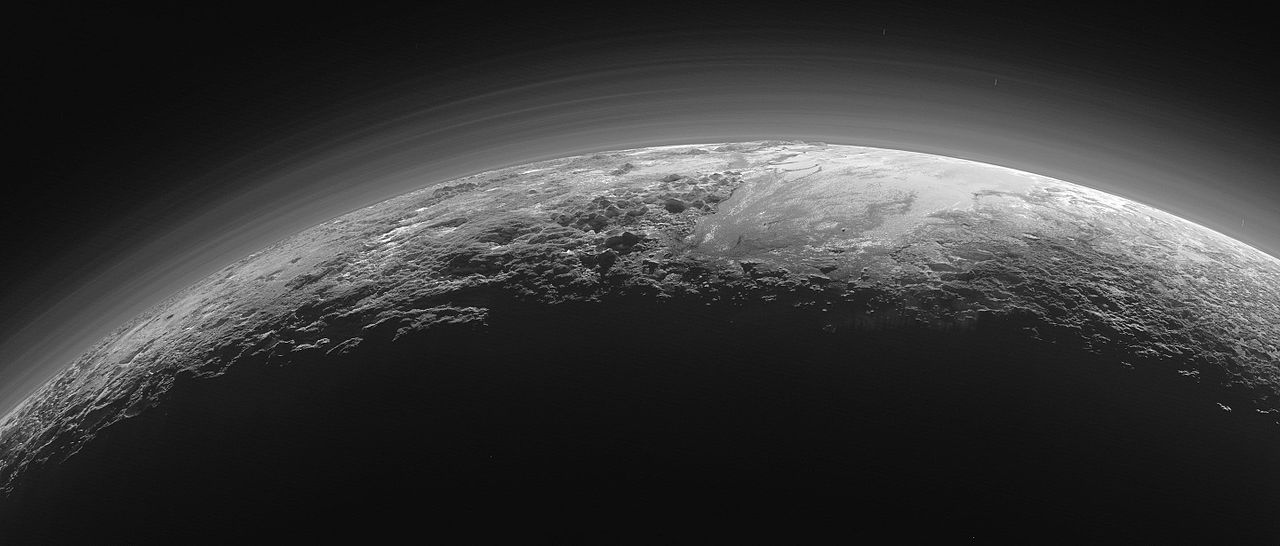
The presence of methane, a powerful greenhouse gas, in Pluto's atmosphere creates a temperature inversion, with the average temperature of its atmosphere tens of degrees warmer than its surface,[142] though observations by New Horizons have revealed Pluto's upper atmosphere to be far colder than expected (70 K, as opposed to about 100 K).[137] Pluto's atmosphere is divided into roughly 20 regularly spaced haze layers up to 150 km high,[7] thought to be the result of pressure waves created by airflow across Pluto's mountains.[137]
Natural satellites


Pluto has five known natural satellites. The largest and closest to Pluto is Charon. First identified in 1978 by astronomer James Christy, Charon is the only moon of Pluto that may be in hydrostatic equilibrium. Charon's mass is sufficient to cause the barycenter of the Pluto–Charon system to be outside Pluto. Beyond Charon there are four much smaller circumbinary moons. In order of distance from Pluto they are Styx, Nix, Kerberos, and Hydra. Nix and Hydra were both discovered in 2005,[143] Kerberos was discovered in 2011,[144] and Styx was discovered in 2012.[145] The satellites' orbits are circular (eccentricity < 0.006) and coplanar with Pluto's equator (inclination < 1°),[146][147] and therefore tilted approximately 120° relative to Pluto's orbit. The Plutonian system is highly compact: the five known satellites orbit within the inner 3% of the region where prograde orbits would be stable.[148]
The orbital periods of all Pluto's moons are linked in a system of orbital resonances and near-resonances.[147][149] When precession is accounted for, the orbital periods of Styx, Nix, and Hydra are in an exact 18:22:33 ratio.[147] There is a sequence of approximate ratios, 3:4:5:6, between the periods of Styx, Nix, Kerberos, and Hydra with that of Charon; the ratios become closer to being exact the further out the moons are.[147][150]
The Pluto–Charon system is one of the few in the Solar System whose barycenter lies outside the primary body; the Patroclus–Menoetius system is a smaller example, and the Sun–Jupiter system is the only larger one.[151] The similarity in size of Charon and Pluto has prompted some astronomers to call it a double dwarf planet.[152] The system is also unusual among planetary systems in that each is tidally locked to the other, which means that Pluto and Charon always have the same hemisphere facing each other — a property shared by only one other known system, Eris and Dysnomia.[153] From any position on either body, the other is always at the same position in the sky, or always obscured.[154] This also means that the rotation period of each is equal to the time it takes the entire system to rotate around its barycenter.[98]
Pluto's moons are hypothesized to have been formed by a collision between Pluto and a similar-sized body, early in the history of the Solar System. The collision released material that consolidated into the moons around Pluto.[155]
Quasi-satellite
In 2012, it was calculated that 15810 Arawn could be a quasi-satellite of Pluto, a specific type of co-orbital configuration.[156] According to the calculations, the object would be a quasi-satellite of Pluto for about 350,000 years out of every two-million-year period.[156][157] Measurements made by the New Horizons spacecraft in 2015 made it possible to calculate the orbit of Arawn more accurately,[158] and confirmed the earlier ones.[159] However, it is not agreed upon among astronomers whether Arawn should be classified as a quasi-satellite of Pluto based on its orbital dynamics, since its orbit is primarily controlled by Neptune with only occasional perturbations by Pluto.[160][158][159]
Origin

Pluto's origin and identity had long puzzled astronomers. One early hypothesis was that Pluto was an escaped moon of Neptune[161] knocked out of orbit by Neptune's largest moon, Triton. This idea was eventually rejected after dynamical studies showed it to be impossible because Pluto never approaches Neptune in its orbit.[162]
Pluto's true place in the Solar System began to reveal itself only in 1992, when astronomers began to find small icy objects beyond Neptune that were similar to Pluto not only in orbit but also in size and composition. This trans-Neptunian population is thought to be the source of many short-period comets. Pluto is the largest member of the Kuiper belt,[n] a stable belt of objects located between 30 and 50 AU from the Sun. As of 2011, surveys of the Kuiper belt to magnitude 21 were nearly complete and any remaining Pluto-sized objects are expected to be beyond 100 AU from the Sun.[163] Like other Kuiper-belt objects (KBOs), Pluto shares features with comets; for example, the solar wind is gradually blowing Pluto's surface into space.[164] It has been claimed that if Pluto were placed as near to the Sun as Earth, it would develop a tail, as comets do.[165] This claim has been disputed with the argument that Pluto's escape velocity is too high for this to happen.[166] It has been proposed that Pluto may have formed as a result of the agglomeration of numerous comets and Kuiper-belt objects.[167][168]
Though Pluto is the largest Kuiper belt object discovered,[130] Neptune's moon Triton, which is larger than Pluto, is similar to it both geologically and atmospherically, and is thought to be a captured Kuiper belt object.[169] Eris (see above) is about the same size as Pluto (though more massive) but is not strictly considered a member of the Kuiper belt population. Rather, it is considered a member of a linked population called the scattered disc.[170]
Like other members of the Kuiper belt, Pluto is thought to be a residual planetesimal; a component of the original protoplanetary disc around the Sun that failed to fully coalesce into a full-fledged planet. Most astronomers agree that Pluto owes its position to a sudden migration undergone by Neptune early in the Solar System's formation. As Neptune migrated outward, it approached the objects in the proto-Kuiper belt, setting one in orbit around itself (Triton), locking others into resonances, and knocking others into chaotic orbits. The objects in the scattered disc, a dynamically unstable region overlapping the Kuiper belt, are thought to have been placed in their positions by interactions with Neptune's migrating resonances.[171] A computer model created in 2004 by Alessandro Morbidelli of the Observatoire de la Côte d'Azur in Nice suggested that the migration of Neptune into the Kuiper belt may have been triggered by the formation of a 1:2 resonance between Jupiter and Saturn, which created a gravitational push that propelled both Uranus and Neptune into higher orbits and caused them to switch places, ultimately doubling Neptune's distance from the Sun. The resultant expulsion of objects from the proto-Kuiper belt could also explain the Late Heavy Bombardment 600 million years after the Solar System's formation and the origin of the Jupiter trojans.[172] It is possible that Pluto had a near-circular orbit about 33 AU from the Sun before Neptune's migration perturbed it into a resonant capture.[173] The Nice model requires that there were about a thousand Pluto-sized bodies in the original planetesimal disk, which included Triton and Eris.[172]
Observation and exploration
Observation

Pluto's distance from Earth makes its in-depth study and exploration difficult. Pluto's visual apparent magnitude averages 15.1, brightening to 13.65 at perihelion.[3] To see it, a telescope is required; around 30 cm (12 in) aperture being desirable.[174] It looks star-like and without a visible disk even in large telescopes,[175] because its angular diameter is maximum 0.11".[3]
The earliest maps of Pluto, made in the late 1980s, were brightness maps created from close observations of eclipses by its largest moon, Charon. Observations were made of the change in the total average brightness of the Pluto–Charon system during the eclipses. For example, eclipsing a bright spot on Pluto makes a bigger total brightness change than eclipsing a dark spot. Computer processing of many such observations can be used to create a brightness map. This method can also track changes in brightness over time.[176][177]
Better maps were produced from images taken by the Hubble Space Telescope (HST), which offered higher resolution, and showed considerably more detail,[106] resolving variations several hundred kilometers across, including polar regions and large bright spots.[108] These maps were produced by complex computer processing, which finds the best-fit projected maps for the few pixels of the Hubble images.[178] These remained the most detailed maps of Pluto until the flyby of New Horizons in July 2015, because the two cameras on the HST used for these maps were no longer in service.[178]
Exploration

The New Horizons spacecraft, which flew by Pluto in July 2015, is the first and so far only attempt to explore Pluto directly. Launched in 2006, it captured its first (distant) images of Pluto in late September 2006 during a test of the Long Range Reconnaissance Imager.[179] The images, taken from a distance of approximately 4.2 billion kilometers, confirmed the spacecraft's ability to track distant targets, critical for maneuvering toward Pluto and other Kuiper belt objects. In early 2007 the craft made use of a gravity assist from Jupiter.
New Horizons made its closest approach to Pluto on July 14, 2015, after a 3,462-day journey across the Solar System. Scientific observations of Pluto began five months before the closest approach and continued for at least a month after the encounter. Observations were conducted using a remote sensing package that included imaging instruments and a radio science investigation tool, as well as spectroscopic and other experiments. The scientific goals of New Horizons were to characterize the global geology and morphology of Pluto and its moon Charon, map their surface composition, and analyze Pluto's neutral atmosphere and its escape rate. On October 25, 2016, at 05:48 pm ET, the last bit of data (of a total of 50 billion bits of data; or 6.25 gigabytes) was received from New Horizons from its close encounter with Pluto.[180][181][182][183]
Since the New Horizons flyby, scientists have advocated for an orbiter mission that would return to Pluto to fulfill new science objectives.[184][185][186] They include mapping the surface at 9.1 m (30 ft) per pixel, observations of Pluto's smaller satellites, observations of how Pluto changes as it rotates on its axis, investigations of a possible subsurface ocean, and topographic mapping of Pluto's regions that are covered in long-term darkness due to its axial tilt. The last objective could be accomplished using laser pulses to generate a complete topographic map of Pluto. New Horizons principal investigator Alan Stern has advocated for a Cassini-style orbiter that would launch around 2030 (the 100th anniversary of Pluto's discovery) and use Charon's gravity to adjust its orbit as needed to fulfill science objectives after arriving at the Pluto system.[187] The orbiter could then use Charon's gravity to leave the Pluto system and study more KBOs after all Pluto science objectives are completed. A conceptual study funded by the NASA Innovative Advanced Concepts (NIAC) program describes a fusion-enabled Pluto orbiter and lander based on the Princeton field-reversed configuration reactor.[188][189]
New Horizons imaged all of Pluto's northern hemisphere, and the equatorial regions down to about 30° South. Higher southern latitudes have only been observed, at very low resolution, from Earth.[190] Images from the Hubble Space Telescope in 1996 cover 85% of Pluto and show large albedo features down to about 75° South.[191][192] This is enough to show the extent of the temperate-zone maculae. Later images had slightly better resolution, due to minor improvements in Hubble instrumentation.[193] The equatorial region of the sub-Charon hemisphere of Pluto has only been imaged at low resolution, as New Horizons made its closest approach to the anti-Charon hemisphere.[194]
Some albedo variations in the higher southern latitudes could be detected by New Horizons using Charon-shine (light reflected off Charon). The south polar region seems to be darker than the north polar region, but there is a high-albedo region in the southern hemisphere that may be a regional nitrogen or methane ice deposit.[195]
See also
Notes
- ^ This photograph was taken by the Ralph telescope aboard New Horizons on July 14, 2015, from a distance of 35,445 km (22,025 mi)
- ^ The mean elements here are from the Theory of the Outer Planets (TOP2013) solution by the Institut de mécanique céleste et de calcul des éphémérides (IMCCE). They refer to the standard equinox J2000, the barycenter of the Solar System, and the epoch J2000.
- ^ Surface area derived from the radius r: .
- ^ Volume v derived from the radius r: .
- ^ Surface gravity derived from the mass M, the gravitational constant G and the radius r: .
- ^ Escape velocity derived from the mass M, the gravitational constant G and the radius r: .
- ^ Based on geometry of minimum and maximum distance from Earth and Pluto radius in the factsheet
- ^ A French astronomer had suggested the name Pluto for Planet X in 1919, but there is no indication that the Lowell staff knew of this.[28]
- ^ For example, ⟨♇⟩ (in Unicode: U+2647 ♇ PLUTO) occurs in a table of the planets identified by their symbols in a 2004 article written before the 2006 IAU definition,[32] but not in a graph of planets, dwarf planets and moons from 2016, where only the eight IAU planets are identified by their symbols.[33] (Planetary symbols in general are uncommon in astronomy, and are discouraged by the IAU.)[34]
- ^ The bident symbol (U+2BD3 ⯓ PLUTO FORM TWO) has seen some astronomical use as well since the IAU decision on dwarf planets, for example in a public-education poster on dwarf planets published by the NASA/JPL Dawn mission in 2015, in which each of the five dwarf planets announced by the IAU receives a symbol.[36] There are in addition several other symbols for Pluto found in astrological sources,[37] including three accepted by Unicode:
 , U+2BD4 ⯔ PLUTO FORM THREE, used principally in southern Europe;
  /
/ , U+2BD6 ⯖ PLUTO FORM FIVE (found in various orientations, showing Pluto's orbit cutting across that of Neptune), used principally in northern Europe; and
  , U+2BD5 ⯕ PLUTO FORM FOUR, used in Uranian astrology.[38]
- ^ The equivalence is less close in languages whose phonology differs widely from Greek's, such as Somali Buluuto and Navajo Tłóotoo.
- ^ The discovery of Charon in 1978 allowed astronomers to accurately calculate the mass of the Plutonian system. But it did not indicate the two bodies' individual masses, which could only be estimated after other moons of Pluto were discovered in late 2005. As a result, because Pluto came to perihelion in 1989, most Pluto perihelion date estimates are based on the Pluto–Charon barycenter. Charon came to perihelion 4 September 1989. The Pluto–Charon barycenter came to perihelion 5 September 1989. Pluto came to perihelion 8 September 1989.
- ^ Because of the eccentricity of Pluto's orbit, some have theorized that it was once a satellite of Neptune.[94]
- ^ The dwarf planet Eris is roughly the same size as Pluto, about 2330 km; Eris is 28% more massive than Pluto. Eris is a scattered-disc object, often considered a distinct population from Kuiper-belt objects like Pluto; Pluto is the largest body in the Kuiper belt proper, which excludes the scattered-disc objects.


.svg/1280px-Pluto_symbol_(southern_Europe).svg.png)
.svg/1280px-Pluto_symbol_(northern_Europe).svg.png)
.svg/1280px-Pluto_symbol_(northern_Europe,_variant).svg.png)
.svg/1280px-Charon_symbol_(fixed_width).svg.png)
References
- ^ "Plutonian". Oxford English Dictionary (Online ed.). Oxford University Press. (Subscription or participating institution membership required.)
- ^ Simon, J.L.; Francou, G.; Fienga, A.; Manche, H. (September 2013). "New analytical planetary theories VSOP2013 and TOP2013" (PDF). Astronomy and Astrophysics. 557 (2): A49. Bibcode:2013A&A...557A..49S. doi:10.1051/0004-6361/201321843. S2CID 56344625. Archived (PDF) from the original on May 27, 2022. Retrieved February 26, 2024. The elements in the clearer and usual format is in the spreadsheet Archived May 15, 2016, at the Wayback Machine and the original TOP2013 elements here. Archived October 19, 2021, at the Wayback Machine
- ^ a b c d e f g h i j k l m n o p q Williams, David R. (July 24, 2015). "Pluto Fact Sheet". NASA. Archived from the original on November 19, 2015. Retrieved August 6, 2015.
- ^ a b "Horizon Online Ephemeris System for Pluto Barycenter". JPL Horizons On-Line Ephemeris System @ Solar System Dynamics Group. Archived from the original on May 10, 2011. Retrieved January 16, 2011. (Observer Location @sun with the observer at the center of the Sun)
- ^ a b c d e Nimmo, Francis; et al. (2017). "Mean radius and shape of Pluto and Charon from New Horizons images". Icarus. 287: 12–29. arXiv:1603.00821. Bibcode:2017Icar..287...12N. doi:10.1016/j.icarus.2016.06.027. S2CID 44935431.
- ^ a b Stern, S.A.; Grundy, W.; McKinnon, W.B.; Weaver, H.A.; Young, L.A. (2017). "The Pluto System After New Horizons". Annual Review of Astronomy and Astrophysics. 2018: 357–392. arXiv:1712.05669. Bibcode:2018ARA&A..56..357S. doi:10.1146/annurev-astro-081817-051935. ISSN 0066-4146. S2CID 119072504.
- ^ a b c d e f Stern, S.A.; et al. (2015). "The Pluto system: Initial results from its exploration by New Horizons". Science. 350 (6258): 249–352. arXiv:1510.07704. Bibcode:2015Sci...350.1815S. doi:10.1126/science.aad1815. PMID 26472913. S2CID 1220226.
- ^ a b c Brozović, Marina; Jacobson, Robert A. (May 8, 2024). "Post-new-horizons Orbits and Masses for the Satellites of Pluto". The Astronomical Journal. 167 (256): 256. Bibcode:2024AJ....167..256B. doi:10.3847/1538-3881/ad39f0.
- ^ Seligman, Courtney. "Rotation Period and Day Length". Archived from the original on September 29, 2018. Retrieved June 12, 2021.
- ^ a b Archinal, Brent A.; A'Hearn, Michael F.; Bowell, Edward G.; Conrad, Albert R.; Consolmagno, Guy J.; et al. (2010). "Report of the IAU Working Group on Cartographic Coordinates and Rotational Elements: 2009" (PDF). Celestial Mechanics and Dynamical Astronomy. 109 (2): 101–135. Bibcode:2011CeMDA.109..101A. doi:10.1007/s10569-010-9320-4. S2CID 189842666. Archived from the original (PDF) on March 4, 2016. Retrieved September 26, 2018.
- ^ "AstDys (134340) Pluto Ephemerides". Department of Mathematics, University of Pisa, Italy. Archived from the original on January 17, 2020. Retrieved June 27, 2010.
- ^ "JPL Small-Body Database Browser: 134340 Pluto". Archived from the original on February 18, 2017. Retrieved September 29, 2022.
- ^ Amos, Jonathan (July 23, 2015). "New Horizons: Pluto may have 'nitrogen glaciers'". BBC News. Archived from the original on October 27, 2017. Retrieved July 26, 2015.
It could tell from the passage of sunlight and radiowaves through the Plutonian "air" that the pressure was only about 10 microbars at the surface
- ^ "Pluto has carbon monoxide in its atmosphere". Physorg.com. April 19, 2011. Archived from the original on May 11, 2011. Retrieved November 22, 2011.
- ^ a b c Clyde Tombaugh & Patrick Moore (2008) Out of the Darkness: The Planet Pluto
- ^ Croswell, Ken (1997). Planet Quest: The Epic Discovery of Alien Solar Systems. New York: The Free Press. p. 43. ISBN 978-0-684-83252-4. Archived from the original on February 26, 2024. Retrieved April 15, 2022.
- ^ a b c Tombaugh, Clyde W. (1946). "The Search for the Ninth Planet, Pluto". Astronomical Society of the Pacific Leaflets. 5 (209): 73–80. Bibcode:1946ASPL....5...73T.
- ^ a b c Hoyt, William G. (1976). "W. H. Pickering's Planetary Predictions and the Discovery of Pluto". Isis. 67 (4): 551–564. doi:10.1086/351668. JSTOR 230561. PMID 794024. S2CID 26512655.
- ^ Littman, Mark (1990). Planets Beyond: Discovering the Outer Solar System. Wiley. p. 70. ISBN 978-0-471-51053-6.
- ^ Buchwald, Greg; Dimario, Michael; Wild, Walter (2000). "Pluto is Discovered Back in Time". Amateur–Professional Partnerships in Astronomy. 220. San Francisco: 335. Bibcode:2000ASPC..220..355B. ISBN 978-1-58381-052-1.
- ^ a b Croswell 1997, p. 50.
- ^ Croswell 1997, p. 52.
- ^ Rao, Joe (March 11, 2005). "Finding Pluto: Tough Task, Even 75 Years Later". Space.com. Archived from the original on August 23, 2010. Retrieved September 8, 2006.
- ^ a b c Kevin Schindler & William Grundy (2018) Pluto and Lowell Observatory, pp. 73–79.
- ^ Croswell 1997, pp. 54–55.
- ^ a b c Rincon, Paul (January 13, 2006). "The girl who named a planet". BBC News. Archived from the original on October 4, 2018. Retrieved April 12, 2007.
- ^ "Pluto Research at Lowell". Lowell Observatory. Archived from the original on April 18, 2016. Retrieved March 22, 2017.
- ^ Ferris (2012: 336) Seeing in the Dark
- ^ Scott & Powell (2018) The Universe as It Really Is
- ^ Coincidentally, as popular science author Martin Gardner and others have noted of the name "Pluto", "the last two letters are the first two letters of Tombaugh's name" Martin Gardner, Puzzling Questions about the Solar System (Dover Publications, 1997) p. 55
- ^ "NASA's Solar System Exploration: Multimedia: Gallery: Pluto's Symbol". NASA. Archived from the original on October 1, 2006. Retrieved November 29, 2011.
- ^ John Lewis, ed. (2004). Physics and chemistry of the solar system (2 ed.). Elsevier. p. 64.
- ^ Jingjing Chen; David Kipping (2017). "Probabilistic Forecasting of the Masses and Radii of Other Worlds". The Astrophysical Journal. 834 (17). The American Astronomical Society: 8. arXiv:1603.08614. Bibcode:2017ApJ...834...17C. doi:10.3847/1538-4357/834/1/17. S2CID 119114880.
- ^ The IAU Style Manual (PDF). 1989. p. 27. Archived (PDF) from the original on July 26, 2011. Retrieved January 29, 2022.
- ^ Dane Rudhyar (1936) The Astrology of Personality, credits it to Paul Clancy Publications, founded in 1933.
- ^ NASA/JPL, What is a Dwarf Planet? Archived December 8, 2021, at the Wayback Machine 2015 Apr 22
- ^ Fred Gettings (1981) Dictionary of Occult, Hermetic and Alchemical Sigils. Routledge & Kegan Paul, London.
- ^ Faulks, David. "Astrological Plutos" (PDF). www.unicode.org. Unicode. Archived (PDF) from the original on November 12, 2020. Retrieved October 1, 2021.
- ^ Heinrichs, Allison M. (2006). "Dwarfed by comparison". Pittsburgh Tribune-Review. Archived from the original on November 14, 2007. Retrieved March 26, 2007.
- ^ Clark, David L.; Hobart, David E. (2000). "Reflections on the Legacy of a Legend" (PDF). Archived (PDF) from the original on June 3, 2016. Retrieved November 29, 2011.
- ^ a b c "Planetary Linguistics". Archived from the original on December 17, 2007. Retrieved June 12, 2007.
- ^ Renshaw, Steve; Ihara, Saori (2000). "A Tribute to Houei Nojiri". Archived from the original on December 6, 2012. Retrieved November 29, 2011.
- ^ Bathrobe. "Uranus, Neptune, and Pluto in Chinese, Japanese, and Vietnamese". cjvlang.com. Archived from the original on July 20, 2011. Retrieved November 29, 2011.
- ^ Stern, Alan; Tholen, David James (1997). Pluto and Charon. University of Arizona Press. pp. 206–208. ISBN 978-0-8165-1840-1.
- ^ Crommelin, Andrew Claude de la Cherois (1931). "The Discovery of Pluto". Monthly Notices of the Royal Astronomical Society. 91 (4): 380–385. Bibcode:1931MNRAS..91..380.. doi:10.1093/mnras/91.4.380.
- ^ a b Nicholson, Seth B.; Mayall, Nicholas U. (December 1930). "The Probable Value of the Mass of Pluto". Publications of the Astronomical Society of the Pacific. 42 (250): 350. Bibcode:1930PASP...42..350N. doi:10.1086/124071.
- ^ Nicholson, Seth B.; Mayall, Nicholas U. (January 1931). "Positions, Orbit, and Mass of Pluto". Astrophysical Journal. 73: 1. Bibcode:1931ApJ....73....1N. doi:10.1086/143288.
- ^ a b Kuiper, Gerard P. (1950). "The Diameter of Pluto". Publications of the Astronomical Society of the Pacific. 62 (366): 133–137. Bibcode:1950PASP...62..133K. doi:10.1086/126255.
- ^ a b Croswell 1997, p. 57.
- ^ Christy, James W.; Harrington, Robert Sutton (1978). "The Satellite of Pluto". Astronomical Journal. 83 (8): 1005–1008. Bibcode:1978AJ.....83.1005C. doi:10.1086/112284. S2CID 120501620.
- ^ Buie, Marc W.; Grundy, William M.; Young, Eliot F.; et al. (2006). "Orbits and photometry of Pluto's satellites: Charon, S/2005 P1, and S/2005 P2". Astronomical Journal. 132 (1): 290–298. arXiv:astro-ph/0512491. Bibcode:2006AJ....132..290B. doi:10.1086/504422. S2CID 119386667.
- ^ Seidelmann, P. Kenneth; Harrington, Robert Sutton (1988). "Planet X – The current status". Celestial Mechanics and Dynamical Astronomy. 43 (1–4): 55–68. Bibcode:1988CeMec..43...55S. doi:10.1007/BF01234554. S2CID 189831334.
- ^ Standish, E. Myles (1993). "Planet X – No dynamical evidence in the optical observations". Astronomical Journal. 105 (5): 200–2006. Bibcode:1993AJ....105.2000S. doi:10.1086/116575.
- ^ Standage, Tom (2000). The Neptune File. Penguin. p. 168. ISBN 978-0-8027-1363-6.
- ^ Ernest W. Brown, On the predictions of trans-Neptunian planets from the perturbations of Uranus Archived January 18, 2022, at the Wayback Machine, PNAS May 15, 1930, 16 (5) 364-371.
- ^ Tyson, Neil deGrasse (February 2, 2001). "Astronomer Responds to Pluto-Not-a-Planet Claim". Space.com. Archived from the original on May 12, 2020. Retrieved November 30, 2011.
- ^ Metzger, Philip T.; Sykes, Mark V.; Stern, Alan; Runyon, Kirby (2019). "The Reclassification of Asteroids from Planets to Non-Planets". Icarus. 319: 21–32. arXiv:1805.04115. Bibcode:2019Icar..319...21M. doi:10.1016/j.icarus.2018.08.026. S2CID 119206487.
- ^ Metzger, Philip T.; Grundy, W. M.; Sykes, Mark V.; Stern, Alan; Bell III, James F.; Detelich, Charlene E.; Runyon, Kirby; Summers, Michael (2022). "Moons are planets: Scientific usefulness versus cultural teleology in the taxonomy of planetary science". Icarus. 374: 114768. arXiv:2110.15285. Bibcode:2022Icar..37414768M. doi:10.1016/j.icarus.2021.114768. S2CID 240071005. Archived from the original on September 11, 2022. Retrieved August 8, 2022.
- ^ "NASA-Funded Scientists Discover Tenth Planet". NASA press releases. July 29, 2005. Archived from the original on May 12, 2020. Retrieved February 22, 2007.
- ^ Soter, Steven (November 2, 2006). "What Is a Planet?". The Astronomical Journal. 132 (6): 2513–2519. arXiv:astro-ph/0608359. Bibcode:2006AJ....132.2513S. doi:10.1086/508861. S2CID 14676169.
- ^ "IAU 2006 General Assembly: Resolutions 5 and 6" (PDF). IAU. August 24, 2006. Archived (PDF) from the original on June 20, 2009. Retrieved June 15, 2008.
- ^ a b "IAU 2006 General Assembly: Result of the IAU Resolution votes". International Astronomical Union (News Release – IAU0603). August 24, 2006. Archived from the original on April 29, 2014. Retrieved June 15, 2008.
- ^ Margot, Jean-Luc (2015). "A Quantitative Criterion for Defining Planets". The Astronomical Journal. 150 (6): 185. arXiv:1507.06300. Bibcode:2015AJ....150..185M. doi:10.1088/0004-6256/150/6/185. S2CID 51684830.
- ^ Soter, Steven (2007). "What is a Planet?". The Astronomical Journal. 132 (6). Department of Astrophysics, American Museum of Natural History: 2513–2519. arXiv:astro-ph/0608359. Bibcode:2006AJ....132.2513S. doi:10.1086/508861. S2CID 14676169. Archived from the original on November 6, 2013. Retrieved April 9, 2012.
- ^ Green, Daniel W. E. (September 13, 2006). "(134340) Pluto, (136199) Eris, and (136199) Eris I (Dysnomia)" (PDF). IAU Circular. 8747: 1. Bibcode:2006IAUC.8747....1G. Archived from the original on February 5, 2007. Retrieved December 1, 2011.
- ^ "JPL Small-Body Database Browser". California Institute of Technology. Archived from the original on July 21, 2011. Retrieved July 15, 2015.
- ^ Britt, Robert Roy (August 24, 2006). "Pluto Demoted: No Longer a Planet in Highly Controversial Definition". Space.com. Archived from the original on December 27, 2010. Retrieved September 8, 2006.
- ^ Ruibal, Sal (January 6, 1999). "Astronomers question if Pluto is real planet". USA Today.
- ^ Britt, Robert Roy (November 21, 2006). "Why Planets Will Never Be Defined". Space.com. Archived from the original on May 24, 2009. Retrieved December 1, 2006.
- ^ Britt, Robert Roy (August 24, 2006). "Scientists decide Pluto's no longer a planet". NBC News. Archived from the original on February 11, 2013. Retrieved September 8, 2006.
- ^ a b Shiga, David (August 25, 2006). "New planet definition sparks furore". NewScientist.com. Archived from the original on October 3, 2010. Retrieved September 8, 2006.
- ^ Buie, Marc W. (September 2006). "My response to 2006 IAU Resolutions 5a and 6a". Southwest Research Institute. Archived from the original on June 3, 2007. Retrieved December 1, 2011.
- ^ Overbye, Dennis (August 24, 2006). "Pluto Is Demoted to 'Dwarf Planet'". The New York Times. Archived from the original on June 22, 2022. Retrieved December 1, 2011.
- ^ DeVore, Edna (September 7, 2006). "Planetary Politics: Protecting Pluto". Space.com. Archived from the original on August 4, 2011. Retrieved December 1, 2011.
- ^ Holden, Constance (March 23, 2007). "Rehabilitating Pluto". Science. 315 (5819): 1643. doi:10.1126/science.315.5819.1643c. S2CID 220102037.
- ^ Gutierrez, Joni Marie (2007). "A joint memorial. Declaring Pluto a planet and declaring March 13, 2007, 'Pluto planet day' at the legislature". Legislature of New Mexico. Archived from the original on May 11, 2020. Retrieved September 5, 2009.
- ^ "Illinois General Assembly: Bill Status of SR0046, 96th General Assembly". ilga.gov. Illinois General Assembly. Archived from the original on May 14, 2011. Retrieved March 16, 2011.
- ^ "Pluto's still the same Pluto". Independent Newspapers. Associated Press. October 21, 2006. Archived from the original on December 1, 2017. Retrieved November 29, 2011.
Mickey Mouse has a cute dog.
- ^ "'Plutoed' chosen as '06 Word of the Year". Associated Press. January 8, 2007. Archived from the original on March 1, 2013. Retrieved January 10, 2007.
- ^ Minkel, J. R. (April 10, 2008). "Is Rekindling the Pluto Planet Debate a Good Idea?". Scientific American. Archived from the original on August 11, 2011. Retrieved December 1, 2011.
- ^ "The Great Planet Debate: Science as Process. A Scientific Conference and Educator Workshop". gpd.jhuapl.edu. Johns Hopkins University Applied Physics Laboratory. June 27, 2008. Archived from the original on August 17, 2011. Retrieved December 1, 2011.
- ^ "Scientists Debate Planet Definition and Agree to Disagree", Planetary Science Institute press release of September 19, 2008, PSI.edu Archived July 15, 2011, at the Wayback Machine
- ^ "Plutoid chosen as name for Solar System objects like Pluto". Paris: International Astronomical Union (News Release – IAU0804). June 11, 2008. Archived from the original on August 10, 2011. Retrieved December 1, 2011.
- ^ "Plutoids Join the Solar Family", Discover Magazine, January 2009, p. 76
- ^ Science News, July 5, 2008, p. 7
- ^ Sanchez, Cameron. "Pluto is a planet again — at least in Arizona". npr.org. NPR. Retrieved April 12, 2024.
- ^ "Pluto to become most distant planet". JPL/NASA. January 28, 1999. Archived from the original on September 2, 2010. Retrieved January 16, 2011.
- ^ Sussman, Gerald Jay; Wisdom, Jack (1988). "Numerical evidence that the motion of Pluto is chaotic". Science. 241 (4864): 433–437. Bibcode:1988Sci...241..433S. doi:10.1126/science.241.4864.433. hdl:1721.1/6038. PMID 17792606. S2CID 1398095. Archived from the original on September 24, 2017. Retrieved May 16, 2018.
- ^ Wisdom, Jack; Holman, Matthew (1991). "Symplectic maps for the n-body problem". Astronomical Journal. 102: 1528–1538. Bibcode:1991AJ....102.1528W. doi:10.1086/115978. Archived from the original on July 10, 2021. Retrieved October 18, 2021.
- ^ a b c d e Williams, James G.; Benson, G. S. (1971). "Resonances in the Neptune-Pluto System". Astronomical Journal. 76: 167. Bibcode:1971AJ.....76..167W. doi:10.1086/111100. S2CID 120122522.
- ^ a b c d Wan, Xiao-Sheng; Huang, Tian-Yi; Innanen, Kim A. (2001). "The 1:1 Superresonance in Pluto's Motion". The Astronomical Journal. 121 (2): 1155–1162. Bibcode:2001AJ....121.1155W. doi:10.1086/318733.
- ^ Hunter, Maxwell W. (2004). "Unmanned scientific exploration throughout the Solar System". Space Science Reviews. 6 (5): 501. Bibcode:1967SSRv....6..601H. doi:10.1007/BF00168793. S2CID 125982610.
- ^ a b c d Malhotra, Renu (1997). "Pluto's Orbit". Archived from the original on July 31, 2019. Retrieved March 26, 2007.
- ^ Sagan, Carl & Druyan, Ann (1997). Comet. New York: Random House. p. 223. ISBN 978-0-3078-0105-0. Archived from the original on February 26, 2024. Retrieved October 18, 2021.
- ^ a b The ecliptic longitude of Pluto Archived February 13, 2024, at the Wayback Machine and of Neptune Archived February 13, 2024, at the Wayback Machine are available from the JPL Horizons On-Line Ephemeris System.
- ^ a b c Alfvén, Hannes; Arrhenius, Gustaf (1976). "SP-345 Evolution of the Solar System". Archived from the original on May 13, 2007. Retrieved March 28, 2007.
- ^ Cohen, C. J.; Hubbard, E. C. (1965). "Libration of the close approaches of Pluto to Neptune". Astronomical Journal. 70: 10. Bibcode:1965AJ.....70...10C. doi:10.1086/109674.
- ^ a b Faure, Gunter; Mensing, Teresa M. (2007). "Pluto and Charon: The Odd Couple". Introduction to Planetary Science. Springer. pp. 401–408. doi:10.1007/978-1-4020-5544-7. ISBN 978-1-4020-5544-7.
- ^ Schombert, Jim; University of Oregon Astronomy 121 Lecture notes Archived July 23, 2011, at the Wayback Machine, Pluto Orientation diagram Archived March 25, 2009, at the Wayback Machine
- ^ Kirschvink, Joseph L.; Ripperdan, Robert L.; Evans, David A. (July 25, 1997). "Evidence for a Large-Scale Reorganization of Early Cambrian Continental Masses by Inertial Interchange True Polar Wander". Science. 277 (5325): 541–545. doi:10.1126/science.277.5325.541. ISSN 0036-8075. S2CID 177135895.
- ^ Keane, James T.; Matsuyama, Isamu; Kamata, Shunichi; Steckloff, Jordan K. (2016). "Reorientation and faulting of Pluto due to volatile loading within Sputnik Planitia". Nature. 540 (7631): 90–93. Bibcode:2016Natur.540...90K. doi:10.1038/nature20120. PMID 27851731. S2CID 4468636.
- ^ Owen, Tobias C.; Roush, Ted L.; Cruikshank, Dale P.; et al. (1993). "Surface Ices and the Atmospheric Composition of Pluto". Science. 261 (5122): 745–748. Bibcode:1993Sci...261..745O. doi:10.1126/science.261.5122.745. JSTOR 2882241. PMID 17757212. S2CID 6039266.
- ^ Grundy, W.M.; Olkin, C.B.; Young, L.A.; Buie, M.W.; Young, E.F. (2013). "Near-infrared spectral monitoring of Pluto's ices: Spatial distribution and secular evolution" (PDF). Icarus. 223 (2): 710–721. arXiv:1301.6284. Bibcode:2013Icar..223..710G. doi:10.1016/j.icarus.2013.01.019. S2CID 26293543. Archived from the original (PDF) on November 8, 2015.
- ^ Drake, Nadia (November 9, 2015). "Floating Mountains on Pluto – You Can't Make This Stuff Up". National Geographic. Archived from the original on November 13, 2015. Retrieved December 23, 2016.
- ^ Buie, Marc W.; Grundy, William M.; Young, Eliot F.; et al. (2010). "Pluto and Charon with the Hubble Space Telescope: I. Monitoring global change and improved surface properties from light curves". Astronomical Journal. 139 (3): 1117–1127. Bibcode:2010AJ....139.1117B. CiteSeerX 10.1.1.625.7795. doi:10.1088/0004-6256/139/3/1117. S2CID 1725219. Archived from the original on July 20, 2015. Retrieved February 10, 2010.
- ^ a b Buie, Marc W. "Pluto map information". Archived from the original on June 29, 2011. Retrieved February 10, 2010.
- ^ Villard, Ray; Buie, Marc W. (February 4, 2010). "New Hubble Maps of Pluto Show Surface Changes". News Release Number: STScI-2010-06. Archived from the original on September 1, 2016. Retrieved February 10, 2010.
- ^ a b Buie, Marc W.; Grundy, William M.; Young, Eliot F.; et al. (2010). "Pluto and Charon with the Hubble Space Telescope: II. Resolving changes on Pluto's surface and a map for Charon". Astronomical Journal. 139 (3): 1128–1143. Bibcode:2010AJ....139.1128B. CiteSeerX 10.1.1.625.7795. doi:10.1088/0004-6256/139/3/1128. S2CID 9343680. Archived from the original on July 7, 2015. Retrieved February 10, 2010.
- ^ Lakdawalla, Emily (October 26, 2016). "DPS/EPSC update on New Horizons at the Pluto system and beyond". The Planetary Society. Archived from the original on October 8, 2018. Retrieved October 26, 2016.
- ^ McKinnon, W. B.; Nimmo, F.; Wong, T.; Schenk, P. M.; White, O. L.; et al. (June 1, 2016). "Convection in a volatile nitrogen-ice-rich layer drives Pluto's geological vigour". Nature. 534 (7605): 82–85. arXiv:1903.05571. Bibcode:2016Natur.534...82M. doi:10.1038/nature18289. PMID 27251279. S2CID 30903520.
- ^ Trowbridge, A. J.; Melosh, H. J.; Steckloff, J. K.; Freed, A. M. (June 1, 2016). "Vigorous convection as the explanation for Pluto's polygonal terrain". Nature. 534 (7605): 79–81. Bibcode:2016Natur.534...79T. doi:10.1038/nature18016. PMID 27251278. S2CID 6743360.
- ^ Lakdawalla, Emily (December 21, 2015). "Pluto updates from AGU and DPS: Pretty pictures from a confusing world". The Planetary Society. Archived from the original on December 24, 2015. Retrieved January 24, 2016.
- ^ Umurhan, O. (January 8, 2016). "Probing the Mysterious Glacial Flow on Pluto's Frozen 'Heart'". blogs.nasa.gov. NASA. Archived from the original on April 19, 2016. Retrieved January 24, 2016.
- ^ Marchis, F.; Trilling, D. E. (January 20, 2016). "The Surface Age of Sputnik Planum, Pluto, Must Be Less than 10 Million Years". PLOS ONE. 11 (1): e0147386. arXiv:1601.02833. Bibcode:2016PLoSO..1147386T. doi:10.1371/journal.pone.0147386. PMC 4720356. PMID 26790001.
- ^ Buhler, P. B.; Ingersoll, A. P. (March 23, 2017). "Sublimation pit distribution indicates convection cell surface velocity of ~10 centimeters per year in Sputnik Planitia, Pluto" (PDF). 48th Lunar and Planetary Science Conference. Archived (PDF) from the original on August 13, 2017. Retrieved May 11, 2017.
- ^ Telfer, Matt W; Parteli, Eric J. R; Radebaugh, Jani; Beyer, Ross A; Bertrand, Tanguy; Forget, François; Nimmo, Francis; Grundy, Will M; Moore, Jeffrey M; Stern, S. Alan; Spencer, John; Lauer, Tod R; Earle, Alissa M; Binzel, Richard P; Weaver, Hal A; Olkin, Cathy B; Young, Leslie A; Ennico, Kimberly; Runyon, Kirby (2018). "Dunes on Pluto" (PDF). Science. 360 (6392): 992–997. Bibcode:2018Sci...360..992T. doi:10.1126/science.aao2975. PMID 29853681. S2CID 44159592. Archived (PDF) from the original on October 23, 2020. Retrieved April 12, 2020.
- ^ Robbins, Stuart J.; Dones, Luke (December 2023). "Impact Crater Databases for Pluto and Charon, Version 2". The Planetary Science Journal. 4 (12): 6. Bibcode:2023PSJ.....4..233R. doi:10.3847/PSJ/acf7be. S2CID 266147862. 233.
- ^ a b c Hussmann, Hauke; Sohl, Frank; Spohn, Tilman (November 2006). "Subsurface oceans and deep interiors of medium-sized outer planet satellites and large trans-neptunian objects". Icarus. 185 (1): 258–273. Bibcode:2006Icar..185..258H. doi:10.1016/j.icarus.2006.06.005. Archived (PDF) from the original on August 31, 2015. Retrieved October 25, 2018.
- ^ "The Inside Story". pluto.jhuapl.edu – NASA New Horizons mission site. Johns Hopkins University Applied Physics Laboratory. 2007. Archived from the original on May 16, 2008. Retrieved February 15, 2014.
- ^ Overlooked Ocean Worlds Fill the Outer Solar System Archived December 26, 2018, at the Wayback Machine. John Wenz, Scientific American. October 4, 2017.
- ^ Samantha Cole. "An Incredibly Deep Ocean Could Be Hiding Beneath Pluto's Icy Heart". Popular Science. Archived from the original on September 27, 2016. Retrieved September 24, 2016.
- ^ Rabie, Passant (June 22, 2020). "New Evidence Suggests Something Strange and Surprising about Pluto - The findings will make scientists rethink the habitability of Kuiper Belt objects". Inverse. Archived from the original on June 23, 2020. Retrieved June 23, 2020.
- ^ Bierson, Carver; et al. (June 22, 2020). "Evidence for a hot start and early ocean formation on Pluto". Nature Geoscience. 769 (7): 468–472. Bibcode:2020NatGe..13..468B. doi:10.1038/s41561-020-0595-0. S2CID 219976751. Archived from the original on June 22, 2020. Retrieved June 23, 2020.
- ^ Singer, Kelsi N. (March 29, 2022). "Large-scale cryovolcanic resurfacing on Pluto". Nature Communications. 13 (1): 1542. arXiv:2207.06557. Bibcode:2022NatCo..13.1542S. doi:10.1038/s41467-022-29056-3. PMC 8964750. PMID 35351895.
- ^ Davies, John (2001). "Beyond Pluto (extract)" (PDF). Royal Observatory, Edinburgh. Archived from the original (PDF) on July 15, 2011. Retrieved March 26, 2007.
- ^ a b "How Big Is Pluto? New Horizons Settles Decades-Long Debate". NASA. July 13, 2015. Archived from the original on July 1, 2017. Retrieved July 13, 2015.
- ^ "Pluto and Charon | Astronomy". courses.lumenlearning.com. Archived from the original on March 24, 2022. Retrieved April 6, 2022.
For a long time, it was thought that the mass of Pluto was similar to that of Earth, so that it was classed as a fifth terrestrial planet, somehow misplaced in the far outer reaches of the solar system. There were other anomalies, however, as Pluto's orbit was more eccentric and inclined to the plane of our solar system than that of any other planet. Only after the discovery of its moon Charon in 1978 could the mass of Pluto be measured, and it turned out to be far less than the mass of Earth.
- ^ Close, Laird M.; Merline, William J.; Tholen, David J.; et al. (2000). Wizinowich, Peter L. (ed.). "Adaptive optics imaging of Pluto–Charon and the discovery of a moon around the Asteroid 45 Eugenia: the potential of adaptive optics in planetary astronomy". Proceedings of the International Society for Optical Engineering. Adaptive Optical Systems Technology. 4007: 787–795. Bibcode:2000SPIE.4007..787C. doi:10.1117/12.390379. S2CID 122678656.
- ^ Young, Eliot F.; Young, Leslie A.; Buie, Marc W. (2007). "Pluto's Radius". American Astronomical Society, DPS Meeting No. 39, #62.05; Bulletin of the American Astronomical Society. 39: 541. Bibcode:2007DPS....39.6205Y.
- ^ a b Brown, Michael E. (November 22, 2010). "How big is Pluto, anyway?". Mike Brown's Planets. Archived from the original on July 21, 2011. Retrieved June 9, 2015. (Franck Marchis on 8 November 2010)[dead link]
- ^ Lellouch, Emmanuel; de Bergh, Catherine; Sicardy, Bruno; et al. (January 15, 2015). "Exploring the spatial, temporal, and vertical distribution of methane in Pluto's atmosphere". Icarus. 246: 268–278. arXiv:1403.3208. Bibcode:2015Icar..246..268L. doi:10.1016/j.icarus.2014.03.027. S2CID 119194193.
- ^ Lakdawalla, Emily (July 13, 2015). "Pluto minus one day: Very first New Horizons Pluto encounter science results". The Planetary Society. Archived from the original on March 2, 2020. Retrieved July 13, 2015.
- ^ NASA's New Horizons Team Reveals New Scientific Findings on Pluto. NASA. July 24, 2015. Event occurs at 52:30. Archived from the original on October 28, 2021. Retrieved July 30, 2015.
We had an uncertainty that ranged over maybe 70 kilometers, we've collapsed that to plus and minus two, and it's centered around 1186
- ^ "Conditions on Pluto: Incredibly Hazy With Flowing Ice". New York Times. July 24, 2015. Archived from the original on July 28, 2015. Retrieved July 24, 2015.
- ^ Croswell, Ken (1992). "Nitrogen in Pluto's Atmosphere". KenCroswell.com. New Scientist. Archived from the original on May 11, 2020. Retrieved April 27, 2007.
- ^ Olkin, C.B.; Young, L.A.; Borncamp, D.; et al. (January 2015). "Evidence that Pluto's atmosphere does not collapse from occultations including the 2013 May 04 event". Icarus. 246: 220–225. Bibcode:2015Icar..246..220O. doi:10.1016/j.icarus.2014.03.026. hdl:10261/167246. Archived from the original on September 29, 2021. Retrieved September 8, 2017.
- ^ a b c d e Kelly Beatty (2016). "Pluto's Atmosphere Confounds Researchers". Sky & Telescope. Archived from the original on April 7, 2016. Retrieved April 2, 2016.
- ^ Than, Ker (2006). "Astronomers: Pluto colder than expected". Space.com. Archived from the original on October 19, 2012. Retrieved November 30, 2011 – via CNN.
- ^ Gladstone, G. R.; Stern, S. A.; Ennico, K.; et al. (March 2016). "The atmosphere of Pluto as observed by New Horizons" (PDF). Science. 351 (6279): aad8866. arXiv:1604.05356. Bibcode:2016Sci...351.8866G. doi:10.1126/science.aad8866. PMID 26989258. S2CID 32043359. Archived from the original (PDF) on May 21, 2016. Retrieved June 12, 2016. (Supplementary Material)
- ^ "What is happening to Pluto's Atmosphere". May 22, 2020. Archived from the original on October 24, 2021. Retrieved October 7, 2021.
- ^ "SwRI Scientists Confirm Decrease In Pluto's Atmospheric Density". Southwest Research Institute. October 4, 2021. Archived from the original on October 15, 2021. Retrieved October 7, 2021.
- ^ Lellouch, Emmanuel; Sicardy, Bruno; de Bergh, Catherine; et al. (2009). "Pluto's lower atmosphere structure and methane abundance from high-resolution spectroscopy and stellar occultations". Astronomy and Astrophysics. 495 (3): L17–L21. arXiv:0901.4882. Bibcode:2009A&A...495L..17L. doi:10.1051/0004-6361/200911633. S2CID 17779043.
- ^ Gugliotta, Guy (November 1, 2005). "Possible New Moons for Pluto". The Washington Post. Archived from the original on October 20, 2012. Retrieved October 10, 2006.
- ^ "NASA's Hubble Discovers Another Moon Around Pluto". NASA. July 20, 2011. Archived from the original on May 12, 2020. Retrieved July 20, 2011.
- ^ Wall, Mike (July 11, 2012). "Pluto Has a Fifth Moon, Hubble Telescope Reveals". Space.com. Archived from the original on May 14, 2020. Retrieved July 11, 2012.
- ^ Buie, M.; Tholen, D.; Grundy, W. (2012). "The Orbit of Charon is Circular" (PDF). The Astronomical Journal. 144 (1): 15. Bibcode:2012AJ....144...15B. doi:10.1088/0004-6256/144/1/15. S2CID 15009477. Archived from the original (PDF) on April 12, 2020.
- ^ a b c d Showalter, M.R.; Hamilton, D.P. (June 3, 2015). "Resonant interactions and chaotic rotation of Pluto's small moons". Nature. 522 (7554): 45–49. Bibcode:2015Natur.522...45S. doi:10.1038/nature14469. PMID 26040889. S2CID 205243819.
- ^ Stern, S. Alan; Weaver, Harold A. Jr.; Steffl, Andrew J.; et al. (2005). "Characteristics and Origin of the Quadruple System at Pluto". arXiv:astro-ph/0512599.
- ^ Witze, Alexandra (2015). "Pluto's moons move in synchrony". Nature. doi:10.1038/nature.2015.17681. S2CID 134519717.
- ^ Matson, J. (July 11, 2012). "New Moon for Pluto: Hubble Telescope Spots a 5th Plutonian Satellite". Scientific American web site. Archived from the original on August 31, 2016. Retrieved July 12, 2012.
- ^ Richardson, Derek C.; Walsh, Kevin J. (2005). "Binary Minor Planets". Annual Review of Earth and Planetary Sciences. 34 (1): 47–81. Bibcode:2006AREPS..34...47R. doi:10.1146/annurev.earth.32.101802.120208. S2CID 1692921.
- ^ Sicardy, Bruno; Bellucci, Aurélie; Gendron, Éric; et al. (2006). "Charon's size and an upper limit on its atmosphere from a stellar occultation". Nature. 439 (7072): 52–54. Bibcode:2006Natur.439...52S. doi:10.1038/nature04351. hdl:11336/39754. PMID 16397493. S2CID 4411478.
- ^ Szakáts, R.; Kiss, Cs.; Ortiz, J.L.; Morales, N.; Pál, A.; Müller, T.G.; et al. (2023). "Tidally locked rotation of the dwarf planet (136199) Eris discovered from long-term ground based and space photometry". Astronomy & Astrophysics. L3: 669. arXiv:2211.07987. Bibcode:2023A&A...669L...3S. doi:10.1051/0004-6361/202245234. S2CID 253522934.
- ^ Young, Leslie A. (1997). "The Once and Future Pluto". Southwest Research Institute, Boulder, Colorado. Archived from the original on March 30, 2004. Retrieved March 26, 2007.
- ^ "NASA's Hubble Finds Pluto's Moons Tumbling in Absolute Chaos". June 3, 2015. Archived from the original on April 6, 2020. Retrieved June 3, 2015.
- ^ a b de la Fuente Marcos, Carlos; de la Fuente Marcos, Raúl (2012). "Plutino 15810 (1994 JR1), an accidental quasi-satellite of Pluto". Monthly Notices of the Royal Astronomical Society Letters. 427 (1): L85. arXiv:1209.3116. Bibcode:2012MNRAS.427L..85D. doi:10.1111/j.1745-3933.2012.01350.x. S2CID 118570875.
- ^ "Pluto's fake moon". Sky & Telescope. September 24, 2012. Archived from the original on February 20, 2020. Retrieved September 24, 2012.
- ^ a b "New Horizons Collects First Science on a Post-Pluto Object". NASA. May 13, 2016. Archived from the original on June 7, 2016. Retrieved June 5, 2016.
- ^ a b de la Fuente Marcos, Carlos; de la Fuente Marcos, Raúl (2016). "The analemma criterion: accidental quasi-satellites are indeed true quasi-satellites". Monthly Notices of the Royal Astronomical Society. 462 (3): 3344–3349. arXiv:1607.06686. Bibcode:2016MNRAS.462.3344D. doi:10.1093/mnras/stw1833. S2CID 119284843.
- ^ Porter, Simon B.; et al. (2016). "The First High-phase Observations of a KBO: New Horizons Imaging of (15810) 1994 JR1 from the Kuiper Belt". The Astrophysical Journal Letters. 828 (2): L15. arXiv:1605.05376. Bibcode:2016ApJ...828L..15P. doi:10.3847/2041-8205/828/2/L15. S2CID 54507506.
- ^ Kuiper, Gerard (1961). Planets and Satellites. Chicago: University of Chicago Press. p. 576.
- ^ Stern, S. Alan; Tholen, David J. (1997). Pluto and Charon. University of Arizona Press. p. 623. ISBN 978-0-8165-1840-1. Archived from the original on February 26, 2024. Retrieved October 23, 2015.
- ^ Sheppard, Scott S.; Trujillo, Chadwick A.; Udalski, Andrzej; et al. (2011). "A Southern Sky and Galactic Plane Survey for Bright Kuiper Belt Objects". Astronomical Journal. 142 (4): 98. arXiv:1107.5309. Bibcode:2011AJ....142...98S. doi:10.1088/0004-6256/142/4/98. S2CID 53552519.
- ^ "Colossal Cousin to a Comet?". pluto.jhuapl.edu – NASA New Horizons mission site. Johns Hopkins University Applied Physics Laboratory. Archived from the original on November 13, 2014. Retrieved February 15, 2014.
- ^ Tyson, Neil deGrasse (1999). "Pluto Is Not a Planet". The Planetary Society. Archived from the original on September 27, 2011. Retrieved November 30, 2011.
- ^ Philip Metzger (April 13, 2015). "Nine Reasons Why Pluto Is a Planet". Philip Metzger. Archived from the original on April 15, 2015.
- ^ Wall, Mike (May 24, 2018). "Pluto May Have Formed from 1 Billion Comets". Space.com. Archived from the original on May 24, 2018. Retrieved May 24, 2018.
- ^ Glein, Christopher R.; Waite, J. Hunter Jr. (May 24, 2018). "Primordial N2 provides a cosmochemical explanation for the existence of Sputnik Planitia, Pluto". Icarus. 313 (2018): 79–92. arXiv:1805.09285. Bibcode:2018Icar..313...79G. doi:10.1016/j.icarus.2018.05.007. S2CID 102343522.
- ^ "Neptune's Moon Triton". The Planetary Society. Archived from the original on December 10, 2011. Retrieved November 30, 2011.
- ^ Gomes R. S.; Gallardo T.; Fernández J. A.; Brunini A. (2005). "On the origin of the High-Perihelion Scattered Disk: the role of the Kozai mechanism and mean motion resonances". Celestial Mechanics and Dynamical Astronomy. 91 (1–2): 109–129. Bibcode:2005CeMDA..91..109G. doi:10.1007/s10569-004-4623-y. hdl:11336/38379. S2CID 18066500.
- ^ Hahn, Joseph M. (2005). "Neptune's Migration into a Stirred-up Kuiper Belt: A Detailed Comparison of Simulations to Observations" (PDF). The Astronomical Journal. 130 (5): 2392–2414. arXiv:astro-ph/0507319. Bibcode:2005AJ....130.2392H. doi:10.1086/452638. S2CID 14153557. Archived (PDF) from the original on July 23, 2011. Retrieved March 5, 2008.
- ^ a b Levison, Harold F.; Morbidelli, Alessandro; Van Laerhoven, Christa; et al. (2007). "Origin of the Structure of the Kuiper Belt during a Dynamical Instability in the Orbits of Uranus and Neptune". Icarus. 196 (1): 258–273. arXiv:0712.0553. Bibcode:2008Icar..196..258L. doi:10.1016/j.icarus.2007.11.035. S2CID 7035885.
- ^ Malhotra, Renu (1995). "The Origin of Pluto's Orbit: Implications for the Solar System Beyond Neptune". Astronomical Journal. 110: 420. arXiv:astro-ph/9504036. Bibcode:1995AJ....110..420M. doi:10.1086/117532. S2CID 10622344.
- ^ "This month Pluto's apparent magnitude is m=14.1. Could we see it with an 11" reflector of focal length 3400 mm?". Singapore Science Centre. 2002. Archived from the original on November 11, 2005. Retrieved November 29, 2011.
- ^ "How to Scope Out Pluto in the Night Sky Friday". Space.com. July 3, 2014. Archived from the original on April 6, 2022. Retrieved April 6, 2022.
- ^ Young, Eliot F.; Binzel, Richard P.; Crane, Keenan (2001). "A Two-Color Map of Pluto's Sub-Charon Hemisphere". The Astronomical Journal. 121 (1): 552–561. Bibcode:2001AJ....121..552Y. doi:10.1086/318008.
- ^ Buie, Marc W.; Tholen, David J.; Horne, Keith (1992). "Albedo maps of Pluto and Charon: Initial mutual event results". Icarus. 97 (2): 221–227. Bibcode:1992Icar...97..211B. doi:10.1016/0019-1035(92)90129-U. Archived from the original on June 22, 2011. Retrieved February 10, 2010.
- ^ a b Buie, Marc W. "How the Pluto maps were made". Archived from the original on February 9, 2010. Retrieved February 10, 2010.
- ^ "New Horizons, Not Quite to Jupiter, Makes First Pluto Sighting". pluto.jhuapl.edu – NASA New Horizons mission site. Johns Hopkins University Applied Physics Laboratory. November 28, 2006. Archived from the original on November 13, 2014. Retrieved November 29, 2011.
- ^ Chang, Kenneth (October 28, 2016). "No More Data From Pluto". New York Times. Archived from the original on March 29, 2019. Retrieved October 28, 2016.
- ^ "Pluto Exploration Complete: New Horizons Returns Last Bits of 2015 Flyby Data to Earth". Johns Hopkins Applied Research Laboratory. October 27, 2016. Archived from the original on October 28, 2016. Retrieved October 28, 2016.
- ^ Brown, Dwayne; Buckley, Michael; Stothoff, Maria (January 15, 2015). "Release 15-011 – NASA's New Horizons Spacecraft Begins First Stages of Pluto Encounter". NASA. Archived from the original on April 7, 2020. Retrieved January 15, 2015.
- ^ "New Horizons". pluto.jhuapl.edu. Archived from the original on October 8, 2016. Retrieved May 15, 2016.
- ^ "Why a group of scientists think we need another mission to Pluto". The Verge. Archived from the original on July 8, 2018. Retrieved July 14, 2018.
- ^ "Why NASA should visit Pluto again". MIT Technology Review. Archived from the original on January 18, 2022. Retrieved January 18, 2022.
- ^ "New videos simulate Pluto and Charon flyby; return mission to Pluto proposed". August 2021. Archived from the original on September 4, 2021. Retrieved September 4, 2021.
- ^ "Going Back to Pluto? Scientists to Push for Orbiter Mission". Space.com. Archived from the original on July 14, 2018. Retrieved July 14, 2018.
- ^ Hall, Loura (April 5, 2017). "Fusion-Enabled Pluto Orbiter and Lander". NASA. Archived from the original on April 21, 2017. Retrieved July 14, 2018.
- ^ Fusion-Enabled Pluto Orbiter and Lander – Phase I Final Report Archived April 29, 2019, at the Wayback Machine. (PDF) Stephanie Thomas, Princeton Satellite Systems. 2017.
- ^ Nadia Drake (July 14, 2016). "5 Amazing Things We've Learned a Year After Visiting Pluto". National Geographic. Archived from the original on March 7, 2021. Retrieved August 19, 2021.
- ^ "HUBBLE REVEALS SURFACE OF PLUTO FOR FIRST TIME". HubbleSite.org. Space Telescope Science Institute. March 7, 1996. Archived from the original on August 19, 2021. Retrieved October 18, 2021.
- ^ "MAP OF PLUTO'S SURFACE". HubbleSite.org. Space Telescope Science Institute. March 7, 1996. Archived from the original on August 19, 2021. Retrieved October 18, 2021.
- ^ A.S.Ganesh (March 7, 2021). "Seeing Pluto like never before". The Hindu. Archived from the original on August 19, 2021. Retrieved August 19, 2021.
- ^ Rothery, David A (October 2015). "Pluto and Charon from New Horizons". Astronomy & Geophysics. 56 (5): 5.19–5.22. doi:10.1093/astrogeo/atv168.
- ^ Lauer, Todd R.; Spencer, John R.; Bertrand, Tanguy; Beyer, Ross A.; Runyon, Kirby D.; White, Oliver L.; Young, Leslie A.; Ennico, Kimberly; MacKinnon, William B.; Moore, Jeffrey M.; Olkin, Catherine B.; Stern, S. Alan; Weaver, Harold A. (October 20, 2021). "The Dark Side of Pluto". The Planetary Science Journal. 2 (214): 214. arXiv:2110.11976. Bibcode:2021PSJ.....2..214L. doi:10.3847/PSJ/ac2743. S2CID 239047659.
Further reading
- Codex Regius (2016), Pluto & Charon, CreateSpace Independent Publishing Platform ISBN 978-1534960749
- Stern, S A and Tholen, D J (1997), Pluto and Charon, University of Arizona Press ISBN 978-0816518401
- Stern, Alan; Grinspoon, David (2018). Chasing New Horizons: Inside the Epic First Mission to Pluto. Picador. ISBN 978-125009896-2.
- Stern, Alan (August 10, 2021). The Pluto System After New Horizons. University of Arizona Press. p. 688. ISBN 978-0816540945.
External links
- New Horizons homepage Archived July 26, 2015, at the Wayback Machine
- Pluto Profile at NASA's Solar System Exploration site
- NASA Pluto factsheet Archived November 19, 2015, at archive.today
- Website of the observatory that discovered Pluto Archived March 2, 2011, at the Wayback Machine
- Earth telescope image of Pluto system
- Keck infrared with AO of Pluto system Archived November 9, 2020, at the Wayback Machine
- Video – Pluto – viewed through the years (GIF) Archived July 26, 2015, at the Wayback Machine (NASA; animation; July 15, 2015).
- Video – Pluto – "FlyThrough" (00:22; MP4) Archived September 29, 2021, at the Wayback Machine (YouTube) Archived December 2, 2020, at the Wayback Machine (NASA; animation; August 31, 2015).
- "A Day on Pluto Video made from July 2015 New Horizon Images" Archived February 23, 2016, at the Wayback Machine Scientific American
- NASA CGI video Archived August 1, 2017, at the Wayback Machine of Pluto flyover (July 14, 2017)
- CGI video Archived October 3, 2020, at the Wayback Machine simulation of rotating Pluto by Seán Doran (see album Archived July 27, 2020, at the Wayback Machine for more)
- Google Pluto 3D Archived August 6, 2020, at the Wayback Machine, interactive map of the dwarf planet
- "Interactive 3D gravity simulation of the Plutonian system". Archived from the original on June 11, 2020.