 Hispanopedia Wiki
In physics and chemistry, "monatomic" is a combination of the words "mono" and "atomic", and means "single atom". It is usually applied to gases: a monatomic gas is a gas in which atoms are not bound to each other. Examples at standard conditions of temperature and pressure include all the noble gases (helium, neon, argon, krypton, xenon, and radon), though all chemical elements will be monatomic in the gas phase at sufficiently high temperature (or very low pressure). The thermodynamic behavior of a monatomic gas is much simpler when compared to polyatomic gases because it is free of any rotational or vibrational energy.[1]
Noble gases
The only chemical elements that are stable single atoms (so they are not molecules) at standard temperature and pressure (STP) are the noble gases. These are helium, neon, argon, krypton, xenon, and radon. Noble gases have a full outer valence shell making them rather non-reactive species.[2] While these elements have been described historically as completely inert, chemical compounds have been synthesized with all but neon and helium.[3]
When grouped together with the homonucleardiatomic gases such as nitrogen (N2), the noble gases are called "elemental gases" to distinguish them from molecules that are also chemical compounds.
Thermodynamic properties
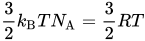
The only possible motion of an atom in a monatomic gas is translation (electronic excitation is not important at room temperature). Thus by the equipartition theorem, the kinetic energy of a single atom of a monatomic gas at thermodynamic temperatureT is given by , where kB is the Boltzmann constant. One mole of atoms contains an Avogadro number () of atoms, so that the energy of one mole of atoms of a monatomic gas is , where R is the gas constant.


En un proceso adiabático , los gases monoatómicos tienen un factor γ idealizado ( C p / C v ) de 5/3, en comparación con 7/5 para los gases diatómicos ideales donde la rotación (pero no la vibración a temperatura ambiente) también contribuye. Además, para gases monoatómicos ideales: [ 4 ] [ 5 ] [ 6 ]
Referencias
- ↑ "gas monoatómico" . Encyclopædia Britannica . Consultado el 6 de junio de 2016 .
- ^ Lászlo, Pierre; Schrobilgen, Gary J. (1 de abril de 1988). "¿Ein Pionier oder mehrere Pioniere? Die Entdeckung der Edelgas-Verbindungen". Angewandte Chemie . 100 (4): 495– 506. Bibcode : 1988AngCh.100..495L . doi : 10.1002/ange.19881000406 . ISSN 1521-3757 .
- ↑ Christe, Karl O. (2001-04-17). "Un renacimiento en la química de los gases nobles" . Angewandte Chemie International Edition . 40 (8): 1419– 1421. doi : 10.1002/1521-3773(20010417)40:8 < 1419::aid-anie1419 > 3.0.co ; 2-j . ISSN 1521-3773 . PMID 11317290 .
- ↑ Capacidad calorífica de un gas ideal
- ↑ Capacidad calorífica de los gases ideales
- ↑ Lección 3: Termodinámica de gases ideales y calorimetría , pág. 2
- Gases