Hispanopedia Wiki
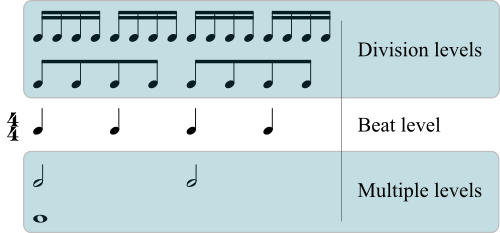
En música, un acorde chop es un " contratiempo recortado ". [ 3 ] [ 4 ] En 4 4 : 1 2 3 4 . Es un acorde apagado que marca los tiempos débiles o fuertes . [ 5 ] Como técnica de guitarra rítmica y mandolina , se logra mediante chucking , en el que el acorde se apaga levantando los dedos de traste inmediatamente después de rasguear , produciendo un efecto percusivo .
El golpe de tambor es similar al de una caja y mantiene el ritmo unido y dinámico. Es una de las innovaciones impulsadas por Bill Monroe , creador del bluegrass , que le dio a la música un ritmo más marcado y la diferenció de la música tradicional y de las montañas.
— Dix Bruce [ 6 ]
Las bandas tradicionales de bluegrass normalmente no tienen baterista, y la función de marcar el ritmo se comparte entre varios instrumentos. El contrabajo generalmente toca los tiempos fuertes , mientras que el banjo mantiene un ritmo constante de corcheas. La mandolina toca acordes de chop en los tiempos débiles o fuertes. [ 7 ] (ver: boom-chick ) Al relajar parcialmente los dedos de la mano izquierda poco después de rasguear, se permite que las cuerdas se eleven de los trastes, y sus oscilaciones son amortiguadas por los dedos. Todas las cuerdas están presionadas ( digitadas ); las cuerdas al aire no se tocan en los acordes de chop.
The offbeat was played on the piano in rhythm and blues "shuffle" style, as heard in songs like Louis Jordan's "It's a Low-Down Dirty Shame" (1942) and Professor Longhair's "Willie Mae" (1949). This popular, danceable shuffle style was present on many early rock and roll records. It was played on the electric guitar at least as early as 1950 by Robert Kelton on Jimmy McCracklin's "Rockin' All Day." Either played on the guitar, piano or both, the "chop", "chuck" or "skank" offbeat eventually influenced Jamaican rhythm and blues of the 1950s, which morphed into ska in late 1962, then rocksteady and reggae, all of which featured the offbeat "chuck" or "skank" guitar.
Guitar
The "chuck" usually consists of a downward strum on the up beat notes. Alternatively, the bass note can be played and allowed to ring, with the remainder of the chord being "chucked" on the up beat.[8] This technique is usually used in a rhythmically simple manner, such as chucking on every beat, or bass notes on down beats and chucking on up beats.Freddie Green, Django Reinhardt and Nile Rodgers are known for this technique.
Mandolin
Mandolin "chunks", or more commonly known as "chops", rarely include a down-beat strum. When a mandolin is playing rhythm it is most often in conjunction with other instruments, such as guitar and bass, which produce the main beat. The mandolin contributes to the rhythm by producing a sharp "chunk" on the upbeat notes.[9] This is particularly common when playing bluegrass music. According to Andy Statman, "the mandolin can drive and push the band in the same way (as) a snare drum."[10]
Fiddle
The chop was introduced to fiddle playing by Richard Greene in the 1960s.[11]
See also
References
- ↑"Introduction to the 'Chop'", Anger, Darol. Strad (0039-2049); 10/01/2006, Vol. 117 Issue 1398, p72-75.
- ↑Horne, Greg (2004). Beginning Mandolin: The Complete Mandolin Method, p.61. Alfred. ISBN 9780739034712.
- ↑Bruce, Dix (2013). Parking Lot Picker's Play-Along Guitar, p.14. Mel Bay. ISBN 9781619114463.
- ↑Bruce, Dix (2010). Getting Into Bluegrass Mandolin, p.18. Mel Bay. ISBN 9781610651196.
- ↑ "Glosario de mandolina: Acorde Chop" . MandolinCafe.com . Consultado el 24 de marzo de 2014 .
- ↑ Bruce (2013), pág. 16.
- ↑ "Chop Chords" (PDF) . MandolinLessons.com . 2010. Archivado del original (PDF) el 18 de agosto de 2013. Consultado el 24 de marzo de 2014 .
- ↑ Dziuba, Mark (1997). Guitarra de blues ,. Alfred Music Publishing. ISBN 9780882848495.
- ↑ " Instrumentos de bluegrass: mandolinas ", PlayBetterBluegrass.com . Consultado el 7 de agosto de 2014.
- ↑ Statman, Andy (1978). Aprende a tocar la mandolina bluegrass .Amsco Music Company, Nueva York. ISBN 9780825603266.
- ↑ "Cómo un dolor de muñeca y una afición por el 'ruido' cambiaron para siempre la forma de tocar el violín" . www.wbur.org .
- Música bluegrass
- Música folklórica
- Técnicas de interpretación de cuerdas
- Bill Monroe