 Hispanopedia Wiki
Bloch's principle is a philosophical principle in mathematics stated by André Bloch.[1]
Bloch states the principle in Latin as: Nihil est in infinito quod non prius fuerit in finito, and explains this as follows: Every proposition in whose statement the actual infinity occurs can be always considered a consequence, almost immediate, of a proposition where it does not occur, a proposition in finite terms.
Bloch mainly applied this principle to the theory of functions of a complex variable. Thus, for example, according to this principle, Picard's theorem corresponds to Schottky's theorem, and Valiron's theorem corresponds to Bloch's theorem.
Based on his Principle, Bloch was able to predict or conjecture several important results such as the Ahlfors's Five Islands theorem, Cartan's theorem on holomorphic curves omitting hyperplanes,[2]Hayman's result that an exceptional set of radii is unavoidable in Nevanlinna theory.
In the more recent times several general theorems were proved which can be regarded as rigorous statements in the spirit of the Bloch Principle:
Zalcman's lemma
A family of functions meromorphic on the unit disc is not normal if and only if there exist:


- a number
- points
- functions
- numbers


such that spherically uniformly on compact subsets of where is a nonconstant meromorphic function on [3]


Zalcman's lemma may be generalized to several complex variables. First, define the following:
A family of holomorphic functions on a domain is normal in if every sequence of functions contains either a subsequence which converges to a limit function uniformly on each compact subset of or a subsequence which converges uniformly to on each compact subset.


For every function of class define at each point a Hermitian form and call it the Levi form of the function at




If function is holomorphic on set This quantity is well defined since the Levi form is nonnegative for all In particular, for the above formula takes the form and coincides with the spherical metric on





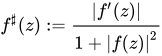

The following characterization of normality can be made based on Marty's theorem, which states that a family is normal if and only if the spherical derivatives are locally bounded:[4]
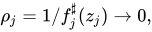
Suppose that the family of functions holomorphic on En algún momento no es normal.Entonces existen secuenciasde tal manera que la secuenciaconverge localmente de manera uniforme ena una función entera no constantesatisfactorio





El lema de Brody
Sea X una variedad analítica compleja compacta , tal que toda aplicación holomorfa del plano complejo a X es constante. Entonces existe una métrica en X tal que toda aplicación holomorfa del disco unitario con la métrica de Poincaré a X no aumenta las distancias. [ 2 ]
Referencias
- ^ Bloch, A. (1926). "La concepción actual de la teoría de funciones enteras y meromorfas". Enseñanza Matemática . vol. 25. págs. 83-103 .
- 1 2 Lang, Serge (2010). Introducción a los espacios hiperbólicos complejos . Nueva York: Springer. ISBN 978-1-4419-3082-8.
- ↑ Zalcman, L. (1975). "Principio heurístico en la teoría de funciones complejas". Amer. Math. Monthly . 82 (8): 813– 817. doi : 10.1080/00029890.1975.11993942 .
- ↑ Dovbush, PV (2020). "El lema de Zalcman en C n" . Variables complejas y ecuaciones elípticas . 65 (5): 796– 800. doi : 10.1080/17476933.2019.1627529 . ISSN 1747-6933 .
- Principios matemáticos
- Filosofía de las matemáticas