 Hispanopedia Wiki
In geometry, the Chebyshev center of a bounded set having non-empty interior is the center of the minimal-radius ball enclosing the entire set , or alternatively (and non-equivalently) the center of largest inscribed ball of .[1]

In the field of parameter estimation, the Chebyshev center approach tries to find an estimator for given the feasibility set , such that minimizes the worst possible estimation error for x (e.g. best worst case).


Mathematical representation
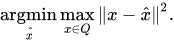
There exist several alternative representations for the Chebyshev center. Consider the set and denote its Chebyshev center by . can be computed by solving:

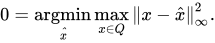
with respect to the Euclidean norm, or alternatively by solving:

Despite these properties, finding the Chebyshev center may be a hard numerical optimization problem. For example, in the second representation above, the inner maximization is non-convex if the set Q is not convex.
Properties
In inner product spaces and two-dimensional spaces, if is closed, bounded and convex, then the Chebyshev center is in . In other words, the search for the Chebyshev center can be conducted inside without loss of generality.[2]
In other spaces, the Chebyshev center may not be in , even if is convex. For instance, if is the tetrahedron formed by the convex hull of the points (1,1,1), (-1,1,1), (1,-1,1) and (1,1,-1), then computing the Chebyshev center using the norm yields[3]

Relaxed Chebyshev center
Consider the case in which the set can be represented as the intersection of ellipsoids.


with

By introducing an additional matrix variable , we can write the inner maximization problem of the Chebyshev center as:


where is the trace operator and



Relaxing our demand on by demanding , i.e. where is the set of positive semi-definite matrices, and changing the order of the min max to max min (see the references for more details), the optimization problem can be formulated as:


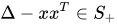


with

This last convex optimization problem is known as the relaxed Chebyshev center (RCC). The RCC has the following important properties:
- The RCC is an upper bound for the exact Chebyshev center.
- The RCC is unique.
- The RCC is feasible.
Constrained least squares
It can be shown that the well-known constrained least squares (CLS) problem is a relaxed version of the Chebyshev center.
El problema CLS original se puede formular de la siguiente manera:

con


Se puede demostrar que este problema es equivalente al siguiente problema de optimización:
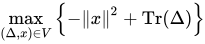
con

Se puede observar que este problema es una relajación del centro de Chebyshev (aunque diferente del RCC descrito anteriormente).
RCC contra CLS
Un conjunto de solucionespara el RCC también es una solución para el CLS y por lo tantoEsto significa que la estimación CLS es la solución de una relajación menos restrictiva que la del RCC. Por lo tanto, la CLS es una cota superior para el RCC , que a su vez es una cota superior para el centro de Chebyshev real.


Restricciones de modelado
Dado que tanto el RCC como el CLS se basan en la relajación del conjunto de factibilidad real, la forma en quesu definición afecta a sus versiones relajadas. Esto, por supuesto, afecta a la calidad de los estimadores RCC y CLS. Como ejemplo sencillo, consideremos las restricciones de caja lineales:

que alternativamente puede escribirse como

Resulta que la primera representación arroja un estimador de límite superior para la segunda, por lo que su uso puede disminuir drásticamente la calidad del estimador calculado.
Este sencillo ejemplo nos muestra que se debe prestar mucha atención a la formulación de las restricciones cuando se utiliza la relajación de la región de viabilidad.
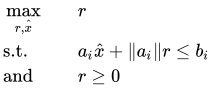
Problema de programación lineal
Este problema puede formularse como un problema de programación lineal , siempre que la región Q sea una intersección de un número finito de hiperplanos. [ 4 ] Dado un politopo , Q, definido como sigue, entonces puede resolverse mediante el siguiente programa lineal.

Véase también
- Esfera delimitadora
- Problema del círculo más pequeño
- Círculo circunscrito (abarca el centro circunscrito )
- Centro (geometría)
- centroide
Referencias
- 1 2 Boyd, Stephen P.; Vandenberghe, Lieven (2004). Optimización convexa (PDF) . Cambridge University Press. ISBN 978-0-521-83378-3. Consultado el 15 de octubre de 2011 .
- ^ Amir, Dan (1984). "Mejor aproximación simultánea (centros Chebyshev)". Serie internacional de matemáticas numéricas / Internationale Schriftenreihe zur Numerischen Mathematik / Série internationale d'Analyse numérique . Birkhäuser. págs. 19 a 35. ISBN 9783034862530.
- ↑ Dabbene, Fabrizio; Sznaier, Mario ; Tempo, Roberto (agosto de 2014). "Estimación óptima probabilística con ruido distribuido uniformemente". IEEE Transactions on Automatic Control . 59 (8): 2113– 2127. doi : 10.1109/tac.2014.2318092 . S2CID 17857976 .
- ↑ "Copia archivada" (PDF) . Archivado del original (PDF) el 12/09/2014 . Recuperado el 12/09/2014 .
{{cite web}}: CS1 mantenimiento: copia archivada como título ( enlace )
- YC Eldar, A. Beck y M. Teboulle, "Un estimador de Chebyshev minimax para la estimación de errores acotados", IEEE Trans. Signal Process., 56(4): 1388–1397 (2007).
- A. Beck y YC Eldar, "Regularización en regresión con ruido acotado: un enfoque del centro de Chebyshev", SIAM J. Matrix Anal. Appl. 29 (2): 606–625 (2007).
- Métodos de estimación
- centros geométricos
- Optimización matemática