 Hispanopedia Wiki
En álgebra abstracta , un semianillo es una estructura algebraica . Los semianillos son una generalización de los anillos , ya que prescinden del requisito de que cada elemento tenga un inverso aditivo . Asimismo, los semianillos son una generalización de los retículos distributivos acotados .
El semianillo más pequeño que no es un anillo es el álgebra booleana de dos elementos , por ejemplo con disyunción lógica.como suma. Un ejemplo motivador que no es ni un anillo ni una red es el conjunto de los números naturales.(incluido el cero) bajo suma y multiplicación ordinarias. Los semianillos son abundantes porque una operación de multiplicación adecuada surge como la composición de funciones de endomorfismos sobre cualquier monoide conmutativo .


Terminología
Algunos autores definen semianillos sin el requisito de que exista unoEsto hace que la analogía entre anillo y semianillo , por un lado, y grupo y semigrupo , por otro, funcione con mayor fluidez. Estos autores suelen usar «rig» para el concepto definido aquí. [ 1 ] [ a ] Esto se originó como una broma, sugiriendo que los rigs son anillos sin elementos negativos . (Similar a usar «rng» para referirse a un anillo sin una identidad multiplicativa ) .


El término dioide (por "monoide doble") se ha utilizado para referirse a semianillos u otras estructuras. Kuntzmann lo empleó en 1972 para designar un semianillo. [ 2 ] (Alternativamente, a veces se utiliza para semianillos ordenados naturalmente [ 3 ] , pero Baccelli et al. también lo emplearon para subgrupos idempotentes en 1992. [ 4 ] )
Definición
Un semianillo es un conjuntoequipado con dos operaciones binariasyllamadas suma y multiplicación, de tal manera que: [ 5 ] [ 6 ] [ 7 ]


- es un monoide conmutativo con un elemento identidad llamado:
- es un monoide con un elemento identidad llamado:









Además, los siguientes axiomas están relacionados con ambas operaciones:
- Mediante la multiplicación, cualquier elemento es aniquilado por la izquierda y por la derecha por la identidad aditiva:
- La multiplicación por la izquierda y por la derecha se distribuye sobre la suma:




Notación
El símboloPor lo general, se omite de la notación; es decir,está simplemente escrito


De manera similar, un orden de operaciones es convencional, en el quese aplica antes. Eso es,denota.


Para evitar ambigüedades, se puede escribiropara enfatizar a qué estructura pertenecen las unidades en cuestión.


Sies un elemento de un semianillo y, entonces-veces multiplicación repetida decon sí mismo se denotay uno escribe de manera similarpara el-veces suma repetida.


Construcción de nuevos semianillos
El anillo cero con conjunto subyacentees un semianillo llamado semianillo trivial. Esta trivialidad se puede caracterizar mediantey así cuando hablamos de semianillos no triviales,A menudo se da por sentado, como si fuera un axioma adicional. Ahora bien, dado cualquier semianillo, existen varias maneras de definir otros nuevos.


Como se ha señalado, los números naturalescon su estructura aritmética forman un semianillo. Tomando el cero y la imagen de la operación sucesora en un semianillo, es decir, el conjuntojunto con las operaciones heredadas, siempre es un subsemirreducción de.


Sies un monoide conmutativo, la composición de funciones proporciona la multiplicación para formar un semianillo: El conjuntode endomorfismosforma un semianillo donde la suma se define a partir de la suma puntual en. El morfismo cero y la identidad son los respectivos elementos neutros. Siconun semianillo, obtenemos un semianillo que puede asociarse con el cuadradomatricescon coeficientes en, el semianillo matricial utilizando las reglas ordinarias de suma y multiplicación de matrices. Dadoyun semianillo,siempre es un semianillo también. Generalmente no es conmutativo incluso siera conmutativo.


Extensiones de Dorroh : Sies un semianillo, entoncescon suma y multiplicación punto por punto dadas por :=\langle x\cdot y+(x\,m+y\,n),n\cdot m\rangle } define otro semianillo con unidad multiplicativa. De manera muy similar, sies cualquier subsemirrelación de, también se puede definir un semianillo en, simplemente reemplazando la suma repetida en la fórmula por una multiplicación. De hecho, estas construcciones incluso funcionan bajo condiciones menos estrictas, ya que la estructuraEn realidad no es necesario tener una unidad multiplicativa.




Los semianillos sin suma cero son, en cierto sentido, los que están más alejados de ser anillos. Dado un semianillo, se puede añadir un nuevo cero.al conjunto subyacente y así obtener un semianillo libre de suma cero que también carece de divisores cero . En particular, ahoray el antiguo semianillo en realidad no es un subsemianillo. Entonces se puede continuar y adjuntar nuevos elementos "encima" uno a la vez, respetando siempre el cero. Estas dos estrategias también funcionan bajo condiciones menos estrictas. A veces las notacionesrespectivamente.se utilizan al realizar estas construcciones.


Al añadir un nuevo cero al semianillo trivial, de esta manera, se obtiene otro semianillo que puede expresarse en términos de los conectores lógicos de disyunción y conjunción:. En consecuencia, este es el semianillo más pequeño que no es un anillo. Explícitamente, viola los axiomas de anillo comoa pesar de, es decirno tiene inverso aditivo. En la definición autodual , la falla está en. (Esto no debe confundirse con el anillo, cuya suma funciona como xor.) En el modelo de von Neumann de los naturales ,,y. El semianillo de dos elementos puede representarse en términos de la unión e intersección de la teoría de conjuntos comoAhora bien, esta estructura de hecho sigue constituyendo un semianillo cuandoes reemplazado por cualquier conjunto habitado.






Los ideales en un semicírculo, con sus operaciones estándar sobre subconjuntos, forman un semianillo reticulado, simple y sin suma cero. Los ideales deestán en biyección con los ideales de. La colección de ideales de izquierda de(y asimismo los ideales correctos) también tienen gran parte de esa estructura algebraica, excepto que entoncesno funciona como una identidad multiplicativa bilateral.
Sies un semianillo yes un conjunto habitado ,denota el monoide libre y los polinomios formalessobre sus palabras forman otro semianillo. Para conjuntos pequeños, los elementos generadores se utilizan convencionalmente para denotar el semianillo polinomial. Por ejemplo, en el caso de un singletonde tal manera que, escribe uno. Sub-semirregimientos sin suma cero depuede utilizarse para determinar subsemirrenos de.


![{\displaystyle R[A^{*}]}](https://wikimedia.org/api/rest_v1/media/math/render/svg/4e4df514fa6d4e155cbcccc45f5e9882cbb4d247)


![{\displaystyle R[X]}](https://wikimedia.org/api/rest_v1/media/math/render/svg/afeccd52deabb878398a8485755c3ceea80caf9a)
Dado un conjunto, no necesariamente solo un singleton, adjuntando un elemento predeterminado al conjunto subyacente de un semianillouno puede definir el semianillo de funciones parciales a partir dea.
Dada una derivaciónen un semianillo, otra la operación ""satisfacciónpuede definirse como parte de una nueva multiplicación en, lo que da como resultado otro semianillo.



La lista anterior no es, ni mucho menos, exhaustiva de construcciones sistemáticas.
Derivaciones
Derivaciones en un semianilloson los mapascony.



Por ejemplo, sies elmatriz unitaria y, entonces el subconjunto dedadas por las matricescones un semianillo con derivación.



Propiedades
Una propiedad básica de los semianillos es queno es un divisor de cero por la izquierda o por la derecha , y esopero tambiéncuadrados a sí mismo, es decir, estos tienen.

Algunas propiedades notables se heredan de las estructuras monoides: Los axiomas monoides exigen la existencia de unidades, por lo que el conjunto subyacente a un semianillo no puede estar vacío. Además, el predicado 2-ariodefinido como, aquí definida para la operación de suma, siempre constituye la relación de preorden canónica correcta . Reflexividades presenciado por la identidad. Además,siempre es válido, por lo que cero es el elemento más pequeño con respecto a este preorden. Considerándolo en particular para la suma conmutativa, la distinción de "derecha" puede ser ignorada. En los enteros no negativos, por ejemplo, esta relación es antisimétrica y fuertemente conectada , y por lo tanto, de hecho, un orden total (no estricto) .


A continuación se analizan más propiedades condicionales.
Semicampos
Cualquier cuerpo es también un semicuerpo , que a su vez es un semianillo en el que también existen inversos multiplicativos.
Anillos
Cualquier cuerpo es también un anillo , que a su vez es un semianillo en el que también existen inversos aditivos. Cabe destacar que un semianillo omite este requisito, es decir, solo requiere un monoide conmutativo , no un grupo conmutativo . El requisito adicional de que sea un anillo implica la existencia de un cero multiplicativo. Esta diferencia explica por qué, en la teoría de semianillos, el cero multiplicativo debe especificarse explícitamente.
Aquí, el inverso aditivo de, cuadrados a. Como diferencias aditivassiempre existen en un anillo,es una relación binaria trivial en un anillo.


semianillos conmutativos
Un semianillo se denomina semianillo conmutativo si, además, la multiplicación es conmutativa. [ 8 ] Sus axiomas pueden enunciarse concisamente: Consta de dos monoides conmutativos.yen un conjunto tal quey.



El centro de un semianillo es un subsemianillo y ser conmutativo es equivalente a ser su propio centro.
El semianillo conmutativo de los números naturales es el objeto inicial entre su tipo, lo que significa que hay un único mapa que preserva la estructura de los números naturales.en cualquier semianillo conmutativo.
Los retículos distributivos acotados son semianillos conmutativos parcialmente ordenados que satisfacen ciertas ecuaciones algebraicas relacionadas con la distributividad y la idempotencia. Por lo tanto, también lo son sus duales .
Semianillos pedidos
Las nociones de orden pueden definirse mediante formulaciones estrictas, no estrictas o de segundo orden . Propiedades adicionales como la conmutatividad simplifican los axiomas.
Dado un orden total estricto (también llamado a veces orden lineal o pseudoorden en una formulación constructiva), entonces por definición, los elementos positivos y negativos cumplenrespectivamente.. Por irreflexividad de un orden estricto, sies un divisor de cero por la izquierda, entonceses falso. Los elementos no negativos se caracterizan por, que luego se escribe.


Generally, the strict total order can be negated to define an associated partial order. The asymmetry of the former manifests as . In fact in classical mathematics the latter is a (non-strict) total order and such that implies . Likewise, given any (non-strict) total order, its negation is irreflexive and transitive, and those two properties found together are sometimes called strict quasi-order. Classically this defines a strict total order – indeed strict total order and total order can there be defined in terms of one another.


Recall that "" defined above is trivial in any ring. The existence of rings that admit a non-trivial non-strict order shows that these need not necessarily coincide with "".

Additively idempotent semirings
A semiring in which every element is an additive idempotent, that is, for all elements , is called an (additively) idempotent semiring.[9] Establishing suffices. Be aware that sometimes this is just called idempotent semiring, regardless of rules for multiplication.


In such a semiring, is equivalent to and always constitutes a partial order, here now denoted . In particular, here . So additively idempotent semirings are zerosumfree and, indeed, the only additively idempotent semiring that has all additive inverses is the trivial ring and so this property is specific to semiring theory. Addition and multiplication respect the ordering in the sense that implies , and furthermore implies as well as , for all and .






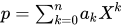
If is additively idempotent, then so are the polynomials in .
![{\displaystyle R[X^{*}]}](https://wikimedia.org/api/rest_v1/media/math/render/svg/703fd4f04d719ca84165f4b11d57966b16cbfb5d)
A semiring such that there is a lattice structure on its underlying set is lattice-ordered if the sum coincides with the join, , and the product lies beneath the meet . The lattice-ordered semiring of ideals of a semiring is not necessarily distributive with respect to the lattice structure.


More strictly than just additive idempotence, a semiring is called simple iff for all . Then also and for all . Here then functions akin to an additively infinite element. If is an additively idempotent semiring, then with the inherited operations is its simple sub-semiring. An example of an additively idempotent semiring that is not simple is the tropical semiring on with the 2-ary maximum function, with respect to the standard order, as addition. Its simple sub-semiring is trivial.




A c-semiring is an idempotent semiring and with addition defined over arbitrary sets.
An additively idempotent semiring with idempotent multiplication, , is called additively and multiplicatively idempotent semiring, but sometimes also just idempotent semiring. The commutative, simple semirings with that property are exactly the bounded distributive lattices with unique minimal and maximal element (which then are the units). Heyting algebras are such semirings and the Boolean algebras are a special case.

Further, given two bounded distributive lattices, there are constructions resulting in commutative additively-idempotent semirings, which are more complicated than just the direct sum of structures.
Number lines
In a model of the ring , one can define a non-trivial positivity predicate and a predicate as that constitutes a strict total order, which fulfills properties such as , or classically the law of trichotomy. With its standard addition and multiplication, this structure forms the strictly ordered field that is Dedekind-complete. By definition, all first-order properties proven in the theory of the reals are also provable in the decidable theory of the real closed field. For example, here is mutually exclusive with .



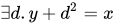
But beyond just ordered fields, the four properties listed below are also still valid in many sub-semirings of , including the rationals, the integers, as well as the non-negative parts of each of these structures. In particular, the non-negative reals, the non-negative rationals and the non-negative integers are such a semirings. The first two properties are analogous to the property valid in the idempotent semirings: Translation and scaling respect these ordered rings, in the sense that addition and multiplication in this ring validate


In particular, and so squaring of elements preserves positivity.

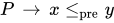
Take note of two more properties that are always valid in a ring. Firstly, trivially for any . In particular, the positive additive difference existence can be expressed as

Secondly, in the presence of a trichotomous order, the non-zero elements of the additive group are partitioned into positive and negative elements, with the inversion operation moving between them. With , all squares are proven non-negative. Consequently, non-trivial rings have a positive multiplicative unit,


Having discussed a strict order, it follows that and , etc.

Discretely ordered semirings
There are a few conflicting notions of discreteness in order theory. Given some strict order on a semiring, one such notion is given by being positive and covering, i.e. there being no element between the units, . Now in the present context, an order shall be called discrete if this is fulfilled and, furthermore, all elements of the semiring are non-negative, so that the semiring starts out with the units.

Denote by the theory of a commutative, discretely ordered semiring also validating the above four properties relating a strict order with the algebraic structure. All of its models have the model as its initial segment and Gödel incompleteness and Tarski undefinability already apply to . The non-negative elements of a commutative, discretely ordered ring always validate the axioms of . So a slightly more exotic model of the theory is given by the positive elements in the polynomial ring, with positivity predicate for defined in terms of the last non-zero coefficient, , and as above. While proves all -sentences that are true about , beyond this complexity one can find simple such statements that are independent of . For example, while -sentences true about are still true for the other model just defined, inspection of the polynomial demonstrates -independence of the -claim that all numbers are of the form or ("odd or even"). Showing that also can be discretely ordered demonstrates that the -claim for non-zero ("no rational squared equals ") is independent. Likewise, analysis for demonstrates independence of some statements about factorization true in . There are characterizations of primality that does not validate for the number .

![{\displaystyle {\mathbb {Z} }[X]}](https://wikimedia.org/api/rest_v1/media/math/render/svg/410cd3eb154d84dc78cd92f1129e96e399e61a7d)



![{\displaystyle {\mathbb {Z} }[X,Y]/(X^{2}-2Y^{2})}](https://wikimedia.org/api/rest_v1/media/math/render/svg/dd7fdccf46cf82403bd1cda2f259360e519e4cab)


![{\displaystyle {\mathbb {Z} }[X,Y,Z]/(XZ-Y^{2})}](https://wikimedia.org/api/rest_v1/media/math/render/svg/7e330d97dab88c3475e903ab3a7aac05db6ae1d1)

In the other direction, from any model of one may construct an ordered ring, which then has elements that are negative with respect to the order, that is still discrete the sense that covers . To this end one defines an equivalence class of pairs from the original semiring. Roughly, the ring corresponds to the differences of elements in the old structure, generalizing the way in which the initial ring can be defined from. This, in effect, adds all the inverses and then the preorder is again trivial in that .


Beyond the size of the two-element algebra, no simple semiring starts out with the units. Being discretely ordered also stands in contrast to, e.g., the standard ordering on the semiring of non-negative rationals , which is dense between the units. For another example, can be ordered, but not discretely so.

![{\displaystyle {\mathbb {Z} }[X]/(2X^{2}-1)}](https://wikimedia.org/api/rest_v1/media/math/render/svg/ef9bc6ad9177d0ef1629dafe52f2e75f89df39ad)
Natural numbers
plus mathematical induction gives a theory equivalent to first-order Peano arithmetic. The theory is also famously not categorical, but is of course the intended model. proves that there are no zero divisors and it is zerosumfree and so no model of it is a ring.
The standard axiomatization of is more concise and the theory of its order is commonly treated in terms of the non-strict "". However, just removing the potent induction principle from that axiomatization does not leave a workable algebraic theory. Indeed, even Robinson arithmetic, which removes induction but adds back the predecessor existence postulate, does not prove the monoid axiom .


Complete semirings
A complete semiring is a semiring for which the additive monoid is a complete monoid, meaning that it has an infinitary sum operation for any index set and that the following (infinitary) distributive laws must hold:[10][11][12]



Examples of a complete semiring are the power set of a monoid under union and the matrix semiring over a complete semiring.[13] For commutative, additively idempotent and simple semirings, this property is related to residuated lattices.
Continuous semirings
A continuous semiring is similarly defined as one for which the addition monoid is a continuous monoid. That is, partially ordered with the least upper bound property, and for which addition and multiplication respect order and suprema. The semiring with usual addition, multiplication and order extended is a continuous semiring.[14]

Any continuous semiring is complete:[10] this may be taken as part of the definition.[13]
Star semirings
A star semiring (sometimes spelled starsemiring) or closed semiring is a semiring with an additional unary operator ,[9][11][15][16] satisfying


A Kleene algebra is a star semiring with idempotent addition and some additional axioms. They are important in the theory of formal languages and regular expressions.[11]
Complete star semirings
In a complete star semiring, the star operator behaves more like the usual Kleene star: for a complete semiring we use the infinitary sum operator to give the usual definition of the Kleene star:[11]
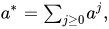
where

Tenga en cuenta que los semianillos estrella no están relacionados con el *-álgebra , donde la operación estrella debe pensarse en cambio como conjugación compleja .
Semianillo de Conway
Un semianillo de Conway es un semianillo estrella que satisface las ecuaciones de suma-estrella y producto-estrella: [ 9 ] [ 17 ]
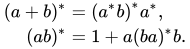
Todo semianillo estrellado completo es también un semianillo de Conway, [ 18 ] pero lo contrario no es cierto. Un ejemplo de semianillo de Conway que no es completo es el conjunto de números racionales no negativos extendidos.con la suma y multiplicación usuales (esta es una modificación del ejemplo con reales no negativos extendidos dado en esta sección al eliminar los números irracionales). [ 11 ] Un semianillo de iteración es un semianillo de Conway que satisface los axiomas del grupo de Conway, [ 9 ] asociados por John Conway a grupos en semianillos estrellados. [ 19 ]

Ejemplos
- Por definición, cualquier anillo y cualquier semicuerpo es también un semianillo.
- Los elementos no negativos de un anillo conmutativo y discretamente ordenado forman un semianillo conmutativo y discretamente ordenado (en el sentido definido anteriormente). Esto incluye los enteros no negativos..
- Además, los números racionales no negativos , así como los números reales no negativos , forman semianillos ordenados conmutativos. [ 20 ] [ 21 ] [ 22 ] Este último se denominasemianillo de probabilidad . [ 6 ] Tampoco son anillos ni retículos distributivos. Estos ejemplos también tienen inversos multiplicativos.
- Se pueden construir nuevos semianillos a partir de los existentes, como se describe. Los números naturales extendidoscon la suma y la multiplicación extendidas de modo que. [ 21 ]
- El conjunto de polinomios con coeficientes de números naturales, denotadoforma un semianillo conmutativo. De hecho, este es el semianillo conmutativo libre sobre un único generador.También se pueden definir polinomios con coeficientes en otros semianillos, como ya se ha comentado.
- Las fracciones terminantes no negativas, en un sistema de numeración posicional a una base dada, forman un subsemirreligión de los racionales. Uno tienesidivide. Para, el conjuntoes el anillo de todas las fracciones terminantes a basey es denso en.
- El semicírculo de troncos encon adición dada porcon multiplicaciónelemento ceroy elemento unitario[ 6 ]
- De manera similar, el semianillo tropical max-plus se define utilizandoconsirviendo como adición de semianillo (identidad)) y la suma ordinaria (identidad 0) que sirve como multiplicación de semianillo. Asimismo, el semianillo tropical min-plus esy min reemplaza a max como operación de suma. [ 23 ] Una versión relacionada tienecomo el conjunto subyacente. [ 6 ] [ 10 ] Son un área activa de investigación, que vincula variedades algebraicas con estructuras lineales por partes . [ 24 ]
- El semianillo de Łukasiewicz : el intervalo cerradocon adición deydado tomando el máximo de los argumentos () y multiplicación deydado poraparece en lógica multivaluada . [ 11 ]
- El semianillo de Viterbi también se define sobre el conjunto base.y tiene el máximo como su suma, pero su multiplicación es la multiplicación usual de números reales. Aparece en el análisis probabilístico . [ 11 ]

![{\displaystyle \mathbb {N} [x],}](https://wikimedia.org/api/rest_v1/media/math/render/svg/4406ba525ce2c3bc9dd67a1199514d5b9b266391)







![{\displaystyle [0,1]}](https://wikimedia.org/api/rest_v1/media/math/render/svg/738f7d23bb2d9642bab520020873cccbef49768d)


- El conjunto de todos los ideales de un semianillo dado forma un semianillo bajo la suma y la multiplicación de ideales.
- Cualquier retículo distributivo acotado es un semianillo conmutativo bajo las operaciones de unión e intersección. Un álgebra booleana es un caso especial de estos. Un anillo booleano también es un semianillo (de hecho, un anillo), pero no es idempotente bajo la suma . Un semianillo booleano es un semianillo isomorfo a un subsemianillo de un álgebra booleana. [ 20 ]
- El semianillo conmutativo formado por el álgebra booleana de dos elementos y definido porTambién se le llama elSemianillo booleano . [ 6 ] [ 21 ] [ 22 ] [ 9 ] Ahora, dados dos conjuntosyrelaciones binarias entreycorresponden a matrices indexadas poryCon entradas en el semianillo booleano, la suma de matrices corresponde a la unión de relaciones, y la multiplicación de matrices corresponde a la composición de relaciones . [ 25 ]
- Cualquier cuantal unitario es un semianillo bajo la unión y la multiplicación.
- Una red normal sesgada en un anilloes un semianillo para las operaciones de multiplicación y nabla, donde esta última operación se define por


Más uso de monoides,
- La construcción de semianillosde un monoide conmutativoSe ha descrito. Como se indicó, dé un semianillo., el matrices form another semiring. For example, the matrices with non-negative entries, form a matrix semiring.[20]
- Given an alphabet (finite set) Σ, the set of formal languages over (subsets of ) is a semiring with product induced by string concatenation and addition as the union of languages (that is, ordinary union as sets). The zero of this semiring is the empty set (empty language) and the semiring's unit is the language containing only the empty string.[11]
- Generalizing the previous example (by viewing as the free monoid over ), take to be any monoid; the power set of all subsets of forms a semiring under set-theoretic union as addition and set-wise multiplication: [22]
- Similarly, if is a monoid, then the set of finite multisets in forms a semiring. That is, an element is a function ; given an element of the function tells you how many times that element occurs in the multiset it represents. The additive unit is the constant zero function. The multiplicative unit is the function mapping to and all other elements of to The sum is given by and the product is given by




Regarding sets and similar abstractions,
- Given a set the set of binary relations over is a semiring with addition the union (of relations as sets) and multiplication the composition of relations. The semiring's zero is the empty relation and its unit is the identity relation.[11] These relations correspond to the matrix semiring (indeed, matrix semialgebra) of square matrices indexed by with entries in the Boolean semiring, and then addition and multiplication are the usual matrix operations, while zero and the unit are the usual zero matrix and identity matrix.
- The set of cardinal numbers smaller than any given infinite cardinal form a semiring under cardinal addition and multiplication. The class of all cardinals of an inner model form a (class) semiring under (inner model) cardinal addition and multiplication.
- La familia de clases combinatorias (conjuntos de una cantidad numerable de objetos con tamaños enteros no negativos tales que hay una cantidad finita de objetos de cada tamaño) con la clase vacía como objeto cero, la clase que consiste únicamente en el conjunto vacío como unidad, la unión disjunta de clases como suma y el producto cartesiano de clases como multiplicación. [ 26 ]
- Las clases de isomorfismo de objetos en cualquier categoría distributiva , bajo operaciones de coproducto y producto , forman un semianillo conocido como un anillo de Burnside. [ 27 ] Un anillo de Burnside es un anillo si y solo si la categoría es trivial .


semianillos estrellados
Varias de las estructuras mencionadas anteriormente pueden equiparse con un sistema de operación estelar.
- El semianillo mencionado de relaciones binarias sobre algún conjunto baseen el cuala pesar deEsta operación estrella es en realidad el cierre reflexivo y transitivo de(es decir, la relación binaria reflexiva y transitiva más pequeña sobreque contiene). [ 11 ]
- El semianillo de lenguajes formales es también un semianillo estrella completo, donde la operación estrella coincide con la estrella de Kleene (para conjuntos/lenguajes). [ 11 ]
- El conjunto de los números reales extendidos no negativosjunto con la suma y multiplicación usual de números reales es un semianillo estrellado completo con la operación estrellada dada porpara(es decir, la serie geométrica ) ypara[ 11 ]
- El semianillo booleano con[ b ] [ 11 ]
- El semicírculo encon suma y multiplicación extendidas, ypara[ b ] [ 11 ]


![{\displaystyle [0,\infty ]}](https://wikimedia.org/api/rest_v1/media/math/render/svg/52088d5605716e18068a460dec118214954a68e9)





Aplicaciones
ElyLos semicírculos tropicales en los números reales se utilizan a menudo en la evaluación del rendimiento de sistemas de eventos discretos. Los números reales representan los "costos" o el "tiempo de llegada"; la operación "máx." corresponde a tener que esperar a que se cumplan todos los prerrequisitos de un evento (tomando así el tiempo máximo), mientras que la operación "mín." corresponde a poder elegir la mejor opción, la menos costosa; y el signo + corresponde a la acumulación a lo largo del mismo camino.


El algoritmo de Floyd-Warshall para caminos más cortos puede reformularse como un cálculo sobre unálgebra. De manera similar, el algoritmo de Viterbi para encontrar la secuencia de estados más probable correspondiente a una secuencia de observaciones en un modelo oculto de Markov también puede formularse como un cálculo sobre un algebra on probabilities. These dynamic programming algorithms rely on the distributive property of their associated semirings to compute quantities over a large (possibly exponential) number of terms more efficiently than enumerating each of them.[28][29]

Generalizations
A generalization of semirings does not require the existence of a multiplicative identity, so that multiplication is a semigroup rather than a monoid. Such structures are called hemirings[30] or pre-semirings.[31] A further generalization are left-pre-semirings,[32] which additionally do not require right-distributivity (or right-pre-semirings, which do not require left-distributivity).
Yet a further generalization are near-semirings: in addition to not requiring a neutral element for product, or right-distributivity (or left-distributivity), they do not require addition to be commutative. Just as cardinal numbers form a (class) semiring, so do ordinal numbers form a near-semiring, when the standard ordinal addition and multiplication are taken into account. However, the class of ordinals can be turned into a semiring by considering the so-called natural (or Hessenberg) operations instead.
In category theory, a 2-rig is a category with functorial operations analogous to those of a rig. That the cardinal numbers form a rig can be categorified to say that the category of sets (or more generally, any topos) is a 2-rig.
See also
- Ring of sets – Family closed under unions and relative complements
- Valuation algebra – Algebra describing information processingPages displaying short descriptions of redirect targets
Notes
Citations
- ↑Głazek (2002), p. 7
- ↑Kuntzmann, J. (1972). Théorie des réseaux (graphes) (in French). Paris: Dunod. Zbl 0239.05101.
- ↑Semirings for breakfast, slide 17
- ↑ Baccelli, François Louis; Olsder, Geert Jan; Quadrat, Jean-Pierre; Cohen, Guy (1992). Sincronización y linealidad. Un álgebra para sistemas de eventos discretos . Serie Wiley sobre probabilidad y estadística matemática. Chichester: Wiley. Zbl 0824.93003 .
- ^ Berstel y Perrin (1985) , pág. 26
- ^ Lothaire ( 2005 ) , pág .211
- ^ Sakarovitch (2009) , págs. 27-28
- ↑ Lothaire (2005) , pág. 212
- 1 2 3 4 5 Ésik, Zoltán (2008). "Semi-anillos de iteración". En Ito, Masami (ed.). Desarrollos en teoría del lenguaje. XII Conferencia internacional, DLT 2008, Kioto, Japón, 16-19 de septiembre de 2008. Actas . Lecture Notes in Computer Science. Vol. 5257. Berlín: Springer-Verlag . págs. 1-20 . doi : 10.1007/978-3-540-85780-8_1 . ISBN 978-3-540-85779-2. Zbl 1161.68598 .
- 1 2 3 Kuich, Werner (2011). «Sistemas algebraicos y autómatas de pila». En Kuich, Werner (ed.). Fundamentos algebraicos en informática. Ensayos dedicados a Symeon Bozapalidis con motivo de su jubilación . Lecture Notes in Computer Science. Vol. 7020. Berlín: Springer-Verlag . pp. 228–256 . ISBN 978-3-642-24896-2. Zbl 1251.68135 .
- 1 2 3 4 5 6 7 8 9 10 11 12 13 14 15 Droste y Kuich (2009) , págs .
- ↑ Kuich, Werner (1990). "Semirrings ω-continuos, sistemas algebraicos y autómatas de pila" . En Paterson, Michael S. (ed.). Autómatas, lenguajes y programación: 17.º Coloquio Internacional, Universidad de Warwick, Inglaterra, 16-20 de julio de 1990, Actas . Lecture Notes in Computer Science. Vol. 443. Springer-Verlag . pp. 103-110 . ISBN 3-540-52826-1.
- 1 2 Sakarovitch (2009) , pág. 471
- ↑ Ésik, Zoltán; Leiß, Hans (2002). "Forma normal de Greibach en semianillos algebraicamente completos". En Bradfield, Julian (ed.). Lógica de la informática. 16.º taller internacional, CSL 2002, 11.ª conferencia anual de la EACSL, Edimburgo, Escocia, 22-25 de septiembre de 2002. Actas . Lecture Notes in Computer Science. Vol. 2471. Berlín: Springer-Verlag . pp. 135-150 . Zbl 1020.68056 .
- ↑ Lehmann, Daniel J. (1977), "Estructuras algebraicas para el cierre transitivo" (PDF) , Theoretical Computer Science , 4 (1): 59–76 , doi : 10.1016/0304-3975(77)90056-1
- ↑ Berstel y Reutenauer (2011) , pág. 27
- ↑ Ésik, Zoltán; Kuich, Werner (2004). «Axiomas ecuacionales para una teoría de autómatas». En Martín-Vide, Carlos (ed.). Lenguajes formales y aplicaciones . Estudios en lógica difusa y computación blanda. Vol. 148. Berlín: Springer-Verlag . pp. 183–196 . ISBN 3-540-20907-7. Zbl 1088.68117 .
- ↑ Droste y Kuich (2009) , pág. 15, Teorema 3.4
- ↑ Conway, JH (1971). Álgebra regular y máquinas finitas . Londres: Chapman and Hall. ISBN 0-412-10620-5. Zbl 0231.94041 .
- 1 2 3 Guterman, Alexander E. (2008). "Funciones de rango y determinante para matrices sobre semianillos". En Young, Nicholas; Choi, Yemon (eds.). Surveys in Contemporary Mathematics . London Mathematical Society Lecture Note Series. Vol. 347. Cambridge University Press . pp. 1–33 . ISBN 978-0-521-70564-6. ISSN 0076-0552 . Zbl 1181.16042 .
- 1 2 3 Sakarovitch (2009) , pág. 28.
- ^ Berstel y Reutenauer (2011) , pág. 4
- ^ Espira, David; Sturmfels, Bernd (2009) [2004]. "Matemáticas Tropicales". Matemáticas. Mag . 82 (3): 163– 173. arXiv : matemáticas/0408099 . doi : 10.4169/193009809x468760 . S2CID 119142649 . Zbl 1227.14051 .
- ↑ Speyer, David; Sturmfels, Bernd (2009). "Matemáticas tropicales" . Mathematics Magazine . 82 (3): 163– 173. arXiv : math/0408099 . doi : 10.1080/0025570X.2009.11953615 . ISSN 0025-570X . S2CID 15278805 .
- ↑ John C. Baez (6 de noviembre de 2001). "Mecánica cuántica sobre un sistema conmutativo" . Grupo de noticias : sci.physics.research . Usenet: 9s87n0$iv5@gap.cco.caltech.edu . Consultado el 25 de noviembre de 2018 .
- ↑ Bard, Gregory V. (2009), Criptoanálisis algebraico , Springer, Sección 4.2.1, "Clases combinatorias", ff., pp. 30–34, ISBN 9780387887579
- ↑ Schanuel SH (1991) Los conjuntos negativos tienen característica y dimensión de Euler. En: Carboni A., Pedicchio MC , Rosolini G. (eds) Teoría de categorías. Lecture Notes in Mathematics, vol 1488. Springer, Berlín, Heidelberg
- ↑ Pair (1967) , pág. 271.
- ↑ Derniame y Pair (1971)
- ↑ Golan (1999) , pág. 1, cap. 1
- ↑ Gondran y Minoux (2008) , pág. 22, capítulo 1, §4.2.
- ↑ Gondran y Minoux (2008) , pág. 20, capítulo 1, §4.1.
Bibliografía
- Derniame, Jean Claude; Pair, Claude (1971), Problèmes de cheminement dans les graphes (Problemas de trayectoria en gráficos) , París: Dunod
- Baccelli, François ; Cohen, Guy; Olsder, Geert Jan; Quadrat, Jean-Pierre (1992), Sincronización y linealidad (versión en línea) (PDF) , Wiley, ISBN 0-471-93609-X
- Golan, Jonathan S. (1999) Semianillos y sus aplicaciones . Versión actualizada y ampliada de La teoría de los semianillos, con aplicaciones a las matemáticas y la informática teórica (Longman Sci. Tech., Harlow, 1992, MR 1163371 ). Kluwer Academic Publishers, Dordrecht. xii+381 pp. ISBN 0-7923-5786-8MR 1746739
- Berstel, Jean; Perrin, Dominique (1985). Teoría de códigos . Matemáticas puras y aplicadas. Vol. 117. Academic Press. ISBN 978-0-12-093420-1. Zbl 0587.68066 .
- Berstel, Jean; Reutenauer, Christophe (2011). Series racionales no conmutativas con aplicaciones . Enciclopedia de Matemáticas y sus Aplicaciones. Vol. 137. Cambridge: Cambridge University Press . ISBN 978-0-521-19022-0. Zbl 1250.68007 .
- Droste, Manfred; Kuich, Werner (2009), "Capítulo 1: Semianillos y series de potencias formales", Manual de autómatas ponderados , págs. 3–28 , doi : 10.1007/978-3-642-01492-5_1
- Durrett, Richard (2019). Probabilidad: Teoría y ejemplos (PDF) . Serie de Cambridge en Matemáticas Estadísticas y Probabilísticas. Vol. 49 (5.ª ed.). Cambridge, Nueva York, NY: Cambridge University Press . ISBN 978-1-108-47368-2OCLC 1100115281. Consultado el 5 de noviembre de 2020 .
- Folland, Gerald B. (1999), Análisis real: técnicas modernas y sus aplicaciones (2.ª ed.), John Wiley & Sons, ISBN 9780471317166
- Golan, Jonathan S. (1999), Semirings and their Applications , Dordrecht: Kluwer Academic Publishers, doi : 10.1007/978-94-015-9333-5 , ISBN 0-7923-5786-8, MR 1746739
- Lotario, M. (2005). Combinatoria aplicada a las palabras . Enciclopedia de Matemáticas y sus aplicaciones. vol. 105. Una obra colectiva de Jean Berstel, Dominique Perrin, Maxime Crochemore, Eric Laporte, Mehryar Mohri, Nadia Pisanti, Marie-France Sagot, Gesine Reinert , Sophie Schbath , Michael Waterman, Philippe Jacquet, Wojciech Szpankowski , Dominique Poulalhon, Gilles Schaeffer, Roman Kolpakov, Gregory Koucherov, Jean-Paul Allouche y Valérie Berthé . Cambridge: Prensa de la Universidad de Cambridge . ISBN 0-521-84802-4. Zbl 1133.68067 .
- Głazek, Kazimierz (2002). Guía de la literatura sobre semianillos y sus aplicaciones en matemáticas y ciencias de la información. Con bibliografía completa . Dordrecht: Kluwer Academic. ISBN 1-4020-0717-5. Zbl 1072.16040 .
- Gondran, Michel; Minoux, Michel (2008). Grafos, diodos y semianillos: nuevos modelos y algoritmos . Serie Interfaces de Investigación Operativa/Ciencias de la Computación. Vol. 41. Dordrecht: Springer Science & Business Media. ISBN 978-0-387-75450-5. Zbl 1201.16038 .
- Pair, Claude (1967), "Sur des algoritmos pour des problèmes de cheminement dans les graphes finis (Sobre algoritmos para problemas de trayectoria en grafos finitos)", en Rosentiehl (ed.), Théorie des graphes (journées internationales d'études) – Theory of Graphs (simposio internacional) , Roma (Italia), julio de 1966: Dunod (París) et Gordon y Breach (Nueva York)
{{citation}}: CS1 mantenimiento: ubicación ( enlace ) - Sakarovitch, Jacques (2009). Elementos de la teoría de autómatas . Traducido del francés por Reuben Thomas. Cambridge: Cambridge University Press . ISBN 978-0-521-84425-3. Zbl 1188.68177 .
Lecturas adicionales
- Golan, Jonathan S. (2003). Semirings and Affine Equations over Them . Springer Science & Business Media. ISBN 978-1-4020-1358-4. Zbl 1042.16038 .
- Grillet, Mireille P. (1970). "Relaciones de Green en un semianillo" . Port. Math . 29 : 181–195 . Zbl 0227.16029 .
- Gunawardena, Jeremy (1998). "Una introducción a la idempotencia". En Gunawardena, Jeremy (ed.). Idempotencia. Basado en un taller, Bristol, Reino Unido, 3-7 de octubre de 1994 (PDF) . Cambridge: Cambridge University Press . pp. 1-49 . Zbl 0898.16032 .
- Jipsen, P. (2004). "De semianillos a retículos de Kleene residuados". Studia Logica . 76 (2): 291– 303. doi : 10.1023/B:STUD.0000032089.54776.63 . S2CID 9946523 . Zbl 1045.03049 .
- Dolan, Steven (2013), "Diversión con semianillos" (PDF) , Actas de la 18.ª conferencia internacional ACM SIGPLAN sobre programación funcional , pp. 101–110 , doi : 10.1145/2500365.2500613 , ISBN 9781450323260, S2CID 2436826 , archivado del original (PDF) el 13-07-2018 , recuperado el 18-08-2014
- Estructuras algebraicas
- teoría de anillos