Hispanopedia Wiki
Una cutícula ( / ˈ k juː t ɪ k əl / ), o cutícula , es cualquiera de las diversas cubiertas externas, resistentes pero flexibles y no minerales, de un organismo o partes de un organismo, que brindan protección. Los distintos tipos de "cutícula" no son homólogos , ya que difieren en su origen, estructura, función y composición química.
Anatomía humana

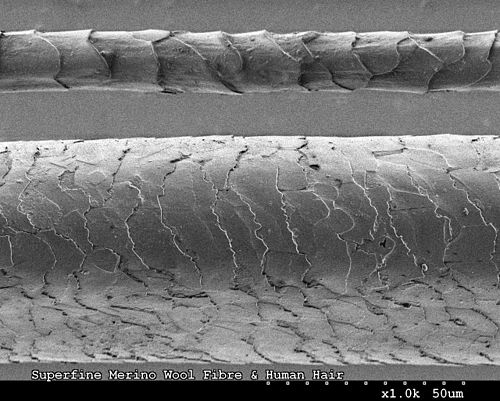
En anatomía humana , "cutícula" puede referirse a varias estructuras, pero se usa en el lenguaje general, e incluso por profesionales médicos, para referirse a la capa engrosada de piel que rodea las uñas de las manos y los pies (el eponiquio ), y para referirse a la capa superficial de células superpuestas que cubren el tallo del cabello ( cutícula pili ), compuesta de células muertas, que fija el cabello a su folículo . [ 1 ] También puede usarse como sinónimo de epidermis , [ 2 ] la capa externa de la piel.
Cutícula de los invertebrados
En zoología , la cutícula o cutícula de los invertebrados es una estructura multicapa que se encuentra fuera de la epidermis de muchos invertebrados, especialmente artrópodos y nematodos , en los que forma un exoesqueleto (véase exoesqueleto de artrópodos ).
Los principales componentes estructurales de la cutícula del nematodo son proteínas , colágenos altamente reticulados y proteínas insolubles especializadas conocidas como "cuticlinas", junto con glicoproteínas y lípidos . [ 3 ]
El principal componente estructural de la cutícula de los artrópodos es la quitina , un polisacárido compuesto por unidades de N -acetilglucosamina , junto con proteínas y lípidos. Las proteínas y la quitina están entrecruzadas. La rigidez depende del tipo de proteínas y de la cantidad de quitina. Se cree que las células epidérmicas producen proteínas y también regulan el momento y la cantidad de proteínas que se incorporan a la cutícula. [ 4 ]
Often, in the cuticle of arthropods, structural coloration is observed, produced by nanostructures.[5] In the mealworm beetle, Tenebrio molitor, cuticular color may suggest pathogen resistance in that darker individuals are more resistant to pathogens compared to more tan individuals.[6]
Botany

In botany, plant cuticles are protective, hydrophobic, waxy coverings produced by the epidermal cells of leaves, young shoots and all other aerial plant organs. Cuticles minimize water loss and effectively reduce pathogen entry due to their waxy secretion. The main structural components of plant cuticles are the unique polymerscutin or cutan, impregnated with wax. Plant cuticles function as permeability barriers for water and water-soluble materials. They prevent plant surfaces from becoming wet and also help to prevent plants from drying out. Xerophytic plants such as cacti have very thick cuticles to help them survive in their arid climates. Plants that live in range of sea's spray also may have thicker cuticles that protect them from the toxic effects of salt.
Some plants, particularly those adapted to life in damp or aquatic environments, have an extreme resistance to wetting. A well-known example is the sacred lotus.[7] This adaptation is not purely the physical and chemical effect of a waxy coating but depends largely on the microscopic shape of the surface. When a hydrophobic surface is sculpted into microscopic, regular, elevated areas, sometimes in fractal patterns, too high and too closely spaced for the surface tension of the liquid to permit any flow into the space between the plateaus, then the area of contact between liquid and solid surfaces may be reduced to a small fraction of what a smooth surface might permit.[8] The effect is to reduce wetting of the surface substantially.[9]
Structural coloration is also observed in the cuticles of plants (see, as an example, the so-called "marble berry", Pollia condensata.[10]
Mycology
"Cuticle" is one term used for the outer layer of tissue of a mushroom's basidiocarp, or "fruit body". The alternative term "pileipellis", Latin for "skin" of a "cap" (meaning "mushroom"[11]) might be technically preferable, but is perhaps too cumbersome for popular use. It is the part removed in "peeling" mushrooms. On the other hand, some morphological terminology in mycology makes finer distinctions, such as described in the article on the "pileipellis". Be that as it may, the pileipellis (or "peel") is distinct from the trama, the inner fleshy tissue of a mushroom or similar fruiting body, and also from the spore-bearing tissue layer, the hymenium.
References
- ↑"CUTICLE | meaning in the Cambridge English Dictionary". Dictionary.cambridge.org. 2022-05-25. Retrieved 2022-05-31.
- ↑Cuticle. Archived from the original on 2019-04-01. Retrieved 2019-04-01.
- ↑Page, Anthony; Johnstone, I. L. (2007). "The cuticle"(PDF). WormBook: 1–15. doi:10.1895/wormbook.1.138.1. PMC 4781593. PMID 18050497.
- ↑"insect physiology" The McGraw-Hill Encyclopedia of Science of Technology, Vol. 9, p. 233, 2007
- ↑Seago, Ainsley E.; Brady, Parrish; Vigneron, Jean-Pol; Schultz, Tom D. (28 October 2008). "Gold Bugs and Beyond: A Review of Iridescence and Structural Colour Mechanisms in Beetles (Coleoptera)". Journal of the Royal Society Interface. 6 (Suppl 2): S165–S184. doi:10.1098/rsif.2008.0354.focus. PMC 2586663. PMID 18957361.
- ↑ Armitage, SAO; Siva-Jothy, MT (2005-04-06). "La función inmune responde a la selección del color cuticular en Tenebrio molitor" . Heredity . 94 (6): 650– 656. Bibcode : 2005Hered..94..650A . doi : 10.1038/sj.hdy.6800675 . ISSN 0018-067X . PMID 15815710 .
- ↑ Quere, D.; Química de superficies. Gotas de fakir, Nature Materials 2002, 1, 14.
- ↑ Onda, T.; Shibuichi, S.; Satoh, N.; Tsujii, K. (1996). "Superficies fractales superhidrófugas". Langmuir . 12 (9): 2125– 27. doi : 10.1021/la950418o .
- ↑ Von Baeyer, HC, "El efecto loto", The Sciences , 2000, enero/febrero, 12
- ↑ Vignolini, Silvia; Rudall, Paula J.; Rowland, Alice V.; Reed, Alison; Moyroud, Edwige; Faden, Robert B.; Baumberg, Jeremy J.; Glover, Beverley J.; Steiner, Ullrich (10 de septiembre de 2012). "Color estructural puntillista en el fruto de Pollia" . Actas de la Academia Nacional de Ciencias . 109 (39): 15712– 5. Bibcode : 2012PNAS..10915712V . doi : 10.1073/pnas.1210105109 . PMC 3465391. PMID 23019355 .
- ↑ Jaeger, Edmund C. (1959). A Source-Book of Biological Names and Terms . Ilustraciones: Merle Gish y el autor (Tercera ed.). Springfield, IL: Charles C. Thomas, Publisher. p. 294. ISBN 0398061793OCLC 16764689. Consultado el 5 de junio de 2023 .
{{cite book}}: Incompatibilidad de ISBN/Fecha ( ayuda )
Enlaces externos
 Medios relacionados con la cocina en Wikimedia Commons
- Anatomía animal
- Anatomía de los nematodos
- Morfología vegetal