 Hispanopedia Wiki
In real analysis, Darboux's theorem states that the derivative of any real-valued function of a real variable has the intermediate value property, that is, that the image of an interval is also an interval.
When is continuously differentiable, this is a consequence of the intermediate value theorem. But even when is not continuous, Darboux's theorem places a restriction on the behaviour of over any closed interval.


Statement of the theorem
Let be an open interval, and let be a real-valued differentiable function. Then has the intermediate value property: If and are points in with , then for every between and , there exists an in such that .[1][2][3]


![{\displaystyle [a,b]}](https://wikimedia.org/api/rest_v1/media/math/render/svg/9c4b788fc5c637e26ee98b45f89a5c08c85f7935)

The original proof by Jean Gaston Darboux has been published in 1875.[4]
Proofs
Proof from the extreme value theorem
The first proof is based on the extreme value theorem.
If equals or , then setting equal to or , respectively, gives the desired result. Now assume that is strictly between and , and in particular that . Let such that . If it is the case that we adjust our below proof, instead asserting that has its minimum on .





Since is continuous on the closed interval , the maximum value of on is attained at some point in , according to the extreme value theorem.
Because , we know cannot attain its maximum value at . (If it did, then for all , which implies .)


![{\displaystyle t\in (a,b]}](https://wikimedia.org/api/rest_v1/media/math/render/svg/9e0718c8b01a9af74d4733f5429948a46cca33c3)

Likewise, because , we know cannot attain its maximum value at .

Therefore, must attain its maximum value at some point . Hence, by Fermat's theorem, , i.e. .


Proof from the mean and intermediate value theorems
The second proof is based on combining the mean value theorem and the intermediate value theorem.[1][2]
Define . For define and . And for define and .
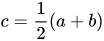


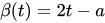

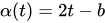

Thus, for we have . Now, define with . is continuous in .


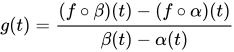


Furthermore, when and when ; therefore, from the Intermediate Value Theorem, if then, there exists such that . Let's fix .





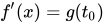
From the Mean Value Theorem, there exists a point such that . Hence, .


Darboux function
A Darboux function is a real-valued function which has the "intermediate value property": for any two values and in the domain of , and any between and , there is some between and with .[5] By the intermediate value theorem, every continuous function on a realinterval is a Darboux function. Darboux's contribution was to show that there are discontinuous Darboux functions.


Every discontinuity of a Darboux function is essential, that is, at any point of discontinuity, at least one of the left hand and right hand limits does not exist.
An example of a Darboux function that is discontinuous at one point is the topologist's sine curve function:
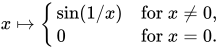
By Darboux's theorem, the derivative of any differentiable function is a Darboux function. In particular, the derivative of the function is a Darboux function even though it is not continuous at one point.

An example of a Darboux function that is nowhere continuous is Conway's base 13 function. Another is Bergfeldt's function where a real number x is written in expanded in binary with digits each 0 or 1, and if the series converges for that x and 0 if it does not.[6]


Darboux functions are a quite general class of functions. It turns out that any real-valued function ƒ on the real line can be written as the sum of two Darboux functions.[7] This implies in particular that the class of Darboux functions is not closed under addition.
A strongly Darboux function is one for which the image of every (non-empty) open interval is the whole real line.[5]
Further restrictions on derivatives
Darboux's theorem gives a necessary condition for a function to be a derivative, but it is not sufficient. Every derivative of a real function is also of Baire class one, and the set of points at which a derivative is discontinuous is a meagre set. Conversely, every meagre subset of the real line can occur as the discontinuity set of a derivative.[8]

A finer restriction is on the sublevel sets of a derivative. For a real function , its associated superlevel and sublevel sets are and , where is real. Zahorski introduced classes of sets describing how large such associated sets must be near their own points. In this terminology, one has the following theorems:

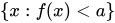

- Every finite derivative has associated sets in .
- Every bounded derivative has associated sets in . Moreover, a set is an associated set of some bounded derivative if and only if it belongs to .[9]


Intuitively, if and , then the set on which cannot be arbitrarily sparse near . If is continuous at , this is trivial: throughout some neighbourhood of , so the local density is . The Zahorski conditions express weaker density requirements that remain valid even when the derivative is discontinuous.


More explicitly, a non-empty set belongs to if, for every , any sequence of closed intervals not containing , with and , satisfies


where denotes Lebesgue measure. Thus, near a point of , gaps in cannot have length comparable to their distance from the point. The class is stronger: belongs to if it can be written as a countable union of closed sets such that, on each , the set occupies a uniformly positive proportion of every sufficiently small one-sided interval whose length is comparable with its distance from the point. In this sense, rules out large nearby holes, while imposes a uniform positive lower-density condition.


Notes
- 12Apostol, Tom M.: Mathematical Analysis: A Modern Approach to Advanced Calculus, 2nd edition, Addison-Wesley Longman, Inc. (1974), page 112.
- 12Olsen, Lars: A New Proof of Darboux's Theorem, Vol. 111, No. 8 (Oct., 2004) (pp. 713–715), The American Mathematical Monthly
- ↑Rudin, Walter: Principles of Mathematical Analysis, 3rd edition, MacGraw-Hill, Inc. (1976), page 108
- ↑Darboux, Gaston (1875), "Mémoire sur les fonctions discontinues" [Dissertation on discontinuous functions], Annales Scientifiques de l'É.N.S., Serie 2 (in French), 4, Paris: École Normale Supérieure: 109–110, doi:10.24033/asens.122
{{citation}}: CS1 maint: date and year (link) - 12Ciesielski, Krzysztof (1997). Set theory for the working mathematician. London Mathematical Society Student Texts. Vol. 39. Cambridge: Cambridge University Press. pp. 106–111. ISBN 0-521-59441-3. Zbl 0938.03067.
- ↑Bergfeldt, Aksel (2018-09-27). "Open maps which are not continuous". Stack Exchange Mathematics. In an answer to the question. Retrieved 2023-07-10.
- ↑Bruckner, Andrew M: Differentiation of real functions, 2 ed, page 6, American Mathematical Society, 1994
- ↑Bruckner, Andrew M.; Leonard, J. L. (1966). "Derivatives". American Mathematical Monthly. 73 (4, Part II): 24–56.
- ↑Bruckner, Andrew M. (1994). Differentiation of Real Functions. CRM Monograph Series. Vol. 5 (2nd ed.). American Mathematical Society. pp. 61–67. ISBN 0-8218-6990-6.
External links
- This article incorporates material from Darboux's theorem on PlanetMath, which is licensed under the Creative Commons Attribution/Share-Alike License.
- "Darboux theorem", Encyclopedia of Mathematics, EMS Press, 2001 [1994]
- Theorems in calculus
- Theory of continuous functions
- Theorems in real analysis