 Hispanopedia Wiki
En física, la teoría del éter de Einstein , también llamada teoría del éter , es el nombre acuñado en 2004 para una modificación de la relatividad general que posee un marco de referencia preferido y, por lo tanto, viola la invariancia de Lorentz . Estas teorías, generalmente covariantes, describen un espaciotiempo dotado de una métrica y un campo vectorial unitario de tipo temporal denominado éter . El éter en esta teoría es un "campo vectorial que viola la invariancia de Lorentz" [ 1 ] , sin relación con las teorías del éter luminífero más antiguas ; el término "Einstein" en el nombre de la teoría proviene del uso de la ecuación de la relatividad general de Einstein. [ 2 ]
Relación con otras teorías de la gravedad
La teoría del éter de Einstein es una teoría alternativa de la gravedad que añade un campo vectorial a la teoría de la relatividad general. También existen modificaciones de campos escalares, incluida la teoría de Brans-Dicke , todas incluidas en la teoría de Horndeski . En sentido contrario, hay teorías que añaden campos tensoriales, bajo el nombre de gravedad bimétrica , o bien se pueden añadir campos escalares y vectoriales, como en la gravedad tensorial-vectorial-escalar . [ 3 ] : 30
Historia
El nombre "teoría del éter de Einstein" fue acuñado en 2004 por T. Jacobson y D. Mattingly. [ 4 ] Este tipo de teoría se originó en la década de 1970 con el trabajo de C.M. Will y K. Nordtvedt Jr. sobre teorías de campos vectoriales acoplados gravitacionalmente. [ 3 ] : 42
En la década de 1980, Maurizio Gasperini añadió un campo escalar , que intuitivamente correspondía a una noción universal de tiempo , a la métrica de la relatividad general . [ 5 ] Dicha teoría tendrá un marco de referencia preferido , aquel en el que el tiempo universal es el tiempo real.
In 2000, Ted Jacobson and David Mattingly developed a model that allows the consequences of preferred frames to be studied.[6] Their theory contains less information than that of Gasperini, instead of a scalar field giving a universal time it contains only a unit vector field which gives the direction of time. Thus observers who follow the aether at different points will not necessarily age at the same rate in the Jacobson–Mattingly theory. In 2008 Ted Jacobson presented a status report on Einstein-aether theory.[7]
Breaking Lorentz symmetry
The existence of a preferred, dynamical time vector breaks the Lorentz symmetry of the theory, more precisely it breaks the invariance under boosts. This symmetry breaking may lead to a Higgs mechanism for the graviton which would alter long distance physics, perhaps yielding an explanation for recent supernova data which would otherwise be explained by a cosmological constant. The effect of breaking Lorentz invariance on quantum field theory has a long history leading back at least to the work of Markus Fierz and Wolfgang Pauli in 1939. Recently it has regained popularity with, for example, the paper Effective Field Theory for Massive Gravitons and Gravity in Theory Space by Nima Arkani-Hamed, Howard Georgi and Matthew Schwartz.[8] Einstein-aether theories provide a concrete example of a theory with broken Lorentz invariance and so have proven to be a natural setting for such investigations.
Action
The action of the Einstein-aether theory is generally taken to consist of the sum of the Einstein–Hilbert action with a Lagrange multiplier λ that ensures that the time vector is a unit vector and also with all of the covariant terms involving the time vector u but having at most two derivatives.
In particular it is assumed that the action may be written as the integral of a local Lagrangian density
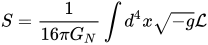
where GN is Newton's constant and g is a metric with Minkowski signature. The Lagrangian density is

Here R is the Ricci scalar, is the covariant derivative and the tensor K is defined by


Here the ci are dimensionless adjustable parameters of the theory.
Solutions
Stars
Several spherically symmetric solutions to ae-theory have been found. Most recently Christopher Eling and Ted Jacobson have found solutions resembling stars[9] and solutions resembling black holes.[10]
In particular, they demonstrated that there are no spherically symmetric solutions in which stars are constructed entirely from the aether. Solutions without additional matter always have either naked singularities or else two asymptotic regions of spacetime, resembling a wormhole but with no horizon. They have argued that static stars must have static aether solutions, which means that the aether points in the direction of a timelike killing vector.
Black holes and potential problems
However this is difficult to reconcile with static black holes, as at the event horizon there are no timelike Killing vectors available and so the black hole solutions cannot have static aethers. Thus when a star collapses to form a black hole, somehow the aether must eventually become static even very far away from the collapse.
In addition the stress tensor does not obviously satisfy the Raychaudhuri equation, one needs to make recourse to the equations of motion. This is in contrast with theories with no aether, where this property is independent of the equations of motion.
Experimental constraints
In a 2005 paper,[11]Nima Arkani-Hamed, Hsin-Chia Cheng, Markus Luty and Jesse Thaler have examined experimental consequences of the breaking of boost symmetries inherent in aether theories. They have found that the resulting Goldstone boson leads to, among other things, a new kind of Cherenkov radiation.
In addition they have argued that spin sources will interact via a new inverse square law force with a very unusual angular dependence. They suggest that the discovery of such a force would be very strong evidence for an aether theory, although not necessarily that of Jacobson, et al.
See also
References
- ↑Clifton, Timothy; Ferreira, Pedro G.; Padilla, Antonio; Skordis, Constantinos (March 2012). "Modified gravity and cosmology". Physics Reports. 513 (1–3): 1–189. arXiv:1106.2476. Bibcode:2012PhR...513....1C. doi:10.1016/j.physrep.2012.01.001.
- ↑Eling, Christopher; Jacobson, Ted (2004-03-08). "Static post-Newtonian equivalence of general relativity and gravity with a dynamical preferred frame". Physical Review D. 69 (6) 064005. arXiv:gr-qc/0310044. Bibcode:2004PhRvD..69f4005E. doi:10.1103/PhysRevD.69.064005. ISSN 1550-7998. S2CID 15888510.
- 12Clifton, Timothy; Ferreira, Pedro G.; Padilla, Antonio; Skordis, Constantinos (March 2012). "Modified gravity and cosmology". Physics Reports. 513 (1–3): 1–189. arXiv:1106.2476. Bibcode:2012PhR...513....1C. doi:10.1016/j.physrep.2012.01.001.
- ↑Jacobson, T.; Mattingly, D. (2004-07-19). "Einstein-aether waves". Physical Review D. 70 (2) 024003. arXiv:gr-qc/0402005. Bibcode:2004PhRvD..70b4003J. doi:10.1103/PhysRevD.70.024003. ISSN 1550-7998. S2CID 119355560.
We refer to the system of the metric coupled to the aether as "Einstein-aether theory"
- ↑Gasperini, M. (1987). "Singularity Prevention and Broken Lorentz Symmetry". Classical and Quantum Gravity. 4 (2): 485–494. Bibcode:1987CQGra...4..485G. doi:10.1088/0264-9381/4/2/026. S2CID 250814796.
- ↑Jacobson, Ted; Mattingly, David (2001-06-26). "Gravity with a dynamical preferred frame". Physical Review D. 64 (2) 024028. arXiv:gr-qc/0007031. Bibcode:2001PhRvD..64b4028J. doi:10.1103/PhysRevD.64.024028. ISSN 0556-2821. S2CID 119372246.
- ↑Jacobson, Ted (2008-01-10). "Einstein-aether gravity: A status report". arXiv:0801.1547v2 [gr-qc].
- ↑Arkani-Hamed, Nima; Georgi, Howard; Schwartz, Matthew D. (2003). "Effective Field Theory for Massive Gravitons and Gravity in Theory Space". Annals of Physics. 305 (2): 96–118. arXiv:hep-th/0210184. Bibcode:2003AnPhy.305...96A. doi:10.1016/S0003-4916(03)00068-X. S2CID 1367086.
- ↑Jacobson, Ted; Mattingly, David (2006). "Spherical Solutions to Einstein-aether Theory: Static Aether and Stars". Classical and Quantum Gravity. 23 (18): 5625–5642. arXiv:gr-qc/0603058. Bibcode:2006CQGra..23.5625E. doi:10.1088/0264-9381/23/18/008. S2CID 120259601.
- ↑Eling, Christopher; Jacobson, Ted (2006). "Black Holes in Einstein-aether Theory". Classical and Quantum Gravity. 23 (18): 5643–5660. arXiv:gr-qc/0604088. Bibcode:2006CQGra..23.5643E. doi:10.1088/0264-9381/23/18/009. S2CID 119488152.
- ↑Arkani-Hamed, Nima; Cheng, Hsin-Chia; Luty, Markus; Thaler, Jesse (2005). "Universal dynamics of spontaneous Lorentz violation and a new spin-dependent inverse-square law force". Journal of High Energy Physics. 2005 (7): 029. arXiv:hep-ph/0407034. Bibcode:2005JHEP...07..029A. doi:10.1088/1126-6708/2005/07/029.
- Aether theories
- Theories of gravity