 Hispanopedia Wiki
The distortion free energy density is a quantity that describes the increase in the free energy density of a liquid crystal caused by distortions from its uniformly aligned configuration. It also commonly goes by the name Frank free energy density named after Charles Frank.
Nematic liquid crystal
The distortion-free energy density in a nematic liquid crystal is a measure of the increase in the Helmholtz free energy per unit volume due to deviations in the orientational ordering away from a uniformly aligned nematic director configuration. The total free energy density for a nematic is therefore given by:

where is the total free energy density of a liquid crystal, is the free energy density associated with a uniformly aligned nematic, and is the contribution to the free energy density due to distortions in this order. For a non-chiral nematic liquid crystal, is commonly taken to consist of three terms given by:



The unit vector is the normalized director of the molecules , which describes the nature of the distortion. The three constants are known as the Frank constants and are dependent on the particular liquid crystal being described. They are usually of the order of dyn.[1] Each of the three terms represent a type of distortion of a nematic. The first term represents pure splay, the second term pure twist, and the third term pure bend. A combination of these terms can be used to represent an arbitrary deformation in a liquid crystal. It is often the case that all three Frank constants are of the same order of magnitude and so it is commonly approximated that .[2] This approximation is commonly referred to as the one-constant approximation and is used predominantly because the free energy simplifies when in this much more computationally compact form:



![{\displaystyle {\mathcal {F}}_{d}={\frac {1}{2}}K\left[(\nabla \cdot \mathbf {\hat {n}} )^{2}+|\nabla \times \mathbf {\hat {n}} |^{2}\right]={\frac {1}{2}}K|\nabla \mathbf {\hat {n}} |^{2}.}](https://wikimedia.org/api/rest_v1/media/math/render/svg/aa9e2d7dae995c6f3fcc44c28767dfe2bde5b258)
A fourth term is also commonly added to the Frank free energy density called the saddle-splay energy that describes the surface interaction. It is often ignored when calculating director field configurations since the energies in the bulk of the liquid crystal are often greater than those due to the surface. It is given by:
![{\displaystyle {\frac {1}{2}}K_{4}\nabla \cdot \left[(\mathbf {\hat {n}} \cdot \nabla )\mathbf {\hat {n}} -\mathbf {\mathbf {\hat {n}} } (\nabla \cdot \mathbf {\hat {n}} )\right].}](https://wikimedia.org/api/rest_v1/media/math/render/svg/cca9e2a967dbe48f4f42c3f785ea418708ad39a4)
If inclusions are added to a liquid crystal, an additional term contributes to the free energy density due to their presence, often characterized by a term known as the Rapini approximation:
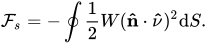
The anchoring energy is given by and the unit vector is normal to the particles surface.[3]


Chiral liquid crystal
For the case when the liquid crystal consists of chiral molecules, an additional term to the distortion free energy density is added. The term changes sign when the axes are inverted and is given by:

The prefactor depende del grado de quiralidad molecular. [ 4 ] Por lo tanto, para el caso de un cristal líquido quiral, la densidad de energía libre total viene dada por:


La cantidaddescribe el lanzamientode la hélice colestérica.


Contribuciones de los campos eléctrico y magnético
Como resultado de las propiedades diamagnéticas anisotrópicas y la polarizabilidad eléctrica de los mesógenos de cristal líquido, los campos eléctricos y magnéticos pueden inducir alineaciones en los cristales líquidos. Al aplicar un campo, se reduce efectivamente la energía libre del cristal líquido. [ 5 ]
Para comprender el efecto que produce un campo magnético sobre la densidad de energía libre de distorsión, se necesita una pequeña región de orden nemático local.a menudo se considera en quéyes la susceptibilidad magnética perpendicular y paralela a. El valordonde N es el número de mesógenos por unidad de volumen. El trabajo por unidad de volumen realizado por el campo viene dado por:




dónde:


Desde elEl término es espacialmente invariante, puede ignorarse y, por lo tanto, la contribución magnética a la densidad de energía libre de distorsión se convierte en:

![{\displaystyle -{\frac {\Delta \chi }{2}}[\mathbf {H} \cdot \mathbf {\hat {n}} ]^{2}.}](https://wikimedia.org/api/rest_v1/media/math/render/svg/317766d9f7a9239a7ecbe64651ad7d6a0b59102d)
A partir de argumentos similares, se puede hallar la contribución del campo eléctrico a la energía libre de distorsión, la cual viene dada por:
![{\displaystyle -{\frac {\Delta \epsilon }{8\pi }}[\mathbf {E} \cdot \mathbf {\hat {n}} ]^{2}.}](https://wikimedia.org/api/rest_v1/media/math/render/svg/5ca1014c2ee74da369dd8825af840e77ba8d0e12)
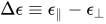
La cantidades la diferencia entre las constantes dieléctricas locales perpendiculares y paralelas a.
Notas
- ↑ de Gennes y Prost 1995 , p. 103
- ^ Chandrasekhar 1992 , pág. 118
- ↑ Kuksenok y otros. 1996 , pág. 5199
- ↑ Chaikin y Lubensky 1995 , págs. 299–300
- ^ Priestley, Wojtowicz y Sheng 1975 , págs. 107-110
Referencias
- Chaikin, Paul M.; Lubensky , Tom C. (1995). Principios de física de la materia condensada . Cambridge University Press. ISBN 0-521-43224-3.
- Chandrasekhar, Sivaramakrishna (1992). Cristales líquidos (2.ª ed.). Cambridge University Press. ISBN 0-521-41747-3.
- de Gennes, Pierre-Gilles ; Prost, J. (10 de agosto de 1995). La física de los cristales líquidos (2.ª ed.). Oxford University Press. ISBN 0-19-851785-8.
- Kamien, Randall D.; Selinger, Jonathan V. (22 de enero de 2001). "Orden y frustración en cristales líquidos quirales". Journal of Physics: Condensed Matter . 13 (3). arXiv : cond-mat/0009094 . Bibcode : 2001JPCM...13R...1K . doi : 10.1088/0953-8984/13/3/201 .
- Kuksenok, OV; Ruhwandl, RW; Shiyanovskii, SV; Terentjev, EM (noviembre de 1996). "Estructura del director alrededor de una partícula coloidal suspendida en un cristal líquido nemático". Physical Review E. 54 ( 5): 5198– 5203. Bibcode : 1996PhRvE..54.5198K . doi : 10.1103/PhysRevE.54.5198 .
- Priestley, EB; Wojtowicz, Peter J.; Sheng, Ping (1975). Introducción a los cristales líquidos . Plenum Press. ISBN 0-306-30858-4.
- cristales líquidos