 Hispanopedia Wiki
This is a list of the fundamental frequencies in hertz (cycles per second) of the keys of a modern 88-key standard or 108-key extended piano in twelve-tone equal temperament, with the 49th key, the fifth A (called A4), tuned to 440 Hz (referred to as A440).[1][2] Every octave is made of twelve steps called semitones. A jump from the lowest semitone to the highest semitone in one octave doubles the frequency (for example, the fifth A is 440 Hz and the sixth A is 880 Hz). The frequency of a pitch is derived by multiplying (ascending) or dividing (descending) the frequency of the previous pitch by the twelfth root of two (approximately 1.059463).[1][2] For example, to get the frequency one semitone up from A4 (A♯4), multiply 440 Hz by the twelfth root of two. To go from A4 up two semitones (one whole tone) to B4, multiply 440 twice by the twelfth root of two (or once by the sixth root of two, approximately 1.122462). To go from A4 up three semitones to C5 (a minor third), multiply 440 Hz three times by the twelfth root of two (or once by the fourth root of two, approximately 1.189207). For other tuning schemes, refer to musical tuning.
This list of frequencies is for a theoretically ideal piano. On an actual piano, the ratio between semitones is slightly larger, owing to string stiffness that causes inharmonicity, i.e., the tendency for the harmonic makeup of each note to run sharp. To compensate for this, octaves are tuned slightly wide, stretched according to the inharmonic characteristics of each instrument.[3] This deviation from equal temperament is graphically represented by the Railsback curve.
The following equation gives the frequency f (Hz) of the nth key on the idealized standard piano with the 49th key tuned to A4 at 440 Hz:
![{\displaystyle f(n)=\left({\sqrt[{12}]{2}}\,\right)^{n-49}\times 440\,{\text{Hz}}\,=2^{\frac {n-49}{12}}\times 440\,{\text{Hz}}\,}](https://wikimedia.org/api/rest_v1/media/math/render/svg/e3bc97363b65f575de67261dd5e8b9af2c2e0781)
where n is shown in the table below.[1]
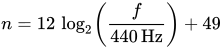
Conversely, the key number of a pitch with a frequency f (Hz) on the idealized standard piano is:
List


Values in bold are exact on an idealized standard piano. Keys shaded gray are rare and only appear on extended pianos. The normal 88 keys are numbered 1 to 88; extra low and high keys which only appear on extended pianos are numbered −11 to 0 and 89 to 100 respectively. A 112-key piano that extends from A-1 to C9 was first built between 2022 and 2024 by Stuart & Sons.[4]
See also
References
- 123Weisstein, Eric. "Equal Temperament -- from Eric Weisstein's Treasure Trove of Music". Eric Weisstein's Treasure Trove of Music. Archived from the original on 2019-06-14. Retrieved 2019-12-26.
- 12Nov, Yuval. "Explaining the Equal Temperament". www.yuvalnov.org. Archived from the original on 2019-05-26. Retrieved 2019-12-26.
- ↑Citak, Ray. "Information on Piano Tuning". www.pianotechnician.com. Archived from the original on 2019-02-26. Retrieved 2019-12-26.
- ↑"World's First 112 Key Acoustic Piano". Stuart Piano News and Events. October 2024. Retrieved 2026-05-05.
- 12Goss, Clint (2019-02-18). "Octave Notation". Flutopedia. Archived from the original on 2019-05-12. Retrieved 2019-12-26.
- ↑Suits, Bryan (1998). "Frequencies of Musical Notes, A4 = 440 Hz". Physics of Music — Notes. Michigan Tech University. Archived from the original on 2019-12-16. Retrieved 2019-12-26.
- Piano
- Musical tuning