 Hispanopedia Wiki

In linear algebra, the column space (also called the range or image) of a matrix is the span (set of all possible linear combinations) of its column vectors. The column space of a matrix is the image or range of the corresponding matrix transformation.

Let be a field. The column space of an matrix with components from is a linear subspace of the m-space. The dimension of the column space is called the rank of the matrix and is at most .[1] A definition for matrices over a ring (i.e., with components from ) is also possible.


The row space is defined similarly.
The row space and the column space of a matrix are sometimes denoted as and , respectively.[2]


This article considers matrices of real numbers. The row and column spaces are subspaces of the real coordinate spaces and , respectively.[3]


Overview
Let A be an m-by-n matrix. Then
- rank(A) = dim(rowsp(A)) = dim(colsp(A)),[4]
- rank(A) = number of pivots in any echelon form of A,
- rank(A) = the maximum number of linearly independent rows or columns of A.[5]
If the matrix represents a linear transformation, the column space of the matrix equals the image of this linear transformation.
The column space of a matrix A is the set of all linear combinations of the columns in A. If A = [a1 ⋯ an], then colsp(A) = span({a1, ..., an}).
Given a matrix A, the action of the matrix A on a vector x returns a linear combination of the columns of A with the coordinates of x as coefficients; that is, the columns of the matrix generate the column space.
Example
Given a matrix J:
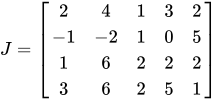
the rows are , , , . Consequently, the row space of J is the subspace of spanned by { r1, r2, r3, r4 }. Since these four row vectors are linearly independent, the row space is 4-dimensional. Moreover, in this case it can be seen that they are all orthogonal to the vector n = [6, −1, 4, −4, 0] (n is an element of the kernel of J ), so it can be deduced that the row space consists of all vectors in that are orthogonal to n.





Column space
Definition
Let K be a field of scalars. Let A be an m × n matrix, with column vectors v1, v2, ..., vn. A linear combination of these vectors is any vector of the form

where c1, c2, ..., cn are scalars. The set of all possible linear combinations of v1, ..., vn is called the column space of A. That is, the column space of A is the span of the vectors v1, ..., vn.
Any linear combination of the column vectors of a matrix A can be written as the product of A with a column vector:

Por lo tanto, el espacio columna de A consta de todos los productos posibles A x , para x ∈ K n . Esto es lo mismo que la imagen (o rango ) de la transformación matricial correspondiente .
Ejemplo
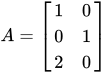
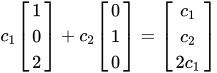
SiEntonces, los vectores columna son v 1 = [1, 0, 2] T y v 2 = [0, 1, 0] T . Una combinación lineal de v 1 y v 2 es cualquier vector de la forma El conjunto de todos esos vectores es el espacio columna de A. En este caso, el espacio columna es precisamente el conjunto de vectores ( x , y , z ) ∈ R 3 que satisfacen la ecuación z = 2 x (usando coordenadas cartesianas , este conjunto es un plano que pasa por el origen en el espacio tridimensional ).
Base
Las columnas de A abarcan el espacio columna, pero es posible que no formen una base si los vectores columna no son linealmente independientes . Afortunadamente, las operaciones elementales de fila no afectan las relaciones de dependencia entre los vectores columna. Esto permite utilizar la reducción de filas para encontrar una base para el espacio columna.
Por ejemplo, consideremos la matriz
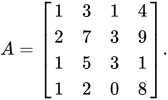
Las columnas de esta matriz abarcan el espacio columna, pero pueden no ser linealmente independientes , en cuyo caso un subconjunto de ellas formará una base. Para encontrar esta base, reducimos A a la forma escalonada reducida por filas :

En este punto, queda claro que la primera, la segunda y la cuarta columna son linealmente independientes, mientras que la tercera columna es una combinación lineal de las dos primeras. (Específicamente, v 3 = −2 v 1 + v 2 .) Por lo tanto, la primera, la segunda y la cuarta columna de la matriz original constituyen una base para el espacio columna:

Nótese que las columnas independientes de la forma escalonada reducida son precisamente las columnas con pivotes . Esto permite determinar qué columnas son linealmente independientes reduciendo únicamente a la forma escalonada .
The above algorithm can be used in general to find the dependence relations between any set of vectors, and to pick out a basis from any spanning set. Also finding a basis for the column space of A is equivalent to finding a basis for the row space of the transpose matrix AT.
To find the basis in a practical setting (e.g., for large matrices), the singular-value decomposition is typically used.
Dimension
The dimension of the column space is called the rank of the matrix. The rank is equal to the number of pivots in the reduced row echelon form, and is the maximum number of linearly independent columns that can be chosen from the matrix. For example, the 4 × 4 matrix in the example above has rank three.
Because the column space is the image of the corresponding matrix transformation, the rank of a matrix is the same as the dimension of the image. For example, the transformation described by the matrix above maps all of to some three-dimensional subspace.


The nullity of a matrix is the dimension of the null space, and is equal to the number of columns in the reduced row echelon form that do not have pivots.[7] The rank and nullity of a matrix A with n columns are related by the equation:

This is known as the rank–nullity theorem.
Relation to the left null space
The left null space of A is the set of all vectors x such that xTA = 0T. It is the same as the null space of the transpose of A. The product of the matrix AT and the vector x can be written in terms of the dot product of vectors:
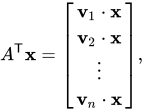
because row vectors of AT are transposes of column vectors vk of A. Thus ATx = 0 if and only if x is orthogonal (perpendicular) to each of the column vectors of A.
It follows that the left null space (the null space of AT) is the orthogonal complement to the column space of A.
For a matrix A, the column space, row space, null space, and left null space are sometimes referred to as the four fundamental subspaces.

For matrices over a ring
Similarly the column space (sometimes disambiguated as right column space) can be defined for matrices over a ringK as

for any c1, ..., cn, with replacement of the vector m-space with "rightfree module", which changes the order of scalar multiplication of the vector vk to the scalar ck such that it is written in an unusual order vector–scalar.[8]
Row space
Definition
Let K be a field of scalars. Let A be an m × n matrix, with row vectors r1, r2, ..., rm. A linear combination of these vectors is any vector of the form

where c1, c2, ..., cm are scalars. The set of all possible linear combinations of r1, ..., rm is called the row space of A. That is, the row space of A is the span of the vectors r1, ..., rm.
For example, if

then the row vectors are r1 = [1, 0, 2] and r2 = [0, 1, 0]. A linear combination of r1 and r2 is any vector of the form

The set of all such vectors is the row space of A. In this case, the row space is precisely the set of vectors (x, y, z) ∈ K3 satisfying the equation z = 2x (using Cartesian coordinates, this set is a plane through the origin in three-dimensional space).
For a matrix that represents a homogeneous system of linear equations, the row space consists of all linear equations that follow from those in the system.
The column space of A is equal to the row space of AT.
Basis
The row space is not affected by elementary row operations. This makes it possible to use row reduction to find a basis for the row space.
For example, consider the matrix
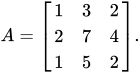
The rows of this matrix span the row space, but they may not be linearly independent, in which case the rows will not be a basis. To find a basis, we reduce A to row echelon form:
r1, r2, r3 represents the rows.
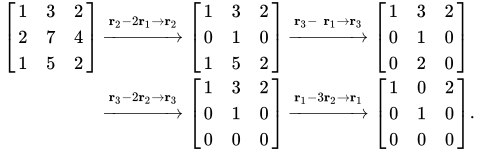
Once the matrix is in echelon form, the nonzero rows are a basis for the row space. In this case, the basis is { [1, 3, 2], [2, 7, 4] }. Another possible basis { [1, 0, 2], [0, 1, 0] } comes from a further reduction.[9]
This algorithm can be used in general to find a basis for the span of a set of vectors. If the matrix is further simplified to reduced row echelon form, then the resulting basis is uniquely determined by the row space.
It is sometimes convenient to find a basis for the row space from among the rows of the original matrix instead (for example, this result is useful in giving an elementary proof that the determinantal rank of a matrix is equal to its rank). Since row operations can affect linear dependence relations of the row vectors, such a basis is instead found indirectly using the fact that the column space of AT is equal to the row space of A. Using the example matrix A above, find AT and reduce it to row echelon form:
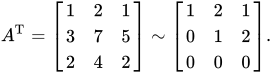
The pivots indicate that the first two columns of AT form a basis of the column space of AT. Therefore, the first two rows of A (before any row reductions) also form a basis of the row space of A.
Dimension
The dimension of the row space is called the rank of the matrix. This is the same as the maximum number of linearly independent rows that can be chosen from the matrix, or equivalently the number of pivots. For example, the 3 × 3 matrix in the example above has rank two.[9]
El rango de una matriz también es igual a la dimensión del espacio columna . La dimensión del espacio nulo se denomina nulidad de la matriz y está relacionada con el rango mediante la siguiente ecuación:

donde n es el número de columnas de la matriz A. La ecuación anterior se conoce como el teorema de rango-nulidad .
Relación con el espacio nulo
El espacio nulo de la matriz A es el conjunto de todos los vectores x para los cuales A x = 0. El producto de la matriz A y el vector x se puede escribir en términos del producto escalar de vectores:
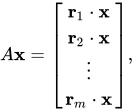
donde r 1 , ..., r m son los vectores fila de A . Por lo tanto, A x = 0 si y solo si x es ortogonal (perpendicular) a cada uno de los vectores fila de A .
De ello se deduce que el espacio nulo de A es el complemento ortogonal del espacio fila. Por ejemplo, si el espacio fila es un plano que pasa por el origen en tres dimensiones, entonces el espacio nulo será la recta perpendicular que pasa por el origen. Esto proporciona una demostración del teorema de rango-nulidad (véase la dimensión más arriba).
El espacio fila y el espacio nulo son dos de los cuatro subespacios fundamentales asociados a una matriz A (los otros dos son el espacio columna y el espacio nulo izquierdo ).
Relación con la coimagen
Si V y W son espacios vectoriales , entonces el núcleo de una transformación lineal T : V → W es el conjunto de vectores v ∈ V para los cuales T ( v ) = 0. El núcleo de una transformación lineal es análogo al espacio nulo de una matriz.
Si V es un espacio con producto interno , entonces el complemento ortogonal del núcleo puede considerarse una generalización del espacio fila. A esto se le llama a veces coimagen de T. La transformación T es biyectiva en su coimagen, y la coimagen se mapea isomórficamente sobre la imagen de T.
When V is not an inner product space, the coimage of T can be defined as the quotient spaceV / ker(T).
See also
References & Notes
- ↑Linear algebra, as discussed in this article, is a very well established mathematical discipline for which there are many sources. Almost all of the material in this article can be found in Lay 2005, Meyer 2001, and Strang 2005.
- ↑Strang, Gilbert (2016). Introduction to linear algebra (Fifth ed.). Wellesley, MA: Wellesley-Cambridge Press. pp. 128, 168. ISBN 978-0-9802327-7-6. OCLC 956503593.
- ↑Anton (1987, p. 179)
- ↑Anton (1987, p. 183)
- ↑Beauregard & Fraleigh (1973, p. 254)
- ↑This computation uses the Gauss–Jordan row-reduction algorithm. Each of the shown steps involves multiple elementary row operations.
- ↑Columns without pivots represent free variables in the associated homogeneous system of linear equations.
- ↑Important only if K is not commutative. Actually, this form is merely a productAc of the matrix A to the column vector c from Kn where the order of factors is preserved, unlike the formula above.
- 12The example is valid over the real numbers, the rational numbers, and other number fields. It is not necessarily correct over fields and rings with non-zero characteristic.
Further reading
- Anton, Howard (1987), Elementary Linear Algebra (5th ed.), New York: Wiley, ISBN 0-471-84819-0
- Axler, Sheldon Jay (1997), Linear Algebra Done Right (2nd ed.), Springer-Verlag, ISBN 0-387-98259-0
- Banerjee, Sudipto; Roy, Anindya (June 6, 2014), Linear Algebra and Matrix Analysis for Statistics (1st ed.), CRC Press, ISBN 978-1-42-009538-8
- Beauregard, Raymond A.; Fraleigh, John B. (1973), A First Course In Linear Algebra: with Optional Introduction to Groups, Rings, and Fields, Boston: Houghton Mifflin Company, ISBN 0-395-14017-X
- Lay, David C. (August 22, 2005), Linear Algebra and Its Applications (3rd ed.), Addison Wesley, ISBN 978-0-321-28713-7
- Leon, Steven J. (2006), Linear Algebra With Applications (7th ed.), Pearson Prentice Hall
- Meyer, Carl D. (February 15, 2001), Matrix Analysis and Applied Linear Algebra, Society for Industrial and Applied Mathematics (SIAM), ISBN 978-0-89871-454-8, archived from the original on March 1, 2001
- Poole, David (2006), Linear Algebra: A Modern Introduction (2nd ed.), Brooks/Cole, ISBN 0-534-99845-3
- Strang, Gilbert (July 19, 2005), Linear Algebra and Its Applications (4th ed.), Brooks Cole, ISBN 978-0-03-010567-8
External links
- Weisstein, Eric W."Row Space". MathWorld.
- Weisstein, Eric W."Column Space". MathWorld.
- Gilbert Strang, MIT Linear Algebra Lecture on the Four Fundamental Subspaces at Google Video, from MIT OpenCourseWare
- Khan Academy video tutorial
- Lecture on column space and nullspace by Gilbert Strang of MIT
- Row Space and Column Space
- Abstract algebra
- Linear algebra
- Matrices (mathematics)