 Hispanopedia Wiki
En matemáticas , específicamente en álgebra abstracta , los teoremas de isomorfismo (también conocidos como teoremas de isomorfismo de Noether ) describen la relación entre cocientes , homomorfismos y subobjetos . Existen versiones de estos teoremas para grupos , anillos , espacios vectoriales , módulos , álgebras de Lie y otras estructuras algebraicas . En álgebra universal , los teoremas de isomorfismo pueden generalizarse al contexto de álgebras y congruencias .
Historia
Los teoremas de isomorfismo fueron formulados con cierta generalidad para homomorfismos de módulos por Emmy Noether en su artículo Abstrakter Aufbau der Idealtheorie in algebraischen Zahl- und Funktionenkörpern , publicado en 1927 en Mathematische Annalen . Tres años después, BL van der Waerden publicó Moderne Algebra , un influyente libro de texto de álgebra abstracta temprana que ayudó a estandarizar el tratamiento estructural de grupos , anillos y cuerpos en los que estos teoremas aparecen prominentemente. [ 1 ] [ 2 ]
Grupos
En primer lugar, presentamos los teoremas de isomorfismo de los grupos .
Teorema A (grupos)

Dejarysean grupos, y dejenSea un homomorfismo . Entonces:


- El núcleo dees un subgrupo normal de,
- La imagen dees un subgrupo de, y
- La imagen dees isomorfo al grupo cociente.


En particular, sies sobreyectiva entonceses isomorfo a.
Este teorema se suele denominar primer teorema de isomorfismo .
Teorema B (grupos)

Dejarser un grupo. Dejemosser un subgrupo dey dejarser un subgrupo normal de. Entonces se cumple lo siguiente:


- El productoes un subgrupo de,
- El subgrupoes un subgrupo normal de,
- La intersecciónes un subgrupo normal de, y
- Los grupos de cocienteyson isomorfos.


Técnicamente, no es necesarioser un subgrupo normal, siempre y cuandoes un subgrupo del normalizador deen. En este caso,no es un subgrupo normal de, perosigue siendo un subgrupo normal del producto.
This theorem is sometimes called the second isomorphism theorem,[3]diamond theorem[4] or the parallelogram theorem.[5]
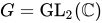
An application of the second isomorphism theorem identifies projective linear groups: for example, the group on the complex projective line starts with setting , the group of invertible 2 × 2 complexmatrices, , the subgroup of determinant 1 matrices, and the normal subgroup of scalar matrices , we have , where is the identity matrix, and . Then the second isomorphism theorem states that:






Theorem C (groups)
Let be a group, and a normal subgroup of . Then
- If is a subgroup of such that , then has a subgroup isomorphic to .
- Every subgroup of is of the form for some subgroup of such that .
- If is a normal subgroup of such that , then has a normal subgroup isomorphic to .
- Every normal subgroup of is of the form for some normal subgroup of such that .
- If is a normal subgroup of such that , then the quotient group is isomorphic to .




The last statement is sometimes referred to as the third isomorphism theorem. The first four statements are often subsumed under Theorem D below, and referred to as the lattice theorem, correspondence theorem, or fourth isomorphism theorem.
Theorem D (groups)
Let be a group, and a normal subgroup of . The canonical projection homomorphism defines a bijective correspondence between the set of subgroups of containing and the set of (all) subgroups of . Under this correspondence normal subgroups correspond to normal subgroups.

This theorem is sometimes called the correspondence theorem, the lattice theorem, and the fourth isomorphism theorem.
The Zassenhaus lemma (also known as the butterfly lemma) is sometimes called the fourth isomorphism theorem.[6]
Discussion
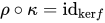
The first isomorphism theorem can be expressed in category theoretical language by saying that the category of groups is (normal epi, mono)-factorizable; in other words, the normal epimorphisms and the monomorphisms form a factorization system for the category. This is captured in the commutative diagram in the margin, which shows the objects and morphisms whose existence can be deduced from the morphism . The diagram shows that every morphism in the category of groups has a kernel in the category theoretical sense; the arbitrary morphism f factors into , where ι is a monomorphism and π is an epimorphism (in a conormal category, all epimorphisms are normal). This is represented in the diagram by an object and a monomorphism :\ker f\rightarrow G} (kernels are always monomorphisms), which complete the short exact sequence running from the lower left to the upper right of the diagram. The use of the exact sequence convention saves us from having to draw the zero morphisms from to and .



If the sequence is right split (i.e., there is a morphism σ that maps to a π-preimage of itself), then G is the semidirect product of the normal subgroup and the subgroup . If it is left split (i.e., there exists some such that ), then it must also be right split, and is a direct product decomposition of G. In general, the existence of a right split does not imply the existence of a left split; but in an abelian category (such as that of abelian groups), left splits and right splits are equivalent by the splitting lemma, and a right split is sufficient to produce a direct sum decomposition . In an abelian category, all monomorphisms are also normal, and the diagram may be extended by a second short exact sequence .






In the second isomorphism theorem, the product SN is the join of S and N in the lattice of subgroups of G, while the intersection S ∩ N is the meet.
The third isomorphism theorem is generalized by the nine lemma to abelian categories and more general maps between objects.
Note on numbers and names
Below we present four theorems, labelled A, B, C and D. They are often numbered as "First isomorphism theorem", "Second..." and so on; however, there is no universal agreement on the numbering. Here we give some examples of the group isomorphism theorems in the literature. Notice that these theorems have analogs for rings and modules.
Es menos común incluir el Teorema D, generalmente conocido como teorema de retículo o teorema de correspondencia , como uno de los teoremas de isomorfismo, pero cuando se incluye, es el último.
Anillos
Los enunciados de los teoremas para anillos son similares, con la noción de subgrupo normal reemplazada por la de ideal de dos lados . Todos los enunciados son válidos si se supone que los anillos involucrados tienen una identidad multiplicativa, con homomorfismos que preservan dicha identidad, o si no se supone que los anillos tengan una identidad.
Teorema A (anillos)
Dejarysean anillos, y dejenSea un homomorfismo de anillos . Entonces:


- El núcleo dees un ideal de dos caras,
- La imagen dees un subanillo de, y
- La imagen dees isomorfo al anillo cociente.


En particular, sies sobreyectiva entonceses isomorfo a. [ 17 ]
Teorema B (anillos)
Dejarser un anillo. Dejaser un subanillo dey dejarser un ideal de dos caras. Entonces:
- La sumaes un subanillo de,
- La intersecciónes un ideal de dos caras, y
- Los anillos de cocienteyson isomorfos.


Teorema C (anillos)
Dejarser un anillo, yun ideal de dos caras. Entonces
- Sies un subanillo dede tal manera que, entonceses un subanillo de.
- Cada subanillo dees de la formapara algún anillo subadede tal manera que.
- Sies un ideal de dos carasde tal manera que, entonceses un ideal de dos caras.
- Todo ideal de izquierda, derecha o de dos lados dees de la formapara algún ideal de izquierda, derecha o de dos ladosdede tal manera que.
- Sies un ideal de dos carasde tal manera que, entonces el anillo cocientees isomorfo a.



Teorema D (anillos)
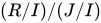
Dejarser un ideal de dos carasLa correspondenciaes una biyección que preserva la inclusión entre el conjunto de subanillosdeque contieneny el conjunto de subanillos de . [ 18 ]

Módulos
Los enunciados de los teoremas de isomorfismo para módulos son particularmente simples, ya que es posible formar un módulo cociente a partir de cualquier submódulo . Los teoremas de isomorfismo para espacios vectoriales (módulos sobre un cuerpo ) y grupos abelianos (módulos sobre) son casos especiales de estos. Para espacios vectoriales de dimensión finita , todos estos teoremas se derivan del teorema de rango-nulidad .

En lo sucesivo, "módulo" significará "módulo izquierdo R " o "módulo derecho R " para algún anillo fijo R.
Teorema A (módulos)
Dejarysean módulos, y deje queSea un homomorfismo de módulos . Entonces:


- El núcleo dees un submódulo de,
- La imagen dees un submódulo de, y
- La imagen dees isomorfo al módulo cociente.

En particular, sies sobreyectiva entonceses isomorfo a.
Teorema B (módulos)
Dejarser un módulo, y dejaryser submódulos de. Entonces:

- La sumaes un submódulo de,
- La intersecciónes un submódulo de, y
- Los módulos de cocienteyson isomorfos.


Teorema C (módulos)
Sea M un módulo, T un submódulo de M.
- Sies un submódulo dede tal manera que, entonceses un submódulo de.
- Cada submódulo dees de la formapara algún submódulodede tal manera que.
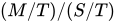
- Sies un submódulo dede tal manera que, entonces el módulo cocientees isomorfo a.



Teorema D (módulos)
Dejarser un módulo,un submódulo de. Existe una biyección entre los submódulos deque contieneny los submódulos deLa correspondencia se da pora pesar de. Esta correspondencia conmuta con los procesos de tomar sumas e intersecciones (es decir, es un isomorfismo reticular entre el retículo de submódulos dey la red de submódulos deque contienen). [ 19 ]


Álgebra universal
Para generalizar esto al álgebra universal , es necesario reemplazar los subgrupos normales por relaciones de congruencia .
Una congruencia en un álgebraes una relación de equivalenciaque forma una subálgebra deconsiderada como un álgebra con operaciones componente a componente. Se puede hacer el conjunto de clases de equivalenciaen un álgebra del mismo tipo definiendo las operaciones a través de representantes; esto estará bien definido ya quees una subálgebra deLa estructura resultante es el álgebra cociente .


Teorema A (álgebra universal)
Dejarsea un homomorfismo de álgebra . Entonces la imagen dees una subálgebra de, la relación dada por(es decir, el núcleo de) es una congruencia eny las álgebrasyson isomorfos . (Nótese que en el caso de un grupo,si y solo si(Así pues, se recupera la noción de núcleo utilizada en la teoría de grupos en este caso).





Teorema B (álgebra universal)
Dado un álgebra, una subálgebradey una congruenciaen, dejarser el rastro deenyla colección de clases de equivalencia que se intersecan. Entonces

![{\displaystyle [B]^{\Phi }=\{K\in A/\Phi :K\cap B\neq \emptyset \}}](https://wikimedia.org/api/rest_v1/media/math/render/svg/44f08f1ef6d27988420cc5c16da7ebc2a675588e)
- es una congruencia en,
- es una subálgebra de, y
- el álgebraes isomorfo al álgebra.

![{\displaystyle \ [B]^{\Phi }}](https://wikimedia.org/api/rest_v1/media/math/render/svg/ddb2a7dd78c7603daf4ede154c4e2dc0ba1efcb7)
![{\displaystyle [B]^{\Phi }}](https://wikimedia.org/api/rest_v1/media/math/render/svg/3388e546ae462dc19269cbc37063c029e9a26e5e)

Teorema C (álgebra universal)
Dejarser un álgebra ydos relaciones de congruencia ende tal manera que. Entonceses una congruencia en, yes isomorfo a


![{\displaystyle \Phi /\Psi =\{([a']_{\Psi },[a'']_{\Psi }):(a',a'')\in \Phi \}=[\ ]_{\Psi }\circ \Phi \circ [\ ]_{\Psi }^{-1}}](https://wikimedia.org/api/rest_v1/media/math/render/svg/c5cb4e3405a238a39279e28854eb9301cad0eb18)


Teorema D (álgebra universal)
Dejarsea un álgebra y denotemosel conjunto de todas las congruencias en. El conjunto es una red completa ordenada por inclusión. [ 20 ] Sies una congruencia y la denotamos porel conjunto de todas las congruencias que contienen(es decires un filtro principal en, además es una subred), entonces el mapa :\left[\Phi ,A\times A\right]\to \operatorname {Con} (A/\Phi ),\Psi \mapsto \Psi /\Phi } es un isomorfismo reticular. [ 21 ] [ 22 ]


![{\displaystyle \left[\Phi ,A\times A\right]\subseteq \operatorname {Con} A}](https://wikimedia.org/api/rest_v1/media/math/render/svg/38f665db70944a173b90a79aff8366f4a46afc19)
![{\displaystyle \left[\Phi ,A\times A\right]}](https://wikimedia.org/api/rest_v1/media/math/render/svg/0184e178fa4264c4799972d0fe2016675f4ddcdc)
![{\displaystyle \alpha :\left[\Phi ,A\times A\right]\to \operatorname {Con} (A/\Phi ),\Psi \mapsto \Psi /\Phi }](https://wikimedia.org/api/rest_v1/media/math/render/svg/f05ff7fcb60b62531e2733d6a9f1374d96c49c2e)
Notas
- ↑ Noether 1927 .
- ↑ McLarty 2006 .
- 1 2 Milne (2013), Cap. 1, sec. Teoremas sobre homomorfismos
- ↑ I. Martin Isaacs ( 1994). Álgebra: Un curso de posgrado . American Mathematical Soc. p. 33. ISBN 978-0-8218-4799-2.
- ↑ Paul Moritz Cohn (2000). Álgebra clásica . Wiley. pág . 245. ISBN 978-0-471-87731-8.
- ↑ Wilson, Robert A. (2009). Los grupos simples finitos . Textos de posgrado en matemáticas 251. Vol. 251. Springer-Verlag Londres. pág. 7. doi : 10.1007/978-1-84800-988-2 . ISBN 978-1-4471-2527-3.
- ↑ Jacobson (2009), sección 1.10
- ^ van der Waerden, Álgebra (1994).
- ↑ Durbin (2009), sec. 54
- ↑ [los nombres son] esencialmente los mismos que [van der Waerden 1994] [ 9 ]
- ↑ Knapp (2016), sección IV 2
- ↑ Grillet (2007), sec. I 5
- ↑ Rotman (2003), sec. 2.6
- ^ Fraleigh (2003), cap. 14, 34
- ↑ Dummit, David Steven (2004). Álgebra abstracta . Richard M. Foote (Tercera ed.). Hoboken, NJ: John Wiley and Sons, Inc. pp. 97–98 . ISBN 0-471-43334-9OCLC 52559229
- ↑ Scott (1964), secciones 2.2 y 2.3
- ↑ Moy, Samuel (2022). "Una introducción a la teoría de las extensiones de campo" (PDF) . Departamento de Matemáticas de la Universidad de Chicago . Recuperado el 20 de diciembre de 2022 .
- ↑ Dummit, David S.; Foote, Richard M. (2004). Álgebra abstracta . Hoboken, NJ: Wiley. pág. 246. ISBN 978-0-471-43334-7.
- ↑ Dummit y Foote (2004), pág. 349
- ↑ Burris y Sankappanavar (2012), pág. 37
- ↑ Burris y Sankappanavar (2012), pág. 49
- ↑ Sun, William. "¿Existe una forma general del teorema de correspondencia?" . Mathematics StackExchange . Consultado el 20 de julio de 2019 .
Referencias
- Noether, Emmy (1927), "Abstrakter Aufbau der Idealtheorie in algebraischen Zahl- und Funktionenkörpern", Mathematische Annalen , 96 : 26– 61
- McLarty, Colin (2006), "La topología 'set theoretic' de Emmy Noether: De Dedekind al auge de los functores", en Gray, Jeremy; Ferreirós, José (eds.), La arquitectura de las matemáticas modernas: Ensayos de historia y filosofía , Oxford University Press, pp. 211–235
- Jacobson, Nathan (2009), Álgebra básica , vol. 1 (2.ª ed.), Dover, ISBN 9780486471891
- Cohn, Paul M., Álgebra universal , Capítulo II.3, pág. 57
- Milne, James S. (2013), Teoría de grupos , 3.13
- van der Waerden, BI (1994), Álgebra , vol. 1 (9 ed.), Springer-Verlag
- Dummit, David S.; Foote, Richard M. (2004). Álgebra abstracta . Hoboken, NJ: Wiley. ISBN 978-0-471-43334-7.
- Burris, Stanley; Sankappanavar, HP (2012). Un curso de álgebra universal (PDF) . S. Burris y HP Sankappanavar. ISBN 978-0-9880552-0-9.
- Scott, WR (1964), Teoría de grupos , Prentice Hall
- Durbin, John R. (2009). Álgebra moderna: Una introducción (6.ª ed.). Wiley. ISBN 978-0-470-38443-5.
- Knapp, Anthony W. (2016), Álgebra básica (segunda edición digital)
- Grillet, Pierre Antoine (2007), Álgebra abstracta (2 ed.), Springer
- Rotman, Joseph J. (2003), Álgebra moderna avanzada (2.ª ed.), Prentice Hall, ISBN 0130878685
- Hungerford, Thomas W. (1980), Álgebra (Textos de posgrado en matemáticas, 73) , Springer, ISBN 0387905189
- van der Waerden, B. L. (1930). Moderne Algebra. Vol. 1. Berlin: J. Springer.
- Isomorphism theorems