 Hispanopedia Wiki
The Kapustinskii equation calculates the lattice energyUL for an ionic crystal, which is experimentally difficult to determine. It is named after Anatoli Fedorovich Kapustinskii who published the formula in 1956.[1]

The calculated lattice energy gives a good estimation for the Born–Landé equation; the real value differs in most cases by less than 5%.
Furthermore, one is able to determine the ionic radii (or more properly, the thermochemical radius) using the Kapustinskii equation when the lattice energy is known. This is useful for rather complex ions like sulfate (SO2−4) or phosphate (PO3−4).
Derivation from the Born–Landé equation
Kapustinskii originally proposed the following simpler form, which he faulted as "associated with antiquated concepts of the character of repulsion forces".[1][2]
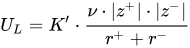
Here, K' = 1.079×10⁻⁴ J·m·mol−1. This form of the Kapustinskii equation may be derived as an approximation of the Born–Landé equation, below.[1][2]
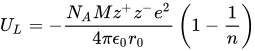
Kapustinskii sustituyó r₀ , la distancia medida entre iones, por la suma de los radios iónicos correspondientes. Además, se asumió que el exponente de Born, n , tenía un valor medio de 9. Finalmente, Kapustinskii observó que la constante de Madelung , M , era aproximadamente 0,88 veces el número de iones en la fórmula empírica. [ 2 ] La derivación de la forma posterior de la ecuación de Kapustinskii siguió una lógica similar, partiendo del tratamiento químico cuántico en el que el término final es 1 − d / r₀ , donde d se define como se indicó anteriormente. Sustituyendo r₀ como antes se obtiene la ecuación completa de Kapustinskii . [ 1 ]
Véase también
Referencias
- 1 2 3 4 Kapustinskii, AF (1956). "Energía reticular de cristales iónicos". Quarterly Reviews, Chemical Society . 10 (3). Royal Society of Chemistry : 283– 294. doi : 10.1039/QR9561000283 .
- 1 2 3 Johnson, David Arthur (2002). Metales y cambio químico . Vol. 1. Royal Society of Chemistry . págs. 135–136 . ISBN 0854046658.
Literatura
- Kapustinsky, A. (1 de enero de 1933). "Allgemeine Formel für die Gitterenergie von Kristallen beliebiger Struktur". Zeitschrift für Physikalische Chemie (en alemán). 22B (1). Walter de Gruyter GmbH: 257. doi : 10.1515/zpch-1933-2220 . ISSN 2196-7156 . S2CID 202045251 .
- AF Kapustinskii; Zhur. Fiz. Jim. Nro. 5, 1943 , págs. 59 y sigs.
- Enlace químico
- Cristalografía
- Inventos soviéticos