 Hispanopedia Wiki
In thermodynamic modelling, the Klincewicz method is a predictive method based both on group contributions and on a correlation with some basic molecular properties. The method estimates the critical temperature, the critical pressure, and the critical volume of pure components. It is named after Karen Klincewicz Gleason who developed it in 1984 in collaboration with Robert C. Reid.[1]
Model description
As a group contribution method the Klincewicz method correlates some structural information of a chemical molecule with the critical data. The used structural information are small functional groups which are assumed to have no interactions. This assumption makes it possible to calculate the thermodynamic properties directly from the sums of the group contributions. The correlation method does not even use these functional groups, only the molecular weight and the number of atoms are used as molecular descriptors.
The prediction of the critical temperature relies on the knowledge of the normal boiling point because the method only predicts the relation of the normal boiling point and the critical temperature and not directly the critical temperature. The critical volume and pressure however are directly predicted.
Model quality
The quality of the Klincewicz method is not superior to older methods, especially the method of Ambrose[2] gives somewhat better results as stated by the original authors and by Reid et al.[3] The advantage of the Klincewicz method is that it is less complex.
The quality and complexity of the Klincewicz method is comparable to the Lydersen method[4] from 1955 which has been used widely in chemical engineering.
The aspect where the Klincewicz method is unique and useful[3] are the alternative equations where only very basic molecular data like the molecular weight and the atom count are used.
Deviation diagrams
The diagrams show estimated critical data of hydrocarbons together with experimental data.[5] An estimation would be perfect if all data points would lie directly on the diagonal line. Only the simple correlation of the Klincewicz method with the molecular weight and the atom count have been used in this example.
 Critical temperatures
 Critical pressures
 Critical volumes
Equations
Klincewicz publicó dos conjuntos de ecuaciones. [ 6 ] El primero utiliza contribuciones de 35 grupos diferentes. Estas ecuaciones basadas en la contribución de grupos dan resultados algo mejores que las ecuaciones muy simples basadas solo en correlaciones con el peso molecular y el número de átomos.
Ecuaciones basadas en la contribución de grupos


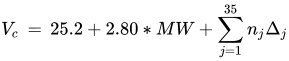
Ecuaciones basadas únicamente en la correlación con el peso molecular y el número de átomos.



con
Contribuciones del grupo
El grupo XCX se utiliza para tener en cuenta la interacción por pares de halógenos unidos a un único átomo de carbono. Su contribución debe sumarse una vez para dos halógenos, pero tres veces para tres halógenos (interacciones entre los halógenos 1 y 2, 1 y 3, y 2 y 3).
Cálculos de ejemplo
Ejemplo de cálculo para la acetona con contribuciones de grupos
*Punto de ebullición normal utilizado T b = 329,250 K
Ejemplo de cálculo para la acetona con solo peso molecular y número de átomos
Peso molecular utilizado: 58,080 g / mol
Cantidad de átomos utilizados: 10
A modo de comparación, los valores experimentales para Tc, Pc y Vc son 508,1 K, 47,0 bar y 209 cm³ / mol, respectivamente. [ 3 ]
Referencias
- ↑ Klincewicz, KM ; Reid, RC (1984). "Estimación de propiedades críticas con métodos de contribución de grupos". AIChE Journal . 30 (1). Wiley: 137–142 . doi : 10.1002/aic.690300119 . ISSN 0001-1541 .
- ↑ Ambrose D., "Correlación y estimación de propiedades críticas vapor-líquido. I. Temperaturas críticas de compuestos orgánicos", Nat. Phys. Lab. Rep. Chem. , Rep. No. NPL Rep. Chem. 92, 1-35, 1978
- 1 2 3 Reid RC, Prausnitz JM, Poling BE, "Las propiedades de los gases y líquidos", Monografía, McGraw-Hill, 4.ª ed., 1-742, 1987
- ↑ Lydersen AL, "Estimación de propiedades críticas de compuestos orgánicos", Facultad de Ingeniería de la Universidad de Wisconsin, Informe de la Estación Experimental de Ingeniería n.° 3, Madison, Wisconsin, 1955
- ↑ Banco de datos de Dortmund
- ↑ Klincewicz, KM, "Predicción de temperaturas, presiones y volúmenes críticos de compuestos orgánicos a partir de la estructura molecular", SMThesis, Instituto Tecnológico de Massachusetts, Cambridge, Massachusetts, 1982
- Modelos termodinámicos