Hispanopedia Wiki
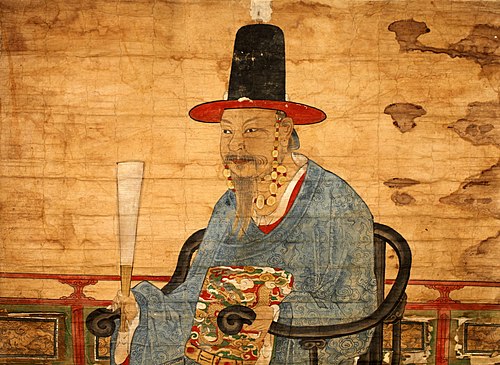
Kwak Chaeu (Korean: 곽재우;Hanja: 郭再祐; 1552–1617[a]) was a Korean military general from Uiryeong. He was called the "Red Robe General" (천강홍의장군;天降紅衣將軍) after his habit of wearing a coat made of red silk.[1] In 1592, nine days into the Imjin War, he formed a righteous army to fight against the Japanese army. He originally did not have an official position, but King Seonjo of Joseon granted him a government position.
Background
Kwak was a yangban. He had passed the examination to enter the civil service when he was thirty-four, but was denied a post as his essay portion was harshly critical of the government.[2] After that, he decided to give up taking the test and stay in hiding for life.[3]
Raising an army
In 1592, Japanese regent Toyotomi Hideyoshi invaded Korea. Kwak began raising a militia to defend the free parts of Kyongsang province from the invaders.[2]
Kwak Chaeu disrupted Japanese supply lines around the Nakdong River in many guerrilla actions. Kwak also had the distinction of winning Korea's first land victory of the war in the Battle of Uiryeong. In part of a two-pronged offensive into Jeolla, Ankokuji Ekei led 6th division men from the south. Ankokuji needed to cross the Nam River to reach Uiryeong, an objective. He had his men find the shallowest parts of the river and mark them with stakes. While Ankokuji's army slept, Kwak's men moved the stakes to deeper sections of the river. When the crossing began, the Japanese soldiers foundered in the deep water, and Kwak's army attacked them. In multiple attempts to cross the river, Ankokuji suffered many losses, and was forced to abandon his attack on Uiryeong. The battle gave the Korean government respect for Kwak's abilities, and he was placed in command of the Korean forces in and around Uiryeong and the nearby Samga.
Red robe
While Chaeu's robe is often simply described as red, Samuel Hawley further elaborates that the robe was "dyed in the first menstrual blood of young girls, which he believed suffused the garment with yin energy that would repel the yang energy of Japanese bullets."[4] Chaeu ultimately survived the war and died of old age at an unknown later date.
Legacy
Hay una estatua de Kwak Chaeu en el Parque Mangu en Daegu . [ 5 ] Además, en Uiryeoung, el santuario Chungiksa consagra a Kwak Chaeu y diecisiete de sus subordinados.
Familia
- Padre
- Kwak Wŏl ( 곽월 ;郭越; 1518-6 de agosto de 1586)
- Madre
- Biológico - Lady Kang del clan Jinju Kang ( 진주 강씨 )
- Paso - Lady Hŏ del clan Gimhae Heo ( 김해 허씨 ; ? –1597)
- Hermanos
- Hermana mayor - Lady Kwak del clan Hyeonpung Gwak ( 현풍 곽씨 )
- Hermano mayor - Kwak Chaehŭi ( 곽재희 ;郭再禧)
- Hermano mayor - Kwak Chaerok ( 곽재록 ;郭再錄)
- Medio hermano menor - Kwak Chaeji ( 곽재지 ;郭再祉)
- Medio hermano menor - Kwak Chaegi ( 곽재기 ;郭再祺; 1573–1649)
- Hermanastra menor - Lady Kwak del clan Hyeonpung Gwak ( 현풍 곽씨 )
- Cónyuge
- Lady Kim del clan Sangju Kim ( 상주 김씨 ;尙州 金氏)
- Asunto
- Hijo - Kwak Yŏng ( 곽영 ;郭濚)
- Hijo - Kwak Hwal ( 곽활 ;郭活)
- Hija - Dama Kwak del clan Hyeonpung Gwak ( 현풍 곽씨 )
Véase también
Notas
- ↑ En el calendario coreano ( lunisolar ), Kwak nació el 28 de agosto de 1552 y murió el 10 de abril de 1617.
Referencias
- ^ "곽재우 장군 의병 깃발을 높이 들다" . OhmyNews (en coreano). 2005-08-10 . Consultado el 17 de marzo de 2021 .
- 1 2 Hawley, Samuel Jay (2005). La guerra de Imjin : la invasión japonesa de Corea en el siglo XVI y el intento de conquistar China (1.ª ed.). Seúl: Royal Asiatic Society Korea Branch . ISBN 8995442425.
- ↑ Instituto de Estudios Coreanos. "곽재우" . terms.naver.com (en coreano) . Consultado el 6 de junio de 2021 .
- ↑ Hawley, Samuel Jay (2005). La guerra de Imjin : la invasión japonesa de Corea en el siglo XVI y el intento de conquistar China (1.ª ed.). Seúl: Royal Asiatic Society Korea Branch . p. 42. ISBN 8995442425.
- ↑ "Mangu Park" (PDF) . Tu guía para una vida universitaria exitosa en la Universidad de Yeungnam . Archivado del original (PDF) el 8 de abril de 2006. Consultado el 9 de agosto de 2006 .
- generales de Joseon
- Gente de la Guerra de Imjin
- 1552 nacimientos
- 1617 muertes
- Pueblo coreano del siglo XVI
- clan Hyeonpung Gwak