Articulo de referencia

List of indefinite sums

This is a list of indefinite sums (also known as antidifferences) of various functions. An indefinite sum ∑ x f ( x ) {\textstyle \sum _{x}f(x)} is the inverse of the forward di...

This is a list of indefinite sums (also known as antidifferences) of various functions. An indefinite sumxf(x){\textstyle \sum _{x}f(x)} is the inverse of the forward difference operator Δ{\displaystyle \Delta }, defined as Δf(x)=f(x+1)f(x){\displaystyle \Delta f(x)=f(x+1)-f(x)}. It satisfies the relation

Δxf(x)=f(x).{\displaystyle \Delta \sum _{x}f(x)=f(x).}

The operator is defined only up to an additive periodic function with period 1.

Antidifferences of rational functions

For positive integer exponents, Faulhaber's formula can be used. Note that x{\displaystyle x} in the result of Faulhaber's formula must be replaced with x1{\displaystyle x-1} due to the offset, as Faulhaber's formula finds 1{\displaystyle \nabla ^{-1}} rather than Δ1{\displaystyle \Delta ^{-1}}.

For negative integer exponents, the indefinite sum is closely related to the polygamma function:[1][2]

x1xa=(1)a1ψ(a1)(x)(a1)!+C,aN{\displaystyle \sum _{x}{\frac {1}{x^{a}}}={\frac {(-1)^{a-1}\psi ^{(a-1)}(x)}{(a-1)!}}+C,\,a\in \mathbb {N} }

For fractions not listed in this section, one may use the polygamma function with partial fraction decomposition. More generally,[1]

xxa={Ba+1(x)a+1+C,if a1ψ(x)+C,if a=1={ζ(a,x)+C,if a1ψ(x)+C,if a=1{\displaystyle \sum _{x}x^{a}={\begin{cases}{\frac {B_{a+1}(x)}{a+1}}+C,&{\text{si }}a\neq -1\\\psi (x)+C,&{\text{si }}a=-1\end{cases}}={\begin{cases}-\zeta (-a,x)+C,&{\text{si }}a\neq -1\\\psi (x)+C,&{\text{si }}a=-1\end{cases}}}

where Ba(x){\displaystyle B_{a}(x)} are the Bernoulli polynomials, ζ(s,a){\displaystyle \zeta (s,a)} is the Hurwitz zeta function, and ψ(z){\displaystyle \psi (z)} is the digamma function. This is related to the generalized harmonic numbers.

As the generalized harmonic numbers use reciprocal powers, a{\displaystyle a} must be substituted for a{\displaystyle -a}, and the most common form uses the inverse of the backward difference offset:[1]

1xa=Hx(a)=ζ(a)ζ(a,x+1).{\displaystyle \nabla ^{-1}x^{a}={H_{x}^{(-a)}}=\zeta (-a)-\zeta (-a,x+1).}

Here, ζ(a){\displaystyle \zeta (-a)} is the constant C{\displaystyle C}.

The Bernoulli polynomials are also related via a partial derivative with respect to x{\displaystyle x}:

x(xxa)=Ba(x)=aζ(1a,x).{\displaystyle {\frac {\partial }{\partial x}}\left(\sum _{x}x^{a}\right)=B_{a}(x)=-a\zeta (1-a,x).}

This relationship can be expressed via the inverse backward difference operator as:

x(1xa)|x=0=aζ(1a,x+1)|x=0=aζ(1a)=Ba.{\displaystyle {\frac {\partial }{\partial x}}\left(\nabla ^{-1}x^{a}\right){\bigg |}_{x=0}=-a\zeta (1-a,x+1){\bigg |}_{x=0}=-a\zeta (1-a)=B_{a}.}

Further generalization comes from use of the Lerch transcendent:[3]

xzx(x+a)s=zxΦ(z,s,x+a)+C,{\displaystyle \sum _{x}{\frac {z^{x}}{(x+a)^{s}}}=-z^{x}\,\Phi (z,s,x+a)+C,}

which generalizes the generalized harmonic numbers as zΦ(z,s,a+1)zx+1Φ(z,s,x+1+a){\displaystyle z\Phi \left(z,s,a+1\right)-z^{x+1}\Phi \left(z,s,x+1+a\right)} when taking 1{\displaystyle \nabla ^{-1}}.

xBa(x)=(x1)Ba(x)aa+1Ba+1(x)+C{\displaystyle \sum _{x}B_{a}(x)=(x-1)B_{a}(x)-{\frac {a}{a+1}}B_{a+1}(x)+C}

Antidifferences of exponential functions

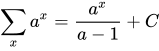
xax=axa1+C{\displaystyle \sum _{x}a^{x}={\frac {a^{x}}{a-1}}+C}[4]

Antidifferences of logarithmic functions

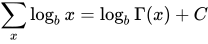
xlogbx=logbΓ(x)+C{\displaystyle \sum _{x}\log _{b}x=\log _{b}\Gamma (x)+C}[4]
xlogbax=logb(ax1Γ(x))+C{\displaystyle \sum _{x}\log _{b}ax=\log _{b}(a^{x-1}\Gamma (x))+C}[4]

Antidifferences of hyperbolic functions

xsinhax=12csch(a2)cosh(a2ax)+C{\displaystyle \sum _{x}\sinh ax={\frac {1}{2}}\operatorname {csch} \left({\frac {a}{2}}\right)\cosh \left({\frac {a}{2}}-ax\right)+C}
xcoshax=12csch(a2)sinh(axa2)+C{\displaystyle \sum _{x}\cosh ax={\frac {1}{2}}\operatorname {csch} \left({\frac {a}{2}}\right)\sinh \left(ax-{\frac {a}{2}}\right)+C}
xtanhax=1aψea(xiπ2a)+1aψea(x+iπ2a)x+C{\displaystyle \sum _{x}\tanh ax={\frac {1}{a}}\psi _{e^{a}}\left(x-{\frac {i\pi }{2a}}\right)+{\frac {1}{a}}\psi _{e^{a}}\left(x+{\frac {i\pi }{2a}}\right)-x+C}

where ψq(x){\displaystyle \psi _{q}(x)} is the q-digamma function.

Antidifferences of trigonometric functions

xsinax=12csc(a2)cos(a2ax)+C,a2nπ{\displaystyle \sum _{x}\sin ax=-{\frac {1}{2}}\csc \left({\frac {a}{2}}\right)\cos \left({\frac {a}{2}}-ax\right)+C\,,\,\,a\neq 2n\pi }[4]
xcosax=12csc(a2)sin(axa2)+C,a2nπ{\displaystyle \sum _{x}\cos ax={\frac {1}{2}}\csc \left({\frac {a}{2}}\right)\sin \left(ax-{\frac {a}{2}}\right)+C\,,\,\,a\neq 2n\pi }[4]
xsin2ax=x2+14csc(a)sin(a2ax)+C,anπ{\displaystyle \sum _{x}\sin ^{2}ax={\frac {x}{2}}+{\frac {1}{4}}\csc(a)\sin(a-2ax)+C\,\,,\,\,a\neq n\pi }
xcos2ax=x214csc(a)sin(a2ax)+C,anπ{\displaystyle \sum _{x}\cos ^{2}ax={\frac {x}{2}}-{\frac {1}{4}}\csc(a)\sin(a-2ax)+C\,\,,\,\,a\neq n\pi }
xtanax=ix1aψe2ia(xπ2a)+C,anπ2{\displaystyle \sum _{x}\tan ax=ix-{\frac {1}{a}}\psi _{e^{2ia}}\left(x-{\frac {\pi }{2a}}\right)+C\,,\,\,a\neq {\frac {n\pi }{2}}}

where ψq(x){\displaystyle \psi _{q}(x)} is the q-digamma function.

xtanx=ixψe2i(x+π2)+C=k=1(ψ(kππ2+1x)+ψ(kππ2+x)ψ(kππ2+1)ψ(kππ2))+C{\displaystyle {\begin{aligned}\sum _{x}\tan x&=ix-\psi _{e^{2i}}\left(x+{\frac {\pi }{2}}\right)+C\\&=-\sum _{k=1}^{\infty }\left(\psi \left(k\pi -{\frac {\pi }{2}}+1-x\right)+\psi \left(k\pi -{\frac {\pi }{2}}+x\right)\right.\\&\quad \left.-\psi \left(k\pi -{\frac {\pi }{2}}+1\right)-\psi \left(k\pi -{\frac {\pi }{2}}\right)\right)+C\end{aligned}}}

xcotax=ixiψe2ia(x)a+C,anπ2{\displaystyle \sum _{x}\cot ax=-ix-{\frac {i\psi _{e^{2ia}}(x)}{a}}+C\,,\,\,a\neq {\frac {n\pi }{2}}}

The antidifference of the normalized sinc function can be obtained by applying the Abel–Plana formula presented in Candelpergher[1] with the shift xx1{\displaystyle x\mapsto x-1}, the condition F(0)=0{\displaystyle F(0)=0}, and recurrence of F(x+1)F(x)=f(x){\displaystyle F(x+1)-F(x)=f(x)}. Using the reflection formula for the digamma function, this simplifies to: xsincx=sinc(x1)(12+(x1)×(ln(2)+ψ(x12)+ψ(1x2)2ψ(x1)+ψ(1x)2))+12+C{\displaystyle {\begin{aligned}\sum _{x}\operatorname {sinc} x&=\operatorname {sinc} (x-1)\left({\frac {1}{2}}+(x-1)\right.\\&\quad \left.\times \left(\ln(2)+{\frac {\psi ({\frac {x-1}{2}})+\psi ({\frac {1-x}{2}})}{2}}\right.\right.\\&\quad \quad \left.\left.-{\frac {\psi (x-1)+\psi (1-x)}{2}}\right)\right)+{\frac {1}{2}}+C\end{aligned}}}

Period rules

If T{\displaystyle T} is a period of function f(x){\displaystyle f(x)} then

xf(Tx)=xf(Tx)+C.{\displaystyle \sum _{x}f(Tx)=xf(Tx)+C.}

If T{\displaystyle T} is an antiperiod of function f(x){\displaystyle f(x)}, that is f(x+T)=f(x){\displaystyle f(x+T)=-f(x)} then

xf(Tx)=12f(Tx)+C.{\displaystyle \sum _{x}f(Tx)=-{\frac {1}{2}}f(Tx)+C.}

Antidifferences of special functions

xψ(x)=(x1)ψ(x)x+C{\displaystyle \sum _{x}\psi (x)=(x-1)\psi (x)-x+C}
xΓ(x)=(1)x+1Γ(x)Γ(1x,1)e+C{\displaystyle \sum _{x}\Gamma (x)=(-1)^{x+1}\Gamma (x){\frac {\Gamma (1-x,-1)}{e}}+C}

where Γ(s,x){\displaystyle \Gamma (s,x)} is the incomplete gamma function.

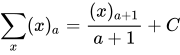
x(x)a=(x)a+1a+1+C{\displaystyle \sum _{x}(x)_{a}={\frac {(x)_{a+1}}{a+1}}+C}[4]

where (x)a{\displaystyle (x)_{a}} is the falling factorial.

xsexpa(x)=lna(sexpa(x))(lna)x+C{\displaystyle \sum _{x}\operatorname {sexp} _{a}(x)=\ln _{a}{\frac {(\operatorname {sexp} _{a}(x))'}{(\ln a)^{x}}}+C}

(véase función superexponencial )

Referencias

  1. 1 2 3 4 Candelpergher, Bernard (2017). "Ramanujan Summation of Divergent Series" (PDF) . HAL Archives Ouvertes . págs. 19–23 . 
  2. Abramowitz, Milton; Stegun, Irene A. (2013). Manual de funciones matemáticas: con fórmulas, gráficos y tablas matemáticas (9.ª ed. impresa por Dover). Nueva York, NY: Dover Publ. pág. 260. ISBN   978-0486612720Consultado el 18 de junio de 2026 .
  3. Olver, Frank WJ "§25.14 Lerch's Transcendent" . DLMF . Consultado el 18 de junio de 2026 .
  4. 1 2 3 4 5 6 Jordan, Charles (1960). Cálculo de diferencias finitas (Segunda edición). Nueva York, NY: Chelsea Publishing Company. págs. 104–105 .