 Hispanopedia Wiki


El maratón (del griego Μαραθώνιος ) es una carrera a pie de larga distancia con una distancia de 42,195 km ( c. 26 mi 385 yd), [1] que normalmente se corre como una carrera en ruta , pero la distancia se puede cubrir en rutas de senderos. El maratón se puede completar corriendo o con una estrategia de correr/caminar. También hay divisiones en silla de ruedas . Cada año se celebran más de 800 maratones en todo el mundo, y la gran mayoría de los competidores son atletas recreativos, ya que los maratones más grandes pueden tener decenas de miles de participantes. [2]
El maratón, creación del filólogo francés Michel Bréal , fue uno de los eventos olímpicos modernos originales en 1896. La distancia no se estandarizó hasta 1921. La distancia también está incluida en los Campeonatos Mundiales de Atletismo , que comenzaron en 1983. Es la única carrera en ruta incluida en ambas competiciones del campeonato (las carreras a pie en ruta también se disputan en ambos).
Historia
Origen
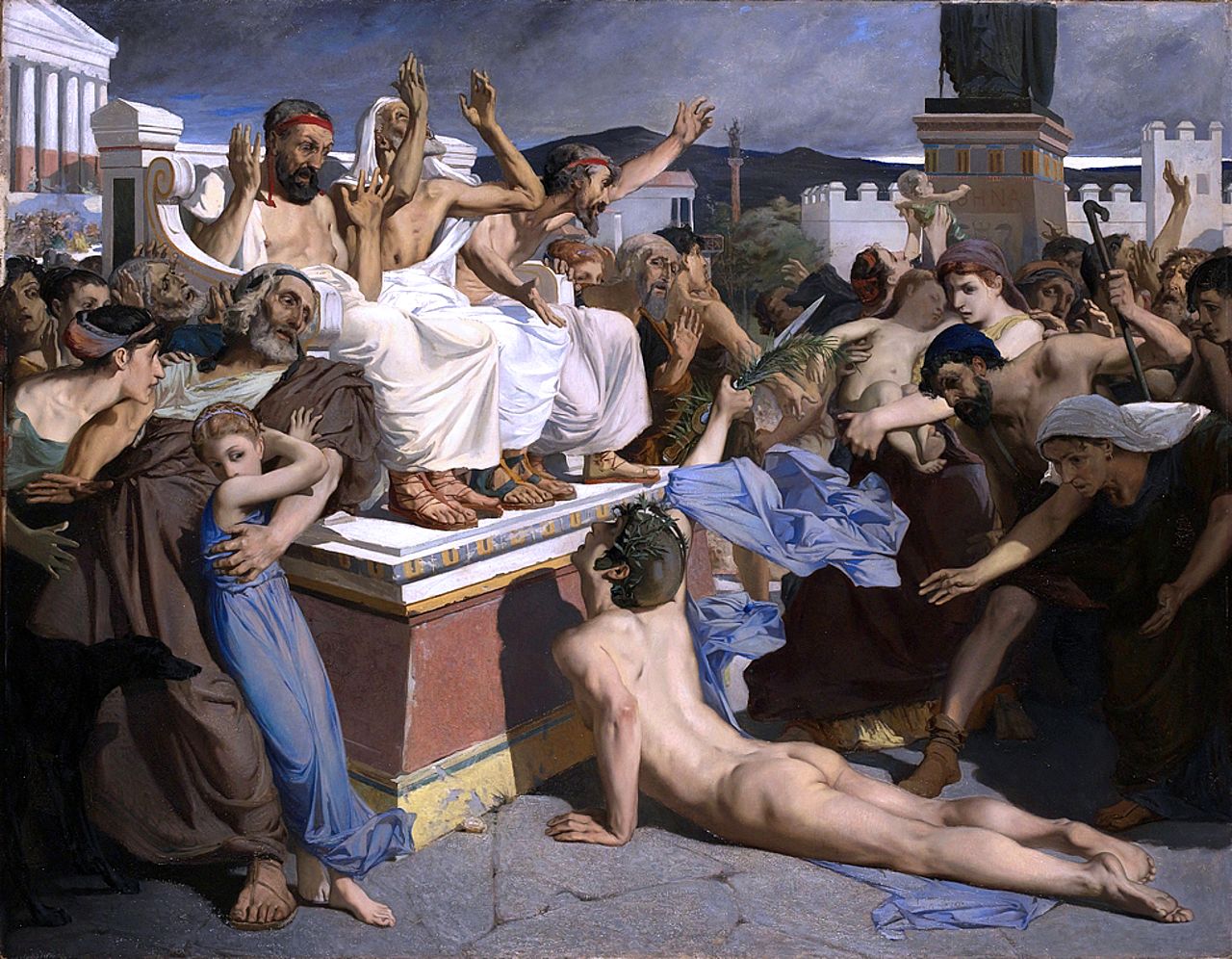
El nombre de Maratón proviene de la leyenda de Filípides , el mensajero griego. La leyenda afirma que, mientras participaba en la batalla de Maratón , que tuvo lugar en agosto o septiembre de 490 a. C., [3] fue testigo de cómo un barco persa cambiaba su rumbo hacia Atenas cuando la batalla estaba cerca de un final victorioso para el ejército griego. Interpretó esto como un intento de los persas derrotados de entrar en la ciudad para reclamar una falsa victoria o simplemente una incursión, [4] reclamando así su autoridad sobre las tierras griegas. Se dijo que corrió toda la distancia hasta Atenas sin detenerse, descartando sus armas e incluso su ropa para perder tanto peso como fuera posible, e irrumpió en la asamblea , exclamando "¡hemos ganado!", antes de desplomarse y morir. [5]
El relato de la carrera desde Maratón hasta Atenas apareció por primera vez en Sobre la gloria de Atenas de Plutarco en el siglo I d. C., que citaba la obra perdida de Heráclides Póntico y daba como nombre del corredor Tersipo de Erquio o Eucles. [6] Este fue el relato adoptado por Benjamin Haydon para su pintura Eucles anunciando la victoria de Maratón, publicado como grabado en 1836 con una ilustración poética de Letitia Elizabeth Landon . [7] El satírico Luciano de Samosata dio uno de los primeros relatos similares a la versión moderna de la historia, pero su veracidad histórica es discutida en base a su escritura irónica y al corredor al que se hace referencia como Philippides y no Pheidippides. [8] [9]
Existe un debate sobre la exactitud histórica de esta leyenda. [10] [11] El historiador griego Heródoto , la principal fuente de las guerras greco-persas , mencionó a Filípides como el mensajero que corrió de Atenas a Esparta pidiendo ayuda, y luego corrió de regreso, una distancia de más de 240 kilómetros (150 millas) en cada sentido. [12] En algunos manuscritos de Heródoto, el nombre del corredor entre Atenas y Esparta se da como Filípides. Heródoto no menciona a un mensajero enviado desde Maratón a Atenas y relata que la parte principal del ejército ateniense, después de haber luchado y ganado la agotadora batalla y temiendo un ataque naval de la flota persa contra una Atenas indefensa, marchó rápidamente de regreso de la batalla a Atenas, llegando el mismo día. [13]
En 1879, Robert Browning escribió el poema Filípides . El poema de Browning, su relato compuesto, pasó a formar parte de la cultura popular de finales del siglo XIX y fue aceptado como una leyenda histórica. [14]
El monte Pentélico se encuentra entre Maratón y Atenas, lo que significa que Filípides habría tenido que correr alrededor de la montaña, ya sea hacia el norte o hacia el sur. La última y más obvia ruta es la que sigue la moderna autopista Maratón-Atenas ( EO83 – EO54 ), que sigue el trazado del terreno hacia el sur desde la bahía de Maratón y a lo largo de la costa, luego toma un ascenso suave pero prolongado hacia el oeste hacia el acceso oriental a Atenas, entre las estribaciones de los montes Himeto y Penteli , y luego desciende suavemente hasta Atenas propiamente dicha. Tal como existía cuando se restablecieron los Juegos Olímpicos en 1896, esta ruta tenía aproximadamente 40 kilómetros (25 millas) de largo. Era la distancia aproximada utilizada originalmente para las carreras de maratón. Sin embargo, ha habido sugerencias de que Filípides podría haber seguido otra ruta: una subida hacia el oeste a lo largo de las laderas este y norte del monte Penteli hasta el paso de Dionisos , y luego un camino recto cuesta abajo hacia el sur hasta Atenas. Esta ruta es un poco más corta, 35 kilómetros (22 millas), pero incluye una subida muy pronunciada durante los primeros 5 kilómetros (3,1 millas).
Maratón olímpico moderno
Cuando comenzaron los Juegos Olímpicos modernos en 1896 , los iniciadores y organizadores buscaban un gran evento de divulgación, que recordara la gloria de la antigua Grecia . La idea de una carrera de maratón surgió de Michel Bréal , quien quería que el evento figurara en los primeros Juegos Olímpicos modernos en 1896 en Atenas. Esta idea fue fuertemente apoyada por Pierre de Coubertin , el fundador de los Juegos Olímpicos modernos, así como por los griegos . [15] Una carrera de selección para el maratón olímpico se llevó a cabo el 22 de marzo de 1896 ( gregoriano ) [a] que fue ganada por Charilaos Vasilakos en 3 horas y 18 minutos. [16] El ganador del primer maratón olímpico , el 10 de abril de 1896 (una carrera solo para hombres), fue Spyridon Louis , un aguador griego, en 2 horas, 58 minutos y 50 segundos. [17] El maratón de los Juegos Olímpicos de Verano de 2004 se corrió en la ruta tradicional de Maratón a Atenas , terminando en el Estadio Panathinaiko , sede de los Juegos Olímpicos de Verano de 1896. Ese maratón masculino fue ganado por el italiano Stefano Baldini en 2 horas 10 minutos y 55 segundos, un tiempo récord para esta ruta hasta el Maratón Clásico de Atenas no olímpico de 2014, cuando Felix Kandie bajó el récord del recorrido a 2 horas 10 minutos y 37 segundos.

El maratón femenino se introdujo en los Juegos Olímpicos de Verano de 1984 (Los Ángeles, EE. UU.) y fue ganado por Joan Benoit de los Estados Unidos con un tiempo de 2 horas 24 minutos y 52 segundos. [20]
Se ha convertido en una tradición que el maratón olímpico masculino sea el último evento del calendario de atletismo, en el último día de los Juegos Olímpicos. [21] Durante muchos años, la carrera finalizó dentro del estadio olímpico; sin embargo, en los Juegos Olímpicos de Verano de 2012 (Londres), la salida y la llegada fueron en The Mall , [22] y en los Juegos Olímpicos de Verano de 2016 ( Río de Janeiro ), la salida y la llegada fueron en el Sambódromo , el área de desfile que sirve como centro comercial para espectadores durante el Carnaval . [23]
A menudo, las medallas de maratón masculina se entregan durante la ceremonia de clausura (incluidos los Juegos de 2004 , los Juegos de 2012 , los Juegos de 2016 y los Juegos de 2020 ).
El récord olímpico masculino es de 2:06:32, establecido en los Juegos Olímpicos de Verano de 2008 por Samuel Kamau Wanjiru de Kenia. [24] El récord olímpico femenino es de 2:23:07, establecido en los Juegos Olímpicos de Verano de 2012 por Tiki Gelana de Etiopía. [25] Per cápita, el grupo étnico Kalenjin de la provincia del Valle del Rift en Kenia ha producido una proporción altamente desproporcionada de ganadores de maratón y atletismo. [26]
La manía del maratón en Estados Unidos
El Maratón de Boston comenzó el 19 de abril de 1897 y se inspiró en el éxito de la primera competencia de maratón en los Juegos Olímpicos de Verano de 1896. Es el maratón anual más antiguo del mundo y se ubica como uno de los eventos de carreras en ruta más prestigiosos del mundo. Su recorrido va desde Hopkinton en el sur del condado de Middlesex hasta Copley Square en Boston. La victoria de Johnny Hayes en los Juegos Olímpicos de Verano de 1908 también contribuyó al crecimiento temprano de las carreras de larga distancia y el maratón en los Estados Unidos. [27] [28] Más tarde ese año, las carreras en torno a la temporada navideña, incluida la Maratón Empire City celebrada el día de Año Nuevo de 1909 en Yonkers , Nueva York, marcaron la locura temprana por correr conocida como "manía maratoniana". [29] Después de los Juegos Olímpicos de 1908, los primeros cinco maratones amateurs en la ciudad de Nueva York se celebraron en días que tenían significados especiales: el Día de Acción de Gracias , el día después de Navidad, el día de Año Nuevo, el cumpleaños de Washington y el cumpleaños de Lincoln . [30]
La victoria de Frank Shorter en el maratón de los Juegos Olímpicos de Verano de 1972 estimularía el entusiasmo nacional por el deporte con mayor intensidad que el que siguió a la victoria de Hayes 64 años antes. [28] En 2014, se estima que 550.600 corredores completaron un maratón en los Estados Unidos. [31] Esto se puede comparar con los 143.000 en 1980. Hoy en día, se celebran maratones en todo el mundo casi semanalmente. [32]
Inclusión de la mujer
Durante mucho tiempo después de que comenzara el maratón olímpico, no hubo carreras de larga distancia, como el maratón, para mujeres. Aunque algunas mujeres, como Stamata Revithi en 1896, habían corrido la distancia del maratón, no se las incluyó en ningún resultado oficial. [33] [34] A Marie-Louise Ledru se le atribuye el mérito de ser la primera mujer en completar un maratón, en 1918. [35] [36] [37] A Violet Piercy se le atribuye el mérito de ser la primera mujer en ser cronometrada oficialmente en un maratón, en 1926. [33]
Arlene Pieper se convirtió en la primera mujer en terminar oficialmente un maratón en los Estados Unidos cuando completó el Maratón Pikes Peak en Manitou Springs, Colorado, en 1959. [38] [39] Kathrine Switzer fue la primera mujer en correr el Maratón de Boston "oficialmente" (con un número), en 1967. [40] Sin embargo, la entrada de Switzer, que fue aceptada a través de un "descuido" en el proceso de selección, fue una "flagrante violación de las reglas", y fue tratada como una intrusa una vez que se descubrió el error. [41] Bobbi Gibb había completado la carrera de Boston de manera no oficial el año anterior (1966), [42] y luego fue reconocida por los organizadores de la carrera como la ganadora femenina de ese año, así como de 1967 y 1968. [ 43]
Distancia
Al principio, la longitud de un maratón olímpico no estaba fijada con precisión. Aun así, las carreras de maratón de los primeros Juegos Olímpicos eran de unos 40 kilómetros (25 millas), [44] aproximadamente la distancia entre Maratón y Atenas por la ruta más larga y llana. La longitud exacta dependía de la ruta establecida para cada sede.
Juegos Olímpicos de 1908
El Comité Olímpico Internacional acordó en 1907 que la distancia para el maratón olímpico de Londres de 1908 sería de aproximadamente 25 millas o 40 kilómetros. Los organizadores decidieron un recorrido de 26 millas desde el inicio en el Castillo de Windsor hasta la entrada real al Estadio White City , seguido de una vuelta (586 yardas 2 pies; 536 m) de la pista, terminando frente al Palco Real. [45] [46] El recorrido se modificó más tarde para utilizar una entrada diferente al estadio, seguida de una vuelta parcial de 385 yardas hasta el mismo final.
La distancia estándar moderna de 42,195 km (26,219 mi) para el maratón fue establecida por la Federación Internacional de Atletismo Amateur (IAAF) en mayo de 1921 [47] [48] [49] [50] directamente a partir de la longitud utilizada en los Juegos Olímpicos de Verano de 1908 en Londres.
La IAAF y los récords mundiales

El recorrido oficial de un maratón de la IAAF es de 42,195 km (solo se permite una tolerancia de 42 m en caso de exceso). [51] Los responsables del recorrido añaden a sus mediciones un factor de prevención de recorrido corto de hasta un metro por kilómetro para reducir el riesgo de que un error de medición produzca una longitud por debajo de la distancia mínima.
En los eventos regidos por las reglas de la IAAF, la ruta debe estar marcada de manera que todos los competidores puedan ver la distancia recorrida en kilómetros. [1] Las reglas no mencionan el uso de millas. La IAAF solo reconocerá récords mundiales establecidos en eventos que se realicen según las reglas de la IAAF. En los eventos principales, es habitual publicar los tiempos de los competidores en la marca de la mitad del recorrido y también en tramos de 5 km; a los corredores de maratón se les pueden acreditar récords mundiales para distancias menores reconocidas por la IAAF (como 20 km, 30 km, etc.) si dichos récords se establecen mientras el corredor está corriendo un maratón y completa el recorrido del maratón. [52]
Carreras de maratón

Anualmente, se organizan más de 800 maratones en todo el mundo. [53] Algunas de ellas pertenecen a la Asociación Internacional de Maratones y Carreras de Distancia (AIMS), que ha crecido desde su fundación en 1982 hasta abarcar más de 300 eventos miembros en 83 países y territorios. [54] Las maratones de Berlín , Boston , Chicago , Londres , Nueva York y Tokio forman la serie World Marathon Majors , que otorga 500.000 dólares anuales a los mejores atletas masculinos y femeninos de la serie.
En 2006, los editores de Runner's World seleccionaron los "10 mejores maratones del mundo", [55] en los que se presentaron los maratones de Ámsterdam , Honolulu , París , Róterdam y Estocolmo junto con los cinco eventos originales de World Marathon Majors (excluyendo Tokio). Otros maratones grandes notables incluyen el Maratón del Cuerpo de Marines de los Estados Unidos , Los Ángeles y Roma . El Maratón de Boston es el maratón anual más antiguo del mundo, inspirado en el éxito del maratón olímpico de 1896 y celebrado todos los años desde 1897 para celebrar el Día de los Patriotas , una festividad que marca el comienzo de la Revolución estadounidense , vinculando así deliberadamente la lucha ateniense y estadounidense por la democracia. [56] El maratón anual más antiguo de Europa es el Maratón de la Paz de Košice , que se celebra desde 1924 en Košice , Eslovaquia. El histórico Maratón Politécnico se suspendió en 1996. El Maratón Clásico de Atenas sigue la ruta del recorrido olímpico de 1896, comenzando en Maratón en la costa oriental del Ática, sitio de la Batalla de Maratón de 490 a. C., y terminando en el Estadio Panatenaico de Atenas . [57]

El maratón del Sol de Medianoche se celebra en Tromsø , Noruega , a 70 grados norte . Utilizando recorridos no oficiales y temporales medidos por GPS, ahora se celebran carreras de distancia de maratón en el Polo Norte , en la Antártida y sobre terreno desértico. Otros maratones inusuales incluyen el Maratón de la Gran Muralla en la Gran Muralla China , el Maratón de los Cinco Grandes entre la fauna salvaje de los safaris de Sudáfrica, el Gran Maratón del Tíbet , un maratón en una atmósfera de budismo tibetano a una altitud de 3.500 metros (11.500 pies), y el Maratón del Círculo Polar en la capa de hielo permanente de Groenlandia .
Algunas maratones cruzan fronteras internacionales y geográficas. La Maratón de Estambul es la única maratón en la que los participantes corren sobre dos continentes (Europa y Asia) durante un solo evento. [b] En la Maratón Detroit Free Press , los participantes cruzan la frontera entre Estados Unidos y Canadá dos veces. [59] La Maratón Internacional de las Cataratas del Niágara incluye un cruce de frontera internacional, a través del Puente de la Paz desde Buffalo , Nueva York, Estados Unidos hasta Fort Erie , Ontario, Canadá. En la Maratón de los Tres Países , los participantes corren por Alemania, Suiza y Austria. [60]
El 20 de marzo de 2018 se celebró una maratón en pista cubierta en el Armory de la ciudad de Nueva York. La carrera de 200 m marcó un récord mundial en la categoría femenina y masculina. Lindsey Scherf (EE. UU.) estableció el récord mundial en pista cubierta femenina con 2:40:55. Malcolm Richards (EE. UU.) ganó con 2:19:01 y obtuvo un récord mundial en pista cubierta masculina. [61]
División de sillas de ruedas

Muchos maratones cuentan con una división para sillas de ruedas. Por lo general, quienes participan en la división de carreras en silla de ruedas comienzan sus carreras antes que sus contrapartes que corren.
El primer maratón en silla de ruedas se celebró en 1974 en Toledo (Ohio) y lo ganó Bob Hall con un tiempo de 2:54. [62] [63] Hall compitió en el maratón de Boston de 1975 y terminó en 2:58, inaugurando la introducción de divisiones en silla de ruedas en el maratón de Boston. [64] [65] A partir de 1977, la carrera fue declarada campeonato nacional de sillas de ruedas de EE. UU. [66] El maratón de Boston otorga 10 000 dólares al atleta ganador que empuje el aro. [67] Ernst van Dyk ha ganado la división de sillas de ruedas del maratón de Boston diez veces y tiene el récord mundial de 1:18:27, establecido en Boston en 2004. [68] Jean Driscoll ganó ocho veces (siete consecutivas) y tiene el récord mundial femenino de 1:34:22. [69]
En 1977, el Maratón de la Ciudad de Nueva York prohibió la participación de atletas en silla de ruedas, alegando motivos de seguridad, pero luego permitió voluntariamente que Bob Hall compitiera después de que la División de Derechos Humanos del estado ordenara que el maratón demostrara su justificación. [70] [71] La División dictaminó en 1979 que el Maratón de la Ciudad de Nueva York y el club New York Road Runners tenían que permitir que compitieran atletas en silla de ruedas, y confirmó esto en apelación en 1980, [72] pero la Corte Suprema de Nueva York dictaminó en 1981 que la prohibición de los corredores en silla de ruedas no era discriminatoria, ya que el maratón era históricamente una carrera a pie. [73] Sin embargo, en 1986 competían 14 atletas en silla de ruedas, [74] y en 2000 se añadió una división oficial de sillas de ruedas al maratón. [67]
Algunas de las personas más rápidas en completar un maratón en silla de ruedas incluyen a Thomas Geierpichler (Austria), quien ganó el oro en el maratón masculino de la clase T52 (sin función de las extremidades inferiores) en 1 hora 49 minutos y 7 segundos en Beijing, China, el 17 de septiembre de 2008; y, Heinz Frei (Suiza) quien ganó el maratón masculino T54 (para corredores con lesiones de la médula espinal) en un tiempo de 1 hora 20 minutos y 14 segundos en Oita, Japón, el 31 de octubre de 1999. [75]
Estadística
Récords mundiales y mejores del mundo
Los récords mundiales no fueron reconocidos oficialmente por la IAAF, ahora conocida como World Athletics , hasta el 1 de enero de 2004; anteriormente, los mejores tiempos para el maratón se denominaban los "mejores del mundo". Los recorridos deben cumplir con los estándares de World Athletics para que se reconozca un récord. Sin embargo, las rutas del maratón aún varían mucho en elevación, recorrido y superficie, lo que hace imposible realizar comparaciones exactas. Por lo general, los tiempos más rápidos se establecen en recorridos relativamente planos cerca del nivel del mar, durante buenas condiciones climáticas y con la ayuda de los líderes . [76]
El actual récord mundial masculino en esta distancia es de 2 horas y 35 segundos, establecido en el Maratón de Chicago por el fallecido Kelvin Kiptum de Kenia el 8 de octubre de 2023.
El récord mundial femenino lo consiguió Tigst Assefa de Etiopía en el Maratón de Berlín el 24 de septiembre de 2023, con un tiempo de 2 horas, 11 minutos y 53 segundos. Esto rompió el récord anterior establecido por Brigid Kosgei de Kenia en el Maratón de Chicago el 13 de octubre de 2019, con un tiempo de 2 horas, 14 minutos y 4 segundos, que batió el récord que Paula Radcliffe de Gran Bretaña había establecido más de 16 años antes en el Maratón de Londres .
Los 25 mejores de todos los tiempos
Los datos son correctos al 2 de octubre de 2024. [update][ 77] [78] [79] [80]
Hombres
Notas
- Eliud Kipchoge (Kenia) corrió un tiempo de 1:59:40.2 en el Ineos 1:59 Challenge en Viena el 12 de octubre de 2019. Este evento se llevó a cabo sin otros competidores y con la asistencia de combustible e hidratación a demanda y marcapasos de entrada y salida. Por lo tanto, el intento no fue elegible para la ratificación oficial. [97] Este fue más rápido que su carrera asistida anterior de 2:00:25 en el Nike Breaking2 en Monza el 6 de mayo de 2017, que también fue inelegible. [98]
- Titus Ekiru (Kenia) corrió un tiempo de 2:02:57 en el Maratón de la Ciudad de Milán el 16 de mayo de 2021, [99] pero luego fue descalificado debido a violaciones de dopaje.
- Geoffrey Mutai (Kenia) corrió un tiempo de 2:03:02 en el Maratón de Boston el 18 de abril de 2011, que se corrió en un recorrido asistido (en el caso de Boston, un recorrido de descenso neto de punto a punto que excedía los estándares) y, por lo tanto, no es elegible para fines de récord según la regla 260.28 de la IAAF.
- Moses Mosop (Kenia) corrió un tiempo de 2:03:06 en el Maratón de Boston el 18 de abril de 2011, que se corrió en un recorrido asistido y, por lo tanto, no es elegible para fines de récord según la regla 260.28 de la IAAF.
Mujer
Season's bests
Oldest marathoner
Fauja Singh, then 100, finished the Toronto Waterfront Marathon, becoming the first centenarian ever to officially complete that distance. Singh, a British citizen, finished the race on 16 October 2011 with a time of 8:11:05.9, making him the oldest marathoner.[114] Because Singh could not produce a birth certificate from rural 1911 Colonial India, the place of his birth, his age could not be verified and his record was not accepted by the official governing body World Masters Athletics.
Johnny Kelley ran his last full Boston Marathon at the documented age of 84 in 1992. He previously had won the Boston Marathon in both 1935 and 1945 respectively. Between 1934 and 1950, Johnny finished in the top five 15 times, consistently running in the 2:30s and finishing in second place a record seven times at Boston. A fixture at Boston for more than a half century, his 1992 61st start and 58th finish in Boston is a record which still stands today.
Gladys Burrill, a 92-year-old Prospect, Oregon woman and part-time resident of Hawaii, previously held the Guinness World Records title of oldest person to complete a marathon with her 9 hours 53 minutes performance at the 2010 Honolulu Marathon.[115][116] The records of the Association of Road Racing Statisticians, at that time, however, suggested that Singh was overall the oldest marathoner, completing the 2004 London Marathon at the age of 93 years and 17 days, and that Burrill was the oldest female marathoner, completing the 2010 Honolulu Marathon at the age of 92 years and 19 days.[117] Singh's age was also reported to be 93 by other sources.[118][119]
In 2015, 92-year-old Harriette Thompson of Charlotte, North Carolina, completed the Rock 'n' Roll San Diego Marathon in 7 hours 24 minutes 36 seconds, thus becoming the oldest woman to complete a marathon.[120] While Gladys Burrill was 92 years and 19 days old when she completed her record-setting marathon, Harriette Thompson was 92 years and 65 days old when she completed hers.[120]
English born Canadian Ed Whitlock is the oldest to complete a marathon in under 3 hours at age 74, and under 4 hours at age 85.[121][122]
Youngest marathoner
Budhia Singh, a boy from Odisha, India, completed his first marathon at age five. He trained under the coach Biranchi Das, who saw potential in him. In May 2006, Budhia was temporarily banned from running by the ministers of child welfare, as his life could be at risk. His coach was also arrested for exploiting and cruelty to a child and was later murdered in an unrelated incident. Budhia is now at a state-run sports academy.[123]
The youngest under 4 hours is Mary Etta Boitano at age 7 years, 284 days; under 3 hours Julie Mullin at 10 years 180 days; and under 2:50 Carrie Garritson at 11 years 116 days.[121]
Participation
In 2016, Running USA estimated that there were approximately 507,600 marathon finishers in the United States,[124] while other sources reported greater than 550,000 finishers.[125] The chart below from Running USA provides the estimated U.S. Marathon Finisher totals going back to 1976.
Marathon running has become an obsession in China, with 22 marathon races in 2011 increasing to 400 in 2017. In 2015, 75 Chinese runners participated in the Boston Marathon and this increased to 278 in 2017.[126]
Multiple marathons
As marathon running has become more popular, some athletes have undertaken challenges involving running a series of marathons.
The 100 Marathon Club is intended to provide a focal point for all runners, particularly from the United Kingdom or Ireland, who have completed 100 or more races of marathon distance or longer. At least 10 of these events must be United Kingdom or Ireland Road Marathons.[127] Club chairman Roger Biggs has run more than 700 marathons or ultras. Brian Mills completed his 800th marathon on 17 September 2011.
Steve Edwards, a member of the 100 Marathon Club, set the world record for running 500 marathons in the fastest average finish time of 3 hours 15 minutes, at the same time becoming the first man to run 500 marathons with an official time below 3 hours 30 minutes, on 11 November 2012 at Milton Keynes, England. The records took 24 years to achieve. Edwards was 49 at the time.[128]
Over 350 individuals have completed a marathon in each state of the United States plus Washington, D.C., and some have done it as many as eight times.[129] Beverly Paquin, a 22-year-old nurse from Iowa, was the youngest woman to run a marathon in all 50 states in 2010.[130] A few weeks later, still in 2010, Morgan Cummings (also 22) became the youngest woman to complete a marathon in all 50 states and DC.[131] In 2004, Chuck Bryant of Miami, Florida, who lost his right leg below the knee, became the first amputee to finish this circuit.[132] Bryant has completed a total of 59 marathons on his prosthesis. Twenty-seven people have run a marathon on each of the seven continents, and 31 people have run a marathon in each of the Canadian provinces. In 1980, in what was termed the Marathon of Hope, Terry Fox, who had lost a leg to cancer and so ran with one artificial leg, attained 5,373 km (3,339 mi) of his proposed cross-Canada cancer fundraising run, maintaining an average of over 37 km (23 mi), close to the planned marathon distance, for each of 143 consecutive days.[133]

On 25 September 2011, Patrick Finney of Grapevine, Texas became the first person with multiple sclerosis to finish a marathon in each state of the United States. In 2004, "the disease had left him unable to walk. But unwilling to endure a life of infirmity, Finney managed to regain his ability to balance on two feet, to walk – and eventually to run – through extensive rehabilitation therapy and new medications."[134]
In 2003, British adventurer Sir Ranulph Fiennes completed seven marathons on seven continents in seven days.[135] He completed this feat despite suffering from a heart attack and undergoing a double heart bypass operation just four months before.[136] This feat has since been eclipsed by Irish ultramarathon runner Richard Donovan who in 2009 completed seven marathons on seven continents in under 132 hours (five and a half days).[137] Starting 1 February 2012 he improved on this by completing the 7 on 7 in under 120 hours or in less than five days.[138][139]
On 30 November 2013, 69-year-old Larry Macon set a Guinness World Record for Most Marathons Run in a Year by Man by running 238 marathons. Larry Macon celebrated his 1,000th career marathon at the Cowtown Marathon in Ft. Worth on 24 February 2013.[140]
Other goals are to attempt to run marathons on a series of consecutive weekends (Richard Worley on 159 weekends),[141] or to run the most marathons during a particular year or the most in a lifetime. A pioneer in running multiple marathons was Sy Mah of Toledo, Ohio, who ran 524 before he died in 1988.[142] As of 30 June 2007, Horst Preisler of Germany had successfully completed 1214 marathons plus 347 ultramarathons, a total of 1561 events at marathon distance or longer.[143] Sigrid Eichner, Christian Hottas and Hans-Joachim Meyer have also all completed over 1000 marathons each.[144] Norm Frank of the United States is credited with 945 marathons.[145]
Christian Hottas is meanwhile the first runner who ever completed 2000 marathons. He ran his 2000th at TUI Marathon Hannover on 5 May 2013 together with a group of more than 80 friends from 11 countries, including 8 officers from the 100 Marathons Clubs U.K., North-America, Germany, Denmark, Austria and Italy.[146] Hottas completed his 2500th marathon on 4 December 2016.[147]
In 2010, Stefaan Engels, a Belgian, set out to run the marathon distance every day of the year. Because of a foot injury he had to resort to a handcycle near the end of January 2010. However, on 5 February he was fully recovered and decided to reset the counter back to zero.[148] By 30 March he broke the existing record of Akinori Kusuda, from Japan, who completed 52 marathons in a row in 2009. On 5 February 2011, Engels had run 365 marathon distances in as many days.[149] Ricardo Abad Martínez, from Spain, later ran 150 marathons in 150 consecutive days in 2009,[150] and subsequently 500 marathons in a row, from October 2010 to February 2012.[151]
Some runners compete to run the same marathons for the most consecutive years. For example, Johnny Kelley completed 58 Boston Marathons (he entered the race 61 times).[152][circular reference][153] Currently, the longest consecutive streak of Boston Marathon finishes—45 in a row—is held by Bennett Beach, of Bethesda, Maryland.[154]
Olympic medalists
Men
Women
World Championships medalists
Men
Women
General participation

Most participants do not run a marathon to win. More important for most runners is their personal finishing time and their placement within their specific gender and age group, though some runners just want to finish. Strategies for completing a marathon include running the whole distance[160] and a run–walk strategy.[4] In 2005, the average marathon time in the U.S. was 4 hours 32 minutes 8 seconds for men, 5 hours 6 minutes 8 seconds for women.[161] In 2015, the men's and women's median marathon times were 4 hours 20 minutes 13 seconds and 4 hours 45 minutes 30 seconds respectively.[162]
A goal many runners aim for is to break certain time barriers. For example, recreational first-timers often try to run the marathon under four hours; more competitive runners may attempt to finish under three hours.[163] Other benchmarks are the qualifying times for major marathons. The Boston Marathon, the oldest marathon in the United States, requires a qualifying time for all non-professional runners.[164] The New York City Marathon also requires a qualifying time for guaranteed entry, at a significantly faster pace than Boston's.[165]
Typically, there is a maximum allowed time of about six hours after which the marathon route is closed, although some larger marathons keep the course open considerably longer (eight hours or more). Many marathons around the world have such time limits by which all runners must have crossed the finish line. Anyone slower than the limit will be picked up by a sweeper bus. In many cases the marathon organizers are required to reopen the roads to the public so that traffic can return to normal.
With the growth in popularity of marathon-running, many marathons across the United States and the world have been filling to capacity faster than ever before. When the Boston Marathon opened up registration for its 2011 running, the field capacity was filled within eight hours.[166]
Training
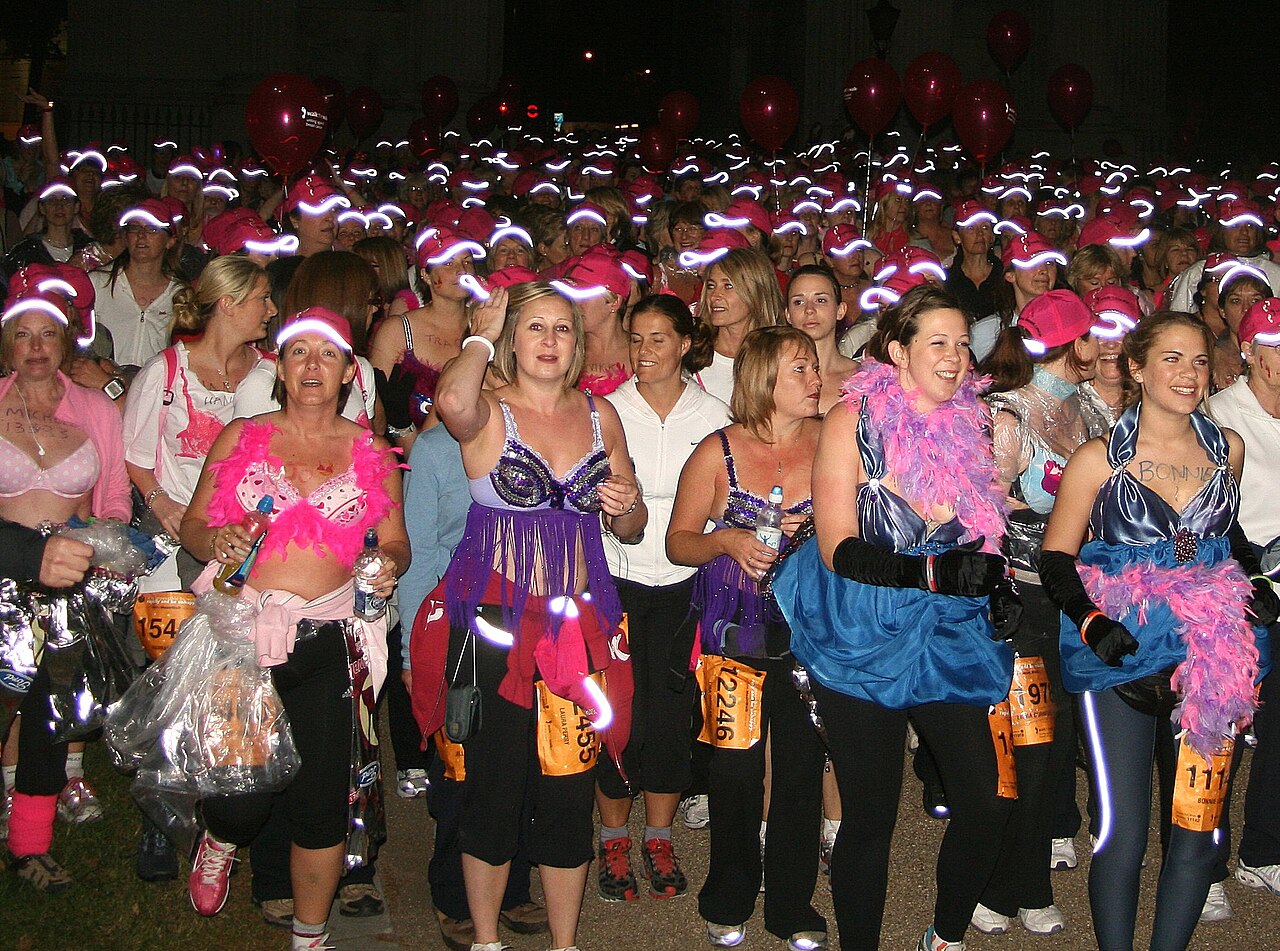
The long run is an important element in marathon training.[167] Recreational runners commonly try to reach a maximum of about 32 km (20 mi) in their longest weekly run and a total of about 64 km (40 mi) a week when training for the marathon, but wide variability exists in practice and in recommendations. More experienced marathoners may run a longer distance during the week. Greater weekly training mileages can offer greater results in terms of distance and endurance, but also carry a greater risk of training injury.[168] Most male elite marathon runners will complete weekly distances of over 160 km (100 mi).[168] It is recommended that those new to running should get a checkup from their doctor, as there are certain warning signs and risk factors that should be evaluated before undertaking any new workout program, especially marathon training.[169]
Many training programs last a minimum of five or six months, with a gradual increase in the distance run and finally, for recovery, a period of tapering in the one to three weeks preceding the race. For beginners wishing to merely finish a marathon, a minimum of four months of running four days a week is recommended.[170][171] Many trainers recommend a weekly increase in mileage of no more than 10%. It is also often advised to maintain a consistent running program for six weeks or so before beginning a marathon training program, to allow the body to adapt to the new stresses.[172] The marathon training program itself would suppose variation between hard and easy training, with a periodization of the general plan.[173]
Training programs can be found at the websites of Runner's World,[174] Hal Higdon,[160] Jeff Galloway,[4] and the Boston Athletic Association,[175] and in numerous other published sources, including the websites of specific marathons.
The last long training run might be undertaken up to two weeks prior to the event. Many marathon runners also "carbo-load" (increase carbohydrate intake while holding total caloric intake constant) during the week before the marathon to allow their bodies to store more glycogen.
Glycogen and "the wall"
Carbohydrates that a person eats are converted by the liver and muscles into glycogen for storage. Glycogen burns rapidly to provide quick energy. Runners can store about 8 MJ or 2,000 kcal worth of glycogen in their bodies, enough for about 30 km/18–20 miles of running. Many runners report that running becomes noticeably more difficult at that point.[176] When glycogen runs low, the body must then obtain energy by burning stored fat, which does not burn as readily. When this happens, the runner will experience dramatic fatigue and is said to "hit the wall". The aim of training for the marathon, according to many coaches,[177] is to maximize the limited glycogen available so that the fatigue of the "wall" is not as dramatic. This is accomplished in part by utilizing a higher percentage of energy from burned fat even during the early phase of the race, thus conserving glycogen.[citation needed]
Carbohydrate-based "energy gels" are used by runners to avoid or reduce the effect of "hitting the wall", as they provide easy to digest energy during the run. Energy gels usually contain varying amounts of sodium and potassium and some also contain caffeine. They need to be consumed with a certain amount of water. Recommendations for how often to take an energy gel during the race range widely.[177]

Alternatives to gels include various forms of concentrated sugars, and foods high in simple carbohydrates that can be digested easily. Many runners experiment with consuming energy supplements during training runs to determine what works best for them. Consumption of food while running sometimes makes the runner sick. Runners are advised not to ingest a new food or medicine just prior to or during a race.[177] It is also important to refrain from taking any of the non-steroidal anti-inflammatory class of pain relievers (NSAIDs, e.g., aspirin, ibuprofen, naproxen), as these drugs may change the way the kidneys regulate their blood flow and may lead to serious kidney problems, especially in cases involving moderate to severe dehydration. NSAIDS block the COX-2 enzyme pathway to prevent the production of prostaglandins. These prostaglandins may act as inflammation factors throughout the body, but they also play a crucial role in maintenance of water retention. In less than 5% of the whole population that take NSAIDS, individuals may be more negatively sensitive to renal prostaglandin synthesis inhibition.[178]
Temperature
A study of the performance of 1.8 million participants in the Berlin, London, Paris, Boston, Chicago, and New York marathons during the years from 2001 to 2010 found that runners recorded their fastest times when the temperature was around 6 °C (43 °F), with an increase of 10 °C (18 °F) leading to a 1.5% reduction in speed.[179][180] A July 2020 study found that increasing temperatures affected faster runners' performance more than slower ones.[181]
After a marathon
Marathon participation may result in various medical, musculoskeletal, and dermatological complaints.[182] Delayed onset muscle soreness (DOMS) is a common condition affecting runners during the first week following a marathon.[183] Various types of mild exercise or massage have been recommended to alleviate pain secondary to DOMS.[183] Dermatological issues frequently include "jogger's nipple", "jogger's toe", and blisters.[184]
The immune system is reportedly suppressed for a short time.[185] Changes to the blood chemistry, such as elevated Cardiac Troponin T,[186] may lead physicians to mistakenly diagnose heart malfunction.[187]
After long training runs and the marathon itself, consuming carbohydrates to replace glycogen stores and protein to aid muscle recovery is commonly recommended. In addition, soaking the lower half of the body for approximately 20 minutes in cold or ice water may force blood through the leg muscles to speed recovery.[188][189]
Health risks
Marathon running has various health risks, though these can be diminished with preparation and care.[190] Training and the races themselves can put runners under stress. While very rare, even death is a possibility during a race.
Common minor health risks include blisters, tendonitis, fatigue, knee or ankle sprain, dehydration (electrolyte imbalance), and other conditions. Many are categorised as overuse injuries.
Cardiac health

In 2016, a systematic medical review found that the risk of sudden cardiac death during or immediately after a marathon was between 0.6 and 1.9 deaths per 100,000 participants, varying across the specific studies and the methods used, and not controlling for age or gender.[191] Since the risk is small, cardiac screening programs for marathons are uncommon. However, this review was not an attempt to assess the overall cardiac health impact of marathon running.
A 2006 study of non-elite Boston Marathon participants tested runners for certain proteins that indicate heart damage or dysfunction (see Troponin) and gave them echocardiogram scans, before and after the marathon. The study revealed that, in that sample of 60 people, runners who had averaged fewer than 56 km (35 mi) of weekly training in the 4 months before the race were most likely to show some heart damage or dysfunction, while runners who had done more than 72 km (45 mi) of weekly training showed few or no heart problems.[192]
According to a Canadian study presented in 2010, running a marathon can temporarily result in decreased function of more than half the muscle segments in the heart's main pumping chamber, but neighboring segments are generally able to compensate. Full recovery is reached within three months. The fitter the runner, the less the effect. The runners with decreased left ventricle function had an average peak weekly training distance of 55.1 km (34.2 mi), while those who did not averaged 69.1 km (42.9 mi). The marathon was held in 35 °C (95 °F) weather. According to one of the researchers: "Regular exercise reduces cardiovascular risk by a factor of two or three in the long run, but while we're doing vigorous exercise such as marathon running, our cardiac risk increases by seven."[193][194]
Hydration

Overconsumption is the most significant concern associated with water consumption during marathons. Drinking excessive amounts of fluid during a race can lead to dilution of sodium in the blood, a condition called exercise-associated hyponatremia, which may result in vomiting, seizures, coma and even death.[195] Dr. Lewis G. Maharam, medical director for the New York City Marathon, stated in 2005: "There are no reported cases of dehydration causing death in the history of world running, but there are plenty of cases of people dying of hyponatremia."[196]
For example, Dr. Cynthia Lucero died at the age of 28 while participating in the 2002 Boston Marathon. It was Lucero's second marathon.[197] At mile 22, Lucero complained of feeling "dehydrated and rubber-legged."[198] She soon wobbled and collapsed to the ground, and was unconscious by the time the paramedics reached her. Lucero was admitted to Brigham and Women's Hospital and died two days later.[199]
Lucero's cause of death was determined to be hyponatremic encephalopathy, a condition that causes swelling of the brain due to an imbalance of sodium in the blood known as exercise-associated hyponatremia (EAH). While EAH is sometimes referred to as "water intoxication", Lucero drank large amounts of Gatorade during the race,[200][201] demonstrating that runners who consume sodium-containing sports drinks in excess of thirst can still develop EAH.[200][202] Because hyponatremia is caused by excessive water retention, and not just loss of sodium, consumption of sports drinks or salty foods may not prevent hyponatremia.[203]
Women are more prone to hyponatremia than men. A study in the New England Journal of Medicine found that 13% of runners completing the 2002 Boston Marathon had hyponatremia.[204]
The International Marathon Medical Directors Association (IMMDA) advised in 2006 that fluid intake should be adjusted individually according to factors such as body weight, sex, climate, pace, fitness (VO2 max), and sweat rate, as fluid requirements can vary between people depending on these variables. The IMMDA also recommended sports drinks that include carbohydrates and electrolytes instead of plain water and said that runners should "drink to thirst", trying to refrain from drinking at every fluid station before feeling thirsty.[205] Heat exposure leads to diminished thirst drive and thirst may not be a sufficient incentive to drink in many situations.[206] The IMMDA and HSL Harpur Hill give recommendations to drink fluid in small volumes frequently at an approximate rate falling between 100–250 ml (3.4–8.5 US fl oz) every 15 minutes.[206][205] A patient suffering hyponatremia can be given a small volume of a concentrated salt solution intravenously to raise sodium concentrations in the blood. Some runners weigh themselves before running and write the results on their bibs. If anything goes wrong, first aid workers can use the weight information to tell if the patient had consumed too much water.
Body temperature
Exertional heat stroke is an emergency condition in which thermoregulation fails and the body temperature rises dangerously above 40 °C (104 °F). It becomes a greater risk in warm and humid weather, even for young and fit individuals. Treatment requires rapid physical cooling of the body.[207]
Charity involvement
Some charities seek to associate with various races. Some marathon organizers set aside a portion of their limited entry slots for charity organizations to sell to members in exchange for donations. Runners are given the option to sign up to run particular races, especially when marathon entries are no longer available to the general public.[citation needed] In some cases, charities organize their own marathon as a fund-raiser, gaining funds via entry fees or sponsorships.[citation needed]
Culture
- Mars rover marathon

In 2015 the Mars rover Opportunity attained the distance of a marathon from its starting location on Mars, and the valley where it achieved this distance was called Marathon Valley, which was then explored.[208][209]
See also
.jpg/1280px-Roman_bronze_copy_of_Myron%E2%80%99s_Discobolos,_2nd_century_CE_(Glyptothek_Munich).jpg)
Records
Lists
- List of marathon races
- List of marathoners
- List of marathon national champions (men)
- List of non-professional marathon runners
Related races
- Ekiden (marathon relays)
- Half marathon
- Ultramarathon
Other endurance races
Organizations
Notable races
- Ineos 1:59 Challenge
- Man versus Horse Marathon
- Marathons at the Paralympics
Other related topics
Notes
- ^ This date is specified as 10 March in some sources as Greece used the Julian calendar at the time.
- ^ A marathon in Yekaterinburg, Russia, the Europe-Asia International Marathon, also claims to cross the border between Europe and Asia.[58]
References
- ^ a b "IAAF Competition Rules for Road Races". International Association of Athletics Federations. 2009. Archived from the original on 23 September 2015. Retrieved 1 November 2010.
- ^ "Marathons in history with >30,000 finishers". AIMS: World Running. Association of International Marathons and Distance Races. 11 July 2016. Archived from the original on 10 March 2017. Retrieved 21 March 2017.
- ^ "Astronomers Unravel Marathon Mystery". Sky & Telescope. 19 July 2004. Archived from the original on 11 February 2017. Retrieved 21 March 2017.
- ^ a b c "Retreats — Athens". Jeffgalloway.com. Archived from the original on 1 June 2009. Retrieved 22 August 2009.
- ^ "Ancient Olympics FAQ 10". Perseus.tufts.edu. Archived from the original on 20 July 2009. Retrieved 22 August 2009.
- ^ Moralia 347C
- ^ Landon, Letitia Elizabeth (1837). Fisher's Drawing Room Scrap Book. Fisher, Son, and Jackson. p. 60.
- ^ "The Myth of Pheidippides and the Marathon". findingdulcinea.com. 4 November 2011. Archived from the original on 6 November 2018. Retrieved 7 May 2019.
- ^ "A slip of the tongue in salutation, Chapter 3; The Works of Lucian of Samosata. Translated by Fowler, H.W. and F.G.; Oxford: The Clarendon Press. 1905". The Lucian of Samosata Project.; "The Greek original of the text of Chapter 3". Lucian, Pro lapsu inter salutandum @ perseus.tufts.edu.
- ^ "Prologue: The Legend". Marathonguide.com. Archived from the original on 16 April 2009. Retrieved 22 August 2009.
- ^ Holland, Tom (2007) Persian Fire, Knopf Doubleday Publishing Group, ISBN 0307386988.
- ^ Kemp, Ian (27 September 2013). "The Great Marathon Myth". Cool Running New Zealand. Archived from the original on 4 December 2016.
- ^ Herodotus, The Histories Herodotus makes no mention of a runner following the battle runner, and such a runner is mentioned only in much later sources, Nowadays the story of the "Marathon runner" is generally rejected as a fiction, possibly arising from confusion with the runner sent to Sparta before the battle. (Penguin Books: New York, 1977) p. 425.
- ^ Burfoot, Amby (26 October 2010). "The Truth about Pheidippides and the Early Years of Marathon History". Runner's World. Archived from the original on 25 December 2014. Retrieved 25 December 2014.
- ^ Richard Benyo; Joe Henderson (2002). Running Encyclopedia. Human Kinetics. pp. 250. ISBN 9780736037341. Retrieved 6 April 2017.
- ^ Anthony Bijkerk; David C. Young (Winter 1999). "That Memorable First Marathon" (PDF). Journal of Olympic History. ISOH: 27. Archived (PDF) from the original on 12 September 2016. Retrieved 6 April 2017.. Results summary: page 27, annotation 3.
- ^ Bill Mallon; Ture Widlund (1997). 1896 Olympic Games: Results for All Competitors in All Events, with Commentary. McFarland. p. 69. ISBN 9781476609508. Archived from the original on 7 April 2017. Retrieved 6 April 2017.
- ^ "1896, Marathon Runners, Burton Holmes". Getty Images. 10 March 2004. Archived from the original on 19 June 2012. Retrieved 10 May 2015.
- ^ Burton Holmes (1905). The Burton Holmes Lectures: The Olympian games in Athens. Grecian journeys. The wonders of Thessaly. New York: McClure, Phillips & Co. p. 69. ISBN 9781276985949. Archived from the original on 16 March 2016. Retrieved 25 April 2015.(Digital compilation from original title: The Burton Holmes Lectures (Volume 3): With Illustrations from Photographs by the Author, Year:1901, ISBN 9781151940469, on 6 November 2008, University of Michigan)
- ^ "Olympic Champion Joan Benoit Samuelson To Be Guest of Honor at Manchester Marathon — Registration Closed". Cool Running. Archived from the original on 11 January 2012.
- ^ "Marathon Race". Marathon Run Museum. Archived from the original on 22 August 2016. Retrieved 21 August 2016.
- ^ "Mapping out the London Olympic Marathon course". The AZ Blog. 31 July 2012. Archived from the original on 23 August 2016. Retrieved 21 August 2016.
- ^ "Visualizing the Rio Olympic Marathon Course". Runner's World. Archived from the original on 22 August 2016. Retrieved 21 August 2016.
- ^ Wanjiru and Gharib break OR in Men's Marathon. En.beijing2008.cn (24 August 2008). Archived 4 November 2013 at the Wayback Machine
- ^ "Women's Marathon – Olympic Athletics". Official site of the London 2012 Olympic and Paralympic Games. Archived from the original on 3 August 2012. Retrieved 5 August 2012.
- ^ Warner, Gregory (1 November 2013). "How One Kenyan Tribe Produces The World's Best Runners". NPR.
- ^ "Track and Field Athletics". The World 1910 Almanac and Encyclopedia. New York: Press Publishing Company. 1909. pp. 384–385. Archived from the original on 9 May 2016. Retrieved 13 December 2015.
- ^ a b Whorton, James C. (1992). ""Athlete's Heart": The Medical Debate over Athleticism, 1870–1920". In Berryman, Jack W.; Park, Robert J. (eds.). Sport and Exercise Science: Essays in the History of Sports Medicine. University of Illinois Press. p. 127. ISBN 0-252-06242-6.
- ^ Robinson, Roger (January–February 2009). "Footsteps: 'Tis the (Racing) Season; 100 Years of Holiday Running". Running Times Magazine. Archived from the original on 22 December 2010. Retrieved 10 February 2011.
- ^ Cooper, Pamela (1999). "New York City Marathon Culture". The American Marathon. Syracuse, New York: Syracuse University Press. pp. 27–48. ISBN 0-8156-0573-0. Archived from the original on 8 May 2016. Retrieved 13 December 2015.
- ^ "2015 Running USA Annual Marathon Report". RunningUSA.org. Running USA. 25 May 2016. Archived from the original on 22 March 2017. Retrieved 21 March 2017.
- ^ "Marathon Guide: International Marathons Report". MarathonGuide. Archived from the original on 16 February 2011. Retrieved 12 November 2010.
- ^ a b "Olympic Marathon (excerpt)". Charlie Lovett. Greenwood Publishing Group, Inc. 1997. Archived from the original on 17 February 2011. Retrieved 1 November 2010.
- ^ Karl Lennartz. "Two Women Ran the Marathon in 1896" (PDF). International Society of Olympic Historians ISOH. Archived from the original (PDF) on 11 April 2017. Retrieved 10 April 2017.
- ^ "World Best Progressions- Road". Association of Road Racing Statisticians. Archived from the original on 14 June 2018. Retrieved 1 November 2010.
- ^ Krise, Raymond and Squires, Bill (1982). Fast Tracks: The History of Distance Running Since 884 B.C., S. Greene Press, p. 43, ISBN 0828904820.
- ^ Gross, Albert C. (1986) Endurance, Dodd Mead, ISBN 0396088880.
- ^ "First woman to run marathon in US". Archived from the original on 11 February 2017. Retrieved 7 May 2019.
- ^ "Arlene Pieper – 1st Lady Marathoner | Marathon and Beyond". marathonandbeyond.com. 5 November 2017. Archived from the original on 16 September 2018. Retrieved 7 May 2019.
- ^ "Boston, 1967: When marathons were just for men". BBC News. 16 April 2012. Archived from the original on 30 December 2014. Retrieved 4 November 2014.
Kathrine Switzer became the first woman to officially run the race 45 years ago, despite stewards trying to physically force the 20-year-old off the road.
- ^ Semple, Jock; with John J. Kelley and Tom Murphy (1981). Just Call Me Jock: The Story of Jock Semple, Boston's Mr. Marathon, pages 7, 114–118, Waterford Publishing Co., ISBN 978-0942052015
- ^ Boston Marathon History. baa.org
- ^ Boston Marathon History: Past Women's Open Champions. baa.org
- ^ Bryant, J. (2007) 100 Years and Still Running, Marathon News
- ^ Wilcock, Bob (March 2008). "The 1908 Olympic Marathon". Journal of Olympic History. 16 (1).
- ^ "History of the Athens Marathon". Archived from the original on 15 August 2012. Retrieved 23 July 2012.
- ^ "Marathon: How it works" Archived 11 March 2013 at the Wayback Machine, IAAF website
- ^ "The Marathon journey to reach 42.195km". european-athletics.org. 25 April 2008. Archived from the original on 24 September 2008. Retrieved 23 July 2009.
- ^ Martin, David E.; Roger W. H. Gynn (May 2000). The Olympic Marathon. Human Kinetics Publishers. p. 113. ISBN 978-0-88011-969-6.
- ^ "IAAF Competition Rules 2008" (PDF). IAAF. p. 195. Archived from the original (PDF) on 25 March 2009. Retrieved 20 April 2009.
- ^ IAAF Competition Rules 2012–2013 – Rule 240 Archived 9 February 2013 at the Wayback Machine. None. Retrieved 18 April 2013.
- ^ "IAAF Competition Rules 2010–2011" (PDF). IAAF. pp. 230–235. Archived from the original (PDF) on 12 May 2011. Retrieved 10 October 2011.
- ^ Day, Sharlene M.; Thompson, Paul D. (4 June 2010). "Cardiac risks associated with marathon running". Sports Health. 2 (4): 301–306. doi:10.1177/1941738110373066. PMC 3445091. PMID 23015951.
- ^ AIMS – About AIMS Archived 16 June 2016 at the Wayback Machine. Aimsworldrunning.org (30 March 2007). Retrieved 19 April 2011.
- ^ The World's Top 10 Marathons. runnersworld.com. Retrieved 18 April 2013.
- ^ "The History of the Boston Marathon: A Perfect Way to Celebrate Patriot's Day". The Atlantic. Archived from the original on 22 April 2013. Retrieved 23 April 2013.
- ^ guest (8 November 2012). "In Pheidippides' Footsteps: 30th Annual Athens Classic Marathon | GreekReporter.com". Greece.greekreporter.com. Archived from the original on 4 November 2013. Retrieved 1 June 2015.
- ^ "Europe-Asia International Marathon". Archived from the original on 9 November 2020. Retrieved 27 August 2021.
- ^ Detroit Free Press Marathon Archived 3 February 2011 at the Wayback Machine. Freepmarathon.com. Retrieved 18 April 2013.
- ^ "Home". Sparkasse 3-Länder Marathon. Retrieved 5 October 2019.
- ^ Snyder, Paul (20 March 2018). "You Won't Believe the Pace (and Patience) Needed to Set the Indoor Marathon World Record". Runner's World. Archived from the original on 30 April 2019. Retrieved 30 April 2019.
- ^ Sports medicine, training, and rehabilitation. Vol. 3. 1991. p. 95.
- ^ Patrick, Dwyne R.; Bignall, John E. (1987). "Creating the competent self: The case of the wheelchair runner". In Joseph A. Kotarba; Andrea Fontana (eds.). The Existential Self in Society. University of Chicago Press. ISBN 0-226-45141-0.
- ^ Davis, Alison (1996). "The History of Wheelchair Racing at the Boston Marathon". Against the Wind. University of Illinois Board of Trustees. Archived from the original on 27 July 2011.
- ^ Davis, Alison (1996). "Interview with Bob Hall". Against the Wind. University of Illinois Board of Trustees. Archived from the original on 27 July 2011.
- ^ Couch, Aaron (18 April 2011). "Boston Marathon: five historic moments". The Christian Science Monitor. Archived from the original on 21 April 2011. Retrieved 20 May 2011.
- ^ a b Dicker, Ron (5 November 2000). "New York City Marathon; New Equipment Stirs Division Within Wheelchair Ranks". The New York Times. Archived from the original on 14 November 2013. Retrieved 20 May 2011.
- ^ Vega, Michael (19 April 2010). "Ernst Van Dyk wins record 9th wheelchair title". The Boston Globe. Archived from the original on 12 January 2012. Retrieved 21 May 2011.
- ^ Cooper, Rory A.; Boninger, Michael L.; Rice, Ian; Sean D. Shimada; Rosemarie Cooper (1996). "Elite athletes with impairments". In Walter R. Frontera; David M. Slovik; David Michael Dawson (eds.). Exercise in rehabilitation medicine. Human Kinetics. p. 333. ISBN 0-7360-5541-X. Archived from the original on 29 June 2016. Retrieved 13 December 2015.
- ^ "Wheelchair entrants axed from marathon". Calgary Herald. 17 October 1977. Archived from the original on 22 December 2015. Retrieved 20 May 2011.
- ^ Association Press (22 October 1977). "Marathon entry on wheels". Lakeland Ledger. Archived from the original on 22 December 2015. Retrieved 20 May 2011.
- ^ "Wheelchair athletes win marathon appeal". Tri City Herald. 26 October 1980. Retrieved 20 May 2011.[permanent dead link]
- ^ United Press International (11 April 1981). "Marathon Wins Wheelchair Ban". The New York Times. Archived from the original on 14 November 2013. Retrieved 20 May 2011.
- ^ "Fast Forward in Reverse". The New York Times. 11 November 1986. Archived from the original on 14 November 2013. Retrieved 21 May 2011.
- ^ Glenday, Craig (2013). Guinness World Records Limited. Jane Boatfield. pp. 247. ISBN 978-1-908843-15-9.
- ^ "Runner's World | What Will It Take to Run A 2-Hour Marathon". rw.runnersworld.com. Archived from the original on 29 August 2017. Retrieved 28 August 2017.
- ^ "Marathon - men - senior - outdoor". www.worldathletics.org. Retrieved 24 April 2022.
- ^ "Marathon - women - senior - outdoor". www.worldathletics.org. Retrieved 24 April 2021.
- ^ "All-time men's best marathon". alltime-athletics.com. 12 October 2021. Retrieved 24 April 2022.
- ^ "All-time women's best marathon". alltime-athletics.com. 12 October 2021. Retrieved 24 April 2022.
- ^ a b c "Kiptum smashes world marathon record with 2:00:35, Hassan runs 2:13:44 in Chicago | REPORT | World Athletics". worldathletics.org. Retrieved 8 October 2023.
- ^ "Kenya's Kipchoge shatters marathon world record in Berlin". Reuters. 25 September 2022. Retrieved 25 September 2022.
- ^ a b Bob Ramsak (29 September 2019). "Bekele clocks 2:01:41 in Berlin, second fastest marathon ever". IAAF. Retrieved 3 October 2019.
- ^ a b c d Emeterio Valiente (3 December 2023). "Lemma breaks course record, Degefa dominates in Valencia". World Athletics. Retrieved 3 December 2023.
- ^ a b c d e f Emeterio Valiente (4 December 2022). "Kiptum and Beriso break course records in Valencia". World Athletics. Retrieved 5 December 2022.
- ^ a b c d "Kipruto and Kebede run Japanese all-comers' records in Tokyo". World Athletics. 3 March 2024. Retrieved 3 March 2024.
- ^ a b c Simon Hart (28 April 2019). "Kipchoge cracks course record in London with second-fastest time in history". IAAF. Archived from the original on 3 May 2019. Retrieved 3 May 2019.
- ^ a b c Jess Whittington (6 March 2022). "Kipchoge and Kosgei race to Japanese all-comers' records in Tokyo". World Athletics. Retrieved 8 March 2022.
- ^ a b c d "Assefa smashes world marathon record in Berlin with 2:11:53, Kipchoge achieves record fifth win". World Athletics. 24 September 2023. Retrieved 24 September 2023.
- ^ a b "Kimetto breaks marathon world record in Berlin with 2:02:57". World Athletics. 28 September 2014. Archived from the original on 27 October 2020. Retrieved 27 August 2021.
- ^ a b "Maratón Valencia Trinidad Alfonso EDP". World Athletics. 6 December 2020. Archived from the original on 4 June 2021. Retrieved 28 August 2021.
{{cite web}}: CS1 maint: bot: original URL status unknown (link) - ^ a b Cathal Dennehy (25 September 2016). "Bekele gets back to his brilliant best at Berlin Marathon". IAAF. Archived from the original on 26 September 2016. Retrieved 25 September 2016.
- ^ a b c d "Mengesha and Ketema claim Berlin Marathon crowns". World Athletics. 29 September 2024. Retrieved 2 October 2024.
- ^ "Zurich Maratón de Sevilla | Results". worldathletics.org. World Athletics. 18 February 2024. Retrieved 19 February 2024.
- ^ a b "Debutant Molla and Chepngetich smash course records in Dubai". IAAF. 25 January 2019. Archived from the original on 25 January 2019. Retrieved 25 January 2019.
- ^ "Rotterdam Marathon 2021 Race Results". Watch Athletics. Retrieved 24 October 2021.
- ^ Bob Ramsak (12 October 2019). "Kipchoge Breaks 2-Hour Barrier in Vienna". IAAF. Retrieved 13 October 2019.
- ^ Jon Mulkeen (6 May 2017). "Kipchoge a 'happy man' in Monza". IAAF. Archived from the original on 6 May 2017. Retrieved 6 May 2017.
- ^ Diego Sampaolo (16 May 2021). "Ekiru and Gebrekidan break Italian all-comers' records in Milan". World Athletics. Retrieved 8 June 2021.
- ^ Jon Mulkeen (13 October 2019). "Kosgei smashes marathon world record in Chicago". IAAF. Retrieved 17 October 2019.
- ^ "Chepngetich dominates in Chicago with second-fastest marathon in history". World Athletics. 9 October 2022. Retrieved 9 October 2022.
- ^ "Radcliffe runs 2:15:25 in London!". World Athletics. 13 April 2003. Archived from the original on 28 August 2021. Retrieved 28 August 2021.
{{cite web}}: CS1 maint: bot: original URL status unknown (link) - ^ "Tigist Assefa 2022 Berlin Marathon Results". mikatiming.com. 25 September 2022. Retrieved 26 September 2022.
- ^ "Kipchoge breaks world record in Berlin with 2:01:09". World Athletics. 25 September 2022. Retrieved 26 September 2022.
- ^ "Ketema stuns with 2:16:07 marathon debut in Dubai". World Athletics. 7 January 2024. Retrieved 7 January 2024.
- ^ "Kipruto and Kebede run Japanese all-comers' records in Tokyo". World Athletics. 3 March 2024. Retrieved 3 March 2024.
- ^ a b c d "Jepchirchir breaks women-only world marathon record in London". World Athletics. 21 April 2024. Retrieved 22 April 2024.
- ^ a b "Wanjiru and Gelmisa triumph in Tokyo Marathon". World Athletics. 5 March 2023. Retrieved 12 March 2023.
- ^ a b "Keitany breaks women's-only world record at London Marathon". World Athletics. 23 April 2017. Archived from the original on 28 August 2021. Retrieved 28 August 2021.
{{cite web}}: CS1 maint: bot: original URL status unknown (link) - ^ "Yehualaw runs 2:17:23 in Hamburg for fastest ever women's marathon debut". World Athletics. 24 April 2022. Retrieved 30 April 2022.
- ^ Ken Nakamura (1 March 2020). "Legese retains Tokyo Marathon crown while Salpeter smashes course record". IAAF. Retrieved 25 March 2020.
- ^ Jon Mulkeen (17 October 2021). "Tanui and Tola smash Dutch all-comers' records in Amsterdam". World Athletics. Retrieved 24 October 2021.
- ^ Simon Hart (3 October 2021). "Jepkosgei and Lemma reign supreme in London". World Athletics. Retrieved 18 October 2021.
- ^ "100-year-old sets record with marathon finish". CBC News. 16 October 2011. Archived from the original on 11 February 2017. Retrieved 17 March 2017.
- ^ 'Gladyator' aged 92 breaks marathon record Archived 15 September 2018 at the Wayback Machine. Telegraph (6 April 2011). Retrieved 19 April 2011.
- ^ Brit woman, 92, breaks world record after finishing Honolulu Marathon Archived 9 April 2011 at the Wayback Machine. Dailyindia.com. Retrieved 19 April 2011.
- ^ "World Single Age Records- Marathon". Association of Road Racing Statisticians. 20 January 2011. Archived from the original on 15 September 2018. Retrieved 6 April 2011.
- ^ Fenton, Ben. (19 April 2004) Everything you wanted to know about the marathon but were too exhausted to ask Archived 15 September 2018 at the Wayback Machine. Telegraph. Retrieved 19 April 2011.
- ^ London Marathon: 25 reasons to celebrate the London Marathon – More Sports, Sport Archived 11 February 2017 at the Wayback Machine. The Independent (16 April 2005). Retrieved 19 April 2011.
- ^ a b "Harriette Thompson, 92, becomes oldest woman to complete a marathon | Sport". The Guardian. Associated Press. Archived from the original on 11 February 2017. Retrieved 1 June 2015.
- ^ a b "Single Age Records Marathon". arrs.run. Archived from the original on 18 April 2019. Retrieved 7 May 2019.
- ^ "Archived copy". Archived from the original on 18 December 2018. Retrieved 21 September 2018.
{{cite web}}: CS1 maint: archived copy as title (link) - ^ 3 year-old marathon runner Archived 7 October 2013 at the Wayback Machine Retrieved 4 July 2013
- ^ "2016 Running USA Annual Marathon Report | Running USA". www.runningusa.org. Archived from the original on 20 August 2017. Retrieved 19 August 2017.
- ^ "Marathon Statistics — FindMyMarathon.com". findmymarathon.com. Archived from the original on 20 August 2017. Retrieved 19 August 2017.
- ^ Meyers, Jessica (11 September 2017). "As running booms in China, marathoners look to Boston". The Boston Globe. Archived from the original on 17 December 2017. Retrieved 12 September 2017.
- ^ "100 Marathon Club". 100 Marathon Club. Archived from the original on 9 September 2012. Retrieved 12 September 2012.
- ^ Trevallion, Lucy (13 November 2012). "New multi marathon world record". Runner's World UK. Archived from the original on 16 November 2012. Retrieved 14 November 2012.
- ^ 50&DC Marathon Group U.S.A. Archived 27 December 2007 at the Wayback Machine. Retrieved 11 April 2010.
- ^ Mile posts: And now the rest of the story with Beverly Paquin | Des Moines Register Staff Blogs Archived 12 July 2012 at archive.today. Blogs.desmoinesregister.com (20 October 2010). Retrieved 19 April 2011.
- ^ Alumna Runs Marathons in 50 States and D.C., Sets Record! « Slice of MIT by the Alumni Association. Alum.mit.edu (16 November 2010). Retrieved 19 April 2011.
- ^ "Accolades". 50anddcmarathongroupusa.com. Archived from the original on 1 June 2009. Retrieved 22 August 2009.
- ^ "CBC Archives: television and radio spots on Terry Fox". Canadian Broadcasting Corporation. Archived from the original on 14 June 2006. Retrieved 22 August 2009.
- ^ Richter, Marice (26 September 2011). "Multiple sclerosis patient finishes 50th marathon". Reuters. Archived from the original on 27 September 2011. Retrieved 26 September 2011.
- ^ "Fiennes relishes marathon feat". BBC News. 3 November 2003. Archived from the original on 27 May 2009. Retrieved 26 April 2010.
- ^ I am not a madman Archived 11 February 2017 at the Wayback Machine. Interview with Guardian, 5 October 2007
- ^ Irish Independent retrieved 120812 Archived 18 October 2012 at the Wayback Machine. Independent.ie (6 February 2009). Retrieved 18 April 2013.
- ^ Interviewed on CNN Archived 23 September 2012 at the Wayback Machine. Edition.cnn.com (28 February 2012). Retrieved 18 April 2013.
- ^ Welcome to the World Marathon Challenge 2012 Archived 18 September 2012 at the Wayback Machine. Worldmarathonchallenge.com. Retrieved 18 April 2013.
- ^ Davis, Leanne (24 February 2013). "Cowtown notes: San Antonio runner logs his 1,000th marathon". Fort Worth Star-Telegram. Archived from the original on 3 November 2013. Retrieved 28 February 2013.
- ^ Orton, Kathy (27 October 2004). "Texan's Weekend Job Provides Great Benefits". The Washington Post. pp. D4. Archived from the original on 7 November 2012. Retrieved 28 November 2007.
- ^ Blaikie, David (14 September 1998). "The Sy Mah Trophy honours a running legend". Ultramarathon World. Archived from the original on 3 December 1998.
- ^ Gesamtstatistik zum 30.06.2008 Archived 21 February 2009 at the Wayback Machine. 100mc.de (30 June 2008). Retrieved 18 April 2013.
- ^ 100 Marathon Club site (in German) Archived 1 July 2009 at the Wayback Machine. 100mc.de. Retrieved 18 April 2013.
- ^ 50 States & D.C. Marathon Group site Archived 27 December 2007 at the Wayback Machine. Retrieved 28 November 2007.
- ^ "2000. Marathon von Christian Hottas – Mitglied der A-Eskorte | 100 Marathon Club Austria". Archived from the original on 29 June 2013. Retrieved 17 June 2013.. Retrieved 17 June 2013.
- ^ Kramer, Michael (5 December 2016). "Christian Hottas lief seinen 2.500sten Marathon". Runner's World Deutschland (in German). Archived from the original on 22 March 2017. Retrieved 21 March 2017.
- ^ Dou, Eva (10 February 2011). "Belgian sets world record for marathon running". Reuters. Archived from the original on 22 March 2017. Retrieved 21 March 2017.
- ^ "Belgian Stefaan Engels completes record 365th marathon". BBC. 5 February 2011. Archived from the original on 8 February 2011. Retrieved 8 February 2011.
- ^ "Seres sobrehumanos". Corredor de fondo. Archived from the original on 8 October 2011. Retrieved 29 September 2011.
- ^ "Challenge accomplished: 500 marathons in 500 days". 13 February 2012. Archived from the original on 27 October 2012. Retrieved 22 August 2012.
- ^ Johnny Kelley
- ^ Litsky, Frank (8 October 2004) John A. Kelley, Marathoner, Dies at 97 Archived 28 May 2015 at the Wayback Machine. The New York Times. Retrieved 6 December 2009.
- ^ Kita, Meghan (30 March 2012). "Runner With Longest Boston Streak Retires". Runner's World. Archived from the original on 6 November 2018. Retrieved 7 May 2019.
- ^ Sometimes listed as representing Luxembourg.
- ^ "Paris 1900 marathon men Results - Olympic athletics". olympics.com. IOC. Retrieved 21 March 2024.
- ^ Arriving without correct documents, a French immigrant to the United States Albert Corey is inconsistently listed as performing in a mixed team in the four mile team race (with four undisputed Americans) and performing for the US in the marathon. Currently, the IOC attributes his medal in the marathon to France and in the team race to a mixed team.
- ^ "St. Louis 1904 Athletics Marathon Men Results". International Olympic Committee. Retrieved 31 January 2022.
- ^ a b Both Sohn Kee-chung and Nam Sung-yong were from Korea. The IOC attributes both medals to Japan due to Korea being a Japanese colony at the time. All Korean Olympians during the Japanese colonial rule could only participate in the games as a representative of Japan and had to compete with Japanese names instead of their original Korean names. However, some sources still refer to Son Kee-chung as the first Korean to win an Olympic marathon today.
- ^ a b "Training programs". Hal Higdon. Archived from the original on 27 October 2009. Retrieved 22 August 2009.
- ^ "2005 Total USA Marathon Finishers". Marathonguide.com. Archived from the original on 17 March 2008. Retrieved 24 April 2008.
- ^ "2015 Running USA Annual Marathon Report". Running USA. Archived from the original on 5 May 2017. Retrieved 6 May 2017.
- ^ "Running a sub 3-hour marathon". allaboutrunning.net. Archived from the original on 15 February 2009. Retrieved 22 August 2009.
- ^ "Boston Athletic Association". Bostonmarathon.org. Archived from the original on 8 June 2009. Retrieved 22 August 2009.
- ^ "Run in 2017". TCS New York City Marathon. 7 September 2016. Archived from the original on 3 May 2019. Retrieved 7 May 2019.
- ^ Online, sprinters win race: Marathon fills its field in a record 8 hours Archived 22 October 2010 at the Wayback Machine. Boston.com (19 October 2010). Retrieved 18 April 2013.
- ^ McMillan, Greg The Marathon Long Run. mcmillanrunning.com
- ^ a b Daniels, J. (2005). Daniels' Running Formula, 2nd Ed. Human Kinetics Publishing. ISBN 0-7360-5492-8.[page needed]
- ^ "Marathon Training Tips". Rush University Medical Center. Archived from the original on 2 July 2015. Retrieved 24 July 2015.
- ^ Whitsett et al. (1998) The Non-Runner's Marathon Trainer. Master's Press.
- ^ Finishing A Marathon Archived 3 April 2015 at the Wayback Machine. Calendarofmarathons.com. Retrieved 18 April 2013.
- ^ Burfoot, A. Ed (1999). Runner's World Complete Book of Running : Everything You Need to Know to Run for Fun, Fitness and Competition. Rodale Books. ISBN 1-57954-186-0.[page needed]
- ^ Marius Bakken. "Training for a Marathon". Marathon Training Schedule. Archived from the original on 9 February 2009. Retrieved 17 April 2009.
- ^ "Marathon Training at Runner's World". Runnersworld.com. 15 February 2008. Archived from the original on 13 August 2009. Retrieved 22 August 2009.
- ^ "Boston Athletic Association". Bostonmarathon.org. Archived from the original on 7 March 2012. Retrieved 1 November 2010.
- ^ "Hitting the wall for marathon runners". Half-marathon-running.com. Archived from the original on 22 March 2017. Retrieved 22 August 2009.
- ^ a b c Klein, Michael (3 October 2008). "Lesser-known Dangers Associated with Running a Marathon". E-articles.info. Archived from the original on 17 January 2013.
- ^ Brater, D. Craig (17 January 2000). "Effects of nonsteroidal anti-inflammatory drugs on renal function: focus on cyclooxygenase −2–selective inhibition". The American Journal of Medicine. 107 (6): 65–70. doi:10.1016/S0002-9343(99)00369-1. PMID 10628595.
- ^ Helou, Nour; Tafflet, Muriel; Berthelot, Geoffroy (23 May 2012). "Impact of Environmental Parameters on Marathon Running Performance". PLOS One. 7 (5): e37407. Bibcode:2012PLoSO...737407E. doi:10.1371/journal.pone.0037407. PMC 3359364. PMID 22649525.
[Data in] Supplementary Table 3–Optimal temperatures for maximal running speeds of each level of performance, with speed losses associated with each temperature increase.
- ^ S, J (4 October 2017). "Can the marathon's two-hour barrier be broken?". The Economist. Retrieved 2 July 2020.
While it is unclear how much—or even if—rain or humidity alone affect marathon times, a little heat can make a big difference. One study published in 2012 found that the optimum temperature was a chilly 4 °C (39 °F) for the top percentile of entrants, and that a rise of 10 °C was associated with a 1.4% drop in speed, with bigger declines for lesser athletes. Another paper produced in 2007 offered no optimum point, but found that an increase in WetBulb Globe Temperature—an overall measure of heat stress—from 8 °C to 17 °C was linked to a 1.6% fall in performance for elite competitors.
- ^ Gasparetto, Thadeu; Nesseler, Cornel (July 2020). "Diverse Effects of Thermal Conditions on Performance of Marathon Runners". Frontiers in Psychology. 11: 1438. doi:10.3389/fpsyg.2020.01438. PMC 7350124. PMID 32719639.
We analyzed endurance performances of the top 1000 runners for every year during the last 12 New York City Marathons. Thermal conditions were estimated with wet-bulb globe temperature (WBGT) and universal thermal climate index (UTCI). Under identical thermal exposure, the fastest runners experienced a larger decline in performance than the slower ones.
- ^ Jaworski CA (June 2005). "Medical concerns of marathons". Current Sports Medicine Reports. 4 (3): 137–43. doi:10.1097/01.csmr.0000306196.51994.5f. PMID 15907265. S2CID 220577417.
- ^ a b Pete Pfitzinger – Lab Reports – Recovering From a Marathon, Part One Archived 10 May 2013 at the Wayback Machine. Pfitzinger.com. Retrieved 19 April 2011.
- ^ Mailler EA, Adams BB (August 2004). "The wear and tear of 26.2: dermatological injuries reported on marathon day". British Journal of Sports Medicine. 38 (4): 498–501. doi:10.1136/bjsm.2004.011874. PMC 1724877. PMID 15273194.
- ^ Mackinnon, Laurel T. (July 2000). "Chronic exercise training effects on immune function". Medicine & Science in Sports & Exercise. 32 (Supplement): S369–S376. doi:10.1097/00005768-200007001-00001. ISSN 0195-9131. PMID 10910293.
- ^ Aengevaeren, Vincent L.; Baggish, Aaron L.; Chung, Eugene H.; George, Keith; Kleiven, Øyunn; Mingels, Alma M.A.; Ørn, Stein; Shave, Rob E.; Thompson, Paul D.; Eijsvogels, Thijs M.H. (14 December 2021). "Exercise-Induced Cardiac Troponin Elevations: From Underlying Mechanisms to Clinical Relevance". Circulation. 144 (24): 1955–1972. doi:10.1161/CIRCULATIONAHA.121.056208. ISSN 0009-7322. PMC 8663527. PMID 34898243.
- ^ Acevedo, Edmund O.; Dzewaltowski, David A.; Kubitz, Karla A.; Kraemer, Robert R. (October 1999). "Effects of a proposed challenge on effort sense and cardiorespiratory responses during exercise". Medicine & Science in Sports & Exercise. 31 (10): 1460–5. doi:10.1097/00005768-199910000-00016. ISSN 0195-9131. PMID 10527320.
- ^ Stouffer Drenth, Tere (2003). Marathon Training for Dummies. United States: Wiley Publishing Inc. p. 182. ISBN 0-7645-2510-7.
- ^ Drenth, Tere Stouffer (7 March 2003). "Marathon Training For Dummies - Tere Stouffer Drenth - Google Books". Wiley. ISBN 9780764525100.
- ^ Keener, Candace. (27 February 2008) HowStuffWorks "The Health Risks of the Marathon" Archived 18 April 2010 at the Wayback Machine. Entertainment.howstuffworks.com. Retrieved 19 April 2011.
- ^ Waite O, Smith A, Madge L, Spring H, Noret N (January 2016). "Sudden cardiac death in marathons: a systematic review" (PDF). The Physician and Sportsmedicine. 44 (1): 79–84. doi:10.1080/00913847.2016.1135036. PMID 26765272. S2CID 36458482. Archived (PDF) from the original on 21 September 2017. Retrieved 19 March 2018.
- ^ Neilan TG, et al. (28 November 2006). "Myocardial injury and ventricular dysfunction related to training levels among non-elite participants in the Boston Marathon". Circulation. 114 (22): 2325–2533. doi:10.1161/CIRCULATIONAHA.106.647461. PMID 17101848.
- ^ Pappas, Stephanie (25 October 2010). "Temporary Heart Damage May Explain Marathon Deaths". Live Science. Archived from the original on 17 April 2017. Retrieved 15 May 2017.
- ^ Gaudreault V, et al. (October 2013). "Transient Myocardial Tissue and Function Changes During a Marathon in Less Fit Marathon Runners". Canadian Journal of Cardiology. 29 (10): 1269–1276. doi:10.1016/j.cjca.2013.04.022. PMID 23910227.
- ^ Merck Manual: Hyponatremia Archived 11 January 2011 at the Wayback Machine. Merckmanuals.com. Retrieved 18 April 2013.
- ^ Kolata, Gina (20 October 2005). "Marathoners Warned About Too Much Water". The New York Times. Archived from the original on 30 August 2012. Retrieved 10 February 2017.
- ^ "Fluid Cited in Marathoner's Death". Associated Press News. 13 August 2002. Archived from the original on 19 April 2014. Retrieved 14 March 2014.
- ^ Noakes, MD, DSc, Tim (1 May 2012). Waterlogged. Human Kinetics. p. 4. ISBN 978-1450424974. Archived from the original on 21 May 2016. Retrieved 13 December 2015.
{{cite book}}: CS1 maint: multiple names: authors list (link) - ^ "ROAD RACING; Boston Marathon Runner Dies". The New York Times. 19 April 2002. Archived from the original on 23 April 2014. Retrieved 14 March 2014.
- ^ a b "Doctors: Marathoner Died From Too Much Water". WCVB News. Archived from the original on 19 April 2014. Retrieved 14 March 2014.
- ^ Nearman, Steve (23 October 2003). "Too much of a good thing". The Washington Times. Archived from the original on 19 April 2014. Retrieved 14 March 2014.
- ^ Almond CS, Shin AY, Fortescue EB, et al. (April 2005). "Hyponatremia among runners in the Boston Marathon". N. Engl. J. Med. 352 (15): 1550–6. doi:10.1056/NEJMoa043901. PMID 15829535. S2CID 42909509.
- ^ Engler, Natalie (2003). "Marathon Dilemma: How Much Water is Too Much?". AMAASportsMed.org. American Running Association. Reuters. Archived from the original on 10 November 2015.
- ^ Almond CS, Shin AY, Fortescue EB, et al. (April 2005). "Hyponatremia among runners in the Boston Marathon". The New England Journal of Medicine. 352 (15): 1550–6. doi:10.1056/NEJMoa043901. PMID 15829535. S2CID 42909509.
- ^ a b Writing committee: Lewis G. Maharam, MD.FACSM (chair), Tamara Hew DPM, Arthur Siegel MD, Marv Adner, MD, Bruce Adams, MD and Pedro Pujol, MD, FACSM (6 May 2006). "IMMDA's REVISED FLUID RECOMMENDATIONS FOR RUNNERS & WALKERS". Association of International Marathons and Distance Races. Archived from the original on 27 April 2012.
{{cite web}}: CS1 maint: multiple names: authors list (link) - ^ a b Bethea, Damian; Powell, Shuma (July 2005). "Dehydration Review, Report Number HSL/2005/29" (PDF). Health & Safety Laboratory Harpur Hill, Buxton, Derbyshire. Archived (PDF) from the original on 4 July 2011. Retrieved 7 July 2011.
- ^ Armstrong, LE; Casa, DJ; Millard-Stafford, M; Moran, DS; Pyne, SW; Roberts, WO (March 2007). "American College of Sports Medicine position stand: Exertional heat illness during training and competition". Medicine & Science in Sports & Exercise. 39 (3): 556–572. doi:10.1249/MSS.0b013e31802fa199. PMID 17473783. S2CID 27001417.
- ^ "NASA's Opportunity Mars Rover Finishes Marathon, Clocks in at Just Over 11 Years - NASA". Retrieved 24 November 2023.
- ^ Fleur, Nicholas St (25 March 2015). "NASA's Opportunity Rover Completes a Martian Marathon". The Atlantic. Retrieved 24 November 2023.
Bibliography
- Hans-Joachim Gehrke, "From Athenian identity to European ethnicity: The cultural biography of the myth of Marathon," in Ton Derks, Nico Roymans (ed.), Ethnic Constructs in Antiquity: The Role of Power and Tradition (Amsterdam, Amsterdam University Press, 2009) (Amsterdam Archaeological Studies, 13), 85–100.
- Hans W. Giessen: Mythos Marathon. Von Herodot über Bréal bis zur Gegenwart. (= Landauer Schriften zur Kommunikations- und Kulturwissenschaft. Band 17). Verlag Empirische Pädagogik, Landau 2010
- Tom Derderian, Boston Marathon: History of the World's Premier Running Event, Human Kinetics, 1994, 1996
External links


- IAAF list of marathon records in XML