 Hispanopedia Wiki
In the pharmaceutical industry, Mean kinetic temperature (MKT) is a calculated temperature that represents the equivalent thermal effect of temperature variations over time, such that the degradation occurring under fluctuating conditions is equal to that which would occur at a constant MKT value.[1]
The mean kinetic temperature can be expressed as:
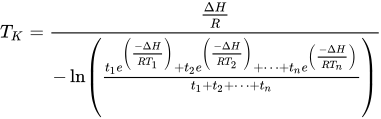
Where:
- is the mean kinetic temperature in kelvins
- is the activation energy (in kJ mol−1)
- is the gas constant (in J mol−1 K−1)
- to are the temperatures at each of the sample points in kelvins
- to are time intervals at each of the sample points


When the temperature readings are taken at the same interval (i.e., = = = ), the above equation is reduced to:


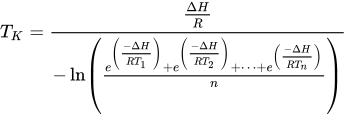
Where:
- is the number of temperature sample points

References
- ↑Jenkins, David; Cancel, Aida; Layloff, Thomas (2022). "Mean kinetic temperature evaluations through simulated temperature excursions and risk assessment with oral dosage usage for health programs". BMC Public Health. 22 (1): 300. doi:10.1186/s12889-022-12660-9. PMC 8842539.
Categories:
- Temperature
- Pharmaceutical industry