Articulo de referencia

Neville theta functions

In mathematics, the Neville theta functions , named after Eric Harold Neville , [ 1 ] are defined as follows: [ 2 ] [ 3 ] [ 4 ] θ c ( z , m ) = 2 π q ( m ) 1 / 4 m 1 / 4 K ( m )...

In mathematics, the Neville theta functions, named after Eric Harold Neville,[1] are defined as follows:[2][3][4]


θc(z,m)=2πq(m)1/4m1/4K(m)k=0(q(m))k(k+1)cos((2k+1)πz2K(m)){\displaystyle \theta _{c}(z,m)={\frac {{\sqrt {2\pi }}\,q(m)^{1/4}}{m^{1/4}{\sqrt {K(m)}}}}\,\,\sum _{k=0}^{\infty }(q(m))^{k(k+1)}\cos \left({\frac {(2k+1)\pi z}{2K(m)}}\right)}

θd(z,m)=2π2K(m)(1+2k=1(q(m))k2cos(πzkK(m))){\displaystyle \theta _{d}(z,m)={\frac {\sqrt {2\pi }}{2{\sqrt {K(m)}}}}\,\,\left(1+2\,\sum _{k=1}^{\infty }(q(m))^{k^{2}}\cos \left({\frac {\pi zk}{K(m)}}\right)\right)}

θn(z,m)=2π2(1m)1/4K(m)(1+2k=1(1)k(q(m))k2cos(πzkK(m))){\displaystyle \theta _{n}(z,m)={\frac {\sqrt {2\pi }}{2(1-m)^{1/4}{\sqrt {K(m)}}}}\,\,\left(1+2\sum _{k=1}^{\infty }(-1)^{k}(q(m))^{k^{2}}\cos \left({\frac {\pi zk}{K(m)}}\right)\right)}

θs(z,m)=2πq(m)1/4m1/4(1m)1/4K(m)k=0(1)k(q(m))k(k+1)sin((2k+1)πz2K(m)){\displaystyle \theta _{s}(z,m)={\frac {{\sqrt {2\pi }}\,q(m)^{1/4}}{m^{1/4}(1-m)^{1/4}{\sqrt {K(m)}}}}\,\,\sum _{k=0}^{\infty }(-1)^{k}(q(m))^{k(k+1)}\sin \left({\frac {(2k+1)\pi z}{2K(m)}}\right)}

where: K(m) is the complete elliptic integral of the first kind, K(m)=K(1m){\displaystyle K'(m)=K(1-m)}, and q(m)=eπK(m)/K(m){\displaystyle q(m)=e^{-\pi K'(m)/K(m)}} is the elliptic nome.

Note that the functions θp(z,m) are sometimes defined in terms of the nome q(m) and written θp(z,q) (e.g. NIST[5]). The functions may also be written in terms of the τ parameter θp(z|τ) where q=eiπτ{\displaystyle q=e^{i\pi \tau }}.

Relationship to other functions

The Neville theta functions may be expressed in terms of the Jacobi theta functions[5]

θs(z|τ)=θ32(0|τ)θ1(z|τ)/θ1(0|τ){\displaystyle \theta _{s}(z|\tau )=\theta _{3}^{2}(0|\tau )\theta _{1}(z'|\tau )/\theta '_{1}(0|\tau )}θc(z|τ)=θ2(z|τ)/θ2(0|τ){\displaystyle \theta _ {c}(z|\tau )=\theta _ {2}(z'|\tau )/\theta _ {2}(0|\tau )}θn(z|τ)=θ4(z|τ)/θ4(0|τ){\displaystyle \theta _ {n}(z|\tau )=\theta _ {4}(z'|\tau )/\theta _ {4}(0|\tau )}θd(z|τ)=θ3(z|τ)/θ3(0|τ){\displaystyle \theta _ {d}(z|\tau )=\theta _ {3}(z'|\tau )/\theta _ {3}(0|\tau )}

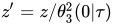
where z=z/θ32(0|τ){\displaystyle z'=z/\theta _ {3}^{2}(0|\tau )}.

The Neville theta functions are related to the Jacobi elliptic functions. If pq(u,m) is a Jacobi elliptic function (p and q are one of s,c,n,d), then
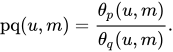
pq(u,m)=θp(u,m)θq(u,m).{\displaystyle \operatorname {pq} (u,m)={\frac {\theta _{p}(u,m)}{\theta _{q}(u,m)}}.}

Examples

  • θc(2.5,0.3)0.65900466676738154967{\displaystyle \theta _{c}(2.5,0.3)\approx -0.65900466676738154967}
  • θd(2.5,0.3)0.95182196661267561994{\displaystyle \theta _{d}(2.5,0.3)\approx 0.95182196661267561994}
  • θn(2.5,0.3)1.0526693354651613637{\displaystyle \theta _{n}(2.5,0.3)\approx 1.0526693354651613637}
  • θs(2.5,0.3)0.82086879524530400536{\displaystyle \theta _{s}(2.5,0.3)\approx 0.82086879524530400536}

Symmetry

  • θc(z,m)=θc(z,m){\displaystyle \theta _ {c}(z,m)=\theta _ {c}(-z,m)}
  • θd(z,m)=θd(z,m){\displaystyle \theta _{d}(z,m)=\theta _{d}(-z,m)}
  • θn(z,m)=θn(z,m){\displaystyle \theta _{n}(z,m)=\theta _{n}(-z,m)}
  • θs(z,m)=θs(z,m){\displaystyle \theta _{s}(z,m)=-\theta _{s}(-z,m)}

Complex 3D plots

References

  1. Abramowitz, Milton; Stegun, Irene Ann, eds. (1983) [June 1964]. Handbook of Mathematical Functions with Formulas, Graphs, and Mathematical Tables. Applied Mathematics Series. Vol. 55 (Ninth reprint with additional corrections of tenth original printing with corrections (December 1972); first ed.). Washington D.C.; New York: United States Department of Commerce, National Bureau of Standards; Dover Publications. pp. 578–579. ISBN 978-0-486-61272-0. LCCN 64-60036. MR 0167642. LCCN 65-12253.
  2. Neville, E. H. (Eric Harold) (1944). Jacobian Elliptic Functions. Oxford Clarendon Press.
  3. The Mathematical Functions Site
  4. The Mathematical Functions Site
  5. 12Olver, F. W. J.; et al., eds. (2017-12-22). "NIST Digital Library of Mathematical Functions (Release 1.0.17)". National Institute of Standards and Technology. Retrieved 2018-02-26.