Articulo de referencia

Funciones theta de Neville

En matemáticas, las funciones theta de Neville , llamadas así en honor a Eric Harold Neville , [1] se definen de la siguiente manera: [2] [3] [4] θ do ( el , metro ) = 2 π q ( m...

En matemáticas, las funciones theta de Neville , llamadas así en honor a Eric Harold Neville , [1] se definen de la siguiente manera: [2] [3] [4]

θ do ( el , metro ) = 2 π q ( metro ) 1 / 4 metro 1 / 4 K ( metro ) a = 0 ( q ( metro ) ) a ( a + 1 ) porque ( ( 2 a + 1 ) π el 2 K ( metro ) ) {\displaystyle \theta _{c}(z,m)={\frac {{\sqrt {2\pi }}\,q(m)^{1/4}}{m^{1/4}{\sqrt {K(m)}}}}\,\,\sum _{k=0}^{\infty }(q(m))^{k(k+1)}\cos \left({\frac {(2k+1)\pi z}{2K(m)}}\right)}
θ d ( el , metro ) = 2 π 2 K ( metro ) ( 1 + 2 a = 1 ( q ( metro ) ) a 2 porque ( π el a K ( metro ) ) ) {\displaystyle \theta _{d}(z,m)={\frac {\sqrt {2\pi }}{2{\sqrt {K(m)}}}}\,\,\left(1+2\,\sum _{k=1}^{\infty }(q(m))^{k^{2}}\cos \left({\frac {\pi zk}{K(m)}}\right)\right)}
θ norte ( el , metro ) = 2 π 2 ( 1 metro ) 1 / 4 K ( metro ) ( 1 + 2 a = 1 ( 1 ) a ( q ( metro ) ) a 2 porque ( π el a K ( metro ) ) ) {\displaystyle \theta _{n}(z,m)={\frac {\sqrt {2\pi }}{2(1-m)^{1/4}{\sqrt {K(m)}}}}\,\,\left(1+2\sum _{k=1}^{\infty }(-1)^{k}(q(m))^{k^{2}}\cos \left({\frac {\pi zk}{K(m)}}\right)\right)}
θ s ( el , metro ) = 2 π q ( metro ) 1 / 4 metro 1 / 4 ( 1 metro ) 1 / 4 K ( metro ) a = 0 ( 1 ) a ( q ( metro ) ) a ( a + 1 ) pecado ( ( 2 a + 1 ) π el 2 K ( metro ) ) {\displaystyle \theta _{s}(z,m)={\frac {{\sqrt {2\pi }}\,q(m)^{1/4}}{m^{1/4}(1-m)^{1/4}{\sqrt {K(m)}}}}\,\,\sum _{k=0}^{\infty }(-1)^{k}(q(m))^{k(k+1)}\sin \left({\frac {(2k+1)\pi z}{2K(m)}}\right)}

donde: K(m) es la integral elíptica completa de primer tipo, , y es el nomo elíptico. K " ( metro ) = K ( 1 metro ) {\displaystyle K'(m)=K(1-m)} q ( metro ) = mi π K " ( metro ) / K ( metro ) {\displaystyle q(m)=e^{-\pi K'(m)/K(m)}}

Nótese que las funciones θ p (z,m) a veces se definen en términos del nombre q(m) y se escriben θ p (z,q) (por ejemplo, NIST [5] ). Las funciones también se pueden escribir en términos del parámetro τ θ p (z|τ) donde . q = mi i π τ {\displaystyle q=e^{i\pi \tau}}

Relación con otras funciones

Las funciones theta de Neville pueden expresarse en términos de las funciones theta de Jacobi [5]


θ s ( el | τ ) = θ 3 2 ( 0 | τ ) θ 1 ( el " | τ ) / θ 1 " ( 0 | τ ) {\displaystyle \theta _{s}(z|\tau )=\theta _{3}^{2}(0|\tau )\theta _{1}(z'|\tau )/\theta '_ {1}(0|\tau)}
θ do ( el | τ ) = θ 2 ( el " | τ ) / θ 2 ( 0 | τ ) {\displaystyle \theta _ {c}(z|\tau )=\theta _ {2}(z'|\tau )/\theta _ {2}(0|\tau )}
θ norte ( el | τ ) = θ 4 ( el " | τ ) / θ 4 ( 0 | τ ) {\displaystyle \theta _ {n}(z|\tau )=\theta _ {4}(z'|\tau )/\theta _ {4}(0|\tau )}
θ d ( el | τ ) = θ 3 ( el " | τ ) / θ 3 ( 0 | τ ) {\displaystyle \theta _ {d}(z|\tau )=\theta _ {3}(z'|\tau )/\theta _ {3}(0|\tau )}

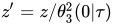
dónde . el " = el / θ 3 2 ( 0 | τ ) {\displaystyle z'=z/\theta _ {3}^{2}(0|\tau )}

Las funciones theta de Neville están relacionadas con las funciones elípticas de Jacobi . Si pq(u,m) es una función elíptica de Jacobi (p y q son uno de s,c,n,d), entonces
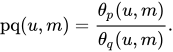
pq ( , metro ) = θ pag ( , metro ) θ q ( , metro ) . {\displaystyle \operatorname {pq}(u,m)={\frac {\theta _{p}(u,m)}{\theta _{q}(u,m)}}.}

Ejemplos

  • θ do ( 2.5 , 0.3 ) 0,65900466676738154967 {\displaystyle \theta _{c}(2,5,0,3)\aproximadamente -0,65900466676738154967}
  • θ d ( 2.5 , 0.3 ) 0,95182196661267561994 {\displaystyle \theta _{d}(2,5,0,3)\aproximadamente 0,95182196661267561994}
  • θ norte ( 2.5 , 0.3 ) 1.0526693354651613637 {\displaystyle \theta _{n}(2,5,0,3)\aproximadamente 1,0526693354651613637}
  • θ s ( 2.5 , 0.3 ) 0,82086879524530400536 {\displaystyle \theta _{s}(2,5,0,3)\aproximadamente 0,82086879524530400536}

Simetría

  • θ do ( el , metro ) = θ do ( el , metro ) {\displaystyle \theta_{c}(z,m)=\theta_{c}(-z,m)}
  • θ d ( el , metro ) = θ d ( el , metro ) {\displaystyle \theta_{d}(z,m)=\theta_{d}(-z,m)}
  • θ norte ( el , metro ) = θ norte ( el , metro ) {\displaystyle \theta_{n}(z,m)=\theta_{n}(-z,m)}
  • θ s ( el , metro ) = θ s ( el , metro ) {\displaystyle \theta_{s}(z,m)=-\theta_{s}(-z,m)}

Gráficos 3D complejos

Notas

  1. ^ Abramowitz y Stegun, págs. 578-579
  2. ^ Neville (1944)
  3. ^ El sitio de funciones matemáticas
  4. ^ El sitio de funciones matemáticas
  5. ^ ab Olver, FWJ; et al., eds. (2017-12-22). "Biblioteca digital de funciones matemáticas del NIST (versión 1.0.17)". Instituto Nacional de Estándares y Tecnología . Consultado el 26 de febrero de 2018 .

Referencias

Obtenido de "https://es.wikipedia.org/w/index.php?title=Funciones_theta_de_Neville&oldid=1223139890"