 Hispanopedia Wiki
In pharmacology, bioavailability is a subcategory of absorption and is the fraction (%) of an administered drug that reaches the systemic circulation.[1]
By definition, when a medication is administered intravenously, its bioavailability is 100%.[2][3] However, when a medication is administered via routes other than intravenous, its bioavailability is lower due to intestinal epithelium absorption and first-pass metabolism. Thereby, mathematically, bioavailability equals the ratio of comparing the area under the plasma drug concentration curve versus time (AUC) for the extravascular formulation to the AUC for the intravascular formulation.[4] AUC is used because AUC is proportional to the dose that has entered the systemic circulation.[5]
Bioavailability of a drug is an average value; to take population variability into account, deviation range is shown as ±.[4] To ensure that the drug taker who has poor absorption is dosed appropriately, the bottom value of the deviation range is employed to represent real bioavailability and to calculate the drug dose needed for the drug taker to achieve systemic concentrations similar to the intravenous formulation.[4] To dose without knowing the drug taker's absorption rate, the bottom value of the deviation range is used in order to ensure the intended efficacy, unless the drug is associated with a narrow therapeutic window.[4]
For dietary supplements, herbs and other nutrients in which the route of administration is nearly always oral, bioavailability generally designates simply the quantity or fraction of the ingested dose that is absorbed.[6][7][8]
Definitions
In pharmacology
Bioavailability is a term used to describe the percentage of an administered dose of a xenobiotic that reaches the systemic circulation.[9] It is denoted by the letter f (or, if expressed in percent, by F).
In nutritional science
En la ciencia de la nutrición , que abarca la ingesta de nutrientes e ingredientes dietéticos no farmacológicos, el concepto de biodisponibilidad carece de los estándares bien definidos asociados con la industria farmacéutica. La definición farmacológica no puede aplicarse a estas sustancias porque la utilización y absorción dependen del estado nutricional y fisiológico del sujeto, [ 6 ] lo que resulta en diferencias aún mayores entre individuos (variabilidad interindividual). Por lo tanto, la biodisponibilidad de los suplementos dietéticos puede definirse como la proporción de la sustancia administrada que es capaz de ser absorbida y está disponible para su uso o almacenamiento. [ 10 ]
Tanto en farmacología como en ciencias de la nutrición, la biodisponibilidad se mide calculando el área bajo la curva (AUC) del perfil de concentración del fármaco en función del tiempo.
Biodisponibilidad absoluta

La biodisponibilidad absoluta compara la biodisponibilidad del fármaco activo en la circulación sistémica tras la administración no intravenosa (es decir, tras la administración oral , bucal, ocular, nasal, rectal, transdérmica , subcutánea o sublingual ), con la biodisponibilidad del mismo fármaco tras la administración intravenosa. Es la fracción de exposición a un fármaco (AUC) mediante la administración no intravenosa en comparación con la administración intravenosa correspondiente del mismo fármaco. [ 11 ] La comparación debe normalizarse según la dosis (por ejemplo, teniendo en cuenta las diferentes dosis o los distintos pesos de los sujetos); en consecuencia, la cantidad absorbida se corrige dividiendo la dosis administrada correspondiente.
En farmacología, para determinar la biodisponibilidad absoluta de un fármaco, se debe realizar un estudio farmacocinético para obtener una gráfica de concentración plasmática del fármaco en función del tiempo, tanto para la administración intravenosa (IV) como extravascular (no intravenosa, es decir, oral). La biodisponibilidad absoluta es el área bajo la curva ( AUC ) corregida por dosis para la administración no intravenosa, dividida por el AUC para la administración intravenosa. La fórmula para calcular la biodisponibilidad absoluta, F , de un fármaco administrado por vía oral (po) se muestra a continuación (donde D es la dosis administrada).
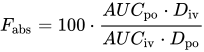
Therefore, a drug given by the intravenous route will have an absolute bioavailability of 100% (f = 1), whereas drugs given by other routes usually have an absolute bioavailability of less than one. If we compare the two different dosage forms having same active ingredients and compare the two drug bioavailability is called comparative bioavailability.[12]
Although knowing the true extent of systemic absorption (referred to as absolute bioavailability) is clearly useful, in practice it is not determined as frequently as one may think. The reason for this is that its assessment requires an intravenous reference; that is, a route of administration that guarantees all of the administered drug reaches systemic circulation. Such studies come at considerable cost, not least of which is the necessity to conduct preclinical toxicity tests to ensure adequate safety, as well as potential problems due to solubility limitations. These limitations may be overcome, however, by administering a very low dose (typically a few micrograms) of an isotopically labelled drug concomitantly with a therapeutic non-isotopically labelled oral dose (the isotopically labelled intravenous dose is sufficiently low so as not to perturb the systemic drug concentrations achieved from the non-labelled oral dose). The intravenous and oral concentrations can then be deconvoluted by virtue of their different isotopic constitution, and can thus be used to determine the oral and intravenous pharmacokinetics from the same dose administration. This technique eliminates pharmacokinetic issues with non-equivalent clearance as well as enabling the intravenous dose to be administered with a minimum of toxicology and formulation. The technique was first applied using stable-isotopes such as 13C and mass-spectrometry to distinguish the isotopes by mass difference. More recently, 14C labelled drugs are administered intravenously and accelerator mass spectrometry (AMS) used to measure the isotopically labelled drug along with mass spectrometry for the unlabelled drug.[13]
There is no regulatory requirement to define the intravenous pharmacokinetics or absolute bioavailability however regulatory authorities do sometimes ask for absolute bioavailability information of the extravascular route in cases in which the bioavailability is apparently low or variable and there is a proven relationship between the pharmacodynamics and the pharmacokinetics at therapeutic doses. In all such cases, to conduct an absolute bioavailability study requires that the drug be given intravenously.[14]
Intravenous administration of a developmental drug can provide valuable information on the fundamental pharmacokinetic parameters of volume of distribution (V) and clearance (CL).[14]
Relative bioavailability and bioequivalence
In pharmacology, relative bioavailability measures the bioavailability (estimated as the AUC) of a formulation (A) of a certain drug when compared with another formulation (B) of the same drug, usually an established standard, or through administration via a different route. When the standard consists of intravenously administered drug, this is known as absolute bioavailability (see above).

Relative bioavailability is one of the measures used to assess bioequivalence (BE) between two drug products. For FDA approval, a generic manufacturer must demonstrate that the 90% confidence interval for the ratio of the mean responses (usually of AUC and the maximum concentration, Cmax) of its product to that of the "brand name drug"[OB] is within the limits of 80% to 125%. Where AUC refers to the concentration of the drug in the blood over time t = 0 to t = ∞, Cmax refers to the maximum concentration of the drug in the blood. When Tmax is given, it refers to the time it takes for a drug to reach Cmax.
While the mechanisms by which a formulation affects bioavailability and bioequivalence have been extensively studied in drugs, formulation factors that influence bioavailability and bioequivalence in nutritional supplements are largely unknown.[15] As a result, in nutritional sciences, relative bioavailability or bioequivalence is the most common measure of bioavailability, comparing the bioavailability of one formulation of the same dietary ingredient to another.
Factors influencing bioavailability
The absolute bioavailability of a drug, when administered by an extravascular route, is usually less than one (i.e., F< 100%). Various physiological factors reduce the availability of drugs prior to their entry into the systemic circulation. Whether a drug is taken with or without food will also affect absorption, other drugs taken concurrently may alter absorption and first-pass metabolism, intestinal motility alters the dissolution of the drug and may affect the degree of chemical degradation of the drug by intestinal microflora. Disease states affecting liver metabolism or gastrointestinal function will also have an effect.
Otros factores pueden incluir, entre otros:
- Propiedades físicas del fármaco ( hidrofobicidad , pKa , solubilidad )
- La formulación del fármaco (liberación inmediata, excipientes utilizados, métodos de fabricación, liberación modificada : liberación retardada, liberación prolongada, liberación sostenida, etc.)
- Si la formulación se administra en estado posprandial o en ayunas
- Tasa de vaciamiento gástrico
- diferencias circadianas
- Interacciones con otros medicamentos/alimentos:
- Interacciones con otros medicamentos (por ejemplo, antiácidos , alcohol, nicotina)
- Interacciones con otros alimentos (por ejemplo, jugo de toronja , pomelo , jugo de arándano , verduras crucíferas )
- Transportadores: Sustrato de los transportadores de eflujo (por ejemplo , la glicoproteína P )
- Salud del tracto gastrointestinal
- Inducción/inhibición enzimática por otros fármacos/alimentos:
- Inducción enzimática (aumento de la tasa metabólica), por ejemplo, la fenitoína induce CYP1A2 , CYP2C9 , CYP2C19 y CYP3A4.
- Inhibición enzimática (disminución de la tasa metabólica), por ejemplo, el jugo de toronja inhibe la CYP3A → concentraciones más altas de nifedipino
- Variación individual en las diferencias metabólicas
- Edad: En general, los fármacos se metabolizan más lentamente en poblaciones fetales, neonatales y geriátricas.
- Diferencias fenotípicas , circulación enterohepática , dieta, género
- estado de enfermedad
Cada uno de estos factores puede variar de un paciente a otro (variabilidad interindividual) e incluso en el mismo paciente a lo largo del tiempo (variabilidad intraindividual). En los ensayos clínicos , la variabilidad interindividual es una medida fundamental que se utiliza para evaluar las diferencias de biodisponibilidad entre pacientes y así garantizar una dosificación predecible.
Véase también
- ADME-Tox
- Sistema de clasificación biofarmacéutica
- Biodisponibilidad (suelo)
- Caco-2
- La regla de Lipinski de los 5
Notas
^ TH: One of the few exceptions where a drug shows F of over 100% is theophylline. If administered as an oral solution F is 111%, since the drug is completely absorbed and first-pass metabolism in the lung after intravenous administration is bypassed.[16]^ OB: Reference listed drug products (i.e., innovator's) as well as generic drug products that have been approved based on an Abbreviated New Drug Application are given in FDA's Orange Book.
References
- ^Hebert, Mary F. (2013). "Impact of Pregnancy on Maternal Pharmacokinetics of Medications". Clinical Pharmacology During Pregnancy. Elsevier. pp. 17–39. doi:10.1016/b978-0-12-386007-1.00003-9. ISBN 978-0-12-386007-1.
- ^Griffin, J. P. (7 December 2009). The Textbook of Pharmaceutical Medicine (6th ed.). Jersey: BMJ Books. p. 114. ISBN 978-1-4051-8035-1.
- ^Flynn, Edward (2007). "Pharmacokinetic Parameters". xPharm: The Comprehensive Pharmacology Reference. Elsevier. pp. 1–3. doi:10.1016/b978-008055232-3.60034-0. ISBN 978-0-08-055232-3.
- ^ abcdDavis, Jennifer L. (2018). "Pharmacologic Principles". Equine Internal Medicine. Elsevier. pp. 79–137. doi:10.1016/b978-0-323-44329-6.00002-4. ISBN 978-0-323-44329-6.
- ^Johanson, G. (2010). "Modeling of Disposition". Comprehensive Toxicology. Elsevier. pp. 153–177. doi:10.1016/b978-0-08-046884-6.00108-1. ISBN 978-0-08-046884-6.
- ^ abHeaney, Robert P. (2001). "Factors Influencing the Measurement of Bioavailability, Taking Calcium as a Model". The Journal of Nutrition. 131 (4): 1344S–8S. doi:10.1093/jn/131.4.1344S. PMID 11285351.
- ^Sanstead, HH; Au, W (2007). "Zinc". Handbook on the Toxicology of Metals. Elsevier. pp. 925–947. doi:10.1016/b978-012369413-3/50102-6. ISBN 978-0-12-369413-3.
Bioavailability is the major factor affecting dietary requirements (Sandstrom, 1997). Flesh foods facilitate bioavailability, although indigestible Zn-binding ligands decrease bioavailability (Mills, 1985).
- ^Solomons, N.W. (2003). "ZINC | Physiology". Encyclopedia of Food Sciences and Nutrition. Elsevier. pp. 6272–6277. doi:10.1016/b0-12-227055-x/01309-2. ISBN 978-0-12-227055-0.
Bioavailability strictly refers to both the uptake and metabolic utilization of a nutrient.
- ^Shargel, L.; Yu, A. B. (1999). Applied Biopharmaceutics & Pharmacokinetics (4th ed.). New York: McGraw-Hill. ISBN 978-0-8385-0278-5.
- ^Srinivasan, V. Srini (2001). "Bioavailability of Nutrients: A Practical Approach to In Vitro Demonstration of the Availability of Nutrients in Multivitamin-Mineral Combination Products". The Journal of Nutrition. 131 (4 Suppl): 1349–1350S. doi:10.1093/jn/131.4.1349S. PMID 11285352.
- ^Guilding, Clare (2023). "Defining and unpacking the core concepts of pharmacology A global initiative". British Journal of Pharmacology. 180 (9): 375–392. doi:10.1111/bph.16222. hdl:2440/139693. PMID 37605852. S2CID 261062472.
- ^Chow, Shein-Chung (July 2014). "Bioavailability and bioequivalence in drug development: BABE in drug development". Wiley Interdisciplinary Reviews: Computational Statistics. 6 (4): 304–312. doi:10.1002/wics.1310. PMC 4157693. PMID 25215170.
- ^Lappin, Graham; Rowland, Malcolm; Garner, R. Colin (2006). "The use of isotopes in the determination of absolute bioavailability of drugs in humans". Expert Opinion on Drug Metabolism & Toxicology. 2 (3): 419–427. doi:10.1517/17425255.2.3.419. PMID 16863443. S2CID 2383402.
- ^ abLappin, Graham; Stevens, Lloyd (2008). "Biomedical accelerator mass spectrometry: Recent applications in metabolism and pharmacokinetics". Expert Opinion on Drug Metabolism & Toxicology. 4 (8): 1021–1033. doi:10.1517/17425255.4.8.1021. PMID 18680438. S2CID 95122610.
- ^Hoag, Stephen W.; Hussain, Ajaz S. (2001). "The Impact of Formulation on Bioavailability: Summary of Workshop Discussion". The Journal of Nutrition. 131 (4 Suppl): 1389–1391S. doi:10.1093/jn/131.4.1389S. PMID 11285360.
- ^Schuppan, D.; Molz, K. H.; Staib, A. H.; Rietbrock, N. (1981). "Bioavailability of theophylline from a sustained-release aminophylline formulation (Euphyllin retard tablets) – plasma levels after single and multiple oral doses". International Journal of Clinical Pharmacology, Therapy, and Toxicology. 19 (5): 223–227. PMID 7251238.
Sources
- Rowland, Malcolm; Tozer, N. (2010). Clinical Pharmacokinetics and Pharmacodynamics: Concepts and Applications (4 ed.). Philadelphia, PA: Lippincott Williams & Wilkins. ISBN 978-0-7817-5009-7.
- Welling, Peter G.; Tse, Francis L. S.; Dighe, Shrikant V. (1991). Pharmaceutical Bioequivalence. Drugs and the Pharmaceutical Sciences. Vol. 48. New York, NY: Marcel Dekker. ISBN 978-0-8247-8484-3.
- Hauschke, Dieter; Steinijans, Volker; Pigeot, Iris (2007). "Metrics to characterize concentration-time profiles in single- and multiple-dose bioequivalence studies". Bioequivalence Studies in Drug Development: Methods and Applications. Statistics in Practice. Chichester, UK: John Wiley and Sons. pp. 17–36. ISBN 978-0-470-09475-4. Retrieved 21 April 2011.
- Chow, Shein-Chung; Liu, Jen-pei (15 October 2008). Design and Analysis of Bioavailability and Bioequivalence Studies. Biostatistics Series. Vol. 27 (3rd ed.). FL: CRC Press. ISBN 978-1-58488-668-6.
- Pharmacokinetic metrics
- Medicinal chemistry
- Life sciences industry