 Hispanopedia Wiki
El umbral de percolación es un concepto matemático en la teoría de la percolación que describe la formación de conectividad de largo alcance en sistemas aleatorios . Por debajo del umbral, no existe un componente conectado gigante ; mientras que por encima de él, existe un componente gigante del orden del tamaño del sistema. En ingeniería y preparación de café , la percolación representa el flujo de fluidos a través de medios porosos , pero en el mundo de las matemáticas y la física generalmente se refiere a modelos reticulares simplificados de sistemas o redes aleatorias ( grafos ) y a la naturaleza de la conectividad en ellos. El umbral de percolación es el valor crítico de la probabilidad de ocupación p , o más generalmente una superficie crítica para un grupo de parámetros p 1 , p 2 , ..., tal que la conectividad infinita ( percolación ) ocurre por primera vez. [ 1 ]
Modelos de percolación
El modelo de percolación más común consiste en tomar una red regular, como una red cuadrada , y convertirla en una red aleatoria "ocupando" aleatoriamente sitios (vértices) o enlaces (aristas) con una probabilidad estadísticamente independiente p . En un umbral crítico p c , aparecen por primera vez grandes cúmulos y conectividad de largo alcance, y esto se denomina umbral de percolación . Dependiendo del método para obtener la red aleatoria, se distingue entre el umbral de percolación de sitios y el umbral de percolación de enlaces . Los sistemas más generales tienen varias probabilidades p 1 , p 2 , etc., y la transición se caracteriza por una superficie o variedad crítica . También se pueden considerar sistemas continuos, como discos y esferas superpuestos colocados aleatoriamente, o el espacio negativo ( modelos de queso suizo ).
Para comprender el umbral, se puede considerar una magnitud como la probabilidad de que exista un camino continuo de un límite a otro a lo largo de sitios o enlaces ocupados, es decir, dentro de un mismo clúster. Por ejemplo, se puede considerar un sistema cuadrado y calcular la probabilidad P de que exista un camino desde el límite superior al límite inferior. En función de la probabilidad de ocupación p , se obtiene una gráfica sigmoidal que va de P=0 en p=0 a P=1 en p=1 . Cuanto mayor sea el cuadrado en comparación con el espaciado de la red, más abrupta será la transición. Cuando el tamaño del sistema tiende a infinito, P(p) será una función escalón en el valor umbral p c . Para sistemas finitos grandes, P(p c ) es una constante cuyo valor depende de la forma del sistema; para el sistema cuadrado descrito anteriormente, P(p c ) = 1/2 exactamente para cualquier red mediante un simple argumento de simetría .
Existen otras características del umbral crítico. Por ejemplo, la distribución de tamaños (número de cúmulos de tamaño s ) disminuye siguiendo una ley de potencias para valores grandes de s en el umbral, n s (p c ) ~ s −τ , donde τ es un exponente crítico de percolación que depende de la dimensión . Para un sistema infinito, el umbral crítico corresponde al primer punto (a medida que p aumenta) donde el tamaño de los cúmulos tiende a infinito.
En los sistemas descritos hasta ahora, se ha asumido que la ocupación de un sitio o enlace es completamente aleatoria; esta es la llamada percolación de Bernoulli . Para un sistema continuo, la ocupación aleatoria corresponde a que los puntos se coloquen mediante un proceso de Poisson . Otras variaciones implican percolación correlacionada, como los clústeres de percolación relacionados con los modelos de Ising y Potts de ferromagnetos, en los que los enlaces se colocan mediante el método de Fortuin- Kasteleyn . [ 2 ] En la percolación bootstrap o k-sat , los sitios y/o enlaces se ocupan primero y luego se eliminan sucesivamente de un sistema si un sitio no tiene al menos k vecinos. Otro modelo importante de percolación, en una clase de universalidad completamente diferente, es la percolación dirigida , donde la conectividad a lo largo de un enlace depende de la dirección del flujo. Otra variación de interés reciente es la percolación explosiva , cuyos umbrales se enumeran en esa página.
En las últimas décadas, se ha dedicado un enorme esfuerzo a determinar los valores exactos y aproximados de los umbrales de percolación para diversos sistemas. Los umbrales exactos solo se conocen para ciertas redes bidimensionales que pueden descomponerse en una matriz autodual, de modo que, tras una transformación triángulo-triángulo, el sistema permanece inalterado. Los estudios que emplean métodos numéricos han propiciado numerosas mejoras en los algoritmos y diversos descubrimientos teóricos.
La dualidad simple en dos dimensiones implica que todas las redes completamente trianguladas (por ejemplo, la triangular, la union jack, la dual cruzada, la dual martini y la dual asanoha o 3-12, y la triangulación de Delaunay) tienen umbrales de sitio de 1/2 , y las redes autoduales (cuadrada, martini-B) tienen umbrales de enlace de 1/2 .
La notación como (4,8 2 ) proviene de Grünbaum y Shephard , [ 3 ] e indica que alrededor de un vértice dado, en sentido horario, se encuentra primero un cuadrado y luego dos octógonos. Además de las once redes arquimedianas compuestas por polígonos regulares con cada sitio equivalente, se han estudiado muchas otras redes más complejas con sitios de diferentes clases.
Las barras de error en el último dígito o dígitos se muestran con números entre paréntesis. Así, 0,729724(3) significa 0,729724 ± 0,000003, y 0,74042195(80) significa 0,74042195 ± 0,00000080. Las barras de error representan, según la fuente, una o dos desviaciones estándar del error neto (incluidos el error estadístico y el error sistemático esperado), o un intervalo de confianza empírico.
Percolación en redes
Para una red aleatoria tipo árbol (es decir, una red conectada sin ciclos) sin correlación grado-grado, se puede demostrar que dicha red puede tener un componente gigante , y el umbral de percolación (probabilidad de transmisión) viene dado por
.
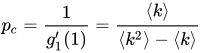
Dóndees la función generadora correspondiente a la distribución de grado en exceso ,es el grado promedio de la red yes el segundo momento de la distribución de grados . Por lo tanto, por ejemplo, para una red ER , dado que la distribución de grados es una distribución de Poisson , dondeEl umbral está en.


En redes con baja agrupación ,, el punto crítico se escala porde tal manera que: [ 4 ]


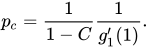
Esto indica que, para una distribución de grados dada, el agrupamiento conduce a un umbral de percolación mayor, principalmente porque, para un número fijo de enlaces, la estructura de agrupamiento refuerza el núcleo de la red a costa de diluir las conexiones globales. Para redes con alto agrupamiento, un agrupamiento fuerte podría inducir la estructura núcleo-periferia, en la que el núcleo y la periferia podrían percolar en diferentes puntos críticos, y el tratamiento aproximado anterior no es aplicable. [ 5 ]
Percolación en 2D
Umbrales en retículos arquimedianos

Nota: a veces se usa "hexagonal" en lugar de "panal", aunque en algunos contextos una red triangular también se denomina red hexagonal . z = número de coordinación global .
Redes 2D con vecindarios extendidos y complejos
En esta sección, sq-1,2,3 corresponde a cuadrado (NN+2NN+3NN), [ 42 ] etc. Equivalente a cuadrado-2N+3N+4N, [ 43 ] sq(1,2,3). [ 44 ] tri = triangular, hc = panal.
Aquí NN = vecino más cercano, 2NN = segundo vecino más cercano (o siguiente vecino más cercano), 3NN = tercer vecino más cercano (o siguiente vecino más cercano), etc. En algunos artículos también se les denomina 2N, 3N y 4N respectivamente. [ 42 ]
- Para cuadrados superpuestos o que se tocan,(sitio) que se muestra aquí es la fracción neta de sitios ocupadossimilar a laen percolación continua. El caso de un cuadrado de 2×2 es equivalente a la percolación de una red cuadrada NN+2NN+3NN+4NN o sq-1,2,3,4 con umbral.con. [ 56 ] El cuadrado de 3×3 corresponde a sq-1,2,3,4,5,6,7,8 con z =44 y. El valor de z para un cuadrado k × k es (2 k +1) 2 -5.




Redes distorsionadas en 2D
Aquí, se distorsiona una red regular de espaciado unitario moviendo los vértices uniformemente dentro de la caja.y considera la percolación cuando los sitios están dentro de la distancia euclidiana.del otro.


Superposición de formas en redes 2D
El umbral del sitio es el número de objetos superpuestos por sitio de la red. k es la longitud (área neta). Los cuadrados superpuestos se muestran en la sección de vecindario complejo. Aquí z es el número de coordinación a k-meros de cualquier orientación, conparapalos.


La cobertura se calcula a partir deporpara palos, porque hay sitios donde un palo provocará una superposición con un sitio determinado.


Para alineadopalitos:

Fórmulas aproximadas para umbrales de retículos arquimedianos
Percolación AB y percolación coloreada en 2D
En la percolación AB, unes la proporción de sitios A entre sitios B, y se dibujan enlaces entre sitios de especies opuestas. [ 63 ] También se denomina antipercolación.

En la percolación coloreada, a los sitios ocupados se les asigna uno decolores con igual probabilidad, y la conexión se realiza a lo largo de los enlaces entre vecinos de diferentes colores. [ 64 ]

Percolación de enlaces de sitio en 2D
Percolación de enlaces del sitio. Aquíes la probabilidad de ocupación del sitio yes la probabilidad de ocupación del enlace, y la conectividad se establece solo si tanto los sitios como los enlaces a lo largo de una ruta están ocupados. La condición de criticidad se convierte en una curva= 0, y algunos pares críticos específicosse enumeran a continuación.


Rejilla cuadrada:
Estructura reticular hexagonal (tipo panal):
Celosía de Kagome:
* Para valores en diferentes redes, véase "Una investigación de la percolación de enlaces de sitio en muchas redes". [ 69 ]
Fórmula aproximada para la percolación de enlaces de sitio en una red de panal
Duales arquimedianos (retículos de Laves)

Las retículas de Laves son las duales de las retículas arquimedianas. Dibujos de. [ 6 ] Véase también Teselaciones uniformes .
Redes 2-uniformes
Tres retículas superiores: #13 #12 #36 Tres retículas inferiores: #34 #37 #11

Dos retículas superiores: #35 #30 Dos retículas inferiores: #41 #42

4 rejillas superiores: #22 #23 #21 #20 3 rejillas inferiores: #16 #17 #15

Dos retículas superiores: #31 #32 Retícula inferior: #33

Red 2-uniforme no homogénea

Esta figura muestra algo similar a la red 2-uniforme n.° 37, excepto que los polígonos no son todos regulares (hay un rectángulo en lugar de los dos cuadrados) y su tamaño ha cambiado. Esta red se encuentra en la representación isoradial, donde cada polígono está inscrito en un círculo de radio unitario. Los dos cuadrados de la red 2-uniforme deben representarse ahora como un único rectángulo para satisfacer la condición isoradial. La red se muestra con bordes negros y la red dual con líneas discontinuas rojas. Los círculos verdes muestran la restricción isoradial tanto en la red original como en la dual. Los polígonos amarillos resaltan los tres tipos de polígonos en la red, y los polígonos rosas resaltan los dos tipos de polígonos en la red dual. La red tiene tipos de vértice ( 1 ⁄ 2 )(3 3 ,4 2 ) + ( 1 ⁄ 2 )(3,4,6,4), mientras que la red dual tiene tipos de vértice ( 1 ⁄ 15 )(4 6 )+( 6 ⁄ 15 )(4 2 ,5 2 )+( 2 ⁄ 15 )(5 3 )+( 6 ⁄ 15 )(5 2 ,4). El punto crítico es donde los enlaces más largos (tanto en la red como en la red dual) tienen una probabilidad de ocupación p = 2 sin (π/18) = 0,347296... que es el umbral de percolación de enlaces en una red triangular, y los enlaces más cortos tienen una probabilidad de ocupación 1 − 2 sin(π/18) = 0,652703..., que es la percolación de enlaces en una red hexagonal. Estos resultados se derivan de la condición isoradial [ 75 ] , pero también se derivan de aplicar la transformación estrella-triángulo a ciertas estrellas en la red de panal. Finalmente, se puede generalizar a tener tres probabilidades diferentes en las tres direcciones diferentes, p 1 , p 2 y p 3 para los enlaces largos, y 1 − p 1 , 1 − p 2 , y 1 − p 3 para los enlaces cortos, donde p 1 , p 2 y p 3 satisfacen la superficie crítica para la red triangular no homogénea.
Umbrales en celosías de pajarita y martini 2D
A la izquierda, en el centro y a la derecha se encuentran: la red martini, la red martini-A y la red martini-B. Abajo: la red de recubrimiento/medial martini, igual que la subred de 2×2 y 1×1 para redes tipo kagome (eliminada).

Otros ejemplos de retículos de pajarita generalizados (ad) y los duales de los retículos (eh):

Umbrales en retículas de cobertura, mediales y de coincidencia 2D


Umbrales en redes no planas de quimeras bidimensionales
Umbrales en redes de subredes

Las subredes kagome de 2 × 2, 3 × 3 y 4 × 4. La subred de 2 × 2 también se conoce como la red "kagome triangular". [ 84 ]
Umbrales de objetos adsorbidos secuencialmente al azar
(Para obtener más resultados y una comparación con la densidad de atasco, consulte Adsorción secuencial aleatoria ).
El umbral indica la fracción de sitios ocupados por los objetos cuando comienza la percolación de sitios (no cuando se produce el bloqueo total). Para k-meros más largos, véase la referencia [ 93 ] .
Umbrales de recubrimientos completos de dímeros en redes bidimensionales
Aquí, trabajamos con redes que se obtienen cubriendo una red con dímeros, y luego consideramos la percolación de enlaces en los enlaces restantes. En matemáticas discretas, este problema se conoce como el problema del " emparejamiento perfecto " o el problema del "recubrimiento de dímeros".
Umbrales de polímeros (paseos aleatorios) en una red cuadrada
El sistema está compuesto por caminatas aleatorias ordinarias (no evitativas) de longitud l en la red cuadrada. [ 95 ]
Umbrales de recorridos autoevitantes de longitud k añadidos por adsorción secuencial aleatoria
Umbrales en redes inhomogéneas 2D
Umbrales para modelos continuos 2D


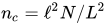
Para discos,es igual al número crítico de discos por unidad de área, medido en unidades del diámetro, dóndees el número de objetos yes el tamaño del sistema
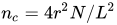


Para discos,equivale al área total crítica del disco.

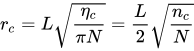
da el número de centros de disco dentro del círculo de influencia (radio 2 r).

es el radio crítico del disco.
para elipses de semiejes mayor y menor a y b, respectivamente. Relación de aspectocon.
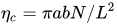


para rectángulos de dimensionesyRelación de aspectocon.
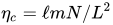


para discos distribuidos de ley de potencias con,.



es igual a la fracción del área crítica.
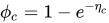
Para discos, consulte la referencia [ 104 ] .dóndees la densidad de discos de radio.


igual al número de objetos de longitud máxima por unidad de área.

Para elipsis,
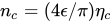
Para la percolación de vacíos,es la fracción de vacío crítica.

Para más valores de elipse, consulte [ 114 ] [ 118 ]
Para obtener más valores de rectángulo, consulte [ 122 ].
Tanto las elipses como los rectángulos pertenecen a las superelipses, conPara obtener más valores de percolación de superelipses, consulte [ 107 ] .

Para los sistemas de partículas monodispersas, los umbrales de percolación de superdiscos de forma cóncava se obtienen como se ve en [ 129 ].
Para dispersiones binarias de discos, véase [ 100 ] [ 130 ] [ 117 ]
Umbrales en redes aleatorias y cuasiredes bidimensionales


* Estimación teórica
Umbrales en sistemas correlacionados 2D
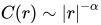
Suponiendo correlaciones de ley de potencias
Umbrales en losas
h es el espesor de la losa, h × ∞ × ∞. Las condiciones de contorno (bc) se refieren a los planos superior e inferior de la losa.
Percolación en 3D
Factor de llenado = fracción del espacio ocupado por esferas en contacto en cada sitio de la red (solo para sistemas con longitud de enlace uniforme ). También llamado factor de empaquetamiento atómico .
Fracción de llenado (o fracción de llenado crítico) = factor de llenado * p c (sitio).
NN = vecino más cercano, 2NN = vecino siguiente más cercano, 3NN = vecino siguiente-siguiente-más cercano, etc.
Los cubos kxkxk son cubos de sitios ocupados en una red, y son equivalentes a la percolación de rango extendido de un cubo de longitud (2k+1), con aristas y esquinas eliminadas, con z = (2k+1) 3 -12(2k-1)-9 (el sitio central no se cuenta en z).
Pregunta: los umbrales de enlace para las redes hcp y fcc coinciden dentro del pequeño margen de error estadístico. ¿Son idénticos? Si no lo son, ¿cuál es la diferencia? ¿Qué umbral se espera que sea mayor? Lo mismo se aplica a las redes del hielo y del diamante. Véase [ 195 ].
Redes tridimensionales distorsionadas
Aquí, se distorsiona una red regular de espaciado unitario moviendo los vértices uniformemente dentro del cubo.y considera la percolación cuando los sitios están dentro de la distancia euclidiana.del otro.

Superposición de formas en redes 3D
El umbral del sitio es el número de objetos superpuestos por sitio de la red. La cobertura φ c es la fracción neta de sitios cubiertos, y v es el volumen (número de cubos). Los cubos superpuestos se dan en la sección sobre umbrales de redes 3D. Aquí z es el número de coordinación a k-meros de cualquier orientación, con

La cobertura se calcula a partir depor para palos ypara plaquetas.


Percolación de dímeros en 3D
Umbrales para modelos continuos 3D
Todo se superpone, excepto las esferas atascadas y la matriz polimérica.
es el volumen total (para esferas), donde N es el número de objetos y L es el tamaño del sistema.

es la fracción de volumen crítica, válida para objetos superpuestos colocados aleatoriamente.
Para discos y placas, se trata de volúmenes efectivos y fracciones de volumen.
Para el modelo vacío ("queso suizo"),es la fracción de vacío crítica.
Para obtener más resultados sobre la percolación de vacíos alrededor de elipsoides y placas elípticas, consulte [ 222 ] .
Para obtener más valores de percolación elipsoidal, consulte [ 207 ] .
Para un análisis del efecto sinérgico de la forma y la polidispersidad de tamaño de óvalos 2D sobre el umbral de percolación de redes de grietas en el espacio 3D, véase [ 223 ] . La influencia de la forma y la polidispersidad de tamaño de los poros y las partículas duras es un factor crítico que debe considerarse en la práctica industrial. Los trabajos preliminares en esta área [ 224 ] [ 225 ] pueden ayudar a mejorar nuestra comprensión de su importancia para las propiedades macroscópicas de los materiales compuestos.
Para los esferocilindros, H/D es la relación entre la altura y el diámetro del cilindro, que luego está rematado por hemisferios. Se proporcionan valores adicionales en [ 204 ] .
Para las superbolas, m es el parámetro de deformación, los valores de percolación se dan en [ 226 ] [ 227 ] Además, los umbrales de las superbolas de forma cóncava también se determinan en [ 129 ]
Para partículas con forma de cuboide (superelipsoides), m es el parámetro de deformación; se proporcionan más valores de percolación en [ 206 ] .
Un estudio derivó una ley de mezcla para la percolación en medios porosos fracturados, combinando poros 3D superpuestos (superovoides) y fracturas 2D (superóvalos) [ 228 ] . El modelo considera la polidispersidad en tamaño y forma, validada mediante simulaciones y datos de la literatura. Este modelo conecta la percolación teórica y aplicada, facilitando la hidrología subterránea, los materiales cementicios y el diseño de nanocompuestos.
Percolación de vacíos en 3D
La percolación del vacío se refiere a la percolación en el espacio alrededor de objetos superpuestos. Aquí se refiere a la fracción del espacio ocupado por los huecos (no por las partículas) en el punto crítico, y está relacionada conpor . se define como en la sección de percolación continua anterior.

Umbrales en redes aleatorias y cuasiredes 3D
Umbrales para otros modelos 3D
En la percolación de perforación, el umbral del sitiorepresenta la fracción de columnas en cada dirección que no han sido eliminadas, y. Para la perforación 1D, tenemos(columnas)(sitios).


† En la percolación de tubos, el umbral de enlace representa el valor del parámetrode tal manera que la probabilidad de establecer una unión entre segmentos de tubo vertical vecinos es, dóndees la altura de superposición de dos segmentos de tubo adyacentes. [ 246 ]


Umbrales en diferentes espacios dimensionales
Modelos continuos en dimensiones superiores
![{\displaystyle \eta _{c}=(\pi ^{d/2}/\Gamma [d/2+1])r^{d}N/L^{d}.}](https://wikimedia.org/api/rest_v1/media/math/render/svg/90173c0ef117e66cd6feaf99b7e0f615aa0d83b7)
En 4d,.

En 5d,.

En 6d,.

es la fracción de volumen crítica, válida para objetos superpuestos.
Para modelos vacíos,es la fracción de vacío crítica, yes el volumen total de los objetos superpuestos
Umbrales en redes hipercúbicas
For thresholds on high dimensional hypercubic lattices, we have the asymptotic series expansions [249][257][260]


where . For 13-dimensional bond percolation, for example, the error with the measured value is less than 10−6, and these formulas can be useful for higher-dimensional systems.

Thresholds in other higher-dimensional lattices
Thresholds in one-dimensional long-range percolation

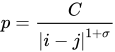
In a one-dimensional chain we establish bonds between distinct sites and with probability decaying as a power-law with an exponent . Percolation occurs[263][264] at a critical value for . The numerically determined percolation thresholds are given by:[265]




Thresholds on hyperbolic, hierarchical, and tree lattices
In these lattices there may be two percolation thresholds: the lower threshold is the probability above which infinite clusters appear, and the upper is the probability above which there is a unique infinite cluster.


Note: {m,n} is the Schläfli symbol, signifying a hyperbolic lattice in which n regular m-gons meet at every vertex
For bond percolation on {P,Q}, we have by duality . For site percolation, because of the self-matching of triangulated lattices.


Cayley tree (Bethe lattice) with coordination number

Thresholds for directed percolation


nn = nearest neighbors. For a (d + 1)-dimensional hypercubic system, the hypercube is in d dimensions and the time direction points to the 2D nearest neighbors.
Directed percolation with multiple neighbors

(1+1)-d square with z NN, square lattice for z odd, tilted square lattice for z even
For large z, pc ~ 1/z [291]
Site-Bond Directed Percolation
pb = bond threshold
ps = site threshold
Site-bond percolation is equivalent to having different probabilities of connections:
P0 = probability that no sites are connected = (1-ps) + ps(1-pb)2
P2 = probability that exactly one descendant is connected to the upper vertex (two connected together) = ps pb (1-pb)
P3 = probability that both descendants are connected to the original vertex (all three connected together)= ps pb2
Normalization: P0 + 2P2 + P3 = 1
Isotropic/Directed Percolation
Here we have a cross between ordinary bond percolation (OP) and directed percolation (DP)[293]. On an oriented system such as shown in the figure "(1+1)d Square Lattice" above, we consider the down probability p↓ = p pd and the up probability p↑ = p(1 − pd ), with p representing the average bond occupation probability and pd controlling the anisotropy. When pd = 0 or 1, we have pure DP, while when pd = 1/2 we have the random diode model or essentially OP, with the threshold twice the OP value. For other values of pd, we have a mixture of the two types of percolation. For a given pd, the critical values of p = pc are given below:
Exact critical manifolds of inhomogeneous systems
Inhomogeneous triangular lattice bond percolation[20]

Inhomogeneous honeycomb lattice bond percolation = kagome lattice site percolation[20]

Inhomogeneous (3,12^2) lattice, site percolation[7][294]
or


Inhomogeneous union-jack lattice, site percolation with probabilities [295]


Inhomogeneous martini lattice, bond percolation[78][296]

Inhomogeneous martini lattice, site percolation. r = site in the star

Inhomogeneous martini-A (3–7) lattice, bond percolation. Left side (top of "A" to bottom): . Right side: . Cross bond: .



Inhomogeneous martini-B (3–5) lattice, bond percolation
Inhomogeneous martini lattice with outside enclosing triangle of bonds, probabilities from inside to outside, bond percolation[296]

![{\displaystyle 1-3z+z^{3}-(1-z^{2})[3x^{2}y(1+y-y^{2})(1+z)+x^{3}y^{2}(3-2y)(1+2z)]=0}](https://wikimedia.org/api/rest_v1/media/math/render/svg/bca37fb3504d909546e2e4e7311696782d08b37c)
Inhomogeneous checkerboard lattice, bond percolation[62][98]

Inhomogeneous bow-tie lattice, bond percolation[61][98]

where are the four bonds around the square and is the diagonal bond connecting the vertex between bonds and .


Rigidity percolation
Assuming a finite graph with unbending bonds, rigidity percolation refers to a situation where the entire graph is rigid everywhere with respect to shear forces being put on it.[297][298][299][300] Another way to say this is that constraints are sufficient to eliminate all zero-frequency vibrational modes, transforming a mechanically floppy network into one capable of supporting stress[301].
The Geiringer–Laman theorem gives a combinatorial characterization of generically rigid graphs in 2-dimensional Euclidean space
Generic lattices have bonds of different lengths, and can be made by randomly displacing the sites of a regular lattice.
Numerical results:
Feng, Sen (1984)[302] pc = 0.58, f = 2.4 ± 0.4.
Lemieux, Breton, Tremblay (1985)[303] pc= 0.649, f = 1.4
Sahimi, Goddard (1985) bond triangular pc=0.65[304]
Arababi, Sahimi (1988): [305]. 3d bond cubic elastic network pc = 0.2492,
Roux, Hansen (1988): central force elastic network: p* = 0.642(2), flv = 3.0(4) , glv = 0.97(2)[306]
Jacobs and Thorpe (1996)[307] Bond threshold, triangular lattice: pc = 0.6602(3), pc = 0.69755(3)
Site percolation, triangular lattice pc = 0.69755(3),[307] 0.6975(3)[308]
Correlation-length exponent: ν = 1.16(3), 1.19(1),[309] 1.21(6)[307], 1/ν = 0.850(3)[301]
Arbibi Sahimi (1993)[310]: 2d bond tri: pc = 0.641(1), site: pc = 0.713(2).
Moukarzel and Duxbury (1995)[308]: 0.6975(3) 𝛼 = -0.48(5) β = 0.175(2)
Fractal dimension df = 1.86(2)[307]. 1.853(5)[311], 1.850(2)[301]
Backbone fractal dimension db = 1.80(3),[307] 1.78(2)[308]
Duxbury, Jacobs, Thorpe, Moukarzel (1999)[312] Bethe lattice z = 6, pc = 0.656
Chubynsky and Thorpe (2007)[313]. 3d: bond fcc, pc = 0.495. bcc: pc = 0.7485
Javerzat (2024) [314] 2d hull fractal dimension: df =1.355(10).
A fast algorithm for 2D Rigidity Percolation, Javerzat and Notarmuzi.[315] (2026) ν = 1.1694(8), df = 1.8423(7), pc = 0.6602741(4).
Lu, Song, Shi, Li, Deng (2026)[316] pc = 0.6602778(10), 1/ν = 0.850(3), and df = 1.850(2),
See also
References
- ↑Stauffer, Dietrich; Aharony, Amnon (2003). Introduction to percolation theory (Rev. 2nd ed.). London: Taylor & Francis. ISBN 978-0-7484-0253-3.
- ↑Kasteleyn, P. W.; Fortuin, C. M. (1969). "Phase transitions in lattice systems with random local properties". Journal of the Physical Society of Japan Supplement. 26: 11–14. Bibcode:1969JPSJS..26...11K.
- 12345Grünbaum, Branko & Shephard, G. C. (1987). Tilings and Patterns. New York: W. H. Freeman. ISBN 978-0-7167-1193-3.
- ↑Berchenko, Yakir; Artzy-Randrup, Yael; Teicher, Mina; Stone, Lewi (March 30, 2009). "Emergence and Size of the Giant Component in Clustered Random Graphs with a Given Degree Distribution". Physical Review Letters. 102 (13) 138701. Bibcode:2009PhRvL.102m8701B. doi:10.1103/PhysRevLett.102.138701. ISSN 0031-9007. PMID 19392410.
- ↑Li, Ming; Liu, Run-Ran; Lü, Linyuan; Hu, Mao-Bin; Xu, Shuqi; Zhang, Yi-Cheng (April 25, 2021). "Percolation on complex networks: Theory and application". Physics Reports. 907: 1–68. arXiv:2101.11761. Bibcode:2021PhR...907....1L. doi:10.1016/j.physrep.2020.12.003. ISSN 0370-1573. S2CID 231719831.
- 1234567Parviainen, Robert (2005). Connectivity Properties of Archimedean and Laves Lattices. Vol. 34. Uppsala Dissertations in Mathematics. p. 37. ISBN 978-91-506-1751-1.
- 123456789Suding, P. N.; R. M. Ziff (1999). "Site percolation thresholds for Archimedean lattices". Physical Review E. 60 (1): 275–283. Bibcode:1999PhRvE..60..275S. doi:10.1103/PhysRevE.60.275. PMID 11969760.
- 1234567Parviainen, Robert (2007). "Estimation of bond percolation thresholds on the Archimedean lattices". Journal of Physics A. 40 (31): 9253–9258. arXiv:0704.2098. Bibcode:2007JPhA...40.9253P. doi:10.1088/1751-8113/40/31/005. S2CID 680787.
- 123456789Ding, Chengxiang; Zhe Fu. Wenan Guo; F. Y. Wu (2010). "Critical frontier for the Potts and percolation models on triangular-type and kagome-type lattices II: Numerical analysis". Physical Review E. 81 (6) 061111. arXiv:1001.1488. Bibcode:2010PhRvE..81f1111D. doi:10.1103/PhysRevE.81.061111. PMID 20866382. S2CID 29625353.
- 12Scullard, C. R.; J. L. Jacobsen (2012). "Transfer matrix computation of generalised critical polynomials in percolation". arXiv:1209.1451 [cond-mat.stat-mech].
- 12345678910111213141516171819202122Jacobsen, J. L. (2014). "High-precision percolation thresholds and Potts-model critical manifolds from graph polynomials". Journal of Physics A. 47 (13) 135001. arXiv:1401.7847. Bibcode:2014JPhA...47m5001G. doi:10.1088/1751-8113/47/13/135001. S2CID 119614758.
- 12Jacobsen, Jesper L.; Christian R. Scullard (2013). "Critical manifolds, graph polynomials, and exact solvability"(PDF). StatPhys 25, Seoul, Korea July 21–26.
- 12345678Scullard, Christian R.; Jesper Lykke Jacobsen (2020). "Bond percolation thresholds on Archimedean lattices from critical polynomial roots". Physical Review Research. 2 (1) 012050. arXiv:1910.12376. Bibcode:2020PhRvR...2a2050S. doi:10.1103/PhysRevResearch.2.012050. S2CID 204904858.
- 12345d'Iribarne, C.; Rasigni, M.; Rasigni, G. (1995). "Determination of site percolation transitions for 2D mosaics by means of the minimal spanning tree approach". Physics Letters A. 209 (1–2): 95–98. Bibcode:1995PhLA..209...95D. doi:10.1016/0375-9601(95)00794-8.
- 1234567891011d'Iribarne, C.; Rasigni, M.; Rasigni, G. (1999). "From lattice long-range percolation to the continuum one". Phys. Lett. A. 263 (1–2): 65–69. Bibcode:1999PhLA..263...65D. doi:10.1016/S0375-9601(99)00585-X.
- 12Schliecker, G.; C. Kaiser (1999). "Percolation on disordered mosaics". Physica A. 269 (2–4): 189–200. Bibcode:1999PhyA..269..189S. doi:10.1016/S0378-4371(99)00093-X.
- ↑Djordjevic, Z. V.; H. E. Stanley; Alla Margolina (1982). "Site percolation threshold for honeycomb and square lattices". Journal of Physics A. 15 (8): L405–L412. Bibcode:1982JPhA...15L.405D. doi:10.1088/0305-4470/15/8/006.
- 12345Feng, Xiaomei; Youjin Deng; H. W. J. Blöte (2008). "Percolation transitions in two dimensions". Physical Review E. 78 (3) 031136. arXiv:0901.1370. Bibcode:2008PhRvE..78c1136F. doi:10.1103/PhysRevE.78.031136. PMID 18851022. S2CID 29282598.
- 1234567Ziff, R. M.; Hang Gu (2008). "Universal condition for critical percolation thresholds of kagomé-like lattices". Physical Review E. 79 (2) 020102. arXiv:0812.0181. doi:10.1103/PhysRevE.79.020102. PMID 19391694. S2CID 18051122.
- 12345Sykes, M. F.; J. W. Essam (1964). "Exact critical percolation probabilities for site and bond problems in two dimensions". Journal of Mathematical Physics. 5 (8): 1117–1127. Bibcode:1964JMP.....5.1117S. doi:10.1063/1.1704215.
- ↑Ziff, R. M.; P. W. Suding (1997). "Determination of the bond percolation threshold for the kagome lattice". Journal of Physics A. 30 (15): 5351–5359. arXiv:cond-mat/9707110. Bibcode:1997JPhA...30.5351Z. doi:10.1088/0305-4470/30/15/021. S2CID 28814369.
- ↑Scullard, C. R. (2012). "Percolation critical polynomial as a graph invariant". Physical Review E. 86 (4) 041131: 1131. arXiv:1111.1061. Bibcode:2012PhRvE..86d1131S. doi:10.1103/PhysRevE.86.041131. PMID 23214553. S2CID 33348328.
- 12Jacobsen, J. L. (2015). "Critical points of Potts and O(N) models from eigenvalue identities in periodic Temperley-Lieb algebras". Journal of Physics A. 48 (45) 454003. arXiv:1507.03027. Bibcode:2015JPhA...48S4003L. doi:10.1088/1751-8113/48/45/454003. S2CID 119146630.
- ↑Lin, Keh Ying; Wen Jong Ma (1983). "Two-dimensional Ising model on a ruby lattice". Journal of Physics A. 16 (16): 3895–3898. Bibcode:1983JPhA...16.3895L. doi:10.1088/0305-4470/16/16/027.
- ↑Derrida, B.; D. Stauffer (1985). "Corrections to scaling and phenomenological renormalization for 2-dimensional percolation and lattice animal problems"(PDF). Journal de Physique. 46 (45): 1623. doi:10.1051/jphys:0198500460100162300. S2CID 8289499.
- ↑Yang, Y.; S. Zhou.; Y. Li. (2013). "Square++: Making a connection game win-lose complementary and playing-fair". Entertainment Computing. 4 (2): 105–113. doi:10.1016/j.entcom.2012.10.004.
- ↑Newman, M. E. J.; R. M. Ziff (2000). "Efficient Monte-Carlo algorithm and high-precision results for percolation". Physical Review Letters. 85 (19): 4104–7. arXiv:cond-mat/0005264. Bibcode:2000PhRvL..85.4104N. CiteSeerX 10.1.1.310.4632. doi:10.1103/PhysRevLett.85.4104. PMID 11056635. S2CID 747665.
- ↑Mertens, Stephan (2022). "Exact site-percolation probability on the square lattice". Journal of Physics A: Mathematical and Theoretical. 55 (33): 334002. arXiv:2109.12102. Bibcode:2022JPhA...55G4002M. doi:10.1088/1751-8121/ac4195. ISSN 1751-8113.
- ↑Yang, Yi; Zhou, Shuigeng (2024). "Comment on 'Critical points of Potts and O(N) models from eigenvalue identities in periodic Temperley–Lieb algebras'". Journal of Physics A: Mathematical and Theoretical. 57 (25): 258001. Bibcode:2024JPhA...57y8001Y. doi:10.1088/1751-8121/ad4d2c.
- ↑Jacobsen, Jesper Lykke (June 21, 2024). "Reply to Comment on 'Critical points of Potts and O(N) models from eigenvalue identities in periodic Temperley–Lieb algebras'". Journal of Physics A: Mathematical and Theoretical. 57 (25): 258002. Bibcode:2024JPhA...57y8002J. doi:10.1088/1751-8121/ad4d33. ISSN 1751-8113.
- ↑de Oliveira, P.M.C.; R. A. Nobrega; D. Stauffer (2003). "Corrections to finite size scaling in percolation". Brazilian Journal of Physics. 33 (3): 616–618. arXiv:cond-mat/0308525. Bibcode:2003BrJPh..33..616O. doi:10.1590/S0103-97332003000300025. S2CID 8972025.
- ↑Lee, M. J. (2007). "Complementary algorithms for graphs and percolation". Physical Review E. 76 (2) 027702. arXiv:0708.0600. Bibcode:2007PhRvE..76b7702L. doi:10.1103/PhysRevE.76.027702. PMID 17930184. S2CID 304257.
- ↑Lee, M. J. (2008). "Pseudo-random-number generators and the square site percolation threshold". Physical Review E. 78 (3) 031131. arXiv:0807.1576. Bibcode:2008PhRvE..78c1131L. doi:10.1103/PhysRevE.78.031131. PMID 18851017. S2CID 7027694.
- ↑Levenshteĭn, M. E.; B. I. Shklovskiĭ; M. S. Shur; A. L. Éfros (1975). "The relation between the critical exponents of percolation theory". Zh. Eksp. Teor. Fiz. 69: 386–392. Bibcode:1975JETP...42..197L.
- ↑Dean, P.; Bird, N. F. (1967). "Monte Carlo estimates of critical percolation probabilities". Mathematical Proceedings of the Cambridge Philosophical Society. 63 (2): 477–479. Bibcode:1967PCPS...63..477D. doi:10.1017/s0305004100041438. S2CID 137386357.
- ↑Dean, P. (1963). "A new Monte Carlo method for percolation problems on a lattice". Mathematical Proceedings of the Cambridge Philosophical Society. 59 (2): 397–410. Bibcode:1963PCPS...59..397D. doi:10.1017/s0305004100037026. S2CID 122985645.
- ↑Tencer, John; Forsberg, Kelsey Meeks (2021). "Postprocessing techniques for gradient percolation predictions on the square lattice". Physical Review E. 103 (1) 012115. Bibcode:2021PhRvE.103a2115T. doi:10.1103/PhysRevE.103.012115. OSTI 1778027. PMID 33601521. S2CID 231961701.
- ↑Betts, D. D. (1995). "A new two-dimensional lattice of coordination number five". Proc. Nova Scotian Inst. Sci. 40: 95–100. hdl:10222/35332.
- ↑Sriram Shastry, B.; Sutherland, Bill (1981). "Exact ground state of a quantum mechanical antiferromagnet". Physica B+C. 108 (1–3): 1069–1070. Bibcode:1981PhyBC.108.1069S. doi:10.1016/0378-4363(81)90838-X.
- 12d'Iribarne, C.; Rasigni, M.; Rasigni, G. (1999). "Minimal spanning tree and percolation on mosaics: graph theory and percolation". J. Phys. A: Math. Gen. 32 (14): 2611–2622. Bibcode:1999JPhA...32.2611D. doi:10.1088/0305-4470/32/14/002.
- 1234567891011121314151617181920212223van der Marck, Steven C. (1997). "Percolation thresholds and universal formulas". Physical Review E. 55 (2): 1514–1517. Bibcode:1997PhRvE..55.1514V. doi:10.1103/PhysRevE.55.1514.
- 123456Malarz, K.; S. Galam (2005). "Square-lattice site percolation at increasing ranges of neighbor bonds". Physical Review E. 71 (1) 016125. arXiv:cond-mat/0408338. Bibcode:2005PhRvE..71a6125M. doi:10.1103/PhysRevE.71.016125. PMID 15697676. S2CID 119087463.
- 123456789101112131415161718192021222324252627Majewski, M.; K. Malarz (2007). "Square lattice site percolation thresholds for complex neighbourhoods". Acta Phys. Pol. B. 38 (38): 2191. arXiv:cond-mat/0609635. Bibcode:2007AcPPB..38.2191M.
- 12345678910Dalton, N. W.; C. Domb; M. F. Sykes (1964). "Dependence of critical concentration of a dilute ferromagnet on the range of interaction". Proc. Phys. Soc. 83 (3): 496–498. doi:10.1088/0370-1328/83/3/118.
- ↑Collier, Andrew. "Percolation Threshold: Including Next-Nearest Neighbours".
- 1234567891011121314Ouyang, Yunqing; Y. Deng; Henk W. J. Blöte (2018). "Equivalent-neighbor percolation models in two dimensions: Crossover between mean-field and short-range behavior". Physical Review E. 98 (6) 062101. arXiv:1808.05812. Bibcode:2018PhRvE..98f2101O. doi:10.1103/PhysRevE.98.062101. S2CID 119328197.
- 12Xu, Wenhui; Junfeng Wang; Hao Hu; Youjin Deng (2021). "Critical polynomials in the nonplanar and continuum percolation models". Physical Review E. 103 (2) 022127. arXiv:2010.02887. Bibcode:2021PhRvE.103b2127X. doi:10.1103/PhysRevE.103.022127. ISSN 2470-0045. PMID 33736116. S2CID 222140792.
- 12345678910111213141516Xun, Zhipeng; DaPeng Hao; Robert M. Ziff (2022). "Site and bond percolation thresholds on regular lattices with compact extended-range neighborhoods in two and three dimensions". Physical Review E. 105 (2) 024105. arXiv:2111.10975. Bibcode:2022PhRvE.105b4105X. doi:10.1103/PhysRevE.105.024105. PMID 35291074. S2CID 244478657.
- 1234567Malarz, Krzysztop (2021). "Percolation thresholds on a triangular lattice for neighborhoods containing sites up to the fifth coordination zone". Physical Review E. 103 (5) 052107. arXiv:2102.10066. Bibcode:2021PhRvE.103e2107M. doi:10.1103/PhysRevE.103.052107. PMID 34134312. S2CID 231979514.
- 1234567Malarz, Krzysztof (2020). "Site percolation thresholds on triangular lattice with complex neighborhoods". Chaos: An Interdisciplinary Journal of Nonlinear Science. 30 (12) 123123. arXiv:2006.15621. Bibcode:2020Chaos..30l3123M. doi:10.1063/5.0022336. PMID 33380057. S2CID 220250058.
- 123456Domb, C.; N. W. Dalton (1966). "Crystal statistics with long-range forces I. The equivalent neighbour model". Proc. Phys. Soc. 89 (4): 859–871. Bibcode:1966PPS....89..859D. doi:10.1088/0370-1328/89/4/311.
- 12345Gouker, Mark; Family, Fereydoon (1983). "Evidence for classical critical behavior in long-range site percolation". Physical Review B. 28 (3): 1449. Bibcode:1983PhRvB..28.1449G. doi:10.1103/PhysRevB.28.1449.
- 1234567891011121314151617Xun, Zhipeng; Dapeng Hao; Robert M. Ziff (2021). "Site percolation on square and simple cubic lattices with extended neighborhoods and their continuum limit". Physical Review E. 103 (2) 022126. arXiv:2010.02895. Bibcode:2021PhRvE.103b2126X. doi:10.1103/PhysRevE.103.022126. PMID 33735955. S2CID 222141832.
- ↑Malarz, Krzysztof (2022). "Random site percolation on honeycomb lattices with complex neighborhoods". Chaos: An Interdisciplinary Journal of Nonlinear Science. 32 (8) 083123. arXiv:2204.12593. Bibcode:2022Chaos..32h3123M. doi:10.1063/5.0099066. PMID 36049902. S2CID 248405741.
- 12345678910111213141516171819202122232425262728293031323334353637383940414243Mecke, K. R.; Seyfried, A (2002). "Strong dependence of percolation thresholds on polydispersity". Europhysics Letters. 58 (1): 28–34. Bibcode:2002EL.....58...28M. doi:10.1209/epl/i2002-00601-y. S2CID 250737562.
- 12345678910111213141516171819202122232425262728Koza, Zbigniew; Kondrat, Grzegorz; Suszczyński, Karol (2014). "Percolation of overlapping squares or cubes on a lattice". Journal of Statistical Mechanics: Theory and Experiment. 2014 (11) P11005. arXiv:1606.07969. Bibcode:2014JSMTE..11..005K. doi:10.1088/1742-5468/2014/11/P11005. S2CID 118623466.
- ↑Malarz, Krzysztof (2023). "Random site percolation thresholds on square lattice for complex neighborhoods containing sites up to the sixth coordination zone". Physica A. 632 (1) 129347. arXiv:2303.10423. Bibcode:2023PhyA..63229347M. doi:10.1016/j.physa.2023.129347.
- 123456Deng, Youjin; Yunqing Ouyang; Henk W. J. Blöte (2019). "Medium-range percolation in two dimensions". J. Phys.: Conf. Ser. 1163 (1) 012001. Bibcode:2019JPhCS1163a2001D. doi:10.1088/1742-6596/1163/1/012001. hdl:1887/82550.
- 123Mitra, S.; D. Saha; A. Sensharma (2019). "Percolation in a distorted square lattice". Physical Review E. 99 (1) 012117. arXiv:1808.10665. Bibcode:2019PhRvE..99a2117M. doi:10.1103/PhysRevE.99.012117. PMID 30780325.
- 123456Jasna, C. K.; V. Sasidevan (2024). "Effect of shape asymmetry on percolation of aligned and overlapping objects on lattices". Phys. Rev. E. 109 (6–1) 064118. arXiv:2308.12932. doi:10.1103/PhysRevE.109.064118. PMID 39020917.
- 1234Scullard, C. R.; R. M. Ziff (2010). "Critical surfaces for general inhomogeneous bond percolation problems". Journal of Statistical Mechanics: Theory and Experiment. 2010 (3) P03021. arXiv:0911.2686. Bibcode:2010JSMTE..03..021S. doi:10.1088/1742-5468/2010/03/P03021. S2CID 119230786.
- 12Wu, F. Y. (1979). "Critical point of planar Potts models". Journal of Physics C. 12 (17): L645–L650. Bibcode:1979JPhC...12L.645W. doi:10.1088/0022-3719/12/17/002.
- 12Mai, T.; Halley, J. W. (1980). Sinha, S. K. (ed.). Ordering in two dimensions. North-Holland, Amsterdam. pp. 369–371.
- 12345678910Kundu, Sumanta; Manna, S. S. (May 15, 2017). "Colored percolation". Physical Review E. 95 (5) 052124. arXiv:1709.00887. Bibcode:2017PhRvE..95e2124K. doi:10.1103/PhysRevE.95.052124. ISSN 2470-0045. PMID 28618459.
- ↑Nakanishi, H (1987). "Critical behaviour of AB percolation in two dimensions". Journal of Physics A: Mathematical and General. 20 (17): 6075–6083. Bibcode:1987JPhA...20.6075N. doi:10.1088/0305-4470/20/17/040. ISSN 0305-4470.
- ↑Debierre, J -M; Bradley, R M (1992). "Scaling properties of antipercolation hulls on the triangular lattice". Journal of Physics A: Mathematical and General. 25 (2): 335–343. Bibcode:1992JPhA...25..335D. doi:10.1088/0305-4470/25/2/014. ISSN 0305-4470.
- ↑Wu, Xian-Yuan; Popov, S. Yu. (2003). "On AB Bond Percolation on the Square Lattice and AB Site Percolation on Its Line Graph". Journal of Statistical Physics. 110 (1/2): 443–449. Bibcode:2003JSP...110..443W. doi:10.1023/A:1021091316925.
- 1234567Hovi, J.-P.; A. Aharony (1996). "Scaling and universality in the spanning probability for percolation". Physical Review E. 53 (1): 235–253. Bibcode:1996PhRvE..53..235H. doi:10.1103/PhysRevE.53.235. PMID 9964253.
- 12345678910111213141516171819Tarasevich, Yuriy Yu; Steven C. van der Marck (1999). "An investigation of site-bond percolation on many lattices". Int. J. Mod. Phys. C. 10 (7): 1193–1204. arXiv:cond-mat/9906078. Bibcode:1999IJMPC..10.1193T. doi:10.1142/S0129183199000978. S2CID 16917458.
- 12345678910González-Flores, M. I.; A. A. Torres; W. Lebrecht; A. J. Ramirez-Pastor (2021). "Site-bond percolation in two-dimensional kagome lattices: Analytical approach and numerical simulations". Physical Review E. 104 (1) 014130. Bibcode:2021PhRvE.104a4130G. doi:10.1103/PhysRevE.104.014130. PMID 34412224. S2CID 237243188.
- 12345Sakamoto, S.; F. Yonezawa; M. Hori (1989). "A proposal for the estimation of percolation thresholds in two-dimensional lattices". J. Phys. A. 22 (14): L699–L704. Bibcode:1989JPhA...22L.699S. doi:10.1088/0305-4470/22/14/009.
- ↑Deng, Y.; Y. Huang; J. L. Jacobsen; J. Salas; A. D. Sokal (2011). "Finite-temperature phase transition in a class of four-state Potts antiferromagnets". Physical Review Letters. 107 (15) 150601. arXiv:1108.1743. Bibcode:2011PhRvL.107o0601D. doi:10.1103/PhysRevLett.107.150601. PMID 22107278. S2CID 31777818.
- ↑Syozi, I (1972). "Transformation of Ising Models". In Domb, C.; Green, M. S. (eds.). Phase Transitions in Critical Phenomena. Vol. 1. Academic Press, London. pp. 270–329.
- 123456789101112131415161718192021Neher, Richard; Mecke, Klaus; Wagner, Herbert (2008). "Topological estimation of percolation thresholds". Journal of Statistical Mechanics: Theory and Experiment. 2008 (1) P01011. arXiv:0708.3250. Bibcode:2008JSMTE..01..011N. doi:10.1088/1742-5468/2008/01/P01011. S2CID 8584164.
- ↑Grimmett, G.; Manolescu, I (2012). "Bond percolation on isoradial graphs: Criticality and universality". Probability Theory and Related Fields. 159 (1–2): 273–327. arXiv:1204.0505. doi:10.1007/s00440-013-0507-y. S2CID 15031903.
- 12Scullard, C. R. (2006). "Exact site percolation thresholds using a site-to-bond transformation and the star-triangle transformation". Physical Review E. 73 (1) 016107. arXiv:cond-mat/0507392. Bibcode:2006PhRvE..73a6107S. doi:10.1103/PhysRevE.73.016107. PMID 16486216. S2CID 17948429.
- 1234Ziff, R. M. (2006). "Generalized cell–dual-cell transformation and exact thresholds for percolation". Physical Review E. 73 (1) 016134. Bibcode:2006PhRvE..73a6134Z. doi:10.1103/PhysRevE.73.016134. PMID 16486243.
- 12345678910111213Scullard, C. R.; Robert M Ziff (2006). "Exact bond percolation thresholds in two dimensions". Journal of Physics A. 39 (49): 15083–15090. arXiv:cond-mat/0610813. Bibcode:2006JPhA...3915083Z. doi:10.1088/0305-4470/39/49/003. S2CID 14332146.
- ↑Ding, Chengxiang; Yancheng Wang; Yang Li (2012). "Potts and percolation models on bowtie lattices". Physical Review E. 86 (2) 021125. arXiv:1203.2244. Bibcode:2012PhRvE..86b1125D. doi:10.1103/PhysRevE.86.021125. PMID 23005740. S2CID 27190130.
- ↑Wierman, John (1984). "A bond percolation critical probability determination based on the star-triangle transformation". J. Phys. A: Math. Gen. 17 (7): 1525–1530. Bibcode:1984JPhA...17.1525W. doi:10.1088/0305-4470/17/7/020.
- ↑Mahmood Maher al-Naqsh (1983). "MAH 007". The Design and Execution of Drawings in Iranian Tilework. Archived from the original on January 9, 2017. Retrieved November 18, 2019.
- ↑"Western tomb tower, Kharraqan".
- 1234567891011121314Melchert, Oliver; Helmut G. Katzgraber; Mark A. Novotny (2016). "Site and bond percolation thresholds in Kn,n-based lattices: Vulnerability of quantum annealers to random qubit and coupler failures on Chimera topologies". Physical Review E. 93 (4) 042128. arXiv:1511.07078. Bibcode:2016PhRvE..93d2128M. doi:10.1103/PhysRevE.93.042128. PMID 27176275. S2CID 206249608.
- ↑Okubo, S.; M. Hayashi; S. Kimura; H. Ohta; M. Motokawa; H. Kikuchi; H. Nagasawa (1998). "Submillimeter wave ESR of triangular-kagome antiferromagnet Cu9X2(cpa)6 (X=Cl, Br)". Physica B. 246–247 (2): 553–556. Bibcode:1998PhyB..246..553O. doi:10.1016/S0921-4526(97)00985-X.
- 1234567891011Haji Akbari, Amir; R. M. Ziff (2009). "Percolation in networks with voids and bottlenecks". Physical Review E. 79 (2) 021118. arXiv:0811.4575. Bibcode:2009PhRvE..79b1118H. doi:10.1103/PhysRevE.79.021118. PMID 19391717. S2CID 2554311.
- 12Cornette, V.; A. J. Ramirez-Pastor; F. Nieto (2003). "Dependence of the percolation threshold on the size of the percolating species". Physica A. 327 (1): 71–75. Bibcode:2003PhyA..327...71C. doi:10.1016/S0378-4371(03)00453-9. hdl:11336/138178.
- 123Lebrecht, W.; P. M. Centres; A. J. Ramirez-Pastor (2019). "Analytical approximation of the site percolation thresholds for monomers and dimers on two-dimensional lattices". Physica A. 516: 133–143. Bibcode:2019PhyA..516..133L. doi:10.1016/j.physa.2018.10.023. hdl:11336/117898. S2CID 125418069.
- 123456789Longone, Pablo; P.M. Centres; A. J. Ramirez-Pastor (2019). "Percolation of aligned rigid rods on two-dimensional triangular lattices". Physical Review E. 100 (5) 052104. arXiv:1906.03966. Bibcode:2019PhRvE.100e2104L. doi:10.1103/PhysRevE.100.052104. PMID 31870027. S2CID 182953009.
- 1234Budinski-Petkovic, Lj; I. Loncarevic; Z. M. Jacsik; S. B. Vrhovac (2016). "Jamming and percolation in random sequential adsorption of extended objects on a triangular lattice with quenched impurities". Journal of Statistical Mechanics: Theory and Experiment. 2016 (5) 053101. Bibcode:2016JSMTE..05.3101B. doi:10.1088/1742-5468/2016/05/053101. S2CID 3913989.
- 12Cherkasova, V. A.; Yu. Yu. Tarasevich; N. I. Lebovka; N.V. Vygornitskii (2010). "Percolation of the aligned dimers on a square lattice". Eur. Phys. J. B. 74 (2): 205–209. arXiv:0912.0778. Bibcode:2010EPJB...74..205C. doi:10.1140/epjb/e2010-00089-2. S2CID 118485353.
- 1234Leroyer, Y.; E. Pommiers (1994). "Monte Carlo analysis of percolation of line segments on a square lattice". Physical Review B. 50 (5): 2795–2799. arXiv:cond-mat/9312066. Bibcode:1994PhRvB..50.2795L. doi:10.1103/PhysRevB.50.2795. PMID 9976520. S2CID 119495907.
- 1234567Vanderwalle, N.; S. Galam; M. Kramer (2000). "A new universality for random sequential deposition of needles". Eur. Phys. J. B. 14 (3): 407–410. arXiv:cond-mat/0004271. Bibcode:2000EPJB...14..407V. doi:10.1007/s100510051047. S2CID 11142384.
- ↑Kondrat, Grzegorz; Andrzej Pękalski (2001). "Percolation and jamming in random sequential adsorption of linear segments on a square lattice". Physical Review E. 63 (5) 051108. arXiv:cond-mat/0102031. Bibcode:2001PhRvE..63e1108K. doi:10.1103/PhysRevE.63.051108. PMID 11414888. S2CID 44490067.
- 1234567Haji-Akbari, A.; Nasim Haji-Akbari; Robert M. Ziff (2015). "Dimer Covering and Percolation Frustration". Physical Review E. 92 (3) 032134. arXiv:1507.04411. Bibcode:2015PhRvE..92c2134H. doi:10.1103/PhysRevE.92.032134. PMID 26465453. S2CID 34100812.
- ↑Zia, R. K. P.; W. Yong; B. Schmittmann (2009). "Percolation of a collection of finite random walks: a model for gas permeation through thin polymeric membranes". Journal of Mathematical Chemistry. 45: 58–64. doi:10.1007/s10910-008-9367-6. S2CID 94092783.
- 1234Wu, Yong; B. Schmittmann; R. K. P. Zia (2008). "Two-dimensional polymer networks near percolation". Journal of Physics A. 41 (2): 025008. Bibcode:2008JPhA...41b5004W. doi:10.1088/1751-8113/41/2/025004. S2CID 13053653.
- 123456789101112131415161718192021222324252627282930Cornette, V.; A.J. Ramirez-Pastor; F. Nieto (2003). "Percolation of polyatomic species on a square lattice". European Physical Journal B. 36 (3): 391–399. Bibcode:2003EPJB...36..391C. doi:10.1140/epjb/e2003-00358-1. S2CID 119852589.
- 123Ziff, R. M.; C. R. Scullard; J. C. Wierman; M. R. A. Sedlock (2012). "The critical manifolds of inhomogeneous bond percolation on bow-tie and checkerboard lattices". Journal of Physics A. 45 (49) 494005. arXiv:1210.6609. Bibcode:2012JPhA...45W4005Z. doi:10.1088/1751-8113/45/49/494005. S2CID 2121370.
- 1234567891011Mertens, Stephan; Cristopher Moore (2012). "Continuum percolation thresholds in two dimensions". Physical Review E. 86 (6) 061109. arXiv:1209.4936. Bibcode:2012PhRvE..86f1109M. doi:10.1103/PhysRevE.86.061109. PMID 23367895. S2CID 15107275.
- 1234Quintanilla, John A.; R. M. Ziff (2007). "Asymmetry in the percolation thresholds of fully penetrable disks with two different radii". Physical Review E. 76 (5): 051115 [6 pages]. Bibcode:2007PhRvE..76e1115Q. doi:10.1103/PhysRevE.76.051115. PMID 18233631.
- 123Quintanilla, J; S. Torquato; R. M. Ziff (2000). "Efficient measurement of the percolation threshold for fully penetrable discs". J. Phys. A: Math. Gen. 33 (42): L399–L407. Bibcode:2000JPhA...33L.399Q. CiteSeerX 10.1.1.6.8207. doi:10.1088/0305-4470/33/42/104.
- 12Lorenz, B; I. Orgzall; H.-O. Heuer (1993). "Universality and cluster structures in continuum models of percolation with two different radius distributions". J. Phys. A: Math. Gen. 26 (18): 4711–4712. Bibcode:1993JPhA...26.4711L. doi:10.1088/0305-4470/26/18/032.
- ↑Rosso, M (1989). "Concentration gradient approach to continuum percolation in two dimensions". J. Phys. A: Math. Gen. 22 (4): L131–L136. Bibcode:1989JPhA...22L.131R. doi:10.1088/0305-4470/22/4/004.
- 12Gawlinski, Edward T; H. Eugene Stanley (1981). "Continuum percolation in two dimensions: Monte Carlo tests of scaling and universality for non-interacting discs". J. Phys. A: Math. Gen. 14 (8): L291–L299. Bibcode:1981JPhA...14L.291G. doi:10.1088/0305-4470/14/8/007.
- 123456789101112131415161718Yi, Y.-B.; A. M. Sastry (2004). "Analytical approximation of the percolation threshold for overlapping ellipsoids of revolution". Proceedings of the Royal Society A. 460 (5): 2353–2380. Bibcode:2004RSPSA.460.2353Y. doi:10.1098/rspa.2004.1279. S2CID 2475482.
- 1234Pike, G. E.; C. H. Seager (1974). "Percolation and conductivity: A computer study I". Physical Review B. 10 (4): 1421–1434. Bibcode:1974PhRvB..10.1421P. doi:10.1103/PhysRevB.10.1421.
- 1234567891011Lin, Jianjun; Chen, Huisu (2019). "Measurement of continuum percolation properties of two-dimensional particulate systems comprising congruent and binary superellipses". Powder Technology. 347: 17–26. doi:10.1016/j.powtec.2019.02.036. S2CID 104332397.
- ↑Li, Mingqi; Chen, Huisu; Lin, Jianjun; Zhang, Rongling; Liu, Lin (July 2021). "Effects of the pore shape polydispersity on the percolation threshold and diffusivity of porous composites: Theoretical and numerical studies". Powder Technology. 386: 382–393. doi:10.1016/j.powtec.2021.03.055. ISSN 0032-5910. S2CID 233675695.
- ↑Koza, Zbigniew; Piotr Brzeski; Grzegorz Kondrat (2023). "Percolation of fully penetrable disks using the three-leg cluster method". J. Phys. A: Math. Theor. (in press) (16): 165001. Bibcode:2023JPhA...56p5001K. doi:10.1088/1751-8121/acc3d0. S2CID 257524315.
- 12345678Charbonneau, Benoit; Patrick Charbonneau; Yi Hu; Zhen Yang (2021). "High-dimensional percolation criticality and hints of mean-field-like caging of the random Lorentz gas". Physical Review E. 104 (2) 024137. arXiv:2105.04711. Bibcode:2021PhRvE.104b4137C. doi:10.1103/PhysRevE.104.024137. PMID 34525662. S2CID 234357912.
- ↑Gilbert, E. N. (1961). "Random Plane Networks". J. Soc. Indust. Appl. Math. 9 (4): 533–543. doi:10.1137/0109045.
- ↑Xu, Wenhui; Junfeng Wang; Hao Hu; Youjin Deng (2021). "Critical polynomials in the nonplanar and continuum percolation models". Physical Review E. 103 (2) 022127. arXiv:2010.02887. Bibcode:2021PhRvE.103b2127X. doi:10.1103/PhysRevE.103.022127. ISSN 2470-0045. PMID 33736116. S2CID 222140792.
- 123Tarasevich, Yuri Yu.; Andrei V. Eserkepov (2020). "Percolation thresholds for discorectangles: numerical estimation for a range of aspect ratios". Physical Review E. 101 (2) 022108. arXiv:1910.05072. Bibcode:2020PhRvE.101b2108T. doi:10.1103/PhysRevE.101.022108. PMID 32168641. S2CID 204401814.
- 12345678910111213141516171819Li, Jiantong; Mikael Östling (2016). "Precise percolation thresholds of two-dimensional random systems comprising overlapping ellipses". Physica A. 462: 940–950. Bibcode:2016PhyA..462..940L. doi:10.1016/j.physa.2016.06.020.
- ↑Nguyen, Van Lien; Enrique Canessa (1999). "Finite-size scaling in two-dimensional continuum percolation models". Modern Physics Letters B. 13 (17): 577–583. arXiv:cond-mat/9909200. Bibcode:1999MPLB...13..577N. doi:10.1142/S0217984999000737. S2CID 18560722.
- ↑Roberts, F. D. K. (1967). "A Monte Carlo Solution of a Two-Dimensional Unstructured Cluster Problem". Biometrika. 54 (3/4): 625–628. doi:10.2307/2335053. JSTOR 2335053. PMID 6064024.
- 123Quintanilla, John A. (2001). "Measurement of the percolation threshold for fully penetrable disks of different radii". Physical Review E. 63 (6) 061108. Bibcode:2001PhRvE..63f1108Q. doi:10.1103/PhysRevE.63.061108. PMID 11415069.
- 123456789101112131415161718192021Xia, W.; M. F. Thorpe (1988). "Percolation properties of random ellipses". Physical Review A. 38 (5): 2650–2656. Bibcode:1988PhRvA..38.2650X. doi:10.1103/PhysRevA.38.2650. PMID 9900674.
- 12345Yuan, Hui; Chen, Huisu; Li, Mingqi; Liu, Lin; Liu, Zhiyong (2023). "Percolation threshold and electrical conductivity of conductive polymer composites filled with curved fibers in two-dimensional space". Soft Matter. 19 (37): 7149–7160. doi:10.1039/D3SM00963G. ISSN 1744-683X.
- 1234567891011121314151617181920212223242526Torquato, S.; Y. Jiao (2012). "Effect of dimensionality on the continuum percolation of overlapping hyperspheres and hypercubes. II. Simulation results and analyses". J. Chem. Phys. 137 (7): 074106. arXiv:1208.3720. Bibcode:2012JChPh.137g4106T. doi:10.1063/1.4742750. PMID 22920102. S2CID 13188197.
- 123456789101112Baker, Don R.; Gerald Paul; Sameet Sreenivasan; H. Eugene Stanley (2002). "Continuum percolation threshold for interpenetrating squares and cubes". Physical Review E. 66 (4): 046136 [5 pages]. arXiv:cond-mat/0203235. Bibcode:2002PhRvE..66d6136B. doi:10.1103/PhysRevE.66.046136. PMID 12443288. S2CID 9561586.
- 123456789101112131415Li, Jiantong; Mikael Östling (2013). "Percolation thresholds of two-dimensional continuum systems of rectangles". Physical Review E. 88 (1) 012101. Bibcode:2013PhRvE..88a2101L. doi:10.1103/PhysRevE.88.012101. PMID 23944408. S2CID 21438506.
- 12Daniels, Ryan K. (July 1, 2026). "Finite-size scaling in quasi-three-dimensional stick percolation". Phys. Rev. E. 114 (1). arXiv:2603.05374. doi:10.1103/nr7x-t2kn. ISSN 2470-0045.
- ↑Li, Jiantong; Shi-Li Zhang (2009). "Finite-size scaling in stick percolation". Physical Review E. 80 (4): 040104(R). Bibcode:2009PhRvE..80d0104L. doi:10.1103/PhysRevE.80.040104. PMID 19905260.
- 123Tarasevich, Yuri Yu.; Andrei V. Eserkepov (2018). "Percolation of sticks: Effect of stick alignment and length dispersity". Physical Review E. 98 (6) 062142. arXiv:1811.06681. Bibcode:2018PhRvE..98f2142T. doi:10.1103/PhysRevE.98.062142. S2CID 54187951.
- 123456789Sasidevan, V. (2013). "Continuum percolation of overlapping discs with a distribution of radii having a power-law tail". Physical Review E. 88 (2) 022140. arXiv:1302.0085. Bibcode:2013PhRvE..88b2140S. doi:10.1103/PhysRevE.88.022140. PMID 24032808. S2CID 24046421.
- 12van der Marck, Steven C. (1996). "Network approach to void percolation in a pack of unequal spheres". Physical Review Letters. 77 (9): 1785–1788. Bibcode:1996PhRvL..77.1785V. doi:10.1103/PhysRevLett.77.1785. PMID 10063171.
- 1234567Jin, Yuliang; Patrick Charbonneau (2014). "Mapping the arrest of the random Lorentz gas onto the dynamical transition of a simple glass former". Physical Review E. 91 (4) 042313. arXiv:1409.0688. Bibcode:2015PhRvE..91d2313J. doi:10.1103/PhysRevE.91.042313. PMID 25974497. S2CID 16117644.
- 12Lin, Jianjun; Zhang, Wulong; Chen, Huisu; Zhang, Rongling; Liu, Lin (2019). "Effect of pore characteristic on the percolation threshold and diffusivity of porous media comprising overlapping concave-shaped pores". International Journal of Heat and Mass Transfer. 138: 1333–1345. Bibcode:2019IJHMT.138.1333L. doi:10.1016/j.ijheatmasstransfer.2019.04.110. S2CID 164424008.
- ↑Meeks, Kelsey; J. Tencer; M.L. Pantoya (2017). "Percolation of binary disk systems: Modeling and theory". Physical Review E. 95 (1) 012118. Bibcode:2017PhRvE..95a2118M. doi:10.1103/PhysRevE.95.012118. PMID 28208494.
- 123Melchert, Oliver (2013). "Percolation thresholds on planar Euclidean relative-neighborhood graphs". Physical Review E. 87 (4) 042106. arXiv:1301.6967. Bibcode:2013PhRvE..87d2106M. doi:10.1103/PhysRevE.87.042106. PMID 23679372. S2CID 9691279.
- 12Bernardi, Olivier; Curien, Nicolas; Miermont, Grėgory (2019). "A Boltzmann approach to percolation on random triangulations". Canadian Journal of Mathematics. 71: 1–43. arXiv:1705.04064. doi:10.4153/CJM-2018-009-x. S2CID 6817693.
- 12345Becker, A.; R. M. Ziff (2009). "Percolation thresholds on two-dimensional Voronoi networks and Delaunay triangulations". Physical Review E. 80 (4) 041101. arXiv:0906.4360. Bibcode:2009PhRvE..80d1101B. doi:10.1103/PhysRevE.80.041101. PMID 19905267. S2CID 22549508.
- ↑Shante, K. S.; S. Kirkpatrick (1971). "An introduction to percolation theory". Advances in Physics. 20 (85): 325–357. Bibcode:1971AdPhy..20..325S. doi:10.1080/00018737100101261.
- 123Hsu, H. P.; M. C. Huang (1999). "Percolation thresholds, critical exponents, and scaling functions on planar random lattices and their duals". Physical Review E. 60 (6): 6361–6370. Bibcode:1999PhRvE..60.6361H. doi:10.1103/PhysRevE.60.6361. PMID 11970550. S2CID 8750738.
- 12Huang, Ming-Chang; Hsiao-Ping Hsu (2002). "Percolation thresholds, critical exponents, and scaling functions on spherical random lattices". International Journal of Modern Physics C. 13 (3): 383–395. doi:10.1142/S012918310200319X.
- 12Norrenbrock, C. (2014). "Percolation threshold on planar Euclidean Gabriel Graphs". Journal of Physics A. 40 (31): 9253–9258. arXiv:0704.2098. Bibcode:2007JPhA...40.9253P. doi:10.1088/1751-8113/40/31/005. S2CID 680787.
- 12Bertin, E; J.-M. Billiot; R. Drouilhet (2002). "Continuum percolation in the Gabriel graph". Adv. Appl. Probab. 34 (4): 689. doi:10.1239/aap/1037990948. S2CID 121288601.
- ↑Lepage, Thibaut; Lucie Delaby; Fausto Malvagi; Alain Mazzolo (2011). "Monte Carlo simulation of fully Markovian stochastic geometries". Progress in Nuclear Science and Technology. 2: 743–748. doi:10.15669/pnst.2.743.
- ↑Zhang, C.; K. De'Bell (1993). "Reformulation of the percolation problem on a quasilattice: Estimates of the percolation threshold, chemical dimension, and amplitude ratio". Physical Review B. 47 (14): 8558–8564. Bibcode:1993PhRvB..47.8558Z. doi:10.1103/PhysRevB.47.8558. PMID 10004894.
- ↑Ziff, R. M.; F. Babalievski (1999). "Site percolation on the Penrose rhomb lattice". Physica A. 269 (2–4): 201–210. Bibcode:1999PhyA..269..201Z. doi:10.1016/S0378-4371(99)00166-1.
- ↑Lu, Jian Ping; Joseph L. Birman (1987). "Percolation and Scaling on a Quasilattice". Journal of Statistical Physics. 46 (5/6): 1057–1066. Bibcode:1987JSP....46.1057L. doi:10.1007/BF01011156. S2CID 121645524.
- 12345678Babalievski, F. (1995). "Percolation thresholds and percolation conductivities of octagonal and dodecagonal quasicrystalline lattices". Physica A. 220 (1995): 245–250. Bibcode:1995PhyA..220..245B. doi:10.1016/0378-4371(95)00260-E.
- ↑Bollobás, Béla; Oliver Riordan (2006). "The critical probability for random Voronoi percolation in the plane is 1/2". Probab. Theory Relat. Fields. 136 (3): 417–468. arXiv:math/0410336. doi:10.1007/s00440-005-0490-z. S2CID 15985691.
- ↑Angel, Omer; Schramm, Oded (2003). "Uniform infinite planar triangulation". Commun. Math. Phys. 241 (2–3): 191–213. arXiv:math/0207153. Bibcode:2003CMaPh.241..191A. doi:10.1007/s00220-003-0932-3. S2CID 17718301.
- ↑Angel, O.; Curien, Nicolas (2014). "Percolations on random maps I: Half-plane models". Annales de l'Institut Henri Poincaré, Probabilités et Statistiques. 51 (2): 405–431. arXiv:1301.5311. Bibcode:2015AIHPB..51..405A. doi:10.1214/13-AIHP583. S2CID 14964345.
- 123Zierenberg, Johannes; Niklas Fricke; Martin Marenz; F. P. Spitzner; Viktoria Blavatska; Wolfhard Janke (2017). "Percolation thresholds and fractal dimensions for square and cubic lattices with long-range correlated defects". Physical Review E. 96 (6) 062125. arXiv:1708.02296. Bibcode:2017PhRvE..96f2125Z. doi:10.1103/PhysRevE.96.062125. PMID 29347311. S2CID 22353394.
- 1234567Sotta, P.; D. Long (2003). "The crossover from 2D to 3D percolation: Theory and numerical simulations". Eur. Phys. J. E. 11 (4): 375–388. Bibcode:2003EPJE...11..375S. doi:10.1140/epje/i2002-10161-6. PMID 15011039. S2CID 32831742.
- 12345678910111213141516171819202122232425262728Horton, M. K.; Moram, M. A. (April 17, 2017). "Alloy composition fluctuations and percolation in semiconductor alloy quantum wells". Applied Physics Letters. 110 (16): 162103. Bibcode:2017ApPhL.110p2103H. doi:10.1063/1.4980089. ISSN 0003-6951.
- 1234567Gliozzi, F.; S. Lottini; M. Panero; A. Rago (2005). "Random percolation as a gauge theory". Nuclear Physics B. 719 (3): 255–274. arXiv:cond-mat/0502339. Bibcode:2005NuPhB.719..255G. doi:10.1016/j.nuclphysb.2005.04.021. hdl:2318/5995. S2CID 119360708.
- 12345678Yoo, Ted Y.; Jonathan Tran; Shane P. Stahlheber; Carina E. Kaainoa; Kevin Djepang; Alexander R. Small (2014). "Site percolation on lattices with low average coordination numbers". Journal of Statistical Mechanics: Theory and Experiment. 2014 (6) P06014. arXiv:1403.1676. Bibcode:2014JSMTE..06..014Y. doi:10.1088/1742-5468/2014/06/p06014. S2CID 119290405.
- 1234567891011Tran, Jonathan; Ted Yoo; Shane Stahlheber; Alex Small (2013). "Percolation thresholds on 3-dimensional lattices with 3 nearest neighbors". Journal of Statistical Mechanics: Theory and Experiment. 2013 (5) P05014. arXiv:1211.6531. Bibcode:2013JSMTE..05..014T. doi:10.1088/1742-5468/2013/05/P05014. S2CID 119182062.
- ↑Wells, A. F. (1984). "Structures Based on the 3-Connected Net 103 – b". Journal of Solid State Chemistry. 54 (3): 378–388. Bibcode:1984JSSCh..54..378W. doi:10.1016/0022-4596(84)90169-5.
- 12Pant, Mihir; Don Towsley; Dirk Englund; Saikat Guha (2017). "Percolation thresholds for photonic quantum computing". Nature Communications. 10 (1): 1070. arXiv:1701.03775. doi:10.1038/s41467-019-08948-x. PMC 6403388. PMID 30842425.
- ↑Hyde, Stephen T.; O'Keeffe, Michael; Proserpio, Davide M. (2008). "A short history of an elusive yet ubiquitous structure in chemistry, materials, and mathematics". Angew. Chem. Int. Ed. 47 (42): 7996–8000. Bibcode:2008ACIE...47.7996H. doi:10.1002/anie.200801519. PMID 18767088.
- 12345678910van der Marck, Steven C. (1997). "Percolation thresholds of the duals of the face-centered-cubic, hexagonal-close-packed, and diamond lattices". Physical Review E. 55 (6): 6593–6597. Bibcode:1997PhRvE..55.6593V. doi:10.1103/PhysRevE.55.6593.
- 12Frisch, H. L.; E. Sonnenblick; V. A. Vyssotsky; J. M. Hammersley (1961). "Critical Percolation Probabilities (Site Problem)". Physical Review. 124 (4): 1021–1022. Bibcode:1961PhRv..124.1021F. doi:10.1103/PhysRev.124.1021.
- 12Vyssotsky, V. A.; S. B. Gordon; H. L. Frisch; J. M. Hammersley (1961). "Critical Percolation Probabilities (Bond Problem)". Physical Review. 123 (5): 1566–1567. Bibcode:1961PhRv..123.1566V. doi:10.1103/PhysRev.123.1566.
- 1234567Gaunt, D. S.; M. F. Sykes (1983). "Series study of random percolation in three dimensions". J. Phys. A. 16 (4): 783. Bibcode:1983JPhA...16..783G. doi:10.1088/0305-4470/16/4/016.
- 1234Xu, Xiao; Junfeng Wang; Jian-Ping Lv; Youjin Deng (2014). "Simultaneous analysis of three-dimensional percolation models". Frontiers of Physics. 9 (1): 113–119. arXiv:1310.5399. Bibcode:2014FrPhy...9..113X. doi:10.1007/s11467-013-0403-z. S2CID 119250232.
- ↑Silverman, Amihal; J. Adler (1990). "Site-percolation threshold for a diamond lattice with diatomic substitution". Physical Review B. 42 (2): 1369–1373. Bibcode:1990PhRvB..42.1369S. doi:10.1103/PhysRevB.42.1369. PMID 9995550.
- 12van der Marck, Steven C. (1997). "Erratum: Percolation thresholds and universal formulas [Phys. Rev. E 55, 1514 (1997)]". Physical Review E. 56 (3): 3732. Bibcode:1997PhRvE..56.3732V. doi:10.1103/PhysRevE.56.3732.2.
- 1234567891011121314151617181920van der Marck, Steven C. (1998). "Calculation of Percolation Thresholds in High Dimensions for FCC, BCC and Diamond Lattices". International Journal of Modern Physics C. 9 (4): 529–540. arXiv:cond-mat/9802187. Bibcode:1998IJMPC...9..529V. doi:10.1142/S0129183198000431. S2CID 119097158.
- 12Sykes, M. F.; D. S. Gaunt; M. Glen (1976). "Percolation processes in three dimensions". J. Phys. A: Math. Gen. 9 (10): 1705–1712. Bibcode:1976JPhA....9.1705S. doi:10.1088/0305-4470/9/10/021.
- 12345678Sykes, M. F.; J. W. Essam (1964). "Critical percolation probabilities by series method". Physical Review. 133 (1A): A310–A315. Bibcode:1964PhRv..133..310S. doi:10.1103/PhysRev.133.A310.
- 123456van der Marck, Steven C. (1998). "Site percolation and random walks on d-dimensional Kagome lattices". Journal of Physics A. 31 (15): 3449–3460. arXiv:cond-mat/9801112. Bibcode:1998JPhA...31.3449V. doi:10.1088/0305-4470/31/15/010. S2CID 18989583.
- ↑Sur, Amit; Joel L. Lebowitz; J. Marro; M. H. Kalos; S. Kirkpatrick (1976). "Monte Carlo studies of percolation phenomena for a simple cubic lattice". Journal of Statistical Physics. 15 (5): 345–353. Bibcode:1976JSP....15..345S. doi:10.1007/BF01020338. S2CID 38734613.
- 123Wang, J; Z. Zhou; W. Zhang; T. Garoni; Y. Deng (2013). "Bond and site percolation in three dimensions". Physical Review E. 87 (5) 052107. arXiv:1302.0421. Bibcode:2013PhRvE..87e2107W. doi:10.1103/PhysRevE.87.052107. PMID 23767487. S2CID 14087496.
- ↑Grassberger, P. (1992). "Numerical studies of critical percolation in three dimensions". J. Phys. A. 25 (22): 5867–5888. Bibcode:1992JPhA...25.5867G. doi:10.1088/0305-4470/25/22/015.
- ↑Acharyya, M.; D. Stauffer (1998). "Effects of Boundary Conditions on the Critical Spanning Probability". Int. J. Mod. Phys. C. 9 (4): 643–647. arXiv:cond-mat/9805355. Bibcode:1998IJMPC...9..643A. doi:10.1142/S0129183198000534. S2CID 15684907.
- ↑Jan, N.; D. Stauffer (1998). "Random Site Percolation in Three Dimensions". Int. J. Mod. Phys. C. 9 (4): 341–347. Bibcode:1998IJMPC...9..341J. doi:10.1142/S0129183198000261.
- ↑Deng, Youjin; H. W. J. Blöte (2005). "Monte Carlo study of the site-percolation model in two and three dimensions". Physical Review E. 72 (1) 016126. Bibcode:2005PhRvE..72a6126D. doi:10.1103/PhysRevE.72.016126. PMID 16090055.
- ↑Ballesteros, P. N.; L. A. Fernández; V. Martín-Mayor; A. Muñoz Sudepe; G. Parisi; J. J. Ruiz-Lorenzo (1999). "Scaling corrections: site percolation and Ising model in three dimensions". Journal of Physics A. 32 (1): 1–13. arXiv:cond-mat/9805125. Bibcode:1999JPhA...32....1B. doi:10.1088/0305-4470/32/1/004. S2CID 2787294.
- 123Lorenz, C. D.; R. M. Ziff (1998). "Universality of the excess number of clusters and the crossing probability function in three-dimensional percolation". Journal of Physics A. 31 (40): 8147–8157. arXiv:cond-mat/9806224. Bibcode:1998JPhA...31.8147L. doi:10.1088/0305-4470/31/40/009. S2CID 12493873.
- 1234567891011Koza, Zbigniew; Jakub Poła (2016). "From discrete to continuous percolation in dimensions 3 to 7". Journal of Statistical Mechanics: Theory and Experiment. 2016 (10) 103206. arXiv:1606.08050. Bibcode:2016JSMTE..10.3206K. doi:10.1088/1742-5468/2016/10/103206. S2CID 118580056.
- ↑Škvor, Jiří; Ivo Nezbeda (2009). "Percolation threshold parameters of fluids". Physical Review E. 79 (4) 041141. Bibcode:2009PhRvE..79d1141S. doi:10.1103/PhysRevE.79.041141. PMID 19518207.
- 1234Adler, Joan; Yigal Meir; Amnon Aharony; A. B. Harris; Lior Klein (1990). "Low-Concentration Series in General Dimension". Journal of Statistical Physics. 58 (3/4): 511–538. Bibcode:1990JSP....58..511A. doi:10.1007/BF01112760. S2CID 122109020.
- 12345678Dammer, Stephan M; Haye Hinrichsen (2004). "Spreading with immunization in high dimensions". Journal of Statistical Mechanics: Theory and Experiment. 2004 (7) P07011. arXiv:cond-mat/0405577. Bibcode:2004JSMTE..07..011D. doi:10.1088/1742-5468/2004/07/P07011. S2CID 118981083.
- 123Lorenz, C. D.; R. M. Ziff (1998). "Precise determination of the bond percolation thresholds and finite-size scaling corrections for the sc, fcc, and bcc lattices". Physical Review E. 57 (1): 230–236. arXiv:cond-mat/9710044. Bibcode:1998PhRvE..57..230L. doi:10.1103/PhysRevE.57.230. S2CID 119074750.
- 12Schrenk, K. J.; N. A. M. Araújo; H. J. Herrmann (2013). "Stacked triangular lattice: percolation properties". Physical Review E. 87 (3) 032123. arXiv:1302.0484. Bibcode:2013PhRvE..87c2123S. doi:10.1103/PhysRevE.87.032123. S2CID 2917074.
- ↑Martins, P.; J. Plascak (2003). "Percolation on two- and three-dimensional lattices". Physical Review. 67 (4) 046119. arXiv:cond-mat/0304024. Bibcode:2003PhRvE..67d6119M. doi:10.1103/physreve.67.046119. PMID 12786448. S2CID 31891392.
- ↑Bradley, R. M.; P. N. Strenski; J.-M. Debierre (1991). "Surfaces of percolation clusters in three dimensions". Physical Review B. 44 (1): 76–84. Bibcode:1991PhRvB..44...76B. doi:10.1103/PhysRevB.44.76. PMID 9998221.
- 123456Kurzawski, Ł.; K. Malarz (2012). "Simple cubic random-site percolation thresholds for complex neighbourhoods". Rep. Math. Phys. 70 (2): 163–169. arXiv:1111.3254. Bibcode:2012RpMP...70..163K. CiteSeerX 10.1.1.743.1726. doi:10.1016/S0034-4877(12)60036-6. S2CID 119120046.
- ↑Gallyamov, S. R.; S.A. Melchukov (2013). "Percolation threshold of a simple cubic lattice with fourth neighbors: the theory and numerical calculation with parallelization"(PDF). Third International Conference "High Performance Computing" HPC-UA 2013 (Ukraine, Kyiv, October 7–11, 2013). Archived from the original(PDF) on August 23, 2019. Retrieved August 23, 2019.
- ↑Sykes, M. F.; D. S. Gaunt; J. W. Essam (1976). "The percolation probability for the site problem on the face-centred cubic lattice". Journal of Physics A. 9 (5): L43–L46. Bibcode:1976JPhA....9L..43S. doi:10.1088/0305-4470/9/5/002.
- 12345678910111213141516171819202122232425262728293031323334Hu, Yi; Patrick Charbonneau (2021). "Percolation thresholds on high-dimensional Dn and E8-related lattices". Physical Review E. 103 (6) 062115. arXiv:2102.09682. Bibcode:2021PhRvE.103f2115H. doi:10.1103/PhysRevE.103.062115. PMID 34271715. S2CID 231979212.
- 12Lorenz, C. D.; R. May; R. M. Ziff (2000). "Similarity of Percolation Thresholds on the HCP and FCC Lattices"(PDF). Journal of Statistical Physics. 98 (3/4): 961–970. arXiv:cond-mat/9908034. Bibcode:2000JSP....98..961L. doi:10.1023/A:1018648130343. hdl:2027.42/45178. S2CID 10950378.
- ↑Tahir-Kheli, Jamil; W. A. Goddard III (2007). "Chiral plaquette polaron theory of cuprate superconductivity". Physical Review B. 76 (1) 014514. arXiv:0707.3535. Bibcode:2007PhRvB..76a4514T. doi:10.1103/PhysRevB.76.014514. S2CID 8882419.
- 1234567Malarz, Krzysztof (2015). "Simple cubic random-site percolation thresholds for neighborhoods containing fourth-nearest neighbors". Physical Review E. 91 (4) 043301. arXiv:1501.01586. Bibcode:2015PhRvE..91d3301M. doi:10.1103/PhysRevE.91.043301. PMID 25974606. S2CID 37943657.
- 12345678910Xun, Zhipeng; Robert M. Ziff (2020). "Bond percolation on simple cubic lattices with extended neighborhoods". Physical Review E. 102 (4) 012102. arXiv:2001.00349. Bibcode:2020PhRvE.102a2102X. doi:10.1103/PhysRevE.102.012102. PMID 32795057. S2CID 209531616.
- 1234Jerauld, G. R.; L. E. Scriven; H. T. Davis (1984). "Percolation and conduction on the 3D Voronoi and regular networks: a second case study in topological disorder". J. Phys. C: Solid State Phys. 17 (19): 3429–3439. Bibcode:1984JPhC...17.3429J. doi:10.1088/0022-3719/17/19/017.
- ↑Xu, Fangbo; Zhiping Xu; Boris I. Yakobson (2014). "Site-Percolation Threshold of Carbon Nanotube Fibers---Fast Inspection of Percolation with Markov Stochastic Theory". Physica A. 407: 341–349. arXiv:1401.2130. Bibcode:2014PhyA..407..341X. doi:10.1016/j.physa.2014.04.013. S2CID 119267606.
- 123Gawron, T. R.; Marek Cieplak (1991). "Site percolation thresholds of the FCC lattice"(PDF). Acta Physica Polonica A. 80 (3): 461. Bibcode:1991AcPPA..80..461G. doi:10.12693/APhysPolA.80.461.
- ↑Harter, T. (2005). "Finite-size scaling analysis of percolation in three-dimensional correlated binary Markov chain random fields". Physical Review E. 72 (2) 026120. Bibcode:2005PhRvE..72b6120H. doi:10.1103/PhysRevE.72.026120. PMID 16196657. S2CID 2708506.
- ↑Sykes, M. F.; Rehr, J. J.; Glen, Maureen (1996). "A note on the percolation probabilities of pairs of closely similar lattices". Mathematical Proceedings of the Cambridge Philosophical Society. 76: 389–392. doi:10.1017/S0305004100049021. S2CID 96528423.
- ↑Weber, H.; W. Paul (1996). "Penetrant diffusion in frozen polymer matrices: A finite-size scaling study of free volume percolation". Physical Review E. 54 (4): 3999–4007. Bibcode:1996PhRvE..54.3999W. doi:10.1103/PhysRevE.54.3999. PMID 9965547.
- 12345Mitra, S.; D. Saha; A. Sensharma (2022). "Percolation in a simple cubic lattice with distortion". Physical Review E. 106 (3) 034109. arXiv:2207.12079. Bibcode:2022PhRvE.106c4109M. doi:10.1103/PhysRevE.106.034109. PMID 36266842.
- ↑Tarasevich, Yu. Yu.; V. A. Cherkasova (2007). "Dimer percolation and jamming on simple cubic lattice". European Physical Journal B. 60 (1): 97–100. arXiv:0709.3626. Bibcode:2007EPJB...60...97T. doi:10.1140/epjb/e2007-00321-2. S2CID 5419806.
- ↑Holcomb, D F..; J. J. Rehr, Jr. (1969). "Percolation in heavily doped semiconductors*". Physical Review. 183 (3): 773–776. Bibcode:1969PhRv..183..773H. doi:10.1103/PhysRev.183.773.
- ↑Holcomb, D F.; F. Holcomb; M. Iwasawa (1972). "Clustering of randomly placed spheres". Biometrika. 59: 207–209. doi:10.1093/biomet/59.1.207.
- ↑Shante, Vinod K. S.; Scott Kirkpatrick (1971). "An introduction to percolation theory". Advances in Physics. 20 (85): 325–357. Bibcode:1971AdPhy..20..325S. doi:10.1080/00018737100101261.
- 12Rintoul, M. D.; S. Torquato (1997). "Precise determination of the critical threshold and exponents in a three-dimensional continuum percolation model". J. Phys. A: Math. Gen. 30 (16): L585. Bibcode:1997JPhA...30L.585R. CiteSeerX 10.1.1.42.4284. doi:10.1088/0305-4470/30/16/005.
- ↑Consiglio, R.; R. Baker; G. Paul; H. E. Stanley (2003). "Continuum percolation of congruent overlapping spherocylinders". Physica A. 319: 49–55. doi:10.1016/S0378-4371(02)01501-7.
- 12345678Xu, Wenxiang; Xianglong Su; Yang Jiao (2016). "Continuum percolation of congruent overlapping spherocylinders". Physical Review E. 93 (3) 032122. Bibcode:2016PhRvE..94c2122X. doi:10.1103/PhysRevE.94.032122. PMID 27078307.
- 12Lorenz, C. D.; R. M. Ziff (2000). "Precise determination of the critical percolation threshold for the three dimensional Swiss cheese model using a growth algorithm"(PDF). J. Chem. Phys. 114 (8): 3659. Bibcode:2001JChPh.114.3659L. doi:10.1063/1.1338506. hdl:2027.42/70114.
- 123456789Lin, Jianjun; Chen, Huisu; Xu, Wenxiang (2018). "Geometrical percolation threshold of congruent cuboidlike particles in overlapping particle systems". Physical Review E. 98 (1) 012134. Bibcode:2018PhRvE..98a2134L. doi:10.1103/PhysRevE.98.012134. PMID 30110832. S2CID 52017287.
- 1234567891011121314151617181920212223242526272829303132333435Garboczi, E. J.; K. A. Snyder; J. F. Douglas (1995). "Geometrical percolation threshold of overlapping ellipsoids". Physical Review E. 52 (1): 819–827. Bibcode:1995PhRvE..52..819G. doi:10.1103/PhysRevE.52.819. PMID 9963485.
- 1234Li, Mingqi; Chen, Huisu; Lin, Jianjun (January 2020). "Efficient measurement of the percolation threshold for random systems of congruent overlapping ovoids". Powder Technology. 360: 598–607. doi:10.1016/j.powtec.2019.10.044. ISSN 0032-5910. S2CID 208693526.
- ↑Li, Mingqi; Chen, Huisu; Lin, Jianjun (April 2020). "Numerical study for the percolation threshold and transport properties of porous composites comprising non-centrosymmetrical superovoidal pores". Computer Methods in Applied Mechanics and Engineering. 361 112815. Bibcode:2020CMAME.36112815L. doi:10.1016/j.cma.2019.112815. ISSN 0045-7825. S2CID 213152892.
- 123Brzeski, Piotr; Kondrat, Grzegorz (2022). "Percolation of hyperspheres in dimensions 3 to 5: from discrete to continuous". Journal of Statistical Mechanics: Theory and Experiment. 2022 (5): 053202. Bibcode:2022JSMTE2022e3202B. doi:10.1088/1742-5468/ac6519. ISSN 1742-5468.
- 123456Dall, Jesper; Michael Christensen (2002). "Random geometric graphs". Physical Review E. 66 (1) 016121. arXiv:cond-mat/0203026. Bibcode:2002PhRvE..66a6121D. doi:10.1103/PhysRevE.66.016121. PMID 12241440. S2CID 15193516.
- ↑Gori, Giacomo; Andrea Trombettoni (2015). "Conformal invariance in three dimensional percolation". Journal of Statistical Mechanics: Theory and Experiment. 2015 (7) P07014. arXiv:1504.07209. Bibcode:2015JSMTE..07..014G. doi:10.1088/1742-5468/2015/07/P07014. S2CID 119292052.
- ↑Balberg, I.; N. Binenbaum (1984). "Percolation thresholds in the three-dimensional sticks system". Physical Review Letters. 52 (17): 1465. Bibcode:1984PhRvL..52.1465B. doi:10.1103/PhysRevLett.52.1465.
- 12345678910Yi, Y.-B.; A. M. Sastry (2004). "Analytical approximation of the percolation threshold for overlapping ellipsoids of revolution". Proc. R. Soc. Lond. A. 460 (2048): 2353–2380. Bibcode:2004RSPSA.460.2353Y. doi:10.1098/rspa.2004.1279. S2CID 2475482.
- ↑Grujicic, M.; Cao, G.; Roy, W. N. (2004). "A computational analysis of the percolation threshold and the electrical conductivity of carbon nanotubes filled polymeric materials". Journal of Materials Science. 39 (14): 4441–4449. doi:10.1023/B:JMSC.0000034136.11779.96. ISSN 0022-2461.
- 123Hyytiä, E.; J. Virtamo; P. Lassila; J. Ott (2012). "Continuum percolation threshold for permeable aligned cylinders and opportunistic networking". IEEE Communications Letters. 16 (7): 1064–1067. Bibcode:2012IComL..16.1064H. doi:10.1109/LCOMM.2012.051512.120497. S2CID 1056865.
- 12345Torquato, S.; Y. Jiao (2012). "Effect of Dimensionality on the Percolation Threshold of Overlapping Nonspherical Hyperparticles". Physical Review E. 87 (2) 022111. arXiv:1210.0134. Bibcode:2013PhRvE..87b2111T. doi:10.1103/PhysRevE.87.022111. PMID 23496464. S2CID 11417012.
- 123Yi, Y. B.; E. Tawerghi (2009). "Geometric percolation thresholds of interpenetrating plates in three-dimensional space". Physical Review E. 79 (4) 041134. Bibcode:2009PhRvE..79d1134Y. doi:10.1103/PhysRevE.79.041134. PMID 19518200.
- 123456Yuan, Hui; Chen, Huisu; Sun, Shaobo; Li, Mingqi; Liu, Zhiyong; Liu, Lin (2024). "Numerical modeling of the effects of the shape and aspect ratio of 3D curved fiber on the percolation threshold and electrical conductivity of conductive polymer composites". Soft Matter. 20 (8): 1746–1759. doi:10.1039/D3SM01708G. ISSN 1744-683X.
- 123Powell, M. J. (1979). "Site percolation in randomly packed spheres". Physical Review B. 20 (10): 4194–4198. Bibcode:1979PhRvB..20.4194P. doi:10.1103/PhysRevB.20.4194.
- 12Ziff, R. M.; Salvatore Torquato (2016). "Percolation of disordered jammed sphere packings". Journal of Physics A: Mathematical and Theoretical. 50 (8): 085001. arXiv:1611.00279. Bibcode:2017JPhA...50h5001Z. doi:10.1088/1751-8121/aa5664. S2CID 53003822.
- 123456Yi, Y. B.; K. Esmail (2012). "Computational measurement of void percolation thresholds of oblate particles and thin plate composites". J. Appl. Phys. 111 (12): 124903–124903–6. Bibcode:2012JAP...111l4903Y. doi:10.1063/1.4730333.
- ↑Li, Mingqi; Chen, Huisu; Liu, Lin; Lin, Jianjun; Ullah, Karim (January 2022). "Permeability of concrete considering the synergetic effect of crack's shape- and size-polydispersities on the percolation". Construction and Building Materials. 315 125684. doi:10.1016/j.conbuildmat.2021.125684.
- ↑Li, Mingqi; Qing, Longbang; Chen, Huisu; Xu, Wenxiang; Lin, Jianjun (February 2023). "Diffusivity of porous media considering the coupling influence of pore shape- and size-polydispersities on the percolation: Theoretical and numerical studies". Computer Methods in Applied Mechanics and Engineering. 404 115830. doi:10.1016/j.cma.2022.115830.
- ↑Li, Mingqi; Chen, Huisu; Qing, Longbang; Lin, Jianjun (January 2023). "Generalized implicit solution of ITZ percolation threshold and its effect on the diffusivity of concrete: Influence of aggregate shape- and size-polydispersities". International Journal of Heat and Mass Transfer. 200 123514. doi:10.1016/j.ijheatmasstransfer.2022.123514.
- ↑Lin, Jianjun; Chen, Huisu (2018). "Continuum percolation of porous media via random packing of overlapping cube-like particles". Theoretical & Applied Mechanics Letters. 8 (5): 299–303. Bibcode:2018TAML....8..299L. doi:10.1016/j.taml.2018.05.007.
- ↑Lin, Jianjun; Chen, Huisu (2018). "Effect of particle morphologies on the percolation of particulate porous media: A study of superballs". Powder Technology. 335: 388–400. doi:10.1016/j.powtec.2018.05.015. S2CID 103471554.
- ↑Yuan, Hui; Chen, Huisu; Li, Mingqi; Lin, Jianjun; Liu, Lin (February 24, 2026). "Universal Percolation Threshold Mixing Law in Fractured Porous Media: Unifying Shape and Size Polydispersity and Dimensionality Coupling". Physical Review Letters. 136 (8). doi:10.1103/8phh-rl9x. ISSN 0031-9007.
- 123456789101112Priour, Jr., D. J.; N. J. McGuigan (2018). "Percolation through voids around randomly oriented polyhedra and axially symmetric grains". Physical Review Letters. 121 (22) 225701. arXiv:1801.09970. Bibcode:2018PhRvL.121v5701P. doi:10.1103/PhysRevLett.121.225701. PMID 30547614. S2CID 119185480.
- 123456789Novak, Igor L.; Fei Gao; Pavel Kraikivski; Boris M. Slepchenko (2011). "Diffusion amid random overlapping obstacles: Similarities, invariants, approximations". J. Chem. Phys. 134 (15): 154104. Bibcode:2011JChPh.134o4104N. doi:10.1063/1.3578684. PMC 3094463. PMID 21513372.
- 123456Yi, Y. B. (2006). "Void percolation and conduction of overlapping ellipsoids". Physical Review E. 74 (3) 031112. Bibcode:2006PhRvE..74c1112Y. doi:10.1103/PhysRevE.74.031112. PMID 17025599.
- 1234567891011121314Ballow, A.; P. Linton; D. J. Priour Jr. (2023). "Percolation through voids around toroidal inclusions". Physical Review E. 107 (1) 014902. arXiv:2208.10582. Bibcode:2023PhRvE.107a4902B. doi:10.1103/PhysRevE.107.014902. PMID 36797924. S2CID 251741342.
- 12Priour, Jr., D. J.; N. J. McGuigan (2017). "Percolation through voids around randomly oriented faceted inclusions". arXiv:1712.10241 [cond-mat.stat-mech].
- ↑Kertesz, Janos (1981). "Percolation of holes between overlapping spheres: Monte Carlo calculation of the critical volume fraction"(PDF). Journal de Physique Lettres. 42 (17): L393–L395. doi:10.1051/jphyslet:019810042017039300. S2CID 122115573.
- ↑Elam, W. T.; A. R. Kerstein; J. J. Rehr (1984). "Critical properties of the void percolation problem for spheres". Physical Review Letters. 52 (7): 1516–1519. Bibcode:1984PhRvL..52.1516E. doi:10.1103/PhysRevLett.52.1516.
- ↑Rintoul, M. D. (2000). "Precise determination of the void percolation threshold for two distributions of overlapping spheres". Physical Review E. 62 (6): 68–72. Bibcode:2000PhRvE..62...68R. doi:10.1103/PhysRevE.62.68. OSTI 751216. PMID 11088435.
- 12Höfling, F.; T. Munk; E. Frey; T. Franosch (2008). "Critical dynamics of ballistic and Brownian particles in a heterogeneous environment". J. Chem. Phys. 128 (16): 164517. arXiv:0712.2313. Bibcode:2008JChPh.128p4517H. doi:10.1063/1.2901170. PMID 18447469. S2CID 25509814.
- ↑Priour, Jr., D.J. (2014). "Percolation through voids around overlapping spheres: A dynamically based finite-size scaling analysis". Physical Review E. 89 (1) 012148. arXiv:1208.0328. Bibcode:2014PhRvE..89a2148P. doi:10.1103/PhysRevE.89.012148. PMID 24580213. S2CID 20349307.
- ↑Clerc, J. P.; G. Giraud; S. Alexander; E. Guyon (1979). "Conductivity of a mixture of conducting and insulating grains: Dimensionality effects". Physical Review B. 22 (5): 2489–2494. doi:10.1103/PhysRevB.22.2489.
- ↑C. Larmier; E. Dumonteil; F. Malvagi; A. Mazzolo; A. Zoia (2016). "Finite-size effects and percolation properties of Poisson geometries". Physical Review E. 94 (1) 012130. arXiv:1605.04550. Bibcode:2016PhRvE..94a2130L. doi:10.1103/PhysRevE.94.012130. PMID 27575099. S2CID 19361619.
- 123456Zakalyukin, R. M.; V. A. Chizhikov (2005). "Calculations of the Percolation Thresholds of a Three-Dimensional (Icosahedral) Penrose Tiling by the Cubic Approximant Method". Crystallography Reports. 50 (6): 938–948. Bibcode:2005CryRp..50..938Z. doi:10.1134/1.2132400. S2CID 94290876.
- ↑Kantor, Yacov (1986). "Three-dimensional percolation with removed lines of sites". Physical Review B. 33 (5): 3522–3525. Bibcode:1986PhRvB..33.3522K. doi:10.1103/PhysRevB.33.3522. PMID 9938740.
- ↑Schrenk, K. J.; M. R. Hilário; V. Sidoravicius; N. A. M. Araújo; H. J. Herrmann; M. Thielmann; A. Teixeira (2016). "Critical Fragmentation Properties of Random Drilling: How Many Holes Need to Be Drilled to Collapse a Wooden Cube?". Physical Review Letters. 116 (5) 055701. arXiv:1601.03534. Bibcode:2016PhRvL.116e5701S. doi:10.1103/PhysRevLett.116.055701. PMID 26894717. S2CID 3145131.
- ↑Grassberger, P. (2017). "Some remarks on drilling percolation". Physical Review E. 95 (1) 010103. arXiv:1611.07939. doi:10.1103/PhysRevE.95.010103. PMID 28208497. S2CID 12476714.
- ↑Grassberger, Peter; Marcelo R. Hilário; Vladas Sidoravicius (2017). "Percolation in Media with Columnar Disorder". J. Stat. Phys. 168 (4): 731–745. arXiv:1704.04742. Bibcode:2017JSP...168..731G. doi:10.1007/s10955-017-1826-7. S2CID 15915864.
- 12Szczygieł, Bartłomiej; Kamil Kwiatkowski; Maciej Lewenstein; Gerald John Lapeyre, Jr.; Jan Wehr (2016). "Percolation thresholds for discrete-continuous models with nonuniform probabilities of bond formation". Physical Review E. 93 (2) 022127. arXiv:1509.07401. Bibcode:2016PhRvE..93b2127S. doi:10.1103/PhysRevE.93.022127. PMID 26986308. S2CID 18110437.
- ↑Abete, T.; A. de Candia; D. Lairez; A. Coniglio (2004). "Percolation Model for Enzyme Gel Degradation". Physical Review Letters. 93 (22) 228301. arXiv:cond-mat/0402551. Bibcode:2004PhRvL..93v8301A. doi:10.1103/PhysRevLett.93.228301. PMID 15601123.
- 123Kirkpatrick, Scott (1976). "Percolation phenomena in higher dimensions: Approach to the mean-field limit". Physical Review Letters. 36 (2): 69–72. Bibcode:1976PhRvL..36...69K. doi:10.1103/PhysRevLett.36.69.
- 1234Gaunt, D. S.; Sykes, M. F.; Ruskin, Heather (1976). "Percolation processes in d-dimensions". J. Phys. A: Math. Gen. 9 (11): 1899–1911. Bibcode:1976JPhA....9.1899G. doi:10.1088/0305-4470/9/11/015.
- 1234567891011121314151617181920Grassberger, Peter (2003). "Critical percolation in high dimensions". Physical Review E. 67 (3) 036101: 4. arXiv:cond-mat/0202144. Bibcode:2003PhRvE..67c6101G. doi:10.1103/PhysRevE.67.036101. PMID 12689126. S2CID 43707822.
- 12Paul, Gerald; Robert M. Ziff; H. Eugene Stanley (2001). "Percolation threshold, Fisher exponent, and shortest path exponent for four and five dimensions". Physical Review E. 64 (2): 8. arXiv:cond-mat/0101136. Bibcode:2001PhRvE..64b6115P. doi:10.1103/PhysRevE.64.026115. PMID 11497659. S2CID 18271196.
- ↑Ballesteros, H. G.; L. A. Fernández; V. Martín-Mayor; A. Muñoz Sudupe; G. Parisi; J. J. Ruiz-Lorenzo (1997). "Measures of critical exponents in the four dimensional site percolation". Phys. Lett. B. 400 (3–4): 346–351. arXiv:hep-lat/9612024. Bibcode:1997PhLB..400..346B. doi:10.1016/S0370-2693(97)00337-7. S2CID 10242417.
- 1234567Kotwica, M.; P. Gronek; K. Malarz (2019). "Efficient space virtualisation for Hoshen–Kopelman algorithm". International Journal of Modern Physics C. 30 (8): 1950055–1950099. arXiv:1803.09504. Bibcode:2019IJMPC..3050055K. doi:10.1142/S0129183119500554. S2CID 4418563.
- 1234567891011121314151617181920Mertens, Stephan; Cristopher Moore (2018). "Percolation Thresholds and Fisher Exponents in Hypercubic Lattices". Physical Review E. 98 (2) 022120. arXiv:1806.08067. Bibcode:2018PhRvE..98b2120M. doi:10.1103/PhysRevE.98.022120. PMID 30253462. S2CID 52821851.
- 1234Harris, A. B.; Fisch, R. (1977). "Critical Behavior of Random Resistor Networks". Physical Review Letters. 38 (15): 796–799. Bibcode:1977PhRvL..38..796H. doi:10.1103/PhysRevLett.38.796.
- 1234Xun, Zhipeng (2020). "Precise bond percolation thresholds on several four-dimensional lattices". Physical Review Research. 2 (1) 013067. arXiv:1910.11408. Bibcode:2020PhRvR...2a3067X. doi:10.1103/PhysRevResearch.2.013067. S2CID 204915841.
- 12Gaunt, D. S.; Ruskin, Heather (1978). "Bond percolation processes in d-dimensions". J. Phys. A: Math. Gen. 11 (7): 1369. Bibcode:1978JPhA...11.1369G. doi:10.1088/0305-4470/11/7/025.
- 12345Adler, Joan; Yigal Meir; Amnon Aharony; A. B. Harris (1990). "Series Study of Percolation Moments in General Dimension". Physical Review B. 41 (13): 9183–9206. Bibcode:1990PhRvB..41.9183A. doi:10.1103/PhysRevB.41.9183. PMID 9993262.
- ↑Stauffer, Dietrich; Robert M. Ziff (1999). "Reexamination of Seven-Dimensional Site Percolation Thresholds". International Journal of Modern Physics C. 11 (1): 205–209. arXiv:cond-mat/9911090. Bibcode:2000IJMPC..11..205S. doi:10.1142/S0129183100000183. S2CID 119362011.
- ↑Mertens, Stephan; Moore, Cristopher (2018). "Series Expansion of Critical Densities for Percolation on ℤd". J. Phys. A: Math. Theor. 51 (47): 475001. arXiv:1805.02701. doi:10.1088/1751-8121/aae65c. S2CID 119399128.
- 123456789101112131415161718Zhao, Pengyu; Jinhong Yan; Zhipeng Xun; Dapeng Hao; Robert M. Ziff (2022). "Site and bond percolation on four-dimensional simple hypercubic lattices with extended neighborhoods". Journal of Statistical Mechanics: Theory and Experiment. 2022 (3): 033202. arXiv:2109.11195. Bibcode:2022JSMTE2022c3202Z. doi:10.1088/1742-5468/ac52a8. S2CID 237605083.
- 12Löbl, Matthias C. (2024). "Loss-tolerant architecture for quantum computing with quantum emitters". Quantum. 8 1302. arXiv:2304.03796. Bibcode:2024Quant...8.1302L. doi:10.22331/q-2024-03-28-1302.
- 12Schulman, L. S. (1983). "Long range percolation in one dimension". Journal of Physics A: Mathematical and General. 16 (17): L639–L641. Bibcode:1983JPhA...16L.639S. doi:10.1088/0305-4470/16/17/001. ISSN 0305-4470.
- ↑Aizenman, M.; Newman, C. M. (December 1, 1986). "Discontinuity of the percolation density in one dimensional 1/|x−y|2 percolation models". Communications in Mathematical Physics. 107 (4): 611–647. Bibcode:1986CMaPh.107..611A. doi:10.1007/BF01205489. ISSN 0010-3616. S2CID 117904292.
- 12Gori, G.; Michelangeli, M.; Defenu, N.; Trombettoni, A. (2017). "One-dimensional long-range percolation: A numerical study". Physical Review E. 96 (1) 012108. arXiv:1610.00200. Bibcode:2017PhRvE..96a2108G. doi:10.1103/physreve.96.012108. PMID 29347133. S2CID 9926800.
- ↑Baek, S.K.; Petter Minnhagen; Beom Jun Kim (2009). "Comment on 'Monte Carlo simulation study of the two-stage percolation transition in enhanced binary trees'". J. Phys. A: Math. Theor. 42 (47) 478001. arXiv:0910.4340. Bibcode:2009JPhA...42U8001B. doi:10.1088/1751-8113/42/47/478001. S2CID 102489139.
- 123Boettcher, Stefan; Jessica L. Cook; Robert M. Ziff (2009). "Patchy percolation on a hierarchical network with small-world bonds". Physical Review E. 80 (4) 041115. arXiv:0907.2717. Bibcode:2009PhRvE..80d1115B. doi:10.1103/PhysRevE.80.041115. PMID 19905281. S2CID 119265110.
- 12345678910111213141516171819202122232425262728293031323334353637383940Mertens, Stephan; Cristopher Moore (2017). "Percolation thresholds in hyperbolic lattices". Physical Review E. 96 (4) 042116. arXiv:1708.05876. Bibcode:2017PhRvE..96d2116M. doi:10.1103/PhysRevE.96.042116. PMID 29347529. S2CID 39025690.
- 123Lopez, Jorge H.; J. M. Schwarz (2017). "Constraint percolation on hyperbolic lattices". Physical Review E. 96 (5) 052108. arXiv:1512.05404. Bibcode:2017PhRvE..96e2108L. doi:10.1103/PhysRevE.96.052108. PMID 29347694. S2CID 44770310.
- 123456789Baek, S.K.; Petter Minnhagen; Beom Jun Kim (2009). "Percolation on hyperbolic lattices". Physical Review E. 79 (1) 011124. arXiv:0901.0483. Bibcode:2009PhRvE..79a1124B. doi:10.1103/PhysRevE.79.011124. PMID 19257018. S2CID 29468086.
- 12345678Gu, Hang; Robert M. Ziff (2012). "Crossing on hyperbolic lattices". Physical Review E. 85 (5) 051141. arXiv:1111.5626. Bibcode:2012PhRvE..85e1141G. doi:10.1103/PhysRevE.85.051141. PMID 23004737. S2CID 7141649.
- 1234Nogawa, Tomoaki; Takehisa Hasegawa (2009). "Monte Carlo simulation study of the two-stage percolation transition in enhanced binary trees". J. Phys. A: Math. Theor. 42 (14) 145001. arXiv:0810.1602. Bibcode:2009JPhA...42n5001N. doi:10.1088/1751-8113/42/14/145001. S2CID 118367190.
- 12Minnhagen, Petter; Seung Ki Baek (2010). "Analytic results for the percolation transitions of the enhanced binary tree". Physical Review E. 82 (1) 011113. arXiv:1003.6012. Bibcode:2010PhRvE..82a1113M. doi:10.1103/PhysRevE.82.011113. PMID 20866571. S2CID 21018113.
- ↑Kozáková, Iva (2009). "Critical percolation of virtually free groups and other tree-like graphs". Annals of Probability. 37 (6): 2262–2296. arXiv:0801.4153. doi:10.1214/09-AOP458.
- 1234567891011121314151617181920212223242526272829303132333435Wang, Junfeng; Zongzheng Zhou; Qingquan Liu; Timothy M. Garoni; Youjin Deng (2013). "A high-precision Monte Carlo study of directed percolation in (d + 1) dimensions". Physical Review E. 88 (4) 042102. arXiv:1201.3006. Bibcode:2013PhRvE..88d2102W. doi:10.1103/PhysRevE.88.042102. PMID 24229111. S2CID 43011467.
- 12Jensen, Iwan; Anthony J. Guttmann (1995). "Series expansions of the percolation probability for directed square and honeycomb lattices". J. Phys. A: Math. Gen. 28 (17): 4813–4833. arXiv:cond-mat/9509121. Bibcode:1995JPhA...28.4813J. doi:10.1088/0305-4470/28/17/015. S2CID 118993303.
- 12Jensen, Iwan (2004). "Low-density series expansions for directed percolation: III. Some two-dimensional lattices". J. Phys. A: Math. Gen. 37 (4): 6899–6915. arXiv:cond-mat/0405504. Bibcode:2004JPhA...37.6899J. CiteSeerX 10.1.1.700.2691. doi:10.1088/0305-4470/37/27/003. S2CID 119326380.
- 1234Essam, J. W.; A. J. Guttmann; K. De'Bell (1988). "On two-dimensional directed percolation". J. Phys. A. 21 (19): 3815–3832. Bibcode:1988JPhA...21.3815E. doi:10.1088/0305-4470/21/19/018.
- ↑Lübeck, S.; R. D. Willmann (2002). "Universal scaling behaviour of directed percolation and the pair contact process in an external field". J. Phys. A. 35 (48): 10205. arXiv:cond-mat/0210403. Bibcode:2002JPhA...3510205L. doi:10.1088/0305-4470/35/48/301. S2CID 11831269.
- 123Jensen, Iwan (1999). "Low-density series expansions for directed percolation: I. A new efficient algorithm with applications to the square lattice". J. Phys. A. 32 (28): 5233–5249. arXiv:cond-mat/9906036. Bibcode:1999JPhA...32.5233J. doi:10.1088/0305-4470/32/28/304. S2CID 2681356.
- ↑Essam, John; K. De'Bell; J. Adler; F. M. Bhatti (1986). "Analysis of extended series for bond percolation on the directed square lattice". Physical Review B. 33 (2): 1982–1986. Bibcode:1986PhRvB..33.1982E. doi:10.1103/PhysRevB.33.1982. PMID 9938508.
- ↑Baxter, R. J.; A. J. Guttmann (1988). "Series expansion of the percolation probability for the directed square lattice". J. Phys. A. 21 (15): 3193–3204. Bibcode:1988JPhA...21.3193B. doi:10.1088/0305-4470/21/15/008.
- 123Jensen, Iwan (1996). "Low-density series expansions for directed percolation on square and triangular lattices". J. Phys. A. 29 (22): 7013–7040. Bibcode:1996JPhA...29.7013J. doi:10.1088/0305-4470/29/22/007. S2CID 121332666.
- 12345678910Blease, J. (1977). "Series expansions for the directed-bond percolation problem". J. Phys. C: Solid State Phys. 10 (7): 917–924. Bibcode:1977JPhC...10..917B. doi:10.1088/0022-3719/10/7/003.
- 123Grassberger, P.; Y.-C. Zhang (1996). ""Self-organized" formulation of standard percolation phenomena". Physica A. 224 (1): 169–179. Bibcode:1996PhyA..224..169G. doi:10.1016/0378-4371(95)00321-5.
- 123456Grassberger, P. (2009). "Local persistence in directed percolation". Journal of Statistical Mechanics: Theory and Experiment. 2009 (8) P08021. arXiv:0907.4021. Bibcode:2009JSMTE..08..021G. doi:10.1088/1742-5468/2009/08/P08021. S2CID 119236556.
- 1234Lübeck, S.; R. D. Willmann (2004). "Universal scaling behavior of directed percolation around the upper critical dimension". J. Stat. Phys. 115 (5–6): 1231–1250. arXiv:cond-mat/0401395. Bibcode:2004JSP...115.1231L. CiteSeerX 10.1.1.310.8700. doi:10.1023/B:JOSS.0000028059.24904.3b. S2CID 16267627.
- ↑Perlsman, E.; S. Havlin (2002). "Method to estimate critical exponents using numerical studies". Europhys. Lett. 58 (2): 176–181. Bibcode:2002EL.....58..176P. doi:10.1209/epl/i2002-00621-7. S2CID 67818664.
- ↑Adler, Joan; J. Berger; M. A. M. S. Duarte; Y. Meir (1988). "Directed percolation in 3+1 dimensions". Physical Review B. 37 (13): 7529–7533. Bibcode:1988PhRvB..37.7529A. doi:10.1103/PhysRevB.37.7529. PMID 9944046.
- 12Grassberger, Peter (2009). "Logarithmic corrections in (4 + 1)-dimensional directed percolation". Physical Review E. 79 (5) 052104. arXiv:0904.0804. Bibcode:2009PhRvE..79e2104G. doi:10.1103/PhysRevE.79.052104. PMID 19518501. S2CID 23876626.
- 12345678910111213Soares, Danyel J. B.; José S Andrade Jr; Hans J. Herrmann (2006). "Precise calculation of the threshold of various directed percolation models on a square lattice". J. Phys. A: Math. Gen. 38 (21): L413–L415. arXiv:cond-mat/0503408. doi:10.1088/0305-4470/38/21/L06.
- ↑Tretyakov, A. Yu.; N Inui (1995). "Critical behaviour for mixed site-bond directed percolation". J. Phys. A: Math. Gen. 28 (14): 3985–3990. arXiv:cond-mat/9505019. Bibcode:1995JPhA...28.3985T. doi:10.1088/0305-4470/28/14/017.
- 12345Zhou, Zongzheng; Ji Yang; Robert M. Ziff; Youjin Deng (2012). "Crossover from isotropic to directed percolation". Physical Review E. 86 (2) 021102. arXiv:1109.6567v4. Bibcode:2012PhRvE..86b1102Z. doi:10.1103/PhysRevE.86.021102. PMID 23005718.
- ↑Wu, F. Y. (2010). "Critical frontier of the Potts and percolation models on triangular-type and kagome-type lattices I: Closed-form expressions". Physical Review E. 81 (6) 061110. arXiv:0911.2514. Bibcode:2010PhRvE..81f1110W. doi:10.1103/PhysRevE.81.061110. PMID 20866381. S2CID 31590247.
- ↑Damavandi, Ojan Khatib; Robert M. Ziff (2015). "Percolation on hypergraphs with four-edges". J. Phys. A: Math. Theor. 48 (40) 405004. arXiv:1506.06125. Bibcode:2015JPhA...48N5004K. doi:10.1088/1751-8113/48/40/405004. S2CID 118481075.
- 12Wu, F. Y. (2006). "New Critical Frontiers for the Potts and Percolation Models". Physical Review Letters. 96 (9) 090602. arXiv:cond-mat/0601150. Bibcode:2006PhRvL..96i0602W. CiteSeerX 10.1.1.241.6346. doi:10.1103/PhysRevLett.96.090602. PMID 16606250. S2CID 15182833.
- ↑Jacobs, D. J.; Thorpe, M. F. (November 27, 1995). "Generic Rigidity Percolation: The Pebble Game". Physical Review Letters. 75 (22): 4051–4054. Bibcode:1995PhRvL..75.4051J. doi:10.1103/PhysRevLett.75.4051. ISSN 0031-9007. PMID 10059802.
- ↑Thorpe, M.; D. Jacobs; M. Chubynsky; J. Phillips (2000). "Self-organization in network glasses". Journal of Non-Crystalline Solids. 266–269: 859–866. Bibcode:2000JNCS..266..859T. doi:10.1016/S0022-3093(99)00856-X.
- ↑Broedersz, Chase P.; Mao, Xiaoming; Lubensky, Tom C.; MacKintosh, Frederick C. (2011s). "Criticality and isostaticity in fibre networks". Nature Physics. 7 (12): 983–988. arXiv:1011.6535. Bibcode:2011NatPh...7..983B. doi:10.1038/nphys2127. ISSN 1745-2473.
- ↑Zhang, Shang; Zhang, Leyou; Bouzid, Mehdi; Rocklin, D. Zeb; Del Gado, Emanuela; Mao, Xiaoming (July 30, 2019). "Correlated Rigidity Percolation and Colloidal Gels". Physical Review Letters. 123 (5) 058001. arXiv:1807.08858. Bibcode:2019PhRvL.123e8001Z. doi:10.1103/PhysRevLett.123.058001. ISSN 0031-9007. PMID 31491284.
- 123Lu, Mingzhong; Yufeng Song; Qiyuan Shi; Ming Li; Youjin Deng (2026). "High-precision Dynamic Monte Carlo Study of Rigidity Percolation". arXiv:2601.21399v1 [cond-mat.stat-mech].
- ↑Feng, Shechao; Sen, Pabitra N. (January 16, 1984). "Percolation on Elastic Networks: New Exponent and Threshold". Physical Review Letters. 52 (3): 216–219. Bibcode:1984PhRvL..52..216F. doi:10.1103/PhysRevLett.52.216. ISSN 0031-9007.
- ↑Lemieux, M.A.; Breton, P.; Tremblay, A.-M.S. (1985). "Unified approach to numerical transfer matrix methods for disordered systems: applications to mixed crystals and to elasticity percolation". Journal de Physique Lettres. 46 (1): 1–7. doi:10.1051/jphyslet:019850046010100. ISSN 0302-072X.
- ↑Sahimi, Muhammad; Goddard, Joe D. (August 1, 1985). "Superelastic percolation networks and the viscosity of gels". Physical Review B. 32 (3): 1869–1871. Bibcode:1985PhRvB..32.1869S. doi:10.1103/PhysRevB.32.1869. ISSN 0163-1829. PMID 9937245.
- ↑Arbabi, Sepehr; Sahimi, Muhammad (October 1, 1988). "Elastic properties of three-dimensional percolation networks with stretching and bond-bending forces". Physical Review B. 38 (10): 7173–7176. Bibcode:1988PhRvB..38.7173A. doi:10.1103/PhysRevB.38.7173. ISSN 0163-1829. PMID 9945432.
- ↑Roux, S; Hansen, A (June 15, 1988). "Transfer-Matrix Study of the Elastic Properties of Central-Force Percolation". Europhysics Letters (EPL). 6 (4): 301–306. Bibcode:1988EL......6..301R. doi:10.1209/0295-5075/6/4/004. ISSN 0295-5075.
- 12345Jacobs, D. J.; Thorpe, M. F. (April 1, 1996). "Generic rigidity percolation in two dimensions". Physical Review E. 53 (4): 3682–3693. Bibcode:1996PhRvE..53.3682J. doi:10.1103/physreve.53.3682. ISSN 1063-651X. PMID 9964678.
- 123Moukarzel, C.; Duxbury, P. M. (November 27, 1995). "Stressed Backbone and Elasticity of Random Central-Force Systems". Physical Review Letters. 75 (22): 4055–4058. arXiv:cond-mat/9612237. Bibcode:1995PhRvL..75.4055M. doi:10.1103/physrevlett.75.4055. ISSN 0031-9007. PMID 10059803.
- ↑Javerzat, Nina; Bouzid, Mehdi (June 28, 2023). "Evidences of Conformal Invariance in 2D Rigidity Percolation". Physical Review Letters. 130 (26) 268201. arXiv:2210.06271. Bibcode:2023PhRvL.130z8201J. doi:10.1103/PhysRevLett.130.268201. ISSN 0031-9007. PMID 37450798.
- ↑Arbabi, Sepehr; Sahimi, Muhammad (January 1, 1993). "Mechanics of disordered solids. I. Percolation on elastic networks with central forces". Physical Review B. 47 (2): 695–702. Bibcode:1993PhRvB..47..695A. doi:10.1103/PhysRevB.47.695. ISSN 0163-1829. PMID 10005543.
- ↑Moukarzel, C.; Duxbury, P. M. (1999). "Comparison of rigidity and connectivity percolation in two dimensions". Physical Review E. 59 (3): 2614–2622. arXiv:cond-mat/9702249. Bibcode:1999PhRvE..59.2614M. doi:10.1103/physreve.59.2614. ISSN 1063-651X.
- ↑Duxbury, P. M.; Jacobs, D. J.; Thorpe, M. F.; Moukarzel, C. (February 1, 1999). "Floppy modes and the free energy: Rigidity and connectivity percolation on Bethe lattices". Physical Review E. 59 (2): 2084–2092. arXiv:cond-mat/9807073. Bibcode:1999PhRvE..59.2084D. doi:10.1103/PhysRevE.59.2084. ISSN 1063-651X.
- ↑ Chubynsky, MV; Thorpe, MF (25 de octubre de 2007). "Algoritmos para el análisis de rigidez tridimensional y una transición de percolación de primer orden" . Physical Review E. 76 ( 4) 041135. arXiv : cond-mat/0702635 . Bibcode : 2007PhRvE..76d1135C . doi : 10.1103/PhysRevE.76.041135 . ISSN 1539-3755 . PMID 17994964 .
- ↑ Javerzat, Nina (2 de enero de 2024). "Evolución de Schramm-Loewner en la percolación de rigidez 2D" . Physical Review Letters . 132 (1) 018201. arXiv : 2301.07614 . Bibcode : 2024PhRvL.132a8201J . doi : 10.1103/PhysRevLett.132.018201 . ISSN 0031-9007 . PMID 38242671 .
- ↑ Javerzat, Nina; Notarmuzi, Daniele (1 de julio de 2025). "Un algoritmo rápido para la percolación de rigidez 2D". arXiv : 2507.00741 [ cond-mat.soft ].
- ^ Lu, Mingzhong; Canción, Yufeng; Shi, Qiyuan; Li, Ming; Deng, Youjin (2026). "Estudio dinámico de Monte Carlo de alta precisión sobre percolación de rigidez". arXiv : 2601.21399 [ cond-mat.stat-mech ].
- teoría de la percolación
- Fenómenos críticos
- Gráficos aleatorios


