 Hispanopedia Wiki


A tribometer is an instrument that measures tribological quantities, such as coefficient of friction, friction force, and wear volume, between two surfaces in contact. It was invented by the 18th century Dutch scientist Musschenbroek[1][2]
Tribotester is the general name given to a machine or device used to perform tests and simulations of wear, friction and lubrication, which are the subject of the study of tribology. Often tribotesters are very specific in their function, fabricated by manufacturers to test and analyze the long-term performance of their products. An example is orthopedic implant manufacturers, who develop tribotesters to accurately reproduce the motions and forces that occur in human hip joints for accelerated wear tests.
Theory

A simple tribometer is described by a hanging mass and a mass resting on a horizontal surface, connected to each other via a string and pulley. The coefficient of friction, μ, when the system is stationary, is determined by increasing the hanging mass until the moment that the resting mass begins to slide. Then using the general equation for friction force:

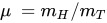
Where N, the normal force, is equal to the weight (mass x gravity) of the sitting mass (mT) and F, the loading force, is equal to the weight (mass x gravity) of the hanging mass (mH).
To determine the kinetic coefficient of friction the hanging mass is increased or decreased until the mass system moves at a constant speed.
In both cases, the coefficient of friction is simplified to the ratio of the two masses:
In most test applications using tribometers, wear is measured by comparing the mass or surfaces of test specimens before and after testing. Equipment and methods used to examine the worn surfaces include optical microscopes, scanning electron microscopes, optical interferometry and mechanical roughness testers.
Types
Tribometers are often referred to by the specific contact arrangement they simulate or by the original equipment developer. Several arrangements are:
- Four-ball[3]
- Pin-on-disc
- Ball-on-disc
- Ring-on-ring
- Ball-on-three-plates
- Reciprocating-pin (usually referred to as SRV or HFRR)[4]
- Block-on-ring
- Bouncing-ball[5]
- Fretting test machine
- Twin-disc
Bouncing-ball
Un tribómetro de bola rebotante consiste en una bola que se golpea en ángulo contra una superficie. Durante una prueba típica, la bola se desliza en ángulo a lo largo de una pista hasta que impacta contra la superficie y rebota. La fricción producida en el contacto entre la bola y la superficie genera una fuerza horizontal sobre la superficie y una fuerza de rotación sobre la bola. La fuerza de fricción se determina midiendo la velocidad de rotación de la bola mediante fotografía de alta velocidad o midiendo la fuerza sobre la superficie horizontal. La presión en el punto de contacto es muy alta debido a la gran fuerza instantánea causada por el impacto con la bola.
Los tribómetros de bola rebotante se han utilizado para determinar las características de cizallamiento de los lubricantes bajo altas presiones, como las que se encuentran en los rodamientos de bolas o los engranajes .
Pin-on-disc
Un tribómetro de pasador sobre disco consta de un pasador fijo que normalmente se carga contra un disco giratorio. El pasador puede tener cualquier forma para simular un contacto específico, pero a menudo se utilizan puntas cilíndricas para simplificar la geometría de contacto. El coeficiente de fricción se determina mediante la relación entre la fuerza de fricción y la fuerza de carga aplicada al pasador.
La prueba de pasador sobre disco ha demostrado ser útil para proporcionar una prueba sencilla de desgaste y fricción para recubrimientos de baja fricción, como los recubrimientos de carbono tipo diamante en los componentes del tren de válvulas en los motores de combustión interna .
Véase también
Referencias
- ↑ Instrumentos científicos históricos en Dinamarca
- ↑ Hutton, Charles. Diccionario matemático y filosófico. Archivado el 26 de septiembre de 2011 en Wayback Machine.
- ↑ Jones, William R.; Poslowski, Agnieszka K.; Shogrin, Bradley A.; Herrera-Fierro, Pilar; Jansen, Mark J. (1999). "Evaluación de varios lubricantes espaciales mediante un tribómetro de cuatro bolas al vacío". Tribology Transactions . 42 (2): 317– 323. doi : 10.1080/10402009908982223 . hdl : 2060/19990013975 . S2CID 137361318 .
- ↑ Wei, DP; Spikes, HA; Korcek, S. (1999). "La lubricidad de la gasolina". Tribology Transactions . 42 (4): 813– 823. doi : 10.1080/10402009908982288 .
- ↑ Höglund, Erik (marzo de 1989). "La relación entre la resistencia al corte del lubricante y la composición química del aceite base". Wear . 130 : 213– 224. doi : 10.1016/0043-1648(89)90234-2 .
- tribología
- Instrumentos de medición
- Ciencias de los materiales