 Hispanopedia Wiki
En mecánica y física , el movimiento armónico simple (a veces abreviado como MAS ) es un tipo especial de movimiento periódico que experimenta un objeto mediante una fuerza restauradora cuya magnitud es directamente proporcional a la distancia del objeto a una posición de equilibrio y actúa hacia dicha posición. Esto da como resultado una oscilación descrita por una sinusoide que continúa indefinidamente (si no hay fricción ni ninguna otra disipación de energía ). [ 1 ]
El movimiento armónico simple puede servir como modelo matemático para diversos movimientos, pero se caracteriza por la oscilación de una masa unida a un resorte cuando está sujeta a la fuerza elástica lineal restauradora dada por la ley de Hooke . El movimiento es sinusoidal en el tiempo y presenta una única frecuencia de resonancia . Otros fenómenos pueden modelarse mediante el movimiento armónico simple, incluido el movimiento de un péndulo simple , aunque para que sea un modelo preciso, la fuerza neta sobre el objeto en el extremo del péndulo debe ser proporcional al desplazamiento (e incluso así, solo es una buena aproximación cuando el ángulo de oscilación es pequeño; véase la aproximación de ángulo pequeño ). El movimiento armónico simple también puede utilizarse para modelar la vibración molecular .
El movimiento armónico simple proporciona una base para la caracterización de movimientos periódicos más complejos mediante las técnicas del análisis de Fourier .
Introducción
El movimiento de una partícula que se desplaza a lo largo de una línea recta con una aceleración cuya dirección siempre apunta hacia un punto fijo en la línea y cuya magnitud es proporcional al desplazamiento desde dicho punto fijo se denomina movimiento armónico simple. [ 2 ]
En el diagrama se muestra un oscilador armónico simple , que consiste en una masa unida a un extremo de un resorte. El otro extremo del resorte está conectado a un soporte rígido, como una pared. Si el sistema se deja en reposo en la posición de equilibrio , no actúa ninguna fuerza neta sobre la masa. Sin embargo, si la masa se desplaza de la posición de equilibrio, el resorte ejerce una fuerza elástica restauradora que obedece la ley de Hooke .
Matemáticamente, donde F es la fuerza elástica restauradora ejercida por el resorte (en unidades del SI : N ), k es la constante del resorte ( N ·m⁻¹ ) y x es el desplazamiento desde la posición de equilibrio (en metros ).

Para cualquier oscilador armónico mecánico simple:
- Cuando el sistema se desplaza de su posición de equilibrio, una fuerza restauradora que obedece la ley de Hooke tiende a devolver el sistema al movimiento lineal.
Una vez que la masa se desplaza de su posición de equilibrio, experimenta una fuerza restauradora neta. Como resultado, acelera y comienza a regresar a la posición de equilibrio. A medida que la masa se acerca a la posición de equilibrio, la fuerza restauradora disminuye. En la posición de equilibrio, la fuerza restauradora neta se anula. Sin embargo, en x = 0 , la masa tiene momento lineal debido a la aceleración que le ha impartido la fuerza restauradora. Por lo tanto, la masa continúa su trayectoria más allá de la posición de equilibrio, comprimiendo el resorte. Una fuerza restauradora neta la frena entonces hasta que su velocidad llega a cero, momento en el que acelera de nuevo hasta la posición de equilibrio.
Mientras el sistema no sufra pérdidas de energía , la masa continúa oscilando. Por lo tanto, el movimiento armónico simple es un tipo de movimiento periódico . Si el sistema pierde energía, la masa presenta una oscilación amortiguada .
Cabe señalar que si el espacio real y el espacio de fases no son colineales, el movimiento en el espacio de fases se vuelve elíptico. El área encerrada depende de la amplitud y del momento máximo.
Dinámica
En mecánica newtoniana , para un movimiento armónico simple unidimensional, la ecuación de movimiento, que es una ecuación diferencial ordinaria lineal de segundo orden con coeficientes constantes , se puede obtener mediante la segunda ley de Newton y la ley de Hooke para una masa unida a un resorte .
where m is the inertial mass of the oscillating body, x is its displacement from the equilibrium (or mean) position, and k is a constant (the spring constant for a mass on a spring).
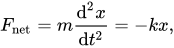
Therefore,

Solving the differential equation above produces a solution that is a sinusoidal function: where The meaning of the constants and can be easily found: setting on the equation above we see that , so that is the initial position of the particle, ; taking the derivative of that equation and evaluating at zero we get that , so that is the initial speed of the particle divided by the angular frequency, . Thus we can write:




This equation can also be written in the form: where

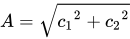

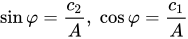
or equivalently


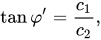
In the solution, c1 and c2 are two constants determined by the initial conditions (specifically, the initial position at time t = 0 is c1, while the initial velocity is c2ω), and the origin is set to be the equilibrium position.[A] Each of these constants carries a physical meaning of the motion: A is the amplitude (maximum displacement from the equilibrium position), ω = 2πf is the angular frequency, and φ is the initial phase.[B]
Using the techniques of calculus, the velocity and acceleration as a function of time can be found:

- Speed:
- Maximum speed: v = ωA (at equilibrium point)


- Maximum acceleration: Aω2 (at extreme points)
By definition, if a mass m is under SHM its acceleration is directly proportional to displacement. where
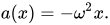

Since ω = 2πf, and, since T = 1/f where T is the time period,
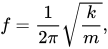
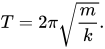
These equations demonstrate that the simple harmonic motion is isochronous (the period and frequency are independent of the amplitude and the initial phase of the motion).
Energy
Substituting ω2 with k/m, the kinetic energyK of the system at time t is and the potential energy is In the absence of friction and other energy loss, the total mechanical energy has a constant value



Examples

The following physical systems are some examples of simple harmonic oscillator.
Mass on a spring
A mass m attached to a spring of spring constant k exhibits simple harmonic motion in closed space. The equation for describing the period: shows the period of oscillation is independent of the amplitude, though in practice the amplitude should be small. The above equation is also valid in the case when an additional constant force is being applied on the mass, i.e. the additional constant force cannot change the period of oscillation.

Uniform circular motion
Simple harmonic motion can be considered the one-dimensional projection of uniform circular motion. If an object moves with angular speed ω around a circle of radius r centered at the origin of the xy-plane, then its motion along each coordinate is simple harmonic motion with amplitude r and angular frequency ω.
Oscillatory motion
The motion of a body in which it moves to-and-fro about a definite point is also called oscillatory motion or vibratory motion. The time period is able to be calculated by where l is the distance from rotation to the object's center of mass undergoing SHM and g is acceleration due to gravity. This is analogous to the mass-spring system.

Mass of a simple pendulum
In the small-angle approximation, the motion of a simple pendulum is approximated by simple harmonic motion. The period of a mass attached to a pendulum of length l with gravitational acceleration is given by

This shows that the period of oscillation is independent of the amplitude and mass of the pendulum but not of the acceleration due to gravity, , therefore a pendulum of the same length on the Moon would swing more slowly due to the Moon's lower gravitational field strength. Because the value of varies slightly over the surface of the earth, the time period will vary slightly from place to place and will also vary with height above sea level.
This approximation is accurate only for small angles because of the expression for angular accelerationα being proportional to the sine of the displacement angle:

where I is the moment of inertia. When θ is small, sin θ ≈ θ and therefore the expression becomes
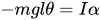
which makes angular acceleration directly proportional and opposite to θ, satisfying the definition of simple harmonic motion (that net force is directly proportional to the displacement from the mean position and is directed towards the mean position).
Scotch yoke
A Scotch yoke mechanism can be used to convert between rotational motion and linear reciprocating motion. The linear motion can take various forms depending on the shape of the slot, but the basic yoke with a constant rotation speed produces a linear motion that is simple harmonic in form.

See also
- Circle group
- Complex harmonic motion
- Compound eccentric mechanisms, elliptical motion
- Damping ratio
- Harmonic oscillator
- Isochronous timing
- Lorentz oscillator model
- Newtonian mechanics
- Pendulum
- Rayleigh–Lorentz pendulum
- Small-angle approximation
- String vibration
- Tusi couple, versions and inversions
- Uniform circular motion
Notes

References
- Fowles, Grant R.; Cassiday, George L. (2005). Analytical Mechanics (7th ed.). Thomson Brooks/Cole. ISBN 0-534-49492-7.
- Taylor, John R. (2005). Classical Mechanics. University Science Books. ISBN 1-891389-22-X.
- Thornton, Stephen T.; Marion, Jerry B. (2003). Classical Dynamics of Particles and Systems (5th ed.). Brooks Cole. ISBN 0-534-40896-6.
- Walker, Jearl (2011). Principles of Physics (9th ed.). Hoboken, New Jersey: Wiley. ISBN 978-0-470-56158-4.
External links
- Simple Harmonic Motion from HyperPhysics
- Java simulation of spring-mass oscillator
- Geogebra applet for spring-mass, with 3 attached PDFs on SHM, driven/damped oscillators, spring-mass with friction
- Classical mechanics
- Motion (physics)
- Pendulums