Articulo de referencia

Tannery's theorem

In mathematical analysis , Tannery's theorem gives sufficient conditions for the interchanging of the limit and infinite summation operations . It is named after Jules Tannery ....

In mathematical analysis, Tannery's theorem gives sufficient conditions for the interchanging of the limit and infinite summation operations. It is named after Jules Tannery.[1]

Statement

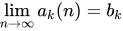
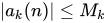
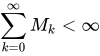
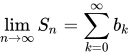
Let Sn=k=0nak(n){\displaystyle S_{n}=\sum _{k=0}^{n}a_{k}(n)} and suppose that limnak(n)=bk{\displaystyle \lim _{n\to \infty }a_{k}(n)=b_{k}}. If |ak(n)|Mk{\displaystyle |a_{k}(n)|\leq M_{k}} and k=0Mk<{\displaystyle \sum _{k=0}^{\infty }M_{k}<\infty }, then limnSn=k=0bk{\displaystyle \lim _{n\to \infty }S_{n}=\sum _{k=0}^{\infty }b_{k}}.[2][3]

Proofs

Tannery's theorem follows directly from Lebesgue's dominated convergence theorem applied to the sequence space1{\displaystyle \ell ^{1}}.

An elementary proof can also be given.[3]

Example

Tannery's theorem can be used to prove that the binomial limit and the infinite series characterizations of the exponentialex{\displaystyle e^{x}} are equivalent. Note that

limn(1+xn)n=limnk=0n(nk)xknk.{\displaystyle \lim _{n\to \infty }\left(1+{\frac {x}{n}}\right)^{n}=\lim _{n\to \infty }\sum _{k=0}^{n}{n \choose k}{\frac {x^{k}}{n^{k}}}.}

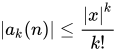
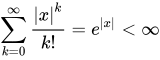
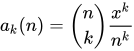
Define ak(n)=(nk)xknk{\displaystyle a_{k}(n)={n \choose k}{\frac {x^{k}}{n^{k}}}}. We have that |ak(n)||x|kk!{\displaystyle |a_{k}(n)|\leq {\frac {|x|^{k}}{k!}}} and that k=0|x|kk!=e|x|<{\displaystyle \sum _{k=0}^{\infty }{\frac {|x|^{k}}{k!}}=e^{|x|}<\infty }, so Tannery's theorem can be applied and
limnk=0(nk)xknk=k=0limn(nk)xknk=k=0xkk!=ex.{\displaystyle \lim _{n\to \infty }\sum _{k=0}^{\infty }{n \choose k}{\frac {x^{k}}{n^{k}}}=\sum _{k=0}^{\infty }\lim _{n\to \infty }{n \choose k}{\frac {x^{k}}{n^{k}}}=\sum _{k=0}^{\infty }{\frac {x^{k}}{k!}}=e^{x}.}

References

  1. Loya, Paul (2018). Amazing and Aesthetic Aspects of Analysis. Springer. ISBN 9781493967957.
  2. Ismail, Mourad E. H.; Koelink, Erik, eds. (2005). Theory and Applications of Special Functions: A Volume Dedicated to Mizan Rahman. New York: Springer. p. 448. ISBN 9780387242330.
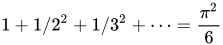
  3. 12Hofbauer, Josef (2002). "A Simple Proof of 1+1/22+1/32+=π26{\displaystyle 1+1/2^{2}+1/3^{2}+\cdots ={\frac {\pi ^{2}}{6}}} and Related Identities". The American Mathematical Monthly. 109 (2): 196–200. doi:10.2307/2695334. JSTOR 2695334.