Hispanopedia Wiki
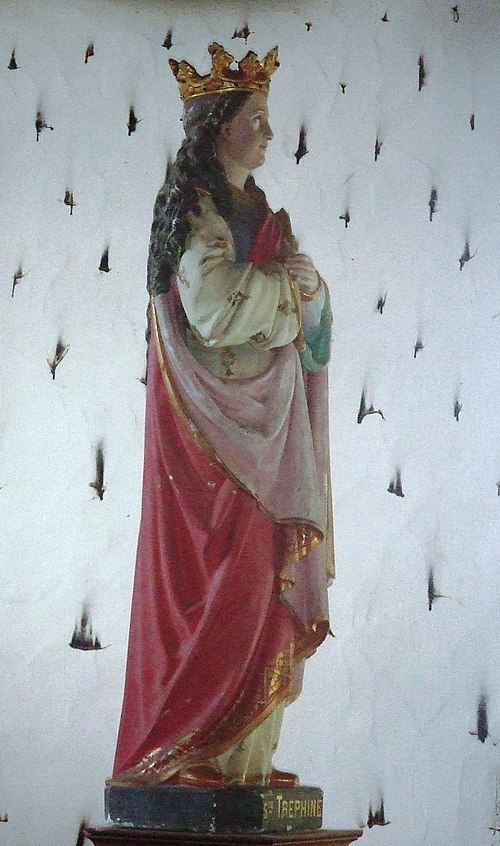
Saint Tryphine (also spelled Trifine, Triphine and Tréphine) is a semi-legendary Breton saint whose life is often considered to be the basis of the story of Bluebeard.[1] In Brittany she is widely revered as a patron saint of sick children and those whose birth is overdue.[2] The legend of Saint Tryphine probably derives from a historical individual who was the wife of the early Breton ruler Conomor.
Historical background
Conomor is said to have married Tryphine, the daughter of his ally Waroch I, but seems later to have violently abused and then murdered her.[3][4][5] Conomor was later killed in battle with a rival, and became a legendary villain in Breton history. Tryphine was elevated to the position of a martyred saint, along with her son Tremeur, and there are many churches dedicated to them.[6] The village of Sainte-Tréphine is named for the former.
Myth of Tryphine and Tremeur
In later legend Conomor's villainy is extended to include the murders of three wives before Tryphine. Tryphine refuses to marry him because of his reputation, but when he threatens to invade her father's lands she agrees, to spare the lives of her father's people. While Conomor is away Tryphine finds a secret room containing relics of the deceased wives.[6][7][8] She prays for their souls, and their ghosts appear to her warning her that Conomor will kill her if she becomes pregnant. Depending on the version of the myth this is either because a prophecy states that he will be killed by his own son or because he is only interested in his wives as providers of sexual pleasure.
When he returns he discovers that she is pregnant. Tryphine escapes with magical aid from the dead wives and gives birth in a forest. She hides her son before Conomor catches her and beheads her.[6] However, Saint Gildas finds her and miraculously restores her to life.[8] She and her son both live lives of saintly retirement, but after Tryphine's death Conomor eventually finds Tremeur and kills him. In other versions Conomor is killed when his castle miraculously collapses onto him.[9]
It has been suggested that the story of Bluebeard derives from this myth.[10]
Myth of Tryphine and King Arthur
El folclorista François-Marie Luzel recopiló una obra de misterio sobre Trifina y el rey Arturo . [ 11 ] En esta historia, Arturo reemplazó a Comonor como esposo de Trifina y ella adquiere algunas características de Ginebra . La trama involucra al malvado hermano de Trifina, Kervoura, quien conspira para heredar el reino de Arturo. Cuando descubre que Trifina está embarazada, decide eliminar el linaje de Arturo. Justo antes de que Trifina dé a luz, Kevoura la secuestra y esconde al niño. Luego la acusa de asesinar a su hijo y usa pruebas falsificadas para implicarla en un supuesto complot para matar a Arturo. Arturo ordena el arresto de Trifina, pero ella escapa y se esconde durante seis años trabajando como sirvienta. Finalmente es descubierta y llevada de regreso a la corte. Arturo ahora acepta su inocencia y tienen una hija juntos. Kervoura la acusa entonces de adulterio, usando testigos sobornados. Es condenada a muerte. Sin embargo, su hijo Tremeur ya es adulto y ha escapado de sus captores para regresar. Se revela justo cuando Tryphine está a punto de ser decapitada por el verdugo y desafía a Kervoura a un duelo. Mata a Kervoura, quien confiesa sus crímenes antes de morir. Arthur y Tryphine se reencuentran. [ 11 ]
Notas
- ↑ Warner, Marina (1994). De la Bestia a la Rubia: Sobre los Cuentos de Hadas y sus Narradores . Nueva York: Farrar, Straus and Giroux. págs. 260–261 .
- ↑ Dictionnaire des Saints Breton , París, 1979, p.350.
- ^ Jobbé-Duval, Emilio (1929). "LES IDÉES PRIMITIVES DANS LA BRETAGNE CONTEMPORAINE: ÉTUDES COMPLÉMENTAIRES. - I. Les contrats. II. Les vœux" . Revue historique de droit français et étranger (1922-) . 8 (3): 431– 472. ISSN 0035-3280 . JSTOR 45402607 .
- ↑ Russo, Stephanie (2022), "The Literary Afterlives of the Tudor Consorts" , Tudor and Stuart Consorts , Queenship and Power, Cham: Springer International Publishing, pp. 181–200 , doi : 10.1007/978-3-030-95197-9_11 , ISBN 978-3-030-95196-2, recuperado el 30-01-2024
- ^ Dubreuil, León (1951). "Lettres de Maurice Barrès à Charles Le Goffic. La revue. Les Chroniques" . Annales de Bretagne et des pays de l'Ouest . 58 (1): 19– 88. doi : 10.3406/abpo.1951.1899 .
- 1 2 3 Duncker, Patricia (2003), "Reimaginando los cuentos de hadas: Las sangrientas cámaras de Angela Carter" , Popular Fictions , Routledge, doi : 10.4324/9781315015934-14 (inactivo el 12 de julio de 2025), ISBN 978-1-315-01593-4, recuperado el 30-01-2024
{{citation}}: CS1 maint: DOI inactivo desde julio de 2025 ( enlace ) - ↑ van der Schoot, Albert (2005). "Una canción que no morirá: Simbolismo cambiante en la interpretación de dos óperas sangrientas" . Muzikologija (5): 57–84 . doi : 10.2298/muz0505057v . ISSN 1450-9814 .
- 1 2 Mulvey-Roberts, Marie (2009), "From Bluebeard's Bloody Chamber to Demonic Stigmatic" , en Wallace, Diana; Smith, Andrew (eds.), The Female Gothic: New Directions , Londres: Palgrave Macmillan UK, pp. 98–114 , doi : 10.1057/9780230245457_7 , ISBN 978-0-230-24545-7, recuperado el 30-01-2024
- ↑ Wendy Mewes, Descubriendo la historia de Bretaña , Red Dog, 2006, pág. 44
- ↑ Gilles Rihouay, Konomor, Barbe-bleue bretón , Éd. Gráfico Keltia, 29540 Spézet, 2001
- 1 2 Brigitte Cazelles y Brett Wells, "Arthur as Barbe-Bleue: The Martyrdom of Saint Tryphine (Breton Mystery)", Yale French Studies , n.º 95, Rereading Allegory: Essays in Memory of Daniel Poirion (1999), págs. 134-151
- Pueblo bretón del siglo VI
- Mujeres bretonas del siglo VI
- Santos cristianos del siglo VI
- Leyenda artúrica
- Santos británicos del suroeste
- Barba Azul