 Hispanopedia Wiki
In mathematics, van der Corput's method generates estimates for exponential sums. The method applies two processes, the van der Corput processes A and B which relate the sums into simpler sums which are easier to estimate.
The processes apply to exponential sums of the form

where f is a sufficiently smooth function and e(x) denotes exp(2πix).
Process A
To apply process A, write the first difference fh(x) for f(x+h)−f(x).
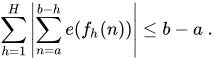
Assume there is H ≤ b−a such that
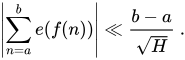
Then
Process B
Process B transforms the sum involving f into one involving a function g defined in terms of the derivative of f. Suppose that f' is monotone increasing with f'(a) = α, f'(b) = β. Then f' is invertible on [α,β] with inverse u say. Further suppose f'' ≥ λ > 0. Write

We have

Applying Process B again to the sum involving g returns to the sum over f and so yields no further information.
Exponent pairs
The method of exponent pairs gives a class of estimates for functions with a particular smoothness property. Fix parameters N,R,T,s,δ. We consider functions f defined on an interval [N,2N] which are R times continuously differentiable, satisfying

uniformly on [a,b] for 0 ≤ r < R.
We say that a pair of real numbers (k,l) with 0 ≤ k ≤ 1/2 ≤ l ≤ 1 is an exponent pair if for each σ > 0 there exists δ and R depending on k,l,σ such that
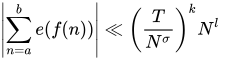
uniformly in f.
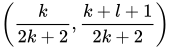
By Process A we find that if (k,l) is an exponent pair then so is . By Process B we find that so is .

Una cota trivial muestra que (0,1) es un par de exponentes.
El conjunto de pares de exponentes es convexo.
Se sabe que si ( k , l ) es un par de exponentes, entonces la función zeta de Riemann en la línea crítica satisface

dónde.

La conjetura del par de exponentes afirma que para todo ε > 0, el par (ε,1/2+ε) es un par de exponentes. Esta conjetura implica la hipótesis de Lindelöf .
Referencias
- Ivić, Aleksandar (1985). La función zeta de Riemann. Teoría de la función zeta de Riemann con aplicaciones . Nueva York, etc.: John Wiley & Sons. ISBN 0-471-80634-X. Zbl 0556.10026 .
- Montgomery, Hugh L. (1994). Diez conferencias sobre la interfaz entre la teoría analítica de números y el análisis armónico . Serie de conferencias regionales en matemáticas. Vol. 84. Providence, RI: Sociedad Matemática Americana . ISBN 0-8218-0737-4. Zbl 0814.11001 .
- Sándor, József; Mitrinović, Dragoslav S.; Crstici, Borislav, eds. (2006). Manual de teoría de números I. Dordrecht: Springer-Verlag . ISBN 1-4020-4215-9. Zbl 1151.11300 .
- exponenciales
- Teoría analítica de números