 Hispanopedia Wiki
In mathematical physics, the WKB approximation or WKB method is a method for finding approximate solutions to linear differential equations with spatially varying coefficients. It is typically used for a semiclassical calculation in quantum mechanics in which the wavefunction is recast as an exponential function, semiclassically expanded, and then either the amplitude or the phase is taken to be changing slowly.
The name is an initialism for Wentzel–Kramers–Brillouin. It is also known as the LG or Liouville–Green method. Other often-used letter combinations include JWKB and WKBJ, where the "J" stands for Jeffreys.
Brief history
This method is named after physicists Gregor Wentzel, Hendrik Anthony Kramers, and Léon Brillouin, who all developed it in 1926.[1] In 1923, mathematician Harold Jeffreys had developed a general method of approximating solutions to linear, second-order differential equations, a class that includes the Schrödinger equation. The Schrödinger equation itself was not developed until two years later, and Wentzel, Kramers, and Brillouin were apparently unaware of this earlier work, so Jeffreys is often neglected credit. Early texts in quantum mechanics contain any number of combinations of their initials, including WBK, BWK, WKBJ, JWKB and BWKJ. An authoritative discussion and critical survey has been given by Robert B. Dingle.[2]
Earlier appearances of essentially equivalent methods are: Francesco Carlini in 1817, Joseph Liouville in 1837, George Green in 1837, Lord Rayleigh in 1912 and Richard Gans in 1915. Liouville and Green may be said to have founded the method in 1837, and it is also commonly referred to as the Liouville–Green or LG method.[3][4]
The important contribution of Jeffreys, Wentzel, Kramers, and Brillouin to the method was the inclusion of the treatment of turning points, connecting the evanescent and oscillatory solutions at either side of the turning point. For example, this may occur in the Schrödinger equation, due to a potential energy hill.
Formulation
Generally, WKB theory is a method for approximating the solution of a differential equation whose highest derivative is multiplied by a small parameter ε. The method of approximation is as follows.
For a differential equation assume a solution of the form of an asymptotic series expansion in the limit δ → 0. The asymptotic scaling of δ in terms of ε will be determined by the equation – see the example below.

![{\displaystyle y(x)\sim \exp \left[{\frac {1}{\delta }}\sum _{n=0}^{\infty }\delta ^{n}S_{n}(x)\right]}](https://wikimedia.org/api/rest_v1/media/math/render/svg/0dcf48f98178c4e673d08dff0f3f6027267f96cf)
Substituting the above ansatz into the differential equation and cancelling out the exponential terms allows one to solve for an arbitrary number of terms Sn(x) in the expansion.
WKB theory is a special case of multiple scale analysis.[5][6][7]
An example
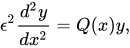
This example comes from the text of Carl M. Bender and Steven Orszag.[7] Consider the second-order homogeneous linear differential equation where . Substituting results in the equation

![{\displaystyle y(x)=\exp \left[{\frac {1}{\delta }}\sum _{n=0}^{\infty }\delta ^{n}S_{n}(x)\right]}](https://wikimedia.org/api/rest_v1/media/math/render/svg/8d7ab03767fae0bcbd9465105922ea1878725028)
![{\displaystyle \epsilon ^{2}\left[{\frac {1}{\delta ^{2}}}\left(\sum _{n=0}^{\infty }\delta ^{n}S_{n}'\right)^{2}+{\frac {1}{\delta }}\sum _{n=0}^{\infty }\delta ^{n}S_{n}''\right]=Q(x).}](https://wikimedia.org/api/rest_v1/media/math/render/svg/539b6caf7321afe992272920734fec1cb6c784da)
To leading order in ϵ (assuming, for the moment, the series will be asymptotically consistent), the above can be approximated as

In the limit δ → 0, the dominant balance is given by
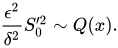
So δ is proportional to ϵ. Setting them equal and comparing powers yields which can be recognized as the eikonal equation, with solution

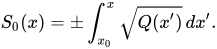
Considering first-order powers of ϵ fixes This has the solution where k1 is an arbitrary constant.


We now have a pair of approximations to the system (a pair, because S0 can take two signs); the first-order WKB-approximation will be a linear combination of the two:
![{\displaystyle y(x)\approx c_{1}Q^{-{\frac {1}{4}}}(x)\exp \left[{\frac {1}{\epsilon }}\int _{x_{0}}^{x}{\sqrt {Q(t)}}\,dt\right]+c_{2}Q^{-{\frac {1}{4}}}(x)\exp \left[-{\frac {1}{\epsilon }}\int _{x_{0}}^{x}{\sqrt {Q(t)}}\,dt\right].}](https://wikimedia.org/api/rest_v1/media/math/render/svg/25a040677f545744a2564bd0cc4967d52771614f)
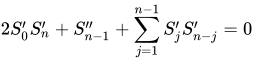
Higher-order terms can be obtained by looking at equations for higher powers of δ. Explicitly, for n ≥ 2.
Precision of the asymptotic series
The asymptotic series for y(x) is usually a divergent series, whose general term δn Sn(x) starts to increase after a certain value n = nmax. Therefore, the smallest error achieved by the WKB method is at best of the order of the last included term.
For the equation with Q(x) <0 an analytic function, the value