 Hispanopedia Wiki
La Navidad es una festividad anual que conmemora el nacimiento de Jesucristo , celebrada principalmente el 25 de diciembre [a] como una celebración religiosa y cultural entre miles de millones de personas en todo el mundo . Una fiesta central del año litúrgico en el cristianismo , sigue a la temporada de Adviento (que comienza cuatro domingos antes) o el Ayuno de la Natividad , e inicia la temporada de Navidad , que históricamente en Occidente dura doce días y culmina en la Duodécima Noche . El día de Navidad es un día festivo en muchos países , es celebrado religiosamente por la mayoría de los cristianos , así como culturalmente por muchos no cristianos, y forma parte integral de la temporada festiva que lo rodea.
La tradicional narración navideña relatada en el Nuevo Testamento , conocida como la Natividad de Jesús , dice que Jesús nació en Belén , de acuerdo con las profecías mesiánicas . Cuando José y María llegaron a la ciudad, la posada no tenía lugar, por lo que se les ofreció un establo donde pronto nacería el Niño Jesús , y los ángeles proclamaron esta noticia a los pastores , quienes luego difundieron la noticia.
Existen diferentes hipótesis sobre la fecha del nacimiento de Jesús, y a principios del siglo IV, la iglesia fijó la fecha como el 25 de diciembre. Es exactamente nueve meses después de la Anunciación el 25 de marzo, también la fecha del equinoccio de primavera. La mayoría de los cristianos celebran el 25 de diciembre en el calendario gregoriano , que ha sido adoptado casi universalmente en los calendarios civiles utilizados en países de todo el mundo. Sin embargo, parte de las Iglesias cristianas orientales celebran la Navidad el 25 de diciembre del antiguo calendario juliano , que actualmente corresponde al 7 de enero en el calendario gregoriano. Para los cristianos, creer que Dios vino al mundo en forma de hombre para expiar los pecados de la humanidad en lugar de saber la fecha exacta del nacimiento de Jesús se considera el propósito principal de la celebración de la Navidad.
Las costumbres asociadas con la Navidad en varios países tienen una mezcla de temas y orígenes precristianos, cristianos y seculares . Las tradiciones navideñas populares incluyen dar regalos ; completar un calendario de Adviento o una corona de Adviento ; música navideña y villancicos ; ver películas navideñas ; ver una obra de teatro de la Natividad ; un intercambio de tarjetas navideñas ; asistir a servicios religiosos ; una comida especial ; y mostrar varias decoraciones navideñas , incluidos árboles de Navidad , luces navideñas , belenes , guirnaldas , coronas , muérdago y acebo . Además, varias figuras relacionadas y a menudo intercambiables, conocidas como Santa Claus , Papá Noel , San Nicolás y Christkind , están asociadas con llevar regalos a los niños durante la temporada navideña y tienen su propio cuerpo de tradiciones y conocimientos. Debido a que la entrega de regalos y muchos otros aspectos del festival de Navidad implican una mayor actividad económica, la festividad se ha convertido en un evento significativo y un período de ventas clave para minoristas y empresas. Durante los últimos siglos, la Navidad ha tenido un efecto económico en constante crecimiento en muchas regiones del mundo.
Etimología
La palabra inglesa Christmas es una forma abreviada de 'Christ's Mass ' ( Misa de Cristo ). [3] La palabra está registrada como Crīstesmæsse en 1038 y Cristes-messe en 1131. [4] Crīst ( genitivo Crīstes ) proviene del griego Χριστός ( Khrīstos , 'Cristo'), una traducción del hebreo מָשִׁיחַ ( Māšîaḥ , ' Mesías '), que significa 'ungido'; [5] [6] y mæsse proviene del latín missa , la celebración de la Eucaristía . [7]
La forma Christenmas también se utilizó durante algunos períodos, pero ahora se considera arcaica y dialectal. [8] El término deriva del inglés medio Cristenmasse , que significa 'misa cristiana'. [9] Xmas es una abreviatura de Christmas que se encuentra particularmente en la prensa, basada en la letra inicial chi (Χ) en el griego Χριστός , aunque algunas guías de estilo desaconsejan su uso. [10] Esta abreviatura tiene precedente en el inglés medio Χρ̄es masse (donde Χρ̄ es otra abreviatura de la palabra griega). [9]
Otros nombres
La festividad ha tenido otros nombres en inglés a lo largo de su historia. Los anglosajones se referían a la fiesta como "midwinter" [11] [12] o, más raramente, como Nātiuiteð (del latín nātīvitās más abajo). [11] [13] Nativity , que significa 'nacimiento', proviene del latín nātīvitās . [14] En inglés antiguo , Gēola (' Yule ') se refería al período correspondiente a diciembre y enero, que finalmente se equiparó con la Navidad cristiana. [15] 'Noel' (también 'Nowel' o 'Nowell', como en " The First Nowell ") entró al inglés a fines del siglo XIV y proviene del francés antiguo noël o naël , que en última instancia proviene del latín nātālis (diēs) que significa 'nacimiento (día)'. [16]
Koleda es el nombre tradicional eslavo para la Navidad y el período desde Navidad hasta la Epifanía o, más generalmente, para los rituales eslavos relacionados con la Navidad, algunos de los cuales datan de tiempos precristianos. [17]
Natividad
.jpg/1280px-Gerard_van_Honthorst_-_Adoration_of_the_Shepherds_(1622).jpg)
Los evangelios de Lucas y Mateo describen a Jesús naciendo en Belén de la Virgen María . En el Evangelio de Lucas, José y María viajan desde Nazaret a Belén para ser contados en un censo, y Jesús nace allí y es colocado en un pesebre . [18] Los ángeles lo proclaman salvador de todas las personas, y tres pastores vienen a adorarlo. En el Evangelio de Mateo, por el contrario, tres magos siguen una estrella hasta Belén para llevar regalos a Jesús, nacido el rey de los judíos . El rey Herodes ordena la masacre de todos los niños menores de dos años en Belén, pero la familia huye a Egipto y luego regresa a Nazaret. [19]
Historia
Época temprana y medieval

En el siglo II, los "primeros registros eclesiásticos" indican que "los cristianos recordaban y celebraban el nacimiento del Señor", una "observancia [que] surgió orgánicamente de la auténtica devoción de los creyentes ordinarios"; aunque "no se pusieron de acuerdo sobre una fecha fija". [20] La evidencia más antigua de que el nacimiento de Cristo se celebró el 25 de diciembre es una frase en el Cronógrafo de 354. [ 21] [22] [23] Los historiadores litúrgicos generalmente coinciden en que esta parte del texto fue escrita en Roma en el año 336 d. C. [22] Aunque la Navidad no apareció en las listas de festividades dadas por los primeros escritores cristianos Ireneo y Tertuliano , [4] los primeros Padres de la Iglesia Juan Crisóstomo , Agustín de Hipona y Jerónimo atestiguaron el 25 de diciembre como la fecha de la Navidad hacia finales del siglo IV. [20] El 25 de diciembre era la fecha tradicional del solsticio de invierno en el Imperio Romano, [24] donde vivían la mayoría de los cristianos, y el festival romano Dies Natalis Solis Invicti (cumpleaños de Sol Invictus , el 'Sol Invencible') se había celebrado en esta fecha desde el año 274 d. C. [25]
En Oriente , el nacimiento de Jesús se celebraba en relación con la Epifanía el 6 de enero. [26] [27] Esta festividad no trataba principalmente del nacimiento de Cristo, sino más bien de su bautismo . [28] La Navidad se promovió en Oriente como parte del renacimiento del cristianismo ortodoxo que siguió a la muerte del emperador proarriano Valente en la batalla de Adrianópolis en 378. La fiesta fue introducida en Constantinopla en 379, en Antioquía por Juan Crisóstomo hacia finales del siglo IV, [27] probablemente en 388, y en Alejandría en el siglo siguiente. [29] El Iadgari georgiano demuestra que la Navidad se celebraba en Jerusalén en el siglo VI . [30]

En la Alta Edad Media , el día de Navidad se vio eclipsado por la Epifanía, que en el cristianismo occidental se centraba en la visita de los magos . Sin embargo, el calendario medieval estaba dominado por las fiestas relacionadas con la Navidad. Los cuarenta días anteriores a la Navidad se convirtieron en los «cuarenta días de San Martín» (que comenzaban el 11 de noviembre, la festividad de San Martín de Tours ), ahora conocidos como Adviento. [31] En Italia, las antiguas tradiciones saturnales se vincularon al Adviento. [31] Alrededor del siglo XII, estas tradiciones se transfirieron nuevamente a los Doce Días de Navidad (del 25 de diciembre al 5 de enero); un tiempo que aparece en los calendarios litúrgicos como Christmastide o Doce Días Santos. [31]
En el año 567, el Concilio de Tours instauró la temporada de Navidad , proclamando "los doce días desde Navidad hasta la Epifanía como una temporada sagrada y festiva, y estableció el deber del ayuno de Adviento en preparación para la fiesta". [32] Esto se hizo para resolver el "problema administrativo del Imperio Romano mientras intentaba coordinar el calendario solar juliano con los calendarios lunares de sus provincias en el este". [33]
La importancia del día de Navidad aumentó gradualmente después de que Carlomagno fuera coronado emperador el día de Navidad de 800. [34] El rey Edmundo el Mártir fue ungido el día de Navidad de 855 y el rey Guillermo I de Inglaterra fue coronado el día de Navidad de 1066. [35]

En la Alta Edad Media , la festividad se había vuelto tan importante que los cronistas anotaban rutinariamente dónde celebraban la Navidad los distintos magnates . El rey Ricardo II de Inglaterra organizó una fiesta de Navidad en 1377 en la que se comieron 28 bueyes y 300 ovejas. [31] El jabalí de Yule era una característica común de las fiestas navideñas medievales. Los villancicos también se hicieron populares y, originalmente, los interpretaba un grupo de bailarines que cantaban. El grupo estaba compuesto por un cantante principal y un círculo de bailarines que proporcionaban el coro. Varios escritores de la época condenaron los villancicos como lascivos, lo que indica que las tradiciones rebeldes de las Saturnales y Yule pueden haber continuado en esta forma. [31] El " desgobierno " (ebriedad, promiscuidad, juegos de azar) también era un aspecto importante del festival. En Inglaterra, se intercambiaban regalos el día de Año Nuevo y había cerveza especial de Navidad. [31]
La Navidad durante la Edad Media era una fiesta pública que incorporaba hiedra , acebo y otras plantas perennes. [36] La entrega de regalos de Navidad durante la Edad Media generalmente se hacía entre personas con relaciones legales, como inquilino y propietario. [36] La indulgencia anual en comer, bailar, cantar, hacer deporte y jugar a las cartas aumentó en Inglaterra, y en el siglo XVII la temporada navideña incluía cenas lujosas, mascaradas elaboradas y desfiles. En 1607, el rey Jaime I insistió en que se representara una obra de teatro en la noche de Navidad y que la corte participara en juegos. [37] Fue durante la Reforma en la Europa de los siglos XVI y XVII que muchos protestantes cambiaron el portador de regalos al Niño Jesús o Christkindl , y la fecha de entrega de regalos cambió del 6 de diciembre a la Nochebuena. [38]
Siglos XVII y XVIII
Después de la Reforma protestante , muchas de las nuevas denominaciones, incluidas la Iglesia anglicana y la Iglesia luterana , continuaron celebrando la Navidad. [39] En 1629, el poeta anglicano John Milton escribió En la mañana del nacimiento de Cristo , un poema que desde entonces ha sido leído por muchos durante la Navidad. [40] Donald Heinz, profesor de la Universidad Estatal de California, Chico , afirma que Martín Lutero "inauguró un período en el que Alemania produciría una cultura única de Navidad, muy copiada en América del Norte". [41] Entre las congregaciones de la Iglesia Reformada Holandesa , la Navidad se celebraba como una de las principales fiestas evangélicas . [42]
Sin embargo, en la Inglaterra del siglo XVII, algunos grupos como los puritanos condenaron enérgicamente la celebración de la Navidad, considerándola una invención católica y la "apariencia del papado " o los "harapos de la Bestia ". [43] En contraste, la Iglesia anglicana establecida "presionó por una observancia más elaborada de las fiestas, las temporadas penitenciales y los días de los santos. La reforma del calendario se convirtió en un importante punto de tensión entre el partido anglicano y el partido puritano". [44] La Iglesia católica también respondió, promoviendo la festividad en una forma más orientada a la religión. El rey Carlos I de Inglaterra ordenó a sus nobles y aristócratas que regresaran a sus propiedades en pleno invierno para mantener su generosidad navideña al estilo antiguo. [37] Después de la victoria parlamentaria sobre Carlos I durante la Guerra Civil Inglesa , los gobernantes puritanos de Inglaterra prohibieron la Navidad en 1647. [43] [45]
Las protestas siguieron a medida que estallaban disturbios a favor de la Navidad en varias ciudades y durante semanas Canterbury estuvo controlada por los alborotadores, que decoraban las puertas con acebo y gritaban consignas realistas . [43] El fútbol, uno de los deportes que los puritanos prohibían los domingos, también se utilizó como una fuerza rebelde: cuando los puritanos prohibieron la Navidad en Inglaterra en diciembre de 1647, la multitud sacó balones de fútbol como símbolo de desgobierno festivo. [46] El libro The Vindication of Christmas (Londres, 1652) argumentó en contra de los puritanos y hace referencia a las antiguas tradiciones navideñas inglesas, la cena, las manzanas asadas en el fuego, los juegos de cartas, los bailes con "niños arados" y "sirvientas", el viejo Papá Noel y el canto de villancicos. [47] Durante la prohibición, se siguieron celebrando servicios religiosos semiclandestinos que conmemoraban el nacimiento de Cristo y la gente cantaba villancicos en secreto. [48]

En Inglaterra, el día de Navidad fue restaurado como feriado legal con la Restauración del rey Carlos II en 1660, cuando la legislación puritana fue declarada nula y sin valor, y la Navidad volvió a celebrarse libremente en Inglaterra. [48] Muchos clérigos calvinistas desaprobaron la celebración de la Navidad. Por ello, en Escocia, la Iglesia Presbiteriana de Escocia desaconsejó la celebración de la Navidad, y aunque Jacobo VI ordenó su celebración en 1618, la asistencia a la iglesia era escasa. [49] El Parlamento de Escocia abolió oficialmente la celebración de la Navidad en 1640, alegando que la iglesia había sido "purgada de toda observación supersticiosa de días". [50] Mientras que en Inglaterra, Gales e Irlanda el día de Navidad es un día festivo de derecho consuetudinario, habiendo sido un día festivo consuetudinario desde tiempos inmemoriales , no fue hasta 1871 que fue designado como feriado bancario en Escocia. [51] Tras la Restauración de Carlos II, el Almanaque del pobre Robin contenía los versos: «Ahora, gracias a Dios por el regreso de Carlos, / cuya ausencia hizo llorar la vieja Navidad. / Porque entonces apenas sabíamos, / si era Navidad o no.» [52] El diario de James Woodforde, de la segunda mitad del siglo XVIII, detalla la celebración de la Navidad y las celebraciones asociadas con la temporada a lo largo de varios años. [53]
Al igual que en Inglaterra, los puritanos en la América colonial se opusieron firmemente a la celebración de la Navidad. [54] Los peregrinos de Nueva Inglaterra pasaron deliberadamente su primer 25 de diciembre en el Nuevo Mundo trabajando normalmente. [54] Los puritanos como Cotton Mather condenaron la Navidad tanto porque las escrituras no mencionaban su observancia como porque las celebraciones navideñas del día a menudo implicaban un comportamiento bullicioso. [55] [56] Muchos no puritanos en Nueva Inglaterra deploraron la pérdida de las fiestas que disfrutaban las clases trabajadoras en Inglaterra. [57] La observancia de la Navidad fue prohibida en Boston en 1659. [54] La prohibición de la observancia de la Navidad fue revocada en 1681 por el gobernador inglés Edmund Andros , pero no fue hasta mediados del siglo XIX que la celebración de la Navidad se puso de moda en la región de Boston. [58]
Al mismo tiempo, los residentes cristianos de Virginia y Nueva York observaban la festividad libremente. Los colonos holandeses de Pensilvania , predominantemente moravos de Bethlehem , Nazareth y Lititz en Pensilvania y los asentamientos de Wachovia en Carolina del Norte, celebraban con entusiasmo la Navidad. Los moravos de Bethlehem tenían los primeros árboles de Navidad en América, así como los primeros belenes. [59] La Navidad cayó en desgracia en los Estados Unidos después de la Revolución estadounidense , cuando se consideró una costumbre inglesa. [60] George Washington atacó a los mercenarios hessianos (alemanes) el día después de Navidad durante la Batalla de Trenton el 26 de diciembre de 1776, siendo la Navidad mucho más popular en Alemania que en Estados Unidos en esa época.
Con el Culto ateo a la Razón en el poder durante la era de la Francia revolucionaria , los servicios religiosos cristianos de Navidad fueron prohibidos y el pastel de los tres reyes pasó a llamarse "pastel de la igualdad" bajo las políticas gubernamentales anticlericales . [61]
Siglo XIX

A principios del siglo XIX, las festividades y los servicios navideños se generalizaron con el surgimiento del Movimiento de Oxford en la Iglesia de Inglaterra , que enfatizaba la centralidad de la Navidad en el cristianismo y la caridad hacia los pobres, [62] junto con Washington Irving , Charles Dickens y otros autores que enfatizaban la familia, los niños, la bondad de corazón, la entrega de regalos y Santa Claus (para Irving), [62] o Papá Noel (para Dickens). [63]
A principios del siglo XIX, los escritores imaginaban la Navidad del período Tudor como un momento de celebración sincera. En 1843, Charles Dickens escribió la novela Un cuento de Navidad , que ayudó a revivir el "espíritu" de la Navidad y la alegría estacional. [64] [65] Su popularidad instantánea jugó un papel importante en la representación de la Navidad como una festividad que enfatiza la familia, la buena voluntad y la compasión. [62]
Dickens intentó construir la Navidad como un festival de generosidad centrado en la familia, vinculando "el culto y la fiesta, dentro de un contexto de reconciliación social". [66] Superponiendo su visión humanitaria de la festividad, en lo que se ha denominado "Filosofía de los villancicos", [67] Dickens influyó en muchos aspectos de la Navidad que se celebran hoy en la cultura occidental, como las reuniones familiares, la comida y bebida de temporada, el baile, los juegos y una generosidad festiva de espíritu. [68] Una frase destacada del cuento, "Feliz Navidad" , se popularizó tras la aparición de la historia. [69] Esto coincidió con la aparición del Movimiento de Oxford y el crecimiento del anglocatolicismo , que provocó un renacimiento de los rituales tradicionales y las observancias religiosas. [70]

El término Scrooge se convirtió en sinónimo de avaro , y la frase "¡Bah! ¡Hurgancias!" se convirtió en un símbolo de una actitud desdeñosa hacia el espíritu festivo. [71] En 1843, Sir Henry Cole produjo la primera tarjeta navideña comercial . [72] El resurgimiento del villancico comenzó con Villancicos antiguos y modernos (1833) de William Sandys , con la primera aparición impresa de " The First Noel ", " I Saw Three Ships ", " Hark the Herald Angels Sing " y " God Rest Ye Merry, Gentlemen ", popularizada en Un cuento de Navidad de Dickens .
.jpg/1280px-The_Christmas_Tree_at_Windsor_Castle,_by_J._L._Williams_-_ILN_1848_(cropped).jpg)
En Gran Bretaña, el árbol de Navidad fue introducido a principios del siglo XIX por la reina Carlota, nacida en Alemania . En 1832, la futura reina Victoria escribió sobre su alegría por tener un árbol de Navidad, adornado con luces , adornos y regalos colocados a su alrededor. [73] Después de su matrimonio con su primo alemán , el príncipe Alberto , en 1841 la costumbre se extendió por toda Gran Bretaña. [74] Una imagen de la familia real británica con su árbol de Navidad en el castillo de Windsor causó sensación cuando se publicó en Illustrated London News en 1848. Una versión modificada de esta imagen se publicó en Godey's Lady's Book , Filadelfia en 1850. [75] [76] En la década de 1870, poner un árbol de Navidad se había vuelto común en Estados Unidos. [75]
En Estados Unidos, el interés por la Navidad había revivido en la década de 1820 gracias a varios cuentos de Washington Irving que aparecen en su The Sketch Book of Geoffrey Crayon, Gent. y "Old Christmas". Los cuentos de Irving describían las armoniosas y cálidas festividades navideñas inglesas que experimentó durante su estancia en Aston Hall , Birmingham, Inglaterra, que había sido abandonada en gran medida, [77] y utilizó el tratado Vindication of Christmas (1652) de antiguas tradiciones navideñas inglesas, que había transcrito en su diario como formato para sus cuentos. [37]

En 1822, Clement Clarke Moore escribió el poema A Visit From St. Nicholas (popularmente conocido por su primera línea: Twas the Night Before Christmas ). [78] El poema ayudó a popularizar la tradición de intercambiar regalos, y las compras navideñas de temporada comenzaron a asumir importancia económica. [79] Esto también inició el conflicto cultural entre el significado espiritual de la festividad y su comercialismo asociado que algunos ven como corruptor de la festividad. En su libro de 1850 The First Christmas in New England , Harriet Beecher Stowe incluye un personaje que se queja de que el verdadero significado de la Navidad se perdió en una juerga de compras. [80]
Aunque la celebración de la Navidad todavía no era una costumbre en algunas regiones de los EE. UU., Henry Wadsworth Longfellow detectó "un estado de transición en torno a la Navidad aquí en Nueva Inglaterra" en 1856. "El antiguo sentimiento puritano impide que sea una fiesta alegre y cordial; aunque cada año lo hace aún más así". [81] En Reading, Pensilvania , un periódico comentó en 1861: "Incluso nuestros amigos presbiterianos que hasta ahora han ignorado firmemente la Navidad, abrieron las puertas de sus iglesias y se reunieron en masa para celebrar el aniversario del nacimiento del Salvador". [81]
La Primera Iglesia Congregacional de Rockford, Illinois , "aunque de origen puritano genuino", se estaba "preparando para un gran jubileo navideño", informó un corresponsal de noticias en 1864. [81] En 1860, catorce estados, incluidos varios de Nueva Inglaterra, habían adoptado la Navidad como feriado legal. [82] En 1875, Louis Prang presentó la tarjeta navideña a los estadounidenses. Se le ha llamado el "padre de la tarjeta navideña estadounidense". [83] El 28 de junio de 1870, la Navidad fue declarada formalmente feriado federal de los Estados Unidos . [84]
Siglos XX y XXI

Durante la Primera Guerra Mundial y, en particular (pero no exclusivamente) en 1914, [85] se produjeron una serie de treguas informales con motivo de la Navidad entre ejércitos enfrentados. Las treguas, que eran organizadas espontáneamente por los combatientes, iban desde promesas de no disparar (gritadas a distancia para aliviar la presión de la guerra del día) hasta la socialización amistosa, el intercambio de regalos e incluso el deporte entre enemigos. [86] Estos incidentes se convirtieron en una parte bien conocida y semimitificada de la memoria popular. [87] Se han descrito como un símbolo de humanidad común incluso en las situaciones más oscuras y se han utilizado para demostrar a los niños los ideales de la Navidad. [88]
Bajo el ateísmo estatal de la Unión Soviética, después de su fundación en 1917, las celebraciones de Navidad, junto con otras festividades cristianas, fueron prohibidas en público. [89] Durante las décadas de 1920, 1930 y 1940, la Liga de Ateos Militantes alentó a los alumnos de las escuelas a hacer campaña contra las tradiciones navideñas, como el árbol de Navidad, así como otras festividades cristianas, incluida la Pascua; la Liga estableció una festividad antirreligiosa que sería el 31 de cada mes como reemplazo. [90] En el apogeo de esta persecución, en 1929, el día de Navidad, se alentó a los niños de Moscú a escupir en los crucifijos como protesta contra la festividad. [91] En cambio, la importancia de la festividad y todos sus adornos, como el árbol de Navidad y la entrega de regalos, se transfirió al Año Nuevo. [92] No fue hasta la disolución de la Unión Soviética en 1991 que la persecución terminó y la Navidad ortodoxa se convirtió nuevamente en un día festivo estatal por primera vez en Rusia después de siete décadas. [93]
El profesor de Historia Europea Joseph Perry escribió que, de la misma manera, en la Alemania nazi , "debido a que los ideólogos nazis veían a la religión organizada como un enemigo del estado totalitario, los propagandistas buscaron restar importancia -o eliminar por completo- a los aspectos cristianos de la festividad" y que "los propagandistas promovieron incansablemente numerosas canciones navideñas nazificadas, que reemplazaron los temas cristianos con las ideologías raciales del régimen". [94]
A medida que las celebraciones navideñas comenzaron a extenderse globalmente incluso fuera de las culturas cristianas tradicionales , varios países de mayoría musulmana comenzaron a prohibir la celebración de la Navidad, alegando que socavaba el Islam . [95] En 2023, las celebraciones públicas de Navidad se cancelaron en Belén , la ciudad sinónimo del nacimiento de Jesús. Los líderes palestinos de varias denominaciones cristianas citaron la actual guerra entre Israel y Hamás en su decisión unánime de cancelar las celebraciones. [96]
Observancia y tradiciones


.jpg/1280px-Complete-church-midnight-mass_(3135957575).jpg)
El día de Navidad se celebra como un festival importante y un día festivo en países de todo el mundo, incluidos muchos cuyas poblaciones son en su mayoría no cristianas. En algunas áreas no cristianas, los períodos de antiguo gobierno colonial introdujeron la celebración (por ejemplo, Hong Kong); en otros, las minorías cristianas o las influencias culturales extranjeras han llevado a las poblaciones a observar la festividad. Países como Japón, donde la Navidad es popular a pesar de haber solo un pequeño número de cristianos, han adoptado muchos de los aspectos culturales de la Navidad, como la entrega de regalos, las decoraciones y los árboles de Navidad. Un ejemplo similar es Turquía , al ser de mayoría musulmana y con un pequeño número de cristianos, donde los árboles de Navidad y las decoraciones tienden a alinearse en las calles públicas durante el festival. [98]
Muchas costumbres populares asociadas con la Navidad se desarrollaron independientemente de la conmemoración del nacimiento de Jesús, y algunos afirman que ciertos elementos están cristianizados y tienen orígenes en festivales precristianos que eran celebrados por poblaciones paganas que luego se convirtieron al cristianismo ; otros eruditos rechazan estas afirmaciones y afirman que las costumbres navideñas se desarrollaron en gran medida en un contexto cristiano. [99] [100] La atmósfera predominante de la Navidad también ha evolucionado continuamente desde el inicio de la festividad, desde un estado a veces estridente, borracho y carnavalesco en la Edad Media , [31] hasta un tema más dócil orientado a la familia y centrado en los niños introducido en una transformación del siglo XIX. [64] [65] La celebración de la Navidad fue prohibida en más de una ocasión dentro de ciertos grupos, como los puritanos y los testigos de Jehová (que no celebran cumpleaños en general), debido a preocupaciones de que fuera demasiado antibíblica. [43] [54] [101]
Antes y durante los primeros siglos cristianos , las fiestas de invierno eran las más populares del año en muchas culturas paganas europeas. Entre las razones se encontraban el hecho de que se necesitaba hacer menos trabajo agrícola durante el invierno, así como la expectativa de un mejor clima a medida que se acercaba la primavera. [102] Las hierbas celtas de invierno como el muérdago y la hiedra , y la costumbre de besarse bajo un muérdago, son comunes en las celebraciones navideñas modernas en los países de habla inglesa. [103]
Los pueblos germánicos precristianos —incluidos los anglosajones y los nórdicos— celebraban un festival de invierno llamado Yule , que se celebraba entre finales de diciembre y principios de enero, lo que dio lugar al yule inglés moderno , que hoy se utiliza como sinónimo de Navidad . [104] En las zonas de habla germánica, numerosos elementos de las costumbres y la iconografía navideñas modernas pueden haberse originado a partir de Yule, incluido el tronco de Yule , el jabalí de Yule y la cabra de Yule . [105] [104] A menudo liderando una procesión fantasmal por el cielo (la Cacería Salvaje ), el dios de barba larga Odín es mencionado como "el de Yule" y "padre de Yule" en los textos nórdicos antiguos, mientras que a otros dioses se los menciona como "seres de Yule". [106] Por otro lado, como no existen referencias confiables de un tronco de Navidad antes del siglo XVI, la quema del bloque de Navidad puede haber sido una invención moderna temprana de los cristianos sin relación con la práctica pagana. [107]
Entre los países con una fuerte tradición cristiana , se han desarrollado diversas celebraciones navideñas que incorporan culturas regionales y locales. Por ejemplo, en Europa del Este, las celebraciones navideñas incorporaron tradiciones precristianas como la Koleda , [108] que comparte paralelismos con el villancico .
Asistencia a la iglesia
El día de Navidad (incluida su vigilia , la Nochebuena), es un festival en las iglesias luteranas , una solemnidad en la Iglesia católica romana y una fiesta principal de la Comunión anglicana . Otras denominaciones cristianas no clasifican sus días festivos, pero sin embargo le dan importancia a la Nochebuena / Día de Navidad, al igual que con otras fiestas cristianas como la Pascua, el Día de la Ascensión y Pentecostés. [109] Como tal, para los cristianos, asistir a un servicio religioso de Nochebuena o el día de Navidad juega un papel importante en el reconocimiento de la temporada navideña . La Navidad, junto con la Pascua, es el período de mayor asistencia anual a la iglesia. Una encuesta de 2010 realizada por LifeWay Christian Resources encontró que seis de cada diez estadounidenses asisten a los servicios religiosos durante este tiempo. [110] En el Reino Unido, la Iglesia de Inglaterra informó una asistencia estimada de 2,5 millones de personas a los servicios navideños en 2015. [111]
Decoraciones

Los belenes se conocen desde la Roma del siglo X. Fueron popularizados por San Francisco de Asís a partir de 1223, extendiéndose rápidamente por toda Europa. [112] En el mundo cristiano se desarrollaron diferentes tipos de decoraciones, dependiendo de la tradición local y los recursos disponibles, y pueden variar desde simples representaciones del pesebre hasta conjuntos mucho más elaborados: las tradiciones de belenes famosas incluyen la colorida szopka de Cracovia en Polonia, [113] que imita los edificios históricos de Cracovia como escenarios, los elaborados presepi italianos (napolitanos [it] , genoveses [it] y boloñeses [it] ), [114] [115] [116] [117] o los belenes provenzales en el sur de Francia, que utilizan figuras de terracota pintadas a mano llamadas santons . [118] En ciertas partes del mundo, en particular Sicilia , los belenes vivientes que siguen la tradición de San Francisco son una alternativa popular a los belenes estáticos. [119] [120] [121] Las primeras decoraciones producidas comercialmente aparecieron en Alemania en la década de 1860, inspiradas en cadenas de papel hechas por niños. [122] En los países donde la representación del belén es muy popular, se anima a la gente a competir y crear las más originales o realistas. Dentro de algunas familias, las piezas utilizadas para hacer la representación se consideran una valiosa reliquia familiar . [123]
Los colores tradicionales de las decoraciones navideñas son el rojo, el verde y el dorado. [124] [125] El rojo simboliza la sangre de Jesús, que fue derramada en su crucifixión ; el verde simboliza la vida eterna, y en particular el árbol de hoja perenne, que no pierde sus hojas en el invierno; y el dorado es el primer color asociado con la Navidad, como uno de los tres regalos de los Reyes Magos , que simboliza la realeza. [126]
_Christmas_tree_-_Jack_and_Jacqueline_Kennedy.jpg/1280px-1962_Entrance_Hall_(Official_White_House)_Christmas_tree_-_Jack_and_Jacqueline_Kennedy.jpg)
El árbol de Navidad fue utilizado por primera vez por los luteranos alemanes en el siglo XVI, con registros que indican que se colocó un árbol de Navidad en la Catedral de Estrasburgo en 1539, bajo el liderazgo del reformador protestante , Martin Bucer . [127] [128] En los Estados Unidos, estos "luteranos alemanes trajeron consigo el árbol de Navidad decorado; los moravos pusieron velas encendidas en esos árboles". [129] [130] Al decorar el árbol de Navidad, muchas personas colocan una estrella en la parte superior del árbol que simboliza la Estrella de Belén , un hecho registrado por The School Journal en 1897. [131] [132] El profesor David Albert Jones de la Universidad de Oxford escribe que en el siglo XIX, se hizo popular que la gente también usara un ángel para coronar el árbol de Navidad con el fin de simbolizar a los ángeles mencionados en los relatos de la Natividad de Jesús . [133] Además, en el contexto de una celebración cristiana de Navidad, el árbol de Navidad, al ser de color perenne, es un símbolo de Cristo, que ofrece vida eterna; las velas o luces del árbol representan la Luz del Mundo —Jesús— nacido en Belén. [134] [135] Se han publicado servicios cristianos para uso familiar y culto público para la bendición de un árbol de Navidad, después de que se ha erigido. [136] [137] Algunos consideran que el árbol de Navidad es una cristianización de la tradición y el ritual paganos que rodean el solsticio de invierno , que incluía el uso de ramas de hoja perenne y una adaptación del culto pagano al árbol ; [138] Según el biógrafo del siglo VIII Æddi Stephanus , San Bonifacio (634-709), que fue misionero en Alemania, tomó un hacha y atacó un roble dedicado a Thor y señaló un abeto , que afirmó que era un objeto de reverencia más apropiado porque apuntaba al cielo y tenía una forma triangular, que según él era simbólica de la Trinidad . [139] La frase en inglés "árbol de Navidad" se registró por primera vez en 1835 [140] y representa una importación del idioma alemán. [138] [141] [142]
.jpg/1280px-Advent_Wreath_(Broadway_United_Methodist_Church).jpg)
Since the 16th century, the poinsettia, a native plant from Mexico, has been associated with Christmas carrying the Christian symbolism of the Star of Bethlehem; in that country it is known in Spanish as the Flower of the Holy Night.[143][144] Other popular holiday plants include holly, mistletoe, red amaryllis, and Christmas cactus.[145]
Other traditional decorations include bells, candles, candy canes, stockings, wreaths, and angels. Both the displaying of wreaths and candles in each window are a more traditional Christmas display.[146] The concentric assortment of leaves, usually from an evergreen, make up Christmas wreaths and are designed to prepare Christians for the Advent season. Candles in each window are meant to demonstrate the fact that Christians believe that Jesus Christ is the ultimate light of the world.[147]

Christmas lights and banners may be hung along streets, music played from speakers, and Christmas trees placed in prominent places.[148] It is common in many parts of the world for town squares and consumer shopping areas to sponsor and display decorations. Rolls of brightly colored paper with secular or religious Christmas motifs are manufactured for the purpose of wrapping gifts. In some countries, Christmas decorations are traditionally taken down on Twelfth Night.[149]
Nativity play

For the Christian celebration of Christmas, the viewing of the Nativity play is one of the oldest Christmastime traditions, with the first reenactment of the Nativity of Jesus taking place in 1223 AD in the Italian town of Greccio.[150] In that year, Francis of Assisi assembled a Nativity scene outside of his church in Italy and children sung Christmas carols celebrating the birth of Jesus.[150] Each year, this grew larger and people travelled from afar to see Francis's depiction of the Nativity of Jesus that came to feature drama and music.[150] Nativity plays eventually spread throughout all of Europe, where they remain popular. Christmas Eve and Christmas Day church services often came to feature Nativity plays, as did schools and theatres.[150] In France, Germany, Mexico and Spain, Nativity plays are often reenacted outdoors in the streets.[150]
Music and carols

The earliest extant specifically Christmas hymns appear in fourth-century Rome. Latin hymns such as "Veni redemptor gentium", written by Ambrose, Archbishop of Milan, were austere statements of the theological doctrine of the Incarnation in opposition to Arianism. "Corde natus ex Parentis" ("Of the Father's love begotten") by the Spanish poet Prudentius (died 413) is still sung in some churches today.[151] In the 9th and 10th centuries, the Christmas "Sequence" or "Prose" was introduced in North European monasteries, developing under Bernard of Clairvaux into a sequence of rhymed stanzas. In the 12th century the Parisian monk Adam of St. Victor began to derive music from popular songs, introducing something closer to the traditional Christmas carol. Christmas carols in English appear in a 1426 work of John Awdlay who lists twenty five "caroles of Cristemas", probably sung by groups of 'wassailers', who went from house to house.[152]

The songs now known specifically as carols were originally communal folk songs sung during celebrations such as "harvest tide" as well as Christmas. It was only later that carols began to be sung in church. Traditionally, carols have often been based on medieval chord patterns, and it is this that gives them their uniquely characteristic musical sound. Some carols like "Personent hodie", "Good King Wenceslas", and "In dulci jubilo" can be traced directly back to the Middle Ages. They are among the oldest musical compositions still regularly sung. "Adeste Fideles" (O Come all ye faithful) appeared in its current form in the mid-18th century.
The singing of carols increased in popularity after the Protestant Reformation in the Lutheran areas of Europe, as the Reformer Martin Luther wrote carols and encouraged their use in worship, in addition to spearheading the practice of caroling outside the Mass.[153] The 18th-century English reformer Charles Wesley, a founder of Methodism, understood the importance of music to Christian worship. In addition to setting many psalms to melodies, he wrote texts for at least three Christmas carols. The best known was originally entitled "Hark! How All the Welkin Rings", later renamed "Hark! The Herald Angels Sing".[154]

Christmas seasonal songs of a secular nature emerged in the late 18th century. The Welsh melody for "Deck the Halls" dates from 1794, with the lyrics added by Scottish musician Thomas Oliphant in 1862, and the American "Jingle Bells" was copyrighted in 1857. Other popular carols include "The First Noel", "God Rest You Merry, Gentlemen", "The Holly and the Ivy", "I Saw Three Ships", "In the Bleak Midwinter", "Joy to the World", "Once in Royal David's City" and "While Shepherds Watched Their Flocks".[155] In the 19th and 20th centuries, African American spirituals and songs about Christmas, based in their tradition of spirituals, became more widely known. An increasing number of seasonal holiday songs were commercially produced in the 20th century, including jazz and blues variations. In addition, there was a revival of interest in early music, from groups singing folk music, such as The Revels, to performers of early medieval and classical music.
One of the most ubiquitous festive songs is "We Wish You a Merry Christmas", which originates from the West Country of England in the 1930s.[156] Radio has covered Christmas music from variety shows from the 1940s and 1950s, as well as modern-day stations that exclusively play Christmas music from late November through December 25.[157] Hollywood movies have featured new Christmas music, such as "White Christmas" in Holiday Inn and Rudolph the Red-Nosed Reindeer.[157] Traditional carols have also been included in Hollywood films, such as "Hark! The Herald Angels Sing" in It's a Wonderful Life (1946), and "Silent Night" in A Christmas Story.[157]
Traditional cuisine

A special Christmas family meal is traditionally an important part of the holiday's celebration, and the food that is served varies greatly from country to country. Some regions have special meals for Christmas Eve, such as Sicily, where twelve kinds of fish are served. In the United Kingdom and countries influenced by its traditions, a standard Christmas meal includes turkey, goose or other large bird, gravy, potatoes, vegetables, sometimes bread and cider. Special desserts are also prepared, such as Christmas pudding, mince pies, Christmas cake, and latterly Panettone and Yule log.[158][159] A traditional Christmas meal in Central Europe features fried carp or other fish.[160]
Cards

Christmas cards are illustrated messages of greeting exchanged between friends and family members during the weeks preceding Christmas Day. The traditional greeting reads "wishing you a Merry Christmas and a Happy New Year", much like that of the first commercial Christmas card, produced by Sir Henry Cole in London in 1843.[161] The custom of sending them has become popular among a wide cross-section of people with the emergence of the modern trend towards exchanging E-cards.[162][163]
Christmas cards are purchased in considerable quantities and feature artwork, commercially designed and relevant to the season. The content of the design might relate directly to the Christmas narrative, with depictions of the Nativity of Jesus, or Christian symbols such as the Star of Bethlehem, or a white dove, which can represent both the Holy Spirit and Peace on Earth. Other Christmas cards are more secular and can depict Christmas traditions, mythical figures such as Santa Claus, objects directly associated with Christmas such as candles, holly, and baubles, or a variety of images associated with the season, such as Christmastide activities, snow scenes, and the wildlife of the northern winter.[164]
Some prefer cards with a poem, prayer, or Biblical verse; while others distance themselves from religion with an all-inclusive "Season's greetings".[165]
Commemorative stamps
A number of nations have issued commemorative stamps at Christmastide.[166] Postal customers will often use these stamps to mail Christmas cards, and they are popular with philatelists.[167] These stamps are regular postage stamps, unlike Christmas seals, and are valid for postage year-round. They usually go on sale sometime between early October and early December and are printed in considerable quantities.
Christmas seals
Christmas seals were first issued to raise funding to fight and bring awareness to tuberculosis. The first Christmas seal was issued in Denmark in 1904, and since then other countries have issued their own Christmas seals.[168]
Gift giving

The exchanging of gifts is one of the core aspects of the modern Christmas celebration, making it the most profitable time of year for retailers and businesses throughout the world. On Christmas, people exchange gifts based on the Christian tradition associated with Saint Nicholas,[169] and the gifts of gold, frankincense, and myrrh which were given to the baby Jesus by the Magi.[170][171] The practice of gift giving in the Roman celebration of Saturnalia may have influenced Christian customs, but on the other hand the Christian "core dogma of the Incarnation, however, solidly established the giving and receiving of gifts as the structural principle of that recurrent yet unique event", because it was the Biblical Magi, "together with all their fellow men, who received the gift of God through man's renewed participation in the divine life."[172] However, Thomas J. Talley holds that the Roman Emperor Aurelian placed the alternate festival on December 25 in order to compete with the growing rate of the Christian Church, which had already been celebrating Christmas on that date first.[173]
Gift-bearing figures
A number of figures are associated with Christmas and the seasonal giving of gifts. Among these are Father Christmas, also known as Santa Claus (derived from the Dutch for Saint Nicholas), Père Noël, and the Weihnachtsmann; Saint Nicholas or Sinterklaas; the Christkind; Kris Kringle; Joulupukki; tomte/nisse; Babbo Natale; Saint Basil; and Ded Moroz. The Scandinavian tomte (also called nisse) is sometimes depicted as a gnome instead of Santa Claus.

The best known of these figures today is red-dressed Santa Claus, of diverse origins. The name 'Santa Claus' can be traced back to the Dutch Sinterklaas ('Saint Nicholas'). Nicholas was a 4th-century Greek bishop of Myra, a city in the Roman province of Lycia, whose ruins are 3 kilometres (1.9 mi) from modern Demre in southwest Turkey.[175][176] Among other saintly attributes, he was noted for the care of children, generosity, and the giving of gifts. His feast day, December 6, came to be celebrated in many countries with the giving of gifts.[38]
Saint Nicholas traditionally appeared in bishop's attire, accompanied by helpers, inquiring about the behaviour of children during the past year before deciding whether they deserved a gift or not. By the 13th century, Saint Nicholas was well known in the Netherlands, and the practice of gift-giving in his name spread to other parts of central and southern Europe. At the Reformation in 16th- and 17th-century Europe, many Protestants changed the gift bringer to the Christ Child or Christkindl, corrupted in English to 'Kris Kringle', and the date of giving gifts changed from December 6 to Christmas Eve.[38]
The modern popular image of Santa Claus, however, was created in the United States, and in particular in New York. The transformation was accomplished with the aid of notable contributors including Washington Irving and the German-American cartoonist Thomas Nast (1840–1902). Following the American Revolutionary War, some of the inhabitants of New York City sought out symbols of the city's non-English past. New York had originally been established as the Dutch colonial town of New Amsterdam and the Dutch Sinterklaas tradition was reinvented as Saint Nicholas.[177]
Current tradition in several Latin American countries (such as Venezuela and Colombia) holds that while Santa makes the toys, he then gives them to the Baby Jesus, who is the one who actually delivers them to the children's homes, a reconciliation between traditional religious beliefs and the iconography of Santa Claus imported from the United States.
In Italy's South Tyrol, Austria, the Czech Republic, Southern Germany, Hungary, Liechtenstein, Slovakia, and Switzerland, the Christkind (Ježíšek in Czech, Jézuska in Hungarian and Ježiško in Slovak) brings the presents. Greek children get their presents from Saint Basil on New Year's Eve, the eve of that saint's liturgical feast.[178] The German St. Nikolaus is not identical with the Weihnachtsmann (who is the German version of Santa Claus / Father Christmas). St. Nikolaus wears a bishop's dress and still brings small gifts (usually candies, nuts, and fruits) on December 6 and is accompanied by Knecht Ruprecht. Although many parents around the world routinely teach their children about Santa Claus and other gift bringers, some have come to reject this practice, considering it deceptive.[179]
Multiple gift-giver figures exist in Poland, varying between regions and individual families. St Nicholas (Święty Mikołaj) dominates Central and North-East areas, the Starman (Gwiazdor) is most common in Greater Poland, Baby Jesus (Dzieciątko) is unique to Upper Silesia, with the Little Star (Gwiazdka) and the Little Angel (Aniołek) being common in the South and the South-East. Grandfather Frost (Dziadek Mróz) is less commonly accepted in some areas of Eastern Poland.[180][181] It is worth noting that across all of Poland, St Nicholas is the gift giver on Saint Nicholas Day on December 6.
Sport
Christmas during the Middle Ages was a public festival with annual indulgences included the sporting.[38] When Puritans outlawed Christmas in England in December 1647 the crowd brought out footballs as a symbol of festive misrule.[46] The Orkney Christmas Day Ba' tradition continues.[182] In the former top tier of English football, home and away Christmas Day and Boxing Day double headers were often played guaranteeing football clubs large crowds by allowing many working people their only chance to watch a game.[183] Champions Preston North End faced Aston Villa on Christmas Day 1889[184] and the last December 25 fixture was in 1965 in England, Blackpool beating Blackburn Rovers 4–2.[183] One of the most memorable images of the Christmas truce during World War I was the games of football played between the opposing sides on Christmas Day 1914.[185]
More recently, in the United States, both NFL and NBA have held fixtures on Christmas Day.[186]
Choice of date

There are two main theories behind December 25 becoming the traditional date for Christmas, although Theology professor Susan Roll says that "No liturgical historian [...] goes so far as to deny that it has any sort of relation with the sun, the winter solstice and the popularity of solar worship in the later Roman Empire".[188] December 25 was the date of the winter solstice in the Roman calendar.[24] Some early Christian writers noted the solar symbolism in placing Jesus's birthday at the winter solstice and John's birthday at the summer solstice.[25][189]
The 'history of religions' theory suggests the Church chose December 25 as Christ's birthday (dies Natalis Christi)[190] to appropriate the Roman winter solstice festival dies Natalis Solis Invicti (birthday of Sol Invictus, the 'Invincible Sun'), held on this date since 274 AD.[24][25] The early Church linked Jesus Christ to the Sun and referred to him as the 'Sun of Righteousness' (Sol Justitiae) prophesied by Malachi.[191][192] Gary Forsythe, Professor of Ancient History, says that the Natalis Solis Invicti followed "the seven-day period of the Saturnalia (December 17–23), Rome's most joyous holiday season since Republican times, characterized by parties, banquets, and exchanges of gifts".[24]
Another theory, the 'computation hypothesis' or 'calculation theory',[25] notes that December 25 is nine months after March 25, a date chosen as Jesus's conception (the Annunciation) and the date of the spring equinox on the Roman calendar.[25][193]
Date according to Julian calendar
Some jurisdictions of the Eastern Orthodox Church, including those of Russia, Georgia, Macedonia, Montenegro, Serbia, and Jerusalem, mark feasts using the older Julian calendar. As of 2024, there is a difference of 13 days between the Julian calendar and the modern Gregorian calendar, which is used internationally for most secular purposes. As a result, December 25 on the Julian calendar currently corresponds to January 7 on the calendar used by most governments and people in everyday life. Therefore, the aforementioned Orthodox Christians mark December 25 (and thus Christmas) on the day that is internationally considered to be January 7.[194]
However, following the Council of Constantinople in 1923,[195] other Orthodox Christians, such as those belonging to the jurisdictions of Constantinople, Bulgaria, Greece, Romania, Antioch, Alexandria, Albania, Cyprus, Finland, and the Orthodox Church in America, among others, began using the Revised Julian calendar, which at present corresponds exactly to the Gregorian calendar.[196] Therefore, these Orthodox Christians mark December 25 (and thus Christmas) on the same day that is internationally considered to be December 25.
A further complication is added by the fact that the Armenian Apostolic Church continues the original ancient Eastern Christian practice of celebrating the birth of Christ not as a separate holiday, but on the same day as the celebration of his baptism (Theophany), which is on January 6. This is a public holiday in Armenia, and it is held on the same day that is internationally considered to be January 6, because since 1923 the Armenian Church in Armenia has used the Gregorian calendar.[197]
However, there is also a small Armenian Patriarchate of Jerusalem, which maintains the traditional Armenian custom of celebrating the birth of Christ on the same day as Theophany (January 6), but uses the Julian calendar for the determination of that date. As a result, this church celebrates "Christmas" (more properly called Theophany) on the day that is considered January 19 on the Gregorian calendar in use by the majority of the world.[198]
Following the 2022 invasion of its territory by Russia, Ukraine officially moved its Christmas date from January 7 to December 25, to distance itself from the Russian Orthodox Church that had supported Russia's invasion.[199][200] This followed the Orthodox Church of Ukraine formally adopting the Revised Julian calendar for fixed feasts and solemnities.[201]
Table of dates
There are four different dates used by different Christian groups to mark the birth of Christ, given in the table below.
Venezuela
In September 2024, Venezuelan president Nicolás Maduro declared Christmas to be brought forward from December 25 to October 1.[205]
Economy

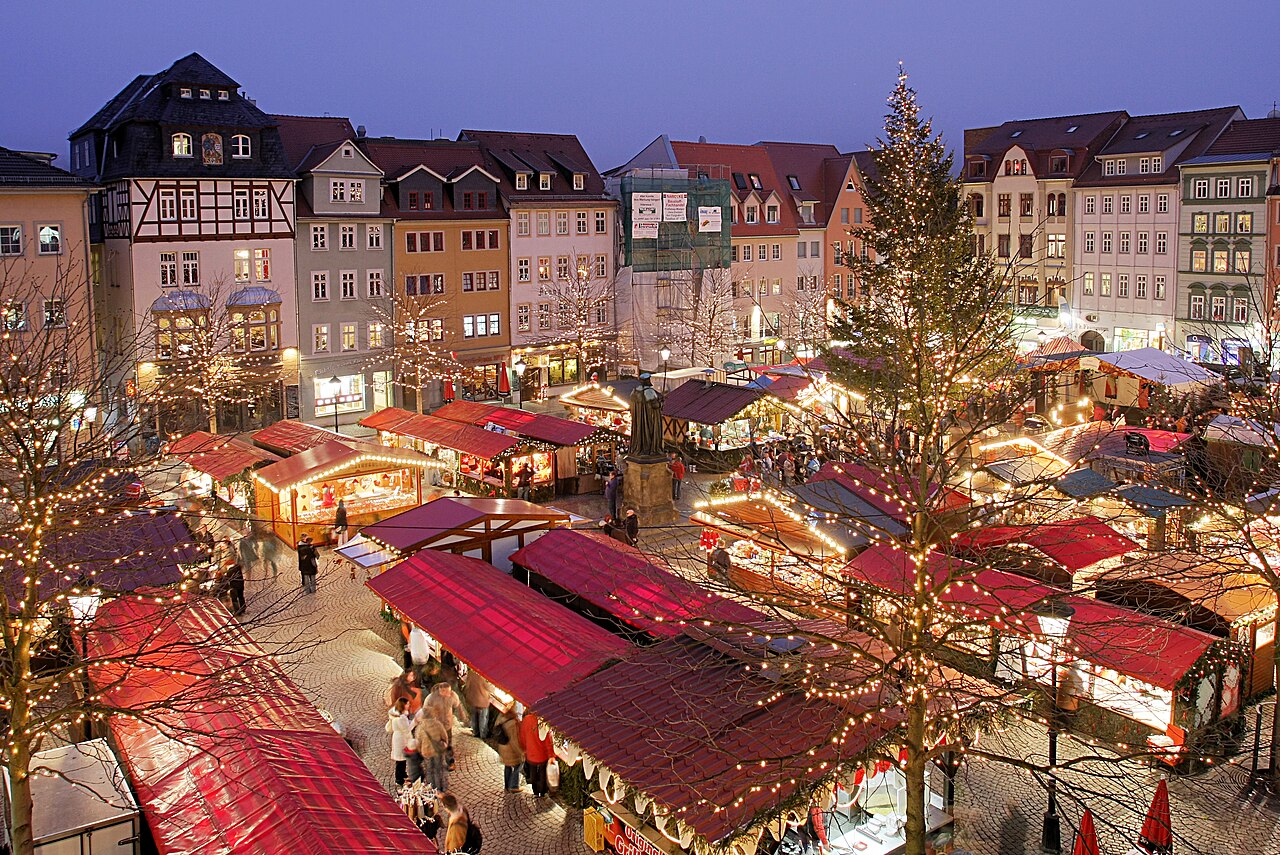
Christmas is typically a peak selling season for retailers in many nations around the world since sales increase dramatically during this time as people purchase gifts, decorations, and supplies to celebrate. In the United States, the "Christmas shopping season" starts as early as October.[206][207] In Canada, merchants begin advertising campaigns just before Halloween (October 31), and step up their marketing following Remembrance Day on November 11. In the UK and Ireland, the Christmas shopping season starts from mid-November, around the time when high street Christmas lights are turned on.[208][209] A concept devised by retail entrepreneur David Lewis, the first Christmas grotto opened in Lewis's department store in Liverpool, England in 1879.[210] In the United States, it has been calculated that a quarter of all personal spending takes place during the Christmas/holiday shopping season.[211] Figures from the US Census Bureau reveal that expenditure in department stores nationwide rose from $20.8 billion in November 2004 to $31.9 billion in December 2004, an increase of 54 percent. In other sectors, the pre-Christmas increase in spending was even greater, there being a November–December buying surge of 100 percent in bookstores and 170 percent in jewelry stores. In the same year employment in American retail stores rose from 1.6 million to 1.8 million in the two months leading up to Christmas.[212] Industries completely dependent on Christmas include Christmas cards, of which 1.9 billion are sent in the United States each year, and live Christmas trees, of which 20.8 million were cut in the US in 2002.[213] For 2019, the average US adult was projected to spend $920 on gifts alone.[214] In the UK in 2010, up to £8 billion was expected to be spent online at Christmas, approximately a quarter of total retail festive sales.[209]

In most Western nations, Christmas Day is the least active day of the year for business and commerce; almost all retail, commercial and institutional businesses are closed, and almost all industries cease activity (more than any other day of the year), whether laws require such or not. In England and Wales, the Christmas Day (Trading) Act 2004 prevents all large shops from trading on Christmas Day. Similar legislation was approved in Scotland in 2007. Film studios release many high-budget movies during the holiday season, including Christmas films, fantasy movies or high-tone dramas with high production values to hopes of maximizing the chance of nominations for the Academy Awards.[215]
One economist's analysis calculates that, despite increased overall spending, Christmas is a deadweight loss under orthodox microeconomic theory, because of the effect of gift-giving. This loss is calculated as the difference between what the gift giver spent on the item and what the gift receiver would have paid for the item. It is estimated that in 2001, Christmas resulted in a $4 billion deadweight loss in the US alone.[216][217] Because of complicating factors, this analysis is sometimes used to discuss possible flaws in current microeconomic theory. Other deadweight losses include the effects of Christmas on the environment and the fact that material gifts are often perceived as white elephants, imposing cost for upkeep and storage and contributing to clutter.[218]
Controversies

Christmas has at times been the subject of controversy and attacks from various sources, both Christian and non-Christian. Historically, it was prohibited by Puritans during their ascendency in the Commonwealth of England (1647–1660), and in Colonial New England where the Puritans outlawed the celebration of Christmas in 1659 on the grounds that Christmas was not mentioned in Scripture and therefore violated the Reformed regulative principle of worship.[220][221] The Parliament of Scotland, which was dominated by Presbyterians, passed a series of acts outlawing the observance of Christmas between 1637 and 1690; Christmas Day did not become a public holiday in Scotland until 1871.[51][222][223] Today, some conservative Reformed denominations such as the Free Presbyterian Church of Scotland and the Reformed Presbyterian Church of North America likewise reject the celebration of Christmas based on the regulative principle and what they see as its non-Scriptural origin.[224][225] Christmas celebrations have also been prohibited by atheist states such as the Soviet Union[226] and more recently majority Muslim states such as Somalia, Tajikistan and Brunei.[227]
Some Christians and organizations such as Pat Robertson's American Center for Law and Justice cite alleged attacks on Christmas (dubbing them a "war on Christmas").[228] Such groups claim that any specific mention of the term "Christmas" or its religious aspects is being increasingly censored, avoided, or discouraged by a number of advertisers, retailers, government (prominently schools), and other public and private organizations. One controversy is the occurrence of Christmas trees being renamed Holiday trees.[229] In the U.S. there has been a tendency to replace the greeting Merry Christmas with Happy Holidays, which is considered inclusive at the time of the Jewish celebration of Hanukkah.[230] In the U.S. and Canada, where the use of the term "Holidays" is most prevalent, opponents have denounced its usage and avoidance of using the term "Christmas" as being politically correct.[231][232][233] In 1984, the U.S. Supreme Court ruled in Lynch v. Donnelly that a Christmas display (which included a Nativity scene) owned and displayed by the city of Pawtucket, Rhode Island, did not violate the First Amendment.[234] American Muslim scholar Abdul Malik Mujahid has said that Muslims must treat Christmas with respect, even if they disagree with it.[235]
The government of the People's Republic of China officially espouses state atheism,[236] and has conducted antireligious campaigns to this end.[237] In December 2018, officials raided Christian churches prior to Christmastide and coerced them to close; Christmas trees and Santa Clauses were also forcibly removed.[238][239]
See also


- Apollo 8 Genesis reading from lunar orbit, December 24, 1968
- Christmas in July – Second Christmas celebration
- Christmas Peace – Finnish tradition
- Christmas Sunday – Sunday after Christmas
- List of Christmas films
- List of Christmas novels – Christmas as depicted in literaturePages displaying short descriptions of redirect targets
- Little Christmas – Alternative title for 6 January
- Nochebuena – Evening or entire day before Christmas DayPages displaying short descriptions of redirect targets
- Mithraism in comparison with other belief systems#25th of December
- Christmas by medium – Christmas represented in different media
Notes
- ^ Several branches of Eastern Christianity that use the Julian calendar also celebrate on December 25 according to that calendar, which is now January 7 on the Gregorian calendar. Armenian Churches observed the nativity on January 6 even before the Gregorian calendar originated. Most Armenian Christians use the Gregorian calendar, still celebrating Christmas Day on January 6. Some Armenian churches use the Julian calendar, thus celebrating Christmas Day on January 19 on the Gregorian calendar, with January 18 being Christmas Eve. Some regions also celebrate primarily on December 24, rather than December 25.
References
- ^ "Christmas as a Multi-Faith Festival" (PDF). BBC Learning English. December 29, 2005. Archived (PDF) from the original on October 1, 2008. Retrieved September 30, 2008.
- ^ "In the U.S., Christmas Not Just for Christians". Gallup, Inc. December 24, 2008. Archived from the original on November 16, 2012. Retrieved December 16, 2012.
- ^ "Christmas". Online Etymology Dictionary. December 20, 2020.
- ^ a b Martindale, Cyril Charles (1908). "Christmas". The Catholic Encyclopedia. Vol. 3. New York: Robert Appleton Company.
- ^ Schoenborn, Christoph (1994). God's human face: the Christ-icon. Ignatius Press. p. 154. ISBN 978-0-89870-514-0.
- ^ Galey, John (1986). Sinai and the Monastery of St. Catherine. American University in Cairo Press. p. 92. ISBN 978-977-424-118-5.
- ^ "Christmas | Origin, Definition, Traditions, History, & Facts | Britannica". www.britannica.com. Retrieved December 22, 2021.
- ^ Christenmas, n., Oxford English Dictionary. Retrieved December 12.
- ^ a b "Christmas" in the Middle English Dictionary. Archived January 5, 2012, at the Wayback Machine
- ^ Griffiths, Emma (December 22, 2004). "Why get cross about Xmas?". BBC News. Archived from the original on November 11, 2011. Retrieved December 12, 2011.
- ^ a b Hutton, Ronald (2001). The Stations of the Sun: A History of the Ritual Year in Britain. Oxford University Press. ISBN 978-0-19-285448-3.
- ^ "Midwinter" in Bosworth & Toller. Archived January 13, 2012, at the Wayback Machine
- ^ Serjeantson, Mary Sidney (1968). A History of Foreign Words in English.
- ^ "Online Etymology Dictionary". Archived from the original on January 13, 2012. Retrieved December 13, 2011.
- ^ Yule Archived January 13, 2012, at the Wayback Machine, Online Etymology Dictionary. Retrieved December 12.
- ^ Online Etymology Dictionary, Noel Archived January 13, 2012, at the Wayback Machine, accessed January 3, 2022
- ^ "Толковый словарь Даля онлайн". slovardalja.net. Retrieved December 25, 2022.
- ^ Rees, Neil (December 10, 2023). "Christmas – the original story". Christian Today. Retrieved December 15, 2023.
- ^ Piñero, Antonio (December 16, 2021). "Biblical stories of Jesus' birth reveal intriguing clues about his times". National Geographic. Retrieved December 15, 2023.
- ^ a b English, Adam C. (October 14, 2016). Christmas: Theological Anticipations. Wipf and Stock Publishers. pp. 70–71. ISBN 978-1-4982-3933-2.
- ^ The manuscript reads, VIII kal. Ian. natus Christus in Betleem Iudeae. ("The Chronography of 354 AD. Part 12: Commemorations of the Martyrs Archived November 22, 2011, at the Wayback Machine", The Tertullian Project. 2006.)
- ^ a b Bradshaw, Paul (2020). "The Dating of Christmas". In Larsen, Timothy (ed.). The Oxford Handbook of Christmas. Oxford University Press. pp. 7–10.
- ^ "Christmas and its cycle". New Catholic Encyclopedia. Vol. 3 (2nd ed.). Catholic University of America Press. 2002. pp. 550–557.
- ^ a b c d Forsythe, Gary (2012). Time in Roman Religion: One Thousand Years of Religious History. Routledge. pp. 113, 123, 141.
- ^ a b c d e Bradshaw, Paul (2020). "The Dating of Christmas". In Larsen, Timothy (ed.). The Oxford Handbook of Christmas. Oxford University Press. pp. 4–10.
- ^ Johnson, Maxwell E. (2005). "The Apostolic Tradition". In Wainwright, Geoffrey; Westerfield Tucker, Karen Beth (eds.). The Oxford History of Christian Worship. Oxford University Press. p. 65. ISBN 978-0-19-513886-3. Retrieved February 3, 2012.
- ^ a b Roy, Christian (2005). Traditional Festivals: A Multicultural Encyclopedia. Santa Barbara, California: ABC-CLIO. p. 146. ISBN 978-1-57607-089-5. Archived from the original on January 11, 2014. Retrieved February 3, 2012.
- ^ Pokhilko, Hieromonk Nicholas. "History of Epiphany". Archived from the original on September 23, 2016. Retrieved December 27, 2017.
- ^ Hastings, James; Selbie, John A., eds. (2003). Encyclopedia of Religion and Ethics. Vol. 6. Kessinger Publishing Company. pp. 603–604. ISBN 978-0-7661-3676-2. Archived from the original on November 22, 2018. Retrieved February 3, 2012.
- ^ Frøyshov, Stig Simeon. "[Hymnography of the] Rite of Jerusalem". Canterbury Dictionary of Hymnology.
- ^ a b c d e f g Murray, Alexander, "Medieval Christmas" Archived December 13, 2011, at the Wayback Machine, History Today, December 1986, 36 (12), pp. 31–39.
- ^ Forbes, Bruce David (October 1, 2008). Christmas: A Candid History. University of California Press. p. 27. ISBN 978-0-520-25802-0.
- ^ Hill, Christopher (2003). Holidays and Holy Nights: Celebrating Twelve Seasonal Festivals of the Christian Year. Quest Books. p. 91. ISBN 9780835608107.
- ^ "Who was Charlemagne? The unlikely king who became an emperor". National Geographic. Retrieved November 30, 2023.
- ^ "William the Conqueror: Crowned at Christmas". The History Press. Retrieved November 30, 2023.
- ^ a b McGreevy, Patrick. "Place in the American Christmas", (JSTOR Archived December 15, 2018, at the Wayback Machine), Geographical Review, Vol. 80, No. 1. January 1990, pp. 32–42. Retrieved September 10, 2007.
- ^ a b c Restad, Penne L. (1995). Christmas in America: a History. Oxford: Oxford University Press. ISBN 978-0-19-510980-1.
- ^ a b c d Forbes, Bruce David, Christmas: a candid history, University of California Press, 2007, ISBN 0-520-25104-0, pp. 68–79.
- ^ Lowe, Scott C. (January 11, 2011). Christmas. John Wiley & Sons. p. 226. ISBN 978-1-4443-4145-4.
- ^ Shawcross, John T. (January 1, 1993). John Milton. University Press of Kentucky. p. 249. ISBN 978-0-8131-7014-5.
- ^ Heinz, Donald (2010). Christmas: Festival of Incarnation. Fortress Press. p. 94. ISBN 978-1-4514-0695-5.
- ^ Old, Hughes Oliphant (2002). Worship: Reformed According to Scripture. Westminster John Knox Press. p. 29. ISBN 978-0-664-22579-7.
- ^ a b c d Durston, Chris (December 1985). "Lords of Misrule: The Puritan War on Christmas 1642–60". History Today. Vol. 35, no. 12. pp. 7–14. Archived from the original on March 10, 2007.
- ^ Old, Hughes Oliphant (2002). Worship: Reformed According to Scripture. Westminster John Knox Press. p. 29. ISBN 978-0-664-22579-7.
- ^ Carl Philipp Emanuel Nothaft (October 2011). "From Sukkot to Saturnalia: The Attack on Christmas in Sixteenth-Century Chronological Scholarship". Journal of the History of Ideas. 72 (4): 504–505. JSTOR 41337151.
- ^ a b "Historian Reveals that Cromwellian Christmas Football Rebels Ran Riot" (Press release). University of Warwick. December 17, 2003. Archived from the original on September 28, 2020. Retrieved August 25, 2023.
- ^ Sandys, William (1852). Christmastide: its history, festivities and carols. London: John Russell Smith. pp. 119–120.
- ^ a b "When Christmas carols were banned". BBC. Retrieved March 11, 2022.
- ^ Chambers, Robert (1885). Domestic Annals of Scotland, p. 211.
- ^ "Act dischairging the Yule vacance". The Records of the Parliaments of Scotland to 1707. (in Middle Scots). St Andrews: University of St Andrews and National Archives of Scotland. Archived from the original on May 19, 2012. Retrieved February 29, 2012.
- ^ a b Anon (May 22, 2007). "Bank Holiday Fact File" (PDF). TUC press release. TUC. Archived from the original (PDF) on June 3, 2013. Retrieved January 12, 2010.
- ^ Miall, Anthony & Peter (1978). The Victorian Christmas Book. Dent. p. 7. ISBN 978-0-460-12039-5.
- ^ Woodforde, James (1978). The Diary of a Country Parson 1758–1802. Oxford University Press. ISBN 978-0-19-281241-4.
- ^ a b c d Barnett, James Harwood (1984). The American Christmas: A Study in National Culture. Ayer Publishing. p. 3. ISBN 978-0-405-07671-8.
- ^ Mather, Cotton (December 25, 1712). Grace defended. A censure on the ungodliness, by which the glorious grace of God, is too commonly abused. A sermon preached on the twenty fifth day of December, 1712. Containing some seasonable admonitions of piety. And concluded, with a brief dissertation on that case, whether the penitent thief on the cross, be an example of one repenting at the last hour, and on such a repentance received unto mercy? (Speech). Boston, Massachusetts: B. Green, for Samuel Gerrish. Retrieved August 12, 2022.
- ^ Stephen W. Nissenbaum, "Christmas in Early New England, 1620–1820: Puritanism, Popular Culture, and the Printed Word", Proceedings of the American Antiquarian Society 106:1: p79-164 (January 1, 1996). Retrieved December 25, 2023.
- ^ Innes, Stephen (1995). Creating the Commonwealth: The Economic Culture of Puritan New England. W.W. Norton & Company. p. 145. ISBN 978-0-393-03584-1.
- ^ Marling, Karal Ann (2000). Merry Christmas!: Celebrating America's Greatest Holiday. Harvard University Press. p. 44. ISBN 978-0-674-00318-7.
- ^ Smith Thomas, Nancy (2007). Moravian Christmas in the South. Old Salem Museums & Gardens. p. 20. ISBN 978-0-8078-3181-6.
- ^ Andrews, Peter (1975). Christmas in Colonial and Early America. United States: World Book Encyclopedia, Inc. ISBN 978-0-7166-2001-3.
- ^ Christmas in France. World Book Encyclopedia. 1996. p. 35. ISBN 978-0-7166-0876-9.
- ^ a b c Rowell, Geoffrey (December 1993). "Dickens and the Construction of Christmas". History Today. 43 (12). Archived from the original on December 29, 2016. Retrieved December 28, 2016.
- ^ Ledger, Sally; Furneaux, Holly, eds. (2011). Charles Dickens in Context. Cambridge University Press. p. 178. ISBN 978-0-19-513886-3. Retrieved December 25, 2020.
- ^ a b Standiford, Les (2008). The Man Who Invented Christmas: How Charles Dickens's A Christmas Carol Rescued His Career and Revived Our Holiday Spirits. Crown. ISBN 978-0-307-40578-4.
- ^ a b Minzesheimer, Bob (December 22, 2008). "Dickens' classic 'Christmas Carol' still sings to us". USA Today. Archived from the original on November 6, 2009. Retrieved April 30, 2010.
- ^ Hutton, Ronald (February 15, 2001). The Stations of the Sun: A History of the Ritual Year in Britain. Oxford University Press. ISBN 978-0-19-157842-7.
- ^ Forbes, Bruce David (October 1, 2008). Christmas: A Candid History. --University of California Press. p. 62. ISBN 978-0-520-25802-0.
- ^ Kelly, Richard Michael, ed. (2003). A Christmas Carol. Broadview Press. pp. 9, 12. ISBN 978-1-55111-476-7.
- ^ Cochrane, Robertson. Wordplay: origins, meanings, and usage of the English language. University of Toronto Press, 1996, p. 126, ISBN 0-8020-7752-8.
- ^ Hutton, Ronald, The Stations of the Sun: The Ritual Year in England. 1996. Oxford: Oxford University Press, p. 113. ISBN 0-19-285448-8.
- ^ Joe L. Wheeler. Christmas in My Heart, Volume 10, p. 97. Review and Herald Pub Assoc, 2001. ISBN 0-8280-1622-4.
- ^ Earnshaw, Iris (November 2003). "The History of Christmas Cards". Inverloch Historical Society Inc. Archived from the original on May 26, 2016. Retrieved July 25, 2008.
- ^ The Girlhood of Queen Victoria: a selection from Her Majesty's diaries, p. 61. Longmans, Green & Co., 1912. University of Wisconsin. Retrieved December 25, 2023.
- ^ Lejeune, Marie Claire. Compendium of symbolic and ritual plants in Europe, p.550. University of Michigan ISBN 90-77135-04-9.
- ^ a b Shoemaker, Alfred Lewis. (1959) Christmas in Pennsylvania: a folk-cultural study. Edition 40. pp. 52, 53. Stackpole Books 1999. ISBN 0-8117-0328-2.
- ^ Godey's Lady's Book, 1850. Godey's copied it exactly, except he removed the Queen's tiara, and Prince Albert's moustache, to remake the engraving into an American scene.
- ^ Kelly, Richard Michael (ed.) (2003), A Christmas Carol, p. 20. Broadview Literary Texts, New York: Broadview Press, ISBN 1-55111-476-3.
- ^ Moore's poem transferred the genuine old Dutch traditions celebrated at New Year in New York, including the exchange of gifts, family feasting, and tales of "sinterklass" (a derivation in Dutch from "Saint Nicholas", from whence comes the modern "Santa Claus") to Christmas.The history of Christmas: Christmas history in America Archived April 19, 2018, at the Wayback Machine, 2006.
- ^ "Americans Celebrate Christmas in Diverse Ways" Archived December 10, 2006, at the Wayback Machine, Usinfo.state.gov, November 26, 2006.
- ^ First Presbyterian Church of Watertown "Oh ... and one more thing" December 11, 2005 Archived February 25, 2007, at the Wayback Machine
- ^ a b c Restad, Penne L. (1995), Christmas in America: a History, Oxford: Oxford University Press, p. 96. ISBN 0-19-510980-5.
- ^ "Christian church of God – history of Christmas". Christianchurchofgod.com. Archived from the original on December 19, 2010. Retrieved February 24, 2011.
- ^ Meggs, Philip B. A History of Graphic Design. 1998 John Wiley & Sons, Inc. p 148 ISBN 0-471-29198-6.
- ^ Jacob R. Straus (November 16, 2012). "Federal Holidays: Evolution and Current Practices" (PDF). Congressional Research Service. Archived (PDF) from the original on January 3, 2014. Retrieved January 2, 2014.
- ^ Crossland, David (December 22, 2021). "Truces weren't just for 1914 Christmas". The Times. ISSN 0140-0460. Retrieved December 24, 2021.
- ^ Baxter, Keven (December 24, 2021). "Peace for a day: How soccer brought a brief truce to World War I on Christmas Day 1914". Los Angeles Times. Archived from the original on December 24, 2021. Retrieved December 24, 2021.
- ^ "The Real Story of the Christmas Truce". Imperial War Museums. Retrieved December 24, 2021.
- ^ "Christmas Truce 1914". BBC School Radio. Retrieved December 24, 2021.
- ^ Connelly, Mark (2000). Christmas at the Movies: Images of Christmas in American, British and European Cinema. I.B.Tauris. p. 186. ISBN 978-1-86064-397-2.
- ^ Ramet, Sabrina Petra (November 10, 2005). Religious Policy in the Soviet Union. Cambridge University Press. p. 138. ISBN 978-0-521-02230-9.
- ^ Zugger, Christopher Lawrence (2001). Catholics of the Soviet Empire from Lenin Through Stalin. Syracuse University Press. p. 210. ISBN 978-0-8156-0679-6.
- ^ Tamkin, Emily (December 30, 2016). "How Soviets Came to Celebrate New Year's Like Christmas (and Why Russians Still Do)". Foreign Policy. Retrieved January 6, 2022.
- ^ Goldberg, Carey (January 7, 1991). "A Russian Christmas—Better Late Than Never: Soviet Union: Orthodox Church celebration is the first under Communists. But, as with most of Yeltsin's pronouncements, the holiday stirs a controversy". Los Angeles Times. Archived from the original on December 22, 2015. Retrieved November 22, 2014.
- ^ Perry, Joseph (December 24, 2015). "How the Nazis co-opted Christmas: A history of propaganda". The Washington Post. Archived from the original on January 6, 2016. Retrieved March 11, 2016.
- ^ "Somalia joins Brunei by banning Christmas celebrations 'to protect Islam'". The Daily Telegraph. December 24, 2015. Archived from the original on May 29, 2018. Retrieved April 4, 2018.
- ^ Neuman, Scott (December 16, 2023). "There's no Christmas in Bethlehem this year. With war in Gaza, festivities are off". NPR. Retrieved December 23, 2023.
- ^ Jespersen, Knud J. V. (June 21, 2011). A History of Denmark. Macmillan International Higher Education. p. 91. ISBN 978-0-230-34417-4.
- ^ Alkan, Sena (December 19, 2015). "The history behind Christmas and Turkey". Daily Sabah. Retrieved November 30, 2022.
- ^ McGrath, Alister E. (January 27, 2015). Christianity: An Introduction. John Wiley & Sons. p. 239. ISBN 978-1-118-46565-3.
- ^ Huckabee, Tyler (December 9, 2021). "No, Christmas Trees Don't Have 'Pagan' Roots". Relevant Magazine. Retrieved December 9, 2022.
- ^ Neal, Daniel (1822). The History of the Puritans. William Baynes and Son. p. 193. Retrieved December 25, 2023. (page 133 in the link above)
- ^ "Christmas – An Ancient Holiday" Archived May 9, 2007, at the Wayback Machine, The History Channel, 2007.
- ^ NEWS, SA (December 24, 2022). "Christmas Day 2022: Facts, Story & Quotes About Merry Christmas". SA News Channel. Retrieved December 26, 2022.
- ^ a b Simek (2007:379).
- ^ Coffman, Elesha. "Why December 25?" Archived September 19, 2008, at the Wayback Machine Christian History & Biography, Christianity Today, 2000.
- ^ Simek (2010:180, 379–380).
- ^ Weiser, Franz Xaver (1958). Handbook of Christian Feasts and Customs. Harcourt.
- ^ "Koliada". Encyclopediaofukraine.com. Retrieved November 19, 2012.
- ^ "2018 Worship and Music Planning Calendar". The United Methodist Church. 2018. Retrieved December 9, 2018.
- ^ Stetzer, Ed (December 14, 2015). "What Is Church Attendance Like During Christmastime? New Data From LifeWay Research". Christianity Today. Archived from the original on January 29, 2018. Retrieved December 9, 2018.
- ^ Bingham, John (October 27, 2016). "British families only attend church at Christmas, new figures suggest". The Daily Telegraph. Archived from the original on December 27, 2017. Retrieved December 24, 2017.
- ^ Collins, Ace, Stories Behind the Great Traditions of Christmas, Zondervan, (2003), ISBN 0-310-24880-9 p.47.
- ^ Internet Archive Susan Topp Weber, Nativities of the World, Gibbs Smith, 2013
- ^ "Alla scoperta dei cinque presepi più belli di Bologna | Nuok". Nuok.it. January 24, 2013. Archived from the original on December 27, 2013. Retrieved December 25, 2013.
- ^ "Presepi in Liguria: provincia di Genova, Tigullio -sito di Paolino". Digilander.libero.it. Archived from the original on December 27, 2013. Retrieved December 25, 2013.
- ^ "Holidays at the Museums: Carnegie Museum of Natural History". Carnegiemnh.org. November 26, 2013. Archived from the original on December 27, 2013. Retrieved December 25, 2013.
- ^ Bershad, David; Carolina Mangone, The Christian Travelers Guide to Italy Archived December 25, 2022, at the Wayback Machine, Zondervan, 2001.
- ^ "The Provençal Nativity Scene". Simplytreasures.com. Archived from the original on September 14, 2012. Retrieved December 25, 2013.
- ^ Seaburg, Carl, Celebrating Christmas: An Anthology Archived December 25, 2022, at the Wayback Machine, iUniverse, 2003.
- ^ Bowler, Gerry, The World Encyclopedia of Christmas Archived December 25, 2022, at the Wayback Machine, Random House LLC, 2012.
- ^ Carol King (December 24, 2012). "A Christmas Living Nativity Scene in Sicily". Italy Magazine. Archived from the original on December 26, 2013. Retrieved December 25, 2013.
- ^ Collins p. 83.
- ^ These Strange German Ways. Edelweiss Publishing Company. 1989. p. 122.
- ^ Nowak, Claire (December 23, 2019). "The Real Reason Why Christmas Colors Are Green and Red". Reader's Digest. Retrieved December 18, 2020.
- ^ Norris, Rebecca (October 29, 2019). "Here's the History Behind Why Red and Green Are the Traditional Christmas Colors". Country Living. Retrieved December 18, 2020.
- ^ Collins, Ace (April 1, 2010). Stories Behind the Great Traditions of Christmas. Zondervan. ISBN 978-0-310-87388-4. Retrieved December 2, 2010.
- ^ Senn, Frank C. (2012). Introduction to Christian Liturgy. Fortress Press. p. 118. ISBN 978-1-4514-2433-1.
- ^ "The Christmas Tree". Lutheran Spokesman. 29–32. 1936.
- ^ Kelly, Joseph F. (2010). The Feast of Christmas. Liturgical Press. p. 94. ISBN 978-0-8146-3932-0.
- ^ Blainey, Geoffrey (October 24, 2013). A Short History of Christianity. Rowman & Littlefield Publishers. p. 418. ISBN 978-1-4422-2590-9.
- ^ Mandryk, DeeAnn (October 25, 2005). Canadian Christmas Traditions. James Lorimer & Company. p. 67. ISBN 978-1-55439-098-4.
- ^ Wells, Dorothy (1897). "Christmas in Other Lands". The School Journal. 55: 697–8.
- ^ Jones, David Albert (October 27, 2011). Angels. Oxford University Press. p. 24. ISBN 978-0-19-161491-0.
- ^ Becker, Udo (January 1, 2000). The Continuum Encyclopedia of Symbols. A & C Black. p. 60. ISBN 978-0-8264-1221-8.
- ^ Crump, William D. (2006). The Christmas Encyclopedia. McFarland & Company. p. 67. ISBN 978-0-7864-2293-7.
- ^ Socias, James (June 24, 2020). Handbook of Prayers. Midwest Theological Forum. ISBN 978-1-936045-54-9.
- ^ Kitch, Anne E. (2004). The Anglican Family Prayer Book. Morehouse Publishing. p. 125.
- ^ a b van Renterghem, Tony. When Santa was a shaman. St. Paul: Llewellyn Publications, 1995. ISBN 1-56718-765-X.
- ^ Fritz Allhoff, Scott C. Lowe (2010). Christmas. John Wiley & Sons.
- ^ Harper, Douglas, Christ Archived May 9, 2006, at the Wayback Machine, Online Etymology Dictionary, 2001.
- ^ "The Chronological History of the Christmas Tree". The Christmas Archives. Archived from the original on December 21, 2007. Retrieved December 18, 2007.
- ^ "Christmas Tradition – The Christmas Tree Custom". Fashion Era. Archived from the original on December 18, 2007. Retrieved December 18, 2007.
- ^ Hewitson, Carolyn (2013). Festivals. Routledge. ISBN 978-1-135-05706-0.
- ^ "The Legends and Traditions of Holiday Plants". www.ipm.iastate.edu. Archived from the original on January 22, 2016. Retrieved February 17, 2016.
- ^ "StackPath". www.gardeningknowhow.com. December 24, 2010. Retrieved December 23, 2020.
- ^ "Germany's Advent wreath tradition, and how to make one of your own". Stripes Europe. November 21, 2019. Archived from the original on December 3, 2021. Retrieved December 23, 2020.
- ^ "Liturgical Year: Symbolic Lights and Fires of Christmas (Activity)". Catholic Culture. Archived from the original on January 13, 2012. Retrieved December 10, 2011.
- ^ Murray, Brian. "Christmas lights and community building in America", History Matters, Spring 2006. Archived June 29, 2010, at the Wayback Machine
- ^ "Epiphany: Should Christmas decorations come down on 6 January?". BBC News. January 6, 2017. Retrieved December 23, 2020.
- ^ a b c d e Collins, Ace (2010). Stories Behind the Great Traditions of Christmas. Zondervan. pp. 139–141. ISBN 978-0-310-87388-4.
- ^ Miles, Clement, Christmas customs and traditions, Courier Dover Publications, 1976, ISBN 0-486-23354-5, p. 32.
- ^ Miles, Clement, Christmas customs and traditions, Courier Dover Publications, 1976, pp. 47–48
- ^ Clancy, Ronald M. (2008). Sacred Christmas Music: The Stories Behind the Most Beloved Songs of Devotion. Sterling Publishing Company. p. 40. ISBN 978-1-4027-5811-9.
- ^ Dudley-Smith, Timothy (1987). A Flame of Love. London: Triangle/SPCK. ISBN 978-0-281-04300-2.
- ^ Thomas, John; Talhaiarn; Thomas Oliphant (1862). Welsh melodies: with Welsh and English poetry. London: Addison, Hollier and Lucas. p. 139. OCLC 63015609.
- ^ Byrne, Eugene (December 24, 2019). "Arguably most famous Christmas song was written by a Bristolian". BristolLive. Retrieved November 6, 2020.
- ^ a b c Smolko, Joanna (February 4, 2012). "Christmas music". Grove Music Online. Oxford University Press. doi:10.1093/gmo/9781561592630.article.A2227990.
- ^ Broomfield, Andrea (2007), Food and Cooking in Victorian England: A History Archived October 25, 2022, at the Wayback Machine, Greenwood Publishing Group, 2007, pp. 149–150.
- ^ Muir, Frank (1977), Christmas customs & traditions, Taplinger Pub. Co., 1977, p. 58.
- ^ "Carp for Christmas: the odd Central European tradition explained". Kafkadesk. December 9, 2018.
- ^ "Christmas card sold for record price" Archived February 5, 2006, at the Wayback Machine, BBC News. Retrieved October 28, 2011.
- ^ Schaverien, Anna (June 19, 2021). "E-Cards Are Back, Thanks to the Pandemic". The New York Times. ISSN 0362-4331. Archived from the original on December 28, 2021. Retrieved November 13, 2021.
- ^ "It's time to mail your holiday cards – if you can find any". NBC News. November 2, 2021. Retrieved November 13, 2021.
- ^ "History of Christmas – Part 2". The Note Pad | Stationery & Party Etiquette Blog by American Stationery. November 28, 2012. Retrieved December 22, 2021.
- ^ Pruitt, Sarah (September 2018). "The War of Words behind 'Happy Holidays'". HISTORY. Retrieved December 24, 2020.
- ^ "In pictures: Christmas stamps". BBC. Retrieved August 29, 2023.
- ^ "The First Christmas Stamps". American Philatelic Society. Retrieved August 29, 2023.
- ^ Loytved, G. (2006). "[Christmas seals]". Pneumologie (Stuttgart, Germany). 60 (11): 701–710. doi:10.1055/s-2006-944325. ISSN 0934-8387. PMID 17109268.
- ^ Collins, Ace (April 20, 2010). Stories Behind the Great Traditions of Christmas. Zondervan. p. 17. ISBN 978-0-310-87388-4. Retrieved April 10, 2012.
- ^ Trexler, Richard (May 23, 1997). The Journey of the Magi: Meanings in History of a Christian Story. Princeton University Press. p. 17. ISBN 978-0-691-01126-4. Archived from the original on December 31, 2015. Retrieved April 10, 2012.
- ^ Collins, Ace (April 20, 2010). Stories Behind the Great Traditions of Christmas. Zondervan. p. 17. ISBN 978-0-310-87388-4. Retrieved April 10, 2012.
- ^ Berking, Helmuth (March 30, 1999). Sociology of Giving. SAGE Publications. p. 14. ISBN 978-0-85702-613-2.
- ^ Talley, Thomas J. (1991). The Origins of the Liturgical Year. Liturgical Press. pp. 88–91. ISBN 978-0-8146-6075-1. Retrieved December 27, 2016.
- ^ Seward, Pat; Lal, Sunandini Arora (2006). Netherlands. Marshall Cavendish. p. 116. ISBN 978-0-7614-2052-1.
- ^ Domenico, Roy Palmer (2002). The regions of Italy: a reference guide to history and culture. Greenwood Publishing Group. p. 21. ISBN 978-0-313-30733-1.
- ^ Collins, Ace (2009). Stories Behind Men of Faith. Zondervan. p. 121. ISBN 978-0-310-56456-0. Retrieved June 20, 2015.
- ^ Jona Lendering (November 20, 2008). "Saint Nicholas, Sinterklaas, Santa Claus". Livius.org. Archived from the original on May 13, 2011. Retrieved February 24, 2011.
- ^ "St. Basil (330–379)". Skiathosbooks.com. Archived from the original on January 12, 2012. Retrieved February 3, 2012.
- ^ Matera, Mariane. "Santa: The First Great Lie" Archived September 14, 2007, at the Wayback Machine, Citybeat, Issue 304.
- ^ "Kto przynosi Wam prezenty? Św. Mikołaj, Gwiazdor, Aniołek, Dzieciątko czy może Dziadek Mróz?". Bezprawnik (in Polish). December 22, 2016. Archived from the original on December 24, 2017. Retrieved December 24, 2017.
- ^ "Nie tylko Mikołaj, czyli kto według tradycji rozdaje prezenty w różnych regionach Polski?". gazeta.pl (in Polish). December 21, 2015. Archived from the original on December 24, 2017. Retrieved December 24, 2017.
- ^ "Christmas Day Ba' 2023". Orkney.com.
- ^ a b "Why football at Christmas is a very British tradition". BBC Bitesize.
- ^ "The Last Time Football Was Played on Christmas Day in England". 90min.com. December 25, 2020.
- ^ John Woodcock (November 17, 2013). "England v Germany: when rivals staged beautiful game on the Somme" Archived June 12, 2020, at the Wayback Machine, The Daily Telegraph.
- ^ "The sports games that don't stop for Christmas Day". December 22, 2017 – via www.bbc.co.uk.
- ^ Kelly, Joseph F., The Origins of Christmas, Liturgical Press, 2004, pp. 67–69.
- ^ Roll, p.107
- ^ Hijmans, S.E., Sol, the sun in the art and religions of Rome, 2009, p. 595. ISBN 978-90-367-3931-3 Archived May 10, 2013, at the Wayback Machine
- ^ Kelly, Joseph F., The Origins of Christmas, Liturgical Press, p.80
- ^ Hijmans, S.E., Sol: The Sun in the Art and Religions of Rome, 2009, p. 584.
- ^ Malachi 4:2
- ^ Melton, J. Gordon (2011). Religious Celebrations: An Encyclopedia of Holidays, Festivals, Solemn Observances, and Spiritual Commemorations [2 volumes]: An Encyclopedia of Holidays, Festivals, Solemn Observances, and Spiritual Commemorations. ABC-CLIO. p. 39. ISBN 978-1-59884-206-7.
- ^ Ramzy, John. "The Glorious Feast of Nativity: 7 January? 29 Kiahk? 25 December?". Coptic Orthodox Church Network. Archived from the original on December 28, 2010. Retrieved January 17, 2011.
- ^ a b Blakemore, Erin (December 26, 2019). "Why some people celebrate Christmas in January". www.nationalgeographic.com. National Geographic Partners LLC. Archived from the original on April 16, 2021. Retrieved July 26, 2022.
- ^ "Christmas in Bethlehem". www.sacred-destinations.com. Archived from the original on June 16, 2010. Retrieved June 12, 2010.
- ^ "Why Do Armenians Celebrate Christmas on January 6th?". armenianchurch.org. Retrieved August 13, 2022.
- ^ "Christmas is here- yet again!". Jerusalem Post. Retrieved August 13, 2022.
- ^ Lukiv, Jaroslav (July 28, 2023). "Ukraine moves Christmas Day in snub to Russia". BBC News. British Broadcasting Corporation. Retrieved December 15, 2023.
- ^ "Ukraine moves official Christmas Day holiday to Dec. 25, denouncing Russian-imposed traditions". AP News. July 29, 2023. Retrieved July 31, 2023.
- ^ RFE/RL. "Orthodox Church Of Ukraine Approves Calendar Switch In Widening Diversion From Russia". RadioFreeEurope/RadioLiberty. Retrieved June 18, 2023.
- ^ Lukiv, Jaroslav (July 28, 2023). "Ukraine moves Christmas Day in snub to Russia". BBC News. Retrieved July 28, 2023.
- ^ The Ethiopian Orthodox Tewahedo Church Faith and Order - Religious Holidays and Calendar Archived October 29, 2021, at the Wayback Machine>
- ^ Siegbert Uhlig, Encyclopaedia Aethiopica He-N, p. 538
- ^ Phillips, Tom (September 3, 2024). "Maduro declares Christmas in October amid Venezuela's post-election strife". The Guardian. ISSN 0261-3077. Retrieved September 8, 2024.
- ^ Varga, Melody. "Black Friday, About:Retail Industry. Archived May 17, 2008, at the Wayback Machine
- ^ "Definition Christmas Creep – What is Christmas Creep". Womeninbusiness.about.com. November 2, 2010. Archived from the original on December 27, 2010. Retrieved February 24, 2011.
- ^ "South Molton and Brook Street Christmas Lights" Archived November 19, 2010, at the Wayback Machine (November 16, 2010), View London.co.uk.
- ^ a b Kollewe, Julia, (November 29, 2010), "West End spree worth £250m marks start of Christmas shopping season" Archived December 21, 2016, at the Wayback Machine, The Guardian.
- ^ "Liverpool's record breaking Christmas grotto beloved by generations". Liverpool Echo. Retrieved April 15, 2024.
- ^ Gwen Outen (December 3, 2004). "Economics Report – Holiday Shopping Season in the U.S." Voice of America. Archived from the original on March 3, 2009.
- ^ US Census Bureau. "Facts. The Holiday Season" December 19, 2005. (accessed November 30, 2009) Archived copy at the Library of Congress (May 7, 2010).
- ^ US Census 2005.
- ^ Haury, Amanda C. (November 8, 2019). "Average Cost of an American Christmas". Investopedia. Dotdash. Retrieved December 17, 2019.
- ^ Zauzmer, Ben (January 31, 2020). "Oscar Seasons: The Intersection of Data and the Academy Awards". Harvard Data Science Review. 2 (1). doi:10.1162/99608f92.6230ce9f. S2CID 213681214. Retrieved November 15, 2021.
- ^ Joel Waldfogel "The Deadweight Loss of Christmas" (PDF), American Economic Review, December 1993, 83 (5). Retrieved December 25, 2023.
- ^ "Is Santa a deadweight loss?" Archived December 21, 2005, at the Wayback Machine The Economist December 20, 2001.
- ^ Reuters. "Christmas is Damaging the Environment, Report Says" Archived March 12, 2007, at the Wayback Machine, December 16, 2005.
- ^ Harper, Timothy (1999). Moscow Madness: Crime, Corruption, and One Man's Pursuit of Profit in the New Russia. McGraw-Hill. p. 72. ISBN 978-0-07-026700-8.
- ^ "Marta Patiño, The Puritan Ban on Christmas". Timetravel-britain.com. Archived from the original on March 1, 2011. Retrieved February 24, 2011.
- ^ Christmas in the Colonies Archived December 25, 2011, at the Wayback Machine Time. Retrieved December 25, 2011.
- ^ Daniels, Bruce Colin (1995). Puritans at Play: Leisure and Recreation in Colonial New England. Macmillan, p. 89, ISBN 978-0-312-16124-8
- ^ Roark, James; Johnson, Michael; Cohen, Patricia; Stage, Sarah; Lawson, Alan; Hartmann, Susan (2011). Understanding the American Promise: A History, Volume I: To 1877. Bedford/St. Martin's. p. 91.
- ^ "The Regulative Principle of Worship". Free Presbyterian Church of Scotland. Retrieved April 12, 2022.
- ^ Minutes of Session of 1905. Reformed Presbyterian Church of North America. 1905. p. 130. Retrieved December 25, 2023.
- ^ Goldberg, Carey (January 7, 1991). "A Russian Christmas—Better Late Than Never: Soviet Union: Orthodox Church Celebration Is the First Under Communists. But, as with Most of Yeltsin's Pronouncements, the Holiday Stirs a Controversy". Los Angeles Times. Archived from the original on December 22, 2015. Retrieved August 11, 2016.
- ^ Woolf, Nicky (December 24, 2015). "Christmas celebrations banned in Somalia, Tajikistan and Brunei". The Guardian. Archived from the original on August 26, 2016. Retrieved August 10, 2016.
- ^ "ACLJ, Christmas laws". Aclj.org. Archived from the original on December 25, 2013. Retrieved December 25, 2013.
- ^ Aliweiwi, Jehad (November 28, 2005). "A Christmas Tree or a Holiday Tree?". Muslim Canadian Congress. Archived from the original on December 31, 2005. Retrieved December 25, 2023. (previous title: "Christmas controversy article")
- ^ Feder, Don, "In the culture, Christmas morphs into holiday" Archived April 12, 2010, at the Wayback Machine, Jewish World Review, December 13, 2000.
- ^ "The Brits Have It Right: Forget Happy Holidays, Just Wish People Merry Christmas". The Guardian. London. August 11, 2016. Archived from the original on December 21, 2016. Retrieved December 11, 2016.
- ^ Jankowski, Paul (August 11, 2016). "Is Saying 'Merry Christmas' Politically Correct? Who Cares?". Forbes. Archived from the original on August 7, 2017. Retrieved August 22, 2017.
- ^ Taylor, Christopher Stuart (August 11, 2016). "If We Can't Say 'Merry Christmas' in Canada, Multiculturalism Failed". HuffPost. Archived from the original on September 29, 2016. Retrieved August 11, 2016.
- ^ "Lynch vs. Donnelly". Belcher Foundation. 1984. Archived from the original on February 16, 2006. Retrieved April 12, 2006.
- ^ Mujahid, Abdul Malik. "Treating Christmas with respect", Sound Vision. Archived April 5, 2017, at the Wayback Machine.
- ^ Dillon, Michael (2001). Religious Minorities and China (PDF). Minority Rights Group International. Retrieved December 25, 2023.
- ^ Buang, Sa'eda; Chew, Phyllis Ghim-Lian (May 9, 2014). Muslim Education in the 21st Century: Asian Perspectives. Routledge. p. 75. ISBN 978-1-317-81500-6.
- ^ "Alarm over China's Church crackdown". BBC. December 18, 2018. Archived from the original on January 5, 2019. Retrieved January 11, 2019.
- ^ "Santa Claus won't be coming to this town, as Chinese officials ban Christmas". South China Morning Post. December 18, 2018. Archived from the original on January 12, 2019. Retrieved January 11, 2019.
Further reading
- Bowler, Gerry, The World Encyclopedia of Christmas (October 2004: McClelland & Stewart). ISBN 978-0-7710-1535-9
- Bowler, Gerry, Santa Claus: A Biography (November 2007: McClelland & Stewart). ISBN 978-0-7710-1668-4
- Comfort, David, Just Say Noel: A History of Christmas from the Nativity to the Nineties (November 1995: Fireside). ISBN 978-0-684-80057-8
- Count, Earl W., 4000 Years of Christmas: A Gift from the Ages (November 1997: Ulysses Press). ISBN 978-1-56975-087-2
- Federer, William J., There Really Is a Santa Claus: The History of St. Nicholas & Christmas Holiday Traditions Archived December 25, 2022, at the Wayback Machine (December 2002: Amerisearch). ISBN 978-0-9653557-4-2
- Kelly, Joseph F., The Origins of Christmas Archived December 25, 2022, at the Wayback Machine (August 2004: Liturgical Press). ISBN 978-0-8146-2984-0
- Miles, Clement A., Christmas Customs and Traditions Archived December 25, 2022, at the Wayback Machine (1976: Dover Publications). ISBN 978-0-486-23354-3
- Nissenbaum, Stephen, The Battle for Christmas (1996; New York: Vintage Books, 1997). ISBN 0-679-74038-4
- Restad, Penne L. (1995). Christmas in America: A History. New York: Oxford University Press. ISBN 978-0-19-509300-1.
- Rosenthal, Jim, St. Nicholas: A Closer Look at Christmas (July 2006: Nelson Reference). ISBN 1-4185-0407-6
- Sammons, Peter (May 2006). The Birth of Christ. Glory to Glory Publications (UK). ISBN 978-0-9551790-1-3.
- . Encyclopædia Britannica. Vol. 6 (11th ed.). 1911. pp. 293–294.
- Martindale, Cyril (1908). . In Herbermann, Charles (ed.). Catholic Encyclopedia. Vol. 3. New York: Robert Appleton Company.
External links
- Christmas collection at the Smithsonian National Museum of American History
- Christmas: Its Origin and Associations, by William Francis Dawson, 1902, from Project Gutenberg
- Christmas: its origin, celebration and significance as related in prose and verse, by Robert Haven Schauffler, 1907