Hispanopedia Wiki
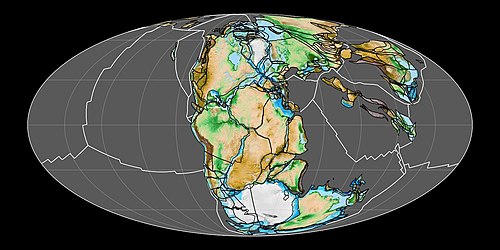
Clevosaurus (meaning "Gloucester lizard") is an extinct genus of rhynchocephalian reptile from the Late Triassic and the Early Jurassicperiods. Species of Clevosaurus were widespread across Pangaea, and have been found on all continents except Australia and Antarctica.[1] Five species of Clevosaurus have been found in ancient fissure fill deposits in south-west England and Wales, alongside other sphenodontians, early mammals and dinosaurs. In regards to its Pangaean distribution, C. hadroprodon is the oldest record of a sphenodontian from Gondwana,[2] though its affinity to Clevosaurus has been questioned.[3]

History of discovery
The first species of Clevosaurus to be described was C. hudsoni, which was described by William Elgin Swinton in 1939 from a fissure fill deposit in Cromhall Quarry (Magnesian Conglomerate Formation) in the county of Gloucestershire, England, with the name of the county lending its name to the genus.[4]
Another notable specimen was discovered in 1953 in Cromhall Quarry alongside the holotype of Cryptovaranoides microlanius.[5]
Description

Species of Clevosaurus varied in body size, with Clevosaurus sectumsemper having an estimated total length of 12 centimetres (4.7 in), while C. hudsoni had a total length of around 25 centimetres (9.8 in). The skull length could range from as little as 1.4 centimetres (0.55 in) in C. sectumsemper and up to 4 centimetres (1.6 in) in C. hudsoni.[6] The reptilian encephalisation quotient (REQ) of C. brasiliensis is much lower than that of the modern tuatara, whose REQ is 0.84–1.16.[7] The teeth of European Clevosaurus tended to be mesio-distally elongated, blade-like, and occluded precisely with the opposite pair of teeth, leaving conspicuous diagonal wear facets and acting as a self-sharpening cutting surface.[8] However, the teeth of C. brasiliensis have a very different morphology with no diagonal wear facets, the teeth of the dentary are all conical excluding the posterior-most tooth which can be up to three-times bigger than any of the other teeth, they also have a unique form of implantation, where the base of the teeth sit deeply within the jaw bones, which is not known of in any other rhynchocephalian.[3]
Paleobiology

Species of Clevosaurus were likely insectivorous. Biomechanical modelling suggests that they had high enough tooth pressures and strong enough bite force to crush chitin, indicating that they had the ability to feed on thick-shelled beetles as well as possibly small vertebrates.[8]
Taxonomy
At least 9 species of Clevosaurus are considered valid:
- †Clevosaurus bairdi Sues et al. 1994 McCoy Brook Formation, Canada, Early Jurassic (Hettangian)
- †Clevosaurus brasiliensis Bonaparte and Sues 2006[9]Caturrita Formation, Brazil, Late Triassic (Norian)
- †Clevosaurus cambrica Keeble et al. 2018[6]Pant-y-ffynnon Quarry fissure fill, Wales, Late Triassic (Rhaetian)
- †Clevosaurus convallis Saila 2005[10] St. Bride's Island fissure fill, Wales, Hettangian
- †Clevosaurus hadroprodon Hsiou et al. 2019[11]Santa Maria Formation, Brazil, Late Triassic (Carnian)
- †Clevosaurus hudsoni Swinton 1939 Cromhall Quarry fissure fill, England, Rhaetian
- †Clevosaurus minor Fraser 1988 Cromhall Quarry fissure fill, England, Rhaetian
- †Clevosaurus sectumsemper Klein et al. 2015[12] Woodleaze Quarry fissure fill, England, Rhaetian
- †Clevosaurus nicholasi Bhat et al. 2023[13]Tiki Formation, India, late Carnian-middle Norian
The three species known from the Sinemurian aged Lufeng Formation of China (C. mcgilli, C.wangi and C. petilus) are now considered indeterminate within the genus.[14] Indeterminate remains are also known from the Stormberg Group (either Elliot or Clarens Formation) of South Africa, dating to the Hettangian.[1] Indeterminate clevosaur remains, possibly representing Clevosaurus, are also known from the Norian aged Fleming Fjord Group of Jameson Land, east Greenland.[15]
Below is a cladogram of the relationships within Clevosauridae based on the phylogenetic analysis of Hsiou et al. (2015):[16]
"Clevosaurus" latidens was recovered outside of Clevosauridae, as the sister taxon of Opisthodontia.[16] It was subsequently assigned to a new genus, Fraserosphenodon, in 2018.[17]
Clevosaurus is considered to be a member of the group Eusphenodontia by the groups definition, due to it possessing characters not shared with more primitive sphenodontians. By definition, it is excluded from Neosphenodontia.[17]
Position of Clevosaurus within Rhynchocephalia, after DeMar et al. 2022.[18]
References
- 12Sues, H. D.; Reisz, R. (1995). "First record of the early mesozoic sphenodontian clevosaurus (lepidosauria: rhynchocephalia) from the southern hemisphere". Journal of Paleontology. 69 (1): 123–126. Bibcode:1995JPal...69..123S. doi:10.1017/s0022336000026974. S2CID 131414921.
- ↑"A new sphenodontian from Brazil is the oldest record of the group in Gondwana". phys.org. Retrieved 2019-08-15.
- 12Chambi-Trowell, Sofia A. V.; Martinelli, Agustín G.; Whiteside, David I.; Vivar, Paulo R. Romo de; Soares, Marina Bento; Schultz, Cesar L.; Gill, Pamela G.; Benton, Michael J.; Rayfield, Emily J. (2021-06-03). "The diversity of Triassic South American sphenodontians: a new basal form, clevosaurs, and a revision of rhynchocephalian phylogeny". Journal of Systematic Palaeontology. 19 (11): 787–820. Bibcode:2021JSPal..19..787C. doi:10.1080/14772019.2021.1976292. hdl:1983/af14affc-a26e-426b-83ca-e1833e355882. ISSN 1477-2019. S2CID 240487298.
- ↑W. E. Swinton. (1939). A new Triassic rhynchocephalian from Gloucestershire. Annals and Magazine of Natural History: Zoology, Botany, and Geology4:591-594
- ↑ Whiteside, DI; Chambi-Trowell, SAV; Benton, Michael James (2022). "Un escamoso corona del Triásico" . Science Advances . 8 (48) eabq8274. Bibcode : 2022SciA....8.8274W . doi : 10.1126/sciadv.abq8274 . hdl : 1983/ a3c7a019 -cfe6-4eb3-9ac0-d50c61c5319e . ISSN 2375-2548 . PMC 10936055. PMID 36459546 .
- 1 2 Keeble, Emily; Whiteside, David I.; Benton, Michael J. (abril de 2018). "La fauna terrestre de las fisuras de la cantera Pant-y-ffynnon del Triásico Tardío, Gales del Sur, Reino Unido y una nueva especie de Clevosaurus (Lepidosauria: Rhynchocephalia)" . Actas de la Asociación de Geólogos . 129 (2): 99–119 . Bibcode : 2018PrGA..129...99K . doi : 10.1016/j.pgeola.2017.11.001 . hdl : 1983/5afdc677-3ea0-4519-813d-6052ef8370ec .
- ↑ Roese‐Miron, Lívia; Jones, Marc Emyr Huw; Ferreira, José Darival; Hsiou, Annie Schmaltz (23 de marzo de 2023). "Endocasts virtuales de Clevosaurus brasiliensis y el tuátara: neuroanatomía de los rincocefalianos y el registro endocraneal más antiguo de los lepidosauria" . The Anatomical Record . 307 (4): 1366– 1389. doi : 10.1002/ar.25212 . ISSN 1932-8486 . Recuperado el 16 de junio de 2025 a través de Wiley Online Library.
- 1 2 Chambi-Trowell, Sofia AV; Whiteside, David I.; Benton, Michael J.; Rayfield, Emily J. (16 de junio de 2020). Lautenschlager, Stephan (ed.). "Propiedades biomecánicas de las mandíbulas de dos especies de Clevosaurus y un reanálisis del morfoespacio dentario de los rincocefalianos" . Palaeontology . 63 (6): 919– 939. Bibcode : 2020Palgy..63..919C . doi : 10.1111/pala.12493 . ISSN 0031-0239 . S2CID 220902843 .
- ↑Bonaparte, J. F.; Sues, H. D. (2006). "A new species of clevosaurus (lepidosauria: rhynchocephalia) from the upper Triassic of Rio Grande do Sul, Brazil". Palaeontology. 49 (1): 917–923. Bibcode:2006Palgy..49..917B. doi:10.1111/j.1475-4983.2006.00568.x. S2CID 26483165.
- ↑Säilä, Laura K. (2005). "A new species of the sphenodontian reptile Clevosaurus from the Lower Jurassic of South Wales". Palaeontology. 48 (4): 817–831. Bibcode:2005Palgy..48..817S. doi:10.1111/j.1475-4983.2005.00486.x.
- ↑Hsiou, Annie S.; Nydam, Randall L.; Simões, Tiago R.; Pretto, Flávio A.; Onary, Silvio; Martinelli, Agustín G.; Liparini, Alexandre; Martínez, Paulo R. Romo de Vivar; Soares, Marina B.; Schultz, Cesar L.; Caldwell, Michael W. (2019-08-14). "A New Clevosaurid from the Triassic (Carnian) of Brazil and the Rise of Sphenodontians in Gondwana". Scientific Reports. 9 (1): 11821. Bibcode:2019NatSR...911821H. doi:10.1038/s41598-019-48297-9. ISSN 2045-2322. PMC 6694142. PMID 31413294.
- ↑Klein, Catherine G.; Whiteside, David I.; de Lucas, Victor Selles; Viegas, Pedro A.; Benton, Michael J. (2015). "A distinctive Late Triassic microvertebrate fissure fauna and a new species of Clevosaurus (Lepidosauria: Rhynchocephalia) from Woodleaze Quarry, Gloucestershire, UK". Proceedings of the Geologists' Association. 126 (3): 402–416. Bibcode:2015PrGA..126..402K. doi:10.1016/j.pgeola.2015.05.003.
- ^ Bhat, Mohd Shafi; Datta, Debajit; Ray, Sanghamitra; Datta, PM (2 de enero de 2023). "Un nuevo clevosáurido (Lepidosauria: Rhynchocephalia) del Triásico superior de la India Cita para este artículo: Bhat, MS, Datta, D., Ray, S. y Datta, PM (2023) Un nuevo clevosáurido (Lepidosauria: Rhynchocephalia) del Triásico superior de la India. Journal of Vertebrate Paleontology" . Revista de Paleontología de Vertebrados . 43 (1). Código Bib : 2023JVPal..43E2833B . doi : 10.1080/02724634.2023.2232833 . ISSN 0272-4634 . S2CID 260525273 .
- ↑ Jones MEH. 2006 Los clevosaurios del Jurásico Temprano de China (Diapsida: Lepidosauria). Boletín de Ciencias Histológicas del Museo de Nuevo México 37, 548–562.
- ↑ Jésus, Valerian JP; Mateus, Octávio; Milàn, Jesper; Clemmensen, Lars B. (2025-04-15). "Vertebrados pequeños y medianos del Triásico Tardío del Grupo del Fiordo de Fleming de la Cuenca de Jameson Land, centro de Groenlandia Oriental" . Palaeontologia Electronica . 28 (1): 1– 21. doi : 10.26879/1423 . hdl : 10362/187606 . ISSN 1094-8074 .
- 1 2 Annie Schmaltz Hsiou; Marco Aurélio Gallo De França; Jorge Ferigolo (2015). "Nuevos datos sobre el Clevosaurus (Sphenodontia: Clevosauridae) del Triásico Superior del Sur de Brasil" . PLOS ONE . 10 (9) e0137523. Bibcode : 2015PLoSO..1037523H . doi : 10.1371/ journal.pone.0137523 . PMC 4565693. PMID 26355294 .
- 1 2 Jorge A. Herrera-Flores; Thomas L. Stubbs; Armin Elsler; Michael J. Benton (2018). "Reevaluación taxonómica de Clevosaurus latidens Fraser, 1993 (Lepidosauria, Rhynchocephalia) y filogenia de rincocefalianos basada en parsimonia e inferencia bayesiana" . Journal of Paleontology . 92 (4): 734– 742. Bibcode : 2018JPal...92..734H . doi : 10.1017/jpa.2017.136 . hdl : 1983/59126b60-16d8-46d2-b657-954693a39d4e .
- ↑ DeMar, David G.; Jones, Marc EH; Carrano, Matthew T. (2022-12-31). "Un esqueleto casi completo de un nuevo eusfenodonte de la Formación Morrison del Jurásico Superior, Wyoming, EE. UU., proporciona información sobre la evolución y la diversidad de Rhynchocephalia (Reptilia: Lepidosauria)" . Journal of Systematic Palaeontology . 20 (1): 1– 64. doi : 10.1080/14772019.2022.2093139 . hdl : 2440/136608 . ISSN 1477-2019 . S2CID 252325953 .
Lecturas adicionales
- Paleófilo
- Gill PG, Säilä LK, Corfe IJ, Challands TJ, Williams M, Clemens WA (2006). La fauna y el paleoambiente de la isla de St. Brides: evidencia de los rellenos de fisuras del Jurásico inferior del sur de Gales. En Barrett PM, Evans SE (eds.). Noveno simposio internacional sobre ecosistemas terrestres y biota del Mesozoico. pp. 48-51. Londres: Museo de Historia Natural.
- Jones MEH (2006) Los clevosaurios del Jurásico Temprano de China (Diapsida: Lepidosauria). Natl Mus Nat Hist Sci Bull, 37:548–562.
- Jones MEH (2009). Forma del diente dentario en Sphenodon y sus parientes fósiles (Diapsida: Lepidosauria: Rhynchocephalia). En Koppe T, Meyer G, Alt KW, (eds). Morfología dental interdisciplinaria, Fronteras de la biología oral (vol. 13). Greifswald, Alemania; Karger. 9–15.
- Reptiles mesozoicos de Asia
- Fósiles de China
- Fósiles de Canadá
- lepidosaurios del Triásico
- lepidosaurios jurásicos
- rincocefalia
- Primeras apariciones en el Triásico tardío
- Extinciones del Jurásico temprano
- Taxones nombrados por William Elgin Swinton
- géneros de reptiles prehistóricos
- Paleontología en Nueva Escocia