 Hispanopedia Wiki
In mathematics, a plane curve is a curve in a plane that may be a Euclidean plane, an affine plane or a projective plane. The most frequently studied cases are smooth plane curves (including piecewise smooth plane curves), and algebraic plane curves. Plane curves also include the Jordan curves (curves that enclose a region of the plane but need not be smooth) and the graphs of continuous functions.
Symbolic representation
A plane curve can often be represented in Cartesian coordinates by an implicit equation of the form for some specific function f. If this equation can be solved explicitly for y or x – that is, rewritten as or for specific function g or h – then this provides an alternative, explicit, form of the representation. A plane curve can also often be represented in Cartesian coordinates by a parametric equation of the form for specific functions and





Plane curves can sometimes also be represented in alternative coordinate systems, such as polar coordinates that express the location of each point in terms of an angle and a distance from the origin.
Smooth plane curve
A smooth plane curve is a curve in a real Euclidean plane and is a one-dimensional smooth manifold. This means that a smooth plane curve is a plane curve which "locally looks like a line", in the sense that near every point, it may be mapped to a line by a smooth function. Equivalently, a smooth plane curve can be given locally by an equation where is a smooth function, and the partial derivatives and are never both 0 at a point of the curve.


Algebraic plane curve
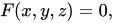
An algebraic plane curve is a curve in an affine or projective plane given by one polynomial equation (or where F is a homogeneous polynomial, in the projective case.)
Algebraic curves have been studied extensively since the 18th century.
Every algebraic plane curve has a degree, the degree of the defining equation, which is equal, in case of an algebraically closed field, to the number of intersections of the curve with a line in general position. For example, the circle given by the equation has degree 2.

The non-singular plane algebraic curves of degree 2 are called conic sections, and their projective completion are all isomorphic to the projective completion of the circle (that is the projective curve of equation ). The plane curves of degree 3 are called cubic plane curves and, if they are non-singular, elliptic curves. Those of degree 4 are called quartic plane curves.

Examples
Numerous examples of plane curves are shown in Gallery of curves and listed at List of curves. The algebraic curves of degree 1 or 2 are shown here (an algebraic curve of degree less than 3 is always contained in a plane):
See also
- Algebraic geometry
- Convex curve
- Differential geometry
- Osgood curve
- Plane curve fitting
- Projective varieties
- Skew curve
References
- Coolidge, J. L. (April 28, 2004), A Treatise on Algebraic Plane Curves, Dover Publications, ISBN 0-486-49576-0.
- Yates, R. C. (1952), A handbook on curves and their properties, J.W. Edwards, ASIN B0007EKXV0.
- Lawrence, J. Dennis (1972), A catalog of special plane curves, Dover, ISBN 0-486-60288-5.
External links
- Weisstein, Eric W. "Plane Curve". MathWorld.