 Hispanopedia Wiki
In mathematics, the generalized symmetric group is the wreath product of the cyclic group of orderm and the symmetric group of order n.

Examples
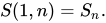
- For the generalized symmetric group is exactly the ordinary symmetric group:
- For one can consider the cyclic group of order 2 as positives and negatives () and identify the generalized symmetric group with the signed symmetric group.



Representation theory
There is a natural representation of elements of as generalized permutation matrices, where the nonzero entries are m-th roots of unity:


The representation theory has been studied since (Osima 1954); see references in (Can 1996). As with the symmetric group, the representations can be constructed in terms of Specht modules; see (Can 1996).
Homology
The first group homology group – concretely, the abelianization – is (for modd this is isomorphic to ): the factors (which are all conjugate, hence must map identically in an abelian group, since conjugation is trivial in an abelian group) can be mapped to (concretely, by taking the product of all the values), while the sign map on the symmetric group yields the These are independent, and generate the group, hence are the abelianization.


The second homology group – in classical terms, the Schur multiplier – is given by (Davies & Morris 1974):

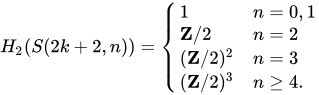
Note that it depends on n and the parity of m: and which are the Schur multipliers of the symmetric group and signed symmetric group.


References
- Davies, J. W.; Morris, A. O. (1974), "The Schur Multiplier of the Generalized Symmetric Group", J. London Math. Soc., 2, 8 (4): 615–620, doi:10.1112/jlms/s2-8.4.615
- Can, Himmet (1996), "Representations of the Generalized Symmetric Groups", Contributions to Algebra and Geometry, 37 (2): 289–307, CiteSeerX 10.1.1.11.9053
- Osima, M. (1954), "Sobre las representaciones del grupo simétrico generalizado", Math. J. Okayama Univ. , 4 : 39– 54
- Grupos de permutación