 Hispanopedia Wiki
In mathematics, a Plücker formula, named after Julius Plücker, is one of a family of formulae, of a type first developed by Plücker in the 1830s, that relate certain numeric invariants of algebraic curves to corresponding invariants of their dual curves. The invariant called the genus, common to both the curve and its dual, is connected to the other invariants by similar formulae. These formulae, and the fact that each of the invariants must be a positive integer, place quite strict limitations on their possible values.
Plücker invariants and basic equations
A curve in this context is defined by a non-degenerate algebraic equation in the complex projective plane. Lines in this plane correspond to points in the dual projective plane and the lines tangent to a given algebraic curve C correspond to points in an algebraic curve C* called the dual curve. In the correspondence between the projective plane and its dual, points on C correspond to lines tangent C*, so the dual of C* can be identified with C.
The first two invariants covered by the Plücker formulas are the degree d of the curve C and the degree d*, classically called the class of C. Geometrically, d is the number of times a given line intersects C with multiplicities properly counted. (This includes complex points and points at infinity since the curves are taken to be subsets of the complex projective plane.) Similarly, d* is the number of tangents to C that are lines through a given point on the plane; so for example a conic section has degree and class both 2. If C has no singularities, the first Plücker equation states that
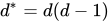
but this must be corrected for singular curves.
De los puntos dobles de C , sea δ el número de puntos ordinarios, es decir, que tienen tangentes distintas (también llamados nodos ) o son puntos aislados , y sea κ el número de cúspides , es decir, que tienen una sola tangente (espinodas). Si C tiene singularidades de orden superior, estas se cuentan como múltiples puntos dobles según un análisis de la naturaleza de la singularidad. Por ejemplo, un punto triple ordinario se cuenta como 3 puntos dobles. Nuevamente, los puntos complejos y los puntos en el infinito se incluyen en estos conteos. La forma corregida de la primera ecuación de Plücker es

De manera similar, sea δ * el número de puntos dobles ordinarios y κ * el número de cúspides de C * . Entonces la segunda ecuación de Plücker establece

La interpretación geométrica de un punto doble ordinario de C * es una línea que es tangente a la curva en dos puntos ( tangente doble ) y la interpretación geométrica de una cúspide de C * es un punto de inflexión (tangente estacionaria).
Consideremos, por ejemplo, el caso de una cúbica lisa:

La fórmula anterior muestra que tiene

Inflexiones. Si la cúbica degenera y obtiene un punto doble, entonces 6 puntos convergen al punto singular y solo quedan 3 inflexiones a lo largo de la curva singular. Si la cúbica degenera y obtiene una cúspide, entonces solo queda una inflexión.
Nótese que las dos primeras ecuaciones de Plücker tienen versiones duales:


Las cuatro ecuaciones dadas hasta ahora son, de hecho, dependientes, por lo que se pueden usar tres cualesquiera para derivar la restante. A partir de ellas, dados tres cualesquiera de los seis invariantes, d , d * , δ, δ * , κ, κ * , se pueden calcular los tres restantes.
Finalmente, el género de C , clásicamente conocido como la deficiencia de C , puede definirse como

Esto es igual a la cantidad dual

y es un número entero positivo.
En total hay cuatro ecuaciones independientes con 7 incógnitas, y con ellas se pueden usar tres de estos invariantes para calcular las cuatro restantes.
Curvas no singulares
Un caso especial importante se da cuando la curva C no es singular, o equivalentemente δ y κ son 0, por lo que los invariantes restantes se pueden calcular solo en términos de d . En este caso, los resultados son:


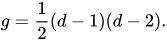
Así, por ejemplo, una curva plana cuártica no singular es de género 3 y tiene 28 bitangantes y 24 puntos de inflexión.
Tipos de curvas
Curves are classified into types according to their Plücker invariants. The Plücker equations together with the restriction that the Plücker invariants must all be natural numbers greatly limits the number of possible types for curves of a given degree. Curves which are projectively equivalent have the same type, though curves of the same type are not, in general, projectively equivalent. Curves of degree 2, conic sections, have a single type given by d=d*=2, δ=δ*=κ=κ*=g=0.
For curves of degree 3 there are three possible types, given by:[1]
Curves of types (ii) and (iii) are the rational cubics and are call nodal and cuspidal respectively. Curves of type (i) are the nonsingular cubics (elliptic curves).
For curves of degree 4 there are 10 possible types, given by:[2]
References
- Shokurov, V. V. (2001) [1994], "Plücker formulas", Encyclopedia of Mathematics, EMS Press
- Salmon, George (1879) A Treatise on the Higher Plane Curves pp. 64ff.
- Algebraic curves