 Hispanopedia Wiki

In the differential geometry of curves, a roulette is a kind of kinematiccurve, generalizing cycloids, epicycloids, hypocycloids, trochoids, epitrochoids, hypotrochoids, and involutes. On a basic level, it is the path traced by a curve while rolling on another curve without slipping.
Definition
Informal definition

Roughly speaking, a roulette is the curve described by a point (called the generator or pole) attached to a given curve as that curve rolls without slipping, along a second given curve that is fixed. More precisely, given a curve attached to a plane which is moving so that the curve rolls, without slipping, along a given curve attached to a fixed plane occupying the same space, then a point attached to the moving plane describes a curve in the fixed plane called a roulette.
Special cases and related concepts
In the case where the rolling curve is a line and the generator is a point on the line, the roulette is called an involute of the fixed curve. If the rolling curve is a circle and the fixed curve is a line then the roulette is a trochoid. If, in this case, the point lies on the circle then the roulette is a cycloid.
A related concept is a glissette, the curve described by a point attached to a given curve as it slides along two (or more) given curves.
Formal definition
Formalmente hablando, las curvas deben ser diferenciables en el plano euclidiano . La curva fija se mantiene invariante; la curva rodante se somete a una transformación de congruencia continua tal que en todo momento las curvas son tangentes en un punto de contacto que se mueve a la misma velocidad al recorrer cualquiera de ellas (otra forma de expresar esta restricción es que el punto de contacto de las dos curvas es el centro instantáneo de rotación de la transformación de congruencia). La ruleta resultante se forma mediante el lugar geométrico de la generatriz sometido al mismo conjunto de transformaciones de congruencia.
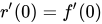
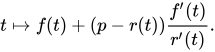
Modelando las curvas originales como curvas en el plano complejo , seasean las dos parametrizaciones naturales del rodamiento () y fijo () curvas, de tal manera que,, ya pesar de. La ruleta del generadorcomose enrollaentonces viene dado por el mapeo:





Generalizaciones
Si, en lugar de fijar un único punto a la curva que se desplaza, se traslada otra curva dada a lo largo del plano móvil, se obtiene una familia de curvas congruentes. La envolvente de esta familia también se conoce como ruleta.
Ciertamente, se pueden imaginar ruletas en espacios superiores, pero es necesario alinear algo más que las tangentes.
Ejemplo
Si la curva fija es una catenaria y la curva móvil es una línea recta , tenemos:


La parametrización de la línea se elige de manera que

Aplicando la fórmula anterior obtenemos:

Si p = − i, la expresión tiene una parte imaginaria constante (es decir, − i ) y la ruleta es una línea horizontal. Una aplicación interesante de esto es que una rueda cuadrada podría rodar sin rebotar sobre una carretera formada por una serie de arcos catenarios.
Lista de ruletas
Véase también
Notas
- 1 2 "Cissoid" en www.2dcurves.com
- ↑ "La ruleta de Sturm" en www.mathcurve.com
- ↑ "La ruleta de Delaunay" en www.mathcurve.com
- 1 2 3 "La ruleta de Delaunay" en www.2dcurves.com
- ↑ Greenhill, G. (1892). Las aplicaciones de las funciones elípticas . Macmillan. pág. 88.
- ↑ "Ruleta con curva recta fija" en www.mathcurve.com
- ↑ "Trocoides centradas" en mathcurve.com
Referencias
- WH Besant (1890) Notas sobre ruletas y glissettes de las Monografías históricas de matemáticas de la Universidad de Cornell , publicadas originalmente por Deighton, Bell & Co.
- Weisstein, Eric W. "Ruleta" . MundoMatemático .
Lecturas adicionales
- Ruleta en 2dcurves.com
- Base, roulante et roulettes d'un mouvement plan sur plan (en francés)
- Eine einheitliche Darstellung von ebenen, verallgemeinerten Rollbewegungen und deren Anwendungen (en alemán)
- Ruletas (curva)