 Hispanopedia Wiki
En matemáticas , los problemas de Cousin son dos cuestiones en varias variables complejas que tratan sobre la existencia de funciones meromorfas especificadas en términos de datos locales. Fueron introducidos en casos particulares por Pierre Cousin en 1895. Actualmente se plantean y resuelven para cualquier variedad compleja M , en términos de condiciones sobre M.
Para ambos problemas, se da una cubierta abierta de M por conjuntos U i , junto con una función meromorfa f i en cada U i .
Problema del primo hermano
El problema del primo primero o problema del primo aditivo supone que cada diferenciaes una función holomorfa , donde está definida. Pide una función meromorfa f en M tal quees holomorfa en U i ; en otras palabras, que f comparte el comportamiento singular de la función local dada. La condición dada en laEs evidentemente necesario para esto; por lo tanto, el problema se reduce a preguntar si es suficiente. El caso de una variable es el teorema de Mittag-Leffler sobre la prescripción de polos, cuando M es un subconjunto abierto del plano complejo . La teoría de superficies de Riemann muestra que se requerirá alguna restricción sobre M. El problema siempre se puede resolver en una variedad de Stein .


El problema del primo primero puede entenderse en términos de cohomología de haces de la siguiente manera. Sea K el haz de funciones meromorfas y O el haz de funciones holomorfas en M. Una sección globalde K pasa a una sección globaldel haz cociente K / O . La pregunta inversa es el primer problema del primo: dada una sección global de K / O , ¿existe una sección global de K de la que surja? El problema consiste, por lo tanto, en caracterizar la imagen del mapa



Por la larga secuencia de cohomología exacta ,

is exact, and so the first Cousin problem is always solvable provided that the first cohomology group H1(M,O) vanishes. In particular, by Cartan's theorem B, the Cousin problem is always solvable if M is a Stein manifold.
Second Cousin problem
The second Cousin problem or multiplicative Cousin problem assumes that each ratio is a non-vanishing holomorphic function, where it is defined. It asks for a meromorphic function f on M such that is holomorphic and non-vanishing. The second Cousin problem is a multi-dimensional generalization of the Weierstrass theorem on the existence of a holomorphic function of one variable with prescribed zeros.


The attack on this problem by means of taking logarithms, to reduce it to the additive problem, meets an obstruction in the form of the first Chern class (see also exponential sheaf sequence). In terms of sheaf theory, let be the sheaf of holomorphic functions that vanish nowhere, and the sheaf of meromorphic functions that are not identically zero. These are both then sheaves of abelian groups, and the quotient sheaf is well-defined. The multiplicative Cousin problem then seeks to identify the image of quotient map



The long exact sheaf cohomology sequence associated to the quotient is

so the second Cousin problem is solvable in all cases provided that The quotient sheaf is the sheaf of germs of Cartier divisors on M. The question of whether every global section is generated by a meromorphic function is thus equivalent to determining whether every line bundle on M is trivial.

The cohomology group for the multiplicative structure on can be compared with the cohomology group with its additive structure by taking a logarithm. That is, there is an exact sequence of sheaves



where the leftmost sheaf is the locally constant sheaf with fiber . The obstruction to defining a logarithm at the level of H1 is in , from the long exact cohomology sequence



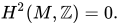
When M is a Stein manifold, the middle arrow is an isomorphism because for so that a necessary and sufficient condition in that case for the second Cousin problem to be always solvable is that


See also
References
- Cartan, Henri (1950). "Idéaux et module de fonctions analytiques de variables complexes" . Boletín de la Société Mathématique de France . 2 : 29– 64. doi : 10.24033/bsmf.1409 .
- Chirka, EM (2001) [1994], "Problemas de primos" , Enciclopedia de Matemáticas , EMS Press.
- Cousin, P. (1895), "Sur les fonctions de n variables" , Acta Math. , 19 : 1– 62, doi : 10.1007/BF02402869.
- Hitotumatu, Pecado (1951). "Problemas de primos para los ideales y el dominio de la regularidad" . Informes del seminario de matemáticas de Kodai . 3 ( 1– 2): 26– 32. doi : 10.2996/kmj/1138843066 .
- Bueno, Kiyoshi (1936). "Sur les fonctions analytiques de plusieurs variables. I. Domaines convexes par rapport aux fonctions rationnelles" . Revista de Ciencias de la Universidad de Hiroshima . 6 : 245– 255. doi : 10.32917/hmj/1558749869 .
- Bueno, Kiyoshi (1937). "Sur les fonctions analytiques de plusieurs variables. II–Domaines d'holomorphie" . Revista de Ciencias de la Universidad de Hiroshima . 7 : 115– 130. doi : 10.32917/hmj/1558576819 .
- Bueno, Kiyoshi (1939). "Sur les fonctions analytiques de plusieurs variables. III–Deuxième problème de Cousin" (PDF) . Revista de Ciencias de la Universidad de Hiroshima . 9 : 7– 19. doi : 10.32917/hmj/1558490525 .
- Gunning, Robert C.; Rossi, Hugo (1965), Funciones analíticas de varias variables complejas , Prentice Hall.
- Chorlay, Renaud (enero de 2010). "De los problemas a las estructuras: los problemas de los primos y el surgimiento del concepto de haz". Archivo para la Historia de las Ciencias Exactas . 64 (1): 1– 73. doi : 10.1007/s00407-009-0052-3 . JSTOR 41342411. S2CID 73633995 .
- Análisis complejo
- Varias variables complejas
- teoría del haz