Articulo de referencia

Two-center bipolar coordinates

Two-center bipolar coordinates. In mathematics , two-center bipolar coordinates is a coordinate system based on two coordinates which give distances from two fixed centers c 1 {...

Two-center bipolar coordinates.

In mathematics, two-center bipolar coordinates is a coordinate system based on two coordinates which give distances from two fixed centers c1{\displaystyle c_{1}} and c2{\displaystyle c_{2}}.[1] This system is very useful in some scientific applications (e.g. calculating the electric field of a dipole on a plane).[2][3]

Transformation to Cartesian coordinates

When the centers are at (+a,0){\displaystyle (+a,0)} and (a,0){\displaystyle (-a,0)}, the transformation to Cartesian coordinates(x,y){\displaystyle (x,y)} from two-center bipolar coordinates (r1,r2){\displaystyle (r_{1},r_{2})} is

x=r22r124a{\displaystyle x={\frac {r_{2}^{2}-r_{1}^{2}}{4a}}}
y=±14a16a2r22(r22r12+4a2)2{\displaystyle y=\pm {\frac {1}{4a}}{\sqrt {16a^{2}r_{2}^{2}-(r_{2}^{2}-r_{1}^{2}+4a^{2})^{2}}}}[1]

Transformation to polar coordinates

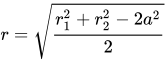
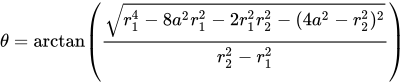
When x > 0, the transformation to polar coordinates from two-center bipolar coordinates is

r=r12+r222a22{\displaystyle r={\sqrt {\frac {r_{1}^{2}+r_{2}^{2}-2a^{2}}{2}}}}
θ=arctan(r148a2r122r12r22(4a2r22)2r22r12){\displaystyle \theta =\arctan \left({\frac {\sqrt {r_{1}^{4}-8a^{2}r_{1}^{2}-2r_{1}^{2}r_{2}^{2}-(4a^{2}-r_{2}^{2})^{2}}}{r_{2}^{2}-r_{1}^{2}}}\right)}

where 2a{\displaystyle 2a} is the distance between the poles (coordinate system centers).

Applications

Polar plotters use two-center bipolar coordinates to describe the drawing paths required to draw a target image.

See also

References

  1. 12Weisstein, Eric W."Bipolar coordinates". MathWorld.
  2. R. Price, The Periodic Standing Wave Approximation: Adapted coordinates and spectral methods.
  3. The periodic standing-wave approximation: nonlinear scalar fields, adapted coordinates, and the eigenspectral method.