 Hispanopedia Wiki

En química de polímeros , la fotooxidación (a veces: fotodegradación oxidativa ) es la degradación de la superficie de un polímero debido a la acción combinada de la luz y el oxígeno. [ 1 ] Es el factor más significativo en el deterioro de los plásticos. [ 2 ] La fotooxidación provoca la ruptura de las cadenas poliméricas ( escisión de cadena ), lo que hace que el material se vuelva cada vez más quebradizo. Esto conduce a fallas mecánicas y, en una etapa avanzada, a la formación de microplásticos . En textiles , el proceso se llama fotolitografía .
Se han desarrollado tecnologías para acelerar e inhibir este proceso. Por ejemplo, se espera que los componentes plásticos de la construcción, como puertas, marcos de ventanas y canalones, duren décadas, lo que requiere el uso de estabilizadores de polímeros UV avanzados . Por el contrario, los plásticos de un solo uso pueden tratarse con aditivos biodegradables para acelerar su fragmentación. Muchos pigmentos y colorantes pueden tener efectos similares debido a su capacidad para absorber la energía UV.
Polímeros susceptibles

La susceptibilidad a la fotooxidación varía según la estructura química del polímero. Algunos materiales presentan una excelente estabilidad, como los fluoropolímeros , las poliimidas , las siliconas y ciertos polímeros de acrilato . Sin embargo, la producción mundial de polímeros está dominada por una gama de plásticos básicos que constituyen la mayor parte de los residuos plásticos . De estos, el tereftalato de polietileno (PET) tiene una resistencia a los rayos UV moderada, mientras que los demás, como el poliestireno , el cloruro de polivinilo (PVC) y las poliolefinas como el polipropileno (PP) y el polietileno (PE), son altamente susceptibles.
La fotooxidación es una forma de fotodegradación y comienza con la formación de radicales libres en la cadena polimérica, que luego reaccionan con el oxígeno en reacciones en cadena . Para muchos polímeros, el mecanismo general de autooxidación es una aproximación razonable de la química subyacente. El proceso es autocatalítico , generando un número creciente de radicales y especies reactivas de oxígeno. Estas reacciones dan como resultado cambios en el peso molecular (y la distribución del peso molecular ) del polímero y, como consecuencia, el material se vuelve más quebradizo. El proceso se puede dividir en cuatro etapas:
- Iniciación del proceso de generación del radical libre inicial.
- Propagación: la conversión de una especie activa en otra.
- Pasos de ramificación en cadena que terminan con la producción de más de una especie activa. La fotólisis de los hidroperóxidos es el principal ejemplo.
- Pasos de terminación en los que se eliminan las especies activas, por ejemplo, mediante desproporción radical.
La fotooxidación puede ocurrir simultáneamente con otros procesos como la degradación térmica , y cada uno de ellos puede acelerar al otro.
Poliolefinas
Las poliolefinas como el polietileno y el polipropileno son susceptibles a la fotooxidación y alrededor del 70 % de los estabilizadores de luz producidos en todo el mundo se utilizan para su protección, a pesar de que representan solo alrededor del 50 % de la producción mundial de plásticos. [ 1 ] Los hidrocarburos alifáticos solo pueden adsorber rayos UV de alta energía con una longitud de onda inferior a ~250 nm; sin embargo, la atmósfera terrestre y la capa de ozono filtran dichos rayos, siendo la longitud de onda mínima normal de 280–290 nm. [ 3 ] Por lo tanto, la mayor parte del polímero es fotoinerte y la degradación se atribuye en cambio a la presencia de diversas impurezas, que se introducen durante las etapas de fabricación o procesamiento. Estas incluyen grupos hidroperóxido y carbonilo , así como sales metálicas como residuos de catalizadores.
All of these species act as photoinitiators.[4] The organic hydroperoxide and carbonyl groups are able to absorb UV light above 290 nm whereupon they undergo photolysis to generate radicals.[5] Metal impurities act as photocatalysts,[6] although such reactions can be complex.[7][8] It has also been suggested that polymer-O2charge-transfer complexes are involved.[9][10] Initiation generates radical-carbons on the polymer chain, sometimes called macroradicals (P•).

Chain initiation

Chain propagation
![{\displaystyle {\mathrm {P} \bullet {}+{}\ \mathrm {O} {\vphantom {A}}_{\smash[{t}]{2}}{}\mathrel {\longrightarrow } {}\mathrm {POO} \bullet }}](https://wikimedia.org/api/rest_v1/media/math/render/svg/412410f4538d45fbe3019f85c490b034288b8fbd)

Chain branching

![{\displaystyle {{\text{PH}}{}+{}\mathrm {OH} \bullet {}\mathrel {\longrightarrow } {}\mathrm {P} \bullet {}+{}\ \mathrm {H} {\vphantom {A}}_{\smash[{t}]{2}}\mathrm {O} }}](https://wikimedia.org/api/rest_v1/media/math/render/svg/c2b65cfed720d540956d0413c3c5bdae05535f43)

Termination



Classically the carbon-centred macroradicals (P•) rapidly react with oxygen to form hydroperoxyl radicals (POO•), which in turn abstract an H atom from the polymer chain to give a hydroperoxide (POOH) and a fresh macroradical. Hydroperoxides readily undergo photolysis to give an alkoxyl macroradical radical (PO•) and a hydroxyl radical (HO•), both of which may go on to form new polymer radicals via hydrogen abstraction. Non-classical alternatives to these steps have been proposed.[11] The alkoxyl radical may also undergo beta scission,[12] generating an acyl-ketone and macroradical. This is considered to be the main cause of chain breaking in polypropylene.[13]

Secondary hydroperoxides can also undergo an intramolecular reaction to give a ketone group, although this is limited to polyethylene.[1][14][15][16]

The ketones generated by these processes are themselves photo-active, although much more weakly. At ambient temperatures they undergo Type II Norrish reactions with chain scission.[17] They may also absorb UV-energy, which they can then transfer to O2, causing it to enter its highly reactive singlet state.[18] Singlet oxygen is a potent oxidising agent and can go on to cause further degradation.

Polystyrene

For polystyrene the complete mechanism of photo-oxidation is still a matter of debate, as different pathways may operate concurrently[20] and vary according to the wavelength of the incident light.[21][22] Regardless, there is agreement on the major steps.[19]
Pure polystyrene should not be able to absorb light with a wavelength below ~280 nm and initiation is explained though photo-labile impurities (hydroperoxides) and charge transfer complexes,[23] all of which are able to absorb normal sunlight.[24]Charge-transfer complexes of oxygen and polystyrene phenyl groups absorb light to form singlet oxygen, which acts as a radical initiator.[23] Carbonyl impurities in the polymer (cf. acetophenone) also absorb light in the near ultraviolet range (300 to 400 nm), forming excited ketones able to abstract hydrogen atoms directly from the polymer.[24] Hyroperoxide undergoes photolysis to form hydroxyl and alkoxyl radicals.
These initiation steps generate macroradicals at tertiary sites, as these are more stabilised. The propagation steps are essentially identical to those seen for polyolefins; with oxidation, hydrogen abstraction and photolysis leading to beta scission reactions and increasing numbers of radicals. These steps account for the majority of chain-breaking, however in a minor pathway the hydroperoxide reacts directly with polymer to form a ketone group (acetophenone) and a terminal alkene without the formation of additional radicals.[25]

Polystyrene is observed to yellow during photo-oxidation, which is attributed to the formation of polyenes from these terminal alkenes.[25]
Polyvinyl chloride (PVC)

Pure organochlorides like polyvinyl chloride (PVC) do not absorb any light above 220 nm. The initiation of photo-oxidation is instead caused by various irregularities in the polymer chain, such as structural defects[26][27] as well as hydroperoxides, carbonyl groups, and double bonds.[28] Hydroperoxides formed during processing are the most important initiator to begin with,[29] however their concentration decreases during photo-oxidation whereas carbonyl concentration increases,[30] as such carbonyls may become the primary initiator over time.[29][31][32]
Propagation steps involve the hydroperoxyl radical, which can abstract hydrogen from both hydrocarbon (-CH2-) and organochloride (-CH2Cl-) sites in the polymer at comparable rates.[29][31] Radicals formed at hydrocarbon sites rapidly convert to alkenes with loss of radical chlorine. This forms allylic hydrogens (shown in red) which are more susceptible to hydrogen abstraction leading to the formation of polyenes in zipper-like reactions.

When the polyenes contain at least eight conjugated double bonds they become coloured, leading to yellowing and eventual browning of the material. This is off-set slightly by longer polyenes being photobleached with atmospheric oxygen,[33] however PVC does eventually discolour unless polymer stabilisers are present. Reactions at organochloride sites proceed via the usual hydroperoxyl and hydroperoxide before photolysis yields the α-chloro-alkoxyl radical. This species can undergo various reactions to give carbonyls, peroxide cross-links and beta scission products.[34]

Poly(ethylene terephthalate) - (PET)
A diferencia de la mayoría de los demás plásticos de uso común, el tereftalato de polietileno (PET) es capaz de absorber los rayos ultravioleta cercanos de la luz solar. La absorción comienza a 360 nm, se vuelve más fuerte por debajo de 320 nm y es muy significativa por debajo de 300 nm. [ 1 ] [ 35 ] [ 36 ] A pesar de esto, el PET tiene una mejor resistencia a la fotooxidación que otros plásticos de uso común , esto se debe a un bajo rendimiento cuántico de la absorción. [ 37 ] La química de degradación es complicada debido a las reacciones simultáneas de fotodisociación (es decir, sin involucrar oxígeno) y fotooxidación de las partes aromáticas y alifáticas de la molécula. La escisión de la cadena es el proceso dominante, siendo la ramificación de la cadena y la formación de impurezas coloreadas menos comunes. El monóxido de carbono, el dióxido de carbono y los ácidos carboxílicos son los principales productos. [ 35 ] [ 36 ] La fotooxidación de otros poliésteres lineales como el tereftalato de polibutileno y el naftalato de polietileno procede de manera similar.
La fotodisociación implica la formación de una unidad de ácido tereftálico excitada que experimenta reacciones de Norrish . Predomina la reacción de tipo I, que provoca la ruptura de la cadena en la unidad carbonilo para dar lugar a una variedad de productos. [ 1 ] [ 38 ]

Las reacciones de Norrish de tipo II son menos comunes, pero dan lugar a acetaldehído a través de ésteres de alcohol vinílico. [ 36 ] Este tiene un umbral de olor y sabor extremadamente bajo y puede causar un sabor desagradable en el agua embotellada. [ 39 ]

Los radicales formados por fotólisis pueden iniciar la fotooxidación en el PET. La fotooxidación del núcleo aromático de ácido tereftálico da como resultado su oxidación gradual a ácido 2,5-dihidroxitereftálico. El proceso de fotooxidación en los sitios alifáticos es similar al observado en las poliolefinas, donde la formación de especies de hidroperóxido conduce finalmente a la escisión beta de la cadena polimérica. [ 1 ]

Factores secundarios
Ambiente
Perhaps surprisingly, the effect of temperature is often greater than the effect of UV exposure.[5] This can be seen in terms of the Arrhenius equation, which shows that reaction rates have an exponential dependence on temperature. By comparison the dependence of degradation rate on UV exposure and the availability of oxygen is broadly linear. As the oceans are cooler than land plastic pollution in the marine environment degrades more slowly.[40][41] Materials buried in landfill do not degrade by photo-oxidation at all, though they may gradually decay by other processes.
Mechanical stress can effect the rate of photo-oxidation[42] and may also accelerate the physical breakup of plastic objects. Stress can be caused by mechanical load (tensile and shear stresses) or even by temperature cycling, particularly in composite systems consisting of materials with differing temperature coefficients of expansion. Similarly, sudden rainfall can cause thermal stress.
Effects of dyes and other additives
Dyes and pigments are used in polymer materials to provide colour, however they can also affect the rate of photo-oxidation. Many absorb UV rays and in so doing protect the polymer, however absorption can cause the dyes to enter an excited state where they may attack the polymer or transfer energy to O2 to form damaging singlet oxygen. Cu-phthalocyanine is an example, it strongly absorbs UV light however the excited Cu-phthalocyanine may act as a photoinitiator by abstracting hydrogen atoms from the polymer.[43] Its interactions may become even more complicated when other additives are present.[44]Fillers such as carbon black can screen out UV light, effectively stabilisers the polymer, whereas flame retardants tend to cause increased levels of photo-oxidation.[45]
Additives to enhance degradation
Biodegradable additives may be added to polymers to accelerate their degradation. In the case of photo-oxidation OXO-biodegradation additives are used.[46] These are transition metal salts such as iron (Fe), manganese (Mn), and cobalt (Co). Fe complexes increase the rate of photooxidation by promoting the homolysis of hydroperoxides via Fenton reactions.
The use of such additives has been controversial due to concerns that treated plastics do not fully biodegrade and instead result in the accelerated formation of microplastics.[47] Oxo-plastics would be difficult to distinguish from untreated plastic but their inclusion during plastic recycling can create a destabilised product with fewer potential uses,[48][49] potentially jeopardising the business case for recycling any plastic. OXO-biodegradation additives were banned in the EU in 2019[50]
Prevention


UV attack by sunlight can be ameliorated or prevented by adding anti-UV polymer stabilizers, usually prior to shaping the product by injection moulding. UV stabilizers in plastics usually act by absorbing the UV radiation preferentially, and dissipating the energy as low-level heat. The chemicals used are similar to those in sunscreen products, which protect skin from UV attack. They are used frequently in plastics, including cosmetics and films. Different UV stabilizers are utilized depending upon the substrate, intended functional life, and sensitivity to UV degradation. UV stabilizers, such as benzophenones, work by absorbing the UV radiation and preventing the formation of free radicals. Depending upon substitution, the UV absorption spectrum is changed to match the application. Concentrations normally range from 0.05% to 2%, with some applications up to 5%.
Frequently, glass can be a better alternative to polymers when it comes to UV degradation. Most of the commonly used glass types are highly resistant to UV radiation. Explosion protection lamps for oil rigs for example can be made either from polymer or glass. Here, the UV radiation and rough weathers belabor the polymer so much, that the material has to be replaced frequently.
Poly(ethylene-naphthalate) (PEN) can be protected by applying a zinc oxide coating, which acts as protective film reducing the diffusion of oxygen.[51] Zinc oxide can also be used on polycarbonate (PC) to decrease the oxidation and photo-yellowing rate caused by solar radiation.[52]
Analysis
Weather testing of polymers

The photo-oxidation of polymers can be investigated by either natural or accelerated weather testing.[53] Such testing is important in determining the expected service-life of plastic items as well as the fate of waste plastic.
In natural weather testing, polymer samples are directly exposed to open weather for a continuous period of time,[54] while accelerated weather testing uses a specialized test chamber which simulates weathering by sending a controlled amount of UV light and water at a sample. A test chamber may be advantageous in that the exact weathering conditions can be controlled, and the UV or moisture conditions can be made more intense than in natural weathering. Thus, degradation is accelerated and the test is less time-consuming.
Through weather testing, the impact of photooxidative processes on the mechanical properties and lifetimes of polymer samples can be determined. For example, the tensile behavior can be elucidated through measuring the stress–strain curve for a specimen. This stress–strain curve is created by applying a tensile stress (which is measured as the force per area applied to a sample face) and measuring the corresponding strain (the fractional change in length). Stress is usually applied until the material fractures, and from this stress–strain curve, mechanical properties such as the Young's modulus can be determined. Overall, weathering weakens the sample, and as it becomes more brittle, it fractures more easily. This is observed as a decrease in the yield strain, fracture strain, and toughness, as well as an increase in the Young's modulus and break stress (the stress at which the material fractures).[55]
Aside from measuring the impact of degradation on mechanical properties, the degradation rate of plastic samples can also be quantified by measuring the change in mass of a sample over time, as microplastic fragments can break off from the bulk material as degradation progresses and the material becomes more brittle through chain-scission. Thus, the percentage change in mass is often measured in experiments to quantify degradation.[56]
Mathematical models can also be created to predict the change in mass of a polymer sample over the weathering process. Because mass loss occurs at the surface of the polymer sample, the degradation rate is dependent on surface area. Thus, a model for the dependence of degradation on surface area can be made by assuming that the rate of change in mass resulting from degradation is directly proportional to the surface area SA of the specimen:[57]

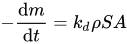
Here, is the density and kd is known as the specific surface degradation rate (SSDR), which changes depending on the polymer sample's chemical composition and weathering environment. Furthermore, for a microplastic sample, SA is often approximated as the surface area of a cylinder or sphere. Such an equation can be solved to determine the mass of a polymer sample as a function of time.

Detection

Degradation can be detected before serious cracks are seen in a product by using infrared spectroscopy,[58] which is able to detect chemical species formed by photo-oxidation. In particular, peroxy-species and carbonyl groups have distinct absorption bands.
In the example shown at left, carbonyl groups were easily detected by IR spectroscopy from a cast thin film. The product was a road cone made by rotational moulding in LDPE, which had cracked prematurely in service. Many similar cones also failed because an anti-UV additive had not been used during processing. Other plastic products which failed included polypropylene mancabs used at roadworks which cracked after service of only a few months.

The effects of degradation can also be characterized through scanning electron microscopy (SEM). For example, through SEM, defects like cracks and pits can be directly visualized, as shown at right. These samples were exposed to 840 hours of exposure to UV light and moisture using a test chamber.[56] Crack formation is often associated with degradation, such that materials that do not display significant cracking behavior, such as HDPE in the right example, are more likely to be stable against photooxidation compared to other materials like LDPE and PP. However, some plastics that have undergone photooxidation may also appear smoother in an SEM image, with some defects like grooves having disappeared afterwards. This is seen in polystyrene in the right example.
See also
- Forensic polymer engineering
- Photodegradation
- Polymer degradation
- Stress corrosion cracking
- Thermal degradation of polymers
References
- ^ abcdefZweifel, Hans; Maier, Ralph D.; Schiller, Michael (2009). Plastics additives handbook (6th ed.). Munich: Hanser. ISBN 978-3-446-40801-2.
- ^Feldman, D. (1 October 2002). "Polymer Weathering: Photo-Oxidation". Journal of Polymers and the Environment. 10 (4): 163–173. Bibcode:2002JPEnv..10..163F. doi:10.1023/A:1021148205366. S2CID 92300829.
- ^Solar spectral irradiance (1st ed.). Vienna: Commission internationale de l'eclairage. 1989. ISBN 978-3-900734-22-0.
- ^Amin, M.U.; Scott, G.; Tillekeratne, L.M.K. (January 1975). "Mechanism of the photo-initiation process in polyethylene". European Polymer Journal. 11 (1): 85–89. Bibcode:1975EurPJ..11...85A. doi:10.1016/0014-3057(75)90179-2.
- ^ abGrause, Guido; Chien, Mei-Fang; Inoue, Chihiro (November 2020). "Changes during the weathering of polyolefins". Polymer Degradation and Stability. 181 109364. doi:10.1016/j.polymdegradstab.2020.109364. S2CID 225243217.
- ^Allen, Norman S.; Chirinos-Padron, Alfonso; Henman, Terence J. (March 1985). "Photoinitiated oxidation of polypropylene: a review". Progress in Organic Coatings. 13 (2): 97–122. doi:10.1016/0033-0655(85)80020-0.
- ^Osawa, Zenjiro (January 1988). "Role of metals and metal-deactivators in polymer degradation". Polymer Degradation and Stability. 20 (3–4): 203–236. doi:10.1016/0141-3910(88)90070-5.
- ^Hussain, Ikram; Atiqullah, Muhammad; Fazal, Atif; Alam, Khurshid; Hossaen, Anwar (December 2010). "Effect of selected residual Ziegler–Natta and metallocene catalysts on the UV-induced degradation of unstabilized ethylene homopolymer films". Polymer Degradation and Stability. 95 (12): 2289–2299. doi:10.1016/j.polymdegradstab.2010.09.004.
- ^Gijsman, Pieter; Sampers, Jacq (January 1997). "The influence of oxygen pressure and temperature on the UV-degradation chemistry of polyethylene". Polymer Degradation and Stability. 58 (1–2): 55–59. doi:10.1016/S0141-3910(97)00012-8.
- ^Chien, J. C. W. (December 1965). "On the Possible Initiation of Photooxidation by Charge-Transfer Excitation". The Journal of Physical Chemistry. 69 (12): 4317–4325. Bibcode:1965JPhCh..69.4317C. doi:10.1021/j100782a040.
- ^Smith, Leesa M.; Aitken, Heather M.; Coote, Michelle L. (18 September 2018). "The Fate of the Peroxyl Radical in Autoxidation: How Does Polymer Degradation Really Occur?". Accounts of Chemical Research. 51 (9): 2006–2013. doi:10.1021/acs.accounts.8b00250. hdl:1885/209140. PMID 30016062. S2CID 51679950.
- ^Gray, Peter; Williams, Alan (1 April 1959). "The Thermochemistry And Reactivity Of Alkoxyl Radicals". Chemical Reviews. 59 (2): 239–328. doi:10.1021/cr50026a002.
- ^Carlsson, D. J.; Wiles, D. M. (November 1969). "The Photodegradation of Polypropylene Films. III. Photolysis of Polypropylene Hydroperoxides". Macromolecules. 2 (6): 597–606. Bibcode:1969MaMol...2..597C. doi:10.1021/ma60012a007.
- ^Costa, L.; Luda, M.P.; Trossarelli, L. (January 1997). "Ultra high molecular weight polyethylene—II. Thermal- and photo-oxidation"(PDF). Polymer Degradation and Stability. 58 (1–2): 41–54. doi:10.1016/S0141-3910(97)00010-4.
- ^Gugumus, F. (January 1990). "Contribution to the photolysis of hydroperoxides in polyethylene". Polymer Degradation and Stability. 27 (1): 19–34. doi:10.1016/0141-3910(90)90094-N.
- ^Gugumus, F. (March 1988). "Contribution to polyethylene photooxidation". Angewandte Makromolekulare Chemie. 158 (1): 151–176. doi:10.1002/apmc.1988.051580108.
- ^Hartley, G. H.; Guillet, J. E. (March 1968). "Photochemistry of Ketone Polymers. I. Studies of Ethylene-Carbon Monoxide Copolymers". Macromolecules. 1 (2): 165–170. Bibcode:1968MaMol...1..165H. doi:10.1021/ma60002a012.
- ^Rabek, J. F.; ??anby, B. (January 1975). "Role of singlet oxygen in photo-oxidative degradation and photostabilization of polymers". Polymer Engineering and Science. 15 (1): 40–43. Bibcode:1975PESci..15...40R. doi:10.1002/pen.760150107.
- ^ abYousif, Emad; Haddad, Raghad (December 2013). "Photodegradation and photostabilization of polymers, especially polystyrene: review". SpringerPlus. 2 (1): 398. doi:10.1186/2193-1801-2-398. PMC 4320144. PMID 25674392.
- ^Kuzina, Svetlana I.; Mikhailov, Alfa I. (November 2001). "Photo-oxidation of polymers 4. The dual mechanism of polystyrene photo-oxidation: a hydroperoxide and a photochain one". European Polymer Journal. 37 (11): 2319–2325. Bibcode:2001EurPJ..37.2319K. doi:10.1016/S0014-3057(01)00028-3.
- ^Kuzina, S.I.; Mikhailov, A.I. (December 1993). "The photo-oxidation of polymers—1. Initiation of polystyrene photo-oxidation". European Polymer Journal. 29 (12): 1589–1594. Bibcode:1993EurPJ..29.1589K. doi:10.1016/0014-3057(93)90250-J.
- ^Gardette, Jean-Luc; Mailhot, Bénédicte; Lemaire, Jacques (January 1995). "Photooxidation mechanisms of styrenic polymers". Polymer Degradation and Stability. 48 (3): 457–470. doi:10.1016/0141-3910(95)00113-Z.
- ^ abRabek, Jan F.; Rånby, Bengt (February 1974). "Studies on the photooxidation mechanism of polymers. I. Photolysis and photooxidation of polystyrene". Journal of Polymer Science: Polymer Chemistry Edition. 12 (2): 273–294. Bibcode:1974JPoSA..12..273R. doi:10.1002/pol.1974.170120203.
- ^ abRanby, B.; Lucki, Julia (1 January 1980). "New aspects of photodegradation and photooxidation of polystyrene". Pure and Applied Chemistry. 52 (2): 295–303. doi:10.1351/pac198052020295.
- ^ abGeuskens, G.; Baeyens-Volant, D.; Delaunois, G.; Lu-Vinh, Q.; Piret, W.; David, C. (1 January 1978). "Photo-oxidation of polymers—I: A quantitative study of the chemical reactions resulting from irradiation of polystyrene at 253.7 nm in the presence of oxygen". European Polymer Journal. 14 (4): 291–297. Bibcode:1978EurPJ..14..291G. doi:10.1016/0014-3057(78)90051-4.
- ^Starnes, William H. (3 May 2005). "Structural defects in poly(vinyl chloride)". Journal of Polymer Science Part A: Polymer Chemistry. 43 (12): 2451–2467. Bibcode:2005JPoSA..43.2451S. doi:10.1002/pola.20811.
- ^Adeniyi, Jacob B.; Scott, Gerald (1 January 1987). "The effects of structural defects on the stability of poly(vinyl chloride): A critical review". Polymer Degradation and Stability. 17 (2): 117–129. doi:10.1016/0141-3910(87)90099-1.
- ^Starnes, W. H. (8 April 1981). "Photodegradation of Polyvinyl Chloride: A Survey of Recent Studies". Photodegradation and Photostabilization of Coatings. 151: 197–215. doi:10.1021/bk-1981-0151.ch014.
- ^ abcBoyd Cooray, B.; Scott, G. (February 1981). "The effect of thermal processing on PVC—Part VIII: The role of thermally formed peroxides on photo-degradation". Polymer Degradation and Stability. 3 (2): 127–135. doi:10.1016/0141-3910(81)90005-7.
- ^Li, Jian; Zhou, Dafei; Zhao, Deren (January 1991). "The photo-degradation of PVC: Part II—Structural changes in PVC chains". Polymer Degradation and Stability. 31 (1): 1–7. doi:10.1016/0141-3910(91)90091-5.
- ^ abDecker, C. (January 1984). "Degradation of poly(vinyl chloride) by u.v. radiation—II". European Polymer Journal. 20 (2): 149–155. doi:10.1016/0014-3057(84)90201-5.
- ^Decker, Christian; Balandier, Michel (July 1981). "Photo-oxidation of poly(vinyl chloride)". Polymer Photochemistry. 1 (3): 221–232. doi:10.1016/0144-2880(81)90021-X.
- ^Rabek, Jan F.; Rånby, Bengt; Östensson, Bengt; Flodin, Per (15 December 1979). "Oxidation of polyene structures in poly(vinyl chloride) by molecular oxygen and singlet oxygen". Journal of Applied Polymer Science. 24 (12): 2407–2413. Bibcode:1979JAPS...24.2407R. doi:10.1002/app.1979.070241209.
- ^Jian, Li; Dafei, Zhou; Deren, Zhao (January 1990). "The photo-degradation of PVC: Part I—Photo-degradation in air and nitrogen". Polymer Degradation and Stability. 30 (3): 335–343. doi:10.1016/0141-3910(90)90087-N.
- ^ abDay, M.; Wiles, D. M. (January 1972). "Photochemical degradation of poly(ethylene terephthalate). II. Effect of wavelength and environment on the decomposition process". Journal of Applied Polymer Science. 16 (1): 191–202. Bibcode:1972JAPS...16..191D. doi:10.1002/app.1972.070160117.
- ^ abcDay, M.; Wiles, D. M. (January 1972). "Photochemical degradation of poly(ethylene terephthalate). III. Determination of decomposition products and reaction mechanism". Journal of Applied Polymer Science. 16 (1): 203–215. Bibcode:1972JAPS...16..203D. doi:10.1002/app.1972.070160118.
- ^Osborn, K. R. (August 1959). "The photolysis of polyethylene terephthalate". Journal of Polymer Science. 38 (134): 357–367. Bibcode:1959JPoSc..38..357O. doi:10.1002/pol.1959.1203813407.
- ^Sang, Tian; Wallis, Christopher J.; Hill, Gavin; Britovsek, George J.P. (August 2020). "Polyethylene terephthalate degradation under natural and accelerated weathering conditions". European Polymer Journal. 136 109873. Bibcode:2020EurPJ.13609873S. doi:10.1016/j.eurpolymj.2020.109873. hdl:10044/1/82034. S2CID 225595988.
- ^Nawrocki, J; Dąbrowska, A; Borcz, A (November 2002). "Investigation of carbonyl compounds in bottled waters from Poland". Water Research. 36 (19): 4893–4901. Bibcode:2002WatRe..36.4893N. doi:10.1016/S0043-1354(02)00201-4. PMID 12448533.
- ^Pegram, Jan E.; Andrady, Anthony L. (January 1989). "Outdoor weathering of selected polymeric materials under marine exposure conditions". Polymer Degradation and Stability. 26 (4): 333–345. doi:10.1016/0141-3910(89)90112-2.
- ^Chamas, Ali; Moon, Hyunjin; Zheng, Jiajia; Qiu, Yang; Tabassum, Tarnuma; Jang, Jun Hee; Abu-Omar, Mahdi; Scott, Susannah L.; Suh, Sangwon (9 March 2020). "Degradation Rates of Plastics in the Environment". ACS Sustainable Chemistry & Engineering. 8 (9): 3494–3511. Bibcode:2020ASCE....8.3494C. doi:10.1021/acssuschemeng.9b06635.
- ^Tyler, David R. (30 December 2004). "Mechanistic Aspects of the Effects of Stress on the Rates of Photochemical Degradation Reactions in Polymers". Journal of Macromolecular Science, Part C: Polymer Reviews. 44 (4): 351–388. doi:10.1081/MC-200033682. S2CID 97316912.
- ^"THE PHOTO-OXIDATION OF POLYMERS - A comparison with low molecular weight compounds"(PDF). Pergamon Press Ltd. 1979 - Pure & Appi. Chem., Vol. 51, pp.233—240. Retrieved 9 February 2011.
- ^Allen, N.S.; Vasiliou, C.; Marshall, G.P.; Chen, W. (January 1989). "Light stabiliser, antioxidant and pigment interactions in the thermal and photochemical oxidation of polyethylene films". Polymer Degradation and Stability. 24 (1): 17–31. doi:10.1016/0141-3910(89)90130-4.
- ^Pfaendner, Rudolf (December 2013). "(Photo)oxidative degradation and stabilization of flame retarded polymers". Polymer Degradation and Stability. 98 (12): 2430–2435. doi:10.1016/j.polymdegradstab.2013.07.005.
- ^Ammala, Anne; Bateman, Stuart; Dean, Katherine; Petinakis, Eustathios; Sangwan, Parveen; Wong, Susan; Yuan, Qiang; Yu, Long; Patrick, Colin; Leong, K.H. (August 2011). "An overview of degradable and biodegradable polyolefins". Progress in Polymer Science. 36 (8): 1015–1049. doi:10.1016/j.progpolymsci.2010.12.002.
- ^"on the impact of the use of oxo-degradable plastic, including oxo-degradable plastic"(PDF). EUROPEAN. Retrieved 11 November 2020.
- ^Babetto, Alex S.; Antunes, Marcela C.; Bettini, Sílvia H. P.; Bonse, Baltus C. (February 2020). "A Recycling-Focused Assessment of the Oxidative Thermomechanical Degradation of HDPE Melt Containing Pro-oxidant". Journal of Polymers and the Environment. 28 (2): 699–712. Bibcode:2020JPEnv..28..699B. doi:10.1007/s10924-019-01641-6. S2CID 209432804.
- ^Aldas, Miguel; Paladines, Andrea; Valle, Vladimir; Pazmiño, Miguel; Quiroz, Francisco (2018). "Effect of the Prodegradant-Additive Plastics Incorporated on the Polyethylene Recycling". International Journal of Polymer Science. 2018: 1–10. doi:10.1155/2018/2474176.
- ^the EU directive 2019/904 (Article 5), EU directive 5 June 2019
- ^L. Guedri-Knani, J. L. Gardette, M. Jacquet, A. Rivaton, Photoprotection of poly(ethylene-naphthalate) by zinc oxide coating, Surface and Coatings Technology, Volumes 180-181, 1 March 2004, Pages 71-75
- ^A. Moustaghfir, E. Tomasella, A. Rivaton, B. Mailhot, M. Jacquet, J. L. Gardette, J. Cellier, Sputtered zinc oxide coatings: structural study and application to the photoprotection of the polycarbonate, Surface and Coatings Technology, Volumes 180-181, 1 March 2004, Pages 642-645.
- ^Jacques, L.F.E (November 2000). "Accelerated and outdoor/natural exposure testing of coatings". Progress in Polymer Science. 25 (9): 1337–1362. doi:10.1016/S0079-6700(00)00030-7.
- ^Kim, Sunwoo; Lee, Youngmin; Kim, Changhwan; Choi, Sunwoong (17 January 2022). "Analysis of Mechanical Property Degradation of Outdoor Weather-Exposed Polymers". Polymers. 14 (2): 357. doi:10.3390/polym14020357. ISSN 2073-4360. PMC 8782030. PMID 35054761.
- ^Koriem, A.; Ollick, A. M.; Elhadary, M. (1 August 2021). "The effect of artificial weathering and hardening on mechanical properties of HDPE with and without UV stabilizers". Alexandria Engineering Journal. 60 (4): 4167–4175. doi:10.1016/j.aej.2021.03.024. ISSN 1110-0168. S2CID 233537494.
- ^ abLessa Belone, Maria Clara; Kokko, Marika; Sarlin, Essi (1 September 2022). "The effects of weathering-induced degradation of polymers in the microplastic study involving reduction of organic matter". Environmental Pollution. 308 119669. Bibcode:2022EPoll.30819669L. doi:10.1016/j.envpol.2022.119669. ISSN 0269-7491. PMID 35750308. S2CID 249937870.
- ^Chamas, Ali; Moon, Hyunjin; Zheng, Jiajia; Qiu, Yang; Tabassum, Tarnuma; Jang, Jun Hee; Abu-Omar, Mahdi; Scott, Susannah L.; Suh, Sangwon (9 March 2020). "Degradation Rates of Plastics in the Environment". ACS Sustainable Chemistry & Engineering. 8 (9): 3494–3511. Bibcode:2020ASCE....8.3494C. doi:10.1021/acssuschemeng.9b06635. ISSN 2168-0485. S2CID 212404939.
- ^Celina, Mathew C.; Linde, Erik; Martinez, Estevan (March 2021). "Carbonyl Identification and Quantification Uncertainties for Oxidative Polymer Degradation". Polymer Degradation and Stability. 188 109550. doi:10.1016/j.polymdegradstab.2021.109550. OSTI 1772948. S2CID 233639741.
- Polymers
- Materials degradation
- Plastics and the environment
- Ultraviolet radiation