 Hispanopedia Wiki
La dilatación del tiempo es la diferencia en el tiempo transcurrido medido por dos relojes , ya sea debido a una velocidad relativa , consecuencia de la relatividad especial , o a una diferencia en el potencial gravitatorio entre sus ubicaciones debido a la dilatación del tiempo gravitatoria . Cuando no se especifica, "dilatación del tiempo" generalmente se refiere al efecto debido a la velocidad. La dilatación compara las lecturas de relojes que se mueven en el mismo sistema de referencia entre eventos medidos en diferentes sistemas de referencia inerciales y no se observa mediante la comparación visual de relojes en diferentes sistemas de referencia en movimiento.
Estas predicciones de la teoría de la relatividad han sido confirmadas repetidamente por experimentos y son de interés práctico, por ejemplo, en el funcionamiento de sistemas de navegación por satélite como el GPS y Galileo . [ 1 ]
Invisibilidad
La dilatación del tiempo es una relación entre las lecturas de los relojes. Las lecturas de los relojes observadas visualmente implican retrasos debidos a la velocidad de propagación de la luz desde el reloj hasta el observador. Por lo tanto, no existe una forma directa de observar la dilatación del tiempo. Como ejemplo de dilatación del tiempo, dos experimentadores que miden el paso de un tren que viaja a 0,86 veces la velocidad de la luz pueden ver una diferencia de 2 segundos en sus relojes, mientras que en el tren el maquinista informa que solo ha transcurrido un segundo cuando los experimentadores pasaron. Las observaciones de un reloj en la parte delantera del tren darían resultados completamente diferentes: la luz del tren no llegaría al segundo experimentador hasta 0,27 s antes de que el tren pasara. Este efecto de los objetos en movimiento sobre las observaciones se asocia con el efecto Doppler . [ 2 ]
Historia
La dilatación del tiempo por el factor de Lorentz fue predicha por varios autores a principios del siglo XX. [ 3 ] [ 4 ] Joseph Larmor (1897) escribió que, al menos para aquellos que orbitan un núcleo, los electrones individuales describen partes correspondientes de sus órbitas en tiempos más cortos para el sistema [en reposo] en la proporción:[ 5 ] Emil Cohn (1904) relacionó específicamente esta fórmula con la frecuencia de los relojes. [ 6 ] En el contexto de la relatividad especial, Albert Einstein (1905) demostró que este efecto concierne a la naturaleza del tiempo mismo, y también fue el primero en señalar su reciprocidad o simetría. [ 7 ] Posteriormente, Hermann Minkowski (1907) introdujo el concepto de tiempo propio , que aclaró aún más el significado de la dilatación del tiempo. [ 8 ]

Dilatación del tiempo causada por una velocidad relativa

La relatividad especial indica que, para un observador en un sistema de referencia inercial , un reloj que se mueve con respecto a él se medirá como si avanzara más lentamente que un reloj en reposo en el sistema de referencia del observador. Esto se conoce a veces como dilatación del tiempo relativista especial. Cuanto mayor sea la velocidad relativa , mayor será la dilatación del tiempo entre ambos relojes, llegando a detenerse el tiempo cuando uno de ellos se aproxima a la velocidad de la luz (299.792.458 m/s).
En teoría, la dilatación del tiempo permitiría a los pasajeros de un vehículo a alta velocidad avanzar hacia el futuro en un breve lapso de su propio tiempo. A velocidades suficientemente altas, el efecto sería espectacular. Por ejemplo, un año de viaje podría equivaler a diez años en la Tierra. De hecho, una aceleración constante de 1 g permitiría a los humanos viajar a través de todo el Universo conocido en una sola vida humana. [ 10 ]
Con la tecnología actual limitando severamente la velocidad de los viajes espaciales, las diferencias experimentadas en la práctica son minúsculas. Después de 6 meses en la Estación Espacial Internacional (EEI), orbitando la Tierra a una velocidad de aproximadamente 7700 m/s, un astronauta envejecerá aproximadamente 5 milisegundos menos que una persona en la Tierra. [ 11 ] Los cosmonautas Sergei Krikalev y Sergey Avdeev experimentaron una dilatación del tiempo de aproximadamente 20 milisegundos en comparación con el tiempo transcurrido en la Tierra. [ 12 ] [ 13 ]
Inferencia simple

La dilatación del tiempo puede inferirse de la constancia observada de la velocidad de la luz en todos los sistemas de referencia, dictada por el segundo postulado de la relatividad especial . Esta constancia de la velocidad de la luz implica que, contrariamente a la intuición, las velocidades de los objetos materiales y de la luz no son aditivas. No es posible hacer que la velocidad de la luz parezca mayor acercándose o alejándose de la fuente de luz. [ 15 ] [ 16 ]
La relatividad del tiempo puede ilustrarse con un experimento mental basado en un reloj vertical abstracto que consta de dos espejos A y B , entre los cuales rebota un pulso de luz. [ 17 ] La separación entre los espejos es L y el reloj da un tic cada vez que el pulso de luz incide en el espejo A. En el sistema de referencia en el que el reloj está en reposo (véase la parte izquierda del diagrama), el pulso de luz traza una trayectoria de longitud 2L y el período de tiempo entre los tics del reloj .es igual a 2 L dividido por la velocidad de la luz c :


Desde el sistema de referencia de un observador en movimiento que viaja a la velocidad v con respecto al sistema de referencia en reposo del reloj (parte derecha del diagrama), el pulso de luz se ve trazando una trayectoria más larga y en ángulo 2D . Mantener la velocidad de la luz constante para todos los observadores inerciales requiere un alargamiento (es decir, una dilatación) del período de tiempo entre los tics de este reloj.desde la perspectiva del observador en movimiento. Es decir, medido en un marco que se mueve con respecto al reloj local, este reloj funcionará (es decir, hará tictac) más lentamente, ya que la frecuencia de tictac es igual a uno dividido por el período de tiempo entre tictacs 1/.

La aplicación directa del teorema de Pitágoras conduce a la conocida predicción de la relatividad especial:
El tiempo total que tarda el pulso de luz en recorrer su trayectoria viene dado por:

La longitud del semirrecorrido se puede calcular en función de cantidades conocidas de la siguiente manera:
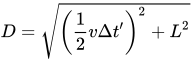
La eliminación de las variables D y L de estas tres ecuaciones da como resultado:
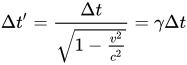
lo cual expresa el hecho de que el período del reloj del observador en movimientoes más largo que el períodoen el marco del propio reloj. El factor de Lorentz gamma ( γ ) se define como [ 18 ]
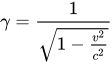
Dado que todos los relojes que tienen un período común en el sistema de referencia en reposo deberían tener un período común cuando se observan desde el sistema de referencia en movimiento, todos los demás relojes —mecánicos , electrónicos, ópticos (como una versión horizontal idéntica del reloj del ejemplo) — deberían exhibir la misma dilatación del tiempo dependiente de la velocidad. [ 19 ]
Reciprocidad

Dado un determinado marco de referencia y el observador "estacionario" descrito anteriormente, si un segundo observador acompañara al reloj "en movimiento", cada uno de los observadores mediría el reloj del otro como si marcara el tiempo a un ritmo más lento que su propio reloj local, debido a que ambos medirían al otro como el que está en movimiento en relación con su propio marco de referencia estacionario.
El sentido común dictaría que, si el paso del tiempo se ralentiza para un objeto en movimiento, dicho objeto percibiría que el tiempo del mundo exterior se acelera en consecuencia. Paradójicamente, la relatividad especial predice lo contrario. Cuando dos observadores se mueven uno con respecto al otro, cada uno medirá que el reloj del otro se ralentiza, en concordancia con su propio movimiento con respecto al sistema de referencia del observador.

Aunque parezca contradictorio, una peculiaridad similar ocurre en la vida cotidiana. Si dos personas, A y B, se observan desde la distancia, B parecerá pequeña para A, pero al mismo tiempo, A parecerá pequeña para B. Conociendo los efectos de la perspectiva , no hay contradicción ni paradoja en esta situación. [ 20 ]
La reciprocidad del fenómeno también conduce a la llamada paradoja de los gemelos , donde se compara el envejecimiento de dos gemelos, uno que permanece en la Tierra y otro que emprende un viaje espacial, y donde la reciprocidad sugiere que ambos deberían tener la misma edad al reunirse. Por el contrario, al final del viaje de ida y vuelta, el gemelo viajero será más joven que su hermano en la Tierra. El dilema que plantea la paradoja se explica por el hecho de que la situación no es simétrica. El gemelo que permanece en la Tierra se encuentra en un único sistema de referencia inercial, y el gemelo viajero se encuentra en dos sistemas de referencia inerciales diferentes: uno en el viaje de ida y otro en el viaje de vuelta. Véase también Paradoja de los gemelos § Papel de la aceleración .
Pruebas experimentales
partículas en movimiento
- Es posible comparar la vida media de los muones a diferentes velocidades. En el laboratorio, se producen muones lentos; y en la atmósfera, los rayos cósmicos introducen muones que se mueven a gran velocidad. Tomando la vida media del muón en reposo como el valor de laboratorio de 2,197 μs, la vida media de un muón producido por rayos cósmicos que viaja al 98 % de la velocidad de la luz es aproximadamente cinco veces mayor, lo que concuerda con las observaciones. Un ejemplo es el trabajo de Rossi y Hall (1941), quienes compararon la población de muones producidos por rayos cósmicos en la cima de una montaña con la observada a nivel del mar. [ 21 ]
- La vida útil de las partículas producidas en aceleradores de partículas es mayor debido a la dilatación del tiempo. En estos experimentos, el "reloj" es el tiempo que tardan los procesos que conducen a la desintegración del muón, y estos procesos tienen lugar en el muón en movimiento a su propia "velocidad de reloj", que es mucho más lenta que la del reloj del laboratorio. Esto se tiene en cuenta habitualmente en física de partículas, y se han realizado numerosas mediciones específicas. Por ejemplo, en el anillo de almacenamiento de muones del CERN se encontró que la vida útil de los muones que circulan con γ = 29,327 se dilataba a 64,378 μs, lo que confirma la dilatación del tiempo con una precisión de 0,9 ± 0,4 partes por mil. [ 22 ]
Efecto Doppler
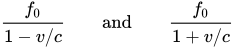
- El propósito declarado por Ives y Stilwell (1938, 1941) de estos experimentos fue verificar el efecto de dilatación del tiempo, predicho por la teoría del éter de Larmor-Lorentz, debido al movimiento a través del éter, utilizando la sugerencia de Einstein de que el efecto Doppler en los rayos canales proporcionaría un experimento adecuado. Estos experimentos midieron el desplazamiento Doppler de la radiación emitida por los rayos catódicos , vista desde el frente y desde atrás. Las frecuencias altas y bajas detectadas no fueron los valores predichos clásicamente:Las frecuencias altas y bajas de la radiación de las fuentes en movimiento se midieron como: [ 23 ]como dedujo Einstein (1905) de la transformación de Lorentz , cuando la fuente se retrasa por el factor de Lorentz.
- Hasselkamp, Mondry y Scharmann [ 24 ] (1979) midieron el desplazamiento Doppler de una fuente que se mueve perpendicularmente a la línea de visión. La relación más general entre las frecuencias de la radiación de las fuentes en movimiento viene dada por:como dedujo Einstein (1905). [ 25 ] Para ϕ = 90° ( cos ϕ = 0 ) esto se reduce a f detectado = f en reposo γ . Esta frecuencia más baja de la fuente en movimiento puede atribuirse al efecto de dilatación del tiempo y a menudo se denomina efecto Doppler transversal y fue predicho por la relatividad.
- En 2010 se observó dilatación del tiempo a velocidades inferiores a 10 metros por segundo utilizando relojes atómicos ópticos conectados por 75 metros de fibra óptica. [ 26 ]


Tiempo propio y diagrama de Minkowski


En el diagrama de Minkowski de la primera imagen de la derecha, el reloj C, situado en el sistema de referencia inercial S′, se encuentra con el reloj A en d y con el reloj B en f (ambos en S). Los tres relojes comienzan a funcionar simultáneamente en S. La línea de universo de A es el eje ct, la línea de universo de B que interseca f es paralela al eje ct, y la línea de universo de C es el eje ct′. Todos los eventos simultáneos con d en S se encuentran en el eje x, y en S′ en el eje x′.
El tiempo propio entre dos eventos está indicado por un reloj presente en ambos eventos. [ 27 ] Es invariante, es decir, en todos los sistemas de referencia inerciales se acepta que este tiempo está indicado por ese reloj. El intervalo df es, por lo tanto, el tiempo propio del reloj C, y es más corto con respecto a los tiempos de coordenadas ef=dg de los relojes B y A en S. Recíprocamente, también el tiempo propio ef de B es más corto con respecto al tiempo if en S′, porque el evento e ya se midió en S′ en el tiempo i debido a la relatividad de la simultaneidad, mucho antes de que C comenzara a funcionar.
De ello se deduce que el tiempo propio entre dos eventos, indicado por un reloj no acelerado presente en ambos, comparado con el tiempo de coordenadas sincronizadas medido en todos los demás sistemas de referencia inerciales, es siempre el intervalo de tiempo mínimo entre dichos eventos. Sin embargo, el intervalo entre dos eventos también puede corresponder al tiempo propio de relojes acelerados presentes en ambos. Entre todos los posibles tiempos propios entre dos eventos, el tiempo propio del reloj no acelerado es máximo , lo cual constituye la solución a la paradoja de los gemelos . [ 27 ]
Derivación y formulación

Además del reloj de luz utilizado anteriormente, la fórmula para la dilatación del tiempo se puede derivar de forma más general de la parte temporal de la transformación de Lorentz . [ 28 ] Supongamos que hay dos eventos en los que el reloj en movimiento indicay, de este modo:


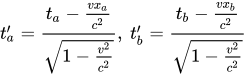
Dado que el reloj permanece en reposo en su marco inercial, sigue, por lo tanto el intervaloestá dado por:

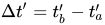
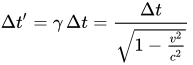
donde Δt , conocido como tiempo propio , es el intervalo de tiempo entre dos eventos colocales (es decir, que ocurren en el mismo lugar) para un observador en algún sistema de referencia inercial (por ejemplo, los tics de su reloj), Δt ′ es el intervalo de tiempo entre esos mismos eventos, medido por otro observador, que se mueve inercialmente con velocidad v con respecto al observador anterior, v es la velocidad relativa entre el observador y el reloj en movimiento, c es la velocidad de la luz, y el factor de Lorentz (denotado convencionalmente por la letra griega gamma o γ ) es:

Así, se observa que la duración del ciclo de un reloj en movimiento aumenta: se mide que "se retrasa". El rango de tales variaciones en la vida cotidiana, donde v ≪ c , incluso considerando los viajes espaciales, no es lo suficientemente grande como para producir efectos de dilatación del tiempo fácilmente detectables, y tales efectos infinitesimalmente pequeños pueden ignorarse con seguridad para la mayoría de los propósitos. Como umbral aproximado, una dilatación del tiempo del 0,5 % puede volverse importante cuando un objeto se acerca a velocidades del orden de 30 000 km/s (1/10 de la velocidad de la luz). [ 29 ]
movimiento hiperbólico
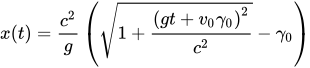
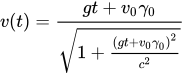
In special relativity, time dilation is most simply described in circumstances where relative velocity is unchanging. Nevertheless, the Lorentz equations allow one to calculate proper time and movement in space for the simple case of a spaceship which is applied with a force per unit mass, relative to some reference object in uniform (i.e. constant velocity) motion, equal to g throughout the period of measurement.
Let t be the time in an inertial frame subsequently called the rest frame. Let x be a spatial coordinate, and let the direction of the constant acceleration as well as the spaceship's velocity (relative to the rest frame) be parallel to the x-axis. Assuming the spaceship's position at time t = 0 being x = 0 and the velocity being v0 and defining the following abbreviation:
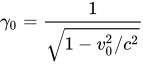
the following formulas hold:[30]
Position:
Velocity:
Proper time as function of coordinate time:
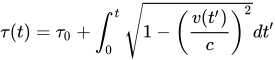
In the case where v(0) = v0 = 0 and τ(0) = τ0 = 0 the integral can be expressed as a logarithmic function or, equivalently, as an inverse hyperbolic function:

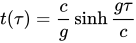
As functions of the proper time of the ship, the following formulae hold:[31]

Position:

Velocity:
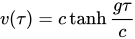
Coordinate time as function of proper time:
Clock hypothesis
The clock hypothesis is the assumption that the rate at which a clock is affected by time dilation does not depend on its acceleration but only on its instantaneous velocity. This is equivalent to stating that a clock moving along a path measures the proper time, defined by:


The clock hypothesis was implicitly (but not explicitly) included in Einstein's original 1905 formulation of special relativity. Since then, it has become a standard assumption and is usually included in the axioms of special relativity, especially in light of experimental verification up to very high accelerations in particle accelerators.[32][33]
Time dilation caused by gravity or acceleration

Gravitational time dilation is experienced by an observer that, at a certain altitude within a gravitational potential well, finds that their local clocks measure less elapsed time than identical clocks situated at higher altitude (and which are therefore at higher gravitational potential). Unlike velocity time dilation, in which both observers measure the other as aging slower (a reciprocal effect), gravitational time dilation is not reciprocal. This means that with gravitational time dilation both observers agree that the clock nearer the center of the gravitational field is slower in rate, and they agree on the ratio of the difference.
Gravitational time dilation is at play e.g. for ISS astronauts. While the astronauts' relative velocity slows down their time, the reduced gravitational influence at their location speeds it up, although to a lesser degree. Also, a climber's time is theoretically passing slightly faster at the top of a mountain compared to people at sea level.
"A clock used to time a full rotation of the Earth will measure the day to be approximately an extra 10 ns/day longer for every km of altitude above the reference geoid."[34] Travel to regions of space where extreme gravitational time dilation is taking place, such as near (but not beyond the event horizon of) a black hole, could yield time-shifting results analogous to those of near-lightspeed space travel.
Richard Feynman suggested in a lecture that, due to time dilation, the core of the Earth is younger than the crust. Subsequent calculations suggest the core is 2.5 years younger, out of 4.5 billion years.[35]
Experimental testing
- In 1959, Robert Pound and Glen Rebka measured the very slight gravitational redshift in the frequency of light emitted at a lower height, where Earth's gravitational field is relatively more intense. The results were within 10% of the predictions of general relativity. In 1964, Pound and J. L. Snider measured a result within 1% of the value predicted by gravitational time dilation.[36] (See Pound–Rebka experiment)
- In 2010, gravitational time dilation was measured at the Earth's surface with a height difference of only one meter, using optical atomic clocks.[26]
Combined effect of velocity and gravitational time dilation

High-accuracy timekeeping, low-Earth-orbit satellite tracking, and pulsar timing are applications that require the consideration of the combined effects of mass and motion in producing time dilation. Practical examples include the International Atomic Time standard and its relationship with the Barycentric Coordinate Time standard used for interplanetary objects.
Relativistic time dilation effects for the Solar System and the Earth can be modeled very precisely by the Schwarzschild solution to the Einstein field equations. In the Schwarzschild metric, the interval is given by:[38][39]


where:
- is a small increment of proper time (an interval that could be recorded on an atomic clock),
- is a small increment in the coordinate (coordinate time),
- are small increments in the three coordinates of the clock's position,
- represents the sum of the Newtonian gravitational potentials due to the masses in the neighborhood, based on their distances from the clock. This sum includes any tidal potentials.


The coordinate velocity of the clock is given by:
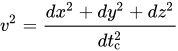
The coordinate time is the time that would be read on a hypothetical "coordinate clock" situated infinitely far from all gravitational masses (), and stationary in the system of coordinates (). The exact relation between the rate of proper time and the rate of coordinate time for a clock with a radial component of velocity is:



where:
- is the radial velocity,
- is the escape speed,
- , and are velocities as a percentage of speed of light c,
- is the Newtonian potential; hence equals half the square of the escape speed.

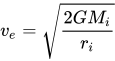


The above equation is exact under the assumptions of the Schwarzschild solution. It reduces to velocity time dilation equation in the presence of motion and absence of gravity, i.e. . It reduces to gravitational time dilation equation in the absence of motion and presence of gravity, i.e. .


Experimental testing

- Hafele and Keating, in 1971, flew caesium atomic clocks east and west around the Earth in commercial airliners, to compare the elapsed time against that of a clock that remained at the U.S. Naval Observatory. Two opposite effects came into play. The clocks were expected to age more quickly (show a larger elapsed time) than the reference clock since they were in a higher (weaker) gravitational potential for most of the trip (cf. Pound–Rebka experiment). But also, contrastingly, the moving clocks were expected to age more slowly because of the speed of their travel. From the actual flight paths of each trip, the theory predicted that the flying clocks, compared with reference clocks at the U.S. Naval Observatory, should have lost 40±23 nanoseconds during the eastward trip and should have gained 275±21 nanoseconds during the westward trip. Relative to the atomic time scale of the U.S. Naval Observatory, the flying clocks lost 59±10 nanoseconds during the eastward trip and gained 273±7 nanoseconds during the westward trip (where the error bars represent standard deviation).[40] In 2005, the National Physical Laboratory in the United Kingdom reported their limited replication of this experiment.[41] The NPL experiment differed from the original in that the caesium clocks were sent on a shorter trip (London–Washington, D.C. return), but the clocks were more accurate. The reported results are within 4% of the predictions of relativity, within the uncertainty of the measurements.
- The Global Positioning System can be considered a continuously operating experiment in both special and general relativity. The in-orbit clocks are corrected for both special and general relativistic time dilation effects as described above, so that (as observed from the Earth's surface) they run at the same rate as clocks on the surface of the Earth.[42]
In popular culture
Popular misconception
The unexpected nature of time dilation makes it a common subject of misconception. One form of misconception claims that time dilation applies only to light-based clocks, such as the light clock used in many textbook derivations of the Lorentz transformation, and not to mechanical, atomic, or biological timekeeping devices. This misunderstanding can lead to incorrect conclusions about experimental results, such as the Hafele–Keating experiment, which involved atomic clocks flown around the Earth.[43]
To address this, a thought experiment known as Einstein's Cat was proposed by physicist Val G. Rousseau.[43] The scenario involves a fictional device—the Sync-or-Die clock—that compares the synchronization of a light clock and a mechanical stopwatch. The life of a cat depends on the precise timing between these two clocks when analyzed in different inertial frames. The paradox arises when time dilation is assumed to apply only to the light pulse but not the mechanical clock. Under this incorrect assumption, the cat would be expected to die only by observers moving relative to the cat. The apparent contradiction is resolved when both clocks are recognized as equally subject to relativistic time dilation. This illustrates the fundamental principle that time dilation is a universal feature of special relativity, independent of the clock's internal mechanism.
In fiction
Velocity and gravitational time dilation have been the subject of science fiction works in a variety of media. Some examples in film are the movies Interstellar and Planet of the Apes.[44] In Interstellar, a key plot point involves a planet, which is close to a rotating black hole and on the surface of which one hour is equivalent to seven years on Earth due to time dilation.[45] Physicist Kip Thorne collaborated in making the film and explained its scientific concepts in the book The Science of Interstellar.[46][47]
The Queen song '39 was written by astrophysicist as well as musician Brian May, and is centred around the time dilation effect on spacefarers searching for a new home for mankind, as we gradually ruin planet Earth. They return successful, only to find that all and everything they knew has long since passed away.
Time dilation was used in the Doctor Who episodes "World Enough and Time" and "The Doctor Falls", which take place on a spaceship in the vicinity of a black hole. Due to the immense gravitational pull of the black hole and the ship's length (400 miles), time moves faster at one end than the other. When The Doctor's companion, Bill, gets taken away to the other end of the ship, she waits years for him to rescue her; in his time, only minutes pass.[48] Furthermore, the dilation allows the Cybermen to evolve at a "faster" rate than previously seen in the show.
Tau Zero, a novel by Poul Anderson, is an early example of the concept in science fiction literature. In the novel, a spacecraft uses a Bussard ramjet to accelerate to high enough speeds that the crew spends five years on board, but thirty-three years pass on the Earth before they arrive at their destination. The velocity time dilation is explained by Anderson in terms of the tau factor which decreases closer and closer to zero as the ship approaches the speed of light—hence the title of the novel.[49] Due to an accident, the crew is unable to stop accelerating the spacecraft, causing such extreme time dilation that the crew experiences the Big Crunch at the end of the universe.[50] Other examples in literature, such as Rocannon's World, Hyperion and The Forever War, similarly make use of relativistic time dilation as a scientifically plausible literary device to have certain characters age slower than the rest of the universe.[51][52]
See also
Footnotes
References
- 123Ashby, Neil (2003). "Relativity in the Global Positioning System". Living Reviews in Relativity. 6 (1) 1: 16. Bibcode:2003LRR.....6....1A. doi:10.12942/lrr-2003-1. PMC 5253894. PMID 28163638.
- ↑Hughes, Theo; Kersting, Magdalena (5 January 2021). "The invisibility of time dilation". Physics Education. 56 (2): 025011. Bibcode:2021PhyEd..56b5011H. doi:10.1088/1361-6552/abce02.
- ↑Miller, Arthur I. (1981). Albert Einstein's Special Theory of Relativity: Emergence (1905) and Early Interpretation (1905–1911). Reading, Massachusetts: Addison–Wesley. ISBN 978-0-201-04679-3..
- ↑Darrigol, Olivier (2005). "The Genesis of the Theory of Relativity". Einstein, 1905–2005(PDF). Vol. 1. pp. 1–22. doi:10.1007/3-7643-7436-5_1. ISBN 978-3-7643-7435-8.
{{cite book}}:|work=ignored (help) - ↑Larmor, Joseph (1897). . Philosophical Transactions of the Royal Society. 190: 205–300. Bibcode:1897RSPTA.190..205L. doi:10.1098/rsta.1897.0020.
- ↑Cohn, Emil (1904), [On the Electrodynamics of Moving Systems II], Sitzungsberichte der Königlich Preussischen Akademie der Wissenschaften (in German and English), vol. 1904/2, no. 43, pp. 1404–1416
- ↑Einstein, Albert (1905). "Zur Elektrodynamik bewegter Körper". Annalen der Physik (in German). 322 (10): 891–921. Bibcode:1905AnP...322..891E. doi:10.1002/andp.19053221004.. See also: English translation.
- ↑Minkowski, Hermann (1908) [1907], [The Fundamental Equations for Electromagnetic Processes in Moving Bodies], Nachrichten von der Gesellschaft der Wissenschaften zu Göttingen, Mathematisch-Physikalische Klasse (in German and English), pp. 53–111
- ↑Hraskó, Péter (2011). Basic Relativity: An Introductory Essay (illustrated ed.). Springer Science & Business Media. p. 60. ISBN 978-3-642-17810-8.Extract of page 60
- ↑Calder, Nigel (2006). Magic Universe: A grand tour of modern science. Oxford University Press. p. 378. ISBN 978-0-19-280669-7.
- ↑-25 microseconds per day results in 0.00458 seconds per 183 days
- ↑Overbye, Dennis (2005-06-28). "A Trip Forward in Time. Your Travel Agent: Einstein". The New York Times. Retrieved 2015-12-08.
- ↑Gott, Richard J. (2002). Time Travel in Einstein's Universe. p. 75.
- ↑Cutner, Mark Leslie (2003). Astronomy, A Physical Perspective. Cambridge University Press. p. 128. ISBN 978-0-521-82196-4.
- ↑Lerner, Lawrence S. (1996). Physics for Scientists and Engineers, Volume 2. Jones and Bartlett. pp. 1051–1052. ISBN 978-0-7637-0460-5.
- ↑Ellis, George F. R.; Williams, Ruth M. (2000). Flat and Curved Space-times (2nd ed.). Oxford University Press. pp. 28–29. ISBN 978-0-19-850657-7.
- ↑Cassidy, David C.; Holton, Gerald James; Rutherford, Floyd James (2002). Understanding Physics. Springer-Verlag. p. 422. ISBN 978-0-387-98756-9.
- ↑Forshaw, Jeffrey; Smith, Gavin (2014). Dynamics and Relativity. John Wiley & Sons. ISBN 978-1-118-93329-9.
- ↑Galli, J. Ronald; Amiri, Farhang (Apr 2012). "The Square Light Clock and Special Relativity". The Physics Teacher. 50 (4). American Association of Physics Teachers: 212. Bibcode:2012PhTea..50..212G. doi:10.1119/1.3694069. S2CID 120089462.
- ↑Adams, Steve (1997). Relativity: An introduction to space-time physics. CRC Press. p. 54. ISBN 978-0-7484-0621-0.
- ↑Stewart, J. V. (2001). Intermediate electromagnetic theory. World Scientific. p. 705. ISBN 978-981-02-4470-5.
- ↑Bailey, J.; et al. (1977). "Measurements of relativistic time dilatation for positive and negative muons in a circular orbit". Nature. 268 (5618): 301. Bibcode:1977Natur.268..301B. doi:10.1038/268301a0. S2CID 4173884.
- ↑Blaszczak, Z. (2007). Laser 2006. Springer. p. 59. ISBN 978-3540711131.
- ↑Hasselkamp, D.; Mondry, E.; Scharmann, A. (1979). "Direct observation of the transversal Doppler-shift". Zeitschrift für Physik A. 289 (2): 151–155. Bibcode:1979ZPhyA.289..151H. doi:10.1007/BF01435932. S2CID 120963034.
- ↑Einstein, A. (1905). "On the electrodynamics of moving bodies". Fourmilab.
- 12Chou, C. W.; Hume, D. B.; Rosenband, T.; Wineland, D. J. (2010). "Optical Clocks and Relativity". Science. 329 (5999): 1630–1633. Bibcode:2010Sci...329.1630C. doi:10.1126/science.1192720. PMID 20929843. S2CID 206527813.
- 12Taylor, Edwin F.; Wheeler, John Archibald (1992). Spacetime Physics: Introduction to Special Relativity. New York: W. H. Freeman. ISBN 978-0-7167-2327-1.
- ↑Born, Max (1964), Einstein's Theory of Relativity, Dover Publications, ISBN 978-0-486-60769-6
{{citation}}: ISBN / Date incompatibility (help) - ↑Petkov, Vesselin (2009). Relativity and the Nature of Spacetime (2nd, illustrated ed.). Springer Science & Business Media. p. 87. ISBN 978-3-642-01962-3.Extract of page 87
- ↑See equations 3, 4, 6 and 9 of Iorio, Lorenzo (2005). "An analytical treatment of the Clock Paradox in the framework of the Special and General Theories of Relativity". Foundations of Physics Letters. 18 (1): 1–19. arXiv:physics/0405038. Bibcode:2005FoPhL..18....1I. doi:10.1007/s10702-005-2466-8. S2CID 15081211.
- ↑Rindler, W. (1977). Essential Relativity. Springer. pp. 49–50. ISBN 978-3540079705.
- ↑Bailey, H.; Borer, K.; Combley, F.; Drumm, H.; Krienen, F.; Lange, F.; Picasso, E.; von Ruden, W.; Farley F. J. M.; Field J. H.; Flegel W. & Hattersley P. M. (1977). "Measurements of relativistic time dilatation for positive and negative muons in a circular orbit". Nature. 268 (5618): 301–305. Bibcode:1977Natur.268..301B. doi:10.1038/268301a0. S2CID 4173884.
- ↑Roos, C. E.; Marraffino, J.; Reucroft, S.; Waters, J.; Webster, M. S.; Williams, E. G. H. (1980). "σ± lifetimes and longitudinal acceleration". Nature. 286 (5770): 244–245. Bibcode:1980Natur.286..244R. doi:10.1038/286244a0. S2CID 4280317.
- ↑Burns, M. Shane; Leveille, Michael D.; Dominguez, Armand R.; Gebhard, Brian B.; Huestis, Samuel E.; Steele, Jeffrey; Patterson, Brian; Sell, Jerry F.; Serna, Mario; Gearba, M. Alina; Olesen, Robert; O'Shea, Patrick; Schiller, Jonathan (18 September 2017). "Measurement of gravitational time dilation: An undergraduate research project". American Journal of Physics. 85 (10): 757–762. arXiv:1707.00171. Bibcode:2017AmJPh..85..757B. doi:10.1119/1.5000802. S2CID 119503665.
- ↑"New calculations show Earth's core is much younger than thought". Phys.org. 26 May 2016.
- ↑Pound, R. V.; Snider J. L. (November 2, 1964). "Effect of Gravity on Nuclear Resonance". Physical Review Letters. 13 (18): 539–540. Bibcode:1964PhRvL..13..539P. doi:10.1103/PhysRevLett.13.539.
- ↑Ashby, Neil (2002). "Relativity in the Global Positioning System". Physics Today. 55 (5): 45. Bibcode:2002PhT....55e..41A. doi:10.1063/1.1485583.
- ↑See equations 2 & 3 (combined here and divided throughout by c2) at pp. 35–36 in Moyer, T. D. (1981). "Transformation from proper time on Earth to coordinate time in solar system barycentric space-time frame of reference". Celestial Mechanics. 23 (1): 33–56. Bibcode:1981CeMec..23...33M. doi:10.1007/BF01228543. hdl:2060/19770007221. S2CID 118077433.
- ↑A version of the same relationship can also be seen at equation 2 inAshbey, Neil (2002). "Relativity and the Global Positioning System"(PDF). Physics Today. 55 (5): 45. Bibcode:2002PhT....55e..41A. doi:10.1063/1.1485583.
- ↑Nave, C. R. (22 August 2005). "Hafele and Keating Experiment". HyperPhysics. Retrieved 2013-08-05.
- ↑"Einstein"(PDF). Metromnia. National Physical Laboratory. 2005. pp. 1–4.
- ↑Kaplan, Elliott; Hegarty, Christopher (2005). Understanding GPS: Principles and Applications. Artech House. p. 306. ISBN 978-1-58053-895-4.Extract of page 306
- 12Rousseau, V.G. (2025). "Einstein's Cat: A Thought Experiment on the Universality of Time Dilation". Physics Education. 60 (4). IOP Publishing. doi:10.1088/1361-6552/adedf1.
- ↑Weiner, Adam (30 April 2008). "The Science of Sci-Fi". Popular Science.
- ↑Luminet, Jean-Pierre (16 January 2016). "The Warped Science of Interstellar (4/6) : Time dilation and Penrose process". e-LUMINESCIENCES.
- ↑Kranking, Carlyn (31 May 2019). Wagner, Ryan (ed.). "Time travel in movies, explained". North by Northwestern.
- ↑Tyson, Neil deGrasse (12 July 2017). "Neil deGrasse Tyson Breaks Down 'Interstellar': Black Holes, Time Dilations, and Massive Waves". The Daily Beast (Interview). Interviewed by Marlow Stern.
- ↑Collins, Frank (26 June 2017). "DOCTOR WHO, 10.11 – 'World Enough and Time'". Frame Rated.
- ↑Meaney, John (17 December 2003). "Time passages (2)". John Meaney's WebLog.
- ↑Langford, David; Stableford, Brian M (20 August 2018). Clute, John; Langford, David; Nicholls, Peter; Sleight, Graham (eds.). "Relativity". The Encyclopedia of Science Fiction.
- ↑Cramer, John G. (20 August 1989). "The Twin Paradox Revisited". Analog Science Fiction and Fact. No. March-1990 – via University of Washington.
- ↑Walter, Damien (22 February 2018). "It's about time: how sci-fi has described Einstein's universe". The Guardian.
Further reading
- Callender, C.; Edney, R. (2001). Introducing Time. Icon Books. ISBN 978-1-84046-592-1.
- Einstein, A. (1905). "Zur Elektrodynamik bewegter Körper"(PDF). Annalen der Physik. 322 (10): 891. Bibcode:1905AnP...322..891E. doi:10.1002/andp.19053221004.
- Einstein, A. (1907). "Über die Möglichkeit einer neuen Prüfung des Relativitätsprinzips". Annalen der Physik. 328 (6): 197–198. Bibcode:1907AnP...328..197E. doi:10.1002/andp.19073280613.
- Hasselkamp, D.; Mondry, E.; Scharmann, A. (1979). "Direct Observation of the Transversal Doppler-Shift". Zeitschrift für Physik A. 289 (2): 151–155. Bibcode:1979ZPhyA.289..151H. doi:10.1007/BF01435932. S2CID 120963034.
- Ives, H. E.; Stilwell, G. R. (1938). "An experimental study of the rate of a moving clock". Journal of the Optical Society of America. 28 (7): 215–226. Bibcode:1938JOSA...28..215I. doi:10.1364/JOSA.28.000215.
- Ives, H. E.; Stilwell, G. R. (1941). "An experimental study of the rate of a moving clock. II". Journal of the Optical Society of America. 31 (5): 369–374. Bibcode:1941JOSA...31..369I. doi:10.1364/JOSA.31.000369.
- Joos, G. (1959). "Bewegte Bezugssysteme in der Akustik. Der Doppler-Effekt". Lehrbuch der Theoretischen Physik, Zweites Buch (11th ed.).
- Larmor, J. (1897). "On a dynamical theory of the electric and luminiferous medium". Philosophical Transactions of the Royal Society. 190: 205–300. Bibcode:1897RSPTA.190..205L. doi:10.1098/rsta.1897.0020. (third and last in a series of papers with the same name).
- Poincaré, H. (1900). "La théorie de Lorentz et le principe de Réaction"(PDF). Archives Néerlandaises. 5: 253–78.
- Puri, A. (2015). "Einstein versus the simple pendulum formula: does gravity slow all clocks?". Physics Education. 50 (4): 431. Bibcode:2015PhyEd..50..431P. doi:10.1088/0031-9120/50/4/431. S2CID 118217730.
- Reinhardt, S.; et al. (2007). "Test of relativistic time dilation with fast optical atomic clocks at different velocities"(PDF). Nature Physics. 3 (12): 861–864. Bibcode:2007NatPh...3..861R. doi:10.1038/nphys778. Archived from the original(PDF) on 2009-07-12.
- Rossi, B.; Hall, D. B. (1941). "Variation of the Rate of Decay of Mesotrons with Momentum". Physical Review. 59 (3): 223. Bibcode:1941PhRv...59..223R. doi:10.1103/PhysRev.59.223.
- Weiss, M. "Two way time transfer for satellites". National Institute of Standards and Technology. Archived from the original on 2017-05-29.
- Voigt, W. (1887). "Über das Doppler'sche princip". Nachrichten von der Königlicher Gesellschaft der Wissenschaften zu Göttingen. 2: 41–51.
External links
 Media related to Time dilation at Wikimedia Commons
- Merrifield, Michael. "Lorentz Factor (and time dilation)". Sixty Symbols. Brady Haran for the University of Nottingham.
- Special relativity
- Time in physics
- Physical phenomena