 Hispanopedia Wiki
In mathematics, a complex Hadamard matrixH of size N with all its columns (rows) mutually orthogonal, belongs to the Butson-typeH(q, N) if all its elements are powers of q-th root of unity,

Existence
If p is prime and , then can exist only for with integerm and it is conjectured they exist for all such cases with . For , the corresponding conjecture is existence for all multiples of 4. In general, the problem of finding all sets such that the Butson-type matrices exist, remains open.


Examples
- contains realHadamard matrices of size N,
- contains Hadamard matrices composed of – such matrices were called by Turyn, complex Hadamard matrices.
- in the limit one can approximate all complex Hadamard matrices.
- Fourier matrices


![{\displaystyle [F_{N}]_{jk}:=\exp[(2\pi i(j-1)(k-1)/N]{\text{ for }}j,k=1,2,\dots ,N}](https://wikimedia.org/api/rest_v1/media/math/render/svg/4738e4460c3441a5c6b69fdbd34ab854dee43a09)
- belong to the Butson-type,

- while


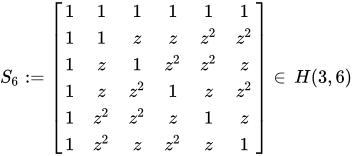
- ,
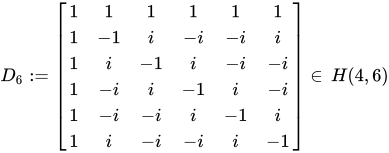
- where

References
- A. T. Butson, Generalized Hadamard matrices, Proc. Am. Math. Soc. 13, 894-898 (1962).
- A. T. Butson, Relations among generalized Hadamard matrices, relative difference sets, and maximal length linear recurring sequences, Can. J. Math. 15, 42-48 (1963).
- R. J. Turyn, Complex Hadamard matrices, pp. 435–437 in Combinatorial Structures and their Applications, Gordon and Breach, London (1970).
External links
- Complex Hadamard Matrices of Butson type - a catalogue, by Wojciech Bruzda, Wojciech Tadej and Karol Życzkowski, retrieved October 24, 2006
Categories:
- Matrices (mathematics)
- Matrix stubs