 Hispanopedia Wiki
In mathematics, specifically in functional analysis, a C∗-algebra (pronounced "C-star") is a Banach algebra together with an involution satisfying the properties of the adjoint. A particular case is that of a complexalgebraA of continuous linear operators on a complexHilbert space with two additional properties:
- A is a topologically closed set in the norm topology of operators.
- A is closed under the operation of taking adjoints of operators.
Another important class of non-Hilbert C*-algebras includes the algebra of complex-valued continuous functions on X that vanish at infinity, where X is a locally compactHausdorff space.

C*-algebras were first considered primarily for their use in quantum mechanics to model algebras of physical observables. This line of research began with Werner Heisenberg's matrix mechanics and in a more mathematically developed form with Pascual Jordan around 1933. Subsequently, John von Neumann attempted to establish a general framework for these algebras, which culminated in a series of papers on rings of operators. These papers considered a special class of C*-algebras that are now known as von Neumann algebras.
Around 1943, the work of Israel Gelfand and Mark Naimark yielded an abstract characterisation of C*-algebras making no reference to operators on a Hilbert space.
C*-algebras are now an important tool in the theory of unitary representations of locally compact groups, and are also used in algebraic formulations of quantum mechanics. Another active area of research is the program to obtain classification, or to determine the extent of which classification is possible, for separable simple nuclear C*-algebras.
Abstract characterization
We begin with the abstract characterization of C*-algebras given in the 1943 paper by Gelfand and Naimark.
A C*-algebra, A, is a Banach algebra over the field of complex numbers, together with a map for with the following properties:


- It is an involution, for every x in A:

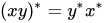
- For all x, y in A:

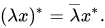
- For every complex number and every x in A:

- For all x in A:

Remark. The first four identities say that A is a *-algebra. The last identity is called the C* identity and is equivalent to:
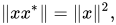
which is sometimes called the B*-identity. For history behind the names C*- and B*-algebras, see the history section below.
The C*-identity is a very strong requirement. For instance, together with the spectral radius formula, it implies that the C*-norm is uniquely determined by the algebraic structure:

A bounded linear map, π : A → B, between C*-algebras A and B is called a *-homomorphism if
- For x and y in A

- For x in A

In the case of C*-algebras, any *-homomorphism π between C*-algebras is contractive, i.e. bounded with norm ≤ 1. Furthermore, an injective *-homomorphism between C*-algebras is isometric. These are consequences of the C*-identity.
A bijective *-homomorphism π is called a C*-isomorphism, in which case A and B are said to be isomorphic.
History: B*-algebras and C*-algebras
The term B*-algebra was introduced by C. E. Rickart in 1946 to describe Banach *-algebras that satisfy the condition:
- for all x in the given B*-algebra. (B*-condition)

This condition automatically implies that the *-involution is isometric, that is, . Hence, , and therefore, a B*-algebra is also a C*-algebra. Conversely, the C*-condition implies the B*-condition. This is nontrivial, and can be proved without using the condition .[1] For these reasons, the term B*-algebra is rarely used in current terminology, and has been replaced by the term 'C*-algebra'.


The term C*-algebra was introduced by I. E. Segal in 1947 to describe norm-closed subalgebras of B(H), namely, the space of bounded operators on some Hilbert space H. 'C' stood for 'closed'.[2][3] In his paper Segal defines a C*-algebra as a "uniformly closed, self-adjoint algebra of bounded operators on a Hilbert space".[4]
Structure of C*-algebras
C*-algebras have a large number of properties that are technically convenient. Some of these properties can be established by using the continuous functional calculus or by reduction to commutative C*-algebras. In the latter case, we can use the fact that the structure of these is completely determined by the Gelfand isomorphism.
Self-adjoint elements
Self-adjoint elements are those of the form . The set of elements of a C*-algebra A of the form forms a closed convex cone. This cone is identical to the elements of the form . Elements of this cone are called non-negative (or sometimes positive, even though this terminology conflicts with its use for elements of ).


The set of self-adjoint elements of a C*-algebra A naturally has the structure of a partially orderedvector space; the ordering is usually denoted . In this ordering, a self-adjoint element satisfies if and only if the spectrum of is non-negative, if and only if for some . Two self-adjoint elements and of A satisfy if .


This partially ordered subspace allows the definition of a positive linear functional on a C*-algebra, which in turn is used to define the states of a C*-algebra, which in turn can be used to construct the spectrum of a C*-algebra using the GNS construction.
Quotients and approximate identities
Any C*-algebra A has an approximate identity. In fact, there is a directed family {eλ}λ∈I of self-adjoint elements of A such that


- In case A is separable, A has a sequential approximate identity. More generally, A will have a sequential approximate identity if and only if A contains a strictly positive element, i.e. a positive element h such that hAh is dense in A.
Using approximate identities, one can show that the algebraic quotient of a C*-algebra by a closed proper two-sided ideal, with the natural norm, is a C*-algebra.
Similarly, a closed two-sided ideal of a C*-algebra is itself a C*-algebra.
Examples
Finite-dimensional C*-algebras
The algebra M(n, C) of n × nmatrices over C becomes a C*-algebra if we consider matrices as operators on the Euclidean space, Cn, and use the operator norm ‖·‖ on matrices. The involution is given by the conjugate transpose. More generally, one can consider finite direct sums of matrix algebras. In fact, all C*-algebras that are finite dimensional as vector spaces are of this form, up to isomorphism. The self-adjoint requirement means finite-dimensional C*-algebras are semisimple, from which fact one can deduce the following theorem of Artin–Wedderburn type:
Theorem. A finite-dimensional C*-algebra, A, is canonically isomorphic to a finite direct sum
where min A is the set of minimal nonzero self-adjoint central projections of A.
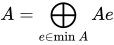
Each C*-algebra, Ae, is isomorphic (in a noncanonical way) to the full matrix algebra M(dim(e), C). The finite family indexed on min A given by {dim(e)}e is called the dimension vector of A. This vector uniquely determines the isomorphism class of a finite-dimensional C*-algebra. In the language of K-theory, this vector is the positive cone of the K0 group of A.
Una †-álgebra (o, más explícitamente, un álgebra †-cerrada ) es el nombre que se usa ocasionalmente en física [ 5 ] para un álgebra C* de dimensión finita. La daga , †, se usa en el nombre porque los físicos suelen usar el símbolo para denotar un adjunto hermitiano y a menudo no se preocupan por las sutilezas asociadas con un número infinito de dimensiones. (Los matemáticos suelen usar el asterisco, *, para denotar el adjunto hermitiano). Las †-álgebras tienen un papel destacado en la mecánica cuántica y, especialmente, en la ciencia de la información cuántica .
Una generalización inmediata de las C*-álgebras de dimensión finita son las C*-álgebras de dimensión aproximadamente finita .
Álgebras C* de operadores
El ejemplo prototípico de un álgebra C* es el álgebra B(H) de operadores lineales acotados (equivalentemente continuos) definidos en un espacio de Hilbert complejo H ; aquí x* denota el operador adjunto del operador x : H → H. De hecho, toda álgebra C*, A , es *-isomorfa a una subálgebra adjunta cerrada en norma de B ( H ) para un espacio de Hilbert adecuado, H ; este es el contenido del teorema de Gelfand-Naimark .
C*-álgebras de operadores compactos
Sea H un espacio de Hilbert separable de dimensión infinita. El álgebra K ( H ) de operadores compactos en H es una subálgebra cerrada en norma de B ( H ). También es cerrada bajo involución; por lo tanto, es un álgebra C*.
Las C*-álgebras concretas de operadores compactos admiten una caracterización similar al teorema de Wedderburn para las C*-álgebras de dimensión finita:
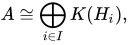
Teorema. Si A es una C*-subálgebra de K ( H ), entonces existen espacios de Hilbert { H i } i ∈ I tales que
donde la suma directa (C*-) consiste en elementos ( T i ) del producto cartesiano Π K ( H i ) con || T i || → 0.
Though K(H) does not have an identity element, a sequential approximate identity for K(H) can be developed. To be specific, H is isomorphic to the space of square summable sequences l2; we may assume that H = l2. For each natural number n let Hn be the subspace of sequences of l2 which vanish for indices k ≥ n and let en be the orthogonal projection onto Hn. The sequence {en}n is an approximate identity for K(H).
K(H) is a two-sided closed ideal of B(H). For separable Hilbert spaces, it is the unique ideal. The quotient of B(H) by K(H) is the Calkin algebra.
Commutative C*-algebras
Let X be a locally compact Hausdorff space. The space of complex-valued continuous functions on X that vanish at infinity (defined in the article on local compactness) forms a commutative C*-algebra under pointwise multiplication and addition. The involution is pointwise conjugation. has a multiplicative unit element if and only if is compact. As does any C*-algebra, has an approximate identity. In the case of this is immediate: consider the directed set of compact subsets of , and for each compact let be a function of compact support which is identically 1 on . Such functions exist by the Tietze extension theorem, which applies to locally compact Hausdorff spaces. Any such sequence of functions is an approximate identity.


The Gelfand representation states that every commutative C*-algebra is *-isomorphic to the algebra , where is the space of characters equipped with the weak* topology. Furthermore, if is isomorphic to as C*-algebras, it follows that and are homeomorphic. This characterization is one of the motivations for the noncommutative topology and noncommutative geometry programs.


C*-enveloping algebra
Given a Banach *-algebra A with an approximate identity, there is a unique (up to C*-isomorphism) C*-algebra E(A) and *-morphism π from A into E(A) that is universal, that is, every other continuous *-morphism π ' : A → B factors uniquely through π. The algebra E(A) is called the C*-enveloping algebra of the Banach *-algebra A.
Of particular importance is the C*-algebra of a locally compact groupG. This is defined as the enveloping C*-algebra of the group algebra of G. The C*-algebra of G provides context for general harmonic analysis of G in the case G is non-abelian. In particular, the dual of a locally compact group is defined to be the primitive ideal space of the group C*-algebra. See spectrum of a C*-algebra.
Von Neumann algebras
Von Neumann algebras, known as W* algebras before the 1960s, are a special kind of C*-algebra. They are required to be closed in the weak operator topology, which is weaker than the norm topology.
The Sherman–Takeda theorem implies that any C*-algebra has a universal enveloping W*-algebra, such that any homomorphism to a W*-algebra factors through it.
Type for C*-algebras
A C*-algebra A is of type I if and only if for all non-degenerate representations π of A the von Neumann algebra π(A)″ (that is, the bicommutant of π(A)) is a type I von Neumann algebra. In fact it is sufficient to consider only factor representations, i.e. representations π for which π(A)″ is a factor.
A locally compact group is said to be of type I if and only if its group C*-algebra is type I.
However, if a C*-algebra has non-type I representations, then by results of James Glimm it also has representations of type II and type III. Thus for C*-algebras and locally compact groups, it is only meaningful to speak of type I and non type I properties.
C*-algebras and quantum field theory
In quantum mechanics, one typically describes a physical system with a C*-algebra A with unit element; the self-adjoint elements of A (elements x with x* = x) are thought of as the observables, the measurable quantities, of the system. A state of the system is defined as a positive functional on A (a C-linear map φ : A → C with φ(u*u) ≥ 0 for all u ∈ A) such that φ(1) = 1. The expected value of the observable x, if the system is in state φ, is then φ(x).
This C*-algebra approach is used in the Haag–Kastler axiomatization of local quantum field theory, where every open set of Minkowski spacetime is associated with a C*-algebra.
See also
- Banach algebra
- Banach *-algebra
- *-algebra
- Hilbert C*-module
- Operator K-theory
- Operator system, a unital subspace of a C*-algebra that is *-closed.
- Gelfand–Naimark–Segal construction
- Jordan operator algebra
Notes
- ↑Doran & Belfi 1986, pp. 5–6, Google Books.
- ↑Doran & Belfi 1986, p. 6, Google Books.
- ↑Segal 1947
- ↑Segal 1947, p. 75
- ↑John A. Holbrook, David W. Kribs, and Raymond Laflamme. "Noiseless Subsystems and the Structure of the Commutant in Quantum Error Correction." Quantum Information Processing. Volume 2, Number 5, pp. 381–419. Oct 2003.
References
- Arveson, W. (1976), An Invitation to C*-Algebra, Springer-Verlag, ISBN 0-387-90176-0. An excellent introduction to the subject, accessible for those with a knowledge of basic functional analysis.
- Connes, Alain (1994), Non-commutative geometry, Gulf Professional, ISBN 0-12-185860-X. This book is widely regarded as a source of new research material, providing much supporting intuition, but it is difficult.
- Dixmier, Jacques (1969), Les C*-algèbres et leurs représentations, Gauthier-Villars, ISBN 0-7204-0762-1. This is a somewhat dated reference, but is still considered as a high-quality technical exposition. It is available in English from North Holland press.
- Doran, Robert S.; Belfi, Victor A. (1986), Characterizations of C*-algebras: The Gelfand-Naimark Theorems, CRC Press, ISBN 978-0-8247-7569-8.
- Emch, G. (1972), Algebraic Methods in Statistical Mechanics and Quantum Field Theory, Wiley-Interscience, ISBN 0-471-23900-3. Mathematically rigorous reference which provides extensive physics background.
- A.I. Shtern (2001) [1994], "C*-algebra", Encyclopedia of Mathematics, EMS Press
- Sakai, S. (1971), C*-algebras and W*-algebras, Springer, ISBN 3-540-63633-1.
- Segal, Irving (1947), "Irreducible representations of operator algebras", Bulletin of the American Mathematical Society, 53 (2): 73–88, doi:10.1090/S0002-9904-1947-08742-5.
- C*-algebras
- Functional analysis