 Hispanopedia Wiki
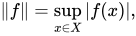
In mathematical analysis, and especially functional analysis, a fundamental role is played by the space of continuous functions on a compactHausdorff space with values in the real or complex numbers. This space, denoted by is a vector space with respect to the pointwise addition of functions and scalar multiplication by constants. It is, moreover, a normed space with norm defined by the uniform norm. The uniform norm defines the topology of uniform convergence of functions on The space is a Banach algebra with respect to this norm.(Rudin 1991, §10.3(a))




Properties
- By Urysohn's lemma, separates points of : If are distinct points, then there is an such that
- The space is infinite-dimensional whenever is an infinite space (since it separates points). Hence, in particular, it is generally not locally compact.
- The Riesz–Markov–Kakutani representation theorem gives a characterization of the continuous dual space of Specifically, this dual space is the space of Radon measures on (regular Borel measures), denoted by This space, with the norm given by the total variation of a measure, is also a Banach space belonging to the class of ba spaces. (Dunford & Schwartz 1958, §IV.6.3)
- Positive linear functionals on correspond to (positive) regularBorel measures on by a different form of the Riesz representation theorem. (Rudin 1966, Chapter 2)
- If is infinite, then is not reflexive, nor is it weaklycomplete.
- The Arzelà–Ascoli theorem holds: A subset of is relatively compact if and only if it is bounded in the norm of and equicontinuous.
- The Stone–Weierstrass theorem holds for In the case of real functions, if is a subring of that contains all constants and separates points, then the closure of is In the case of complex functions, the statement holds with the additional hypothesis that está cerrado bajo conjugación compleja .
- Siyson dos espacios compactos de Hausdorff, yes un homomorfismo de álgebras que conmuta con la conjugación compleja, entonceses continuo. Además,tiene la formapara alguna función continua En particular, siyson isomorfos como álgebras, entoncesyson espacios topológicos homeomorfos .
- Dejarsea el espacio de ideales máximos en Entonces existe una correspondencia uno a uno entre Δ y los puntos de Además,puede identificarse con la colección de todos los homomorfismos complejos Equiparcon la topología inicial con respecto a este emparejamiento con(es decir, la transformada de Gelfand ). Entonceses homeomorfo a Δ equipado con esta topología. ( Rudin 1991 , §11.13(a))
- Una secuencia enes débilmente Cauchy si y solo si está (uniformemente) acotada eny convergente puntualmente. En particular,es solo débilmente completo paraun conjunto finito.
- La topología vaga es la topología débil* en el dual de
- El teorema de Banach-Alaoglu implica que cualquier espacio normado es isométricamente isomorfo a un subespacio depara algunos







Generalizaciones
El espacioLas funciones continuas de valor real o complejo pueden definirse en cualquier espacio topológico. En el caso no compacto, sin embargo,En general, no es un espacio de Banach con respecto a la norma uniforme, ya que puede contener funciones no acotadas. Por lo tanto, es más típico considerar el espacio, denotado aquí.de funciones continuas acotadas en Se trata de un espacio de Banach (de hecho, un álgebra de Banach conmutativa con identidad) respecto a la norma uniforme. ( Hewitt y Stromberg, 1965 , Teorema 7.9)

A veces es deseable, particularmente en la teoría de la medida , refinar aún más esta definición general considerando el caso especial cuandoes un espacio de Hausdorff localmente compacto . En este caso, es posible identificar un par de subconjuntos distinguidos de: ( Hewitt y Stromberg 1965 , §II.7)
- el subconjunto deque consiste en funciones con soporte compacto . Esto se denomina el espacio de funciones que se anulan en un entorno del infinito .
- el subconjunto deque consta de funciones tales que para cadaHay un conjunto compactode tal manera quea pesar de Esto se denomina el espacio de funciones que se anulan en el infinito .


El cierre dees precisamente En particular, este último es un espacio Banach.


Referencias
- Dunford, N.; Schwartz, JT (1958), Operadores lineales, Parte I , Wiley-Interscience.
- Hewitt, Edwin; Stromberg, Karl (1965), Análisis real y abstracto , Springer-Verlag.
- Rudin, Walter (1991). Análisis funcional . Serie internacional de matemáticas puras y aplicadas. Vol. 8 (Segunda edición). Nueva York, NY: McGraw-Hill Science/Engineering/Math . ISBN 978-0-07-054236-5OCLC 21163277
- Rudin, Walter (1966), Análisis real y complejo , McGraw-Hill, ISBN 0-07-054234-1.
- Espacios Banach
- Análisis complejo
- Teoría de las funciones continuas
- Análisis funcional
- Análisis real
- Tipos de funciones