 Hispanopedia Wiki

Los números triangulares o números triangulares son la secuencia de enteros positivos que se pueden representar como una red de puntos dispuestos en un triángulo equilátero . La red triangular que representa elEl número triangular contienefilas: la primera fila contiene un punto, la segunda fila contiene dos, y este patrón continúa hasta lala fila que contienePor lo tanto, los números triangulares también pueden representarse mediante la fórmula


Los números triangulares son el tipo más simple de número figurado ; los números figurados generalizan su concepto a otros polígonos bidimensionales, como los números pentagonales , así como a poliedros de dimensiones superiores, como los números tetraédricos . Tomando(ver suma vacía ), los primeros términos son

Fórmula

Los números triangulares se obtienen mediante las siguientes fórmulas explícitas:

dóndees la notación para un coeficiente binomial . Representa el número de pares distintos que se pueden seleccionar de n + 1 objetos, y se lee en voz alta como " n más uno elige dos".

El hecho de que elEl número triangular es igual apuede ilustrarse mediante una prueba visual . [ 1 ] Para cada número triangular, imagina una disposición de objetos en forma de "medio rectángulo" que corresponda al número triangular, como en la figura siguiente. Copiar esta disposición y rotarla para crear una figura rectangular duplica el número de objetos, produciendo un rectángulo con dimensiones, que también es el número de objetos en el rectángulo. Claramente, el número triangular en sí es siempre exactamente la mitad del número de objetos en dicha figura, o:. El ejemplosigue:


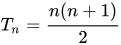


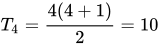

Esta fórmula puede demostrarse formalmente mediante inducción matemática . [ 2 ] Es claramente cierto para:

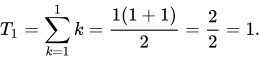
Ahora supongamos que, para algún número natural,. Luego podemos verificarlo para:

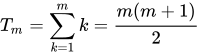


entonces si la fórmula es verdadera para, es cierto para. Dado que es claramente cierto para, it is therefore true for , , and ultimately all natural numbers by induction.


An apocryphal story claims that the German mathematician Gauss found this relationship in his early youth, by multiplying n/2 pairs of numbers in the sum by the values of each pair n + 1.[3] In any case, Gauss was not the first to discover this formula, and some find it likely that its origin goes back to the Pythagoreans in the 5th century BC.[4] The two formulas were described by the Irish monk Dicuil in about 816 in his Computus.[5] An English translation of Dicuil's account is available.[6]
Occasionally it is necessary to compute large triangular numbers where the standard formula t = n*(n+1)/2 would suffer integer overflow before the final division by 2. For example, T20 = 210 < 256, so will fit into an 8-bit byte, but not the intermediate product 420. This can be solved by dividing either n or n+1 by 2 before the multiplication, whichever is even. This does not require a conditional branch if implemented as t = (n|1) * ((n+1)/2). If n is odd, the binary OR operation n|1 has no effect, so this is equivalent to t = n * ((n+1)/2) and thus correct. If n is even, setting the low bit with n|1 is the same as adding 1, while the 1 added before the division is truncated away, so this is equivalent to t = (n+1) * (n/2) and also correct.
Relations to other figurate numbers
Triangular numbers have a wide variety of relations to other figurate numbers.
Most simply, the sum of two consecutive triangular numbers is a square number, since:[7][8]




with the sum being the square of the difference between the two (and thus the difference of the two being the square root of the sum):

This property, colloquially known as the theorem of Theon of Smyrna,[9] is visually demonstrated in the following sum, which represents as digit sums:
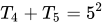
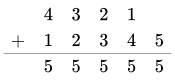
This fact can also be demonstrated graphically by positioning the triangles in opposite directions to create a square:
 10 + 15 = 25
The double of a triangular number, as in the visual proof from the above section § Formula, is called a pronic number.
There are infinitely many triangular numbers that are also square numbers; e.g., 1, 36, 1225. Some of them can be generated by a simple recursive formula: with


All square triangular numbers are found from the recursion with and



The square of the nth triangular number is also the same as the sum of the cubes of the integers 1 to n. This can also be expressed as
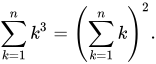

The sum of the first n triangular numbers is the nth tetrahedral number:

More generally, the difference between the nth m-gonal number and the nth (m + 1)-gonal number is the (n − 1)th triangular number. For example, the sixth heptagonal number (81) minus the sixth hexagonal number (66) equals the fifth triangular number, 15. Every other triangular number is a hexagonal number. Knowing the triangular numbers, one can reckon any centered polygonal number; the nth centered k-gonal number is obtained by the formula

where T is a triangular number.
The positive difference of two triangular numbers is a trapezoidal number.
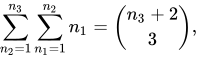
The pattern found for triangular numbers and for tetrahedral numbers which uses binomial coefficients, can be generalized. This leads to the formula:[11]
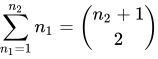


Other properties
Triangular numbers correspond to the first-degree case of Faulhaber's formula.

{{{annotations}}}

Alternating triangular numbers (1, 6, 15, 28, ...) are also hexagonal numbers.
Every even perfect number is triangular (as well as hexagonal), given by the formula where Mp is a Mersenne prime. No odd perfect numbers are known; hence, all known perfect numbers are triangular.

For example, the third triangular number is (3 × 2 =) 6, the seventh is (7 × 4 =) 28, the 31st is (31 × 16 =) 496, and the 127th is (127 × 64 =) 8128.
The final digit of a triangular number is 0, 1, 3, 5, 6, or 8, and thus such numbers never end in 2, 4, 7, or 9. A final 3 must be preceded by a 0 or 5; a final 8 must be preceded by a 2 or 7.
In base 10, the digital root of a nonzero triangular number is always 1, 3, 6, or 9. Hence, every triangular number is either divisible by three or has a remainder of 1 when divided by 9:
0 = 9 × 0 1 = 9 × 0 + 1 3 = 9 × 0 + 3 6 = 9 × 0 + 6 10 = 9 × 1 + 1 15 = 9 × 1 + 6 21 = 9 × 2 + 3 28 = 9 × 3 + 1 36 = 9 × 4 45 = 9 × 5 55 = 9 × 6 + 1 66 = 9 × 7 + 3 78 = 9 × 8 + 6 91 = 9 × 10 + 1 ...
The digital root pattern for triangular numbers, repeating every nine terms, as shown above, is "1, 3, 6, 1, 6, 3, 1, 9, 9".
The converse of the statement above is, however, not always true. For example, the digital root of 12, which is not a triangular number, is 3 and divisible by three.
If x is a triangular number, a is an odd square, and b = a − 1/8, then ax + b is also a triangular number. Note that b will always be a triangular number, because 8Tn + 1 = (2n + 1)2, which yields all the odd squares are revealed by multiplying a triangular number by 8 and adding 1, and the process for b given a is an odd square is the inverse of this operation. The first several pairs of this form (not counting 1x + 0) are: 9x + 1, 25x + 3, 49x + 6, 81x + 10, 121x + 15, 169x + 21, ... etc. Given x is equal to Tn, these formulas yield T3n + 1, T5n + 2, T7n + 3, T9n + 4, and so on.
The sum of the reciprocals of all the nonzero triangular numbers is
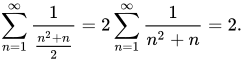
This can be shown by using the basic sum of a telescoping series:
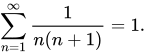
In addition, the nth partial sum of this series can be written as:

Two other formulas regarding triangular numbers are and both of which can be established either by looking at dot patterns (see above) or with some simple algebra.


In 1796, Gauss discovered that every positive integer is representable as a sum of three triangular numbers, writing in his diary his famous words, "ΕΥΡΗΚΑ!num = Δ + Δ + Δ". The three triangular numbers are not necessarily distinct, or nonzero; for example 20 = 10 + 10 + 0. This is a special case of the Fermat polygonal number theorem.
The largest triangular number of the form 2k −1 is 4095 (see Ramanujan–Nagell equation).
Wacław Franciszek Sierpiński posed the question as to the existence of four distinct triangular numbers in geometric progression. It was conjectured by Polish mathematician Kazimierz Szymiczek to be impossible and was later proven by Fang and Chen in 2007.[12][13]
Formulas involving expressing an integer as the sum of triangular numbers are connected to theta functions, in particular the Ramanujan theta function.[14][15]
The number of line segments between closest pairs of dots in the triangle can be represented in terms of the number of dots or with a recurrence relation:

In the limit, the ratio between the two numbers, dots and line segments is

Applications

The triangular number Tn solves the handshake problem of counting the number of handshakes if each person in a room with n + 1 people shakes hands once with each person. In other words, the solution to the handshake problem of n people is Tn−1.[16]
Equivalently, a fully connected network of n computing devices requires the presence of Tn −1 cables or other connections.
A triangular number is equivalent to the number of principal rotations in dimension . For example, in five dimensions the number of principal rotations is 10 which is .[17]

In a tournament format that uses a round-robin group stage, the number of matches that need to be played between n teams is equal to the triangular number Tn −1. For example, a group stage with 4 teams requires 6 matches, and a group stage with 8 teams requires 28 matches. This is also equivalent to the handshake problem and fully connected network problems.

Una forma de calcular la depreciación de un activo es el método de la suma de los dígitos de los años , que consiste en hallar T n , donde n es la duración en años de la vida útil del activo. Cada año, el artículo pierde ( b − s ) × n − y / T n , donde b es el valor inicial del artículo (en unidades monetarias), s es su valor residual final, n es el número total de años que el artículo es utilizable, e y es el año actual en el plan de depreciación. Según este método, un artículo con una vida útil de n = 4 años perdería 4 / 10 de su valor "perdible" en el primer año, 3 / 10 en el segundo, 2 / 10 en el tercero y 1 / 10 en el cuarto, acumulando una depreciación total de 10 / 10 (la totalidad) del valor perdible.
Los diseñadores de juegos de mesa Geoffrey Engelstein e Isaac Shalev describen los números triangulares como algo que ha alcanzado "casi el estatus de un mantra o koan entre los diseñadores de juegos ", describiéndolos como "profundamente intuitivos" y "presentes en una enorme cantidad de juegos, [demostrando] una increíble versatilidad para proporcionar recompensas crecientes para conjuntos más grandes sin incentivar excesivamente la especialización excluyendo todas las demás estrategias". [ 18 ]
Raíces triangulares y pruebas para números triangulares
Por analogía con la raíz cuadrada de x , se puede definir la raíz triangular (positiva) de x como el número n tal que T n = x : [ 19 ]
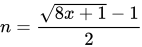
which follows immediately from the quadratic formula. So an integer x is triangular if and only if8x + 1 is a square. Equivalently, if the positive triangular root n of x is an integer, then x is the nth triangular number.[19]
Alternative name
By analogy with the factorial function, a product whose factors are the integers from 1 to n, Donald Knuth proposed the name Termial function,[20] with the notation n? for the sum whose terms are the integers from 1 to n (the nth triangular number). Although some other sources use this name and notation,[21] they are not in wide use. Thus, the termial function can be defined in notation as:[20]

See also
- 1 + 2 + 3 + 4 + ⋯
- Doubly triangular number, a triangular number whose position in the sequence of triangular numbers is also a triangular number
- Tetractys, an arrangement of ten points in a triangle, important in Pythagoreanism
- Factoriangular number
- Šindel sequence
References
- ↑"Triangular Number Sequence". Math Is Fun.
- ↑Spivak, Michael (2008). Calculus (4th ed.). Houston, Texas: Publish or Perish. pp. 21–22. ISBN 978-0-914098-91-1.
- ↑Hayes, Brian. "Gauss's Day of Reckoning". American Scientist. Computing Science. Archived from the original on 2015-04-02. Retrieved 2014-04-16.
- ↑Eves, Howard. "Webpage cites AN INTRODUCTION TO THE HISTORY OF MATHEMATICS". Mathcentral. Retrieved 28 March 2015.
- ↑Esposito, Mario (August 1907). "An unpublished astronomical treatise by the Irish monk Dicuil". Proceedings of the Royal Irish Academy, Section C (in English and Latin). 26. Dublin: 378–446+i (PDF pages 704–773).
- ↑Ross, H.E.; Knott, B.I. (2019). "Dicuil (9th century) on triangular and square numbers". British Journal for the History of Mathematics. 34 (2): 79–94. doi:10.1080/26375451.2019.1598687. hdl:1893/29437.
- ↑Beldon, Tom; Gardiner, Tony (2002). "Triangular Numbers and Perfect Squares". The Mathematical Gazette. 86 (507): 423–431. doi:10.2307/3621134. JSTOR 3621134. Retrieved 25 April 2024.
- ↑Eric W. Weisstein. "Triangular Number". Wolfram MathWorld. Retrieved 2024-04-14. See equations 18–20.
- ↑Shell-Gellasch, Amy; Thoo, John (October 15, 2015). Algebra in Context: Introductory Algebra from Origins to Applications. Johns Hopkins University Press. p. 210. doi:10.1353/book.49475. ISBN 9781421417288.
- ↑"Wolfram Demonstrations Project". demonstrations.wolfram.com. Retrieved 2026-07-23.
- ↑Baumann, Michael Heinrich (2018-12-12). "Die k-dimensionale Champagnerpyramide"(PDF). Mathematische Semesterberichte (in German). 66: 89–100. doi:10.1007/s00591-018-00236-x. ISSN 1432-1815. S2CID 125426184.
- ↑Chen, Fang: Triangular numbers in geometric progression
- ↑Fang: Nonexistence of a geometric progression that contains four triangular numbers
- ↑Liu, Zhi-Guo (2003-12-01). "An Identity of Ramanujan and the Representation of Integers as Sums of Triangular Numbers". The Ramanujan Journal. 7 (4): 407–434. doi:10.1023/B:RAMA.0000012425.42327.ae. ISSN 1382-4090. S2CID 122221070.
- ↑Sun, Zhi-Hong (2016-01-24). "Ramanujan's theta functions and sums of triangular numbers". arXiv:1601.06378 [math.NT].
- ↑"The Handshake Problem | National Association of Math Circles". MathCircles.org. Archived from the original on 10 March 2016. Retrieved 12 January 2022.
- ↑"The Lost 4-Dimensional Rotation". henders.one. 9 May 2022. Retrieved 2025-07-26.
- ↑Engelstein, Geoffrey; Shalev, Isaac (2019-06-25). Building Blocks of Tabletop Game Design. doi:10.1201/9780429430701. ISBN 978-0-429-43070-1. S2CID 198342061.
- 12Euler, Leonhard; Lagrange, Joseph Louis (1810), Elements of Algebra, vol. 1 (2nd ed.), J. Johnson and Co., pp. 332–335
- 12Knuth, Donald (1997). Fundamental Algorithms. The Art of Computer Programming. Vol. 1 (3rd ed.). Reading, MA: Addison-Wesley Professional. p. 48.
- ↑Stone, John David (2018), Algorithms for Functional Programming, Springer, p. 282, doi:10.1007/978-3-662-57970-1, ISBN 978-3-662-57968-8, S2CID 53079729
External links
- "Arithmetic series", Encyclopedia of Mathematics, EMS Press, 2001 [1994]
- Triangular numbers at cut-the-knot
- There exist triangular numbers that are also square at cut-the-knot
- Weisstein, Eric W."Triangular Number". MathWorld.
- Hypertetrahedral Polytopic Roots by Rob Hubbard, including the generalisation to triangular cube roots, some higher dimensions, and some approximate formulas
- Figurate numbers
- Factorial and binomial topics
- Integer sequences
- Proof without words
- Squares in number theory
- Triangles
- Simplex numbers