 Hispanopedia Wiki
Un falso dilema , también conocido como falsa dicotomía o falso binario , es una falacia informal basada en una premisa que limita erróneamente las opciones disponibles. El origen de la falacia no reside en una inferencia inválida, sino en una premisa falsa. Esta premisa tiene la forma de una afirmación disyuntiva : sostiene que una de varias alternativas debe ser verdadera. Esta disyunción es problemática porque simplifica en exceso la elección al excluir alternativas viables, presentando al interlocutor solo dos opciones absolutas cuando, en realidad, podría haber muchas.
Los falsos dilemas suelen consistir en tratar dos proposiciones contrarias , ambas falsas, como contradictorias , de las cuales una es necesariamente verdadera. Diversos esquemas inferenciales se asocian con los falsos dilemas, por ejemplo, el dilema constructivo , el dilema destructivo o el silogismo disyuntivo . Los falsos dilemas se suelen analizar en términos de argumentos deductivos , pero también pueden presentarse como argumentos refutables .
La propensión humana a cometer falsos dilemas puede deberse a la tendencia a simplificar la realidad ordenándola mediante enunciados dicotómicos, una tendencia inherente al lenguaje humano. Esto también podría estar relacionado con la tendencia a insistir en una distinción clara, negando la ambigüedad de muchas expresiones comunes.
Definición
Un falso dilema es una falacia informal basada en una premisa que limita erróneamente las opciones disponibles. [ 1 ] [ 2 ] [ 3 ] En su forma más simple, llamada falacia de bifurcación , se excluyen todas las alternativas excepto dos. Una falacia es un argumento , es decir, una serie de premisas junto con una conclusión, que es inválido , es decir, no es válido y verdadero a la vez. Las falacias se dividen generalmente en falacias formales e informales . Las falacias formales son inválidas debido a su estructura, mientras que las falacias informales lo son debido a su contenido. [ 3 ] [ 4 ] [ 1 ] [ 5 ] El contenido problemático en el caso del falso dilema tiene la forma de una afirmación disyuntiva : afirma que una de varias alternativas debe ser verdadera. Esta disyunción es problemática porque simplifica demasiado la elección al excluir alternativas viables. [ 1 ] A veces se hace una distinción entre un falso dilema y una falsa dicotomía . Desde esta perspectiva, el término "falsa dicotomía" se refiere a la afirmación disyuntiva falsa, mientras que el término "falso dilema" se refiere no solo a esta afirmación, sino también al argumento basado en ella. [ 1 ]
Tipos
Disyunción con contrarios
In its most common form, a false dilemma presents the alternatives as contradictories, while in truth they are merely contraries.[5][6] Two propositions are contradictories if it has to be the case that one is true and the other is false. Two propositions are contraries if at most one of them can be true, but leaves open the option that both of them might be false, which is not possible in the case of contradictories.[5] Contradictories follow the law of the excluded middle but contraries do not.[6] For example, the sentence "the exact number of marbles in the urn is either 10 or not 10" presents two contradictory alternatives. The sentence "the exact number of marbles in the urn is either 10 or 11" presents two contrary alternatives: the urn could also contain 2 marbles or 17 marbles. A common form of using contraries in false dilemmas is to force a choice between extremes on the agent: someone is either good or bad, rich or poor, normal or abnormal. Such cases ignore that there is a continuous spectrum between the extremes that is excluded from the choice.[5] While false dilemmas involving contraries, i.e. exclusive options, are a very common form, this is just a special case: there are also arguments with non-exclusive disjunctions that are false dilemmas.[1] For example, a choice between security and freedom does not involve contraries since these two terms are compatible with each other.[5]
Logical forms
In logic, there are two main types of inferences known as dilemmas: the constructive dilemma and the destructive dilemma. In their most simple form, they can be expressed in the following way:[7][6][1]
- simple constructive:
- simple destructive:
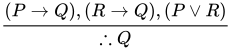

The source of the fallacy is found in the disjunctive claim in the third premise, i.e. and respectively. The following is an example of a false dilemma with the simple constructive form: (1) "If you tell the truth, you force your friend into a social tragedy; and therefore, are an immoral person". (2) "If you lie, you are an immoral person (since it is immoral to lie)". (3) "Either you tell the truth, or you lie". Therefore "[y]ou are an immoral person (whatever choice you make in the given situation)".[1] This example constitutes a false dilemma because there are other choices besides telling the truth and lying, like keeping silent. A false dilemma can also occur in the form of a disjunctive syllogism:[6]


- disjunctive syllogism:
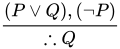
In this form, the first premise () is responsible for the fallacious inference. Lewis's trilemma is a famous example of this type of argument involving three disjuncts: "Jesus was either a liar, a lunatic, or Lord".[3] By denying that Jesus was a liar or a lunatic, one is forced to draw the conclusion that he was God. But this leaves out various other alternatives, for example, that Jesus was a prophet.[3]

Deductive and defeasible arguments
False dilemmas are usually discussed in terms of deductive arguments. But they can also occur as defeasible arguments.[1] A valid argument is deductive if the truth of its premises ensures the truth of its conclusion. For a valid defeasible argument, on the other hand, it is possible for all its premises to be true and the conclusion to be false. The premises merely offer a certain degree of support for the conclusion but do not ensure it.[8] In the case of a defeasible false dilemma, the support provided for the conclusion is overestimated since various alternatives are not considered in the disjunctive premise.[1]
Explanation and avoidance
Parte de la comprensión de las falacias implica ir más allá de la lógica y adentrarse en la psicología empírica para explicar por qué existe la tendencia a cometer o caer en la falacia en cuestión. [ 9 ] [ 1 ] En el caso del falso dilema , la tendencia a simplificar la realidad ordenándola mediante enunciados dicotómicos puede desempeñar un papel importante. Esta tendencia está, en cierta medida, integrada en el lenguaje humano, que está lleno de pares de opuestos. [ 5 ] Este tipo de simplificación a veces es necesaria para tomar decisiones cuando no hay tiempo suficiente para obtener una perspectiva más detallada. Para evitar los falsos dilemas, el agente debe ser consciente de opciones adicionales además de las alternativas preestablecidas. El pensamiento crítico y la creatividad pueden ser necesarios para desentrañar la falsa dicotomía y descubrir nuevas alternativas. [ 1 ]
Relación con las distinciones y la vaguedad
Algunos filósofos y académicos creen que «a menos que una distinción pueda hacerse rigurosa y precisa, en realidad no es una distinción». [ 10 ] Una excepción es John Searle , filósofo analítico que la consideraba una suposición incorrecta que produce falsas dicotomías. Searle insiste en que «es condición para la adecuación de una teoría precisa de un fenómeno indeterminado que esta caracterice precisamente dicho fenómeno como indeterminado; y una distinción no deja de serlo por permitir una familia de casos relacionados, marginales y divergentes». [ 11 ]
De manera similar, cuando se presentan dos opciones, a menudo son, aunque no siempre, dos puntos extremos en algún espectro de posibilidades; esto puede dar credibilidad al argumento más amplio al dar la impresión de que las opciones son mutuamente excluyentes , aunque no necesariamente lo sean. [ 12 ] Además, las opciones en las falsas dicotomías suelen presentarse como colectivamente exhaustivas , en cuyo caso la falacia puede superarse, o al menos debilitarse, al considerar otras posibilidades, o tal vez al considerar todo un espectro de posibilidades, como en la lógica difusa . [ 13 ] Este problema surge de dicotomías reales en la naturaleza, el ejemplo más frecuente es la ocurrencia de un evento. O sucedió o no sucedió. Esta ontología establece una construcción lógica que no puede aplicarse razonablemente a la epistemología .
Ejemplos
Elección falsa
The presentation of a false choice often reflects a deliberate attempt to eliminate several options that may occupy the middle ground on an issue. A common argument against noise pollution laws involves a false choice. It might be argued that in New York City noise should not be regulated, because if it were, a number of businesses would be required to close. This argument assumes that, for example, a bar must be shut down to prevent disturbing levels of noise emanating from it after midnight. This ignores the fact that law could require the bar to lower its noise levels, or install soundproofing structural elements to keep the noise from excessively transmitting onto others' properties.[14]
Black-and-white thinking
In psychology, a phenomenon related to the false dilemma is "black-and-white thinking" or "thinking in black and white". There are people who routinely engage in black-and-white thinking, an example of which is someone who categorizes other people as all good or all bad.[15]
Similar concepts
Various different terms are used to refer to false dilemmas. Some of the following terms are equivalent to the term false dilemma, some refer to special forms of false dilemmas and others refer to closely related concepts.
- Bifurcation fallacy
- Black-or-white fallacy
- Denying a conjunct (similar to a false dichotomy)
- Double bind
- Either/or fallacy
- Fallacy of exhaustive hypotheses
- Fallacy of the excluded middle
- Fallacy of the false alternative[16]
- False binary
- False choice
- False dichotomy
- Invalid disjunction
- No middle ground
See also
- Argument to moderation
- Bivalence
- Choice architecture
- Degrees of truth
- Dichotomy
- Distinction without a difference
- Euthyphro dilemma
- Fallacy of the single cause
- Half-truth
- Hobson's choice
- Law of excluded middle
- Lewis' trilemma
- Loaded question
- Love–hate relationship
- Many-valued logic
- Morton's fork
- Mutually exclusive
- Nolan Chart
- Nondualism
- None of the above
- Obscurantism
- Pascal's Wager
- Perspectivism
- Political systems
- Rogerian argument
- Show election
- Slippery slope
- Sorites paradox
- Splitting (psychology)
- Strange loop § In cognitive science
- Straw man
- Thinking outside the box
- Unreasonable
- You're either with us, or against us
- Zero-sum thinking
References
- 1 2 3 4 5 6 7 8 9 10 11 Tomić, Taeda (2013). " Falso dilema: una exposición sistemática" . Argumentación . 27 (4): 347– 368. doi : 10.1007/s10503-013-9292-0 . S2CID 144781912. Archivado del original el 10 de febrero de 2023. Recuperado el 13 de marzo de 2021 .
- ↑ Dowden, Bradley. "Falacias: 6. Lista parcial de falacias" . Enciclopedia de filosofía en Internet . Archivado del original el 3 de junio de 2019. Consultado el 13 de marzo de 2021 .
- 1 2 3 4 Vleet, Van Jacob E. (2010). "Introducción". Falacias lógicas informales: una breve guía . Upa. Archivado del original el 28 de febrero de 2022. Recuperado el 13 de marzo de 2021 .
- ↑ Hansen, Hans (2020). «Falacias» . La Enciclopedia de Filosofía de Stanford . Laboratorio de Investigación en Metafísica, Universidad de Stanford. Archivado del original el 29 de marzo de 2021. Recuperado el 13 de marzo de 2021 .
- 1 2 3 4 5 6 Engel, S. Morris (1982). "4. Falacias de presunción". Con buena razón: una introducción a las falacias informales . Archivado del original el 1 de marzo de 2022. Recuperado el 13 de marzo de 2021 .
- 1 2 3 4 "La falacia del blanco o negro" . www.fallacyfiles.org . Archivado del original el 6 de diciembre de 2020. Consultado el 13 de marzo de 2021 .
- ↑ Honderich, Ted (2005). "Dilemas". The Oxford Companion to Philosophy . Oxford University Press. Archivado del original el 29 de enero de 2021. Recuperado el 13 de marzo de 2021 .
- ↑ Koons, Robert (2017). "Razonamiento refutable" . La Enciclopedia de Filosofía de Stanford . Laboratorio de Investigación en Metafísica, Universidad de Stanford. Archivado del original el 15 de marzo de 2023. Recuperado el 13 de marzo de 2021 .
- ↑Walton, Douglas N. (1987). "3. The logic of propositions". Informal Fallacies: Towards a Theory of Argument Criticisms. John Benjamins. Archived from the original on 2 March 2022. Retrieved 13 March 2021.
- ↑Jacques Derrida (1991) Afterword: Toward An Ethic of Discussion, published in the English translation of Limited Inc., pp. 123–24, 126
- ↑Vermeule, Emily (26 March 1992). "The World Turned Upside Down". The New York Review of Books. Retrieved 21 October 2024.
- ↑Baronett, Stan (2008). Logic. Upper Saddle River, N.J.: Pearson Prentice Hall. p. 101. ISBN 9780131933125. Retrieved 31 October 2015.
- ↑Arfi, Badredine (2010). Linguistic fuzzy logic methods in social sciences (1. ed.). Berlin, Germany: Springer. ISBN 9783642133428. Retrieved 31 October 2015.
- ↑Desantis, Nick (23 January 2012). "Data Shows Bars With Most Noise Complaints, But Is It Just Sound and Fury?". The New York Times. Archived from the original on 4 August 2016. Retrieved 31 October 2015.
- ↑A. James Giannini, M. D. (1 July 2001). "Use of Fiction in Therapy". Psychiatric Times. 18 (7): 56–57.
- ↑Davies, W. Martin (May 2006). "An 'infusion' approach to critical thinking: Moore on the critical thinking debate"(PDF). Higher Education Research & Development. 25 (2): 179–193. doi:10.1080/07294360600610420. S2CID 144167015. Archived(PDF) from the original on 26 May 2023. Retrieved 23 July 2019.
External links
- The Black-or-White FallacyArchived 6 December 2020 at the Wayback Machine entry in The Fallacy Files
- Barriers to critical thinking
- Deception
- Dilemmas
- Error
- Ignorance
- Informal fallacies
- Propaganda