 Hispanopedia Wiki
In music theory and tuning, a tonality diamond is a diamond-shaped diagram of ratios comprising overlapping tonalities in which the major tonalities orient along one diagonal and the minor tonalities along the other.
An n-limit tonality diamond ("limit" here is in the sense of odd limit, not prime limit) is an arrangement in diamond-shape of the set of rational numbersr, , such that the odd part of both the numerator and the denominator of r, when reduced to lowest terms, is less than or equal to the fixed odd numbern. Equivalently, the diamond may be considered as a set of pitch classes, where a pitch class is an equivalence class of pitches under octave equivalence. The tonality diamond is often regarded as comprising the set of consonances of the n-limit. Although originally invented by Max Friedrich Meyer,[1][2] the tonality diamond is now most associated with Harry Partch ("Many theorists of just intonation consider the tonality diamond Partch's greatest contribution to microtonal theory."[3]).

The diamond arrangement
Partch arranged the elements of the tonality diamond in the shape of a rhombus subdivided into (n+1)2/4 smaller rhombuses, where n is the odd limit (the highest odd number used in the ratios defining the pitch classes of the tonality diamond). In the rhombuses along the upper left edge of the diamond are placed ratios whose overnumbers (numerators) are the odd numbers from 1 to n. The undernumber (denominator) of each is the minimum integer power of 2 such that , where is the value or quotient of the ratio. For example, 1/1 3/2 5/4. The ratios are then sorted in ascending order (1/1 5/4 3/2) within those rhombuses. In the rhombuses along the lower left edge are placed the corresponding reciprocal ratios with the undernumbers containing the odd numbers 1 to n and the overnumbers taking the powers of 2 such that . For example, 1/1 8/5 4/3. In all other rhombuses are placed the products of the diagonally upper-left and lower-left ratios also satisfying Esto define todos los elementos del diamante tonal, con cierta repetición. Las diagonales que se inclinan en una dirección forman otonalidades y las diagonales que se inclinan en la dirección opuesta forman utonalidades. Uno de los instrumentos de Partch, la marimba diamante , está dispuesto según el diamante tonal.

nexo numérico
Un nexo numerario es una identidad compartida por dos o más razones de intervalo en su numerador o denominador , con identidades diferentes en el otro. [ 4 ] Por ejemplo, en la siguiente otonalidad , el denominador siempre es 1, por lo tanto, 1 es el nexo numerario:
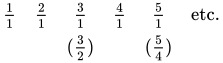
En la siguiente utonalidad, el numerador siempre es 1 y, por lo tanto, el nexo numerario también es 1:
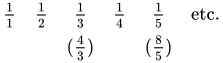
Cualquier identidad puede usarse como nexo numérico para formar una otonalidad o utonalidad. Por ejemplo, en un diamante de tonalidad, como el diamante de límite 11 de Harry Partch , cada razón de una fila inclinada a la derecha comparte un numerador y cada razón de una fila inclinada a la izquierda comparte un denominador. Cada razón de la fila superior izquierda tiene 7 como denominador, mientras que cada razón de la fila superior derecha tiene 7 (o 14) como numerador.
límite de 5
Este diamante contiene tres identidades (1, 3, 5).
Límite de 7
Este diamante contiene cuatro identidades (1, 3, 5, 7).
límite de 11

Este diamante contiene seis identidades (1, 3, 5, 7, 9, 11). Harry Partch utilizó el diamante de tonalidad límite 11, pero lo giró 90 grados.
límite de 15
Este diamante contiene ocho identidades (1, 3, 5, 7, 9, 11, 13, 15).

Geometría del diamante de tonalidad
Los diamantes de tonalidad de cinco y siete límites exhiben una geometría altamente regular dentro del espacio modulatorio , lo que significa que todos los elementos no unísonos del diamante están a solo una unidad del unísono. El diamante de cinco límites se convierte entonces en un hexágono regular que rodea al unísono, y el diamante de siete límites en un cuboctaedro que lo rodea. Erv Wilson ha realizado otros ejemplos de retículos de diamantes que van desde el diamante triádico hasta el ogdoádico, donde a cada intervalo se le da su propia dirección única. [ 5 ]
Propiedades del diamante tonalidad
Tres propiedades del diamante de tonalidad y las proporciones que contiene:
- Todas las razones entre razones vecinas son razones superparticulares , aquellas con una diferencia de 1 entre numerador y denominador . [ 6 ]
- Las razones con números relativamente más bajos tienen más espacio entre sí que las razones con números más altos. [ 6 ]
- El sistema, incluyendo las proporciones entre proporciones, es simétrico dentro de la octava cuando se mide en cents y no en proporciones. [ 6 ]
Por ejemplo:
- The ratio between 6⁄5 and 5⁄4 (and 8⁄5 and 5⁄3) is 25⁄24.
- The ratios with relatively low numbers 4⁄3 and 3⁄2 are 203.91 cents apart, while the ratios with relatively high numbers 6⁄5 and 5⁄4 are 70.67 cents apart.
- The ratio between the lowest and 2nd lowest and the highest and 2nd highest ratios are the same, and so on.
Size of the tonality diamond
If φ(n) is Euler's totient function, which gives the number of positive integers less than n and relatively prime to n, that is, it counts the integers less than n which share no common factor with n, and if d(n) denotes the size of the n-limit tonality diamond, we have the formula
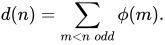
From this we can conclude that the rate of growth of the tonality diamond is asymptotically equal to . The first few values are the important ones, and the fact that the size of the diamond grows as the square of the size of the odd limit tells us that it becomes large fairly quickly. There are seven members to the 5-limit diamond, 13 to the 7-limit diamond, 19 to the 9-limit diamond, 29 to the 11-limit diamond, 41 to the 13-limit diamond, and 49 to the 15-limit diamond; these suffice for most purposes.

Translation to string length ratios
Yuri Landman published an otonality and utonality diagram that clarifies the relationship of Partch's tonality diamonds to the harmonic series and string lengths (as Partch also used in his Kitharas) and Landman's Moodswinger instrument.[7]
In Partch's ratios, the over number corresponds to the number of equal divisions of a vibrating string, and the under number corresponds to which division the string length is shortened to. For example, 5⁄4 is derived from dividing the string into 5 equal parts and shortening the length to the 4th part from the bottom. In Landman's diagram, those numbers are inverted, changing the frequency ratios into string length ratios.
See also
References
- ↑ Meyer, Max F. (1929) « Aritmética del músico: Problemas de práctica para una introducción al estudio científico de la composición musical », The University of Missouri Studies. Vol. 4, n.º 1. Universidad de Missouri. 1 de enero de 1929. p. 22. archive.org . Consultado el 23 de julio de 2026.
- ↑ Forster, Cristiano (2000). " Matemáticas musicales: El diamante de Meyer ", Chrysalis-Foundation.org . Consultado el 9 de diciembre de 2016.
- ↑ Granade, S. Andrew (2014). Harry Partch, Hobo Composer , p. 295. Boydell & Brewer. ISBN 9781580464956>
- ↑ Rasch, Rudolph (2000). «Unas palabras sobre las afinaciones de Harry Partch», Harry Partch: Una antología de perspectivas críticas , pág. 28. Dunn, David, ed. ISBN 90-5755-065-2.
- ↑ " Diamond Lattices ", The Wilson Archives, Anaphoria.com . Consultado el 9 de diciembre de 2016.
- 1 2 3 Rasch (2000), pág. 30.
- ↑ Comparación de escalas utonal armónicas con 12TET y la serie armónica en Mi (Imagen). Archivado del original el 2 de abril de 2018.
- Harry Partch
- Espacio de juego