 Hispanopedia Wiki
In algebraic topology, universal coefficient theorems (UCT) establish relationships between homology groups (or cohomology groups) with different coefficients. For instance, for every topological spaceX, its integral homology groups:

completely determine its homology groups with coefficients inA, for any abelian groupA:

Here might be the simplicial homology, or more generally the singular homology. The usual proof of this result is a pure piece of homological algebra about chain complexes of free abelian groups. The form of the result is that other coefficients A may be used, at the cost of using a Tor functor.

For example, it is common to take to be , so that coefficients are modulo 2. This becomes straightforward in the absence of 2-torsion in the homology. Quite generally, the result indicates the relationship that holds between the Betti numbers of and the Betti numbers with coefficients in a field. These can differ, but only when the characteristic of is a prime number for which there is some -torsion in the homology.


Statement of the homology case
Consider the tensor product of modules. The theorem states there is a short exact sequence involving the Tor functor
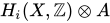

Furthermore, this sequence splits, though not naturally. Here is the map induced by the bilinear map .


If the coefficient ring is , this is a special case of the Bockstein spectral sequence.

Universal coefficient theorem for cohomology
Let be a module over a principal ideal domain (for example , or any field.)


There is a universal coefficient theorem for cohomology involving the Ext functor, which asserts that there is a natural short exact sequence

As in the homology case, the sequence splits, though not naturally. In fact, suppose

and define

Then above is the canonical map:

![{\displaystyle h([f])([x])=f(x).}](https://wikimedia.org/api/rest_v1/media/math/render/svg/f164abcf136148c7617c1fa33724d5d15f84e34a)
An alternative point of view can be based on representing cohomology via Eilenberg–MacLane space, where the map takes a homotopy class of maps to the corresponding homomorphism induced in homology. Thus, the Eilenberg–MacLane space is a weak right adjoint to the homology functor.[1]

Example: mod 2 cohomology of the real projective space
Let , the real projective space. We compute the singular cohomology of with coefficients in using integral homology, i.e., .


Knowing that the integer homology is given by:

We have and , so that the above exact sequences yield


for all . In fact the total cohomology ring structure is

![{\displaystyle H^{*}(X;G)=G[w]/\left\langle w^{n+1}\right\rangle .}](https://wikimedia.org/api/rest_v1/media/math/render/svg/6bf43418ab8e91b974947fdf5b9ddc0b642c6942)
Corollaries
A special case of the theorem is computing integral cohomology. For a finite CW complex, is finitely generated, and so we have the following decomposition.

where are the Betti numbers of and is the torsion part of . One may check that


and

This gives the following statement for integral cohomology:

For an orientable, closed, and connected-manifold, this corollary coupled with Poincaré duality gives that .


Universal coefficient spectral sequence
There is a generalization of the universal coefficient theorem for (co)homology with twisted coefficients.
For cohomology we have

where is a ring with unit, is a chain complex of free modules over , is any -bimodule for some ring with a unit , and is the Ext group. The differential has degree .


Similarly for homology,

for the Tor group and the differential having degree .


Notes
References
- Allen Hatcher, Algebraic Topology, Cambridge University Press, Cambridge, 2002. ISBN 0-521-79540-0. A modern, geometrically flavored introduction to algebraic topology. The book is available free in PDF and PostScript formats on the author's homepage.
- Kainen, P. C. (1971). "Weak Adjoint Functors". Mathematische Zeitschrift. 122: 1–9. doi:10.1007/bf01113560. S2CID 122894881.
- Jerome Levine. “Knot Modules. I.” Transactions of the American Mathematical Society 229 (1977): 1–50. https://doi.org/10.2307/1998498
External links
- Universal coefficient theorem with ring coefficients
- Homological algebra
- Theorems in algebraic topology