 Hispanopedia Wiki
"¿ Quién es judío? " ( hebreo : מיהו יהודי pronunciado [ˈmi(h)u je(h)uˈdi] ) es una pregunta básica sobre la identidad judía y consideraciones de la autoidentificación judía . La pregunta se refiere a ideas sobre la personalidad judía , que tienen dimensiones culturales , étnicas , religiosas , políticas , genealógicas y personales. El judaísmo ortodoxo y el judaísmo conservador siguen la ley judía ( halajá ), considerando que las personas son judías si sus madres son judías o si se sometieron a una conversión halájica . El judaísmo reformista y el judaísmo reconstruccionista aceptan tanto la descendencia matrilineal como la patrilineal , así como la conversión. El judaísmo caraíta sigue predominantemente la descendencia patrilineal, así como la conversión.
La identidad judía también suele definirse a través de la etnicidad . Las encuestas de opinión han sugerido que la mayoría de los judíos modernos consideran que ser judío es una cuestión predominantemente de ascendencia y cultura, más que de religión. [1] [2]
En Israel existe una controversia sobre la identificación judía, ya que afecta a cuestiones de ciudadanía y estatus personal como el matrimonio. La Ley del Retorno de Israel otorga la ciudadanía a quienes tienen un padre o abuelo judío, incluso si no son religiosos. Pero los tribunales rabínicos utilizan reglas halájicas para el matrimonio, exigiendo conversiones ortodoxas para quienes no tienen una madre judía. Esto crea conflictos entre las diferentes ramas del judaísmo.
Los nazis definieron a los judíos en función de su ascendencia y los persiguieron por motivos raciales . Los antisemitas también han definido a los judíos con fines discriminatorios. Pero los propios judíos tienen distintas autodefiniciones, que van desde la observancia religiosa hasta la identidad étnica secular. No hay consenso, pero los temas comunes enfatizan la ascendencia, la cultura y la pertenencia a la comunidad, incluso para los judíos seculares y los conversos a otras religiones.
¿Qué es un judío?
El término "judío" se presta a varias definiciones más allá de simplemente denotar a alguien que practica el judaísmo . Los israelitas y/o hebreos históricos , que promulgaron el judaísmo, no eran simplemente un conjunto homogéneo unido por una ideología común, que es la religión judía; constituyeron un grupo etnoreligioso del que desciende directamente la mayoría de los judíos modernos, [3] [4] [5] [6] [7] y, por lo tanto, existe una forma étnica de identidad judía junto con la forma religiosa de identidad judía. Como tal, los conceptos de etnicidad, nación y religión judías están fuertemente interrelacionados, [8] [9] sin embargo, a través de la conversión , es posible que alguien que no tiene una conexión histórica con la población judía histórica se convierta en judío, en ese sentido.
En esencia, la palabra "judío" puede definirse como un conglomerado de varias ideas diferentes, aunque estrechamente relacionadas:
- Un judío es aquel que practica la religión judía, el judaísmo. Esto incluye tanto a los conversos como a aquellos que han sido miembros de la religión judía desde su nacimiento.
- Un judío es aquel que desciende del antiguo grupo étnico israelita y, por lo tanto, es miembro del pueblo judío . Esto incluye a quienes no son practicantes de una religión o pueden ser completamente irreligiosos y afirman tener una conexión cultural manifiesta. [10] [11] Pero algunos eruditos limitan la definición a los descendientes de israelitas que practican el judaísmo. [12]
- Un judío es una persona que, independientemente de su identidad religiosa actual, desciende directamente de un antepasado judío. Tradicionalmente, esto solo se ha aplicado a la ascendencia matrilineal , aunque algunos grupos judíos también reconocen el judaísmo a través de la descendencia patrilineal .
Interpretación tradicional y variaciones
La definición de quién es judío varía según si lo consideran los judíos sobre la base de la ley y la tradición religiosas o la autoidentificación, o los no judíos por otras razones, a veces con fines prejuiciosos. Dado que la identidad judía puede incluir características de una etnia , [13] una religión, [14] o un pueblo, la definición depende de interpretaciones tradicionales o más nuevas de la ley y la costumbre judías. [15]
La Ley del Retorno de Israel estipula que un judío es alguien con una madre judía o alguien que se ha convertido al judaísmo y no es miembro de otra religión. [16] El Gran Rabinato israelí requiere documentos que prueben el judaísmo de la madre, abuela, bisabuela y tatarabuela cuando se solicita matrimonio . [17] La Oficina del Gran Rabino (OCR) ha subrayado el principio básico de que un niño no es reconocido por la OCR y otros organismos como judío a menos que su madre sea judía, o haya experimentado una conversión reconocida por el organismo. [18]
Según la definición más simple que utilizan la mayoría de los judíos para identificarse a sí mismos, una persona es judía de nacimiento o se convierte en judía a través de la conversión religiosa. Sin embargo, existen diferencias en las interpretaciones cuando se trata de denominaciones judías no ortodoxas en la aplicación de esta definición, incluyendo
- ¿Debe considerarse judía una persona que sólo tiene un padre judío?
- ¿Qué procesos de conversión deben considerarse válidos?
- ¿Puede uno seguir siendo judío después de convertirse a otra religión?
- ¿Cómo afecta al estatus judío el no saber que uno tiene padres judíos?
- ¿Cómo se determina la identidad judía en diferentes países a lo largo de la diáspora judía?
- ¿Cómo se resuelve la reclamación de la ciudadanía israelí en el contexto de las Leyes Básicas de Israel ?
Judaísmo tannaítico
Según la Mishná , la primera fuente escrita de la halajá , el estatus de los descendientes de matrimonios mixtos se determinaba matrilinealmente.
Según el historiador Shaye JD Cohen , en la Biblia, el estatus de la descendencia de los matrimonios mixtos se determinaba de forma patrilineal. Aporta dos explicaciones probables para el cambio en los tiempos de la Mishná: en primer lugar, la Mishná puede haber estado aplicando la misma lógica a los matrimonios mixtos que a otras mezclas ( kilayim ). Así, un matrimonio mixto está prohibido, al igual que la unión de un caballo y un burro, y en ambas uniones la descendencia es juzgada matrilinealmente. En segundo lugar, los Tannaim pueden haber sido influenciados por la ley romana, que dictaba que cuando un padre no podía contraer un matrimonio legal, la descendencia seguiría a la madre . [19]
Judaísmo contemporáneo
Todos los movimientos religiosos judíos coinciden en que una persona puede ser judía por nacimiento o por conversión. Según la halajá , un judío de nacimiento debe haber nacido de una madre judía. La halajá afirma que la aceptación de los principios y prácticas del judaísmo no convierte a una persona en judía. Sin embargo, quienes nacen judíos no pierden ese estatus porque dejan de ser judíos observantes, incluso si adoptan las prácticas de otra religión.
El judaísmo reformista y reconstruccionista, como movimientos que rechazan el concepto de halajá , a menudo aceptan a un niño como judío cuando solo el padre es judío, siempre que el niño elija identificarse como judío. [20] Como los procesos de conversión difieren, los realizados por denominaciones más liberales no son aceptados por las denominaciones más ortodoxas. [20]
Judío de nacimiento
Según la halajá , para determinar el estatus judío de una persona (hebreo: yuhasin ) uno necesita considerar el estatus de ambos padres. Si ambos padres son judíos, su hijo también será considerado judío, y el niño toma el estatus del padre (por ejemplo, como kohen ). Si alguno de los padres está sujeto a una discapacidad genealógica (por ejemplo, es un mamzer ), entonces el niño también está sujeto a esa discapacidad. Si uno de los padres no es judío, la regla es que el niño toma el estatus de la madre ( Kiddushin 68b, Shulján Aruj , EH 4:19). [21] La regla se deriva de varias fuentes, incluyendo Deuteronomio 7:1-5, Levítico 24:10, Esdras 10:2-3. [21] En consecuencia, si la madre es judía, también lo es su hijo, y si no es judía, tampoco se considera judío a su hijo. En el judaísmo ortodoxo, el hijo de una madre no judía puede ser considerado judío sólo mediante un proceso de conversión al judaísmo . [22] [ se necesita una mejor fuente ] El niño también está libre de cualquier discapacidad y estatus especial al que el padre pueda haber estado sujeto (por ejemplo, ser un mamzer o kohen ) bajo la ley judía. [23]
Las ramas ortodoxa y conservadora del judaísmo sostienen que las reglas halájicas (es decir, la descendencia matrilineal) son válidas y vinculantes. El judaísmo reformista y liberal no aceptan las reglas halájicas como vinculantes, y la mayoría de las ramas aceptan a un niño de un padre judío, ya sea padre o madre, como judío si los padres crían al niño como judío y fomentan una identidad judía en el niño, señalando que "en la Biblia, la línea siempre siguió al padre, incluidos los casos de José y Moisés , que se casaron con familias sacerdotales no israelitas". [24] [ mejor fuente necesaria ] (Sin embargo, según la tradición oral del judaísmo ortodoxo, las esposas de José y Moisés se convirtieron al judaísmo antes de casarse con ellos). [ fuente no primaria necesaria ] [ cita requerida ] El estándar del movimiento reformista establece que "para aquellos más allá de la infancia que afirman identidad judía, se pueden agregar o sustituir otros actos públicos o declaraciones después de consultar con su rabino". [25] Los defensores de la descendencia patrilineal señalan Génesis 48:15-20 y Deuteronomio 10:15. [26] Esta política se conoce comúnmente como descendencia patrilineal , aunque "bilineal" sería más preciso.
Descendencia patrilineal
En 1983, la Conferencia Central Reformista de Rabinos Americanos aprobó la Resolución sobre Descendencia Patrilineal, declarando que "el hijo de un padre judío está bajo la presunción de descendencia judía. Esta presunción del estatus de la descendencia de cualquier matrimonio mixto debe establecerse mediante actos públicos y formales apropiados y oportunos de identificación con la fe y el pueblo judíos... Dependiendo de las circunstancias, las mitzvot que conducen a una identidad judía positiva y exclusiva incluirán la entrada en el pacto, la adquisición de un nombre hebreo, el estudio de la Torá, el Bar/Bat Mitzvah y la Kabalat Torá (Confirmación). Para aquellos que más allá de la infancia afirman identidad judía, otros actos públicos o declaraciones pueden agregarse o sustituirse después de consultar con su rabino". [27]
El rabino Mark Washofsky resume la resolución del CCAR de 1983 y las interpretaciones subsiguientes en la literatura reformista de la siguiente manera:
- "La resolución es consultiva, no halájica en el sentido tradicional. No establece una nueva definición de la identidad judía, ya que su preámbulo establece expresamente que pretende ser aplicable sólo a los judíos reformistas de Norteamérica, no a todos los judíos del mundo".
- "La ascendencia judía puede provenir de cualquiera de los padres... El Movimiento Reformista presume que el hijo de uno de los padres, ya sea madre o padre, es judío. De hecho, la resolución de 1983 es, en un aspecto importante, más estricta que la definición tradicional de condición judía. El hijo de madre judía y padre gentil, a quien la halajá considera claramente judío, goza únicamente de una presunción de condición judía que debe ser "establecida" mediante "actos públicos y formales de identificación apropiados y oportunos".
- "La biología sigue siendo un factor decisivo. En la determinación de la identidad judía... el hijo de dos padres gentiles es, como antes, definitivamente no judío y debe pasar por una conversión formal para poder llegar a ser judío."
- "Tanto la descendencia como la conducta son cruciales para determinar el estatus judío según la resolución. El estatus judío de un hijo de un matrimonio mixto no puede determinarse "automáticamente" ni por la biología ni por la conducta. Ambos elementos -la descendencia de un padre judío y el cumplimiento de las mitzvot que conducen a una "identidad judía positiva y exclusiva- deben estar presentes, y deben estar presentes durante la infancia".
- “La resolución se aplica únicamente a los niños criados exclusivamente como judíos... Un niño criado simultáneamente en el judaísmo y en otra tradición religiosa no desarrolla una identidad judía “positiva y exclusiva”; por lo tanto, la presunción de estatus judío queda desmentida y la resolución no se aplica a ese niño. Él o ella deberá convertirse antes de celebrar su bar o bat mitzvah en la sinagoga.” [28]
Renunciar a la necesidad de una conversión formal para cualquier persona que tuviera al menos un padre judío que hubiera realizado actos afirmativos de identidad judía fue un alejamiento de la posición tradicional que requería la conversión formal al judaísmo para los niños sin una madre judía . [29] [ se necesita una mejor fuente ]
La resolución de 1983 de la CCAR ha tenido una recepción mixta en las comunidades judías reformistas fuera de los Estados Unidos. En particular, el Movimiento Israelí para el Judaísmo Progresista ha rechazado la descendencia patrilineal y exige la conversión formal para todo aquel que no haya nacido de madre judía. [30]
El judaísmo caraíta cree que la identidad judía sólo puede transmitirse por descendencia patrilineal, basándose en que toda descendencia en la Torá fue según la línea masculina, basando esta idea "en el hecho de que, en la Biblia, las tribus reciben nombres masculinos y que los personajes bíblicos siempre son referenciados por los nombres de sus padres". [31] Sin embargo, una minoría de caraítas modernos cree que la identidad judía requiere que ambos padres sean judíos, y no sólo el padre. [32]
La divergencia de puntos de vista se ha convertido en un problema porque las comunidades ortodoxas y conservadoras no reconocen a una persona como judía si sólo su padre es judío. [20] Para que una persona sea aceptada como judía por una comunidad ortodoxa o conservadora (por ejemplo, en ocasión de su bar o bat mitzvah o matrimonio), se requiere una conversión formal (de acuerdo con los estándares halájicos). El judaísmo ortodoxo tiene una posición predominante en Israel. Aunque el judaísmo ortodoxo y conservador no reconocen el judaísmo a través de la descendencia patrilineal, "también debe notarse, sin embargo, que en el caso de un niño nacido de un padre judío pero de una madre no judía, la mayoría de los rabinos ortodoxos relajarán las estrictas demandas que normalmente se hacen a los potenciales conversos", [33] [ se necesita una mejor fuente ] y la Asamblea Rabínica del movimiento conservador "acordó que los 'judíos sinceros por elección' deberían ser cálidamente bienvenidos en la comunidad".
Conversos al judaísmo
En la actualidad, todas las formas dominantes del judaísmo están abiertas a los conversos sinceros, y la mayoría de los subgrupos tienen un proceso específico para aceptar a los conversos. No todas las variedades del judaísmo reconocen todas las conversiones. [34]
En el judaísmo rabínico , las leyes de conversión se basan en las fuentes clásicas de la ley judía , especialmente las discusiones en el Talmud , y la ley tal como está codificada en el Shulkhan Arukh . [35] Este corpus de la ley judía tradicional (halajá) es considerado como autoritario por los movimientos ortodoxos [36] y conservadores . [37] Los requisitos halájicos tradicionales para la conversión son la instrucción en los mandamientos, la circuncisión (si es varón), la inmersión en un cuerpo de agua aceptable ante testigos válidos y la aceptación de los mandamientos ante un tribunal rabínico . Si un varón ya está circuncidado, se extrae una gota de sangre del pene. [38]
Las autoridades ortodoxas exigen que las conversiones se realicen de acuerdo con la ley judía tradicional y reconocen sólo aquellas conversiones en las que el converso acepta y se compromete a observar la ley judía tal como la interpretan los rabinos ortodoxos . Dado que los rabinos de los otros movimientos no exigen que los conversos asuman este compromiso, las autoridades ortodoxas no suelen aceptar como válidas las conversiones realizadas fuera de la comunidad ortodoxa. [39]
Las autoridades conservadoras también exigen que las conversiones se realicen de acuerdo con la ley judía tradicional. Llevar a cabo una conversión sin los requisitos tradicionales de inmersión en un baño ritual y circuncisión para los varones es una violación de una norma de la Asamblea Rabínica y motivo de expulsión. [40] Las autoridades conservadoras generalmente reconocen cualquier conversión realizada de acuerdo con los requisitos de la ley judía, incluso si se realiza fuera del movimiento conservador. En consecuencia, los rabinos conservadores pueden aceptar la validez de algunas conversiones de otros movimientos no ortodoxos. [41] [42]
La Unión para el Judaísmo Reformista afirma que "se espera que las personas que estén considerando la conversión estudien teología, rituales, historia, cultura y costumbres judías, y que comiencen a incorporar prácticas judías en sus vidas. La duración y el formato del curso de estudio variarán de un rabino a otro y de una comunidad a otra, aunque la mayoría ahora requiere un curso de judaísmo básico y estudio individual con un rabino, así como la asistencia a los servicios y la participación en la práctica en el hogar y la vida de la sinagoga". [43] Su Conferencia Central de Rabinos Americanos recomienda que tres rabinos estén presentes para la ceremonia de conversión. [44] El Tribunal Rabínico del Movimiento Israelí para el Judaísmo Progresista requiere un promedio de un año de estudio para familiarizarse con la vida y la tradición judías. Después de esto, los conversos deben sumergirse en un baño ritual, ser circuncidados si son varones y aceptar los mandamientos ante el tribunal rabínico. [45]
Aunque la conversión de un niño puede ser aceptada en algunas circunstancias (como en el caso de niños adoptados o niños cuyos padres se convierten), a los niños que se convierten normalmente se les pregunta si quieren seguir siendo judíos después de alcanzar la edad adulta religiosa, que es de 12 años para una niña y 13 para un niño, como lo exige la ley judía. [46] [47]
El judaísmo caraíta no acepta las tradiciones legales orales del judaísmo rabínico. Tiene requisitos diferentes para la conversión y se abstuvo de aceptar conversos hasta hace poco. [31] Tradicionalmente no proselitistas, el 1 de agosto de 2007, los caraítas convirtieron a sus primeros miembros en 500 años. En una ceremonia en su sinagoga del norte de California, diez adultos y cuatro menores juraron lealtad al judaísmo después de completar un año de estudio. Esta conversión se produjo 15 años después de que el Consejo de Sabios Caraíta revocara su prohibición centenaria de aceptar conversos. [48]
Las comunidades judías sirias no suelen realizar conversiones, en particular cuando se sospecha que la conversión tiene como fin el matrimonio. Tampoco aceptan a conversos de otras comunidades, ni a los hijos de matrimonios mixtos o de matrimonios en los que participen conversos de ese tipo. [49]
Judíos que han practicado otra religión
En general, el judaísmo ortodoxo considera judíos a los individuos nacidos de madres judías, incluso si se convierten a otra religión o son criados en ella. El judaísmo reformista considera no judíos a los judíos que se convierten a otra religión o son criados en ella. Por ejemplo, "... cualquiera que afirme que Jesús es su salvador ya no es judío..." [Contemporary American Reform Responsa, #68]. [50] [51] [52]
Históricamente, un judío que ha sido declarado hereje ( hebreo: מין , romanizado: min ) o cristiano (hebreo: נוצרי , romanizado: notzri , que significa "nazareno") puede haber tenido un cherem (similar a la excomunión ) colocado sobre él o ella; pero la práctica de exclusión comunitaria y religiosa no afecta su condición de nacimiento judío. [53] El judaísmo también considera judíos a aquellos que involuntariamente se convierten del judaísmo a otra religión ( hebreo : anusim , אנוסים, que significa "forzados"), y sus descendientes matrilineales también son considerados judíos.
El judaísmo tiene una categoría para aquellos que son judíos pero que no practican o no aceptan los principios del judaísmo, se hayan convertido o no a otra religión. La visión tradicional sobre estos individuos, conocidos como Meshumadim (hebreo: משומדים ), es que son judíos; sin embargo, existe mucho debate en la literatura rabínica sobre su estatus en relación con la aplicación de la ley judía y su participación en el ritual judío, [53] pero no sobre su estatus como judíos.
Un judío que abandona el judaísmo es libre de volver a esa religión en cualquier momento. En general, no se requiere ninguna ceremonia formal ni declaración para volver a las prácticas judías. Todos los movimientos del judaísmo acogen con agrado el retorno al judaísmo de quienes han abandonado o se han criado en otra religión. Al regresar al judaísmo, se espera que estas personas abandonen sus prácticas anteriores y adopten las costumbres judías.
En principio, las mismas reglas se aplican a los descendientes matrilineales de dichas personas, aunque algunas autoridades rabínicas pueden exigir pruebas más estrictas de ascendencia judía que otras. El que dichas personas deban someterse a una conversión formal completa depende de la comunidad y de sus circunstancias individuales. Por ejemplo, un hombre que haya tenido un brit milá , que tenga un conocimiento general del judaísmo, pero que haya sido criado en un hogar secular, podría no estar obligado a someterse a una conversión ritual. Sin embargo, en la mayoría de las comunidades, puede que se les exija someterse a una conversión ritual completa a un hombre que no haya tenido un brit milá, a un hombre o una mujer que se haya convertido o haya sido criado en otra religión, o a un individuo criado en un hogar completamente secular sin ninguna educación judía. Para participar plenamente en la comunidad (por ejemplo, para casarse con la participación de un rabino), puede que se les exija que muestren sinceridad, como una declaración de compromiso con el judaísmo. [54]
Otro ejemplo de las cuestiones en juego es el caso de los conversos al judaísmo que dejan de practicar el judaísmo (ya sea que sigan considerándose judíos o no), no aceptan ni siguen la halajá o ahora se adhieren a otra religión. Técnicamente, esa persona sigue siendo judía, como todos los judíos, siempre que la conversión original sea válida. Sin embargo, en algunos casos recientes, las autoridades rabínicas haredíes , así como el actual Gran Rabinato israelí religioso sionista , han adoptado la opinión de que el desvío de un determinado converso de la observancia judía ortodoxa es evidencia de que no puede, ni siquiera en el momento de la conversión, haber tenido la plena intención de observar los mandamientos y que, por lo tanto, la conversión debe haber sido inválida.
Un tribunal judío válido y de suficiente autoridad tiene la capacidad de revocar el estatus de judío de una persona o un grupo. Esto se hizo en el caso de las diez tribus perdidas de Israel [55] y de los samaritanos [56] .
Definiciones religiosas
Perspectiva halájica
Según la visión rabínica tradicional, sostenida por todas las ramas del judaísmo ortodoxo y el judaísmo conservador , y algunas ramas del judaísmo reformista , [57] sólo la halajá puede definir quién es o no judío cuando surge una cuestión de identidad, linaje o ascendencia judía sobre cualquier persona que busque definirse o afirmar que es judía.
En consecuencia, la mera creencia en los principios del judaísmo no convierte a nadie en judío. De manera similar, la no adhesión de un judío a las 613 Mitzvot , o incluso la conversión formal a otra religión, no hace que uno pierda su condición de judío. Por lo tanto, los descendientes inmediatos de todas las mujeres judías (incluso las apóstatas ) siguen siendo considerados judíos, al igual que los de todas sus descendientes femeninas. Incluso aquellos descendientes que no son conscientes de que son judíos o practican una religión distinta del judaísmo, son definidos por esta perspectiva como judíos, siempre que provengan de una línea de descendencia femenina ininterrumpida. Como corolario, los hijos de un padre judío y una madre no judía no son considerados judíos por la Halajá a menos que se conviertan formalmente de acuerdo con la Halajá, incluso si fueron criados en la plena observancia de las Mitzvot. [58] [59]
Aquellos que no nacieron de madre judía pueden ser aceptados como judíos por las comunidades ortodoxa y conservadora a través de un proceso formal de conversión al judaísmo para convertirse en "conversos justos" ( Gerei Tzedek - hebreo : גרי צדק ). Además, la Halajá requiere que el nuevo converso se comprometa a observar sus principios; esto se llama Kabbalat Ol Mitzvot ( hebreo : קבלת עול מצוות ), "Aceptación del Yugo de los Mandamientos". La Kabbalat mitzvot ( hebreo : קבלת מצוות ) es utilizada por el judaísmo reformista de acuerdo con la responsa reformista y la Halajá. [60] [ aclaración necesaria ]
Tanto el judaísmo haredí como el judaísmo ortodoxo moderno aceptan un conjunto similar de reglas sobre el estatus judío basadas en el judaísmo rabínico clásico, que incluyen tanto la descendencia matrilineal como los requisitos de que las conversiones sean realizadas por rabinos ortodoxos y que los conversos prometan observar estrictamente elementos del judaísmo tradicional como el Shabat y la Niddah . Sin embargo, su aplicación de estas reglas ha sido diferente, y la diferencia ha ido aumentando en los últimos años. Las autoridades ortodoxas modernas han estado más inclinadas a fallar a favor del estatus judío y a aceptar la palabra de judíos no ortodoxos en casos dudosos que involucran a personas que afirman ser judías, mientras que las autoridades haredíes en los últimos años han tendido a presumir el estatus no judío y requerir reglas y estándares de evidencia más estrictos para probar el estatus judío, y han tendido a desconfiar de la evidencia de judíos que no son personalmente ortodoxos. Los rabinos haredíes han tendido a mirar la observancia personal actual de un converso y a considerar las deficiencias o la falta de ortodoxia en la observancia actual como evidencia de que el converso nunca tuvo la intención de convertirse válidamente. Además, la situación actual se complica aún más por el hecho de que algunos rabinos haredíes ya no consideran confiables a algunos rabinos ortodoxos modernos. [61] [62] [63]
Judaísmo caraíta
El judaísmo caraíta se basa en el Tanaj para indicar que el judaísmo se transmite a través de la línea paterna, no de la línea materna, como sostiene el judaísmo ortodoxo (aunque una minoría sostiene que ambos padres deben ser judíos). Los judíos caraítas tienen derecho a hacer aliá en virtud de la Ley del Retorno . La elegibilidad de los conversos al judaísmo a través del movimiento caraíta para hacer aliá en virtud de la Ley del Retorno aún no ha sido abordada en los tribunales israelíes. [64]
Varios versículos en la Biblia mencionan leyes de herencia familiar dependiendo del linaje paterno de la tribu: [65]
Así no se trasladará la herencia de los hijos de Israel de una tribu a otra, sino que cada uno de los hijos de Israel conservará la herencia de la tribu de sus padres. Y toda hija que posea herencia en alguna tribu de los hijos de Israel se casará con un descendiente de la tribu de su padre, para que los hijos de Israel disfruten cada uno de la herencia de sus padres.
— Libro de Números 36 :7–8
Judaísmo reformista
El judaísmo reformista reconoce que un niño es judío si uno de sus padres es judío y el niño es criado como judío. Algunas voces dentro del movimiento reformista dicen que la ley, que cambió a matriarcal hace unos 2.000 años (originalmente en la Torá la descendencia se determinaba por descendencia patriarcal) y se basaba en las trágicas circunstancias que enfrentaba el pueblo judío, alguna vez fue útil pero ya no es relevante.
Las denominaciones judías progresistas modernas tienen un proceso de conversión basado en sus principios . En los EE. UU., una resolución oficial de la Reforma en 1893 abolió la circuncisión como requisito para los conversos, [66] y la Reforma no exige que los conversos tengan tevilah, inmersión ritual. Un "posible converso declara, oralmente y por escrito, en presencia de un rabino y no menos de dos líderes laicos de la congregación y la comunidad, la aceptación de la religión judía y la intención de vivir de acuerdo con sus mitzvot ". [67] [ se necesita una mejor fuente ]
Controversias
La controversia a la hora de determinar “quién es judío” se refiere a cuatro cuestiones básicas:
Un problema surge porque los movimientos reformistas norteamericanos y liberales del Reino Unido han cambiado algunos de los requisitos halájicos para la identidad judía de dos maneras:
- Los hijos nacidos de un solo progenitor judío –independientemente de que el padre o la madre sean judíos– pueden reivindicar una identidad judía. Un hijo de un solo progenitor judío que no reivindique esta identidad ha perdido, a los ojos del movimiento reformista, su identidad judía. En cambio, la visión halájica es que todo hijo nacido de madre judía es judío, haya sido o no criado como tal, o incluso si la madre se considera judía. Por ejemplo, los hijos de Madeleine Albright (que fue criada como católica y desconocía su herencia judía) serían todos judíos según la halajá, ya que los antepasados femeninos rastreables de su madre eran todos judíos y sus tres hijos eran mujeres. Sin embargo, esta no es la creencia del judaísmo progresista, que considera a los judíos que se convierten a otra religión o son criados en ella como no judíos.
- Se ha relajado el requisito de la brit milá , así como el de la inmersión ritual (aunque el movimiento conservador permite la conversión sin circuncisión en algunos casos, la mayoría de los judíos ortodoxos no lo permiten).
En segundo lugar, el judaísmo ortodoxo afirma que los rabinos no ortodoxos no están calificados para formar un beit din . [63] Esto ha llevado a que las conversiones no ortodoxas generalmente no sean aceptadas en las comunidades ortodoxas. Dado que el judaísmo ortodoxo mantiene los estándares tradicionales para la conversión, en los que se requiere el compromiso de observar la halajá, las conversiones no ortodoxas generalmente no son aceptadas en las comunidades ortodoxas porque los movimientos no ortodoxos realizan conversiones en las que el nuevo converso no se compromete a observar la halajá tal como la entiende el judaísmo ortodoxo.
Una tercera controversia se refiere a las personas (ya sean judíos de nacimiento o conversos al judaísmo) que se han convertido a otra religión. La visión tradicional es que esas personas siguen siendo judías. [68] [69] El judaísmo reformista considera a esas personas como apóstatas, [70] [71] y afirma con respecto a los judíos mesiánicos : " Los 'judíos mesiánicos' afirman que son judíos, pero debemos preguntarnos [ sic ] si los identificamos como judíos. No podemos hacerlo ya que consideran a Jesús de Nazaret como el Mesías que ha cumplido las promesas mesiánicas. De esta manera, se han colocado claramente dentro del cristianismo. Pueden ser algo diferentes de otros cristianos ya que siguen varios ritos y ceremonias judías, pero eso no los convierte en judíos". [72] De todos modos, esas personas no cuentan como judías a los efectos de las leyes de ciudadanía israelíes.
Una cuarta controversia se deriva de la manera en que el Gran Rabinato de Israel ha estado manejando las decisiones sobre matrimonios y conversiones en los últimos años. Las conversiones y los matrimonios dentro de Israel están controlados legalmente por el Gran Rabinato Ortodoxo de Israel; por lo tanto, una persona que no haya demostrado ser judía a satisfacción del Rabinato no está legalmente autorizada a casarse con un judío en Israel hoy en día. Aunque el Rabinato siempre se ha negado a aceptar conversiones no ortodoxas, hasta hace pocos años estaba más dispuesto a aceptar la paternidad judía de los solicitantes basándose en el testimonio personal, y la validez de las conversiones basada en el testimonio de rabinos ortodoxos. Sin embargo, en los últimos años el rabinato, cuyos rabinos históricamente tenían una orientación ortodoxa más moderna , ha sido cada vez más poblado por el bando haredí más estricto . Se ha inclinado cada vez más a presumir que los solicitantes no son judíos hasta que se demuestre lo contrario, y exige estándares de prueba más estrictos que en el pasado. Ha implementado una política de negarse a aceptar el testimonio de judíos no ortodoxos en cuestiones de estatus judío, con el argumento de que dicho testimonio no es confiable. También ha sido cada vez más escéptico respecto de la fiabilidad de los rabinos ortodoxos ordenados por instituciones no sujetas a su acreditación, particularmente en materia de conversión. En consecuencia, los judíos no ortodoxos nacidos de padres judíos, y algunos judíos convertidos por rabinos ortodoxos, han sido cada vez más incapaces de demostrar su judaísmo a satisfacción del Rabinato, porque no pueden encontrar un rabino ortodoxo que sea aceptable para el Rabinato y que esté familiarizado y dispuesto a dar fe del judaísmo de su linaje materno o de la validez de su conversión. [61] [62] [63]
Se han hecho varios intentos de convocar a representantes de los tres principales movimientos para formular una solución práctica a esta cuestión, pero hasta ahora han fracasado, aunque todos los partidos reconocen que la importancia de la cuestión es mayor que cualquier sentimiento de rivalidad entre ellos.
Definiciones étnicas
Judío étnico es un término que se utiliza generalmente para describir a una persona de ascendencia y origen judíos que no necesariamente practica activamente el judaísmo, pero que se identifica con el judaísmo o con otros judíos cultural o fraternalmente, o con ambos. El término judío étnico no excluye específicamente a los judíos practicantes, pero normalmente se los llama simplemente "judíos" sin el adjetivo calificativo "étnico". [a]
El término puede referirse a personas de diversas creencias y orígenes porque la genealogía define en gran medida quién es "judío". "Judío étnico" se utiliza a veces para distinguir a los judíos no practicantes de los judíos practicantes (religiosos). Otros términos incluyen judío no observante , judío no religioso , judío no practicante y judío secular .
El término también puede referirse a los judíos que no practican la religión del judaísmo. Por lo general, los judíos étnicos son conscientes de su origen judío y pueden sentir fuertes vínculos culturales (aunque no religiosos) con las tradiciones judías y con el pueblo o la nación judía. Al igual que las personas de cualquier otra etnia, los judíos étnicos no religiosos a menudo se asimilan a una cultura no judía circundante, pero, especialmente en áreas donde hay una fuerte cultura judía local, pueden permanecer en gran medida como parte de esa cultura.
Los "judíos étnicos" incluyen a ateos , agnósticos, deístas no denominacionales , judíos con solo conexiones casuales con denominaciones judías o conversos a otras religiones, como el cristianismo , el budismo o el islam. Los judíos religiosos de todas las denominaciones a veces se involucran en actividades de divulgación entre judíos no religiosos. En el caso de algunas denominaciones jasídicas (por ejemplo, Jabad-Lubavitch ), esta divulgación se extiende a la proselitización activa de judíos más seculares. [73] [74] [75] [76]
Opinión pública
El estudio de 2013 de Pew Research sobre los judíos estadounidenses reveló que el 62% pensaba que ser judío era principalmente una cuestión de ascendencia y cultura, mientras que el 15% pensaba que era principalmente una cuestión de religión. De los que se declararon judíos por religión, el 55% pensaba que ser judío era principalmente una cuestión de ascendencia y cultura, mientras que dos tercios pensaban que no era necesario creer en Dios para ser judío. [77]
Definiciones históricas europeas
Durante la Edad Media no era necesario preguntarse quién era judío, porque la diferencia entre la comunidad judía y la no judía era clara para ambas partes. [78] [79] Por ejemplo, una persona nacida en una familia judía era judía, los matrimonios entre judíos y no judíos no estaban permitidos y la única manera de abandonar la identidad judía era no sólo abandonando la religión, sino también cortando todos los lazos con la comunidad judía, incluidos la familia y los amigos. Para los judíos medievales, la diferencia más esencial entre ellos y los demás no era la fe, sino el pueblo al que estaba vinculada su comunidad religiosa, y se llamaban a sí mismos "Israel". [78]
A medida que la emancipación de los judíos en Europa se hizo relevante, [78] la ideología del nacionalismo comenzó a surgir [80] y en partes de Europa occidental la religión se separó más claramente de la etnicidad, [79] la cuestión de qué tipo de grupo eran los judíos - religioso, cultural, racial, nacional o algo más - comenzó a discutirse más. Debido a la emancipación, se esperaba que los judíos se asimilaran a las naciones europeas. La diferencia religiosa se toleraba mejor que la étnica, [81] y los judíos ahora a veces eran definidos simplemente como un grupo religioso, por ejemplo, los judíos en Alemania fueron definidos como alemanes que practicaban la "fe mosaica". [80] [81] Los propios judíos por lo general no estaban contentos con esta definición. [81] Sin embargo, en busca de derechos civiles iguales y para demostrar que los judíos también pueden ser parte de las civilizaciones occidentales, algunos judíos de Europa Central comenzaron a resaltar su identidad más como un grupo religioso, con algunos rechazando las definiciones étnicas de judaísmo por completo y algunos deshaciéndose conscientemente de sus hábitos "orientales". [82] Sin embargo, muchos judíos, especialmente en Europa del Este, criticaron a los judíos occidentales por perder su judaísmo. [83] Sin embargo, al mismo tiempo, se acuñó el concepto de "raza semita", que incluía a los judíos. Esto también condujo a ideas pseudocientíficas de que los judíos eran racialmente inferiores a los "arios". [84] Más tarde, el Holocausto hizo que algunos judíos más evitaran asociar elementos étnicos o raciales al hecho de ser judío. [85] [86] En la ex Unión Soviética , "judío" era una nacionalidad por ley, al igual que con otras nacionalidades como los rusos, ucranianos, georgianos y otros, [87] y los propios judíos soviéticos tenían un fuerte sentido de judaísmo étnico (" Yiddishkeit ") que los habría separado de los grupos étnicos circundantes. [88] Hubo ciertas restricciones a sus libertades civiles en los primeros años de la Unión Soviética. [87]
ADN
La moderna prueba genealógica de ADN para determinar la etnicidad es una definición no religiosa de “¿quién es judío?”, ya que cada vez más personas descubren sus orígenes biológicos y culturales fuera del marco religioso tradicional. [89] Ha habido controversia sobre el uso de pruebas de ADN en los tribunales rabínicos israelíes como prueba de judaísmo. [90] [91]
"Medio judío"
En los Estados Unidos y Europa, debido a los matrimonios mixtos , la población de "mitad judíos" está empezando a rivalizar con la de los judíos con dos padres judíos. Los autoidentificados como "mitad judíos" consideran el término una categoría familiar, que refleja múltiples herencias y posibles prácticas culturales o espirituales judías. [92] [93] Otros términos similares que se han utilizado incluyen: "parcialmente judío" y "parcialmente judíos". El término "Gershom", "Gershomi" o "Beta Gershom" también se ha utilizado rara vez como alternativa a "mitad judío" y "parcialmente judío" en relación con los descendientes de matrimonios mixtos, siendo Gershom el hijo bíblico de Moisés y su esposa madianita Séfora . [94] El término normalmente no tiene un significado religioso, como lo tienen términos como judío cristiano , sino que describe al judaísmo étnico.
Otras definiciones no religiosas
La Sociedad para el Judaísmo Humanista define a un judío como "alguien que se identifica con la historia, la cultura y el destino del pueblo judío". En su opinión, es posible, por lo tanto, que un individuo no religioso adopte el judaísmo y se una a una comunidad judía humanista, y que la Sociedad para el Judaísmo Humanista adopte a la persona que quiera ser parte de la familia judía humanista. [95] Como dice el autor israelí Amos Oz , "un judío es cualquiera que elige o se ve obligado a compartir un destino común con otros judíos". [96] Oz resumió su posición de manera más sucinta en un monólogo publicado en Tikkun , diciendo "¿Quién es un judío? Todo aquel que está lo suficientemente loco como para llamarse judío es un judío". [97] Desde una perspectiva similar, es posible que una persona nacida y criada como judía abandone el judaísmo y deje de ser judía: ejemplos históricos famosos son Heinrich Heine , Benjamin Disraeli , Gustav Mahler y Georg Brandes .
Estructura jurídica en Israel
Los documentos constitucionales israelíes no han definido "quién es judío", aunque la decisión de si alguien es judío o no tiene importantes ramificaciones jurídicas, sociales y financieras. Esta falta de definición ha dado lugar a controversias jurídicas en Israel y ha habido muchos casos judiciales en Israel que han abordado la cuestión. [98] [99]
Prueba de judaísmo
As of 2010[update], anyone who immigrated to Israel after 1990 and wishes to marry or divorce via the Jewish tradition within the state limits must go through a "Judaism test"[100] at an Orthodox Rabbinical court. In this test, a person would need to prove their claim to be Jewish to an investigator beyond a reasonable doubt. They would need to present original documentation of their matriline up to their great-grandmother (4 generations),[101] or in the case of Ethiopian Jews, 7 generations back.[102] In addition, they should provide government documents with nationality/religion shown as Jewish (e.g., birth/death certificates, marriage documents, etc.).
In the case of people whose original documents have been lost or never existed, it may take considerable effort to prove they are Jewish.[103] The court rulings are not final, and any clerk has the power to question them[104] even 20 years later, changing one's citizenship status to "on hold", and putting them in jeopardy of deportation.[105]
The two biggest communities affected by these documentation issues are:
- Immigrants from the former Soviet Union (FSU) – a study conducted between 2003 and 2005 showed that 83% of people from the FSU who started the Judaism test process successfully finished it. An estimated 10% left the process before completion. In a later study, in 2011, a 90% success rate was achieved in the FSU immigrant community.[106] Many Jews in the former Soviet Union took steps to hide their Jewishness. Besides post-Soviet copies of documents are suspected by the tribunal after widespread falsification, and the archived originals are difficult to access for genealogists.[107]
- Immigrants from the United States, where government documents generally do not show religion or Jewish ethnicity.[108][109][110][111]
Law of Return
Following the birth of the modern State of Israel in 1948, the Law of Return was enacted in 1950 to give any Jew the right to immigrate to Israel and become a citizen.[112] However, due to an inability on the lawmakers to agree, the Law did not define who was a Jew, relying instead on the issue to resolve itself over time. As a result, the Law relied in form on the traditional halakhic definition. But, the absence of a definition of who is a Jew, for the purpose of the Law, has resulted in the divergent views of the various streams of Judaism competing for recognition.
Besides the generally accepted halakhic definition of who is a Jew, in 1970, the Law extended the categories of person who are entitled to immigration and citizenship to the children and grandchildren of Jews, regardless of their present religious affiliation, and their spouses.[113] Also, converts to Judaism whose conversion was performed outside the State of Israel, regardless of who performed it, are entitled to immigration under the Law. Once again, issues arose as to whether a conversion performed outside Israel was valid. The variation of the definition in the Law and the definition used by various branches of Judaism has resulted in practical difficulties for many people.
It has been estimated that between 1986 and 2006, about 200,000 non-Jews and even practicing Christians have entered Israel from the former Soviet Union on the basis of being a child or grandchild of a Jew or by being married to a Jew.[114]
However, there is an exception in the case of a person who has formally converted to another religion. This is derived from the Rufeisen Case in 1962,[98] in which the Supreme Court ruled that such a person, no matter what their halakhic position, is not entitled to immigration under the Law; they concluded that "no one can regard an apostate as belonging to the Jewish people".[115]
Current Israeli definitions specifically exclude Jews who have openly and knowingly converted to or were raised in a faith other than Judaism, including Messianic Judaism. This definition is not the same as that in traditional Jewish law; in some respects it is deliberately wider, so as to include those non-Jewish relatives of Jews who may have been perceived to be Jewish, and thus faced antisemitism.
The Law of Return does not, of itself, define the Jewish status of a person; it only deals with those who have a right to immigration to Israel.
In the early 1950s, the Israeli Chief Rabbinate originally objected to the immigration of Karaite Jews to Israel, and unsuccessfully tried to obstruct it. In 2007 Rabbi David Chayim Chelouche, the chief rabbi of Netanya, was quoted in the Jerusalem Post as saying: "A Karaite is a Jew. We accept them as Jews and every one of them who wishes to come back [to mainstream Judaism] we accept back. There was once a question about whether Karaites needed to undergo a token circumcision in order to switch to rabbinic Judaism, but the rabbinate agrees that today that is not necessary."[116]
Israeli laws governing marriage and divorce
In relation to marriage, divorce, and burial, which are under the jurisdiction of the Israeli Interior Ministry, the halakhic definition of who is a Jew is applied. When there is any doubt, the Israeli Chief Rabbinate generally determines the issue.
In terms of social relations, most secular Jews view their Jewish identity as a matter of culture, heritage, nationality, or ethnicity.[117] Ancestral aspects can be explained by the many Jews who view themselves as atheists and are defined by matrilineal descent or a Cohen (Kohen) or Levi, which is connected by ancestry.[118] The question of "who is a Jew" is a question that is under debate.[119][better source needed] Issues related to ancestral or ethnic Jews are dealt with by the Israeli Chief Rabbinate.[120][121][122]
Orthodox halachic rules apply to converts who want to marry in Israel. Under these rules, a conversion to Judaism must strictly follow halachic standards to be recognised as valid. The rabbinate even scrutinizes Orthodox conversions, with some who have converted by orthodox authorities outside Israel not being permitted to marry in Israel.[122][123]
If one's ancestral line of Jewishness is in doubt, then a proper conversion would be required in order to be allowed to marry in the Orthodox community, or in Israel, where such rules govern all marriages.
Israeli definition of nationality
The Jewish status of a person in Israel is considered a matter of "nationality".
In the registering of "nationality" on Israeli identity cards, which is administered by the Ministry of the Interior, a person had to meet the Halakhic definition to be registered as a "Jew". However, in a number of cases the Supreme Court of Israel has ordered the Ministry of Interior to register Reform and Conservative converts as Jews. The right of people who convert in the Diaspora under Reform or Conservative auspices to immigrate to Israel and claim citizenship as Jews is detailed in Israeli law.[124]
Until recently, Israeli identity cards had an indication of nationality, and the field was left empty for those who immigrated not solely on the basis of being Jewish (i.e. as a child, grandchild or spouse of a Jew only) to indicate that the person may not be a Jew. Many Israeli citizens who are not recognised by the Rabbinate as Jewish have been issued with Israeli identity cards that do not include their Hebrew calendar birth date.
Outside Israel
In 2010 the Labour Court of South Africa addressed the question of who is a Jew for the purposes of the Employment Equity Act.[125] The question has also arisen in the United Kingdom, where religious schools are allowed to select all or a proportion of their intake based upon religion. A 2009 ruling, R(E) v Governing Body of JFS, determined that the definition of Jewish religion based upon descent constituted discrimination on ethnic grounds, and therefore contravened racial discrimination laws. Also in the UK, under the Sunday Trading Act 1994 "a person of the Jewish religion" who observes the Jewish Sabbath can open their shops on Sundays. The Act defines "person of the Jewish religion" as someone who holds a certificate that they are Jewish from a Rabbi, synagogue secretary or the representative body of British Jewry, the Board of Deputies.
Other definitions
There have been other attempts to determine Jewish identity beside the traditional Jewish approaches. These range from genetic population studies[b] to controversial evolutionary perspectives including those espoused by Kevin B. MacDonald and Yuri Slezkine. Historians, such as the late Kamal Salibi, have utilized etymology and geography to reconstruct the prehistoric origin of the Jewish people in the Arabian Peninsula.[126]
Sociology and anthropology
As with any other ethnic identity, Jewish identity is, to some degree, a matter of either claiming that identity or being perceived by others (both inside and outside the ethnic group) as belonging to that group, or both. Returning again to the example of Madeleine Albright—during her Catholic childhood, her being in some sense Jewish was presumably irrelevant. It was only after she was nominated to be Secretary of State that she, and the public, discovered her Jewish ancestry.
Ido Abram states that there are five aspects to contemporary Jewish identity:
- Religion, culture, and tradition.
- The tie with Israel and Zionism.
- Dealings with antisemitism, including issues of persecution and survival.
- Personal history and life-experience.
- Relationship with non-Jewish culture and people.[127][128]
The relative importance of these factors may vary enormously from place to place. For example, a typical Dutch Jew might describe their Jewish identity simply as "I was born Jewish," while a Jew in Romania, where levels of antisemitism are higher, might say, "I consider any form of denying as a proof of cowardice."[129][clarification needed]
The Inquisition
During the time of the Spanish and Portuguese Inquisitions, conversion to Roman Catholicism did not result in total termination of the person's Jewish status. Legally, the converts were no longer regarded as Jews and thus allowed to stay in the Iberian Peninsula. During the Inquisition in Spain and Portugal, however, many Jews were forced to convert, but thereafter were regarded by many people, though not in a legal form, as New Christians, distinguishing them as separate from the Old Christians of non-Jewish lineage. Since legal, political, religious and social pressure pushed many people to untrue conversions (public behaviour as Christians while retaining some Jewish beliefs and practices privately, a kind of crypto-Judaism),[c] they were still treated with suspicion, a stigma sometimes carried for several generations by their identifiable descendants. The limpieza de sangre ("Cleanliness of blood") required public officials or candidates for membership of many organizations to prove that they did not have Jewish or Muslim ancestry.
Secular philosophy
Jean-Paul Sartre, who was not Jewish, suggested in Anti-Semite and Jew (1948) that Jewish identity "is neither national nor international, neither religious nor ethnic, nor political: it is a quasi-historical community." While Jews as individuals may be in danger from the antisemite who sees only "Jews" and not "people", Sartre argues that the Jewish experience of antisemitism preserves—even creates—the sense of Jewish community. In his most extreme statement of this view he wrote, "It is the anti-Semite who creates the Jew." Conversely, that sense of specific Jewish community may be threatened by the democrat who sees only "the person" and not "the Jew".
Hannah Arendt repeatedly asserted a principle of claiming Jewish identity in the face of antisemitism. "If one is attacked as a Jew, one must defend oneself as a Jew. Not as a German, not as a world-citizen, not as an upholder of the Rights of Man, or whatever"; "A man attacked as a Jew cannot defend himself as an Englishman or a Frenchman. The world can only conclude from this that he is simply not defending himself at all."
Wade Clark Roof (1976), a sociologist at the University of California at Santa Barbara, proposed that social sectors in modern life, in which traditional symbols and rituals are meaningful, provide an alternative approach for explaining the social basis of religion in a secular order, in doing so, he turned to the local community as a sphere in modern society that still persists "as a complex system of friendship and kinship networks, formal and informal associations, as well as symbolic attachments, very much rooted in family life and ongoing socialization processes".[130]
Antisemitic definitions
The question "who is a Jew?" is also sometimes of importance to non-Jews. Historically, it had exceptional significance when it was considered by anti-Jewish groups for the purpose of targeting Jews for persecution or discrimination. The definition can have an impact on whether a person may have a certain job, live in certain locations, receive a free education, live or continue to live in specific countries, be imprisoned, or executed.
Nazism
The question was of critical importance during the rule of the Nazi party in Germany, which persecuted the Jews and defined them for the government's purposes by the Nuremberg Laws. In 2009, a United Kingdom court considered whether the question was a racial issue, in the case R(E) v Governing Body of JFS (2009).[131]
The Nazi regime instituted laws which discriminated against Jews, declared a race by the Nazis, and thus needed a working definition of who is a Jew as to its law-defined race system. These definitions almost completely categorised persons through the religions followed by each individual's ancestors, according to membership registries. Thus, personal faith or individual observance, as well as the religious definitions of Judaism as given by the Halacha, were mostly ignored.
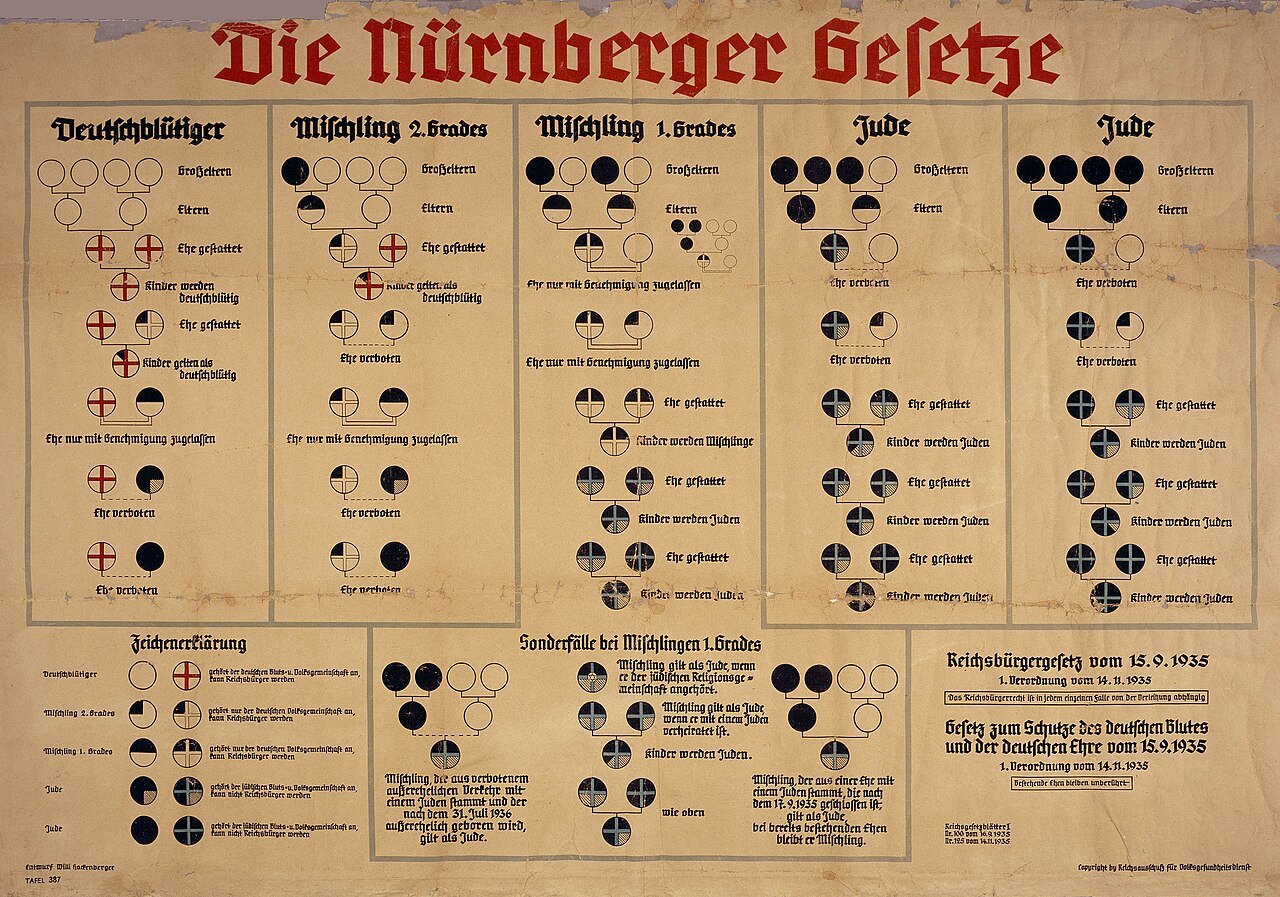
In Germany itself, the Ahnenpass and the Nuremberg Laws classified people as being of the Jewish race if they were descended from three or four grandparents enrolled in Jewish congregations. A person with one or two grandparents enrolled in a Jewish congregation could be classified as Mischling,[132] a crossbreed, of "mixed blood", even if they were not a member of a Jewish congregation at the time the Nuremberg Laws were enacted. The Mischling Test was introduced in order to identify Europeans with Jewish blood, and these were classified as "Jews of the first or second degree". Only people with at least two grandparents of "German blood" could be German Reich citizens. Other Germans were dropped into a new second class group of citizens, the so-called "state subjects" (Staatsangehörige).[133]
If a person with grandparents of the same religious combination was enrolled as a member of a Jewish congregation in 1935, or later enrolled, they switched from the discriminatory class of Mischlinge into that of Geltungsjude, "Jew by legal validity" even if they did not meet the criterion of descent from three or four Jewish grandparents. In the eyes of the Nazi government, one could not become a non-Jew by seceding from one's Jewish congregation, becoming non-practicing, marrying outside the religion, or converting to Christianity. Thus any Mischling could move into the class of Geltungsjude by joining a Jewish congregation, but the Nuremberg Laws provided that the classification of any Geltungsjude would not change even she or he tried to evade harm by withdrawing from their Jewish congregation after 1935, considering such secessions as being of no effect. Similarly, after 1935, any Mischling with two Jewish grandparents (colloquially called a half-Jew) who married anybody classified as a Jew would drop into the Geltungsjude class. Mischlinge with one Jewish grandparent were usually forbidden from marrying anybody with any Jewish grandparents.
In 1935 the Nuremberg Laws forbade new marriages between people who were classified as Jews and people who belonged to other classifications.[d] Earlier contracted marriages between spouses of different classifications (so-called mixed marriages; Mischehe) provided the Jewish-classified spouse with uncertain protection from some discriminations and atrocities.
There were very few Karaites in Europe during the Nazi era; most of them lived in Turkey, Greece, and the Crimea. Karaites were not considered Jewish for the purpose of the Holocaust extermination policy;[134] according to SS Obergruppenführer Gottlob Berger, writing on November 24, 1944, discrimination against the Karaites had been prohibited due to their proximity to the Crimean Tatars, to whom Berger views the Karaites as being related. Nazis still retained hostility towards the Karaites, on grounds of their religion; and there were a number of small scale massacres of Karaites.
In German-occupied France, an ordinance defined a Jew as an individual who belonged to the Jewish religion or who had more than two Jewish grandparents.[135]
The Vichy régime in southern France defined a Jew as an individual with three Jewish grandparents or two grandparents if his/her spouse was Jewish. Richard Weisberg points out that this was a potentially broader classification than the one used in Occupied France, for example, a Mischling could not be classified a Jew under the Nazi dictate, by her/his spouse's classification if the marriage was contracted before the imposition of antisemitic marriage laws there, but would be deemed one under the Vichy act if he/she had married a Jew, regardless when.[135]
Israelite identity loss claims
There are various groups besides Jews which have claimed to be descended from the biblical Israelites. The question nowadays arises in relation to Israel's Law of Return, with various groups seeking to migrate there. Some claims have been accepted, some are under consideration, while others have been rejected by Israel's rabbinate.
Cochin Jews (Indian Jews)
Some sources say that the earliest Jews of Cochin, India, were those who settled in the Malabar Coast during the times of King Solomon of Israel, and after the Kingdom of Israel split into two. There is historical documentation of the Jews being in Cochin after the fall of the Second Temple, from around the first century CE. Later additions were smaller immigration of Sephardic Jews from Europe in the sixteenth century after the expulsion from Spain, and Baghdadi Jews, Arabic-speaking Jews who arrived in the late eighteenth century, at the beginning of the British colonial era.[136] Following the independence of India and the establishment of Israel, most Cochin Jews emigrated to Israel in the mid-1950s. Some have gone on to North America or Britain.
Bene Israel
The Bene Israel in India claim to be descended from Jews who escaped persecution in Galilee in the 2nd century BCE. The Bene Israel resemble the non-Jewish Marathi people in appearance and customs, which indicates some intermarriage between Jews and Indians. The Bene Israel, however, maintained the practices of Jewish dietary laws, male circumcision and observation of the Sabbath as a day of rest. From the late eighteenth century, other Jewish communities instructed them in normative Judaism.
Initially, the Orthodox rabbinate in Israel said that the Bene Israel would have to undergo conversion in order to marry other Jews, as matrilineal descent could not be proven. In 1964 the Israeli Rabbinate declared that the Bene Israel are "full Jews in every respect".
The Bene Israel claim a lineage to the Kohanim, the Israelite priestly class, which claims descent from Aaron, the brother of Moses. In 2002, DNA testing revealed that the Bene Israel shared some genetic markers of the Kohanim. These are not exclusive to the Kohanim, but appear among them at a higher frequency. These are also shared with some non-Jewish Semitic peoples.[137][138]
Many of the Bene Israel emigrated from India to Israel, where around 6,000 Jews of this group reside. About 5,000 remain in India. They maintain 65 synagogues in Israel.[139]
Beta Israel
The Beta Israel or Falasha is a group formerly living in Ethiopia who have a tradition of descent from the lost tribe of Dan. They have a long history of practicing such Jewish traditions as kashrut, Sabbath and Passover, and had Jewish texts. In 1975, their claim of Jewishness was accepted by the Chief Rabbinate of Israel and the Israeli government. The government assisted them in emigrating en masse to Israel during the 1980s and 1990s as Jews under the Law of Return, when Ethiopia was undergoing a civil war. Some who claim to be Beta Israel still live in Ethiopia.
Bnei Menashe
The Bnei Menashe is a group in India claiming to be descendants of the half-tribe of Menashe. Members who have studied Hebrew and who observe the Sabbath and other Jewish laws in 2005 received the support of the Sephardic Chief Rabbi of Israel to arrange formal conversion to Judaism. Some have converted and immigrated to Israel under the Law of Return.
The Kaifeng Jews
The Kaifeng Jews, a Mandarin-speaking group from Henan Province, China, experienced first contact with Europeans in 1605 via the religious scholar Matteo Ricci. Modern researchers believe these Jews were descended from Persian merchants who settled in China during the early Song dynasty. They prospered during the Ming dynasty as Confucian civil servants, soldiers, and merchants, but they quickly assimilated and lost much of their Jewish heritage. By the beginning of the 19th century, the last rabbi with knowledge of Hebrew died, leaving no successor. The community had become extinct religiously by the late Qing dynasty due to anti-foreign persecutions brought on by the Taiping Rebellion and Boxer Rebellion. There are a small number of Chinese people today who consider themselves to be descendants of these Jews.[140]
Despite their isolation from the rest of the Jewish diaspora, the Jews of Kaifeng preserved Jewish traditions and customs for many centuries. In the 17th century, assimilation began to erode these traditions. The rate of intermarriage between Jews and other ethnic groups, such as the Han Chinese, and the Hui and Manchu minorities in China, increased. The destruction of the synagogue in the 1860s led to the community's demise.[141] However, J. L. Liebermann, the first Western Jew to visit Kaifeng in 1867, noted that "they still had a burial ground of their own". S. M. Perlmann, the Shanghai businessman and scholar, wrote in 1912 that "they bury their dead in coffins, but of a different shape than those of the Chinese are made, and do not attire the dead in secular clothes as the Chinese do, but in linen".[142] To date, there is only one scholar, Zhou Xu, who doubts the Kaifeng community's Jewishness and claims them to have been a western construct.[143]
Today, 600–1,000 residents of Kaifeng trace their lineage to this community.[141] After contact with Jewish tourists, the Jews of Kaifeng have reconnected to mainstream Jewry. With the help of Jewish organizations, some members of the community have emigrated to Israel.[141] In 2009, Chinese Jews from Kaifeng arrived in Israel as immigrants.[144][145][146]
The Lemba
The Lemba, group of people from southern Africa, primarily Zimbabwe and South Africa, speak the Bantu languages spoken by their geographic neighbours and resemble them physically, but they have some religious practices and beliefs similar to those in Judaism and Islam, which they claim were transmitted by oral tradition.[citation needed] They have a tradition of ancient Jewish or South Arabian descent through their male line.[147] Genetic Y-DNA analyses in the 2000s have established a partially Middle-Eastern origin for a portion of the male Lemba population.[148][149] More recent research argues that DNA evidence does not support claims for a specifically Jewish genetic heritage.[150][151]
New Mexico's Crypto-Jews
A small Hispano group of Sephardic Jews in northern New Mexico may be one of the oldest groups of practicing Jews in North America, dating back to the early Spanish settlers of Jewish descent who had been forcibly converted to Catholicism as Conversos or New Christians, or both after 1492. Some families of Conversos began to settle in Mexico City in the 1530s and 1540s. Some converted back to Judaism; others maintained some Jewish beliefs and practices in secret. After the Spanish Inquisition came to the New World in 1571, the conversos were threatened with death if it was found they were practicing Judaism.
In 1598, the first expedition was made to New Mexico and included conversos.[152] After that, other conversos fled to the northwestern frontier of the Spanish Empire,[153] today the southwestern United States, to evade the scrutiny and threat of discovery in the more monitored settlements. Outwardly Catholic, these forced converts maintained Jewish practices and customs for generations in secret, hence their name, "Crypto-Jews". They have been the subject of recent academic study.[154] Some of New Mexico's Crypto-Jews have begun to return to normative Judaism in recent years, through study and ritual conversion.[155] Others feel enlarged by learning this part of their history but continue as practicing Catholics.
A genetic study of men in the early 2000s showed that many Hispanos of the North-American Southwest are descended from Anusim (Sephardic Jews who were forcibly converted to Roman Catholicism). Only Catholic Spanish were allowed to go to the New World with the exploration and colonial expeditions. Families first kept their secrets for protection and then out of habit. Michael Hammer, a research professor at the University of Arizona and an expert on Jewish genetics, said that fewer than 1% of non-Semites possessed the male-specific "Cohanim marker" or Cohen Modal Haplotype, which is prevalent among Jews claiming descent from hereditary priests. 30 of 78 Latinos tested in New Mexico (38.5%), were found to have Y-DNA with the Cohanim marker.[153] Wider DNA testing of Hispanic populations has revealed between 10% and 15% of men living in New Mexico, south Texas and northern Mexico have a Y chromosome associated with the Middle East. Their history makes it most likely that they are Jewish rather than Arabic Muslims.
In 2008, a gene mutation that is typically found only in Ashkenazi Jews, and is linked to a virulent form of breast cancer in women, was discovered in a cluster of Hispanic Catholic women in southern Colorado, many of whom trace their family's roots to northern New Mexico. It was conclusively shown to be related to Jewish ancestry, given the history of the people in the area, and many families reported knowledge of a high incidence of cancer. After testing and notification of families, researchers worked with the extended families on genetic counseling and to develop health strategies for monitoring, early detection and treatment, as they were faced with the higher risk associated with the gene.[152]
See also
Notes and references
Notes
- ^ See Ethnic group.
- ^ See Y-chromosomal Aaron
- ^ See Marrano and Anusim
- ^ See Anti-miscegenation laws#Nazi Germany, Mischlinge
References
- ^ "A closer look at Jewish identity in Israel and the U.S." March 16, 2016.
- ^ "Poll: Many Israelis see Jewish identity as being self-defined – Israel News – Jerusalem Post". www.jpost.com. September 17, 2014. Retrieved September 5, 2019.
- ^ Raymond P. Scheindlin (1998). A Short History of the Jewish People: From Legendary Times to Modern Statehood. Oxford University Press. pp. 1–. ISBN 978-0-19-513941-9. Israelite origins and kingdom: "The first act in the long drama of Jewish history is the age of the Israelites"
- ^ Facts On File, Incorporated (2009). Encyclopedia of the Peoples of Africa and the Middle East. Infobase Publishing. pp. 337–. ISBN 978-1-4381-2676-0."The people of the Kingdom of Israel and the ethnic and religious group known as the Jewish people that descended from them have been subjected to a number of forced migrations in their history"
- ^ Harry Ostrer MD (2012). Legacy: A Genetic History of the Jewish People. Oxford University Press. pp. 26–. ISBN 978-0-19-997638-6.
- ^ "In the broader sense of the term, a Jew is any person belonging to the worldwide group that constitutes, through descent or conversion, a continuation of the ancient Jewish people, who were themselves descendants of the Hebrews of the Old Testament." Jew at Encyclopædia Britannica
- ^ "Hebrew, any member of an ancient northern Semitic people that were the ancestors of the Jews." Hebrew (People) at Encyclopædia Britannica
- ^ Eli Lederhendler (2001). Studies in Contemporary Jewry: Volume XVII: Who Owns Judaism? Public Religion and Private Faith in America and Israel. Oxford University Press. pp. 101–. ISBN 978-0-19-534896-5. "Historically, the religious and ethnic dimensions of Jewish identity have been closely interwoven. In fact, so closely bound are they, that the traditional Jewish lexicon hardly distinguishes between the two concepts. Jewish religious practice, by definition, was observed exclusively by the Jewish people, and notions of Jewish peoplehood, nation, and community were suffused with faith in the Jewish God, the practice of Jewish (religious) law and the study of ancient religious texts"
- ^ Tet-Lim N. Yee (2005). Jews, Gentiles and Ethnic Reconciliation: Paul's Jewish identity and Ephesians. Cambridge University Press. pp. 102–. ISBN 978-1-139-44411-8. "This identification in the Jewish attitude between the ethnic group and religious identity is so close that the reception into this religion of members not belonging to its ethnic group has become impossible."
- ^ Ernest Krausz; Gitta Tulea (1997). Jewish Survival: The Identity Problem at the Close of the Twentieth Century; [... International Workshop at Bar-Ilan University on the 18th and 19th of March, 1997]. Transaction Publishers. pp. 90–. ISBN 978-1-4128-2689-1. "A person born Jewish who refutes Judaism may continue to assert a Jewish identity, and if he or she does not convert to another religion, even religious Jews will recognize the person as a Jew"
- ^ "A Portrait of Jewish Americans". Pew Research Center. October 1, 2013.
But the survey also suggests that Jewish identity is changing in America, where one-in-five Jews (22%) now describe themselves as having no religion.
- ^ Schwartz, Daniel R. (2014). Judeans and Jews: Four Faces of Dichotomy in Ancient Jewish History. University of Toronto Press. pp. 3–10. ISBN 978-1442648395. JSTOR 10.3138/j.ctt1287s34.
- ^ * Ethnic minorities in English law. Google Books. Retrieved 2010-12-23.
- Edgar Litt (1961). "Jewish Ethno-Religious Involvement and Political Liberalism". Social Forces. 39 (4): 328–332. doi:10.2307/2573430. JSTOR 2573430.
- "Are Jews a Religious Group or an Ethnic Group?" (PDF). Institute for Curriculum Services. Archived from the original (PDF) on October 21, 2013. Retrieved October 21, 2013.
- Sean Ireton (2003). "The Samaritans – A Jewish Sect in Israel: Strategies for Survival of an Ethno-religious Minority in the Twenty First Century". Anthrobase. Retrieved December 30, 2009.
- Levey, Geoffrey Brahm. "Toward a Theory of Disproportionate American Jewish Liberalism".
{{cite journal}}: Cite journal requires|journal=(help)[permanent dead link] - J. Alan Winter (March 1996). "Symbolic Ethnicity or Religion Among Jews in the United States: A Test of Gansian Hypotheses". Review of Religious Research. 37 (3). Archived from the original on February 24, 2020. Retrieved September 18, 2017.
- ^ Sharot, Stephen, "Judaism and Jewish Ethnicity: Changing Interrelationships and Differentiations in the Diaspora and Israel," in Ernest Krausz, Gitta Tulea, (eds.) Jewish Survival: The Identity Problem at the Close of the Twentieth Century, pp. 87–104
- ^ Will Herberg, David G. Dalin, From Marxism to Judaism: the Collected Essays of Will Herberg, p.240
- ^ McGonigle, Ian V.; Herman, Lauren W. (June 17, 2015). "Genetic citizenship: DNA testing and the Israeli Law of Return". Journal of Law and the Biosciences. 2 (2): 469–478. doi:10.1093/jlb/lsv027. PMC 5034383. PMID 27774208.
- ^ Hammer, Reuven (May 24, 2011). On Proving Jewish Identity (PDF). The Rabbinical Assembly (Thesis).
- ^ "You're still Jewish – even if your mother isn't". The Independent. June 26, 2009. Retrieved September 5, 2019.
- ^ Shaye J.D. Cohen (1999). The Beginnings of Jewishness. U. California Press. pp. 305–306. ISBN 0-585-24643-2.
- ^ a b c "Who Is a Jew?". Judaism101. Retrieved November 8, 2013.
- ^ a b "In-Laws and Shabbat Law". Ohr Somayach. 2009.
- ^ "Who Is A Jew?". Jewish Virtual Library. Retrieved October 24, 2015.
- ^ The Principles of Jewish Law, Ed. Menachem Elon, p. 429m ISBN 0-7065-1415-7.
- ^ Patrilineal Descent, Jewish Virtual Library, . Retrieved September 2, 2008.
- ^ "Reform Movement's Resolution on Patrilineal Descent, The Status of Children of Mixed Marriages" from the final text of the Report of the Committee on Patrilineal Descent adopted on March 15, 1983, Central Conference of American Rabbis
- ^ Fighting for Patrilineal Descent, Jewish Justice Archived May 31, 2009, at the Wayback Machine, . Retrieved September 2, 2008.
- ^ Jewish Living: A Guide to Reform Contemporary Practice by Rabbi Mark Washofsky (URJ Press)
- ^ Jewish Living: A Guide to Reform Contemporary Practice, Rabbi Mark Washofsky (URJ Press)
- ^ "Reform Movement's Resolution on Patrilineal Descent (March 1983)". www.jewishvirtuallibrary.org.
- ^ "The Establishment of Reform Judaism in Israel". American Jewish Committee. Archived from the original on March 4, 2016. Retrieved July 26, 2015.
- ^ a b p.154, Levinson, David (Ed.), Encyclopedia of World Cultures Vol 9 : Africa and the Middle East, G. K. Hall & Co., Boston, 1995
- ^ "Karaite FAQ: Frequently Asked Questions About Karaism". karaite-korner.org. Retrieved July 26, 2015.
- ^ "Patrilineal Descent". Jewish Virtual Library. Retrieved January 6, 2015.
- ^ Epstein, Lawrence J. (July 1, 1994). Conversion to Judaism. Jason Aronson. ISBN 9781461627999. Retrieved January 6, 2015.
- ^ Ben Rafael, Eliezer, Jewish identities: fifty intellectuals answer Ben Gurion, p.210
- ^ Elon, Menachem (1994). Jewish Law : History, Sources, Principles. Vol. 3. Jewish Publication Society. ISBN 978-0-8276-0387-5. as quoted in "Jewish Law Research Guide". University of Miami School of Law. 2011. Archived from the original on July 5, 2008. Retrieved August 16, 2011.
The Shulchan Aruch, completed in 1565, is probably the most important of the legal codes. For hundreds of years, it has been accepted as the final and authoritative codification of the laws found in the Talmud. (3 ELON at 1368–1422.) Even the work's title indicates its authority. Shulchan Aruch translates as "set table", thereby symbolically stating that the Jewish law has finally be set and settled in a clear code. (The authoritative code of Jewish law is the Shulchan Aruch along with glosses on the Shulchan Aruch added by Moshe Isserles (c. 1525–1572), also called Rama or Remu, that present legal opinions omitted by Karo, especially opinions specific to the Ashkenazic (German and Eastern European) Jewish customs. The glosses are called the "table cloth" to the "set table" of the Shulchan Aruch. The two together still form the definitive codification of Jewish law. 3 ELON at 1359–1365.)
- ^ Schechter, Solomon; Louis Ginzberg (1906). "Law, Codification of". Jewish Encyclopedia. Funk & Wagnalls. pp. 645–647. Retrieved August 16, 2011.
Only when authorities like Samuel b. David and Shabbethai b. Meïr, notwithstanding their scholarship and independence, accepted most of the decisions of the Shulḥan 'Aruk as authoritative, did the work become what it now is, the codex par excellence of rabbinical Judaism.
- ^ Klein, Isaac. A Guide to Jewish Religious Practice. The Jewish Theological Seminary, 1979. p. 442-443
- ^ "Conversion to Judaism – Jewish Converting". judaismconversion.org. Retrieved July 26, 2015.
- ^ "Proving Jewish Identity" (PDF). Retrieved September 5, 2019.
- ^ "The Status of Non-Halakhic Conversions" (PDF). Archived from the original (PDF) on December 28, 2005.
- ^ "Should the Kashrut of Conversions be Investigated?" (PDF). Archived from the original (PDF) on June 28, 2006.
- ^ "www.templeisrael-ne.org". Archived from the original on January 12, 2015. Retrieved January 6, 2015.
- ^ "Guidelines for Rabbis Working with Prospective Gerim" Archived July 21, 2011, at the Wayback Machine
- ^ Zemer, Moshe. Evolving Halakha. Jewish Lights Publishing, 1999. pp. 137–138
- ^ Robinson, George. Essential Judaism: A Complete Guide to Beliefs, Customs and Rituals. New York: Simon & Schuster, 2000. ISBN 0-671-03480-4, pgs 229–232.
- ^ "S.C.J. FAQ: Section 2.3. Who We Are: What is Conservative Judaism?". Archived from the original on October 18, 1996. Retrieved January 6, 2015.
- ^ Karaites hold first conversion in 500 years Archived October 11, 2008, at the Wayback Machine. August 2, 2007, JTA Breaking News.
- ^ Although no scientific studies have been completed in regard to the Syrian-Jewish intermarriage rate, anecdotal evidence suggests that the Syrian community's current rate of intermarriage with non-Jews is between 2 and 3%. The National Jewish Population Survey study cited by Gordon and Horowitz Antony Gordon and Richard Horowitz. "Will Your Grandchildren Be Jewish". Retrieved February 19, 2008. gives intermarriage rates for Centrist and Hasidic Jews of 3% for those between the ages of 18–39 and 6% overall, as compared with 32% for Conservative Jews, 46% for Reform Jews and 49% for secular Jews. Gordon and Horowitz suggest that the main reason for the difference is the growing commitment to Jewish Day School education: "The combination of Jewish commitment and having experienced a complete K-12 Orthodox Jewish Day School education results in an intermarriage rate of not greater than 3%." This suggests that Jewish day schools, rather than the edict, are the decisive factor in discouraging intermarriage.
- ^ "Question 18.3.4: Reform's Position On...What is unacceptable practice?". FAQs.org. July 17, 2008. Retrieved July 17, 2008.
- ^ Voll, Fritz. "What about Christian Jews or Jewish Christians?". Jewish-Christian Relations. International Council of Christians and Jews. Retrieved July 17, 2008.
- ^ Federow, Stuart (2003). "Jews believe that "Jews for Jesus," "Messianic Jews," and "Hebrew Christians" are no longer Jews, even if they were once Jews". What Jews Believe.org. Archived from the original on June 28, 2008. Retrieved July 17, 2008.
- ^ a b Lichtenstein, Aharon (March 2004). Leaves of Faith: Selected Essays of Rabbi Aharon Lichtenstein. KTAV Publishing House, Inc. ISBN 0-88125-668-4. Retrieved July 17, 2008.
- ^ Zelizer, Gerald L. (June 14, 1995). "The Return of Second Generation Apostates" (PDF). YD. 268 (12). The Rabbinical Assembly: 146–50. Retrieved March 8, 2013.
- ^ Babylonian Talmud, Yebamoth 16b)
- ^ Pirke De-Rabbi Elieze, chapter 36
- ^ "Reform Judaism – Halachah". Archived from the original on November 4, 2013. Retrieved November 8, 2013.
- ^ Angel, Marc, Choosing to be Jewish: the Orthodox road to conversion, pp.114–117
- ^ The Jewish oral tradition adduces the law of matrilineal descent from Deuteronomy 7:3–4: “you shall not intermarry with them: you shall not give your daughter to his son, and you shall not take his daughter for your son. For he will turn away your son from following Me, and they will worship the gods of others…” By looking very closely and diacritically at the wording of the text, it says "...since he (the Canaanite father) will turn away your son (i.e. the child born to your Jewish daughter) from following me." Here, it is implied that God still reckons the child to be Jewish by calling him your son – even though such unions were forbidden. The text calls him your son, implying that he is still an Israelite because he was born from a Jewish mother. However, the opposite is not true. The Torah does not say, "...for she (the Canaanite mother) will turn away your son." In this case, the child would no longer be considered your son, but rather a gentile. (Yom Tov Asevilli (1985). Chiddushei Ha-Ritva (in Hebrew). Jerusalem: Mossad Harav Kook. pp. 726–727. OCLC 878066707., s.v. Kiddushin 68b; cf. Babylonian Talmud, Yevamot 17a; Numbers Rabba 19:3)
- ^ "Guidelines for Rabbis Working with Prospective gerim". Central Conference of American Rabbis. September 6, 2001. Archived from the original on July 21, 2011.
Prior to completing the process of giur, a rabbi should require that each prospective ger/gioret make commitments within each of the following areas. These commitments should be viewed as a demonstration of a dedication to kabbalat mitzvot within the context of the brit between God and the Jewish people and as a starting point for increased Jewish involvement by the prospective ger/gioret.
- ^ a b "As Rabbinate Stiffens Rules, Orthodox Rites Face Scrutiny". Forward. June 2, 2006. Archived from the original on January 14, 2009. Retrieved May 4, 2008.
- ^ a b Schmemann, Serge (February 10, 1998). "Israel's Chief Rabbis Reject Call By Non-Orthodox on Conversion". The New York Times.
- ^ a b c Gersom Gorenberg (March 2, 2008). "How do you prove you're a Jew?". The New York Times.
- ^ Yaron, Y., Joe Pessah, and Abraham Qanai. An Introduction to Karaite Judaism: History, Theology, Practice, and Culture. N.p.: Qirqisani Center, 2003. Print.
- ^ Numbers 26 :53–55, Numbers 36 :7–8
- ^ Meyer, Michael "Berit Mila within the History of the Reform Movement" in Barth, Lewis (1990) Berit Mila in the Reform Context. New York: Berit Milah Board of reform Judaism
- ^ "The Tenets of Reform Judaism". Jewish Virtual Library. Retrieved January 6, 2015.
- ^ Lessner, Richard (1982). "Efforts to convert Jews draw fire from interdenominational group". The Arizona Republic.
- ^ "Jewish People – Define". Archived from the original on December 30, 2014. Retrieved January 6, 2015.
- ^ Apostate in the Synagogue Archived September 29, 2011, at the Wayback Machine
- ^ "American Reform Responsa : 71. An Apostate Proselyte". Archived from the original on September 29, 2011.
An adult proselyte who has become a Jew voluntarily cannot annul this process in any way
- ^ Jacob, Walter (1987). Contemporary American Reform Responsa : 67. Burial of "Messianic Jews". CCAR Press. ISBN 9780881230031.
- ^ Orly Halpern (December 22, 2006). "Knesset Mulls Ban on Proselytizing". The Jewish Daily Forward.
- ^ Andrew Buckser (Spring 2005). "Chabad In Copenhagen: Fundamentalism And Modernity In Jewish Denmark". Ethnology. 44 (2): 125–145. doi:10.2307/3773993. JSTOR 3773993.
- ^ "492 U.S. 573". Retrieved January 6, 2015.
- ^ Samuel G. Freedman (April 13, 2003). "Men In Black". The New York Times.
- ^ "A Portrait of Jewish Americans". Pew Research Center's Religion & Public Life Project. October 1, 2013. Retrieved January 6, 2015.
- ^ a b c Nicholas de Lange: Atlas of the Jewish world, p. 79. Equinox, 1991.
- ^ a b Gitelman, Zvi: Jewish Identities in Postcommunist Russia and Ukraine, p. 62. Cambridge University Press, 2012.
- ^ a b Denick, Lars (2005). "Jewishness in Postmodernity: The Case of Sweden". Rappaport Center for Assimilation Research and Strengthening Jewish Vitality. p. 25.
- ^ a b c Gitelman, Zvi (ed.): Religion or Ethnicity? Jewish Identities in Evolution. Rutgers University Press, 2009.
- ^ Illman, Karl-Johan & Harviainen, Tapani: Juutalaisten historia. Gaudeamus, 1987.
- ^ Simon Rabinovitch (ed.): Jews and Diaspora Nationalism: Writings on Jewish Peoplehood in Europe and the United States. Brandeis University Press, 2012.
- ^ Harviainen, Tapani & Illman, Karl-Johan (ed.): Juutalainen kulttuuri, p. 33. Keuruu: Otava, 2003.
- ^ Gitelman, Zvi: Jewish Identities in Postcommunist Russia and Ukraine, p. 66. Cambridge University Press, 2012.
- ^ Schwartz, Oscar (June 13, 2019). "What does it mean to be genetically Jewish?". the Guardian. Retrieved August 7, 2021.
- ^ a b Decter, Moshe (January 1963). "The Status of the Jews in the Soviet Union". The Council on Foreign Relations. Retrieved April 21, 2015.
{{cite magazine}}: Cite magazine requires|magazine=(help) - ^ "Ethnic Jewishness". pluralism.org. Retrieved September 5, 2021.
- ^ Vence, Tracy. (July 10, 2014) "DNA Ancestry for All". The Scientist. Retrieved 4 July 2015. The Scientist website
- ^ Maltz, Judy (February 4, 2019). "Israeli Rabbinate Accused of Using DNA Testing to Prove Jewishness". Haaretz.
- ^ "What does it mean to be genetically Jewish?". The Guardian. June 13, 2019.
- ^ "Beta-Gershom.org". Retrieved January 6, 2015.
- ^ Daniel Klein and Freke Vuijst, The Half-Jewish Book: A Celebration, New York: Villard Books, 2000.
- ^ "Beta-Gershom.org". Retrieved January 6, 2015.
- ^ "SHJ Philosophy". Archived from the original on August 13, 2013. Retrieved November 8, 2013.
- ^ Yair Auron (2012). Israeli Identities: Jews and Arabs Facing the Self and the Other. Berghahn Books. p. 25. ISBN 978-0-85745-305-1.
- ^ Amos Oz (March 1998). "Behind the Sound and the Fury" (PDF). Tikkun. Archived from the original (PDF) on February 2, 2014. Retrieved January 28, 2014.
- ^ Uzi Rebhun, Chaim Isaac Waxman, Jews in Israel: contemporary social and cultural patterns, pp.296–297
- ^ "Judaism Test Guidelines" (PDF) (in Hebrew). Israel: Israeli Rabbanut. 2010. Archived from the original (PDF) on August 15, 2013. Retrieved June 24, 2012.
- ^ "(unknown title)" (MSWord doc) (in Hebrew). Rabbinical Court, State of Israel. Retrieved June 24, 2012.
- ^ "(unknown title)" (PDF) (in Hebrew). Israel: Ministry of Religious Affairs, State of Israel. p. 1. Archived from the original (PDF) on May 21, 2013. Retrieved June 24, 2012.
- ^ "מחפשים את האמא היהודיה – בגליון השבוע". ערוץ 7. February 22, 2008. Retrieved January 6, 2015.
- ^ "All non-Jews. Until proven otherwise". YNet (in Hebrew). Israel. May 25, 2010. Retrieved June 24, 2012.
- ^ Hasson, Nir (June 16, 2011). "Said in an interview that his mother is not Jewish and Interior Ministry investigates the status". Haaretz (in Hebrew). Israel. Retrieved June 24, 2012.
- ^ Ettinger, Yair (December 2, 2011). "A New Role for Former Mossad chief: Finding Jewish grandma". Haaretz (in Hebrew). Israel. Retrieved June 24, 2012.
- ^ Getting Married in Israel: Why It So Often Means Hiring a Detective, Daniel Estrin, The Atlantic, February 13, 2013.
- ^ Gorenberg, Gershom (March 2, 2008). "How Do You Prove You're a Jew?". The New York Times. New York. Retrieved June 24, 2012.
- ^ Hammer, Reuven (January 13, 2012). "Removing stumbling blocks to Jewish identity". The Jerusalem Post. Israel. Retrieved June 24, 2012.
- ^ Ahren, Raphael (July 30, 2010). "Sokolow's niece "not Jewish enough" to marry here". Haaretz. Israel. Retrieved June 24, 2012.
- ^ Armangue, Bernat (November 1, 2010). "Israeli Jews at odds with liberal Judaism in U.S." USA Today. Archived from the original on February 6, 2011. Retrieved June 24, 2012.
- ^ Navot, Suzi, Constitutional law of Israel, p.188
- ^ Law of Return, paragraph 4A. This provision does not extend to the spouse of an Israeli Jew (a non-Israeli person who married an Israeli Jew).
- ^ Jonathan Rosenblum, "Our New Mixed Multitude", Jacob Richman Home Page. Retrieved March 16, 2006.
- ^ Yabuda Savir, The Definition of a Jew under Israel's Law of Return, 17 Sw L.J. 123 (1963)
- ^ Joshua Freeman (May 22, 2007). "Laying down the (Oral) law". The Jerusalem Post.
- ^ Rich, Tracey R. "What Is Judaism?". Judaism 101. Retrieved July 17, 2008.
- ^ "The Tribe". The Cohen-Levi Family Heritage. Retrieved July 17, 2008.
- ^ Weiner, Rebecca. "Who is a Jew?". Jewish Virtual Library. Retrieved July 17, 2008.
- ^ "Amar: Bnei Menashe are Descendants of Ancient Israelites". Haaretz. January 4, 2005. Archived from the original on January 5, 2009. Retrieved July 17, 2008.
- ^ Freund, Michael (October 3, 2006). "Right On: A Miracle of Biblical Proportions". The Jerusalem Post. Archived from the original on June 15, 2011. Retrieved July 17, 2008.
- ^ a b Tigay, Chanan (May 26, 2006). "Israel's Chief Rabbinate Rejects some Diaspora Orthodox Conversions". New Jersey Jewish Standard. Archived from the original on October 15, 2007. Retrieved July 17, 2008.
- ^ Meyers, Nechemia (July 12, 1997). "Are Israel's Marriage Laws 'Archaic and Irrelevant'?". Jewish News Weekly. Retrieved July 17, 2008.
- ^ Nathan Jeffay (March 16, 2011). "Israeli Government Rejects Orthodox Converts' Bids To Immigrate as Jews". The Jewish Daily Forward.
- ^ "Lewis v Media 24 Ltd (C88/2007) [2010] ZALC 218; (2010) 31 ILJ 2416 (LC) (4 May 2010)". Retrieved January 6, 2015.
- ^ Salibi, Kamal S. (1988). Secrets of the Bible People. New York: Interlink Books. p. 75 sqq. ISBN 0-940793-16-4
- ^ "What does it mean to be Jewish", Jewish Historical Museum. Retrieved March 16, 2006.
- ^ Monica Săvulescu Voudouris and Camil Fuchs, Jewish identity after the Second World War, Editura Hasefer, Bucharest, 1999, p. 16. ISBN 973-9235-73-5
- ^ Monica Săvulescu Voudouris and Camil Fuchs (1999), p. 56.
- ^ Alice Goldstein, "Jews on the move: implications for Jewish identity'", in eds. Ivan Kalmar & Derek Penslar, Orientalism and The Jews, pp. 4. SUNY Press, 1995 (ISBN 0-7914-2747-1)
- ^ Nazi Germany's Nuremberg Laws sources:
- Lyall, Sarah (November 8, 2009). "Who Is a Jew? Court Ruling in Britain Raises Question". The New York Times.
- "Jewish school admissions unlawful". BBC News. June 25, 2009.
- R(E) v Governing Body of JFS [2009] EWCA Civ 626 (25 June 2009)
- ^ A Mischling was called Mischling of first degree, or colloquially half-Jew, if they had two grandparents enrolled in a Jewish congregation, and Mischling of second degree, or colloquially quarter-Jew, respectively, if they had one grandparent enrolled in a Jewish congregation.
- ^ Nazi guide to the Nuremberg laws.
- ^ Ruth Tsoffar (2006). The Stains of Culture: An Ethno-Reading of Karaite Jewish Women. Detroit: Wayne State University Press. p. 41.
- ^ a b Daniel C. Kramer, "Review of Vichy Law and the Holocaust in France by Rishard H. Weisberg" Archived June 2, 2009, at the Wayback Machine, Law & Politics Book Review, Vol. 7 No. 2 (February 1997) pp. 41–45 . Retrieved October 18, 2008.
- ^ Katz 2000; Koder 1973; Thomas Puthiakunnel 1973; David de Beth Hillel, 1832; Lord, James Henry 1977.
- ^ Ahmed, Rashmee Z (July 20, 2002). "India's children of Israel find their roots". The Times of India. India.
- ^ Parfitt, T.; Egorova, Y. (June 2005). "Genetics, History, and Identity: The Case of the Bene Israel and the Lemba". Culture, Medicine and Psychiatry. 29 (2): 193–224. doi:10.1007/s11013-005-7425-4. PMID 16249950. S2CID 19691358.
- ^ "Indian Jewish Community in Israel". indjews.com. Retrieved July 26, 2015.
- ^ Xu, Xin. The Jews of Kaifeng, China: History, Culture, and Religion. Jersey City, NJ: KTAV Pub. House, 2003.
- ^ a b c Pfeffer, Anshel (June 27, 2008). "Taking the Silk Route back home". Haaretz. Archived from the original on January 24, 2010. Retrieved December 28, 2009.
- ^ Dawid, Heinz (1998). Goldstein, Jonathan (ed.). "From Berlin To Tianjin". The Jews of China. 1: 117. ISBN 978-0-7656-0103-2.
- ^ Xun Zhou, "The Kaifeng Jew Hoax: Constructing the 'Chinese Jews'", in eds. Ivan Kalmar & Derek Penslar, Orientalism and The Jews, pp. 68–80. Brandeis University Press (USA), 2004 (ISBN 1-58465-411-2)
- ^ "Descendants of Chinese Jews arrive in Israel". Jewish Telegraphic Agency. October 26, 2009.
- ^ "Chinese Jews from Kaifeng arrive in Israel 2009". YouTube. Archived from the original on December 22, 2021.
A short documentary produced by Shavei Israel on the aliyah of Jews from Kaifeng China to Israel.
- ^ Rebecca Bitton (August 24, 2010). "Kaifeng Jews study in Israeli yeshiva".
- ^ van Warmelo, N.J. (1966). "Zur Sprache und Herkunft der Lemba". Hamburger Beiträge zur Afrika-Kunde. 5. Deutsches Institut für Afrika-Forschung: 273, 278, 281–282.
- ^ Spurdle, AB; Jenkins, T (November 1996), "The origins of the Lemba "Black Jews" of southern Africa: evidence from p12F2 and other Y-chromosome markers.", Am. J. Hum. Genet., 59 (5): 1126–33, PMC 1914832, PMID 8900243
- ^ Kleiman, Yaakov (2004). DNA and Tradition – Hc: The Genetic Link to the Ancient Hebrews. Devora Publishing. p. 81. ISBN 1-930143-89-3.
- ^ Tofanelli, Sergio; Taglioli, Luca; Bertoncini, Stefania; Francalacci, Paolo; Klyosov, Anatole; Pagani, Luca (2014). "Mitochondrial and y chromosome haplotype motifs as diagnostic markers of Jewish ancestry: A reconsideration". Frontiers in Genetics. 5: 384. doi:10.3389/fgene.2014.00384. PMC 4229899. PMID 25431579.
- ^ Himla Soodyall; Jennifer G. R Kromberg (October 29, 2015). "Human Genetics and Genomics and Sociocultural Beliefs and Practices in South Africa". In Kumar, Dhavendra; Chadwick, Ruth (eds.). Genomics and Society: Ethical, Legal, Cultural and Socioeconomic Implications. Academic Press/Elsevier. p. 316. ISBN 978-0-12-420195-8.
- ^ a b Jeff Wheelwright (October 2008). "The 'Secret Jews' of San Luis Valley". Smithsonian Magazine.
- ^ a b Kelly, David (December 5, 2004). "DNA Clears the Fog Over Latino Links to Judaism in New Mexico". Los Angeles Times.
- ^ Hordes, Stanley M. (2005). To The End of The Earth: A History of the Crypto-Jews of New Mexico, Columbia University Press. pp. 376. ISBN 978-0-231-12937-4.
- ^ Romero, Simon (October 29, 2005). "Hispanics Uncovering Roots as Inquisition's 'Hidden' Jews". The New York Times.
Bibliography
External links
- Humanistic Judaism view on Who is a Jew
- Reform view of who is a Jew by the Union for Reform Judaism
- Who is a Jew by Jewish Virtual Library
- Orthodox and Non-Orthodox Judaism: How to Square the Circle by JCPA
- The "Who Is a Jew?" Controversy by the U.S. Library of Congress