 Hispanopedia Wiki
La Casa de Loredan ( en italiano: [lore'dan] , en veneciano: [loɾeˈdaŋ] ) es una familia noble veneciana de supuesto origen romano antiguo , que ha desempeñado un papel importante en la conformación de la historia del mundo mediterráneo . Esta familia, una dinastía política , ha producido a lo largo de los siglos una serie de personalidades famosas: dux , estadistas , magnates , financieros , diplomáticos , procuradores , comandantes militares , capitanes navales , dignatarios eclesiásticos y escritores.
En los siglos posteriores a la caída del Imperio Romano de Occidente , los Loredanos fueron señores en Emilia-Romaña , desde donde llegaron a Venecia a principios del siglo XI. Al establecerse allí, la familia creció en poder en la Alta Edad Media , amasando una gran riqueza en el lucrativo comercio de la seda y las especias , y en los siglos siguientes se volvería poderosa e influyente en regiones de todo el Mediterráneo, desempeñando un papel importante en la configuración de su historia a lo largo de la Baja Edad Media , el Renacimiento y el período moderno temprano . La familia estaba presente en prácticamente todos los territorios nacionales y de ultramar de la República de Venecia , y en varios puntos de la historia, sus miembros han tenido títulos en lo que ahora son países modernos de Italia , Austria , Eslovenia , Croacia , Montenegro , Albania , Francia , Grecia y Chipre , y han realizado operaciones comerciales hasta Egipto , Persia , India y China . Junto con otras familias de la nobleza urbana de Venecia , han desempeñado un papel importante en el fomento del mercantilismo y el capitalismo temprano .
Aunque los Loredan eran defensores de la orientación tradicional y marítima de Venecia y veían con desconfianza su expansión en el continente italiano, han desempeñado un papel clave en el desarrollo territorial y, en última instancia, en la historia de la República de Venecia , ayudando a expandir sus dominios continentales y el Estado del Mar. La familia fue significativa en la Guerra de la Liga de Cambrai , con el dogo Leonardo Loredan liderando a Venecia a una victoria contra los Estados Pontificios , lo que resultó en que el Papa tuviera que pagar a la familia Loredan un acuerdo financiero de aproximadamente 500.000 ducados , una enorme cantidad de dinero, convirtiéndolos en una de las familias más ricas del mundo en ese momento. Además, muchos de sus miembros se distinguieron como almirantes y generales en la defensa de Europa de las conquistas otomanas en las guerras otomano-venecianas . Sus diversos triunfos navales han sido honrados con el crucero auxiliar MV Loredan de la Marina Real Italiana .
La familia también ha jugado un papel importante en la creación de la ópera moderna con la Accademia degli Incogniti , también llamada Academia Loredana, y ha encargado muchas obras de arte a artistas de la Escuela Veneciana , incluidos Giovanni y Gentile Bellini , Giorgione , Vittore Carpaccio , Vincenzo Catena , Sebastiano del Piombo , Tiziano , Paris Bordone , Jacopo y Domenico Tintoretto , Paolo Veronese , Palma il Giovane , Canaletto , Pietro Longhi y Francesco Guardi , entre otros. En el apogeo del Renacimiento , las residencias de la familia estaban siendo diseñadas y construidas por arquitectos de renombre , en particular Mauro Codussi , Jacopo Sansovino y Andrea Palladio .
La riqueza de la familia Loredan en Venecia era legendaria, y probablemente alcanzó su apogeo en el siglo XVIII, cuando poseían numerosos palacios, así como cientos de propiedades y vastas propiedades de tierra en los territorios de la República, principalmente en Véneto , Friuli , Istria y Dalmacia . Además del comercio de seda y especias, también participaron en el comercio medieval de esclavos , y fueron, más de una vez, acusados de usura y sodomía , a menudo por rivales políticos de larga data como las familias Faliero y Foscari . En casos de corrupción, asalto, asesinato y otros escándalos, cuando estaban involucrados miembros de su propia familia, los Loredan generalmente siguieron una política de indulgencia y tolerancia absoluta, y apuntaron a resolver las acusaciones relacionadas mediante amenazas o sobornos.
Bajo el gobierno de los Loredan , en 1516 se creó en Venecia el primer gueto judío del mundo, aunque algunos miembros de la familia defendieron en el Senado la reducción de la suma que los judíos debían pagar por su "conducta". A partir del siglo XVII, los Loredan se hicieron famosos por apoyar y acoger a los judíos que llegaban a Venecia, varios de los cuales adoptaron el nombre de "Loredan" en reconocimiento a la generosidad de la familia.
En la actualidad, el escudo de armas de Loredan, que presenta seis flores de laurel (o rosa ) sobre un escudo de color amarillo y azul, se exhibe en numerosos edificios y palacios en los territorios que antes estaban en manos de la República de Venecia; desde el Véneto y Friuli , Istria y Dalmacia , y en posesiones más distantes como las Islas Jónicas y Creta . En Venecia , incluso está tallado en el Puente de Rialto y en la fachada de la Basílica de San Marcos .
Origen y etimología

Algunos historiadores remontan el origen de la familia a la familia Mainardi, a su vez descendiente de Cayo Mucio Escévola . Entonces adquirieron el apellido de Laureati debido a la gloria histórica de sus antepasados. Además, según la leyenda, fundaron la ciudad de Loreo en el año 816 d. C. y se trasladaron a la Laguna de Venecia en el año 1015 d. C. Las primeras referencias escritas de la familia, sin embargo, datan del siglo XI. [1]
Según escribió el filósofo italiano del siglo XVI Jacopo Zabarella en su Trasea Peto , los loredanos ya eran señores de Bertinoro en Emilia-Romaña , y eran de ilustre linaje antiguo derivado de Roma , donde ganaron gran fama por las muchas victorias que consiguieron en las batallas. [2] Fueron llamados así por los romanos Laurae , luego Laureati por su excelencia y más tarde Lauretani por corrupción, por lo que fueron expulsados de Bertinoro. Luego fueron a Ferrara , y finalmente a Venecia , donde construyeron el Castillo de Loredo. Por su nobleza, así como por la riqueza que poseían, fueron adscritos por la República a su Gran Consejo en 1080, con la persona de Marco Loredan . Zabarella también señala que la familia poseía el señorío de Antipario (hoy Antiparos , Grecia ) en el mar Egeo , y más recientemente el condado de Ormelle en la provincia de Treviso . [3]
El nombre de la familia también puede tener su origen en la palabra laurel , un símbolo de triunfo y nobleza. El escudo de armas de la familia Loredan presenta seis flores de laurel. [3]
El nombre también puede significar "que viene de Loreo", como para describir a una persona que es del pueblo homónimo. [b] Los ciudadanos de Loreo hoy son llamados "Loredani" .
Además de la rama veneciana, también había una rama siciliana ( Loredanos de Sicilia ). [4]
Ramas de cadetes
A lo largo de la historia, la familia se organizó y dividió en muchas ramas , la mayoría de las cuales tradicionalmente llevaban el nombre de topónimos venecianos, generalmente parroquias , como era común en la nobleza veneciana . Algunas de las ramas son: Santo Stefano (extinta en 1767), San Pantaleone della Frescada , San Cancian , San Vio , Santa Maria ( Formosa y Nova ), San Luca , San Marcilian , Sant'Aponal , etc. [5] Pietro Loredan , miembro de la rama San Cancian , es también el progenitor de las ramas de Santa Maria Formosa y Nova por sus hijos Giacomo y Polo.
Santo Stefano
La rama familiar de Santo Stefano (también llamada San Vitale ) se estableció en el Palazzo Loredan en Campo S. Stefano . [6] Se considera que el progenitor de esta rama fue Gerolamo Loredan di S. Vitale, padre del dogo Leonardo Loredan . Además de Leonardo, la rama también dio al dogo Francesco Loredan , así como a la dogaresa Caterina Loredan y al embajador Francesco Loredan . Esta rama también fue significativa ya que sus miembros eran propietarios feudales de las ciudades de Barban y Rakalj en Istria , que adquirieron en una subasta en 1535 por 14.700 ducados. La línea principal (agnaticia) de la rama de Santo Stefano terminó con Andrea di Girolamo Loredan, quien murió joven en 1750, aunque la rama se extinguió en 1767 con la muerte de Giovanni Loredan, hermano del dogo Francesco. [7]
San Pantaleón de la Frescada
La rama familiar de San Pantaleone della Frescada se estableció alrededor de la iglesia de San Pantaleone Martire en el barrio de Dorsoduro de Venecia, cerca del canal Rio della Frescada. Esta rama fue la que dio al dux Pietro Loredan . [8]
San Cancian
La rama familiar de San Cancian se estableció en el Palazzo Loredan a San Cancian en el distrito de Cannaregio de Venecia. Se sabe que esta rama produjo una ilustre dinastía de almirantes y políticos, entre ellos Pietro Loredan (1372-1438), Alvise Loredan (1393-1466), Giacomo Loredan (1396-1471), Giorgio Loredan (fallecido en 1475), Antonio Loredan (1446-1514), así como el duque de Candia Giovanni Loredan (fallecido en 1420). [9]
Santa María
La rama familiar de Santa Maria toma su nombre de las parroquias de Santa Maria Formosa y Santa Maria dei Miracoli , alrededor de las cuales se estableció históricamente. Se considera que su progenitor es el almirante y procurador Pietro Loredan , por sus hijos Giacomo y Polo. Uno de sus miembros más notables es Antonio Loredan , gobernador de la Dalmacia veneciana , Albania y Morea , conocido por la exitosa defensa de Scutari en 1474 de los otomanos . [10] También sirvió como capitán general del mar en la marina veneciana , al igual que su padre y su abuelo. [11] Giovanni Loredan, señor de Antiparos , es significativo por construir el castillo de Antiparos en 1440 y traer habitantes a la isla a sus expensas. [12] Taddea Caterina Loredan, duquesa del Archipiélago , fue la esposa de Francesco III Crispo , conocido como el «Duque Loco», quien la asesinó en 1510. [13] Giovanni Francesco Loredan fue un escritor y político que jugó un papel importante en la creación de la ópera moderna con su Accademia degli Incogniti . [14] Marco Loredan fue un senador y político, además de conde de Brescia , Feltre , Rovigo , Salò y Famagusta . [15]
San Vio
La rama familiar de San Vio (con el Palacio Loredan Cini ) se estableció históricamente en Campo San Vio, en el distrito de Dorsoduro de Venecia. La rama sigue existiendo hoy en día.
Historia
Siglo XIII: ElSerrata, seda, especias y esclavitud

La familia Loredan ha estado ocupando asientos hereditarios en el Gran Consejo desde la Serrata del Maggior Consiglio de 1297, por la cual la membresía en el Gran Consejo de Venecia se convirtió en un título hereditario, y se limitó a las familias inscritas en el Libro de Oro de la nobleza veneciana . [16] Esto resultó en la exclusión de los aristócratas menores y plebeyos de participar en el Gobierno de la República. [17] [d]
Al igual que muchos patricios venecianos , los loredanos participaron en el lucrativo comercio de la seda y las especias , aumentando así su riqueza e influencia, [18] mientras Venecia y otras repúblicas marítimas monopolizaban el comercio europeo con Oriente Medio . La familia también participó en el comercio de esclavos medieval , [18] ya que Venecia había establecido operaciones de comercio de esclavos siglos antes. [g]
En esta época, documentos de la década de 1290 muestran que dos loredanos, Zanetto y Zorzi, estaban siendo demandados por comerciantes cristianos de Amalfi , presumiblemente por participar en actividades de piratería , ya que se habían apoderado de un barco en la costa de Malta . [19]
Siglo XIV: Conspiraciones y expansión del comercio
Algunos miembros de la familia participaron en la sangrienta conspiración de Tiepoline de 1310, en la que participaron los Querini, Badoer y otras familias de la antigua aristocracia, en un intento de derrocar al estado, principalmente al dux y al Gran Consejo . La evidencia indica que los Loredan inicialmente apoyaron la conspiración, habiéndose casado recientemente con un miembro de la familia Tiepolo. [20] El complot fracasó debido a la traición, la mala planificación, el apoyo popular insuficiente y el clima tormentoso. Los rebeldes fueron detenidos cerca de la Piazza San Marco por fuerzas fieles al dux Pietro Gradenigo y derrotados. La noche antes del levantamiento, los detalles del complot fueron revelados al dux y a sus asesores; los Loredan que estaban involucrados en la conspiración pasaron astutamente al otro lado, y para mostrar su lealtad al dux, acosaron a los conspiradores involucrados hasta que fueron encontrados. [19]
Los habitantes de Loredan se caracterizan por muchas cosas e historias interesantes, una de las cuales tuvo lugar a principios del siglo XIV: en 1316, Zanotto Loredan estaba gravemente enfermo, tanto que se creía que estaba muerto, por lo que el pueblo lo llevó a la iglesia de San Matteo en Murano para enterrarlo. Después del rito fúnebre, quisieron depositar el cuerpo en la tumba, cuando alguien notó que el color de su rostro había cambiado. Lo llevaron al hospital del convento, lo calentaron y se recuperó. Más tarde continuó viviendo normalmente, se casó y tuvo hijos. [21] [22]
En cuanto a la influencia ejercida por los viajes de Marco Polo , han salido a la luz nuevos documentos procedentes de investigaciones de archivo. De ellos se desprende que, a partir de la década de 1320, los comerciantes venecianos acudieron en masa a Persia (donde a partir de 1324 Venecia tenía su propio cónsul en Tabriz ), India y China , donde formaron compañías comerciales. [23] El jefe de una de estas compañías era Giovanni Loredan, cuya empresa junto con otros cinco nobles es un ejemplo representativo de una commenda , conocida en Venecia como colleganza, una forma temprana de sociedad limitada , que implicaba un acuerdo entre un socio inversor y un socio viajero para llevar a cabo una empresa comercial, normalmente en el extranjero. Su viaje comenzó en 1338 cuando navegaron en las galeras de Rumanía hasta Tana para embarcarse en un viaje a Delhi . Tras los viajes de los Polo , varios venecianos viajaron a través de Asia Central hasta China. Sin embargo, nunca antes se había hecho un viaje al este desde Tana y luego al sur bordeando las montañas de Pamir para cruzar las montañas del Hindu Kush hacia la India; se trataba de intentar algo nuevo. Antes de esto, Giovanni Loredan acababa de regresar de un viaje a China, y su esposa e hijos trataron de disuadirlo de emprender el nuevo viaje. Sin embargo, Giovanni creía que se podía hacer una fortuna visitando a cierto príncipe indio, que tenía fama de cruel pero también de generoso con los comerciantes extranjeros. [24] Por lo tanto, Giovanni, junto con otros cinco nobles que se habían unido a la empresa, incluido su hermano Paolo, juntaron fondos para llevar consigo regalos, maravillas mecánicas como un reloj y una fuente, que esperaban que agradaran al príncipe indio. Cada uno de ellos también se llevó algunas mercancías por su cuenta, y Giovanni Loredan se llevó un poco de tela florentina, un trozo del cual vendió en el camino para pagar los gastos. Para reunir su parte de los fondos necesarios, Giovanni también aceptó dinero en la colleganza de su suegro, Alberto Calli, quien invirtió 6 ducados . Habiendo llegado a Delhi, Giovanni y los otros nobles lograron complacer al príncipe indio, ya que les dio un rico regalo, que luego invirtieron en una compra conjunta de perlas . Sin embargo, el viaje terminó trágicamente, ya que Giovanni y otros dos nobles murieron en el transcurso del viaje. [25]El hermano de Giovanni, Paolo, asumió las obligaciones de su hermano fallecido y continuó el viaje. De regreso a casa, las perlas se dividieron entre los socios supervivientes, pero Giovanni no estaba allí para aprovechar al máximo el resultado que había imaginado antes del viaje. Después de que los nobles regresaran a Venecia, el suegro de Giovanni, uno de los primeros inversores en la colleganza, demandó a los tutores de los hijos pequeños de Giovanni para recuperar no solo el valor de su inversión, sino también las ganancias habituales de un viaje de ese tipo. [26] A pesar de ganar el caso, casi con toda seguridad se sintió decepcionado cuando ni siquiera duplicó su inversión inicial en lo que se había proyectado como una empresa altamente lucrativa. El viaje de los hermanos Loredan es una de las anécdotas más populares utilizadas por los historiadores para describir el florecimiento de una economía global durante esa época. [27]
Uno de los usureros más notorios de la época fue Leonardo Loredan (fallecido en 1349), que pedía préstamos a tipos de interés que oscilaban entre el 65% y el 100%. [20] Sus representantes no dudaron en echar a las familias de sus hogares, se atiborró de préstamos de guerra y fue procesado por tribunales eclesiásticos para responder por cargos de usura agravada , pero siempre se las arregló para refutar los cargos mediante regalos, sobornos y palancas ocultas. [19] Más tarde, gran parte de su riqueza se destinó a la construcción de dos palacios de Loredan en la ciudad. [19]
_-_Tomb_of_Paolo_Loredan.jpg/1280px-Chapel_of_the_Crucifix_Santi_Giovanni_e_Paolo_(Venice)_-_Tomb_of_Paolo_Loredan.jpg)
Después del infame y fallido golpe de Estado de 1355 de Faliero , que involucró al dogo Marino Faliero y sus socios, incluido Filippo Calendario , que intentaron derrocar al gobierno republicano e instaurar una dictadura, Andrea y Daniele Loredan lograron producir un testimonio contra Faliero, sobre sus complots secretos contra la clase dominante, después de lo cual manipularon al Consejo de los Diez y luego encabezaron el llamado a su brutal tortura. [20] En la noche del 17 de abril de 1355, en el espacio de unas pocas horas, interrogaron a Faliero, lo incriminaron, lo torturaron y lo decapitaron. Además, diez de sus cómplices fueron ahorcados y exhibidos desde el balcón del Palacio Ducal . [19]
Marco Loredan, que vivió en el siglo XIV, fue elegido procurador de San Marcos , uno de los cargos políticos más altos de la República de Venecia, y fue uno de los electores del dux Andrea Dandolo . Sus contemporáneos son Paolo Loredan (fallecido en 1372), un general militar que se distinguió en los más altos cargos militares de tierra y mar, y Alvise Loredan, que también llegó a ser procurador de San Marcos. [7]
Giovanni Loredan (lat. Ioannes Lauredanus ) sirvió como obispo de Capo d'Istria (hoy Koper , Eslovenia ) desde 1390 hasta su muerte el 11 de abril de 1411. [28] Desde 1354 fue presbítero de la Basílica de San Marcos , Venecia . Fue nombrado obispo de Capo d'Istria el 21 de noviembre de 1390. [28] Según varias cronologías eclesiásticas, antes de eso también fue obispo en Venecia, en lo que entonces era la diócesis de Castello . Se registra que en 1391 dedicó la Iglesia de San Jorge en Piran . Fue enterrado en la Catedral de la Asunción de la Santísima Virgen María en Koper. [28] En algunas fuentes históricas se le menciona con el nombre de Giacomo o el esloveno Jakob . [29]
Siglo XV: ascenso político y militar
Uno de los miembros importantes de la familia en el siglo XV fue Pietro Loredan (1372-1438), que fue tres veces capitán general del mar ; [30] en 1416 conquistó varias fortalezas dálmatas y más tarde derrotó a los otomanos en Galípoli , capturando quince galeras; en 1431 derrotó a los genoveses y milaneses en Rapallo, logrando la captura de ocho galeras y al general Francesco Spinola. Pietro murió en 1439. [31] Fue enterrado en el Monasterio de Santa Elena , y la inscripción funeraria indica explícitamente el envenenamiento como la causa de su muerte. [32] Muchos historiadores identifican al principal como su rival de mucho tiempo, el dogo Francesco Foscari , cuya enemistad con el fallecido Pietro era bien conocida. [33] En el imaginario popular, los nombres de los Foscari y de los Loredan permanecen ligados a una especie de disputa generacional, en parte documentada, en parte debida a ciertas forzaduras historiográficas; y sin embargo es innegable cómo, en los momentos cruciales que marcaron la vida de Francesco y de su hijo Jacopo Foscari, siempre estuvo presente un Loredan. [34]
Se ha conservado la carta de Loredan dirigida al dux de Venecia después de la batalla de Galípoli :
"Yo, como comandante, ataqué vigorosamente la primera galera, que opuso una sólida defensa, estando excelentemente tripulada por valientes turcos que luchaban como dragones. Con la ayuda de Dios la vencí y corté en pedazos a la mayoría de los susodichos turcos. Sin embargo, me costó mucho salvarla, porque otras de sus galeras se dirigieron hacia mi lado de babor, arañándome con sus flechas. De hecho, las sentí; porque una me golpeó en la mejilla izquierda, justo debajo del ojo, atravesándome la mejilla y la nariz; y otra me atravesó la mano izquierda. Y estas fueron solo las heridas graves; recibí muchas otras en el cuerpo y también en mi mano derecha, aunque estas fueron de relativamente poca importancia. No me retiré, ni me habría retirado mientras me quedara vida; pero, todavía enderezándome vigorosamente, hice retroceder a los atacantes, tomé la primera galera e izé mi bandera en ella... Luego, girando de repente, embestí una galera, cortando en pedazos a muchos de sus tripulantes, subí a bordo a algunos de mis propios hombres y volví a izar mi bandera... Su flota luchó Los turcos lucharon con gran éxito, pues estaban tripulados por la flor y nata de los marinos turcos, pero por la gracia de Dios y la intercesión de San Marcos, nuestro evangelista, finalmente los pusimos en fuga; muchos de sus hombres, para su vergüenza, se arrojaron al mar... La batalla duró desde la madrugada hasta pasadas las dos de la madrugada; tomamos seis de sus galeras, con sus tripulaciones, y nueve galeotas. Y los turcos que estaban a bordo fueron pasados a espada, incluido el almirante y todos sus sobrinos y muchos otros grandes capitanes... Terminada la batalla, navegamos bajo los muros de Galípoli, bombardeándolos con misiles y llamando a los que estaban dentro a salir y luchar; pero no quisieron. "Nos retiramos, pues, para que los hombres pudieran refrescarse y curarse las heridas... Y a bordo de los barcos capturados encontramos genoveses, catalanes, sicilianos, provenzales y cretenses, de los cuales yo mismo ordené que fueran descuartizados y ahorcados los que no habían perecido en la batalla... junto con todos los pilotos y navegantes, de los que los turcos ya no disponen. Entre ellos estaba Giorgio Calergi, un rebelde contra Vuestra Gracia, a quien, a pesar de sus muchas heridas, ordené que fuera alojado en la popa de mi propia galera, como advertencia para cualquier cristiano lo suficientemente cobarde como para ponerse al servicio de los infieles de ahora en adelante. Ahora podemos decir que el poder de los turcos en esta región ha sido completamente destruido, y seguirá así durante mucho tiempo. Tengo mil cien prisioneros..."
Ténedos, 2 de junio de 1416
Extracto de: Norwich, John Julius . Una historia de Venecia
El hijo de Pietro, Giacomo Loredan, fue un general que sirvió como Capitán del Golfo y tres veces como Capitán General del Mar en la Armada veneciana . [35] Derrotó a los otomanos en 1464. [9]
También fue importante en esta época Alvise Loredan (1393-1466), que se convirtió en capitán de galeras a una edad temprana y sirvió con distinción como comandante militar, con un largo historial de batallas contra los otomanos, desde las expediciones navales para ayudar a Tesalónica , hasta la Cruzada de Varna y las etapas iniciales de la guerra otomano-veneciana , así como las Guerras en Lombardía contra el Ducado de Milán . [36] Los loredanos eran defensores de la orientación marítima tradicional de Venecia, y veían con desconfianza su expansión en el continente italiano (la Terraferma ), que la había llevado a un conflicto con Milán. Alvise Loredan compartía esta opinión, como se puede ver en una propuesta que presentó ante el Gran Consejo en febrero de 1442, ordenando a los gobernadores de Bérgamo demoler sus fortificaciones como señal de buena voluntad y confianza hacia Visconti , tras la conclusión de la paz con Milán en el Tratado de Cremona . [11] También ocupó varios puestos de alto nivel en el gobierno, como gobernador provincial, Savio del Consiglio y Procuratore de Supra de la Basílica de San Marcos , y fue conde de Bérgamo y Belluno . Murió en Venecia el 6 de marzo de 1466 y fue enterrado en la iglesia de Santa Maria dei Servi. [36]
Giorgio Loredan (f. 1475) fue un almirante, general militar y político, conocido por investigar crímenes políticos y escándalos como jefe del Consejo de los Diez . [37] También fue conde de Zara , Chioggia y Padua . [37]
Antonio Loredan (1420-1482) fue capitán de Scutari, en poder de Venecia , y gobernador de Split ( Dalmacia veneciana ), Albania veneciana y Morea . [38] Es famoso por la exitosa defensa de Scutari de las fuerzas otomanas del sultán Mehmed II lideradas por Hadım Suleiman Pasha . [10] Según algunas fuentes, cuando la guarnición de Scutari se quejó por la falta de comida y agua, Loredan les dijo: "Si tenéis hambre, aquí está mi carne; si tenéis sed, os doy mi sangre". [39] También sirvió como Capitán General del Mar y es notable por encargar la Leyenda de Santa Úrsula (1497/98), una serie de grandes pinturas murales de Vittore Carpaccio creadas originalmente para la Scuola di Sant'Orsola, que estaba bajo el patrocinio de la familia Loredan. [40]
Giovanni Loredan, señor de Antiparos, construyó el castillo de Antiparos en 1440 y trajo habitantes a la isla a sus expensas. [41] Se casó con Maria Sommaripa, de la familia gobernante de Paros , y tuvieron una hija, Lucrezia Loredan, dama de Ios y Therasia . [42]
Andrea Loredan (1455-1499) fue un almirante y duque de Corfú , más conocido por sus exitosas hazañas contra los piratas que asolaban el Adriático y el Mediterráneo . [43] Luchó en el mar contra almirantes famosos como Kemāl Reis , robándole múltiples barcos y destruyendo muchos de ellos mediante el fuego, y Pedro Navarro , a quien logró herir después de seis horas de feroz batalla en Roccella Ionica cerca de Crotone en 1497. Andrea murió en un barco en llamas mientras luchaba contra los otomanos en la batalla de Zonchio en agosto de 1499. [11]
Antonio Loredan (1446-1514) fue duque de Friuli y embajador en los Estados Pontificios , el Reino de Francia y el Sacro Imperio Romano Germánico . [44]
En ese mismo siglo, Luigi y Giacomo Loredan, ambos Procuradores de San Marcos, se distinguieron con importantes cargos políticos. [7]

Leonardo Loredan , nacido en 1436, hijo de Gerolamo Loredan di S. Vitale y Donata Donà di Natale, fue el primer dux de la familia Loredan. Recibió una buena educación clásica, centrada en la literatura, tras lo cual se dedicó al comercio en África y el Levante para aumentar las finanzas de la familia, donde hizo fortuna. [45] En 1461 se casó con Giustina Giustiniani , de la rica rama de S. Moisè , con quien tuvo nueve hijos: Lorenzo (que se convirtió en procurador de San Marcos), Girolamo (el único que continuó la rama), Alvise, Vincenzo (fallecido en Trípoli en 1499), Bernardo, Donata, Maria (esposa de Giovanni Venier, de la rama que dio origen al dogo Francesco Venier ), Paola (esposa de Giovanni Alvise Venier, descendiente del dogo Antonio Venier ) y Elisabetta. [46]
El ascenso político de Leonardo comenzó a los diecinueve años, cuando se convirtió en abogado en los "Giudici di Petizion", una magistratura que se ocupaba principalmente de escándalos financieros y quiebras, para la que tenía como garante a Filippo Loredan. Durante su carrera política, ocupó múltiples altos cargos como chambelán del Común , sabio del consejo, podestà de Padua y procurador de San Marcos. [47] El 31 de marzo de 1495, fue uno de los tres designados por el dux Agostino Barbarigo para negociar la alianza entre Venecia, el papa Alejandro VI , el emperador del Sacro Imperio Romano Germánico Maximiliano I de Habsburgo , los gobernantes españoles Fernando V e Isabel I y el duque de Milán Ludovico María Sforza ( también se unió el rey Enrique VII de Inglaterra ), con el objetivo de contrarrestar las operaciones militares del rey de Francia Carlos VIII que había, casi sin encontrar resistencia militar, entrado en Nápoles en febrero. El ejército de la Liga, dirigido por el marqués de Mantua Francesco II Gonzaga , en la batalla de Fornovo del 6 de julio obligó al ejército francés a retirarse del territorio italiano. En octubre del mismo año, Loredan firmó el acuerdo para la conducción de Niccolò Orsini , conde de Pitigliano , al servicio de la República de Venecia como gobernador general de las milicias terrestres por un período de tres a cuatro años. En enero de 1497, Loredan, junto con el sabio de la Terraferma Lodovico Venier, ratificó la rendición de Tarento en nombre del dux. [46]
Siglo XVI: Los otomanos y la Liga de Cambrai

A la muerte del dux Agostino Barbarigo (20 de septiembre de 1501), Leonardo Loredan fue uno de los candidatos designados en la elección del nuevo dux, que comenzó el 27 de septiembre y terminó el 2 de octubre con Loredan saliendo en primer lugar con 27 votos en la sexta mano de la primera votación. [48] La elección fue exitosa gracias a sus influyentes relaciones y las de su esposa y a la repentina muerte del oponente más popular, el rico procurador Filippo Tron, hijo del dux Nicolò Tron . [49] Leonardo se convirtió en el 75.º dux de la República de Venecia y su dux es considerado uno de los más importantes en la historia de Venecia . [50] [51] [52]
Guerra otomano-veneciana
En el momento de su acceso al dux, Venecia estaba involucrada en la segunda guerra otomano-veneciana , [53] y Leonardo había perdido a su primo Andrea Loredan , un oficial naval, en la desastrosa batalla de Zonchio . [54] La guerra también se desarrolló mal en tierra, y los venecianos perdieron un territorio considerable. [55] Esto incluyó la ciudad estratégica de Modon , que fue el sitio de una sangrienta batalla que involucró un combate cuerpo a cuerpo, seguido por la decapitación de cientos de venecianos después de la victoria turca. [55] La guerra tuvo un alto costo para la economía veneciana, y en 1502/1503 Loredan acordó un tratado de paz con los otomanos . [56] Fue ayudado en las negociaciones por Andrea Gritti , un veneciano que había estado realizando negocios en Constantinopla y más tarde se convertiría en el propio dux de Venecia . [57]
Guerra de la Liga de Cambrai
Tras la muerte del papa Alejandro VI en 1503, Venecia ocupó varios territorios en los Estados Pontificios del norte . [49] Cuando Julio II fue elegido como eventual sucesor de Alejandro, los venecianos esperaban que su toma del territorio papal fuera aceptada tácitamente, ya que Julio había sido apodado Il Veneziano por sus simpatías pro-venecianas. [58] [59] Pero en lugar de eso, el nuevo Papa excomulgó a la República y exigió que se devolvieran las tierras. [49] La República de Venecia, aunque dispuesta a reconocer la soberanía papal sobre estas ciudades portuarias a lo largo de la costa adriática y dispuesta a pagarle a Julio II un tributo anual, se negó a entregar las ciudades mismas. [60] En 1508, Julio formó una alianza llamada la Liga de Cambrai , uniendo los Estados Pontificios con Francia , el Sacro Imperio Romano Germánico y varios otros estados cristianos. [49] [61]
Los problemas del Dogo no terminaron en Europa. En 1509, tuvo lugar la Batalla de Diu , en la India, donde la flota portuguesa derrotó a una flota otomana y mameluca, que había sido trasladada desde el mar Mediterráneo al mar Rojo con ayuda veneciana. La derrota marcó el fin del rentable comercio de las especias , que los venecianos compraron a los mamelucos en Egipto y a su vez monopolizaron su venta en Europa, obteniendo grandes ingresos de ello. [62]

Después de perder contra las fuerzas de la liga en la batalla de Agnadello , Venecia vio cómo sus posesiones en Italia se reducían drásticamente. [63] Pronto Padua , la fortaleza estratégicamente más vital de Venecia en Terraferma , había caído, y la propia Venecia estaba amenazada. Loredan unió a la población, pidiendo sacrificio y movilización total . [64] Padua fue recuperada, aunque Venecia todavía se vio obligada a aceptar una paz a regañadientes, tras lo cual se unió al Papa como un aliado menor en su nueva guerra contra los franceses. [65] La alianza estaba al borde de la victoria, pero surgió una disputa por el territorio. El emperador Maximiliano se negó a entregar ningún territorio imperial , que a sus ojos incluía la mayor parte del Véneto , a la República; con este fin, firmó un acuerdo con el Papa para excluir a Venecia por completo de la partición final. Cuando la República se opuso, Julio amenazó con reformar la Liga de Cambrai. En respuesta, Venecia recurrió a Luis; El 23 de marzo de 1513 se firmó en Blois un tratado que prometía dividir todo el norte de Italia entre Francia y la República . [66] Bajo esta alianza con el rey francés Luis XII , los venecianos lograron una victoria decisiva sobre los Estados Pontificios y pudieron recuperar todos los territorios que habían perdido. [67] Además, el Papado , es decir, el Papa León X , un Medici , se vio obligado a pagar muchas deudas pendientes a la familia Loredan por un total de aproximadamente 500.000 ducados , una enorme cantidad de dinero. [68]
En esa época, el primo de Leonardo , Andrea Loredan , conocido como coleccionista de arte, encargó el Ca' Loredan Vendramin Calergi , un palacio en el Gran Canal , según los diseños de Mauro Codussi . [69] El palacio fue pagado por el dux. Andrea también encargó y pagó el coro de la iglesia de San Michele in Isola , también diseñado por Codussi. En 1513, durante la Guerra de la Liga de Cambrai , tuvo que aceptar el papel de intendente general del ejército, y murió en la batalla de La Motta ese mismo año, decapitado por dos soldados que se pelearon por su cuerpo. [11]
El fin de la guerra y la actitud del dux, que tal vez pensaba que debía disfrutar de los últimos años de su vida en lugar de dedicarlos a la administración del Estado, provocaron cierta frivolidad en la sociedad veneciana. [70] Los escándalos financieros estaban a la orden del día y muchos cargos públicos se compraban a precios desproporcionados en lugar de obtenerse por méritos. En este período el dux compraba títulos y cargos para hijos y parientes, sacando el máximo partido de su influencia. [70]
A pesar de los deseos de Loredan, no pudo llevar esta vida placentera por mucho tiempo, ya que comenzó a experimentar problemas de salud. Alrededor de los primeros días de junio de 1521 su salud comenzó a deteriorarse y pronto se le desarrolló una gangrena en la pierna. Cualquier intervención fue inútil y la gangrena se extendió, matándolo en la noche entre el 20 y el 21 de junio. [71] Se dice que, para advertir a los consejeros y regentes del estado, la noticia de su muerte fue silenciada por el propio hijo del dux y fue comunicada solo a última hora de la mañana. [70]
Curiosamente, el mercantilismo y la conducta poco ejemplar de sus últimos años no escaparon a la atenta mirada de los Inquisidores de los Muertos, una magistratura creada tras la muerte de Francesco Foscari , encargada de investigar la "cuenta" final del dux. Tal vez el proceso fue montado astutamente con fines políticos, pero sin duda hubo motivos incriminatorios, porque los herederos del dux, a pesar de ser defendidos por el abogado Carlo Contarini, uno de los mejores de la época, fueron condenados a una fuerte multa de 9.500 ducados. [71]
_-_Monument_of_doge_Leonardo_Loredan.jpg/1280px-Choir_of_Santi_Giovanni_e_Paolo_(Venice)_-_Monument_of_doge_Leonardo_Loredan.jpg)
Leonardo Loredan murió en Venecia el 22 de junio de 1521. La muerte, ocurrida entre las ocho y las nueve, se mantuvo en secreto hasta los dieciséis años por orden de los hijos que, durante la agonía de su padre, no tuvieron ningún cuidado de transportar muebles y objetos desde el apartamento del dux hasta su residencia. Como es costumbre, el cuerpo fue sometido a prácticas de embalsamamiento. En la mañana del 23 de junio, después de que el cuerpo fuera trasladado a la sala Piovego del Palacio Ducal , el féretro fue cerrado. En el solemne funeral el erudito Andrea Navagero leyó el panegírico , y también estuvo presente Pietro Bembo , entonces abad y secretario del papa León X. [46] [70]
Loredan murió "con gran fama de príncipe". [72] Fue enterrado en la iglesia de Santi Giovanni e Paolo , en una sencilla tumba con una lápida de mármol celestial sin inscripción, colocada sobre los escalones del altar mayor y hoy ya no existente. [73] En torno a 1572, y tras algunas disputas entre los herederos de Loredan y los frailes de la iglesia, se le erigió un monumento funerario , dividido en tres partes y adornado con columnas corintias de mármol de Carrara, colocado a la izquierda del altar mayor, con arquitectura de Girolamo Grappiglia, y adornado con una estatua extremadamente realista, obra temprana del escultor Girolamo Campagna , que lo representa en el acto de "levantarse y arrojarse con valentía en defensa de Venecia contra la Europa conspirada en Cambrai". [74] A su derecha estaba la estatua de Venecia con la espada en la mano y a la izquierda la de la Liga de Cambrai, con el escudo adornado con los escudos heráldicos de las potencias enfrentadas (éstas, y las otras del monumento fueron realizadas por Danese Cattaneo , un alumno de Sansovino ). [75] [76]
En los dramáticos acontecimientos de principios del siglo XVI, las tramas y luchas maquiavélicas de Loredan contra la Liga de Cambrai , los otomanos , los mamelucos , el Papa , la República de Génova , el Sacro Imperio Romano Germánico , los franceses , los egipcios y los portugueses salvaron a Venecia de la caída. [68]
Se han pintado numerosos retratos del dux Leonardo Lauredano , siendo los más famosos los de Giovanni Bellini y Vittore Carpaccio . [77] [78] [79] El Panegyricus Leonardo Lauredano fue creado en 1503 en su honor. [80] [81] [82]
Leonardo Loredan fue sucedido por el dogo Antonio Grimani en 1521, quien estaba casado con la hermana de Leonardo, Dogaressa Caterina Loredan : "La tradición loredana de patriotismo y nobleza fue transmitida en el gracioso personaje de Dogaressa Caterina Loredan, hermana del dogo Leonardo Loredan, la consorte de su sucesor, el dogo Antonio Grimani". [72] Tuvieron varios hijos, incluido el cardenal Domenico Grimani . [83]

Taddea Caterina Loredan, duquesa del Archipiélago , conocida como «una dama de sabiduría y gran talento», [13] fue la esposa de Francesco III Crispo , que padecía una enfermedad mental y era conocido como el «duque loco». [13] Francesco la atacó en agosto de 1510; Taddea intentó escapar de él, y huyó al castillo de su prima Lucrezia Loredan, dama de Ios y Therasia , donde Francesco la había seguido un día después y la había atacado de nuevo, el 17 de agosto de 1510, asesinándola. [13] Su hijo Juan IV Crispo se convirtió en el siguiente duque del Archipiélago en 1517, después de un período de regencia durante el cual todavía era demasiado joven para gobernar. Un libro de 1908 del historiador William Miller titulado "Los latinos en el Levante, una historia de la Grecia franca" indica que el regente del Ducado de 1511 a 1517 fue el hermano de Taddea, Antonio Loredan. [13]
En 1535, Venecia cedió la ciudad de Barban en Istria (hoy parte de Croacia ) a la familia Loredan, que la había adquirido en una subasta, como posesión hereditaria. La familia la convirtió en su residencia de verano. [84]
En 1536, la familia Loredan adquirió lo que pronto se convertiría en el Palazzo Loredan en Campo Santo Stefano . Antes de la restauración del arquitecto Antonio Abbondi , era un grupo de edificios adyacentes, de estilo gótico , perteneciente a la familia Mocenigo . [85] Los edificios adquiridos fueron sustancialmente restaurados y transformados en un único edificio para la residencia de los Loredan de Santo Stefano .
Marco Loredan (1489-1557) fue un senador y político, además de conde de Brescia , Feltre , Rovigo , Saló y Famagusta , que presidió una época de hambruna y pobreza tras la Guerra de la Liga de Cambrai . [15]
Marco Loredan (fallecido en 1577) fue un sacerdote y senador que fue designado por el Papa Julio II como obispo de Nona (hoy Nin , Croacia ), cargo que ocupó desde 1554 hasta 1577. [86] También fue designado por el Papa Gregorio XIII como Administrador Apostólico y Arzobispo de Zara (hoy Zadar , Croacia ), donde permaneció desde 1573 hasta su muerte el 25 de junio de 1577. [87]

Pietro Loredan , nacido en 1482, se convirtió en el 84.º dux de Venecia y el segundo dux que dio la familia Loredan. Fue el tercer hijo de Alvise di Polo di Francesco Loredan, y su madre, Isabella Barozzi , provenía de una de las familias nobles venecianas más antiguas. Pietro tuvo una intensa pero no necesariamente prestigiosa carrera política, que acompañó con el cuidado de los intereses comerciales según la tradición familiar. Pietro se casó con Maria Pasqualigo, y luego con Maria Lucrezia di Lorenzo Capello, con quien tuvo un hijo, Alvise Loredan (1521-1593), que continuó el linaje con numerosa descendencia. [8]
Presente en 1509 y en 1510 en la defensa de Padua y Treviso , debutó en la vida pública en 1510 como sopracomito . En abril de 1511 fue elegido senador, e intervino en el Senado , pidiendo la reducción de la suma que los judíos debían pagar por su "conducta" y falló a favor de una liga con Francia, dispuesto también a vender Cremona y Ghiara d'Adda a cambio de otros territorios. En 1513 partió de nuevo a defender Padua y Treviso y, disponible para funciones militares, se ofreció a ocupar los puestos de administrador de los Stradioti y de administrador de Adria . Rechazó su nombramiento como cónsul en Alejandría en 1516, cuando intensificó su actividad empresarial: en 1517 Pietro, junto con sus hermanos, armó un barco para transportar peregrinos a Tierra Santa y al año siguiente montó una galera de mercado en la ruta de Alejandría. [88]
Los negocios, sin embargo, no lo distrajeron del servicio público, como lo demuestran las diversas candidaturas y el nombramiento en el Colegio de los Veinte Sabios , mientras que su fortuna financiera le permitió ingresar en el comité de fiadores del Banco Priuli. En 1545 fue uno de los nueve electores del dux Francesco Donà ; entre 1546 y 1549 se presentó varias veces al Consejo de los Diez , en el que, después de otro período en el Senado (1549), entró a principios de 1550, convirtiéndose en su jefe. Más tarde en el año se convirtió en consejero ducal del distrito de Dorsoduro . En la década de 1550, Pietro consolidó su prestigio personal, se sentó asiduamente en el Senado, en el Consejo de los Diez, así como en la Signoria como consejero ducal. En 1559 fue incluido entre los cuarenta y un electores del dux Girolamo Priuli . [89]
El 29 de noviembre de 1567 fue elegido dux, lo que para él supuso una sorpresa. «Un hombre de 85 años, pero muy próspero», escribió de él el nuncio papal Giovanni Antonio Facchinetti, que más tarde se convertiría en el papa Inocencio IX . [90] Considerado una figura de poca importancia política, su duxismo fue considerado el más adecuado por ser transitorio y políticamente inofensivo. Religioso y moralmente recto, culto y de una sabiduría poco común, Pietro se mostró reacio al principio, pero en los dos años y medio de su reinado mostró reconocidas cualidades de equilibrio y prudencia. [8]
Pietro Loredan murió el 3 de mayo de 1570. El día 7, debido al mal tiempo, se organizaron los funerales de Estado en San Marco , en lugar de Santi Giovanni e Paolo . El cuerpo de Pietro fue llevado al claustro de S. Giobbe y enterrado en el arca familiar. [8]
El dogo Pietro Loredan fue retratado en el palacio ducal por Domenico Tintoretto para el cuadro colocado en la sala del Senado, y por Jacopo Tintoretto para el de la sala del Scrutinio. [91]
En 1581, la familia Loredan, es decir, los herederos de Andrea Loredan , vendieron el famoso Palazzo Loredan Vendramin Calergi por 50.000 ducados a Erico II, duque de Brunswick-Lüneburg, quien pidió préstamos para comprarlo. [85]
En 1598, ocurrió un incidente que dio lugar a una leyenda urbana conocida como El fantasma de Fosco Loredan . [92] En un arranque de ira resultante de los celos de su esposa Elena que atraía a muchos pretendientes, en este caso su prima de la familia Mocenigo , Fosco Loredan la asesinó en Campiello del Remèr decapitándola , y luego su tío, el dogo Marino Grimani , le ordenó caminar hasta Roma mientras llevaba su cuerpo desfigurado sobre su espalda para pedir el perdón del Papa, ya que era el único que podía otorgarlo a un noble del rango de Loredan. [93] Después de escuchar la historia, el papa Clemente VIII no quiso verlo y, por desesperación, Fosco escapó de los guardias que iban a encarcelarlo y regresó a Venecia, donde se ahogó en el Gran Canal . Supuestamente, en el aniversario del asesinato de su esposa, su fantasma puede ser visto vagando por las calles de Venecia por la noche buscando la paz, la paz que perdió en el estallido de ira la noche en que asesinó trágicamente a su joven esposa. [94]
Siglo XVII: La ópera y laAcademia

Giovanni Francesco Loredan , nacido en 1607, fue un escritor y político. Nació en Venecia como hijo de Lorenzo Loredan y Leonora Boldù. Cuando sus padres murieron siendo muy joven, fue criado por su tío Antonio Boldù y tuvo como maestro a Antonio Colluraffi. [95] [96]
Dividió su juventud entre el estudio duro y un estilo de vida extravagante. [97] Asistió a las clases del renombrado filósofo aristotélico Cesare Cremoni en Padua y comenzó, antes de 1623, a reunir a su alrededor al grupo de eruditos que entonces formaron la Accademia degli Incogniti , también llamada Academia Loredana. [98] Como fundador de la Accademia degli Incogniti y miembro de muchas otras Academias, tuvo un estrecho contacto con casi todos los eruditos de su tiempo. [99] Él y su círculo desempeñaron un papel decisivo en la creación de la ópera moderna . [100] [101] Además de la actividad literaria, también participó en los asuntos públicos. [102] A los veinte años fue registrado en el Libro de Oro , pero su carrera comenzó bastante tarde: en septiembre de 1632 fue elegido ' Savio agli Ordini ' y en 1635 fue Tesorero de la fortaleza de Palmanova . A su regreso reorganizó la Accademia degli Incogniti (1636) y, en 1638, a pesar de los intentos de evitarlo, se vio obligado, como único descendiente de su rama, a contraer matrimonio con Laura Valier. [103] Fue entonces Provveditore ai Banchi (1640), 'Provveditore alle Pompe' (1642), y en 1648 dio el salto al rango de avogador del Comùn que ostentó varias veces (1651, 1656 y 1657) y 'Provveditore alle Biave' (1653). [104] Posteriormente ingresó en los cargos de Inquisidor de Estado y se convirtió en miembro del Consejo de los Diez . En 1656 entró en el Minor Consiglio , es decir, entre los seis patricios que, junto con el dux, componían la Serenissima Signoria . Sin embargo, es posible que luego lo echaran del cargo, ya que en los años siguientes ya no ocupó cargos importantes. En 1660 fue Provveditore en Peschiera . Al año siguiente (13 de agosto de 1661) murió. [105]
La dogaressa Paolina Loredan era hija de Lorenzo Loredan y esposa del dogo Carlo Contarini , con quien se casó el 22 de febrero de 1600 en la iglesia de San Polo . Era una «mujer inmensamente corpulenta y de aspecto increíblemente feo», por lo que decidió no aparecer en público por miedo a ser objeto de burlas por parte del populacho. [106] En la fachada de la iglesia de San Vitale , Giuseppe Guoccola esculpió los bustos del dogo Carlo y la dogaressa Paolina Loredan, colocados allí en agradecimiento por sus nobles legados al clero. [106]
Curiosamente, cerca del Palacio Contarini-Sceriman y del puente cercano, Leonardo Loredan (fallecido en 1675) fue encontrado muerto en un barco. La muerte inexplicable fue el origen de muchos rumores, que afirmaban que se trataba de una muerte accidental, un asesinato por parte de familiares o un asesinato por parte de los inquisidores de la República . [107]
En la segunda mitad del siglo, su hijo Francesco Loredan (1656-1715) es notable, ya que fue el embajador veneciano en Viena durante las negociaciones de paz del Tratado de Karlowitz . [11] [108]
Siglo XVIII: Riqueza, Ilustración y decadencia de la República
En junio de 1715, al final de su último encargo, como reformador en la Universidad de Padua, Francesco Loredan cayó enfermo y después de veintidós días murió, en el Palacio de Santo Stefano , el 10 de julio de 1715. Permaneció soltero, y dejó una herencia muy respetable, aumentada con los años, a pesar de los enormes gastos incurridos para la embajada, y consistente en propiedades en Venecia y vastas propiedades de tierra, embellecidas con prestigiosas casas señoriales, en el área veneciana, alrededor de Treviso y Padua , en el área veronesa y en los territorios de Rovigo y Polesine , a su hermano, Giovanni, también soltero, y a sus sobrinos, hijos de su hermano Andrea. [108]

Francesco Loredan , nacido en 1685, fue el 116.º dux de Venecia y el tercero y último de la familia Loredan. Ejerció como dux desde el 18 de marzo de 1752 hasta su muerte el 19 de mayo de 1762. Loredan fue elegido dux el 18 de marzo de 1752, pero el anuncio se hizo el 6 de abril, pospuesto debido a la Pascua. [109] En este punto, la figura del dux había perdido casi todo su poder y se adaptó rápidamente a esta nueva situación. Como escribió Giacomo Nani en 1756, Loredan pudo afrontar las cargas de convertirse en dux y ejercer el cargo porque su familia era una de las de "primera clase", es decir, familias "muy ricas". [110] Pródigo y generoso, fue descrito como "padre de los pobres" en dos pinturas de Pietro Longhi . [111] No tenía un interés particular por la cultura y poseía una biblioteca limitada que mostraba solo un cierto activismo en el campo artístico; además de ser retratado por pintores menores como Bartolomeo Nazzari y Fortunato Pasquetti , diseñó la reconstrucción de los mapas comerciales de territorios y países en la Sala dello Scudo en el palacio ducal y los retratos de los últimos cuarenta y seis dux en la Sala dello Scrutinio. [111] También hizo pintar al fresco de Giuseppe Angeli parte del piso noble del palacio familiar en S. Stefano . Sin embargo, su interés más constante que él mismo fue la gestión del patrimonio familiar, que en ese momento incluía numerosos palacios y vastas propiedades de tierra. Uno de los mayores problemas de la política interna en ese momento era el enfrentamiento entre los conservadores y los reformistas. Estos últimos querían reformar sustancialmente la República y buscaban construir reformas internas. Los grupos de presión conservadores lograron bloquear estos planes y encarcelaron o exiliaron a los líderes reformistas, como Angelo Querini , una figura importante de la Ilustración veneciana. El dux no quería mostrarse favorable a uno u otro bando, por lo que permaneció totalmente pasivo y limitó su apoyo a facilitar las cosas al bando vencedor, perdiendo así su oportunidad de cambiar el destino de la moribunda república. [111] Al impedir el desarrollo de las ideas reformistas, posiblemente provocó el pequeño auge económico que comenzó alrededor de 1756 con el estallido de la Guerra de los Siete Años . La neutralidad de la República durante este tiempo permitió a los comerciantes comerciar en enormes mercados sin competidores. La derrota francesa incluso permitió que Venecia se convirtiera en el mayor mercado de especias orientales. [111]

Curiosamente, en 1752, Francesco Loredan ofreció el Palazzo dell'Ambasciatore como residencia para el embajador del Sacro Imperio Romano Germánico , y el primer embajador imperial que vivió allí fue el conde Philip Joseph Orsini-Rosenberg . En 1759, Loredan recibió la Rosa de Oro del Papa Clemente XIII , convirtiéndose en el primer y único dux en obtener el galardón. [112]
En un momento dado, el dogo, que ya estaba viejo y cansado, parecía a punto de morir, pero se recuperó y vivió un año más, hasta su muerte el 19 de mayo de 1762. El funeral tuvo lugar el 25 de mayo y fue enterrado en la basílica de Santi Giovanni e Paolo , en la tumba dogal de Leonardo Loredan . [113] El funeral costó una suma impresionante de alrededor de 18.700 ducados, y fue pagado por el hermano de Francesco, Giovanni. [114] [111]
Curiosamente, el famoso autor y aventurero Giacomo Casanova fue encerrado en las famosas cámaras de plomo durante el gobierno de Francesco Loredan en 1755 por actividades sospechosas, de donde logró escapar de manera espectacular. [115]
Durante esta época, la familia Loredan era increíblemente rica y poseía numerosos palacios. [111]
La línea principal de la rama familiar de Santo Stefano terminó en 1750 con Andrea di Girolamo Loredan, quien murió joven, y la rama se extinguió en 1767 con la muerte de Giovanni Loredan, hermano del dogo Francesco. [111]
Siglo XIX: Después de la caída de Venecia
Después de la caída de la República de Venecia en 1797, algunas ramas de la familia fueron nombradas sobre la base de topónimos venecianos: San Luca , San Giovanni in Bragora , San Pantaleone, etc. [116]
Antonio Francesco di Domenico Loredan ostentaba el título de conde en el Imperio austríaco , y sus hermanos también figuraban en la lista oficial de nobles. [117] [118]
Teodoro Loredan Balbi ( Krk , 7 de noviembre de 1745 - Novigrado , 23 de mayo de 1831) fue el último obispo de Novigrado , cargo que ocupó desde 1795 hasta su muerte el 23 de mayo de 1831. [29] Fue ordenado sacerdote en 1768. Su tío, el obispo de Pula , Giovanni Andrea Balbi, lo nombró canónigo escolástico, examinador prosinodal e inquisidor en su diócesis. [119] En 1795 recibió su doctorado en teología por la Universidad de Padua , y en el mismo año el Papa Pío VI lo nombró obispo de Novigrado . Pronto se produjeron cambios políticos repentinos provocados por las guerras napoleónicas : el colapso de la República de Venecia en 1797, un breve cambio en el gobierno austríaco y francés, y el eventual establecimiento del gobierno austríaco en Istria después del Congreso de Viena en 1815. [29] Aunque no se involucró en los acontecimientos políticos de la época, las autoridades de Napoleón lo detuvieron durante 10 meses en Venecia después de un juicio, donde experimentó todo tipo de humillaciones. Después de regresar a la sede, fue durante un tiempo el único obispo de Istria y, bajo la autoridad de la Santa Sede , visitó las diócesis de Poreč y Pula . [29] Por sugerencia del emperador del Sacro Imperio Romano Germánico Francisco I , el papa León XII abolió la diócesis de Novigrado en 1828, que pasó a formar parte de la diócesis de Trieste , pero, según la orden del Papa, solo después de la muerte de Teodoro. Como obispo envió tres cartas a la Santa Sede , en 1798, 1802 y 1807; en ellas informó que en la diócesis había una catedral y una iglesia coral, 17 parroquias y muchas fraternidades; que abrió un seminario y una casa de empeños, fundó una canonjía de teólogos y penitentes, etc. Fue enterrado en la iglesia de Santa Águeda en Novigrado, y sus restos fueron trasladados en 1852 a la tumba del obispo en la catedral. [29]
Siglo XX: Villas y bodegas

En los años 50, el conde Piero Loredan, descendiente del dux Leonardo Loredan , fundó la bodega Conte Loredan Gasparini. Eligió el territorio de Vignigazzu para establecer su residencia en una gran villa palladiana : la Villa Loredan en Paese . [120] La bodega está ubicada en Venegazzù di Volpago del Montello , en la región del Véneto , en el corazón de la Marca Trevigiana , una zona famosa por la producción de vinos desde el siglo XVI. [120]
En los años 60, la condesa Nicoletta Loredan Moretti degli Adimari fundó la bodega Barchessa Loredan , situada en Selva del Montello , dentro de una barchessa palladiana del siglo XVI . La Barchessa Loredan es un magnífico ejemplo de arquitectura palladiana . La residencia noble fue construida en el siglo XVI; originalmente formaba parte de un vasto complejo que también incluía una gran villa destruida en 1840. La imponente Barchessa permanece del complejo original, con las puertas de entrada y parte de la muralla circundante. El edificio consta de nueve arcos con clave de voluta y enmarcados por pilastras dóricas que sostienen un entablamento moldurado, que se extiende por toda la planta baja. Sobre el pórtico se eleva el primer piso, con un amplísimo ático, perfectamente restaurado, en el que se conservan los recuerdos más significativos de la familia Loredan. [121]
En la década de 1980, tras la muerte de su marido Antonio Rizzardi, la condesa Maria Cristina Rizzardi Loredan se encontró gestionando la bodega Guerrieri Rizzardi, con sede en el lago de Garda , que amplió con nuevos viñedos y vinos, aplicando también el concepto de ' Cru ' como marca de calidad restringida a un viñedo bien definido. [122] Luego se convirtió en presidenta del Consorcio de Tutela del Aceite de Garda en 1984, y obtuvo el reconocimiento del aceite de oliva virgen extra en la DOP Garda. En 2010 fue galardonada con la Orden del Mérito Laboral por el Presidente de Italia . [122]
Heráldica
Escudo de armas

El escudo de armas de la familia Loredan presenta un escudo de color amarillo (arriba) y azul (abajo) con seis flores de laurel (o rosa ) dibujadas en él; tres en el área amarilla y tres en el área azul. En la parte superior del escudo se encuentra el corno ducale , la corona ceremonial y el conocido símbolo del dux de Venecia . [123] Se muestra en múltiples edificios y palacios en los territorios anteriormente ocupados por la República de Venecia ; desde Véneto y Friuli , Istria y Dalmacia , y en las posesiones más distantes como las Islas Jónicas y Creta . En Venecia , incluso está tallado en el Puente de Rialto y la fachada de la Basílica de San Marcos . [124]
-
 Escudo de Loredano en el Panegírico de Leonardo Lauredano , 1503
 -
 Un pergamino del dux Leonardo Loredan , 1504
 -

-

-
 Cresta de Loredan en Porta San Bortolo en Rovigo
 -
 Cresta en el Palazzo Loredan a San Cancian
 -
 Escudo de Loredan en Ca' Loredan Vendramin Calergi (detalle)


Lema

La hermosa fachada de la Ca' Loredan Vendramin Calergi hecha de piedra de Istria tiene la inscripción en latín: NON NOBIS DOMINE . [124] El verso se deriva del Antiguo Testamento ( Salmo 115 :1) y fue el comienzo de un famoso lema inscrito en la bandera de guerra de los Caballeros Templarios : "Nōn nōbīs, Domine, nōn nōbīs, sed nōminī tuō dā glōriam" ( RV : "No a nosotros, oh Señor, no a nosotros, sino a tu nombre da la gloria"). El verso simbolizaba la gratitud y la humildad de los Templarios que, durante las Cruzadas , lucharon por la gloria de Dios y no por beneficio personal. [125] Se sabe que Andrea Loredan , el comisario del palacio, era cercano a las ideas y al legado de los Templarios, por lo que el versículo bíblico se convirtió posteriormente en el lema de la familia Loredan en su conjunto. [126] Debido a su interés por la historia de los Templarios, incluso se cree que su palacio era uno de los lugares de reunión de la Orden de Venecia . Andrea, sin embargo, no solo era un general militar, sino también un humanista protector de las artes y, de hecho, puso considerable energía y capital en el palacio para obtener una vivienda digna de su valor y de la dignidad de su familia. Las hojas de roble alrededor de la inscripción representaban en la tradición latina al defensor de la ciudad, es decir, aquel que está comprometido con el bien público, un tema muy querido por la nobleza veneciana de la época. Con esta inscripción, Andrea Loredan casi parece querer ocultar su increíble riqueza, mostrando así un fuerte sentido de humildad y devoción al Señor. [127] La esencia del lema loredano es, de hecho, una muestra de piedad y humildad proveniente de una familia muy poderosa. [124]
Títulos

A lo largo de la historia, los miembros de la familia Loredan ostentaron numerosos títulos nobiliarios y políticos, algunos de los cuales incluyen:
Genealogía
Vale la pena señalar que todas las ramas cadetes probablemente comparten un ancestro común, presumiblemente Marco Loredan , ya que fue adscrito al Gran Consejo de la República en 1080, según el filósofo del siglo XVI Jacopo Zabarella . [2] [3]
Nota: Los árboles genealógicos se construyeron principalmente a partir de información proporcionada en el Dizionario Biografico degli Italiani .
Nota: El único árbol genealógico completo es el de la rama de Santo Stefano ; los árboles genealógicos de otras ramas son parciales y no presentan miembros recientes.
Santo Stefano
Nota: La rama de Santo Stefano también se conoce como rama de San Vidal ( San Vitale ). [e]
Nota: Faltan algunas generaciones entre Girolamo Loredan (1468-1532) y Francesco Loredan (siglo XVII).
Nota: Giustina Giustiniani (m. 1500), esposa del dux Leonardo Loredan (1436-1521), también es conocida como Morosina Giustiniani.
Nota: Caterina Loredan , dogaressa de Venecia , aparece en el árbol genealógico como hija de Gerolamo Loredan (fallecido en 1474) y Donata Donà porque, en algunas fuentes, se la menciona como hermana del dogo Leonardo Loredan (1436-1521), aunque puede haber sido hija de Domenico Loredan.
Curiosamente, cerca del Palacio Contarini-Sceriman y del puente cercano, Leonardo Loredan (fallecido en 1675) fue encontrado muerto en un barco. La muerte inexplicable fue el origen de muchos rumores, que afirmaban que se trataba de una muerte accidental, un asesinato por parte de familiares o un asesinato por parte de los inquisidores de la República .
Andrea Loredan (fallecido en 1750) murió joven, poniendo así fin a la línea masculina (agnaticia) de la rama de Santo Stefano.
San Pantaleón de la Frescada
Nota: Alvise Loredan y Elena Emo tuvieron muchos hijos, [8] pero solo Elisabetta Loredan Foscari aparece en el árbol genealógico.
Pietro Loredan (1482-1570) reinó como el 84º dux de Venecia desde 1567 hasta su muerte en 1570. [8]
San Cancian
Nota: En el idioma veneciano , Pietro Loredan (1372–1438) era conocido como Piero Loredan. [f]
Nota: Además de los cuatro hijos y una hija enumerados en el árbol, Lorenzo Loredan y Marina Contarini tuvieron otros dos hijos, Bortolo y Piero, pero murieron al dar a luz. [44]
Santa María Formosa
Nota: Giacomo Loredan (1396–1471) y Beatrice Marcello tuvieron varios hijos, [33] aunque solo Antonio Loredan y Luca Loredan aparecen en este árbol genealógico.
Nota: Antonio Loredan (1420–1482) y Orsola Pisani tuvieron muchos hijos, [128] aunque solo tres hijos (Giovanni, Marco, Jacopo) aparecen en este árbol genealógico. [11] [129]
Santa María Nueva
Nota: Alvise Loredan (fallecido en 1502) y Argentina Vincenzina Contarini tuvieron 10 hijos (4 varones y 6 mujeres), aunque solo Alessandro, Lorenzo y Marco Loredan (1489-1557) aparecen en el árbol genealógico. [8]
Nota: Además de los cinco hijos enumerados, Marco Loredan (1489-1557) y Elisabetta Contarini también tuvieron hijas.
Alvise Loredan (fallecido en 1502) fue un general militar.
Alvise Loredan (1533-1560) fue asesinado en 1560.
Giovanni Loredan (1537-1571) murió en las Equinades , mar Jónico , como comandante de una galera en la batalla de Lepanto .
Polo Loredan (1540–1493) fue quien continuó el linaje.
Línea ducal en Grecia
Miembros
Dux de Venecia 
La familia contribuyó con tres dux : Leonardo Loredan (1501-1521), Pietro Loredan (1567-1570) y Francesco Loredan (1752-1762), de los cuales sólo el primero dejó verdaderamente su huella en la historia de Venecia ; el retrato del dux Leonardo Loredan de Giovanni Bellini (1501) hace que su rostro aún resulte familiar. [130] [131] [132]
Otros miembros

Marco Loredano vivió en el siglo XI y es posiblemente el antepasado más antiguo conocido de la familia Loredana, además de Cayo Mucio Escévola , considerado el progenitor tradicional de la familia. Según el filósofo del siglo XVI Jacopo Zabarella , Marco fue adscrito al Gran Consejo de la República en 1080, debido a la nobleza y riqueza de su familia. [2] [3]
Zanotto Loredan es conocido por un hecho ocurrido a principios del siglo XIV: en 1316, enfermó gravemente, tanto que se creyó que estaba muerto, por lo que el pueblo lo llevó a la iglesia de San Matteo en Murano para darle sepultura. Después del rito fúnebre, quisieron depositar el cuerpo en la tumba, cuando alguien notó que el color de su rostro había cambiado. Lo llevaron al hospital del convento, lo calentaron y se recuperó. Más tarde continuó viviendo con normalidad, se casó y tuvo hijos. [107]
Paolo Loredan (fallecido aproximadamente en 1372) fue un general militar que se distinguió en los puestos más altos en tierra y mar.
El almirante Pietro Loredan (1372-1438), un miembro famoso de la familia, logró dos grandes victorias contra los dos rivales por el poder en el Mediterráneo : sobre los turcos otomanos en la batalla de Galípoli en junio de 1416, y sobre la República de Génova cerca de Rapallo en 1431. Su intento de ser elegido dux de Venecia fracasó en 1423: fue derrotado por su rival de toda la vida Francesco Foscari . Loredan fue nombrado general de la República en 1436 durante una guerra con Mantua y fue elegido generalísimo en 1438, siendo asesinado poco después. [33]
Alvise Loredan (1393–1466) fue un político veneciano y comandante de la flota. [36]
Giacomo Loredan (1396-1471) fue general y fue elegido Procuratore di San Marco de Citra en 1467. [133]
Giorgio Loredan (d. 1475) was an admiral, military general and politician, known for investigating political crimes and scandals as head of the Council of Ten.[37]

Antonio Loredan (1420–1482) was the captain of Venetian-held Scutari and governor of Split (Venetian Dalmatia), Albania Veneta, and Morea. He is best known for the successful defense of Scutari in 1474.[11][134] According to some sources, when the Scutari garrison complained for lack of food and water, Loredan told them: "If you are hungry, here is my flesh; if you are thirsty, I give you my blood."[39] He is also notable for commissioning the Legend of Saint Ursula (1497/98), a series of large wall-paintings by Vittore Carpaccio originally created for Scuola di Sant'Orsola which was under the patronage of the Loredan family.[135]
Taddea Caterina Loredan, Duchess of the Archipelago, was the wife of Francesco III Crispo, known as the "Mad Duke", who murdered her in 1510.[13]
Antonio Loredan (1446–1514) was the Duke of Friuli, and ambassador the Papal States, the Kingdom of France and the Holy Roman Empire.[44]
Andrea Loredan (1455–1499) was an admiral and the Duke of Corfu.[136][11]
Pietro Loredan was appointed captain of two Venetian galleys by Doge Nicolò Marcello in 1473–74.[137]
Tommaso Loredan was given a commission as captain of two Venetian galleys in 1490 by Doge Agostino Barbarigo.[138]
Andrea Loredan is known for commissioning the Ca' Loredan Vendramin Calergi to designs by Mauro Codussi. The Bust of Andrea Loredan, which is today featured in the Museo Correr, was sculptured by Antonio Rizzo, one of the greatest architects and sculptors of the Venetian Renaissance.[139][140] Joseph Lindon Smith depicted the bust in one of his paintings, which is today kept in the Harvard Art Museums.
,_by_Domenico_Tintoretto.jpg/1280px-A_Loredan_senator_(middle),_by_Domenico_Tintoretto.jpg)
Marco Loredan was a senator and politician, as well as Count of Brescia, Feltre, Rovigo, Salò and Famagusta.[15]
Fosco Loredan was a nobleman known for the murder of his wife in 1598, which resulted in an urban legend known as The Ghost of Fosco Loredan.
Giovanni Loredan, Lord of Antiparos, is notable for building the Castle of Antiparos in 1440 and bringing inhabitants to the island at his own expense. His daughter was Lucrezia Loredan, Lady of Antiparos.[42][12]
Bartolomeo, Girolamo, Antonio and Zorzi Loredan were counts of Zara in the 17th and 18th centuries,[141] while Antonio, Luigi, Giacomo and Girolamo Loredan were among the counts of Spalato.[142]
Marco Loredan and Antonio Loredan were dukes of Morea in the 18th century,[143] and some members of the family were dukes of Candia.
Further politicians were Giacomo Loredan (1396–1471), Giorgio Loredan (before 1404–1475), Antonio Loredan (1446–1514), Marco Loredan (1489–1557), Giovanni Francesco Loredan (1607–1661), Francesco Loredan (1656–1715), ambassador to Vienna.[144][145]
Among literary figures, Giovanni Francesco Loredan (1607–1661) is remembered for the Accademia degli Incogniti, also known as the Loredanian Academy, that he founded in 1630.[146]
Giovanni Loredan (lat. Ioannes Lauredanus), served as the Bishop of Koper from 1390 until his death on 22 April 1411.[28]
Marco Loredan (d. 1577) served as the Bishop of Nin from 1554 to 1577 and as the apostolic administrator and Archbishop of Zara from 1573 until his death in 1577.[87]
Teodoro Loredan Balbi (1745–1831) was an inquisitor in Pula and was anointed Bishop of Novigrad by Pope Pius VI in 1795, a position which he held until his death in 1831.[29]
Influence
Istria 
Barban and Rakalj
On 23 December 1535, the Loredan family acquired the town of Barban in Istria (today part of Croatia) for 14,760 ducats, and ownership was held by the brothers Leonardo, Lorenzo and Francesco, of the Santo Stefano branch.[84] At the time, Barban also included Rakalj, and the two territories were organized as a separate feud owned by the Loredan family, who owned it until the abolition of feudal rights in 1869.[107][29]
When the family acquired the towns, they built a palace in Rakalj, where they first settled. However, in 1606, the already existing castle in Barban was transformed into the family palace that still holds the Loredan coat of arms to this day. Still, the family made the town of Rakalj their summer residence due to its more pleasant climate and coastal location. The family managed the feud through their officer who held the title of captain.[107]
The Loredan Terminations
“The Loredan Terminations” were written orders of the Loredan family.[147] They were created for the purpose of communication between the masters who were in Venice and the family representatives in Istria. From them we can learn about the internal structure of the feud. The captain had political and judicial power, and was appointed by the Loredans. He had to reside permanently on the estate and participate in the election of prefects, deputy prefects and other officials. He had a chancellor who recorded all the documents in special books, and he also took care of the distribution of grain. Twelve judges, the prefect and the deputy prefect took care of the supply, solved smaller disputes and imposed lesser sentences. Church and fraternal goods were managed by the gastald and the municipal money was collected by the chamberlain. The Loredan terminations also deal with the prohibition of deforestation, management of municipal property, maintenance of cleanliness, burial of the dead, running of the fair, teaching of religion, civil law provisions, etc.[147]
Since the Loredans were the feudal owners of the towns, all residents from that area had a number of obligations to the family. The first painful obligation was - selling wine. The wine had to be sold to the inn chosen by the Loredans, at a price defined by the Loredans. Then the innkeeper would continue to sell the same wine at a much higher price, giving a percentage to the Loredans. In a situation like this, the villagers would get an awfully low price so they preferred to hide their wine in "unofficial" taverns, smuggling it and selling it on the black market. The outcome of this was that, in really good years, the Loredans had a very low income from the wine. Villagers would explain that the wine was drunk by their family members "so there was not much left to sell to the innkeeper". That is why the Loredans announced their first official decision (Termination) on 6 October 1614. The decision determined in advance how much wine each family must sell to the innkeeper, whether the year was good or bad. By their decision the Loredans prohibited the wholesale of wine, or the sale of wine at a price different from the one they defined. There were also penalties for violation of the decision: whipping, imprisonment or exile to a galley. Since one decision did not solve anything, more decisions soon followed. However, the people weren't born yesterday; each decision they cunningly bypassed. To avoid one of the decisions the peasants started to pour water into wine which they had to sell to the innkeeper. As soon as the Loredans discovered the trick, they announced a new decision - pouring water into wine was forbidden. The next decision, due to the poor quality of the wine, determined the exact date when vintage begins... and so on.[29]
The Terminations are kept in the Croatian State Archives in Rijeka.[29]
Pula
Many family members served as the Chief Executive of Pula, holding the titles of Count and Provveditore.[148][149]
Giovanni Loredan (lat. Ioannes Lauredanus), served as the Bishop of Koper from 1390 until his death on 22 April 1411. He is buried in the Cathedral of the Assumption of the Blessed Virgin Mary in Koper, Slovenia. In some historical sources he is mentioned by the name of Giacomo or Slovenian Jakob.[28]
Teodoro Loredan Balbi (1745–1831) was an inquisitor in Pula and was anointed Bishop of Novigrad by Pope Pius VI in 1795. After the Congress of Vienna, he performed visits in the Diocese of Poreč and Pula as the only bishop present in Istria.[29]
Dalmatia 
Besides Istria, the family also made their mark in Dalmatia.
.jpg/1280px-Old_Town,_Zadar_(P1080837).jpg)
Pietro Loredan, Giorgio and Lorenzo Loredan were counts of Zara (today Zadar, Croatia) in the 15th century, while Bartolomeo, Girolamo, Antonio and Zorzi Loredan held that title in the 17th and 18th centuries, where they would have resided in the Rector's Palace.[141] As Count of Zara and Duke of Dalmatia, Pietro Loredan is notable for commissioning the Zadar city walls (Bedemi), which are today listed on the UNESCO World Heritage Sites as "Venetian Works of Defence between the 16th and 17th centuries: Stato da Terra – Western Stato da Mar".[150]
Although most Venetian nobles usually came to Dalmatian cities on political or military duty, and stayed until the end of their term, branches of some Venetian noble families, such as the Loredans, the Venier, and the da Mosto families, settled in and around Zara.[151] A part of the Santa Maria branch of the Loredan family has been settled on the Dalmatian island of Ugljan (today part of Croatia) since the 18th century. Descendants today still live on the island, as well as in London.[141]

Marco Loredan (d. 1577) served as the Bishop of Nin from 1554 to 1577 and as the apostolic administrator and Archbishop of Zara from 1573 until his death in 1577.[87]
Antonio Loredan, Luigi, Girolamo, Giacomo and Domenico were among the counts of Spalato (today Split, Croatia).[142][152]
Throughout history, members of the family were also influential in numerous other Dalmatian towns and cities.[151]
Montenegro 
Three members of the family served as governors of the Venetian-held Bay of Kotor (today part of Montenegro) in the 16th, 17th and 18th centuries.
Albania 

A distinct feature of Venetian rule in Albania was the tendency of Venetian administrators to use their official duties in order to pursue personal interests. The Loredan family is an example of how Venetian aristocratic but nevertheless elected officials mingled state duties with profitable, private commercial transactions. The family was involved in numerous business ventures along the Albanian coast, with notable members in Albania including Giorgio Loredan, Count and Captain of Durazzo in the 1410s, and Giuliano Loredan, Viscount of Durazzo in the 1420s. Andrea Loredan had the same position in Drivasto, where he robbed the city of all the money and disappeared with it. The Signoria condemned him in absentia in 1410.[153] Fabrizio Loredan was Count of Durazzo in the 1430s and was known as “Ser Fabricius de Durachio”. He engaged in illegal trade with the Ottoman Turks, from whom he purchased horses at a low price and sold them afterwards at a great profit. The Senate punished his actions in 1425.[154] In 1431, Fabrizio was using the citizens of Cattaro as commercial correspondents in Albania and Ragusa. With ships hired in Cattaro, his correspondents were looking after the interests of the Loredan family in Durazzo, Scutari, Alessio and Budua. Loredan was also transporting grain from Albanian to Dalmatian ports, and was furthermore involved in complicated commercial activities involving Albania, Dalmatia and the Italian states. Administrators such as these considered their short-term official appointments across the State of the Sea as opportunities to accumulate as much personal wealth as possible through various ventures, including smuggling prohibited items, robbing the locals and cheating the Venetian government. Such practices were strongly forbidden and constantly punished by the state, which, despite continuous efforts to direct all overseas trade profits to its coffers, seemed at times unable to control and eradicate the rampant corruption of its own officials.[155]
The most notable family member significant in Albania was Antonio Loredan (1420–1482), who was the captain of Venetian-held Scutari (today Shkodër) and governor of Venetian Albania.[11][134] He is best known for the successful defence of Scutari against the Ottomans in 1474.[135] According to some sources, when the Scutari garrison complained for lack of food and water, Loredan told them: "If you are hungry, here is my flesh; if you are thirsty, I give you my blood."[39]
Greece 

Two Loredans were dukes of the Kingdom of the Morea and many were baili on Greek islands; a bailo was a diplomat who oversaw the affairs of the Republic of Venice in overseas territories.[143] Members of the family also held titles Regent of the Archipelago, Duchess of the Archipelago, Lord of Antiparos, Lady of Antiparos, Lady of Ios, Lady of Therasia, Lady of Naxos and Lady of Paros.[13]
Lordship of Antiparos
The family is significant for the island of Antiparos in the Aegean Sea.[2] Apparently the Venetians did not pay much attention to the island which by the beginning of the 15th century was a pirate base and haven. This changed when the lord of the island became Giovanni Loredan, who had married Maria Sommaripa (d. 1446) from the family of the rulers of Paros, with whom he had a daughter Lucrezia Loredan (1446–1528), Lady of Antiparos.[42] Loredan brought new inhabitants to the island at his own expense and built the Castle of Antiparos in 1440 which had a very specific and unique style of architecture.[156] The castle and the island remained in the ownership of the House of Loredan until 1480 when they were given as a dowry to Domenico Pisani, son of the Duke of Crete who had married Fiorenza, the daughter of the Duke of Naxos.[12]

Austria 
Francesco Loredan (1656–1715) was the Ambassador of the Republic to Vienna during the peace negotiations between the Ottoman Empire and the Holy League resulting in the Treaty of Karlowitz (1699).[144][145]
Antonio Francesco di Domenico Loredan held the title of count in the Austrian Empire, and his brothers were also listed in the official list of nobles.[107][118]
Wealth
Throughout the Renaissance and the early modern period, the wealth of the Loredan family in Venice and the rest of the Republic was legendary, particularly from around 1500 to 1800, and especially in the 18th century, when the family owned numerous palaces and hundreds of estates across northeastern Italy and various other territories of the Republic.[111]
In the Middle Ages

Certain historians, such as Jacopo Zabarella, stated that the Loredans were already wealthy upon their arrival to Venice in the early 11th century, and some sources claimed they are descended from an illustrious ancient lineage originating in Rome.[2] That is why Gaius Mucius Scaevola was at times boasted as the traditional progenitor of the family. While the ancient Roman origin of the Loredans has not been proven true or false, it is most likely true that they greatly increased their wealth in the lucrative silk and spice trade, as well as the slave trade, in the Middle Ages.[20] After the travels of Marco Polo in the late 13th century, many Venetian merchants set out to establish trade companies in Asia, and the Loredans were no exception, with the family already sending out and operating trade convoys to Egypt, Persia, India and China by the 1330s.
Besides the now established trading activities, some sources point to instances of piracy and notorious organised usury by family members in the 13th and 14th centuries, of which they were accused multiple times but managed to avoid charges by means of threats or bribery.[20] The wealth which came from these activities was then put into building some of the Loredan palaces in Venice.[20]
In the 15th century, the family came into possession of the Aegean island of Antiparos, with Giovanni Loredan building the Castle of Antiparos in 1440 and bringing inhabitants to the island at his own expense.[12] At this time, the branch of the family which was settled in the Aegean married into the ruling families of other Greek islands, with Antonio Loredan even briefly ruling the Duchy of the Archipelago as regent in the early 16th century while his nephew and future duke John IV Crispo was still a child.[13]
In the Renaissance and the early modern period
The family's wealth started to significantly increase with the start of the 16th century, mainly due to increased power and influence arising from Leonardo Loredan’s election as Doge in 1501. Besides being one of the most important rulers in the history of Venice, Leonardo was a very capable merchant and businessman from a young age, devoting himself to trade in Africa and the Levant, thus increasing the family's finances.[45] Leonardo Loredan would rule for twenty years, until 1521, during which time, and due to his cunning political and wartime military maneuvers, the family grew to be incredibly wealthy and powerful. In the War of the League of Cambrai, after making an alliance with the King of France Louis XII, Leonardo led Venice to a victory against the Papal States, after which the Pope was forced to repay many outstanding debts to the Loredan family totalling approximately 500,000 ducats, an obscene amount of money.[157] For comparison purposes, a century earlier Venice acquired the entire coastal region of Dalmatia from Hungary for 100,000 ducats.[158]
Towards the end of his reign, financial scandals became the order of the day in Venice, and many public offices and positions were bought at disproportionate prices. The doge did not hesitate to make the most of his influence, and many titles and offices were bought for his children and relatives.[70] After his death, and due to the questionable behaviour in his final years, the family was sued and sentenced to a hefty fine of 9,500 ducats, despite being defended by Carlo Contarini, one of the best lawyers of the time.[70] While this would mean that there was an incriminating element to Leonardo's actions, the trial was nevertheless artfully mounted for political purposes by rival families.[70]
At the time, many beautiful and iconic palaces were acquired and built, including the Palazzo Loredan dell’Ambasciatore, the Ca’ Loredan Vendramin Calergi and the Palace of Santo Stefano. Of particular significance is the impressive Ca’ Loredan Vendramin Calergi, which the heirs of Andrea Loredan sold in 1581 for 50,000 ducats to the Eric II, Duke of Brunswick-Lüneburg, who had to take loans to be able to afford it.[85]

On the family's colossal wealth in the 18th century, it is enough to look at the reported revenues and spending habits of just one man, Francesco Loredan, who became Doge in 1752. According to the historian Giacomo Nani, Francesco was able to face the burdens of becoming doge and exercising the office because his family was one of those "first class", that is, "very rich" families.[110] In 1741 he declared revenues of nearly 11,000 ducats; in 1758 alone he spent almost 43,000 for dogal endeavours and when he died, his income exceeded 118,000 ducats. This was joined by the very extensive family landholdings. The costs of election feasts have often been incorrectly estimated, even by contemporaries (a 1772 writing in the Loredan files speaks of 90,000 ducats, while Samuele Romanin estimates them to be around 21,700).[159] The surviving list of the individual items, however, allows us to estimate the cost at just over 38,600 ducats (of these, 2310 for the orchestra, 7635 for refreshments, 5800 donated to the people and 2140 to the arsenalotti). The figure for the celebrations seems incredibly high, with Romanin estimating it to be much higher than previous doges and unsurpassed by several successors.[159] Despite this, one of the sonnets composed for the occasion complained of insufficient results, mocking the music and claiming that the "machine" of fireworks had funerary references. The expenses in the first year of his dogeship are also impressive, spending more than 117,000 ducats, including 6250 spent on furs.[160] His more constant interest than himself, however, was the management of the family estate. In addition to the famous palace, two buildings in S. Stefano and a house in San Basso, from the tithing census of 1739 and from other sources there were at least 76 houses and shops owned in various districts of Venice and Mazzorbo.[111] There were also many buildings, agricultural lands and fields in the Venetian hinterland (Marghera, Meolo), in the Polesine (Canda, Anguillara Veneta, S. Martino di Venezze, Rovigo, Badia Polesine, Polesella) and in the Paduan area (Montagnana, Cittadella, Piove di Sacco, Altichiero), Trevigiano (Monastier, Conegliano, Asolo), Vicentino (Noventa Vicentina) and Verona, Friuli (Latisana) and Istria (Rovigno and Barban).[111] Particularly important are the villas and land in Stra, Canda and Noventa Vicentina. It seems that these possessions, until 1755 in co-ownership with uncle Giovanni di Leonardo, brother of his father, largely dated back to the marriage, in the 1620s, of Francesca Barbarigo with Francesco Loredan, Loredan's great-grandfather. According to an estimate from 1755, the ex-Barbarigo lands yielded 11,000 ducats per year.[111]
Estates
Palaces
The Palazzo Loredan dell'Ambasciatore on the Grand Canal derived its popular name as the residence of the ambassador of the Holy Roman Empire, which was offered as a residence for the Imperial ambassador by Doge Francesco Loredan.[85][161] The great collector in the family was Andrea Loredan who constructed a palazzo on the Cannaregio to designs by Mauro Codussi; it was paid for by Doge Leonardo Loredan; it was bought in the eighteenth century by the Vendramin family, and the Ca' Loredan Vendramin Calergi is notable today for its association with Richard Wagner.[69] Palazzo Loredan in Campo S. Stefano is today the Venetian Institute of Science, Literature and Arts, and it holds the busts of famous Venetians which form the Panteon Veneto.[162][163][164][165] Palazzo Loredan Cini, a Gothic style palace located on the Grand Canal, has a large collection of precious artworks which are on permanent display on the first floor of the palace.[166] Ca' Loredan, whose main facade features polifora windows, is today home to the city's municipal council.[167] The Palazzo Giustinian Loredan is still today owned by the family.[168] Palazzo Loredan Gheltoff is a 14th/15th century early Gothic palace located at Calle dell'Aseo in the Cannaregio district of Venice.[169][170] Palazzo Loredan a San Cancian is a palace of the San Cancian branch of the Loredan family located at Calle Larga Widmann in the Cannaregio district of Venice, near the Church of San Canciano after which it was named.[85] The Loredan Palace in Barban was transformed from an already existing castle into a family residence in 1606.[29] Giovanni Loredan, Lord of Antiparos, built the Castle of Antiparos in 1440 and brought new inhabitants to the island at his own expense.[42]
Loredan villas
In the terraferma there are numerous Loredan villas - at Strà on the Brenta Canal; at Paese, near Treviso, the villa painted by Francesco Guardi; at Asolo; at Sant'Urbano, near Padua. The domain of the Villa Loredan at Paese was planted with grapevines in the 1950s by Count Pietro Loredan; the award-winning wine continues to be made under the label Conte Loredan Gasparini.[120]
-

-
 Villa Loredan Grimani Avezzù in Fratta Polesine
 -
 Villa Loredan Morosini in Resana
 -

-

-
 Villa Marcello Loredan Franchin in Ceggia
 -

-

-
 Villa Loredan Bragadin in Noventa Padovana
 -
 Villa Loredan van Axel in Montebelluna
 -


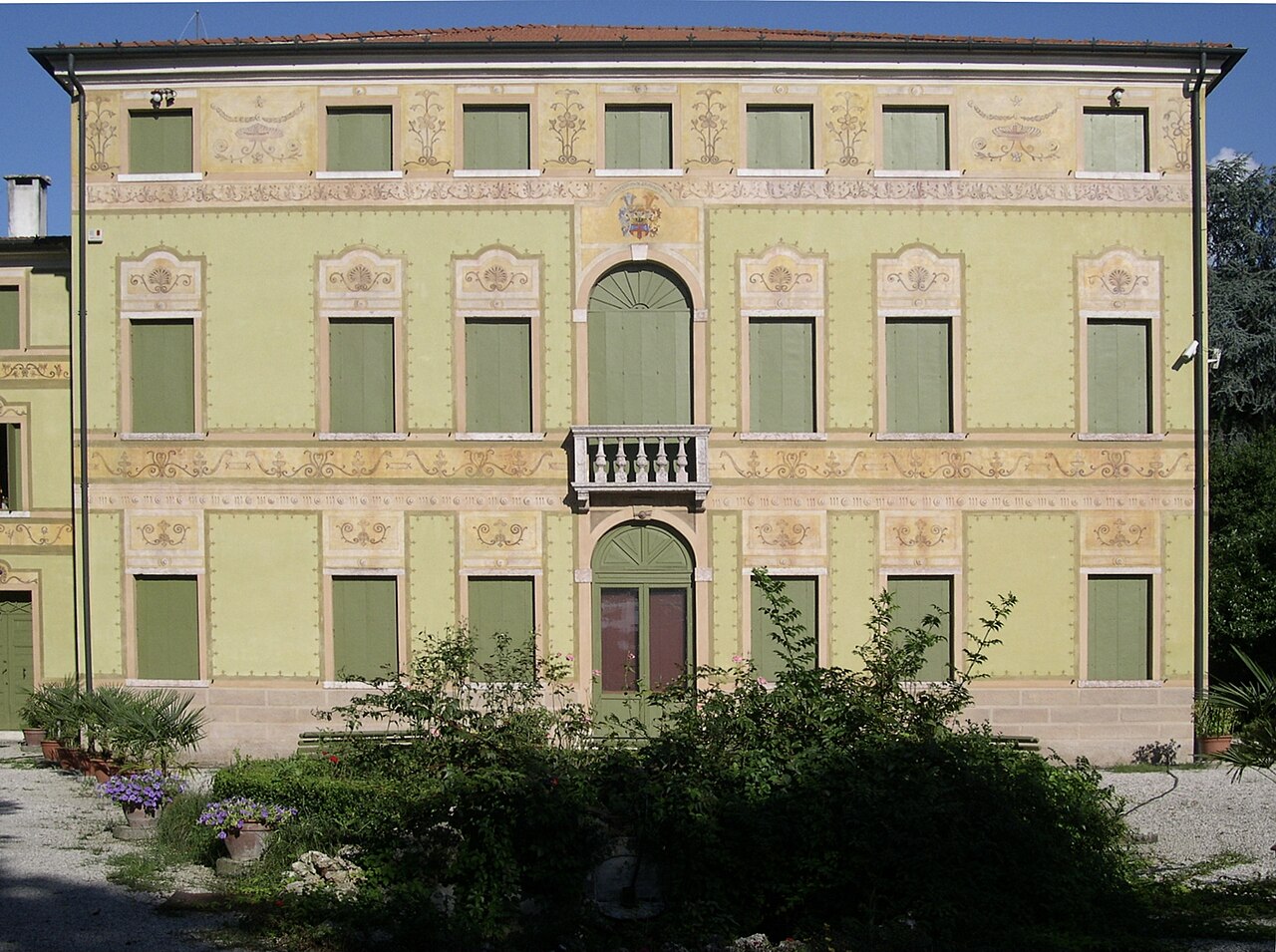


Depictions in art
-
 Palazzo Loredan Vendramin Calergi, by Canaletto, 1750s, Private Collection
 -

-

-

-

-
 Capriccio of the Scuola di San Marco from the Loggia of the Palazzo Grifalconi Loredan, by Canaletto, 1750s, Private Collection
 -
 Campo Santo Stefano, by Canaletto, c. 1735–1740, featuring Palazzo Loredan in Campo S. Stefano (right), Royal Collection
 -
 View of Campo Santo Stefano with the Loredan Palace and the Morosini Palace, by Luca Carlevarijs, 1703, Metropolitan Museum of Art, New York City


Lands
Among the more substantial land possessions and estates privately held by the family throughout history were the island of Antiparos in Greece, the towns of Bertinoro, Loreo, Ormelle, and Vangadizza in northern and central Italy, as well as Barban and Rakalj on the Istrian Peninsula in Croatia.
-

-
 Bertinoro, Emilia-Romagna, owned by the family in the Middle Ages.
 -

-

-
 Antiparos, a Greek island owned by Giovanni Loredan and his family in the 15th century.


Legacy
Impact on Jewish history
The Venetian Ghetto

On March 29, 1516, by decree of Doge Leonardo Loredan, the Venetian Senate declared that if the Jews wanted to continue living in Venice, they had to stay on a small island surrounded by canals in the northern part of the city.[171] By this decision, the first Jewish ghetto in the world was created in the Cannaregio district of Venice, thus starting centuries of segregation which would spread across Europe, and the Venetian word ghèto soon became a popular term to describe isolated urban communities of ethnic minorities. Scholars believe that the Loredan government which had established the Ghetto did so because they believed that the Jews could not be integrated with the city's mainly Roman Catholic population.[172]
Life in the Ghetto was very restricted, and the movement of Jews outside of the ghetto was difficult. Jews were locked in the ghetto at night and Christian guards on boats patrolled the narrow canals and short bridges to enforce the rules. The Jews were even forced to pay the salaries of their Christian wardens.[172] While appallingly discriminatory, it was, for some, a shelter from even worse persecution elsewhere.[173]
Although it was home to a large number of Jews, accounting for 1,000 people out of the city's 160,000 at the time, and mainly consisting of merchants, the population living in the Venetian Ghetto never assimilated to form a distinct, "Venetian Jewish" ethnicity. Four of the five synagogues were clearly divided according to ethnic identity: separate synagogues existed for the German (the Scuola Grande Tedesca), Italian (the Scuola Italiana), Spanish and Portuguese (the Scuola Spagnola), and Levantine Sephardi communities (the Scuola Levantina). The fifth, the Scuola Canton, was possibly built as a private synagogue and also served the Venetian Ashkenazi community. At its peak in the middle of the 17th century, nearly 5,000 Jews lived in the Ghetto. To accommodate births and new arrivals, they could only build upwards, resulting in some of the world's first “skyscrapers,” which at seven or eight storeys are still some of the tallest buildings in the city.[172]
In 1797, the French Army of Italy commanded by 28-year-old Napoleon Bonaparte occupied Venice, forcing the Republic to collapse on 12 May 1797, and ended the ghetto's separation from the city on 11 July of the same year. Today, the Ghetto is still a center of Jewish life in the city. The Jewish community of Venice, that counts about 450 people, is culturally active, although only a few members live in the Ghetto because the area has become increasingly expensive.[174] Anniversary events are held in the ghetto and include a production of William Shakespeare’s play The Merchant of Venice and a major exhibition called "Venice, the Jews, and Europe", at the Doge's Palace - the same place where the decree that started the ghetto was signed 500 years ago.[172]
Relationship with the Jewish community
.jpg/1280px-'Portrait_of_Doge_Pietro_Loredan',_oil_on_canvas_painting_by_Tintoretto_(Jacopo_Robusti).jpg)
Despite playing a part in the creation of the first Jewish ghetto, the decision to do so was not only made by Leonardo Loredan, but by other senators who advocated for segregation believing that the presence of Jews in the city and their money lending practices would degrade the Christian morals and values of Venetian citizens. Later in the 16th century, some members of the Loredan family, including Pietro Loredan, fought in the Senate for the reduction of the sum the Jews had to pay for their “conduct”.[175]
In the 17th century onwards, the Loredans were noted for supporting and taking in Jews arriving in Venice, several of whom adopted the “Loredan” name in recognition of the family's generosity. For instance, records exist of a Spanish Jewish family fleeing persecution in Spain who took the Loredan name after a member of the Loredan family sponsored their education and conversion to Christianity. As a result, descendants of these Loredan converts can be found in the former Venetian territories and the diaspora.[176]
In the 18th century, as Captain General of the Sea, one Loredan wrote letters of recommendation for many Jews from Mediterranean cities and islands, and helped them with affording and boarding ships bound for Venice.[177]
Patronage and impact on art history
Loredans in art

Many Loredans were portrayed by renowned artists of the Venetian School contemporaneous to the family members who had commissioned the associated artworks, and also posthumously. The most famous of these is the Portrait of Doge Leonardo Loredan, painted by Giovanni Bellini in 1501/02, around the time of Leonardo's ascension to the dogeship, and now on display at the National Gallery in London. Vittore Carpaccio's Portrait of Leonardo is another famous depiction of the doge, displayed at the Museo Correr. Another well-known depiction of him is the Portrait of Doge Leonardo Loredan with Four Sons, again by Bellini, and now on display at the Gemäldegalerie in Berlin. Leonardo Loredan was also featured in paintings by Gentile Bellini, Palma the Younger, Vincenzo Catena, Domenico Tintoretto, Carlo and Gabriele Caliari, Pompeo Batoni, Francesco Maggiotto, as well as various other painters, and in sculptures created by the likes of Girolamo Campagna, Danese Cattaneo, and Pietro Lombardo. He was also depicted posthumously in a number of paintings celebrating his victory over the League of Cambrai. The second Loredan doge, Pietro, was likewise portrayed by a number of artists; the most famous depiction of him is the Portrait by Tintoretto, painted in 1567 and now on display at the Kimbell Art Museum in Fort Worth, Texas. Palma the Younger's Doge Pietro Loredan Beseeching the Virgin is another famous depiction, located at the Doge's Palace. The third doge, Francesco, was portrayed in the 18th century by Fortunato Pasquetti and Jacopo Guarana, among others.
Patronage
Immortalised in painting by numerous renowned artists, Leonardo Loredan is one of the most easily distinguishable figures of the Italian Renaissance. Nevertheless, little is known about his patronage of the arts during this crucial era in art history. Furthermore, there still remains much to be explored regarding the wide range of artistic endeavours carried out for the Doge's extended family, many of which overlapped with those under Leonardo's direction. This is especially the case for Andrea Loredan, a cousin of Leonardo, and one of the most prominent art collectors of the time. It is certain, however, that Loredan patronage, which included both the public and the private, the official, religious, and dynastic, was a massive, intricately connected undertaking that adorned numerous sites throughout Venice and involved nearly every significant artist active in the city during this period.

Among the most famous works of art commissioned by the family is the Legend of Saint Ursula, a series of large wall-paintings on canvas by the Venetian Renaissance master Vittore Carpaccio.[178] Originally created for the School of Saint Ursula, which was under the family's patronage, the paintings are now on display at the Gallerie dell'Accademia in Venice. The series was commissioned by Antonio Loredan, who is depicted in several of the paintings, although these paintings were created well after his death.
The family was also among the first to discover the talents of Titian, Giorgione, and Sebastiano del Piombo. Titian's first masterpiece, The Flight into Egypt, which he painted aged only 18, was commissioned by Andrea Loredan, and was intended for the portico of Andrea's newly constructed palace on the Grand Canal, now known as the Ca' Loredan Vendramin Calergi.[179] Likewise, Sebastiano del Piombo's early painting The Judgement of Solomon was commissioned around the same time, also for the purpose of adorning the new Loredan palace.[180]
-

-

-

-
 The Judgement of Solomon, by Sebastiano del Piombo, c. 1505–1510, Kingston Lacy (National Trust), Dorset


In popular culture
.jpg/1280px-Doge_Francesco_Loredan_and_Giacomo_Casanova,_in_Casanova_(2005).jpg)
Francesco Loredan was portrayed by Tim McInnerny (as 'The Doge') in the 2005 American romance film Casanova, loosely based on the life of the famous adventurer and author Giacomo Casanova, who was imprisoned in the Piombi under Loredan's government in 1755 for affront to religion and common decency.
Leonardo Loredan appeared as one of the characters in the 2009 action-adventure video game Assassin’s Creed II. Set at the height of the Italian Renaissance, the game also features other historical figures of the time, including Leonardo da Vinci, Niccolò Machiavelli, Caterina Sforza, Bartolomeo d'Alviano, the Medici family, the Pazzi family, the Barbarigo family, and Pope Alexander VI.
MV Loredan
The MV Loredan was an Italian mixed motor ship and auxiliary cruiser of the Italian Royal Navy in World War II, named in honour of the many admirals of the Loredan family.[181]
Built in 1936 in Monfalcone, it initially served as a civil transport ship on several lines in the Adriatic Sea.[182] In 1941 it was registered as an auxiliary cruiser in the Italian Royal Navy. In twenty-one months of service, it carried out a total of 193 missions, consisting mainly of escort services in the Tyrrhenian Sea.[183]
On 10 April 1943, it left the port of Cagliari as an escort to a small convoy headed for the archipelago of La Maddalena. Shortly after the departure, the convoy was spotted by the British submarine HMS Safari, which proceeded to launch torpedoes at the Italian ships, sinking the Loredan with nearly all her crew.[184]
The wreck of the Loredan lies on its left side, with the stern severely damaged, at a depth of between 52 and 67 meters, on the seabed of the Gulf of Cagliari, at 39°08' N and 9°23' E. Today, she is a frequent diving destination.[184]
A new Loredan cargo ship was subsequently built in 1946, and broken up in 1971.[185]
Curiosities

- In 1316, Zanotto Loredan was seriously ill, so much so that it was thought he was dead, so the people took him to the church of San Matteo in Murano for burial. After the funeral rite, they wanted to deposit the body in the tomb, when someone noticed that the color of his face had changed. They took him to the convent hospital, warmed him and he recovered. Later he continued to live normally, married and had children.[21]
- In 1410, Andrea Loredan, who was Count of Drivasto, robbed the city of all its money and disappeared with it. The Signoria condemned him in absentia soon after.[153]
- In the 1412 Battle of Motta, Pietro Loredan helped the Venetian military score a decisive victory over Hungary, by cunningly burning the bridges surrounding the Venetian camp so that fleeing Venetian troops could not escape following an unexpected Hungarian assault.[187] This calculated decision completely changed the fortunes of the Venetians, rallying them back into combat, and ultimately securing their victory.[188] Following the battle, Pietro ordered the bombardment of Motta, forcing the Hungarians to surrender the city.[189]
- In the 1416 Battle of Gallipoli, Pietro Loredan managed to lead the Venetian fleet to victory over the Ottomans while being wounded by an arrow below the eye and the nose, and by another that passed through his left hand, as well as several other arrows that struck him with lesser effect.[190] Following the battle, he took 1,100 Ottoman soldiers as captives, with most of them being sold into slavery afterwards.[191]
- In 1423, when Pietro Loredan lost the election for the dogeship to his fierce rival Francesco Foscari, two of Loredan's daughters, Maria and Marina, were deliberately married to Francesco Barbaro and Ermolao Donà respectively, both of them opponents of Foscari. Furthermore, when Foscari proposed a marriage between his own daughter and one of Loredan's sons, it was rejected.[11]
- In 1500, the Venetian Senate brought charges against Vincenzo Loredan and three other noblemen; they were accused of having repeatedly entered the Monastero delle Vergine at night to sleep with some of the nuns. These affairs went on for years without being discovered or acted upon.[192]
- Giovanni Bellini’s 1501 Portrait of Doge Leonardo Loredan is significant as it was the first portrait of an Italian ruler to be painted face-front.[193] Previously, face-front portraits were reserved for holy figures, while mortals would be portrayed in profile to signify their spiritual incompleteness.
- During Leonardo Loredan’s reign, in 1507, the events of the Fornaretto of Venice took place, the story of an innocent baker sentenced to death for an uncommitted murder. The story of the fornaretto, however, is not historical: it is the fruit of the imagination of the playwright Francesco Dall'Ongaro, who wrote it in 1846.[194]

Portrait of Doge Leonardo Loredan, by Gentile Bellini, 1501, Dorotheum, Vienna - At the height of the War of the League of Cambrai, and with Venice's resources diminishing, Doge Leonardo Loredan set a noble example by sending all of his gold and silver plates and the jewels of his late wife to the Mint to be melted down for money.[195] In his speech before the Great Council, which was described as a model of patriotism and eloquence and greeted rapturously, he also invited other nobles to contribute as much money as possible in order to meet the enormous expenses of resistance.[196]
- In the Latin inscription on the Tomb of Doge Leonardo Loredan, the year of his death is mistakenly written as MDXIX (1519) instead of MDXXI (1521).
- In 1570, at the death of Doge Pietro Loredan, who tried to tackle food shortages of 1569/1570 by introducing bread made of millet, and who was held personally responsible for the famine, the people of Venice were heard singing: "Rejoice, rejoice! The Doge is dead, who gave us millet in our bread!"[197] and "Long live our saints and lords of noble birth, dead is the Doge who brought upon us dearth!"[198]
- Another theory about Doge Pietro Loredan's death is that, instead of being struck with illness, he died a peaceful death in his villa in east Italy. There he was being fed grapes by his servants, and while eating, his mistress tried to start a conversation with him, leading Loredan to choke and suffocate on his grape. They tried to get the grape dislodged from his throat but to no avail.
- In 1598, an incident occurred which resulted in an urban legend known as The Ghost of Fosco Loredan.[92] In a burst of anger resulting from jealousy of his wife Elena who attracted many suitors, Fosco Loredan murdered her at Campiello del Remèr by decapitating her, and was then ordered by her uncle, Doge Marino Grimani, to walk to Rome while carrying her disfigured body on his back to ask for the Pope's forgiveness, as he was the only one who could grant it to a noble of the rank of Loredan.[93] After hearing the story, Pope Clement VIII did not want to see him, and, out of desperation, Fosco went back to Venice and drowned himself in the Grand Canal. Supposedly, on the anniversary of his wife's killing, his ghost can be seen wandering the streets of Venice at night searching for peace.[94]

Bust of Doge Leonardo Loredan, by Danese Cattaneo, 16th century, Birmingham Museum of Art, Birmingham - Dogaressa Paolina Loredan made a decision never to appear in any public ceremonials out of fears that she would be mocked by the populace due to her being an immensely stout and unusually plain-looking woman.[106]
- In 1675, near the Palazzo Contarini-Sceriman and the nearby bridge, Leonardo Loredan was found dead in a boat. The unexplained death was the source of many rumors, claiming accidental death, murder by relatives, or murder by the Inquisitors of the Republic.[107]
- Despite the incredible amount of money Francesco Loredan spent on celebrations upon his ascension to the dogeship in 1752, one of the sonnets composed for the occasion complained of insufficient results, mocking the music and claiming that the "machine" of fireworks had funerary references.[159]
- Interestingly, the Loredans were one of the rare families in which feudal ownership of an estate could be inherited by a woman. The family's Istrian fief of Barban and Rakalj was the only feudal estate in Istria in which ownership could be passed down to a female heiress.[84] This shows how the family was able to keep ownership of their Istrian lands until 1869, a century after the family branch of Santo Stefano, which had owned it, became extinct in the male line.[29]
- The MV Loredan ship, built in 1936 and named in honour of the many Loredan admirals throughout history, was torpedoed by British submarine HMS Safari on 10 April 1943, 10 miles off the coast of Sardinia, while carrying cargo from Cagliari to the archipelago of La Maddalena, serving as part of the Italian Navy in the Second World War.[199] The ship sunk immediately with nearly all her crew.[200] The wreck of the Loredan lies on its left side, with the stern severely damaged, at a depth of between 52 and 67 meters, on the seabed of the Gulf of Cagliari, at 39°08' N and 9°23' E. Today, she is a frequent diving destination.Exploration of the Loredan shipwreck and an illustration depicting the ship lying on its left side.


- Francesco Loredan was portrayed by Tim McInnerny in the 2005 romance film Casanova, loosely based on the life of the famous adventurer and author Giacomo Casanova.
- Leonardo Loredan appeared as one of the characters in the 2009 action-adventure video game Assassin’s Creed II, alongside other historical figures of the Renaissance, including Leonardo da Vinci, Niccolò Machiavelli, Caterina Sforza, Bartolomeo d'Alviano, the Medici family, the Pazzi family, the Barbarigo family, and Pope Alexander VI.
- The feminine name Loredana, common in Italy and Romania, is derived from the name of the Loredan family.[201] Notable people with the name include even the botanist and Dogaressa of Venice Loredana Marcello (1533 - 1572).
Loredan wineries
Conte Loredan Gasparini 


The Conte Loredan Gasparini winery was founded in the 1950s by Count Piero Loredan, descendant of the Doge of Venice Leonardo Loredan, who chose the territory of Vignigazzu to establish his home in a grand Palladian villa - The Villa Loredan at Paese.[120]
The winery is located in Venegazzù di Volpago del Montello, in the Veneto region, in the heart of the Marca Trevigiana, an area famous for the production of wines since the 16th century.[202]


Barchessa Loredan 


The Barchessa Loredan winery is located in Selva del Montello, within a 16th-century Palladian barchessa. It is owned by the Loredan family, who managed the latest renovation.[121]
It directly produces and markets its wines obtained from D.O.C. Montello and D.O.C.G. Asolo. The farm covers an area of 50 hectares (120 acres) of vineyards in the hamlets of Selva and Venegazzù, and is managed by Countess Nicoletta Loredan Moretti degli Adimari, who founded it in the 1960s. The Barchessa, surrounded by vineyards, is also clearly visible from the Schiavonesca state road, (Montebelluna Conegliano) to which it is connected by a long avenue of centuries-old hazelnuts.[121]
The Barchessa Loredan is a magnificent example of Palladian architecture. The noble residence was built in the 16th century; originally it was part of a vast complex which also included a large villa destroyed in 1840.[121]
The imposing Barchessa remains of the original complex, with the entrance gates and part of the surrounding wall. The building consists of nine arches with a volute keystone and framed by Doric pilasters supporting a moulded entablature, which extends over the entire ground floor.[121]
Above the portico rises the first floor, with a very large attic, perfectly restored, in which the most significant memories of the Loredan family are preserved.[121]


Guerrieri Rizzardi 


In the 1980s, after the death of her husband Antonio Rizzardi, Countess Maria Cristina Rizzardi Loredan found herself managing the Guerrieri Rizzardi winery, based on Lake Garda. Carrying on from her husband, she further developed the estates and the vineyards, seeking out new international markets and developing new wines. She succeeded in expanding the winery with new vineyards and wines, also applying the concept of ‘Cru’ as a mark of quality restricted to a well-defined vineyard.[122] The Countess would become a well-known figure in the wine world and her hard work, keen vision and determination were widely recognised. Her achievements were honoured in 2010 when she was the first woman from the region to be awarded the Order of Merit for Labour, Italy's highest honour for those who are meritorious business people in agriculture, commerce and industry.[122]
-
 The Bardolino Estate
 -
 The Valpolicella Estate
 -
 The Soave Estate
 -
 The Val d'Adige Estate


Notes
^ a: The Loredan family was one of the rare families in which a feudal estate could be inherited by a female heiress. This shows how the family was able to keep ownership of their Istrian lands, Barban and Rakalj, until 1869, a century after the family branch of Santo Stefano, which had owned it, became extinct in the male line.[29]
^ b: Many families in the Veneto have surnames indicating the town from which their ancestors came from (e.g. Trevisan).
^ c: Although most Venetian nobles usually came to Dalmatian cities on political or military duty, and stayed until the end of their term, branches of some Venetian noble families, such as the Loredans, the Venier, and the da Mosto families, settled in and around Zara.[151]
^ d: Although the Great Council Lockout was formerly provisional, the Ordinance later became a permanent Act, and since then it was disregarded only at times of political or financial crisis (e.g. after the War of the League of Cambrai).[17]
^ e: The family branch of Santo Stefano was named after Campo Santo Stefano, where the palace is located, although the branch is also known as San Vitale, after the nearby church of San Vidal.
^ f: In the actual Venetian language, his name was Pie[t]ro Loredan; in contemporary Greek sources, he is encountered as Πέτρος Λορδᾶς, Λαυρεδάνος, or Λορδάνο.
^ g: By the reign of Pope Zachary (741–752), Venice had established a thriving slave trade, buying in Italy, among other places, and selling to the Moors in Northern Africa (Zacharias himself reportedly forbade such traffic out of Rome).[203][204][205] When the sale of Christians to Muslims was banned (pactum Lotharii), the Venetians began to sell Slavs and other Eastern European non-Christian slaves in greater numbers. Between 1414 and 1423 alone, at least 10,000 slaves were sold in Venice.[206]
References
- ^ Manfroni, Camillo (1934). Enciclopedia Italiana.
- ^ a b c d e Zabarella, Jacopo (1646). Trasea Peto (in Italian). Padua.
- ^ a b c d Venezia, Conoscere. "Famiglia Loredano | Conoscere Venezia" (in Italian). Retrieved 2 March 2021.
- ^ Nappo, Tommaso (1993). Indice Biografico Italiano, vol. 3 (in Italian). p. 837.
- ^ Bertoša, Slaven (2012). Gli orizzonti mediterranei della famiglia veneziana Loredan. p. 539.
- ^ Gullino, G. (1985). I Loredan di Santo Stefano: Cenni storici. Venice.
{{cite book}}: CS1 maint: location missing publisher (link) - ^ a b c "LOREDAN in "Enciclopedia Italiana"". www.treccani.it (in Italian). Retrieved 16 January 2021.
- ^ a b c d e f g "LOREDAN, Pietro in "Dizionario Biografico"". www.treccani.it (in Italian). Retrieved 16 January 2021.
- ^ a b "LOREDAN, Pietro in "Dizionario Biografico"". www.treccani.it (in Italian). Retrieved 10 April 2021.
- ^ a b Soranzo, Girolamo (1968). Bibliografia veneziana in aggiunta e continuazione del "Saggio" di E. A. Cicogna (in Italian). Bologna. p. 73.
{{cite book}}: CS1 maint: location missing publisher (link) - ^ a b c d e f g h i j Gullino, Giuseppe (2005). Dizionario Biografico degli Italiani, vol. 65 (in Italian).
- ^ a b c d Papathanassiou, Manolis. "Castle of Antiparos". Καστρολόγος. Retrieved 2 March 2021.
- ^ a b c d e f g h Miller, William (1908). The Latins in the Levant: A History of Frankish Greece (1204–1566). London: John Murray. pp. 618–620. OCLC 563022439.
- ^ "LOREDAN, Giovan Francesco in "Dizionario Biografico"". www.treccani.it (in Italian). Retrieved 13 April 2021.
- ^ a b c "LOREDAN, Marco in "Dizionario Biografico"". www.treccani.it (in Italian). Retrieved 9 April 2021.
- ^ Schröder, Francesco (1972). Repertorio genealogico delle famiglie confermate nobili e dei titolati nobili esistenti nelle provincie venete, vol. 1 (in Italian). Bologna. pp. 447–448.
{{cite book}}: CS1 maint: location missing publisher (link) - ^ a b Lane, Frederic C. (1973). Venice, a Maritime Republic. The Johns Hopkins University Press.
- ^ a b Martines, Lauro (2012). Loredana: A Venetian Tale. p. 100.
- ^ a b c d e Martines, Lauro (2012). Loredana: A Venetian Tale. p. 101.
- ^ a b c d e f Martines, Lauro (2012). Loredana: A Venetian Tale. Random House. ISBN 9781448139828.
- ^ a b Bertoša, Slaven (2012). Gli orizzonti mediterranei della famiglia veneziana Loredan. p. 560.
- ^ Dolcetti, Giovanni (1983). Il Libro d'argento delle famiglie venete (in Italian). Bologna.
{{cite book}}: CS1 maint: location missing publisher (link) - ^ "POLO, Marco in "Enciclopedia Italiana"". www.treccani.it (in Italian). Retrieved 7 July 2021.
- ^ Mack, Rosamond E. (2002). Bazaar to Piazza: Islamic Trade and Italian Art, 1300-1600. Berkeley: University of California Press. p. 19. ISBN 9780520221314.
- ^ Lane, Frederic C. (1973). Venice, a Maritime Republic. The Johns Hopkins University Press. p. 139
- ^ Medieval Trade in the Mediterranean World: Illustrative Documents. Translated by Lopez, Robert S.; Raymond, Irving W. New York: Columbia University Press. 2001. p. 284. ISBN 9780231515122.
- ^ Ruggiero, Guido (2008). A Companion to the Worlds of the Renaissance. John Wiley & Sons. p. 259. ISBN 9780631215240.
- ^ a b c d e Ughelli, Ferdinando (1653). Italia Sacra. Rome.
- ^ a b c d e f g h i j k l m Bertoša, Slaven (2015). Istarska enciklopedija (in Croatian).
- ^ Norwich, John Julius (2003). A History of Venice. p. 313.
- ^ Romano, Dennis (2007). The Likeness of Venice. Yale University Press. ISBN 978-0-300-11202-3.
- ^ Setton, Kenneth M. (1978). The Papacy and the Levant. Philadelphia: The American Philosophical Society. ISBN 0-87169-127-2.
- ^ a b c "LOREDAN, Giacomo in "Dizionario Biografico"". www.treccani.it (in Italian). Retrieved 11 April 2021.
- ^ Norwich, John Julius (2003). A History of Venice. p. 355.
- ^ Norwich, John Julius (2003). A History of Venice. p. 348.
- ^ a b c "LOREDAN, Alvise in "Dizionario Biografico"". www.treccani.it (in Italian). Retrieved 9 April 2021.
- ^ a b c "LOREDAN, Giorgio in "Dizionario Biografico"". www.treccani.it (in Italian). Retrieved 13 April 2021.
- ^ Honour, Hugh (1997). The Companion Guide to Venice. Companion Guides. p. 53. ISBN 978-1-900639-24-8.
- ^ a b c Marshall Smith, C. (1927). The Seven Ages of Venice: A Romantic Rendering of Venetian History. Blackie & Son. p. 134.
- ^ Gentili, Augusto (1996). Carpaccio. p. 111.
- ^ Miller, William (1908). The Latins in the Levant: A History of Frankish Greece (1204–1566). p. 631.
- ^ a b c d "The Venetian Castle of Antiparos". Antiparos island, Greece - Antiparos.com. Retrieved 2 March 2021.
- ^ Norwich, John Julius (2003). A History of Venice. p. 406.
- ^ a b c "LOREDAN, Antonio in "Dizionario Biografico"". www.treccani.it (in Italian). Retrieved 11 April 2021.
- ^ a b Brunetti, M. (1925). Due dogi sotto inchiesta: Agostino Barbarigo e Leonardo Loredan.
- ^ a b c "LOREDAN, Leonardo in "Dizionario Biografico"". www.treccani.it (in Italian). Retrieved 16 January 2021.
- ^ Barzman, Karen-edis (2017). The Limits of Identity: Early Modern Venice, Dalmatia, and the Representation of Difference. p. 124.
- ^ Spalding, William (1841). Italy and the Italian Islands: From the Earliest Ages to the Present Time. Oliver & Boyd. p. 144.
- ^ a b c d Partridge, Loren (2015). Art of Renaissance Venice. p. 98.
- ^ Rendina, Claudio (1984). I Dogi: Storia e Segreti. Venice: Newton Compton. pp. 270–279.
- ^ Distefano, Giovanni (2011). Enciclopedia Storica di Venezia. Venice: Supernova. p. 683. ISBN 978-88-96220-51-1.
- ^ Bembo, Pietro. Della Istoria Viniziana (in Italian).
- ^ Barzman, Karen-edis (2017). The Limits of Identity: Early Modern Venice, Dalmatia, and the Representation of Difference. p. 113.
- ^ Barzman, Karen-edis (2017). The Limits of Identity: Early Modern Venice, Dalmatia, and the Representation of Difference. str. 114.
- ^ a b Barzman, Karen-edis (2017). The Limits of Identity: Early Modern Venice, Dalmatia, and the Representation of Difference. str. 118.
- ^ Setton, Kenneth Meyer (1976). The Papacy and the Levant, 1204–1571: The Fifteenth Century. p. 523.
- ^ Barzman, Karen-edis (2017). The Limits of Identity: Early Modern Venice, Dalmatia, and the Representation of Difference. p. 122.
- ^ Shaw, Christine (1993). Julius II: The Warrior Pope. Oxford: Blackwell Publishers. ISBN 0-631-16738-2.
- ^ Norwich, John Julius (2003). A History of Venice. p. 594.
- ^ Mallett, Michael; Shaw, Christine (2012). The Italian Wars, 1494–1559: War, State and Society in Early Modern Europe. Harlow: Pearson Education. p. 85. ISBN 978-0-582-05758-6.
- ^ Guicciardini, Francesco (1984). The History of Italy. Translated by Alexander, Sydney. Princeton: Princeton University Press. ISBN 0-691-00800-0.
- ^ Norwich, John Julius (1982). A History of Venice. Allen Lane.
- ^ Setton, Kenneth Meyer (1976). The Papacy and the Levant, 1204–1571: The Sixteenth Century. p. 60.
- ^ Norwich, John Julius (2003). A History of Venice. p. 454.
- ^ Setton, Kenneth Meyer (1976). The Papacy and the Levant, 1204–1571: The Sixteenth Century. p. 80.
- ^ Norwich, John Julius (2003). A History of Venice. p. 425.
- ^ Norwich, John Julius (2003). A History of Venice. p. 431.
- ^ a b "A Tale of Two Doges". Pondering Art. 7 July 2021.
- ^ a b Berendt, John (2005). The City of Falling Angels. Penguin Press. ISBN 1-59420-058-0.
- ^ a b c d e f g Morelli, Iacopo (1790). Della Istoria Viniziana di Monsignor Pietro Bembo Cardinale (in Italian). Venice.
- ^ a b dal Borgo, Michela (2005). Leonardo Loredan, Dizionario Biografico degli Italiani (in Italian). Rome: Istituto dell'Enciclopedia Italiana.
- ^ a b Staley, Edgcumbe (1910). The Dogaressas of Venice: The Wives of the Doges. p. 239.
- ^ Logan, O. (1972). Culture and Society in Venice. London.
{{cite book}}: CS1 maint: location missing publisher (link) - ^ Simi, S. (1992). Considerazioni attorno un busto di Leonardo Loredan.
- ^ Musatti, Eugenio (1888). La storia della promissione ducale (in Italian). Padua.
{{cite book}}: CS1 maint: location missing publisher (link) - ^ Colombo, Stefano. "The Commemorative Monument to Doge Leonardo Loredan in Santi Giovanni e Paolo: Rethinking the Funerary memory in Early Seventeenth-Century Venice, (Mausolus, Summer Bulletin, 2016)": 23–29.
{{cite journal}}: Cite journal requires|journal=(help) - ^ "Save Venice Inc. | Dedicated to preserving the artistic heritage of Venice". Save Venice Inc. | Dedicated to preserving the artistic heritage of Venice. Retrieved 2 March 2021.
- ^ Ferrara, D. (1991). Il ritratto di doge Leonardo Loredano: Strategie dell'abito tra politica e religione.
- ^ Ferrara, D. Carpaccio e lo spazio simbolico del bacino marciano: Il ritratto del doge Leonardo Loredan e il Leone di San Marco (in Italian).
- ^ "Walters Ms. W.479, Panegyricus Leonardo Lauredano". www.thedigitalwalters.org. Retrieved 6 February 2022.
- ^ Museum (Baltimore/MD/USA), The Walters Art (17 June 2019). "Walters Ms. W.479, Panegyricus Leonardo Lauredano". Walters Art Museum Ms. W.479. Retrieved 6 February 2022.
- ^ "Panegyricus Leonardo Lauredano". The Walters Art Museum. Retrieved 6 February 2022.
- ^ "GRIMANI, Antonio in "Dizionario Biografico"". www.treccani.it (in Italian). Retrieved 13 April 2021.
- ^ a b c Bertoša, Slaven (2012). Gli orizzonti mediterranei della famiglia veneziana Loredan. p. 568.
- ^ a b c d e Brusegan, Marcello (2005). La grande guida dei monumenti di Venezia. Rome: Newton & Compton. ISBN 88-541-0475-2.
- ^ Les Ordinations Épiscopales, Year 1554.
- ^ a b c Hierarchia Catholica, Vol. 3. p. 260.
- ^ Dumler, Helmut (2001). Venedig und die Dogen (in German). Düsseldorf.
{{cite book}}: CS1 maint: location missing publisher (link) - ^ da Mosto, Andrea (1983). I Dogi di Venezia. Florence.
{{cite book}}: CS1 maint: location missing publisher (link) - ^ Cecchetti, Bartolomeo (1864). Il Doge di Venezia (in Italian). Venice.
{{cite book}}: CS1 maint: location missing publisher (link) - ^ "Portrait of Doge Pietro Loredan | Kimbell Art Museum". www.kimbellart.org. Retrieved 2 March 2021.
- ^ a b "Fosco and Elena - veveglass". 21 January 2020. Retrieved 24 October 2021.
- ^ a b "Il fantasma di Fosco e della bella Elena". Venezia Eventi (in Italian). 24 April 2019. Retrieved 24 October 2021.
- ^ a b "Il delitto di Elena e il fantasma di Fosco Loredan". VeneziaToday (in Italian). Retrieved 24 October 2021.
- ^ Ferrari, Luigi (1947). Onomasticon. Milan. p. 415.
{{cite book}}: CS1 maint: location missing publisher (link) - ^ Miato, M. (1998). L'Accademia degli Incogniti di Giovan Francesco Loredan. Florence.
{{cite book}}: CS1 maint: location missing publisher (link) - ^ Maidalchino, Francesco (1634). Il Loredano. Venice: Panegirico.
- ^ Brocchi, V. L'accademia e la novella nel Seicento: Giovan Francesco Loredan. 1897.
- ^ Ivanoff, N. (1965). Giovan Francesco Loredan e l'ambiente artistico a Venezia nel Seicento.
- ^ Rosand, Ellen (2007). Opera in Seventeenth-Century Venice: the Creation of a Genre. University of California Press.
- ^ Manini, L. (2015). Giovan Francesco Loredano, Morte del Volestein e altre opere. La Finestra Editrice. ISBN 978-8895925-60-8.
- ^ Morini, A. (1994). La vie et l'oeuvre de Giovan Francesco Loredan (in French). Université de Paris.
- ^ Brunacci, G. (1662). Vita di Giovan Francesco Loredan. Venice.
- ^ Morini, A. (1997). Giovan Francesco Loredan: sémiologie d'une crise (in French).
- ^ Lupis, A. (1663). Vita di Giovan Francesco Loredan senator veneto. Venice.
- ^ a b c Staley, Edgcumbe (1910). The Dogaressas of Venice: The Wives of the Doges. p. 295.
- ^ a b c d e f Bertoša, Slaven (2012). Gli Orizzonti Mediterranei della Famiglia Veneziana Loredan (in Italian). pp. 537–569.
- ^ a b "LOREDAN, Francesco in "Dizionario Biografico"". www.treccani.it (in Italian). Retrieved 9 April 2021.
- ^ Lazzarini, Vittorio (1903). I titoli dei Dogi di Venezia (in Italian). Venice.
{{cite book}}: CS1 maint: location missing publisher (link) - ^ a b Nani, Giacomo (1756). Saggio politico del Corpo aristocratico della Repubblica di Venezia per l'anno 1756 (in Italian). Venice.
- ^ a b c d e f g h i j k "LOREDAN, Francesco in "Dizionario Biografico"". www.treccani.it (in Italian). Retrieved 9 April 2021.
- ^ Norwich, John Julius (2003). A History of Venice. p. 623.
- ^ Colombo, Stefano (2016).The Commemorative Monument to Doge Leonardo Loredan in Santi Giovanni e Paolo. p. 29.
- ^ Cessi, Roberto (1928). Venezia ducale, vol. 1 (in Italian). Padua.
{{cite book}}: CS1 maint: location missing publisher (link) - ^ Casanova, Giacomo (1788). Histoire de ma fuite des prisons de la République de Venise qu'on appelle les Plombs. Leipzig.
- ^ Spreti, Vittorio. Enciclopedia storico-nobiliare italiana (in Italian).
- ^ Bertoša, Slaven (2012). Gli orizzonti mediterranei della famiglia veneziana Loredan. p. 563.
- ^ a b Schröder, Francesco. Repertorio genealogico.
- ^ Bertoša, Slaven (2016.). Ljudi 18. stoljeća na hrvatskom prostoru: od plemića i crkvenih dostojanstvenika do težaka i ribara. p. 216.
- ^ a b c d Conte Loredan Gasparini
- ^ a b c d e f "Barchessa Loredan | L'Azienda" (in Italian). Retrieved 26 February 2021.
- ^ a b c d "Guerrieri Rizzardi. Wines from Valpolicella, Bardolino e Soave". Guerrieri-Rizzardi. Retrieved 31 May 2021.
- ^ Sharpe, Samuel (1863). Egyptian Mythology and Egyptian Christianity, with their modern influence on the opinions of modern Christendom. p. 11.
- ^ a b c Berendt, John (2005). City of Falling Angels. p. 111.
- ^ Waite, A. E. (1921). A New Encyclopedia of Freemasonry vol. 1. p. 67.
- ^ "The strange inscription on Palazzo Vendramin Calergi on the Grand Canal in Venice". venetoinside.com. Retrieved 18 May 2021.
- ^ "Ca' Vendramin Calergi and the Wagner Museum: a symphony on the Grand Canal". Visit Venezia. Retrieved 18 May 2021.
- ^ "LOREDAN, Antonio in "Dizionario Biografico"". www.treccani.it (in Italian). Retrieved 11 April 2021.
- ^ Mason Rinaldi, Stefania (2000). Carpaccio: The Major Pictorial Cycles. Skira. p. 33. ISBN 978-88-8118-737-9.
- ^ Gatward Cevizli, Antonia. "Bellini, a Doge and how to use visual clues to explore a painting". Sotheby's. London.
- ^ Glover, Michael (21 August 2009). "Great Works: Doge Leonardo Loredan (1501-2), Giovanni Bellini". The Independent. London.
- ^ Jones, Jonathan (16 September 2000). "Doge Leonardo Loredan, Giovanni Bellini's (c.1501-4)". The Guardian. London.
- ^ Venice, Biblioteca del Museo Correr, ms. Classe III 13; see also Dizionario biografico degli italiani, 1960-.
- ^ a b Barleti, Marin (1478). The Siege of Shkodra: Albania's Courageous Stand Against Ottoman Conquest.
- ^ a b Cicogna, Emanuele Antonio (1967). Saggio di bibliografia veneziana (in Italian). Bologna. p. 102.
{{cite book}}: CS1 maint: location missing publisher (link) - ^ "LOREDAN, Andrea in "Dizionario Biografico"". www.treccani.it (in Italian). Retrieved 11 March 2021.
- ^ Commission of Doge Nicolò Marcello, 1473-74, in Venice, Museo Correr, ms. Classe III 43, document description and first page online at nuovabibliotecamanoscritta,
- ^ Paris, Bibliothèque nationale de France, MS. Lat.4730.
- ^ Italian Art Masterpieces of Sculpture. 1935.
- ^ Gusman, Pierre (1926). Venise.
- ^ a b c De Benvenuti, Angelo. Storia di Zara dal 1409 al 1797. Milan.
- ^ a b Romanin, Samuele. Storia documentata della Repubblica di Venezia. Venice.
- ^ a b von Ranke, Leopold (1862). On the Venetian rule in the Peloponnese (1685-1715). Pandora.
- ^ a b Battista di Crollalanza, Giovanni (1965). Dizionario storico-blasonico delle famiglie nobili e notabili italiane estinte e fiorenti, vol. 2. Bologna. p. 32.
{{cite book}}: CS1 maint: location missing publisher (link) - ^ a b King, Margaret L. Umanesimo e patriziato a Venezia nel Quattrocento, vol. 1 (in Italian). Rome.
- ^ King, Margaret L. (1989). Il circolo umanistico veneziano. Rome.
{{cite book}}: CS1 maint: location missing publisher (link) - ^ a b Bertoša, Slaven (2012). Gli orizzonti mediterranei della famiglia veneziana Loredan. p. 567.
- ^ Miscellanea codici I – Storia veneta 20, cit., Registro IV, vol. 19 (in Italian).
- ^ "Upravljali su Pulom od 1186. godine: | Grad Pula". www.pula.hr. Retrieved 7 July 2021.
- ^ "Zadarski bedemi uvršteni na Popis svjetske baštine UNESCO-a". Grad Zadar (in Croatian). 20 June 2016. Retrieved 25 July 2021.
- ^ a b c Sander-Faes, Stephan Karl (2013). Urban Elites of Zadar: Dalmatia and the Venetian Commonwealth (1540-1569). Viella. p. 176.
- ^ Mogućnosti (in Croatian). Split: Matica hrvatska. 1991. p. 430.
- ^ a b Schmitt, Oliver Jens (2007). Arbëria Venedike. Translated by Klosi, Ardian. Tirana: K&B. pp. 176–177. ISBN 9789994303793.
- ^ Ducellier, Alain (1997). Kotor as a Point of Convergence. Padua. pp. 136–137.
{{cite book}}: CS1 maint: location missing publisher (link) - ^ Kola, Azeta (2012). Aspects of the Economic Policies and Commercial Practices of the Venetian Administration in Littoral Albanian Cities. Medievo Adriatico. pp. 4–5.
- ^ Miller, William (1908). The Latins in the Levant, a History of Frankish Greece (1204-1566). New York City: E.P. Dutton & Company.
- ^ Norwich, John Julius (3 July 2003). A History of Venice. Penguin UK. ISBN 978-0-14-101383-1.
- ^ Wolff, Larry (2001). Venice and the Slavs: The Discovery of Dalmatia in the Age of Enlightenment. p. 6.
- ^ a b c Romanin, Samuele (1859). Storia documentata di Venezia. Venice. pp. 96–142.
{{cite book}}: CS1 maint: location missing publisher (link) - ^ Pilot, A. (1917). L'elezione e la morte del doge F. L. in tre sonetti inediti (in Italian). pp. 168–170.
- ^ Valenti Durazzo, Angela (2012). Il Fratello del Doge.
- ^ "Panteon Veneto" (PDF). Istituto Veneto.
- ^ Merkel, E. (1985). Il mecenatismo artistico dei Loredan e il loro palazzo a Santo Stefano. Venice.
{{cite book}}: CS1 maint: location missing publisher (link) - ^ Bassi, Elena; Pallucchini, Rodolfo (1985). Palazzo Loredan e l'Istituto Veneto di Scienze, Lettere ed Arti. Venice.
{{cite book}}: CS1 maint: location missing publisher (link) - ^ Romanelli, Giandomenico; Craievich, Alberto; Fellin, Lorenzo; Caputo, Fulvio (2009). Palazzo Loredan e Palazzo Cavalli Franchetti l'Istituto veneto nelle sue sedi. Venice. ISBN 978-88-95996-18-9.
{{cite book}}: CS1 maint: location missing publisher (link) - ^ Douglas, Hugh A. Venice on Foot: With the Itinerary of the Grand Canal and Several Direct. p. 321.
- ^ Brusegan, Marcello (2007). La grande guida dei monumenti di Venezia. p. 87.
- ^ "ca' giustinian cicogna loredan a san stin". www.veneziamuseo.it. Retrieved 27 February 2021.
- ^ Lorenzetti, G. (1974). Venezia e il suo estuario. p. 409.
- ^ Brusegan, Marcello (2007). I Palazzi di Venezia. Newton & Compton. p. 222.
- ^ "Inventing the ghetto". The Economist. 1 April 2016. ISSN 0013-0613. Retrieved 29 May 2021.
- ^ a b c d Bianchi, Philip Pullella, Alessandro (24 March 2016). "Jews of world's first ghetto reflect on Europe's migrant crisis". Reuters. Retrieved 29 May 2021.
{{cite news}}: CS1 maint: multiple names: authors list (link) - ^ Roberts, Hannah (25 May 2016). "Survivor's story: Venetian Ghetto's last witness to Auschwitz". www.ft.com. Retrieved 29 May 2021.
- ^ Laskin, David (9 March 2016). "500 Years of Jewish Life in Venice". The New York Times. ISSN 0362-4331. Retrieved 29 May 2021.
- ^ Tassini, Giuseppe (1863). Curiosità Veneziane (in Italian).
- ^ Lappa, Daphne (2015). Variations on a religious theme : Jews and Muslims from the Eastern Mediterranean converting to Christianity, 17th and 18th Centuries. p. 109.
- ^ Lappa, Daphne (2015). Variations on a religious theme : Jews and Muslims from the Eastern Mediterranean converting to Christianity, 17th and 18th Centuries. p. 181.
- ^ Zorzi, Ludovico (1998). Carpaccio e la rappresentazione di Sant'Orsola. Turin: Einaudi.
- ^ "Titian's First Masterpiece: The Flight into Egypt | Press release: March 2012 | National Gallery, London". www.nationalgallery.org.uk. Retrieved 16 April 2023.
- ^ Trust, National. "The Judgement of Solomon 1257074". www.nationaltrustcollections.org.uk. Retrieved 16 April 2023.[permanent dead link]
- ^ Rolando Notarangelo, Gian Paolo Pagano, Navi mercantili perdute, pp. 167-274.
- ^ "...:: Museo della Cantieristica ::..." 4 March 2016. Archived from the original on 4 March 2016. Retrieved 10 January 2022.
- ^ "Relitto Loredan (Sardegna)". Divemania.it (in Italian). Retrieved 10 January 2022.
- ^ a b "Trimix Scuba Association - TSA europe". 2 August 2010. Archived from the original on 2 August 2010. Retrieved 10 January 2022.
- ^ "Loredan - IMO 5212244 - ShipSpotting.com - Ship Photos and Ship Tracker". www.shipspotting.com. Retrieved 7 January 2022.
- ^ Staley, Edgcumbe (1910). The Dogaressas of Venice: The Wives of the Doges. p. 240.
- ^ von Studenitz, Carl W. (1833). Kriegsgeschichte. Berlin.
- ^ Hazlitt, William Carew (1860). History of the Venetian Republic. Vol. 3. London.
{{cite book}}: CS1 maint: location missing publisher (link) - ^ Muratori, Ludovico Antonio (1733). Rerum Italicarum Scriptores. Milan.
- ^ Sanudo, Marin (1733). Vite de' duchi di Venezia (in Italian). Milan.
- ^ Manfroni, Camillo (1902). La battaglia di Gallipoli e la politica veneto-turca (1381-1420). Venice. pp. 129–169.
{{cite book}}: CS1 maint: location missing publisher (link) - ^ "Fornicators of Nuns". History Walks in Venice. 12 March 2024. Retrieved 24 September 2024.
- ^ "Portrait of Doge Leonardo Loredan by BELLINI, Giovanni". www.wga.hu. Retrieved 11 June 2021.
- ^ "Il Fornaretto di Venezia: quando il mito viene spacciato per realtà". www.paolomameli.altervista.org. Retrieved 11 June 2021.
- ^ Staley, Edgcumbe (1910). The Dogaressas of Venice: The Wives of the Doges. p. 237.
- ^ Norwich, John Julius (2003). A History of Venice. p. 419.
- ^ Renaissance Society of America (2001). Venice: A Documentary History, 1450-1630. University of Toronto Press. p. 112. ISBN 9780802084248.
- ^ van Gelder, Maartje (2009). Trading Places: The Netherlandish Merchants in Early Modern Venice. BRILL. p. 49. ISBN 9789004175433.
- ^ "LOREDAN WRECK". Explorers Team. Retrieved 7 January 2022.
- ^ "Loredan Ship". Wrecksite.
- ^ Campbell, Mike. "Meaning, origin and history of the name Loredana". Behind the Name. Retrieved 4 November 2021.
- ^ "Conte Loredan Gasparini". Loredan Gasparini.
- ^ Duchesne, Louis Marie Olivier. XCIII Zacharias (741–752). Le Liber pontificalis; texte, introduction et commentaire par L. Duchesne (Volume 1). 1886. pp. 426–439. Available on archive.org
- ^ "CATHOLIC ENCYCLOPEDIA: Pope St. Zachary". newadvent.org. Retrieved 24 December 2019.
- ^ Reverend Alban Butler. "St. Zachary, Pope and Confessor". The Lives of the Saints, Volume 3. 1866. [1]
- ^ Rawlins, Gregory J.E. Rebooting Reality — Chapter 2, Labor (archive from December 23, 2008)
Bibliography
- Barzman, Karen-edis (2017). The Limits of Identity: Early Modern Venice, Dalmatia, and the Representation of Difference. Brill. ISBN 9789004331518.
- Norwich, John Julius (2003). A History of Venice. Penguin UK. p. 594. ISBN 978-0-14-101383-1.
- Setton, Kenneth Meyer (1976). The Papacy and the Levant, 1204–1571: The Fifteenth Century. American Philosophical Society. ISBN 978-0-87169-127-9.
- Miller, William. The Latins in the Levant: A History of Frankish Greece (1204–1566). London: 1908.
- Stahl, Alan M. (2009). "Michael of Rhodes: Mariner in Service to Venice". In Long, Pamela O. (ed.). The Book of Michael of Rhodes: A Fifteenth-Century Maritime Manuscript. Volume III: Studies. Cambridge, Massachusetts: MIT Press. pp. 35–98. ISBN 978-0-262-12308-2.
- Martines, Lauro (2012). Loredana: A Venetian Tale. ISBN 9781448139828.
- Maidalchini, Francesco. Il Loredano. Panegirico. Venice 1634.
- Brunacci, G. Vita di Giovan Francesco Loredan. Venice 1662.
- Lupis, Antonio. Vita di Giovan Francesco Loredan Senator Veneto. Venice 1663.
- Brocchi, V. L'accademia e la novella nel Seicento: Giovan Francesco Loredan, "Atti del R. Istituto veneto di scienze, lettere e arti", s. 7, IX (1897–98), pp. 284–311.
- Ivanoff, N. Giovan Francesco Loredan e l'ambiente artistico a Venezia nel Seicento, "Ateneo veneto", III 1965, pp. 186–190.
- Morini, A. Sous le signe de l'inconstance. La vie et l'oeuvre de Giovan Francesco Loredan (1606-1661), noble vénitien, fondateur de l'Académie des Incogniti, diss., Université de Paris IV, 1994.
- Morini, A. Giovan Francesco Loredan: sémiologie d'une crise, "Revue des études italiennes", XLIII 1997, pp. 23–50.
- Morini, A. Giovan Francesco Loredan (1606-1661): le retour à la bergerie, in: Soulèvements et ruptures: l'Italie en quête de sa révolution. Actes du Colloque du CSLI, a cura di B. Toppan, Nancy 1998, pp. 73–88.
- Miato, M. L'Accademia degli Incogniti di Giovan Francesco Loredan. Venezia (1630-1661), Florence 1998.
- Loredan, Giovanni Francesco. Morte del Volestein e altre opere, a c. di L. Manini, La Finestra editrice, Lavis 2015 ISBN 978-8895925-60-8.
- Rosand, Ellen, Opera in Seventeenth-Century Venice: the Creation of a Genre. University of California Press, 2007 ISBN 978-0-520-25426-8 ISBN 0520254260.
- Zorzi, Ludovico (1998). Carpaccio e la rappresentazione di Sant'Orsola. Torino: Einaudi.
- Bertoša, Slaven (2005). Istarska enciklopedija. (on the Loredan Terminations and the Barban and Rakalj estate in Istria)
- Bertoša, Slaven (2012). Gli Orizzonti Mediterranei della Famiglia Veneziana Loredan.
- Morelli, Jacopo (1790). Della Istoria Viniziana di Monsignor Pietro Bembo Cardinale. Venice.
- Romanin, Samuele. Storia documentata di Venezia, Venice 1859, pp. 96–142, 302. (on the spending amounts of Doge Francesco Loredan)
- Nani, Giacomo (1752). Componimenti presentati al serenissimo principe F. Loredano doge di Venezia dalla città di Brescia. Brescia.
- Nani, Giacomo (1756). Saggio politico del Corpo aristocratico della Repubblica di Venezia per l'anno 1756.
- Gullino, G. (1985). I Loredan di Santo Stefano: Cenni storici. Venice.
- Merkel, E. (1985). Il mecenatismo artistico dei Loredan e il loro palazzo a Santo Stefano. Venice.
- Pilot A. (1917). L'elezione e la morte del doge Francesco Loredan in tre sonetti inediti. pp. 168–170.
- Simi, S. (1992). Considerazioni attorno un busto di Leonardo Loredan.
- Dizionario Biografico degli Italiani, Volume 65: Levis–Lorenzetti. Rome: Istituto dell'Enciclopedia Italiana. (individual biographies of many family members)
- Manfroni, Camillo (1934). Enciclopedia Italiana.
- Cessi, Roberto (1928). Venezia ducale, vol. 1. Padua.
- Musatti, Eugenio (1888). La storia della promissione ducale (in Italian). Padua.
- Da Mosto, Andrea. I Dogi di Venezia. Florence. 1983.
- Dumler, Helmut. Venedig und die Dogen. Düsseldorf. 2001.
- King, Margaret L. Umanesimo e patriziato a Venezia nel Quattrocento, vol. 1. Rome.
- Battista di Crollalanza, Giovanni (1965). Dizionario storico-blasonico delle famiglie nobili e notabili italiane estinte e fiorenti, vol. 2. Bologna. p. 32.
- Staley, Edgcumbe (1910). The Dogaressas of Venice: The Wives of the Doges. London: T.W. Laurie. (on the dogaressas Caterina and Paolina Loredan)
- Berendt, John (2005). The City of Falling Angels. Penguin Press. ISBN 1-59420-058-0.
- Brusegan, Marcello (2005). La grande guida dei monumenti di Venezia. Rome: Newton & Compton. ISBN 88-541-0475-2.
- Lorenzetti, G. (1974). Venezia e il suo estuario.
- Douglas, Hugh A. Venice on Foot.
- Zabarella, Jacopo (1646). Trasea Peto. Padua. (on the ancient Roman origin of the Loredans)
- Ughelli, Ferdinando (1653). Italia Sacra. Rome. (on the bishop Giovanni Loredan)
- Hierarchia Catholica, Vol. 3. p. 260. (on the bishop Marco Loredan)
- Les Ordinations Épiscopales, Year 1554. (on the ordination of the bishop Marco Loredan)
External links

- Famiglia Loredano at conoscerevenezia.it
- Leonardo Loredan at treccani.it
- Pietro Loredan at treccani.it
- Francesco Loredan at treccani.it
- Pietro Loredan (admiral) at treccani.it
- Alvise Loredan at treccani.it
- Antonio Loredan at treccani.it
- Andrea Loredan at treccani.it
- Giovanni Francesco Loredan at treccani.it
- Francesco Loredan (diplomat) at treccani.it
- Marco Loredan at treccani.it
- Giacomo Loredan at treccani.it
- Giorgio Loredan at treccani.it
- Antonio Loredan (politician) at treccani.it
- Portrait of Doge Leonardo Loredan at nationalgallery.org.uk
- Portrait of Doge Leonardo Loredan at sothebysinstitute.com
- Portrait of Doge Leonardo Loredan at independent.co.uk
- Portrait of Doge Leonardo Loredan at the guardian.com
- Portrait of Doge Pietro Loredan at kimbellart.org
- Portraits of Leonardo and Pietro Loredan at artothings.com
- Tomb of Doge Leonardo Loredan at academia.edu
- Conte Loredan Gasparini winery
- Barchessa Loredan winery
- Palazzo Loredan Cini
- Palazzo Loredan dell'Ambasciatore at vovcollection.com
- Castle of Antiparos at kastra.eu
- Panteon Veneto at istitutoveneto.org