 Hispanopedia Wiki


En las organizaciones militares, se cree que la práctica de llevar colores , estandartes , banderas o banderines , tanto para actuar como punto de reunión de las tropas como para marcar la ubicación del comandante, se originó en el Antiguo Egipto hace unos 5000 años. El Imperio Romano también hizo que los estandartes de batalla que leían SPQR fueran parte de sus vastos ejércitos. Se formalizó en los ejércitos de Europa en la Alta Edad Media , con estandartes blasonados con el escudo de armas del comandante .
Uso general

_-_BL_Add.Or.741.jpg/1280px-Hindu_priest_garlanding_the_flags_of_the_35th_Bengal_Light_Infantry_(c.1847)_-_BL_Add.Or.741.jpg)
A medida que los ejércitos se entrenaban y adoptaban formaciones fijas, la capacidad de cada regimiento para mantener su formación era potencialmente crítica para su éxito (y, por lo tanto, para el de su ejército). En el caos de la batalla, debido a la cantidad de polvo y humo en el campo de batalla, los soldados necesitaban poder determinar dónde se encontraba su regimiento.
Las banderas de regimiento suelen ser entregadas por un jefe de estado durante una ceremonia. Por lo tanto, se las trataba con respeto, ya que representaban el honor y las tradiciones del regimiento. Los colores pueden llevar inscritos los nombres de batallas u otros símbolos que representan logros anteriores (véase honores de batalla ).
Los regimientos solían adoptar " guardias de color ", compuestas por soldados experimentados o de élite, para proteger sus colores. Como resultado, la captura de un estandarte enemigo se consideraba una gran hazaña de armas.
Nunca se destruyen por capricho; cuando son demasiado viejas para usarse, se reemplazan y se guardan en museos, edificios religiosos y otros lugares de importancia para el regimiento. Sin embargo, en la mayoría de los ejércitos modernos, las órdenes vigentes exigen que las banderas se destruyan intencionalmente si alguna vez corren el riesgo de ser capturadas por el enemigo. [ cita requerida ]
Debido a la llegada de armas modernas y los consiguientes cambios en las tácticas, los colores ya no se llevan a la batalla, pero continúan utilizándose en eventos de carácter formal.
Bandera
Asia
Camboya
En Camboya , los colores de las fuerzas armadas y otras instituciones uniformadas siguen las prácticas británicas, estadounidenses y francesas.
Hasta 2022, lo que era esencialmente una versión grande de la bandera de Camboya con el nombre de la unidad debajo en blanco en la franja azul inferior se usó como el color del rey de las formaciones de la RCAF antes de ser reasignada como el color nacional para desfiles y ceremonias. En 2023, debutó un nuevo diseño derivado de China, pero que también recuerda a los días de los antiguos reinos en territorios camboyanos: es un diseño unificado con la insignia de la unidad o formación en el centro y el nombre de la unidad en jemer debajo, pero con colores diferentes según el servicio:
- Ejército y Gendarmería - Rojo
- Marina - Azul marino
- Fuerza Aérea - Azul cielo
China, República Popular de (China continental)

El Ejército Popular de Liberación es el organismo general de todas las fuerzas armadas de la República Popular China y está representado por una única bandera, que sirve como color ceremonial para todos los regimientos y formaciones mayores. Está basada en la bandera nacional , pero en lugar de las cuatro estrellas doradas más pequeñas, tiene los caracteres chinos para los números "8" y "1", que representan el 1 de agosto , el día de 1927 en que se fundó el EPL. Cuando desfila, la bandera tiene flecos dorados y está montada en un mástil rojo y dorado.
Cada rama del EPL tiene su propia bandera, basada en la bandera del ejército (Estandartes del EPL):
- Fuerzas Terrestres : idéntica a la bandera del Ejército, pero con el 40% inferior de color verde.
- Marina : idéntica a la bandera del Ejército, pero con el 40% inferior tiene tres franjas horizontales azules y dos blancas de igual ancho.
- Fuerza Aérea : idéntica a la bandera del Ejército, pero con el 40% inferior de color azul de la fuerza aérea.
- Fuerzas de cohetes : idéntica a la bandera del ejército, pero con el 40% inferior siendo una franja dorada.
Estos tampoco se exhiben públicamente, excepto con la misma franja dorada que la bandera del ejército.
Los colores de las unidades individuales basados en el color de servicio del EPL se introducirían solo a partir de 2018 (y eso, solo a modo de prueba), cuando los contingentes móviles de las unidades del Comando del Teatro Norte que participaron en el ejercicio militar conjunto "Vostok 2018" con las Fuerzas Armadas Rusas llevaron colores rojos con el nombre de la unidad en la franja blanca más cercana al asta de la bandera. Los colores de batalla de prueba se habían entregado a la Policía Armada Popular algunos años antes de que la práctica fuera adoptada por las Fuerzas Terrestres del EPL en un período experimental. Durante el desfile militar civil del 1 de octubre de 2019 que marcó el 70 aniversario de la República Popular China , una unidad de guardia de color móvil estrenó después de muchos años los colores de guarnición otorgados a cada formación y agencia del EPL, que son rojos con el nombre de la formación o agencia en chino mandarín en letras blancas o doradas (pero sin la franja blanca), con algunos colores que llevan inscripciones adicionales con honores de batalla o condecoraciones otorgadas a la formación o agencia en cuestión.
China, República de (Taiwán)
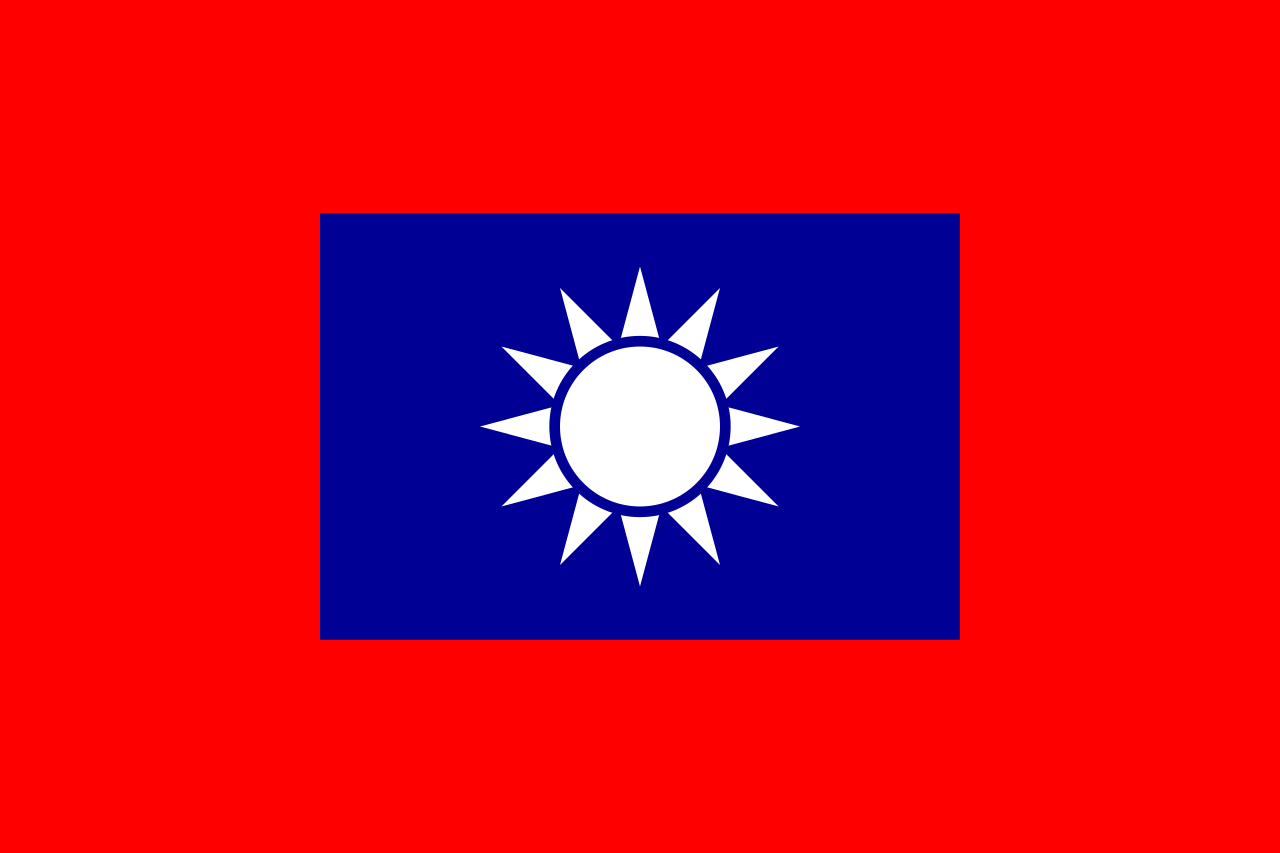
El ejército de la República de China (Taiwán) también tiene una única bandera que utiliza, que es roja, con un estandarte del cielo azul con un sol blanco en el centro. Tiene un asta roja con un remate de punta de lanza plateada y borlas rojas inmediatamente debajo. Las unidades individuales usan una variación de la bandera del ejército como su propio color de identificación; esto presenta una franja blanca junto al polipasto, que tiene el nombre de la unidad en caracteres negros, así como una franja dorada (como es el caso desde 1961 para todas las unidades de las Fuerzas Armadas de la República de China , pero desde 1947 se limitaron solo a las unidades del ejército por encima del nivel de regimiento). El color de la guardia de honor del ejército es dorado con el escudo de armas de la unidad en el centro.
Los colores de la Armada de la República de China eran el rojo pero con el sello de la Armada en un cantón azul oscuro en el centro hasta la década de 1980, los colores de la compañía de la guardia de honor solo usan azul oscuro y el sello de la Armada, que son los mismos colores utilizados hoy en otras unidades de la ROCN.
Para el Cuerpo de Marines de la República de China , los colores de batalla de su unidad, desde 1960, reflejan los del USMC, pero desde la década de 1980 el nombre de la unidad está en la franja blanca cerca del polipasto (al igual que el resto de las fuerzas armadas, anteriormente estaba en un pergamino similar al del USMC).
Los colores utilizados por la Fuerza Aérea de la República de China son azul cielo con el sello de la fuerza aérea en el centro (anteriormente era rojo con el cantón azul cielo con el escudo de armas, el diseño antiguo sólo lo usa hoy la guardia de honor).
Las unidades de la Policía Militar de la República de China , que antes utilizaban el color azul, ahora utilizan el color marrón con los brazos del ROCMP.
Las unidades que dependen del Ministerio de Defensa Nacional llevan el color naranja con el escudo de armas del Ministerio en el centro. Los colores de la guarnición son azules con el emblema del Kuomintang, una corona de trigo y tres círculos entrelazados en amarillo, rojo y azul respectivamente. Las unidades de reserva llevan el color rojo, mientras que la Reserva de Taiwán usa el verde.
Sólo las siguientes academias militares lucen sus colores, ya que el color ROCAF es utilizado por la Academia de la Fuerza Aérea de la República de China :
En todos los eventos en que esté involucrada la ROCAF, la bandera de la ROC se utilizará como color nacional.
Indonesia
En Indonesia , los colores de las Fuerzas Armadas Nacionales de Indonesia , la Policía Nacional de Indonesia y otras instituciones uniformadas se conocen como Panji-panji . El Panji-panji es llevado y escoltado por un guardia de color conocido como "Pataka", una abreviatura de Pasukan Tanda Kehormatan en indonesio . [1]
Colores nacionales y colores de servicio

Durante los desfiles de graduación y de graduación, siempre que se toma el juramento de alistamiento o de nombramiento, se utiliza la bandera de Indonesia como color nacional.
En los desfiles, los colores de servicio más comunes son los de las Fuerzas Armadas Nacionales de Indonesia (TNI), la Policía Nacional de Indonesia y las unidades de la Policía Municipal (conocidas como Panji-Panji Kesatuan/Lambang-Lambang Kesatuan ). Dentro de las TNI, existen colores de servicio para las tres ramas militares. Panji-panji significa colores militares/de servicio en indonesio.
- Fuerzas Armadas Nacionales de Indonesia Tri-Service Color: rojo con el escudo de armas en el anverso y el escudo nacional en el reverso
- Ejército de Indonesia Color: verde con escudo de armas en el anverso
- Marina de Indonesia Color: Azul oscuro con escudo de armas en el anverso
- Fuerza Aérea de Indonesia Color: Azul cielo con escudo de armas en el anverso
No militar:
- Policía Nacional de Indonesia Color: negro y el escudo nacional en el reverso.
- Policía Municipal Color: Azul oscuro
Colores de los comandos y de abajo
Tunggul y Pataka son términos utilizados para identificar colores por debajo del nivel de comando o especialidad de servicio dentro de las Fuerzas Armadas, la Policía Nacional y la Policía Municipal. Los primeros son para unidades de nivel de batallón/escuadrón y comandos territoriales militares o equivalentes, los segundos para brigadas/regimientos, divisiones/comandos regionales y comandos de especialidad de servicio y operativos. Comparten un diseño común: el escudo heráldico de la unidad aparece en el anverso, mientras que el emblema de su formación de informes aparece en el reverso. Todos los colores tienen flecos dorados y llevan un remate Garuda basado en el escudo nacional.
Dentro del TNI , Policía y Policía Municipal , los colores de especialidad son:
- Verde : Infantería , Cuerpo de Ingenieros del Ejército, Comandos Militares Regionales, Comandos Operacionales y Administrativos, Agencias y Departamentos
- Rojo : Comando de Reserva Estratégica del Ejército , batallones y brigadas de Fuerzas Especiales del Ejército , Componente de Reserva
- Negro : Blindados y Caballería, Infantería de la Fuerza Aérea , Infantería de asalto (unidades aerotransportadas y mecanizadas incluidas), Policía municipal, Policía
- Brown : Artillería y artillería de defensa aérea, Academia Militar de Indonesia
- Gray : Logística y transporte, Policía militar, Servicios del ejército
- Azul marino : Azul marino
- Azul ultramar : Fuerza Aérea
- Maroon : Cuerpo de Brigada Móvil (Policía)
- Magenta : Cuerpo de Marines
- Violeta : Comando de Aviación del Ejército
Corea, República Popular Democrática de Corea (Corea del Norte)
.svg/1280px-Flag_of_the_Korean_People's_Army_(1948).svg.png)
.svg/1280px-Flag_of_the_Korean_People's_Army_(1992).svg.png)
El Ejército Popular de Corea es el organismo que agrupa a todas las fuerzas armadas de la República Popular Democrática de Corea . Hasta 1993, el Ejército Popular de Corea estaba representado por una única bandera, que servía como color ceremonial para todos los regimientos, instituciones educativas y formaciones más grandes. El color se basa en la bandera nacional , pero el emblema nacional sustituye a la estrella [2] y en los desfiles los colores estaban rodeados por una franja dorada. Las letras doradas en Hangul hasta 1992 eran "Por la unificación e independencia de la patria y el pueblo" ( 조국의 통일 독립과 인민을 위하여 ), luego reemplazadas por el segundo lema "Por la unificación y la independencia de la patria, y la libertad y felicidad del pueblo" ( 조국의 통). 일, 독립과 인민의 자유와 행복을 위하여 ). A partir de 2023, el lema es "¡Por la prosperidad infinita de la patria y la seguridad del pueblo! ( 조국의 무궁한 번영과 인민의 안녕을 위하여 )".
En 1993, como parte del 40º aniversario de la conclusión de la Guerra de Corea y el 45º desde la fundación de la RPDC, el antiguo color fue reemplazado por los diseños vistos durante más de tres décadas en los principales desfiles festivos. Todos los colores comparten el mismo reverso con el emblema del Partido de los Trabajadores de Corea en oro y, a excepción de los Guardias Rojos Obreros y Campesinos, tienen un dorado idéntico en Hangul que dice "Fuerzas armadas revolucionarias del Partido de los Trabajadores de Corea, Ejército Popular de Corea [nombre de la unidad] / Unidad No.425 (en ceremonias)" ( 조선로동당의 혁명적무장력인 조선인민군 제425 군부대 ), el número 425 en honor a la fecha (25 de abril) de la fundación en 1932 del Ejército Guerrillero Popular Antijaponés, cuyo linaje continúa el servicio actual, pero con los mismos colores que en el anverso, que también muestra la marca 4.25 en numeración dorada. Las unidades de la Guardia también tenían su insignia debajo de la marca 4.25. En 2023, se adoptó un nuevo diseño modificado basado en las plantillas de 1992-93 para el KPA con el lema conservado, y la marca 4.25 finalmente se eliminó, reemplazándola ahora por la fecha de la rama o unidad de servicio. Las formaciones de la Guardia conservaron su emblema oficial debajo de la fecha de fundación. El reverso de estos colores se actualizó. Estos colores están en flecos dorados cuando se muestran en desfiles públicos en Pyongyang , la capital nacional, y durante las visitas de estado de los guardias de honor del Comando de la Guardia Suprema , que es una formación interservicios a diferencia del resto del comando cuyo personal proviene de las Fuerzas Terrestres. Los colores del diseño de 1948 y 1992, desde las celebraciones del 60 aniversario de la conclusión de la Guerra de Corea en 2013, han sido utilizados solo por unidades de guardias y batallones del KPA que visten uniformes de gala históricos de la década de 1940 y principios de la de 1950, los colores de 1992 tienen un contorno de insignia de guardias dorado en el reverso para indicar el estado de guardias del color de la unidad, mientras que los colores solo usan las armas y el lema de 1948 en lugar del actual.
- Antiguo color del KPA hasta 1993: rojo con el emblema nacional en dorado. Anteriormente, el emblema del KPA era dorado (gavillas de trigo y una presa estilizada con una estrella roja rodeada por un círculo dorado con una corona debajo). La bandera anterior no tenía lema en el anverso, sino solo en el reverso. El lema dorado en Hangul decía "¡Por la prosperidad sin fin de la patria y la seguridad del pueblo!" (El lema del KPA se puede encontrar en la página web del KPA )
- KPA propiamente dicho a partir de 2023: rojo con una corona de laurel, un anillo dorado y una estrella roja con el emblema nacional en oro, y el lema Hangul en oro encima y debajo del emblema en el anverso, y el nombre del servicio en Hangul debajo del patrón gráfico con el cuartel general del WPK, dos espadas y un escudo con el emblema del WPK en el reverso, el lema Hangul dorado en las franjas azules superior e inferior que dice "¡Por la prosperidad infinita de la patria y la seguridad del pueblo!"
- Fuerzas Terrestres 1993-97 y 2012-2023 (también utilizada como bandera no oficial de todo el KPA): color en los colores de la bandera nacional pero con las armas nacionales en dorado (anteriormente el emblema del KPA en dorado) y el lema Hangul dorado en el anverso.
- Fuerzas Terrestres 1997–2011 (también utilizada como bandera no oficial de todo el KPA): Color en los colores de la bandera nacional pero con el emblema del KPA en oro y el lema Hangul dorado en las franjas azules superior e inferior que dice "¡Defendamos la sede de la revolución encabezada por el gran camarada Kim Jong Il con nuestras vidas!" ( 위대한 김정일동지를 수반으로 하는 혁명의 수뇌부를 목숨으로 사수하자! ) [2] con el nombre de Kim Jong Il ligeramente ampliado, lema dorado también utilizado en las banderas de las otras ramas
- Fuerzas Terrestres 2012-2023 (también utilizada como bandera no oficial de todo el KPA): Color en los colores de la bandera nacional pero con el emblema del KPA en oro y el lema Hangul dorado en las franjas azules superior e inferior que dice "Por la unificación e independencia de la patria, y la libertad y felicidad del pueblo" ( 조국의 통일, 독립과 인민의 자유와 행복을 위하여 ).
- Fuerzas Terrestres a partir de 2023: Colorea los colores de la bandera nacional pero con un patrón decorativo barroco, un anillo dorado y una estrella roja con el emblema nacional en oro, el lema Hangul dorado en las franjas azules superior e inferior que dice "¡Por la prosperidad infinita de la patria y la seguridad del pueblo!"
- Fuerza Aérea 1993–2023: emblema del KPA con alas (emblema actualizado en 2012), la mitad superior grande en azul de la fuerza aérea y la mitad inferior pequeña en azul oscuro, con 6 franjas alternas (3 azul oscuro, 3 azul de la fuerza aérea), anteriormente alas doradas y una estrella dorada sobre el emblema
- Fuerza Aérea de 2023: la mitad superior pequeña en blanco y negro, la mitad central en azul cielo de la fuerza aérea y la parte inferior en negro dividida por rayas en forma de V en blanco, azul cielo, negro y blanco, la mitad también tiene un anillo dorado con cinco estrellas doradas arriba y un ala dorada debajo, una estrella roja con el emblema nacional en oro y se completa con una silueta de aviones de combate.
- Marina 1993–2023: Emblema del KPA con cuatro anclas doradas encima, bicolor blanco y azul marino con 5 franjas alternas entre las franjas grandes (3 azul oscuro, 2 blancas) en el medio
- Azul marino a partir de 2023: Un anillo dorado con corona de laurel arriba y abajo, una estrella roja con el emblema nacional en dorado, bicolor blanco y azul marino con 5 franjas alternas entre las franjas grandes (3 azul oscuro, 2 blancas) en el medio y una franja azul adicional en la parte superior.
- Fuerzas Estratégicas (color anterior): Verde con el emblema del KPA y una corona más grande sobre la parte superior estilizada de un globo terráqueo, con rayas de color amarillo claro debajo del globo terráqueo.
- Fuerzas de Operaciones Especiales (color anterior): Azul oscuro con el emblema del KPA y una corona más grande, con la Osa Mayor debajo de la marca 4.25
- Oficina General de Misiles: Negro con dos franjas doradas cerca de la parte superior e inferior y estrellas en tonos azul oscuro o celeste, el emblema de la Oficina General de Misiles se logra con un patrón decorativo barroco y una silueta de misiles.
- Escuelas militares revolucionarias hasta 2023: Rojas con el emblema del KPA y el lema Hangul en letras doradas arriba y abajo
- Escuelas militares revolucionarias a partir de 2023: La mitad superior pequeña en rojo y una estrecha franja dorada, la mitad central en verde militar con cuatro franjas rojas, la mitad inferior pequeña en rojo y rematada con una estrecha franja dorada, un anillo dorado con una estrella roja con el emblema nacional en dorado.
- Guardias Rojos Obreros-Campesinos : Rojo con emblema de servicio (estrella roja y corona dorada) en el centro y el lema Hangul en oro encima y debajo del emblema en el anverso, y el nombre del servicio en Hangul debajo del emblema del WPK en el reverso, de 1997 a 2011 el lema Hangul dorado decía "¡Defendamos con nuestras vidas el liderazgo de la revolución liderada por el camarada Kim Jong Il!", de 2012 a 2023 fue "¡Defendamos con nuestras vidas al Comité Central del Partido encabezado por el querido camarada Kim Jong Un!"
- Guardias Rojos Obreros-Campesinos a partir de 2023: Rojo con emblema de servicio (estrella roja y corona dorada) en el centro y el lema en Hangul dorado encima y debajo del emblema en el anverso, y el nombre del servicio en Hangul debajo del patrón gráfico con el Cuartel General del WPK, dos espadas y un escudo con el emblema del WPK en el reverso, el lema en Hangul dorado decía "¡Por la prosperidad infinita de la patria y la seguridad del pueblo!".
Corea, República de (Corea del Sur)
.jpg/1280px-2014.10.1_%EA%B1%B4%EA%B5%B0_66%EC%A3%BC%EB%85%84_%EA%B8%B0%EB%85%90_%EA%B5%AD%EA%B5%B0%EC%9D%98%EB%82%A0_%ED%96%89%EC%82%AC_(15415316492).jpg)
Las tradiciones de los colores de las unidades militares y de las ramas de las Fuerzas Armadas de la República de Corea se derivan en su mayoría de la práctica occidental de considerar la bandera de Corea del Sur como un color nacional.
En la actualidad, cada una de las ramas de servicio de la ROKAF tiene los colores de su regimiento, todos con flecos dorados, que llevan los guardias de color siguiendo una mezcla de tradiciones occidentales. Los colores son los siguientes:
- Ejército : azul y blanco con emblema de servicio.
- Marina : Azul con cantón blanco ( taegeuk con anclas cruzadas)
- Cuerpo de Marines : Escarlata con emblema de servicio
- Fuerza Aérea : Fuerza aérea/azul cielo con emblema de servicio dorado
En los principales desfiles festivos se utilizan dos colores adicionales como parte de la guardia de colores nacional.
- Color Honorario de las Fuerzas Armadas y del Ministerio de Defensa Nacional: Rojo con emblema de las fuerzas armadas
- Color del Estado Mayor Conjunto del MND y ROKAF: carmesí
Los colores de la unidad y de las especialidades siguen una mezcla de los modelos occidentales con influencias del modelo occidental, compartiendo desde los años 1990 un diseño común con el nombre de la unidad en Hangul debajo del emblema (en la Marina, el nombre de la unidad/comando está en un pergamino blanco debajo siguiendo el precedente estadounidense).
- Colores de las unidades del Ejército de la República de Corea
- Colores de regimiento, brigada, división y cuerpo: color del ejército con DUI/emblema de la unidad que reemplaza el escudo de armas
- Infantería: Azul
- Armadura: Amarilla
- Mando de Artillería y Misiles: Rojo burdeos
- Artillería de defensa aérea: Verde
- Ingenieros: Azul claro
- Operaciones especiales: Negro
- Soporte logístico y de servicio: Blanco/Naranja
- Unidades de reserva: Azul oscuro
- Aviación del ejército: Azul
- Colores de las unidades de la Armada de la República de Corea
- Fuerzas de la flota y otros comandos: Azul marino
- Cuerpo de Marines: Escarlata
- Soporte de servicio: Blanco
- Instituciones educativas y de formación: Blanco/Azul marino
- Todas las formaciones de la Fuerza Aérea de la República de Corea: Azul cielo
Además, la unidad de guardia tradicional de la 3.ª División de Infantería de la República de Corea lleva colores similares a los utilizados durante la era imperial, que usaban los Sumunjang o guardias del palacio real con su banda militar tradicional, Daechwita . Solo se utilizan durante las visitas de estado a la república y en los días festivos importantes.
Laos
En Laos , los colores de las fuerzas armadas y otras instituciones uniformadas siguen la práctica norcoreana. Básicamente, se trata de una versión grande de la bandera laosiana con el nombre de la unidad debajo en blanco en la franja superior y roja en la inferior.
Filipinas
Los colores militares filipinos son la bandera de Filipinas como color nacional, los colores de la organización y el color de batalla de la unidad. La bandera de Filipinas es el color nacional de las Fuerzas Armadas de Filipinas , pero a diferencia del color estadounidense, no tiene marcas en la bandera. Los colores de la organización son las banderas de los cuatro comandos de servicio principales de las AFP, mientras que el color de batalla de la unidad difiere según el brazo de servicio y la unidad. Al igual que los EE. UU., también tiene banderas de segundo orden para compañías y tropas, pero también se basan en las banderas y estandartes militares españoles, no en los estadounidenses, lo que refleja la larga historia del establecimiento militar aquí. Por lo tanto, estas banderas no son de cola de golondrina, excepto para la PMA, el Batallón de Escolta y Seguridad del Ejército de Filipinas y algunas otras unidades bajo el Ejército de Filipinas.
Los colores de los colores organizacionales son:
- Ejército : Verde
- Azul marino : azul ultramar
- Fuerza Aérea : Fuerza Aérea Azul
- Cuartel general de la AFP: azul de la fuerza aérea, azul oscuro y verde
Tailandia

Cada unidad de las Fuerzas Armadas Reales de Tailandia recibe un color llamado " Thong Chai Chalermphol " ( en tailandés : ธงชัยเฉลิมพล ) o Colores de la Victoria. Estos son entregados personalmente a cada unidad por el Rey de Tailandia . Los colores se dividen en cuatro diseños diferentes, para: el Ejército Real de Tailandia , la Marina Real de Tailandia , la Fuerza Aérea Real de Tailandia y las unidades de la Guardia Real . Los colores de la Marina Real no llevan flecos, el resto tienen flecos dorados. Todos llevan la cifra del monarca reinante en la esquina superior derecha cerca del polipasto.
Antes de su presentación, los colores son bendecidos ceremonialmente en una ceremonia religiosa a la que asisten monjes budistas y otros dignatarios de alto rango dentro del Templo del Buda de Esmeralda en Bangkok . Durante la ceremonia, en medio del canto de los monjes, el Rey martillará personalmente los clavos de latón en el bastón de cada color usando un martillo de plata. Cada color contiene alrededor de 32 a 35 clavos, en los que se une la tela al bastón de madera. Dentro de la misma ceremonia, el Rey también tomará un mechón de su propio cabello y lo ocultará dentro de un compartimento en la parte superior del bastón, que está cerrado por una tapa redonda de rosca de plata. El Rey también unirá cada color con su propia imagen ceremonial de Buda y bendecirá cada color con agua bendita. La ceremonia está impregnada de herencia budista y brahmica; simboliza y consolida el papel del Rey como Kshatriya Jefe (กษัตริย์) o gobernante guerrero de su reino. También enfatiza su papel constitucional como Jefe y Jefe de las Fuerzas Armadas tailandesas (จอมทัพไทย: Chomthap Thai).
Estos colores son similares a la bandera de Tailandia y, por lo tanto, se tratan como los colores estatales de la Commonwealth, pero no se bajan al suelo sino que se mantienen sobre él al son de Sansoen Phra Barami (el himno real) cuando se saluda con estos colores a la familia real tailandesa (especialmente al Rey y la Reina) en todos los eventos militares a los que asisten.
-
 Color de la unidad del ejército real tailandés
 -
 Color de la unidad de la Marina Real Tailandesa
 -
 Color de la unidad de la Real Fuerza Aérea Tailandesa
 -
 Colores de las unidades de la Guardia Real


Pavo
La bandera de Turquía es utilizada por las Fuerzas Armadas turcas como color nacional y, por lo tanto, tiene características distintivas:
- El TC dorado (monograma turco de la República de Turquía) en la esquina superior izquierda, rodeado de rayos dorados
- El nombre del regimiento, abreviado, debajo de la media luna y la estrella en blanco.
Vietnam
De manera similar a la práctica china, la bandera de Vietnam se usa como color nacional en todas las formaciones de nivel de batallón superior dentro del Ejército Popular de Vietnam . Tiene flecos dorados y, cuando se usa en ceremonias, suele tener el lema dorado Quyết thắng ("determinación para ganar") en la esquina superior derecha del color, cerca del asta, con cualquier condecoración o medalla adherida a él.
Mancomunidad de Naciones
Un trapo comido por la polilla en un poste carcomido,
no parece que vaya a conmover el alma de un hombre.
Son las acciones que se hicieron bajo el trapo comido por la polilla,
cuando el poste era un bastón y el trapo una bandera.
Sir Edward Hamly al ver algunos antiguos colores del 32.º Regimiento de Infantería en la iglesia de Monmouth . [3]
Mientras sus colores perduren y quede un hombre para llevarlos, un regimiento nunca puede morir; pueden reclutarlo de nuevo alrededor de ese hombre, y el regimiento continuará su camino hacia la gloria futura con las mismas tradiciones antiguas detrás de él y la misma atmósfera que lo rodeaba que hizo hombres valientes de sus antepasados. Así que, aunque los colores no son exactamente el alma de un regimiento, son la encarnación concreta de él, y son incluso más sagrados que la persona de un soberano reinante.
Talbot Mundy , El alma de un regimiento
Los colores de la infantería y los estandartes de la caballería son un conjunto de grandes banderas, propias de cada regimiento, que el soldado raso podría identificar inmediatamente. [ cita requerida ]
Australia, Canadá y Nueva Zelanda


Las fuerzas navales y aéreas de estos tres países también tienen colores similares basados en sus propias insignias. Las reglas estipuladas por el Departamento de Defensa canadiense establecen que el Primer Color o el Color Superior simboliza la lealtad de la unidad a la Corona ; la autorización para poseer el color de un rey solo puede ser otorgada, y el color presentado, por el monarca o su representante virreinal. El diseño basado en la bandera de Canadá refleja la costumbre establecida para los regimientos de línea de infantería a mediados del siglo XVIII, cuando el color del soberano se basaba en la bandera nacional, como era la práctica en las unidades británicas y francesas en Canadá. [4]
Fuerzas aéreas
- Real Fuerza Aérea Australiana : El color principal de la RAAF es la insignia de la Real Fuerza Aérea Australiana . Es similar a la de la RAF, pero además del redondel de la RAAF, que se encuentra en la parte inferior, tiene la estrella de la Commonwealth en la parte inferior y las estrellas de la Cruz del Sur en la parte superior, con la cifra real en el centro. La bandera tiene un borde de zarzo dorado y flecos dorados. Los colores del escuadrón y del mando son de color azul de la fuerza aérea con los honores y el emblema heráldico de la formación.
- Real Fuerza Aérea Canadiense : El color del rey de la RCAF es diferente al de otras fuerzas aéreas de la Commonwealth en que no se basa en la insignia, sino que es similar a los colores del rey de los regimientos de infantería: es una bandera nacional de seda de Canadá con un círculo rojo en la hoja de arce inscrito con el nombre del comando, rodeando la cifra real y enarbolando la corona real. Única entre las fuerzas aéreas de la Commonwealth, la RCAF también tiene un color de comando, análogo al color de un regimiento de infantería. Este es azul claro con la insignia de la RCAF en el centro y una hoja de arce en cada esquina, con los tallos hacia adentro. [5] Los escuadrones con 25 años o más de servicio activo reciben estandartes de escuadrón con honores de batalla que rodean la insignia de la unidad sobre el mismo fondo azul claro bordeado con flores (los diez emblemas florales provinciales ).
Ejército

- Los batallones de infantería australianos formados justo antes o durante la Primera Guerra Mundial tenían un par (un soporte) de colores, siendo un Color del Rey basado en la Bandera de la Unión y un Color de Regimiento separado blasonado con el número del batallón y su parche de color (insignia de hombro). Los honores de batalla también se blasonaban en el Color de Regimiento. Estas costumbres seguían la tradición británica. Algunos de esos batallones de la Primera Guerra Mundial se fusionaron antes o durante la Segunda Guerra Mundial . Por ejemplo, el 57.º Batallón se fusionó con el 60.º Batallón en 1930, formando el 57.º/60.º Batallón que vio acción en las campañas del Pacífico Sudoeste durante la Segunda Guerra Mundial. El 57.º/60.º Batallón no tenía sus propios colores, pero a fuerza de la historia heredó ambos soportes de colores del 57.º y el 60.º. De acuerdo con el orden de batalla, el 57.º/60.º llevaba el parche de color del 57.º en sus uniformes, pero aún así desfilaban y presentaban los colores tanto del 57.º como del 60.º. La reina Isabel II dio permiso en 1960 para que los honores de batalla de la Segunda Guerra Mundial (Pacífico Sudoeste 1943-45, Liberación de Nueva Guinea Australiana, Commando Road, etc.) se blasonaran en los colores de la Reina, en lugar de en los colores del Regimiento, que ya estaban blasonados con honores de la Primera Guerra Mundial (Somme, Passchendaele, Villers-Bretonneux, Amiens, etc.). Una situación similar ocurrió con la fusión en 1942 del 58.º Batallón y el 59.º Batallón para formar el 58.º/59.º Batallón , que llevaba el parche de color del 58.º Batallón en sus uniformes, pero heredó y desfiló con ambos colores del 58.º Batallón y el 59.º Batallón . El 57.º/60.º Batallón y el 58.º/59.º Batallón se disolvieron poco después de la Segunda Guerra Mundial y los colores se depositaron en el Santuario del Recuerdo en Melbourne, donde se exhiben en la Cripta. El Santuario y otros monumentos de guerra e iglesias en toda Australia exhiben muchos otros colores del batallón que se han depositado bajo su cuidado, como la Iglesia de San Esteban, en Sídney .
- Aunque los colores de los regimientos de infantería del ejército australiano siguen la tradición británica, a partir de la década de 1960 se utilizan como color del rey los colores basados en la bandera nacional australiana . Las unidades blindadas llevan estandartes y banderines, banderas más pequeñas que los colores y que tradicionalmente llevan las unidades de caballería, lanceros, caballos ligeros e infantería montada. El 1.er Regimiento Blindado es la única unidad del ejército australiano que lleva un estandarte, siguiendo la tradición de las unidades blindadas pesadas. Las unidades de aviación también llevan banderines. Solo los regimientos de la Artillería Real Australiana utilizan cañones en lugar de banderas como colores, a excepción de la Batería de Campaña A , que lleva el estandarte del rey en reconocimiento al servicio como la primera batería de artillería totalmente australiana. El regimiento en su conjunto lleva su propio estandarte del rey. Las unidades que no combaten (cuerpos de apoyo al servicio de combate) no tienen colores, sino estandartes o estandartes. El Royal Military College, Duntroon también tiene un color adicional, el Estandarte del Soberano, llevado anualmente por la Compañía Campeona del RMC del Cuerpo de Cadetes del Estado Mayor formado por la mejor compañía de cadetes del año, que en los desfiles tiene precedencia sobre las otras compañías como la Compañía del Soberano. [6] El propio Ejército desde 2001 tiene un estandarte conocido como el Estandarte del Ejército, llevado en todos los eventos del servicio (ya que el Ejército es el protector de las tradiciones de la Bandera de Australia y, por lo tanto, no tiene su propio color de servicio). Está adornado con flecos dorados, tiene cordones y borlas dorados y carmesí, y está montado en una pica con el remate habitual del escudo real británico. [7] El Estandarte del Ejército lleva el Escudo de Armas de Australia en el anverso, con las fechas "1901–2001" en oro en el asta superior. En el reverso aparece la insignia del "sol naciente" del Ejército australiano, flanqueada por siete honores de campaña en pequeñas volutas con bordes dorados: Sudáfrica , Primera Guerra Mundial , Segunda Guerra Mundial , Corea , Malaya-Borneo , Vietnam del Sur , Mantenimiento de la Paz y Timor Oriental. Fue entregada al Ejército en celebración de su centenario en 2001.
- En el ejército canadiense , los regimientos del Real Cuerpo Blindado Canadiense (RCAC) designados guardias a caballo y guardias de dragones, junto con el Regimiento Canadiense de Operaciones Especiales , tienen estandartes de regimiento. Los estandartes del RCAC tienen un campo carmesí y el estándar del CSOR tiene un campo tostado. Los regimientos del RCAC que no sean guardias a caballo ni guardias de dragones tienen banderines de regimiento carmesí. Cada batallón del Real Cuerpo de Infantería Canadiense , excepto los de regimientos de fusileros, tiene un soporte de dos colores: un color del rey y un color de regimiento. Para los guardias de a pie, los colores del rey tienen un campo carmesí y los colores del regimiento se basan en la bandera nacional canadiense . Para otros regimientos de infantería, los colores del rey se basan en la bandera nacional y los colores del regimiento son del color de la cara del regimiento. Solo el Real Regimiento de Artillería Canadiense usa armas como sus colores. Los regimientos de fusileros comparten las tradiciones de los antiguos regimientos de fusileros británicos de tener sus honores de batalla llevados en sus tambores. Los Ingenieros Reales Canadienses no tienen colores, pero tienen el lema ubique , que en latín significa "en todas partes", en sus insignias y gorras para representar su servicio en todas partes.
- Solo el Regimiento de Infantería Real de Nueva Zelanda , el único regimiento de infantería del Ejército de Nueva Zelanda, tiene un conjunto de colores, con el color del rey ahora basado en la bandera de Nueva Zelanda , con el cantón de la bandera de la Unión que lleva la insignia del regimiento y el color del regimiento es azul real debido a su condición de regimiento real. Los conjuntos de colores están presentes en los dos batallones regulares y tres de reserva del regimiento. Hasta 1964, cuando la infantería de Nueva Zelanda se reorganizó en un solo regimiento, todos los regimientos de infantería de reserva también llevaban sus propios colores. El único regimiento blindado, Queen Alexandra's Mounted Rifles , lleva un banderín en las tradiciones de las unidades de caballería formadas en Nueva Zelanda desde el siglo XIX.
Marina de guerra
- Marina Real Australiana : El color del rey de la RAN es la bandera blanca australiana , que es un reverso de la bandera nacional australiana (blanca con estrellas azules), con la cifra real de Isabel II y la banda de la Jarretera colocadas entre la estrella de la Commonwealth y las estrellas que representan la Cruz del Sur. (Véase los colores anteriores en la Capilla Naval, Garden Island NSW ). La RAN posee dos colores, el primero es el color de la flota que ostenta en nombre de las unidades de la flota el Cuartel General de la Flota, HMAS Kuttabul . El segundo, conocido como el color del Establecimiento, lo ostenta el HMAS Cerberus en nombre de los establecimientos de la costa.
- Marina Real Canadiense : La bandera naval del rey es una variación de la bandera naval canadiense : es blanca, con la bandera canadiense en el cantón, el símbolo de la bandera personal de Isabel II para la Commonwealth (una "E" coronada rodeada de una corona de rosas) en el centro y el símbolo de la marina en la parte inferior. El borde de la bandera está bordeado de oro. Hasta 1979, la RCN poseía dos colores idénticos: uno para la flota del Atlántico y otro para la flota del Pacífico. Desde entonces, se ha mantenido un solo color en el Cuartel General del Servicio Naval.
- Marina Real de Nueva Zelanda : desde 1968, la bandera real de la RNZN es una variante de la insignia naval de Nueva Zelanda (la bandera de Nueva Zelanda, pero en blanco), con la cifra real de Isabel II y la banda de la Jarretera situadas cerca de la Cruz del Sur.
-
 Color del Rey de la Marina Real Australiana
 -
 Color del Rey de la Marina Real Canadiense
 -
 Color del Rey de la Marina Real de Nueva Zelanda


India
Dada su herencia de la Commonwealth como antigua colonia británica, las Fuerzas Armadas de la India lucen colores equivalentes a los utilizados en el ejército británico.
Colores presidenciales para prestar servicios en las distintas ramas de las fuerzas armadas
-
 Bandera del Presidente de la Armada de la India
 -
 El color del presidente de la Fuerza Aérea de la India


Sólo la Armada y la Fuerza Aérea lucen los Colores de Servicio del Presidente, que son sus respectivas insignias navales y banderas de la Fuerza Aérea , que tienen flecos dorados con modificaciones:
- El PSC de la Armada, utilizado desde 2022, lleva el capitel del león de Ashoka , la base del emblema estatal, sobre las armas heráldicas navales, con el lema nacional Satyameva Jayate ( Sólo la verdad triunfa ) debajo.
- El PSC de la Fuerza Aérea tiene un elefante sobre el escudo de la Fuerza Aérea.
Colores/estandartes/banderas/estandartes presidenciales de unidades militares

Los colores del Presidente (el estandarte y el banderín para las unidades montadas del Ejército y las unidades de vuelo de la Fuerza Aérea, y los estandartes para las armas de servicio y la infantería ligera) son otorgados a unidades distinguidas de las Fuerzas Armadas por el Presidente de la India , que es el Comandante Supremo de las Fuerzas Armadas ; son los equivalentes a los colores de regimiento británicos. En el Ejército , estos colores llevan la insignia del regimiento/batallón y cualquier honor de batalla reconocido ganado por la unidad.
- Ejército
- Estandartes de caballería: por color de cara
- Guidons de caballería – igual que los estándares
- Banderas de artillería y defensa aérea: rojo burdeos y azul
- Colores de infantería: según el color respectivo
- Colores de infantería ligera y fusileros: los mismos que los de la infantería regular
- Banderas/colores del Cuerpo de Servicio: según los colores respectivos
- Fuerza Aérea – azul cielo
Sólo la Guardia Presidencial ha tenido en la actualidad un estandarte completo siguiendo la práctica británica, compuesto por el Estandarte del Presidente y un Estandarte del Regimiento.
Malasia
El mismo formato de los colores del soberano y del regimiento se aplica también en Malasia. Los colores del rey y del regimiento de las Fuerzas Armadas de Malasia son las banderas otorgadas por el rey de Malasia en sus responsabilidades como comandante supremo en jefe de las Fuerzas Armadas y por los otros ocho monarcas estatales. Los colores se otorgan a las unidades reconocidas como unidades reales y a las banderas de grandes formaciones (el color del rey) y a las unidades que reciben sus nuevos colores de regimiento (el color de regimiento de la unidad).
El color del rey es amarillo con el escudo nacional rodeado de arroz en el centro. Por lo tanto, Malasia es uno de los dos únicos países de la Commonwealth, el otro es Brunei , que no utiliza su bandera nacional como color principal (la bandera es el color principal de todo el establecimiento de las Fuerzas Armadas). Los lados están blasonados con los honores de batalla de la unidad. En el cantón se puede ver el emblema de servicio de cualquiera de los servicios de las Fuerzas Armadas (Ejército, Marina y Fuerza Aérea). El color del regimiento, sin embargo, difiere según el brazo o rama del servicio (este último caso se utiliza en el Ejército) y la unidad. Ambas banderas tienen flecos dorados que las rodean. Estos colores solo están presentes en los desfiles formales.
Durante el Desfile del Día de la Independencia y el Día de las Fuerzas Armadas, el 21 de septiembre, como las fuerzas armadas que participan en el desfile no visten sus uniformes de gala, solo el 1.er Batallón del Regimiento Real Malayo , que viste uniformes de gala, está presente con sus colores del Rey y del Regimiento. Para el resto de los servicios que participan en el desfile público, se aplica el siguiente orden:
- Bandera de servicio/bandera del campamento del regimiento
- Bandera de Malasia (color nacional)
- Color de las Fuerzas Armadas de Malasia
Además, en la década de 1910 se le concedió a la Real Fuerza Militar de Johor el privilegio de tener su propio color de regimiento, como única fuerza de defensa estatal del país.
La Institución Victoria es la única institución educativa privada que recibió la distinción por su papel en la Segunda Guerra Mundial.
Singapur
Los colores militares de las Fuerzas Armadas de Singapur se dividen hoy en colores de estado de servicio y colores de regimiento de unidad. Hasta 1997 también había colores de regimiento de servicio y colores de estado de unidad. Los colores de estado de servicio son similares a la bandera de Singapur , pero difieren según el servicio, con el emblema del servicio en el campo blanco. Pero los colores de regimiento son diferentes y difieren según la unidad o el brazo de servicio (excepto las banderas de la Fuerza Aérea y la Marina que muestran sus respectivos colores de servicio en su lugar y algunos comandos de servicio de las SAF como la Policía Militar). Su diseño común es el de las armas de regimiento o de comando en el centro del color, que es del color de los revestimientos del uniforme de la unidad o la rama de servicio a la que pertenece. Ambos tienen flecos dorados y se muestran solo en ocasiones importantes. Los antiguos colores de estado de unidad llevaban el emblema o insignia de la unidad en el campo blanco de la bandera nacional.
Sri Lanka

Cuando Sri Lanka se declaró república en 1972, las unidades que tenían el color del Rey, primero con la Union Jack y luego con la bandera nacional actual , lo retiraron. Se reemplazaron por el nuevo Color del Presidente , que se otorgó por primera vez en 1972. Se han otorgado los siguientes colores:
- Ejército de Sri Lanka
- Regimientos
- Establecimientos
- Centro de entrenamiento del ejército – 1972, fuera de servicio el 20 de agosto de 1992
- Academia Militar de Sri Lanka – 1997
- Fuerza Aérea de Sri Lanka
- Fuerza Aérea de Sri Lanka – 1976
- Regimiento de la SLAF – 2009
- Escuadrones
- Estaciones
- Katunayake de la SLAF – 2001
- Marina de Sri Lanka
- Comandantes
- Establecimientos
- Academia Naval y Marítima – 2000
Los colores del regimiento siguen el modelo británico, y los dos regimientos de infantería ligera ( el Regimiento Sinha de Sri Lanka y el Cuerpo de Fusileros de Sri Lanka ) no llevan ningún color. A diferencia de la Artillería Real británica, la Artillería de Sri Lanka lleva un conjunto de colores del Presidente y del Regimiento, lo mismo ocurre con los Ingenieros de Sri Lanka.
A diferencia de la Fuerza Aérea, que utiliza un diseño de un solo color similar al de la RAF, la Marina utiliza colores de unidad y comando de la misma manera que el Ejército.
El diseño de los colores del Presidente de las unidades de la Armada y la Fuerza Aérea son las versiones con flecos dorados de sus banderas de servicio. El color del Presidente del Ejército es una bandera nacional con flecos dorados con el escudo nacional entre las franjas verde azulado y naranja a la izquierda.
Reino Unido
Infantería de línea y guardias de a pie


En los regimientos de infantería del ejército británico y de los ejércitos de otros países de la Commonwealth , cada batallón lleva dos colores, que en conjunto se denominan bandera. Se trata de banderas grandes, normalmente de 36 x 45 pulgadas (91 cm × 114 cm), montadas sobre una media pica de 8 pies y 7 pulgadas de largo.+1 ⁄ 2 pulgadas (2,629 m) de largo; el color del rey o la reina (color del estado o del presidente si el país es una república) suele ser una versión de la bandera nacional del país , a menudo adornada con tela dorada y con la insignia del regimiento colocada en el centro. El color del regimiento es una bandera de un solo color, generalmente el color de los revestimientos del uniforme (cuello/solapas y puños) del regimiento, nuevamente a menudo adornado y con la insignia en el centro. La mayoría de los regimientos que se designan como regimientos "reales" (es decir, tienen la palabra "Real" o el patrocinio de un personaje real en su nombre) tienen un color de regimiento azul real , la mayoría de los regimientos reales tienen un cantón de la bandera de la Unión en ese fondo. Los regimientos irlandeses, hoy el Regimiento Real Irlandés , tienen un color de regimiento verde oscuro.
Los colores de los cinco regimientos de la Guardia de Infantería tienen el patrón de la infantería de línea invertido, siendo el color del rey de cada uno de los 1.º Batallones el carmesí con la insignia del regimiento, una corona real y honores, y el color del regimiento una variación de la bandera de la Unión con los honores de batalla bordados. Los colores del rey de los batallones adicionales de estos regimientos (actualmente en manos de las cinco compañías adicionales de cuatro de los seis regimientos) presentan un cantón de la bandera de la Unión en la esquina superior.
Colores adicionales

- Los guardias de Granaderos , Coldstream y Escoceses tienen cada uno al menos un color estatal; este suele ser carmesí con varios dispositivos y honores del regimiento, y la cifra real en las esquinas. Solo los usan las guardias de honor de cualquier unidad de estos regimientos, no los encuentra la Guardia del Rey, montados en ocasiones estatales cuando el Rey está presente. Solo se arrian ante el Rey y la Reina y en ocasiones estatales solo cuando el rey está presente, incluso si la guardia de honor se monta en honor de algún otro personaje. El diseño de color es más grande que los colores normales de la División de Guardias utilizados en ceremonias.
- El 1.er Batallón, Regimiento Real de la Princesa de Gales , como descendiente directo, lleva el tercer color inicialmente llevado por el 2.º Regimiento de Infantería, posteriormente rebautizado como Regimiento Real de la Reina (West Surrey) que, por una razón u otra, nunca fue quitado del regimiento en el siglo XVIII cuando se implementaron nuevas regulaciones sobre los colores.
- El 1.er Batallón, Regimiento Real de Fusilieros lleva el color del tambor otorgado después de la Batalla de Wilhelmsthal al 5.º Regimiento de Infantería (más tarde los Fusilieros Reales de Northumberland ), del que es descendiente directo.
- El 3er Batallón, Regimiento de Yorkshire (Duque de Wellington) , como descendiente directo, lleva los colores honorarios del Rey y del Regimiento que la Honorable Compañía de las Indias Orientales entregó al 76º Regimiento de Infantería después de sus acciones en Delhi y Allyghur .
- El 2.º Batallón de Fusilieros Reales de las Tierras Altas, Regimiento Real de Escocia, lleva el color Assaye otorgado como color honorario al 74.º Regimiento de Infantería después de la Batalla de Assaye , que se luce todos los años en el Día de Assaye.
- La Honorable Compañía de Artillería tiene tanto un conjunto de colores (del rey y del regimiento) como de cañones. Estos últimos también se consideran colores y reciben los mismos elogios, al igual que la Artillería Real considera sus cañones como sus colores.
Regimientos de fusileros
Por tradición, los regimientos de fusileros no llevan banderas, algo que se remonta a su formación, cuando se utilizaban como tiradores y escaramuzadores. Aunque las unidades individuales pueden haber tenido estandartes o banderines para distinguirse de otras unidades, los regimientos en su conjunto nunca necesitaron una bandera completa. Hoy en día, los dos regimientos de fusileros del ejército británico, los fusileros y los fusileros gurkhas reales, llevan sus honores de batalla en sus tambores, mientras que los Royal Green Jackets también los tenían inscritos en la insignia de su gorra ; esta tradición se mantiene en los fusileros, que llevan la insignia de la cruz de Malta de los Royal Green Jackets, inscrita con los honores del regimiento, como insignia del cinturón. En lugar de un color de regimiento, los gurkhas llevan la porra de la reina otorgada en 1863.
El Regimiento Sinha de Sri Lanka fue el primer regimiento moderno no británico en recibir porras cuando se le otorgaron en 2017. En 2019, se otorgó una porra similar, la Rana Parashuwa , al Regimiento de Fuerzas Especiales del Ejército de Sri Lanka , la primera de su tipo otorgada a una formación de fuerzas especiales de la Commonwealth. Anteriormente, el Regimiento de Rangers Reales del Ejército de Malasia recibió una porra de regimiento en 1966.
En la India , el presidente de la India entrega colores o estandartes en lugar de porras, siguiendo la práctica rusa y de acuerdo con las antiguas tradiciones indias, a todos los regimientos de infantería de reconocimiento y fusileros .
Colores en los regimientos de caballería
En las unidades de caballería del ejército británico , el estandarte de caballería del rey y el estandarte del regimiento (para la caballería pesada) y los banderines de caballería del rey y los banderines del regimiento (para la caballería ligera) son los equivalentes a los colores de la infantería de línea. El estandarte del rey es carmesí con el escudo de armas real y la cifra, más los honores del regimiento, mientras que el estandarte del regimiento (escuadrón/unión) tiene un color de fondo adaptable por unidad (el color es a veces escarlata) e incluye a veces la insignia de la Unión debajo de la corona y la cifra real a los lados de la insignia, con los honores de la unidad debajo. El banderín de caballería ligera tiene cola de golondrina e incluye el escudo de armas y los honores del regimiento. Sin embargo, antes de la década de 1950, los timbales en los caballos de tambor (y más tarde los tambores de caja, bajos y tenores en las bandas desmontadas) llevaban los honores y las insignias del regimiento de caballería ligera. Para los regimientos de guardias de dragones , la secuencia es mixta, ya que estos regimientos tienen un estandarte de caballería del rey y banderines de regimiento.
La Caballería de la Casa Real tiene los siguientes colores únicos:
- Los Guardias de la Vida: Sólo el estandarte de la caballería del Rey
- Los azules y los reales : estandarte de caballería del rey, banderín del regimiento
Adornos
Entretejidos sobre los colores se encuentran honores de batalla ; el color del rey tiene honores de la Primera Guerra Mundial y la Segunda Guerra Mundial, mientras que el color del regimiento tiene honores de otras campañas. El color del regimiento también puede tener otras distinciones, incluidos emblemas anteriores y honores únicos; un ejemplo significativo es el emblema de la Esfinge que llevan los regimientos que participaron en la campaña de Egipto de 1801. Los guardias de infantería llevan honores de batalla de todos los enfrentamientos en ambos colores. Si el regimiento tiene más de un batallón, entonces hay marcas de identificación en los colores para mostrar a qué batallón pertenecen.
Hay varios otros adornos que se pueden agregar a los colores en diversas ocasiones:
- En los aniversarios de diversos honores de batalla y algunos otros eventos, se añade una corona de laurel en la parte superior de la pica.
- Se pueden añadir a los colores los equivalentes a honores de batalla otorgados por países extranjeros, siempre que se obtenga el permiso del jefe de estado . En la Commonwealth, se permite a tres batallones de infantería exhibir la cinta azul de 1,2 m (4 pies) de largo que simboliza la Mención Presidencial de Unidad/Mención Distinguida de Unidad (PUC), que es el premio colectivo más alto otorgado por los Estados Unidos:
En el Reino Unido, el 41.er Comando de los Royal Marines y el 1.er Batallón del Regimiento de Gloucestershire también recibieron la PUC y se les permitió exhibir la cinta de los colores de su regimiento.
Por su importancia para el regimiento, antes de presentar un nuevo conjunto de colores, se consagran .
Real Fuerza Aérea

Los colores de la RAF están hechos de seda azul celeste y miden aproximadamente 36" × 36". Se han concedido los siguientes colores:
- RAF College, Cranwell , aprobado el 27 de diciembre de 1947, presentado el 6 de julio de 1948.
- La RAF en el Reino Unido, aprobado el 27 de diciembre de 1947, presentado el 16 de mayo de 1951.
- No. 1 Escuela de Entrenamiento Técnico de la RAF , aprobada el 27 de diciembre de 1947, presentada el 25 de julio de 1952.
- Regimiento de la RAF , presentado el 17 de marzo de 1953.
- Fuerza Aérea del Cercano Oriente , presentado el 14 de octubre de 1960, fuera de servicio el 31 de mayo de 1976.
- Fuerza Aérea del Lejano Oriente , presentado el 13 de julio de 1961, retirado el 30 de enero de 1972.
- Escuela Central de Vuelo , presentada el 26 de junio de 1969.
- RAF Alemania , presentado el 16 de septiembre de 1970, retirado el 27 de junio de 1993.
- Real Fuerza Aérea Auxiliar , presentada el 12 de junio de 1989.
- RAF Halton , presentado el 31 de octubre de 1997.
- Regimiento de la Real Fuerza Aérea , presentado en julio de 2017. [8]
El color del rey de la Real Fuerza Aérea del Reino Unido es una variación de la insignia de la RAF con sus dimensiones modificadas. El escudo de la RAF se ha trasladado a la parte inferior del ala, y su lugar en el centro lo ocupa de nuevo la cifra real coronada por la corona. Otros colores presentan la insignia de la unidad en el centro con la cifra real y la corona en el primer cuartel.
Los estandartes del escuadrón de la RAF son su contraparte de los colores del regimiento. Son de color azul de la fuerza aérea rodeados de una franja dorada, con las insignias y los honores del escuadrón.
Hospital Real, Chelsea
El Royal Hospital, Chelsea no tuvo colores ni ningún otro elemento distintivo durante toda su historia, hasta que en 2002 la reina Isabel II le entregó la Maza del Soberano . Ahora, un grupo de pensionistas la luce en todos los actos ceremoniales del Royal Hospital.
Marines reales
El Cuerpo de Marines Reales tiene un único color real, que es la bandera de la Unión con el ancla sucia y la cifra del soberano reinante entrelazadas en el centro. Arriba hay un pergamino con el único honor de batalla de Gibraltar coronado por la Corona de San Eduardo . Debajo está el globo (que representa los muchos honores de batalla que los Marines Reales habían ganado) rodeado por una corona de laurel (que representa la Batalla de Belle Isle) y debajo de esto hay un pergamino con el lema del cuerpo. Cada uno de los cuatro comandos (las formaciones del tamaño de un batallón que componen la mayor parte del cuerpo) tiene un color real, con la única diferencia que es el color de los cordones y las borlas. Cada comando también tiene su propio color de regimiento. El color del regimiento es una bandera azul oscuro (porque el cuerpo está clasificado como un "regimiento real") con una pequeña bandera de la Unión en la punta de la pica. El color lleva adornos centrales similares al color del rey, con la excepción de que la cifra de Jorge IV reemplaza a la del monarca reinante y el número de unidad está debajo. La cifra real está en las otras esquinas. Los colores del regimiento también tienen cordones y borlas de colores, que son dorados combinados con los siguientes colores:
- 40 Commando : Azul claro
- 42 Comando : Blanco
- 43 Commando : Oro viejo y escarlata
- 45 Comando : Rojo
El ex 41.º Comando recibió la Mención de Unidad Distinguida por su servicio en la Guerra de Corea , y por lo tanto se le permitió llevar la cinta en su color de regimiento. [9]
Marina Real
Los colores de los barcos de Su Majestad en la Marina Real consisten en:
- una bandera blanca (usada en la popa, o desde el garfio o la verga mayor cuando se está en el mar);
- una Union Jack (usada en el mástil del barco en la proa cuando no está en navegación o cuando el barco está aparejado);
- un gallardete de mástil (usado en el tope del mástil, excepto cuando es reemplazado por la bandera de un almirante o el gallardete ancho de un comodoro ).
Además, cada mando principal de la Marina Real tiene también su propio color real, que es una variación de la bandera blanca , con sus dimensiones modificadas para reflejar las de los colores de los regimientos de infantería. En el centro se encuentra la cifra real del monarca reinante dentro de la Jarretera , coronada por la corona .
A diferencia de los colores de los regimientos del Ejército, los colores del rey de la Marina Real son idénticos y no tienen honores de batalla. Las siguientes unidades llevan el color del rey de la Marina Real:
- Comando de Aviación Naval (ACOS (AV)), HMS Heron )
- Comando de Submarinos (CAPTFASFLOT), HMS Neptune )
- Flota ( sede de la CINCFLEET )
- Colegio Naval Real Britannia
- Flotilla de superficie (MWS, HMS Collingwood )
- Reserva Naval Real (Comandante, HMS Vivid )
La Royal Fleet Auxiliary también lleva el color real, algo único para una organización civil. Es una variación de la insignia azul de la RFA , con las dimensiones modificadas para reflejar el color real de la Royal Navy. Tiene la misma cifra real en el centro.
Europa
Bélgica
Las unidades de infantería llevan un drapeau / vaandel , un cuadrado tricolor vertical de negro, amarillo y rojo basado en la bandera nacional dentro de una franja dorada de 15 mm de ancho, con una superficie total de 90 cm cuadrados. Los nombres de los honores de batalla por los que se citó a la unidad están bordados en oro en francés en el anverso y en holandés en el reverso, en líneas rectas.
Dinamarca

Las unidades de la Armada, el Ejército y la Fuerza Aérea danesas llevan un color de unidad ( en danés : regimentsfane ) y para los Guardias Salvavidas un color de batallón ( bataljonsfane ), que mide 105 × 140 cm, las antiguas unidades a caballo un banderín ligeramente más pequeño. [10] La bandera es una variación de la Dannebrog , con una cruz de Dannebrog blanca curvilínea, llamada cruz de Mantua, colocada con su centro aproximadamente a la mitad del ancho del asta desde el borde del asta. La cifra real está bordada en oro sobre el centro de la cruz, la insignia de la unidad en oro en el asta superior y el número de la unidad, el nombre o ambos en oro en el asta inferior. Algunos regimientos tienen marcas adicionales en la mosca superior. El Jyske Dragonregiment , por ejemplo, tiene la cifra del Príncipe Henrik en la mosca superior. El remate es una punta de lanza calada de oro adornada con la cifra real en el centro. Debajo de la punta de lanza se pueden colocar una o más banderines de campaña ( fanebånd ). El color está decorado con un cordón dorado con dos borlas y bordeado con una fina tira de cordón dorado. La manga que sujeta el color a la pica está unida con clavos ornamentales, los tres primeros de los cuales representan al soberano, la Patria y la Unión.
Finlandia
Las unidades de las Fuerzas de Defensa de Finlandia tienen un solo color. Los colores pueden ser activos o tradicionales. Un color activo pertenece a una brigada o unidad equivalente en las FDF. Un color tradicional pertenece a un batallón o regimiento que anteriormente estaba separado, pero ahora es parte de una brigada. La diferencia entre un color activo y tradicional es la forma de presentarlos. El color activo siempre tiene una guardia de dos oficiales, mientras que el color tradicional se lleva sin uno. El juramento militar siempre se realiza en presencia del color activo de la unidad.
La heráldica militar finlandesa es una mezcla de tradición escandinava y rusa. Los colores suelen inspirarse en las banderas de regimiento sueco del siglo XVII, pero algunas unidades llevan banderas que recuerdan a las tradiciones rusas o alemanas. Los colores suelen llevar el emblema de la provincia en la que se encuentra una unidad. También suelen presentar los colores tradicionales de una rama de servicio o un elemento de diseño compartido, por ejemplo, las banderas negras de la mayoría de las unidades de ingenieros . No se otorgaron honores de batalla durante la Guerra de Continuación (cobeligerante con la Alemania nazi ), pero algunas unidades tienen honores de batalla de la Guerra Civil Finlandesa y la Guerra de Invierno .
Las unidades e instituciones de las Fuerzas de Defensa de Finlandia que no han recibido un color propio utilizan la bandera de Finlandia sin adornos con forma de cola de golondrina como su color estatal, y el juramento de servicio para los suboficiales y el personal alistado voluntario asignado a estas unidades se realiza en su presencia.
-
 El color del Regimiento de Cazadores de la Guardia Finlandesa . Observe el diseño de la bandera al estilo imperial ruso, que simboliza el linaje del regimiento como parte de la guardia imperial rusa.
 -
 El color de la Brigada Blindada presenta los colores negro y plateado de las ramas de las tropas blindadas finlandesas, mientras que el emblema principal es un casco de coracero que simboliza la fuerza blindada.
 -
 El color de la Brigada Pori incluye los colores azul y amarillo de Satakunta y los escudos de armas de Satakunta y Finlandia Propia en sus dos lados. El color lleva la cinta de la Orden de la Cruz de la Libertad como banderín.
 -
 El color tradicional del Batallón Kymi Jaeger, que hoy forma parte de la Brigada Karelia , es el definido para la infantería ligera. El Batallón Kymi Jaeger sigue las tradiciones del 3.er Batallón de Ciclistas y lleva ese número en su color, y la Orden de la Cruz de la Libertad tanto como banderín como en la punta del bastón.
 -
 El color tradicional del Batallón de Transmisiones de Finlandia Oriental, parte de la Brigada de Carelia, tiene los colores de la rama del cuerpo de transmisiones: púrpura y dorado. El emblema que representa un urogallo occidental es un retroceso a la denominación anterior, Batallón de Transmisiones de Finlandia Central. El emblema principal, los tres rayos, es un símbolo de comunicación.
 -
 El color tradicional de la 7.ª Flotilla de Combate de Superficie de la Flota Costera presenta un merlion azul adaptado del León de Finlandia , que golpea con un tridente.
 -
 El color del Centro Internacional de las Fuerzas de Defensa de Finlandia muestra un león de Finlandia que sostiene un bastón de heraldo además de una espada. El tono de azul es el mismo que el de la bandera de las Naciones Unidas .
 -
 El color del Mando Aéreo de Carelia , como todos los colores de la Fuerza Aérea finlandesa , es una esvástica dentro de un círculo alado. El elemento de identificación es un pequeño escudo de armas de Carelia.
 -
 El color del Regimiento Utti Jaeger presenta un grifo, que representa la aviación militar al combinar el león del ejército con el águila de la fuerza aérea. La esvástica estilizada se asemeja al rotor giratorio de un helicóptero.
 -
 El color del Batallón de Cazadores de Kainuu, parte de la Brigada de Kainuu , sigue el formato tradicional de cola de golondrina de las unidades de infantería. La bandera presenta el escudo familiar del fundador de la ciudad de Kajaani , el conde Brahe , así como el símbolo de la 14.ª División que se formó y luchó en las cercanías.


Francia
En enero de 1188, en una reunión entre Enrique II de Inglaterra y Felipe II de Francia , se acordó que ambos irían a una cruzada, y que Enrique II usaría una cruz blanca y Felipe II usaría una cruz roja. [11] Más tarde, [ año necesario ] este uso se invirtió, y los ingleses comenzaron a usar una cruz roja sobre blanco, y los franceses una cruz blanca sobre rojo. [ cita requerida ]
Fondo
A medida que el uso de los colores de los regimientos se extendió por Europa, se desarrolló la costumbre de utilizar una cruz blanca simétrica como base del diseño de las banderas de los regimientos franceses y, en el siglo XVIII, casi todos los regimientos tenían una cruz blanca. Los regimientos se distinguían por los colores de los cantones .
Después de la Revolución Francesa y la aparición de la nueva Tricolore , las cruces desaparecen en 1794 y se utilizan diversas combinaciones de la bandera tricolor. Napoleón la estandariza primero en 1804 con una chape-chausse de campo blanco de rojo y azul, y en 1812 con la bandera francesa moderna. En lo alto del asta de colores del ejército napoleónico se coloca el Águila Imperial (inspirada en la antigua Aquila romana ), que en realidad llegó a ser un símbolo más importante del regimiento que los propios colores.
-
 Francés, cruz blanca, e inglés, cruz roja, luchando en la batalla de Formigny durante la Guerra de los Cien Años .
 -
 Regimiento de Auvernia .
 -
 Regimiento de Normandía .
 -
 Regimiento del Rey ( Régiment du Roi ).
 -
 Las banderas de los regimientos prerrevolucionarios inspiraron la bandera de Quebec (aquí, las Compagnies Franches de la Marine ).
 -
 Bandera del regimiento imperial francés con su águila (1804-1812).
 -
 Bandera del regimiento del 1er Regimiento de Granaderos de la Guardia Imperial Francesa (1812).


Honores de batalla con los colores actuales

The modern French Armed Forces are not officially considered to be the successors of the Royal Army and Navy, although many of their individual units trace their histories to before the foundation of the First Republic. Accordingly, battles fought and won by the Royal Army and Navy before the French Revolution (such as Patay, Fontenoy, Chesapeake, Porto Praya and so on) do not appear as battle honours on regimental colours. The names of battles of the old times, however, which are rightly still considered as glorious by the modern French Army, are honoured by being given to ships or armoured vehicles, and remembered by anniversaries.
As an example, the 1st Infantry Regiment, founded in 1479 during the reign of Louis XI, has fought a number of battles since the 15th century, but its battle honours are only recorded from 1792 onwards:
- Valmy 1792
- Fleurus 1794
- Moeskirch 1800
- Biberach 1800
- Miliana 1842
- Guise 1914
- Verdun – L'Yser 1916–1917
- La Somme 1916
- L'Ourcq 1918
- Résistance Berry 1944
- AFN 1952–1962.
Latest official regulations
The following official documents relate to the colours of the Land Army (armée de Terre) :
- recommendation (circulaire) 808 EMM/CAB of 5 December 1985 rules what sorts of units can be given colours, abiding to previous regulations of joint services;
- decision 12350/SGA/DPMA/SHD/DAT of 14 September 2007 deals with the inscriptions of battle honours upon the flags and standards of the units of the Army, the Defence Health service and the Military Fuel Service;[12]
- government order of 19 November 2004 relates to the award of the AFN 1952–1962 battle honour to flags and standards of Army and Services units.[13]
Army in general
- Regimental colours of units which are traditionally on foot, such as Infantry regiments of the line, Marine Infantry, Foreign Legion Infantry, Parachute Infantry, Engineers, Signal Corps and Military Colleges are called drapeaux (flags).
- Regimental colours of the (traditionally) mounted units of the Armoured Cavalry Branch and other cavalry units such as Dragoon Paratroopers, Hussar Paratroopers, Legion Cavalry, Artillery (including Marine Artillery, Legion Artillery, etc.), Transportation, Army Aviation, and Materiel, are called étendards (standards).

Regimental colours are 90 cm × 90 cm Tricolore silk square flags – standards are smaller: 64 cm × 64 cm – surrounded by a golden fringe. Both are set on a stave (2.11 m long and 32 mm diameter – staves for standards are slightly shorter) ended by a 38 cm pike-shaped finial with a cartouche bearing the initials "RF" for République française on one side, and the name or number of the unit on the other side.
The cravate hanging from the pike is made of two tricolour silk ribbons, 90 cm long and 24 cm wide, ended by an 8 cm gold fringe on which the unit number or monogram is embroidered in gold, encircled by an oak and laurel wreath. French decorations and fourragères[note 1] awarded to the unit are pinned or tied to the cravate; foreign awards and decorations are borne on a red velvet cushion.
All writings on the colour are embroidered in gold, as well the unit number (or monogram) encircled in antique oak and laurel wreath in each corner of the colour.
Obverse of a colour:
- République française
- (Name of the unit)
Reverse of a colour:
- Honneur (Honour)
- Et (and)
- Patrie (Fatherland)
- (Battle Honours)
Rifle battalions (chasseurs à pied)

By tradition, all the Army's rifle battalions (the bataillons de chasseurs à pied together with the chasseurs alpins) share a single collective colour. Individual battalions have pennants (fanions) and the flag of the Rifles (Drapeau des chasseurs) is held each year in turn by a different rifle battalion. As a result, the single flag displays all the battle honours earned by every rifle battalion.
Other specific colours

- Since 1844, the obverse of Foreign Legion regimental colours do not carry the motto "Honneur et Patrie" but "Honneur et Fidélité" (Honour and Fidelity). This motto was originally written on the flags of the Swiss regiments in French service, such as the Régiment de Diesbach (85th Infantry of the line).
- The École polytechnique, as a military college, also has a colour which does not carry "Honneur et Patrie" but instead "Pour la Patrie, les Sciences et la Gloire" (For the Fatherland, Sciences and Glory). The reverse of the École polytechnique's colour has one battle honour written under the motto: Défense de Paris 1814, awarded in 1901 by President Émile Loubet.
- Since 1880, the motto of the Paris Fire Brigade (which is a military unit belonging to the Engineering Arm), "Dévouement et Discipline" (Devotion and Discipline), is written under "Honneur et Patrie".
- The reverse of the Saint-Cyr Military College's colour has seven lines: Honneur / et / patrie / Ils s'instruisent pour vaincre / Premier / bataillon / de France (Honour / and / Fatherland / They study for victory / First / battalion / of France).
Air Force

The colours of Air Force (armée de l'Air) units are by all means similar to those of the Army from which it separated as an independent military arm in 1933. Colours are generally not bestowed to Air Army units smaller than escadres (wings), land combat regiments, air force bases, instruction centres or air force colleges.
National Gendarmerie
The units of the National Gendarmerie (Gendarmerie nationale) have colours which are very similar to those of the Land Army. Each region (formerly legion), instruction centre, college or Republican Guard Regiment has its flag or standard, altogether 56 flags and 2 standards. The reverse of colours of the Departmental Gendarmerie units and Gendarmerie instruction centres have the same motto as the Land Army units (Honneur et Patrie), but the colours of the Mobile Gendarmerie have their own particular motto: Valeur et Discipline (Valour and Discipline). Most subordinate or smaller units use 50 cm large × 40 cm high pennants.
The National Gendarmerie also has a common flag, under the guard of the Director-general, on which five battle honours are registered:
- Hondschoote 1793
- Villodrigo 1812
- Taguin 1843
- Sébastopol 1855
- Indochine 1945–1954
National Navy

The Colours worn by the ships of the National Navy (Marine nationale) consist of the National Ensign and the jack:
- the National Ensign[note 2] is flown at the stern and at the bowsprit if not replaced there by the FNFL jack or a military award jack;
- the FNFL jack is flown at the ship's jackstaff if the ship has fought with the Free French Naval Forces, or is named after such a ship;
- military award jacks may also be flown at the ship's jackstaff if the ship has received mention in dispatches (in which case crew members wear the corresponding fourragère).
Currently, only eight individual National Navy units have colours[14] other than the National Ensign or the FNFL jack. Under recommendation 808 EMM/CAB of 5 December 1985, naval units to which colours can be bestowed must be those with manpower equivalent to that of a regiment, which are specialised in combat or services on land (or corps which have inherited their traditions from such units), and naval instruction centres or colleges. The flags are quite similar to those of Land Army units, the difference being the wreaths in corners which encircle anchors instead of the name of unit, except for the Naval Gunners (initials CM) and the Fleet Engineering Cadets College (initials EAMF).
As of today, these units are (between brackets is where the colours are currently kept):
- the 1er Régiment de fusiliers marins (École des fusiliers marins) – the 1st Naval Fusiliers Regiment (Naval Fusiliers College);
- the Demi-brigade de fusiliers marins (Compagnie de fusiliers marins de Cherbourg) – the Naval Fusiliers Half-Brigade (Cherbourg Naval Fusiliers Company);
- the Canonniers marins (Centre d' instruction naval de Saint-Mandrier) – the Naval Gunners (Saint-Mandrier Naval Instruction Centre);
- the École navale (Groupe des écoles du Poulmic) – the Naval College (Poulmic Schools Group);
- the École militaire de la flotte (Groupe des écoles du Poulmic) – the Fleet Military College (Poulmic Schools Group);
- the École des mousses (Centre d'instruction naval de Brest) – the Cabin Boys College (Brest Naval Instruction Centre);
- the École des apprentis mécaniciens de la flotte (Centre d' instruction naval de Saint-Mandrier)' – the Fleet Engineering Cadets College (Saint-Mandrier Naval Instruction Centre);
- the Bataillon de marins pompiers de Marseille (Bataillon de marins pompiers de Marseille) – the Marseille Marine Fire Battalion (The Marseille Marine Fire Battalion).
French influence
Nations of the former French Empire
Many of today's armed forces of independent countries that once were part of the French Empire share customs and traditions closely similar if not identical to those of the French military regarding organisation of military arms, army and navy rank structures and uniform styles. Indeed, in countries where the decolonisation process had been conducted through peaceful political negotiations (chiefly French West Africa and French Equatorial Africa), French colonial units were sometimes directly inherited by the former colonies where they had been raised to form the basis of the new national armies. This legacy not only included colour etiquette (the way colours are respected, taken care of and paraded), but also design, adapted to new national flag designs.
On the contrary, in countries where independence came as the aftermath of bloody wars of liberation, such as in Vietnam and Algeria, due to the Cold War context, French military culture was strongly rejected often only to be replaced by communist Soviet or Chinese style military culture (colours, ranks, uniforms, parade pace, etc.).
Other nations
As one of the World's great powers together with Great Britain, France did not only exercise its influence by conquest, but also by the prestige of its military. At the height of European colonial expansion in the 19th century, France's army and Britain's navy were each regarded as the most powerful forces ever on land and at sea. This lead many a military to copy both powers' military and naval cultures. As most navies in the World adopted the British naval looks (double-breasted navy blue jacket and peaked cap for officer, blue jean collar for ratings, etc.), numerous land armies adopted French-inspired uniforms during the 1860s and 1870s (both Union and Confederate armies during the American Civil War, the Chilean Army of the War of the Pacific, the Imperial Russian Army, etc.) and even sometimes imported types of French units (e.g. Zouave regiments). France's influence on military fashion dimmed for the time being after the unexpected French defeat ending the Franco-Prussian War of 1870–1871. Many armies then changed to adopt Prussian military style (as a perfect example of this trend, Chilean soldiers traded their kepis for Pickelhauben).
As far as regimental colours are concerned, French influence was mainly to be seen in armies of smaller European powers with strong cultural, economical or political ties to France, notably in such countries whose national flag itself was patterned after the French national flag, such as Belgium or Romania.
-
 Djiboutian colours: French influence through legacy.
 -
 Belgian colours: French influence through common culture.
 -
 Romanian colours: French influence through prestige.


Germany

Units of the Bundeswehr have only a single Colour. The Truppenfahne is a square version of the national flag with the Bundesadler (national shield) overall in the centre. The flag is surrounded by a black, red, and gold lacework border and edged on three sides by gold fringe. The finial is a gilt bronze openwork spearhead surrounding a black and silver Iron Cross. Below the finial, a streamer is attached with the unit badge at the top and its designation embroidered in gold at the end. These streamers are red for army (Heer) units, blue for the navy (Marine), and white for the air force (Luftwaffe). The streamer is the same length as the hoist of the flag.[15]
The tradition was also observed by the National People's Army of East Germany, whose unit colours mirrored the national flag.
Until the Second World War German military units maintained colours of the Prussian pattern regardless of service branch, while the Waffen-SS followed the national flag pattern.
Greece

Traditionally, Army infantry and tank/cavalry regiments have a single colour/standard or war flag (Greek: Πολεμική Σημαία). This is blue, with a white cross and features St George and the Dragon in the centre.[16] The flag has no distinguishing features for individual regiments, although battle honours are sometimes added to the flag; the regiment's identity is inscribed on the flagstaff. The pattern has been in use since the 1830s, with no changes between the periods of monarchy or republic. The Hellenic Army Academy has also been awarded a war flag, its cadets having participated in the Battle of Crete in 1941. Similar flags exist also for the Air Force, featuring the archangel Michael. Recently war flags were assigned to the Army NCO Academy and the Police Academy.
Unlike the Army, Police and Air Force, the Hellenic Navy uses as both the naval ensign and national colour the flag that later became the modern official national Flag of Greece. The Hellenic Coast Guard and the Hellenic Fire Service use the Navy pattern.
Holy See

The flag of the Swiss Guard, the army of the Vatican City, consists of four-quarters. The Coat of Arms of the current pope is in the first quarter, while the arms of Pope Julius II are in the fourth quarter. In the second and third quarters are horizontal stripes of red, yellow and blue, the colours of the unit's uniforms.
The flag also has the coat of arms of the commander within a wreath, on a background of the colour of his canton. The design of the flag changes with the election of a new pope and the appointment of a new commander.
Hungary

The 120 cm × 140 cm Unit colour of the Hungarian Defence Force is the current regulation colour of all Hungarian Defence Forces units since 15 March 1991. The flag is made of white fibres-satin. The height of the coat of arms with the crown is 57, and the width is 58 cm along with the crown. The coat of arms is made of silk with gold and silver embroidery. The edges of the flagship are surrounded by 11–11, and 9–9, 10 cm, red and green flames on the longer sides, extending 15 centimetres. The flames of the flames start and end on each side with a red colour, with the flaming tongues separated by a green circle in the four corners of the flag. The flagpole has a 5 mmm national-colour silk ribbon on its 3 free edges that do not fit the rod, with 10–10 centimetres national colour silk ribs on two free tips. The white part of the flagpole outside the party is twisted once on the pole, fixed with 3 equally spaced brass nails - 25-25-25 mm equally spaced. The flagpole is a 21-centimeter long, stylized leaf-shaped sandblasted brass, on both sides with a baroque, bronze Coat of arms of Hungary, without shield holders. The rod is 238 centimetres long, cylindrical, scarlet-lacquered, bottom-foldable in the lower third. Brass rings at the pole separation lines and a brass cap at the bottom end.[17]
Italy
The Colour (bandiera di guerra) for army units (other than cavalry) is a square version of the national tricolour in silk, 99 cm × 99 cm. It is mounted on a pike 2.2 m long, made of wood covered with green velvet and decorated with ornate brass nails arranged in a spiral. The pike is topped by a 35 cm high finial consisting of an ornate gilt brass spearhead chased with a five pointed star and the monogram RI (for Repubblica Italiana), which is in turn mounted atop a gilt brass ball on which is the name and date of establishment of the unit. The pike is adorned with two silver cords 67 cm long, each with a 10 cm long silver tassel and a blue silk cravat 8 cm × 66 cm with an 8 cm silver fringe at each end, to which the unit's decorations are pinned, the ribbons of the decorations overlapping so that the medals hang down the cravat.
Lithuania
Lithuania's military colours under the Lithuanian Armed Forces tend to follow a mix of the Russian and British practice, as well as of US tradition, with the national flag being designated as a National Colour, but only flown by guards of honour in ceremonies. Unit colours of the Land Forces follow the Imperial Russian pattern, with the fringe in gold or bi-colour of red/green and bearing Vytis (obverse) and unit emblem (reverse) in the centre. The Naval Forces uses a ceremonial form of the naval ensign as an overall branch colour with gold fringe following British precedence.
Netherlands

In the Dutch armed forces, the colour (or standard in case of the mounted (i.e. cavalry and field and horse artillery) regiments) is orange (except for the colour of the midshipman corps,[clarification needed] which is red). All are gold fringed.
On the obverse is the royal cypher of the monarch that gave the regiment its (original) colour, with the unit's name underneath (including the year the regiment or corps was established), both in gold; around the four edges is a laurel branch. Battle honours are added in the corners of the obverse and sometimes also on the left and right of the royal cypher; if additional honours are awarded, they are placed on streamers that are attached to the pike until the presentation of a new colour. Battle honours refer to places (e.g. Waterloo or Rotterdam), areas (West-Java or Afghanistan) (seas included, for example Java-zee), or to a military campaign (Tiendaagse Veldtocht or Veldtocht van 1815); the year or years of engagement are always added, except on the colours of the Netherlands Marine Corps.
On the reverse is the arms of the Kingdom of the Netherlands without the mantle. The shield is blue and is strewn with small upright rectangles; the main device is a crowned rampant lion, holding a sword in its upper paw and a bundle of seven arrows in its lower paw. The lion and rectangles are gold, whilst the blade of the sword is silver. Supporting the shield on either side is a gold rampant lion, facing outwards towards the viewer. There is a gold crown above the shield; whilst below it is a blue scroll with the royal motto Je maintiendrai (French for 'I will maintain') in gold. The shield and lions are surrounded by a wreath of green palm and oak leaves tied together with an orange and blue ribbon, and there is another wavy gold laurel wreath around the four edges.
The Military Order of William or other decorations are attached to the pike when awarded. The pike has a finial of a lion on a plinth holding a sword and a bunch of seven arrows. Traditionally a colour is 87 cm × 87 cm (with a pike 2.50 m long). Guards regiments carry the same colour, with some differing details. The same applies to the colours carried by the Royal Military Academy and the Royal Military School. Standards measure 50 cm × 50 cm with a pike 2 m long.[18]
Only Regiment van Heutsz has a full British-styled stand as a variant of the national flag used by the regiment in the Korean War is used as the Regimental Colour with the orange colour as the King's Colour (or Queen's).
Norway
Norwegian infantry units have a stand of colours – the first (King's Colour) is the national flag, while the second (Regimental Colour) is unique to each unit:
- Infantry: Norwegian line infantry units carry regimental colours, either of a solid colour or divided vertically into two or three stripes, with the Norwegian lion in the centre, the name of the unit, and battle honours embroidered on the field. The colours vary by regiment and derive either from historic associations with predecessor regiments or from the colours of the regiment's oldest known uniform.
- Guards: The Royal Norwegian Guards regiment has a regimental colour that is all white, again with the lion in the centre, and with the royal cypher of the reigning monarch in each corner.
Poland

The standard military colours of the Polish Armed Forces are in red and white, with the design tracing back to the Polish Second Republic, a standardized form based on earlier colours. The motto of the Armed Forces, "God, Honour, Fatherland" (Polish: Bóg, Honor, Ojczyzna) are at the reverse while the Polish military eagle (which differs per service) surrounded by a gold wreath is at the centre of the obverse. The unit's name is inscribed on the obverse. The eagle is also featured as the finial in all colours.
Portugal

Each of the commands, units, forces and establishments of the Portuguese Armed Forces has a national colour, which is considered the parade version of the Flag of Portugal. The National Republican Guard, the Public Security Police and some fire departments also have national colours.
The traditional distinction between colours (Portuguese: bandeiras, literally "flags") - carried by foot units - and standards (estandartes) - carried by mounted units - was abolished in the 1960s, with all of them being uniformly reclassified as "national standards" (estandartes nacionais). At the same time, another type of standard was introduced, this being the heraldic standard, each of which reflects the particular heraldic symbology of the corresponding unit.
The official model for the military colours was established in 1911 and states that they should measure 120 cm in the hoist by 130 cm in the fly, the field being vertically divided in green and red, with the National coat of arms in the centre, surrounded by two golden olive branches tied by a white scroll containing the motto Esta é a Ditosa Pátria Minha Amada (This is my Beloved Blissful Motherland). Despite the existence of this official model, the various branches of the Armed Forces adopted different models of colours over the years, with various designs and dimensions.
In March 2020, a uniform model of national colours was adopted for all the branches. This is based in the 1911 official model, but measuring 120 cm both in the hoist and in the fly. The name of the unit, its heraldic symbol and their battle honours are embroidered in a gravat attached to the base of the finial, the colour of the gravate varying accordingly with the branch of service. Naval units were allowed to keep the traditional Order of Christ Cross embroidered in the canton of the cloth of their national colours. The several commands, units, forces and establishments of the Armed Forces will have to replace their old national colours by the new model within 10 years.
The national colours of the National Republican Guard and of the Public Security Police follow the 1911 model and continue to keep the traditional practice of having the names of the units inside white scrolls which are inserted on the field of the flag itself.
Romania
According to the Romanian General Staff, "The military colours (drapel de luptă) are the symbol of military honour, bravery and glory. They evoke the past struggle of the Romanian people for national liberty and the traditions of unity, reminding each soldier of his sacred duty to serve the Fatherland with trust, and to defend at all costs the unity, sovereignty and independence of Romania".
The military colours are granted to military units by presidential decree, on the advice of the Minister of National Defence, the Minister of Internal Affairs or the director of the Romanian Intelligence Service. According to the Ministry of National Defence, the complete description of this military insignia is as follows:

The military colours of Romania are made of double silk cloth and have dimensions of 100 × 66 cm (2:3 ratio). The canvas has the colours of the Romanian flag and its obverse is identical with the reverse. The national coat of arms, measuring 29 × 21.5 cm, is applied in the middle of the yellow stripe, 18 cm above its base. In each corner, 5 cm from the edge of the canvas, is sewed a wreath of oak leaves, which surrounds the weapon signs, all of golden thread:
- two crossed swords for land forces units
- a helicopter blade juxtaposed over a pair of wings in downward flight, a radar and a crossed rocket and telescope for the Air Force
- an anchor for the Naval Forces
- the letter J in a rhombus over two crossed swords for gendarmerie units
- the emblem of the Romanian Intelligence Service for its units
The three sides of the flag not attached to the pole are decorated with fringes of golden thread (5–7 cm long) and tassels of the same material (10–12 cm long) hang from the corners of the fly. The flag is attached to the pole by an antioxidant metal rod 70 cm long.
The pole, of brown wood, is 240 cm high and 3.5 cm in diameter. A brass cylinder is at the base, 4 cm long and closed on the bottom. The rod is attached to the pole by a brass ring, gilt on its lower part, and a 6 cm high cylindrical protective tube of the same material and gilt on its upper part. The ring (3.2 cm high) is inscribed with the name of the unit. Another brass cylinder is placed on the tip of the pole, 6 cm long and of brass. The eagle (similar to the Roman aquila), of gilt copper, sheet, 15 cm high and 11.5 cm wide, is placed over this. Looking rightward, the eagle's wings are pointed downward and it holds the thunderbolts of Jupiter in its talons. It is placed on a parallelepipedal support of the same metal (10 × 3.5 × 2 cm), which has a 3.4 cm high ornament on its lower part. The support is screwed onto the brass cylinder and has inscribed into the front the motto Onoare și Patrie ("Honour and Fatherland"). The name of the respective unit is engraved into the reverse.
Other features of the military colours are a tie for attaching decorations, six sashes for the armed escort of the colour guard and the colour ensign and a protective cover of impermeable fabric.
The military colours of navy vessels are identical to their ensign. The ensign is in turn identical to the national flag, being made of ordinary canvas in various dimensions, according to the ship's rank, size and place of hoisting. They are flown in their vessels in accordance with relevant regulations.
Russia and Soviet Union
Until Peter the Great assumed the office and throne of Tsar in 1685, various flag designs were used by land and naval units of Imperial Russia.
In the 18th century the Imperial Russian Army started to have colours of its own. Starting from the 1730s, Cross style flags in the colours of the various military units appeared in various units: large flags for the infantry and the other arms and small flags for the cavalry and horse artillery. These flags mirrored the Commonwealth military colours of today, with one colour set as the state colour and the rest as the regimental and battalion or squadron colours. 1797 regulations introduced new designs for the infantry—for regular units, the state colour being white with the state emblem and the company, battalion and/or regimental colours using the assigned colours of their units, for the Imperial Guard a different emblem was used, and the design was identical. New colours were issued in 1800, but only Guards units used them.
Regulations set in 1813 unified infantry unit colours into one. Guards units used the orange and black of the Order of Saint George with the facing colours and unit emblem at the centre.
All these years, the cavalry colours were different.
Naval flags, until 1861–62 (with a brief break in the late 1790s) whilst using the St. Andrew's cross in blue on white, mirrored the British Royal Navy.

From 1942 onwards, each regiment in the armed forces of the Soviet Union (especially the Army and Air Force) had its own colour, which was produced to a standard design:
- Obverse: red field, a red star yellow bordered and the full name and number of a military unit/school below. Each unit has its own inscription.
- Reverse: red field, a gold hammer and sickle and the motto "For our Soviet Motherland!" (За нашу советскую родину!, Za nashu sovyetskuyu rodinu)
The colour was gold fringed.
The former designs had a red star on the reverse with the name of the Central Executive Committee and later, the Supreme Soviet of the USSR surrounding it, and the obverse had the unit inscription below the coat of arms of the Soviet Union, which had the Soviet Union state motto ("Workers of the world, unite!") and the red star with the hammer and sickle inside (both were on the flag of the Soviet Union) above it (the latter was near the hoist). Naval flags until 1935 sported different designs. (Distinguished units would be given a second colour, the Revolutionary Red Banner of Honour, by the all-Union CEC (before 1924 by the All-Russian Central Executive Committee).)
The Soviet Navy colours had the 1935 official design with them (it was later revised in 1950), with additions for units honoured with the Order of the Red Banner, but in 1964 the Supreme Commander's and Defence Minister's own naval colour and the colours of the Navy Commander-in-Chief (formerly the Minister for the Navy) and Chief of Naval Operations were issued with different designs used, with the addition of the Armed Forces General Staff's own naval colour. The first colour was red with the USSR state arms, the next two had the arms with blue stripes indicating office rank, and the final two were adaptations of the naval ensign (with a different ensign with the rank) plus the stripes. The 1935 design (that of a white field with a blue lower stripe and the red star plus the hammer and sickle above the blue stripe) replaced a much earlier, post-revolutionary naval colours design adopted in 1925. In 1944 a different flag was issued to the Navy for its land based units – the same design used by the Army with a different obverse having the unit name below the naval ensign.
Early flags even had the RKKA and RKKF insignia (the Army General Staff, represented by crossed blue rifles and later became the General Staff's naval colour until 1964, the Naval General Staff and the Army Naval Operations Staff, later the flag of the People's Comissariat for the Navy on its 1938 creation and was issued with two new colours for the Navy Commissar and Deputy Commissar) beside the hammer and sickle, even the flags of the People's Commissar for National Defence and that of the Navy General Staff and the various flags of naval officers which had the ensign on a canton surrounded by a red field, derived from the Navy Commissar's. The cruiser Aurora since 1968 has had a different version of the ensign, flanked by the Order of the Red Banner and of the Order of the October Revolution on the top sides of the star, as the Aurora was the only naval recipient of the latter order in 1967 while in 1918, the Order of the Red Banner was conferred to the ship.
Regimental colours of the Guards units
The colours of those regiments that were classed as "Guards" was slightly different as per 1942 regulations. These had the portrait of Lenin, the Za nashu motto and the abbreviation "USSR" (СССР, SSSR) on the obverse and the small star with hammer and sickle in its centre, unit's name and a motto on the reverse of the colour. The mottoes were different for every regiment (for example, those regiments made Guards in the Great Patriotic War bore the motto "Death to the German invaders", Смерть Немецким захватчикам, Smyert' Nyemyetskim zahvatchikam). In some Guards Armies and Corps, different designs on the obverse and reverse were used. Even the Lenin portrait was different in these colours. All of them were gold fringed.
The Navy's Guards units still had the 1935 design, with the addition of the Guards ribbon below, except for units which were honoured with the Order of the Red Banner and became Guard units later. The difference is in the red five-pointed star, in which Red Banner Guard unit flags had applied the Guards ribbon below aside from the Order of the Red Banner on the star for units that had the order bestowed on their colours earlier. Units which used the 1944 regimental colour design but adapted for the navy's guards units[19] included air and marine units which still had the obverse of Army and Air Force guards units standards.
Colours of the present-day Russian Armed Forces
Since the birth of the Armed Forces of the Russian Federation in the aftermath of the dissolution of the Soviet Union, the old Soviet unit colours were retained. Starting in 1998, the traditional Imperial Russian Armed Forces flag designs were reinstated; however, the new designs began to appear in the early years of the 21st century in the Army and Air Force. But the Russian Navy's old naval colour (St. Andrew's cross in blue on a white field) began to be used again in 1992. It has several variations, and the old jack colour of the Soviet Navy (pre-1935) soon became its jack colour, with the red star with the hammer and sickle removed. The unit colours (especially those of the Navy honour guards) have the same design with the unit insignia at the centre of it while Guards units and bemerited and decorated units apply a different version of the colour.
The new Army and Air Force unit colours are square shaped, have a St. Andrew's cross in the colours of the Ribbon of Saint George, and with the unit insignia in the middle of the obverse and the national arms at the reverse, with the service branch emblem on the corners. These colours are the basis for similar ones used today in the various Russian uniformed services.
Spain

- Standard colours: Units of the Spanish Armed Forces have a single colour based on the national flag. This has the coat of arms in the centre of the flag, surrounded by the regiment's name in black lettering. It is fringed in gold. Red and yellow tassels are attached to the finial which have the battle honours embroidered on them. Formerly a white regimental colour with the unit insignia on the middle of a red Cross of Burgundy or at the sides was used by these units until the adoption of the present colours design in 1843. Large colours are the standard of infantry formations, small colours for cavalry and artillery.
- Coronelas: Up until the early years of the 20th century, some Spanish regiments had a coronela , or King's Colour in addition to their Regimental Colour based on the national flag. Although officially the only colour is the standard one, some older regiments continue to carry a copy of their old coronela which are used on some occasions to maintain regimental traditions. However, the coronelas no longer have any official standing and are not used on official occasions. The design of such colours are white with the royal arms at the centre and the unit insignia and honours at the sides.
- Second order colours – regimental/wing guidons and banners: In the Spanish Armed Forces, guidons and banners are second order colours, but are more smaller (guidons are medium square shaped while banners are small square shaped). Guidons are used by battalions, squadrons and groups (even vessels) in the Armed Forces while the banners are used by companies, troops, flights and batteries. All have different and unique designs with some of these having the old Burgundy cross on them. These have also the unit insignia at the centre. Like the Regimental Colour the finials of these colours have the attached unit battle honours and decorations.
Sweden

The design of the colours of the Swedish Armed Forces of today dates back to several separate regulations from early 19th century up to the first united regulations of the three fighting services in 1972. The majority of the army colours are dated back to the summarized regulations of 1950. The colours of the Swedish Amphibious Corps (former Swedish Coastal Artillery) were decided in model 1944. The colours of the Swedish Air Force were modelled in 1938. Most older colours are embroidered by hand while younger ones can be both machine and handmade.[20] When a military unit, as regards traditions, is amalgamated with another, both colours will be carried together. In principle this will go on as long as both colours are usable. When one of the two (or more) no longer can be repaired, the unit will be granted a new colour. This new colour will reflect the traditions of both units without altering the prescribed model.[20]
Exceptions from this rule are:[20]
- The Life Guards (LG) which maintains its privilege to present both the colour of the former Svea Life Guards (I 1) and the standard of the former Life Guard Dragoons (K 1)
- The South Scanian Regiment (P 7) which maintains its privilege to present both the colour of the South Scanian Regiment (P 7) and the standard of the former Scanian Dragoon Brigade (Skånska dragonbrigaden, MekB 8)
- The Artillery Regiment (A 9) which maintains its privilege to present both the standard of the Artillery Regiment (A 9) and the honorary standard of the former Wendes Artillery Regiment (A 3)
- The Uppland Regiment (S 1) which maintains its privilege to present both the colour of the former Royal Signal Regiment (S 1) and the colour of the former Royal Uppland Regiment (I 8)
A colour is normally granted to the following by the King, by the Prime Minister or the Commander of the Armed Forces:[20]
- an army unit belonging to the Infantry Branch, the Armoured Troops, the Engineer Troops, the Signal Troops and the Service Troops
- the regiments of the Amphibious Corps
- the wings of the Swedish Air Force
Ukraine

At the turn of the 13th and 14th centuries, quadrangular flags with wedge panels on the free end appeared. The most used colors were red, followed by white, blue, and occasionally yellow. The most widely used flag images were crosses, holy and princely symbols and ancestral tridents-bidents. The flag of the Galicia-Volynia principality was blue with a golden lion.
In 1410, Ruthenian troops took part in the Battle of Grunwald on the side of the Kingdom of Poland and the Grand Duchy of Lithuania against their old ally from the time of the Principality of Galicia-Volhynia, the Teutonic Order. The Polish chronicler Jan Dlugosz left a description of the banners of the troops from the ruthenian lands who appeared to fight the crusaders.
The Zaporozhian Army received their first flags from foreign monarchs from the 16th century: during the Moldavian campaigns of the Austro-Turkish war and the campaign of the Holy League.[21]

In 1646, for the campaign against the Turks, Wladyslav IV Vasa provided a flag: ironically, it was under this banner that the Cossacks won their first resounding victories over the Polish army during the Khmelnytskyj uprising — at Yellow Waters, Korsun, and Pyliavtsi.
According to the system, there were regimental, sotnia and kish banners. Among the flags of the day, rectangular and trapezoidal panels prevailed. The insignia of numerous units had a triangular shape of various shades of red. Instead of a single state flag, the highest heraldic symbol of the Hetmanate was the image of the Archangel Michael on a red background. Most of the flags that have survived to our time contain an equilateral Cossack cross and eight-pointed stars, sometimes combined with images of the crescent moon, a symbol of the Christian-Muslim civilizational confrontation, the latter, from 1572 (in honor of Lepanto), had a pan-European distribution as a symbol of victory in the confrontation with the Islamic threat.[22] From the 18th century, primarily in the Poltava (1717) and Lubny (1758) regiments, two-color flags of yellow and blue became widespread.
In general, until the second half of the 18th century. there are relatively fragmentary data available, more detailed information from the time of the unification of flags during the time of Kyril Razumovsky: on March 8/18, 1755, he issued a form for the manufacture of flags according to a single model according to the project of Colonel Ivan Kulyabka of Lubny — one side was to contain the Coat of Arms of the Nation, and the other symbol of a military unit. Despite this, the colors and sizes of the flags were arbitrary. Similar standards existed until 1768 - the reign of Peter Rumyantsev, who began to introduce imperial symbols in the Cossack army.

The unification of the banners of the Hetmanate did not in any way affect the ensign of the Zaporozhian Army, the general banner — the Great Banner — still contained Archangel Michael on a red background, the flags of the kurin and palanquins were mostly crimson in color. The banner of sea campaigns with the image of St. Nicholas was white, besides it, after the Oleshkivsk sich period, there was also a titular red banner of imperial origin. Among the kurin banners, the red ones with the image of St. George.
The first Cossack colonizers of the Sloboda region formed the Slobid regiments, the banner of which also featured Christian and religious themes. In total, there were 36 flags in the five regiments, together with the sotnias. The reverse side of the sotnia flags contained the name of the regiment and the sotnia. In contrast to the banners of the rest of the Ukrainian Cossacks, the Slobid banners contained the image of the Mother of God, the patroness of the Cossacks, as the main motif. With the reorganization into regular hussars, the previous symbols of the units were abolished.
In 1792, the Zaporozhians were moved to the Kuban, where the Tmutarakan Principality was located, forming the Black Sea Cossack Army.

Following the collapse of the Russian Empire, the Tsentralna Rada came to power in Ukraine in spring of 1917, it was forced to promptly put together an army to defend the new republic against their enemies. Nearly all units of the newly created army were detached from the Imperial Russian Army. After the first all-Ukrainian military congress that took place on May 18–21, 1917 in Kyiv, the Ukrainian General Military Committee was created. The committee was placed in charge for creation and restructuring of the army.
The next congress, defying a ban placed by the Russian Provisional Government, took place on June 18–23, 1917 in Kyiv. The main requests of the congress were proclamation of the Ukrainian Democratic Republic, full Ukrainization of army and navy, and an immediate peace treaty.
On January 27, 1918, the Ukrainian Central Rada approved the project of the Ukrainian naval ensign, developed by the Ukrainian Maritime Council (it consisted of two stripes: blue at the top, yellow at the bottom; on the top - the golden sign of Prince Volodymyr - the Trident with a cross at the top), modeled after the British White Ensign.

In 1919, blue-yellow unit colours based on the national flag were adopted for units of both the regular Army of the Ukrainian People's Republic and the Ukrainian Galician Army.

With restored independence the Armed Forces of Ukraine adopted a maroon design for its colours, which were gold fringed and contained the official heraldic arms of the armed forces.
Maroon and gold are the colours used in the current military colours used in the Armed Forces of Ukraine, with origins in the Imperial Russian Army's Cossacks and Ukrainian units. In the obverse the Coat of arms of Ukraine, surrounded by a gold wreath, is at the centre of an Orthodox Cross – both symbols form the emblem of the Armed Forces – with a St. Andrew's Cross under it with the same emblem in the sides, with the Armed Forces Motto (For Ukraine, for her Freedom) surrounding the emblem and crosses. The unit's name is in the reverse. The colour is gold fringed and is mounted on a pole with a trident finial modeled on the national arms. The same design is used in the National Guard of Ukraine but in blue and with the 2015 grenade badge. Active duty NG units sport dark blue colours with the Orthodox Cross, grenade and the coat of arms at the corners.
Only the 93rd Mechanized Brigade (Ground Forces), the Ukrainian Air Assault Forces and the Ukrainian Marine Corps have been granted additional colours so far in addition to the official maroon unit colours.
The State Border Guard Service of Ukraine shares a similar colour design to the Armed Forces but with the green colour added to distinguish its units.
Yugoslavia and post-Yugoslav nations
The first Yugoslav military colours came about when the Kingdom of Yugoslavia was established in 1918. These were the square versions of the Flag of the Kingdom of Yugoslavia with the state coat of arms and the motto of the Yugoslav Royal Army. The unit names were attached to a ribbon at the pole. The colours were inspired by the military colours of Serbia and of the Croat, Slovene and Bosnian military units of resistance against Austria-Hungary during the First World War.
With the birth of the communist Partisans in 1941 in time for the Second World War, their flags showed the same Pan-Slavic colours on them (arranged according to nationality) but this time a red star was added in the middle. The naval units had a different ensign used and these flags became the basis for the military colours of Democratic Federal Yugoslavia at the time of its 1943 proclamation.
By the time, these flags had the unit name on the pole pennants and were gold fringed. The Partisan General Staff had their own version of it.
Post-war colours (from 1947, when the nation became a Federal People's Republic) used various flag design with the Yugoslav People's Army motto in Serbo-Croatian (For the freedom and independence of the socialist fatherland) both in Cyrillic and Latin and differed per unit or service arm of the YPA, but was longer and were gold fringed. Just as before, the unit name stayed on the attached ribbon. Both the Flag of Yugoslavia and the flag of the League of Communists of Yugoslavia were used as National Colours in parades. Unique colours were issued to the Navy, to YPA reserve units and the Territorial Defence Forces of the republics.
Today all the nations of the former Yugoslavia have separate colour traditions per armed forces, but keep their unique appearance.
Serbia
The Serbian Armed Forces colour design is very much unique, while gold fringe can be seen in these colours. At the obverse is the national flag design, a tricolour with the national coat of arms in the center of the colour, while the emblem and facing colour of the unit represented (combat formation or support unit) is in the reverse.
North America
Cuba
Cuba's military colours under the Cuban Revolutionary Armed Forces tend to follow a mix of the Soviet and US practice, as the Cuban flag is treated as a National Colour.
- Regiments/Wings: bicolour vertical flag with a white field in the centre with the Coat of arms of Cuba and the service or branch colour at the sides
- Infantry Divisions of the Revolutionary Army, Territorial Troops Militias, Youth Labour Army and Camilio Cienfuegos Military Schools System: Red with coat of arms with title on gold or white surrounding
- Armoured Divisions: Black with coat of arms with title on white
- Air Force Brigades: Blue with coat of arms with title on white surrounding
- Antonio Maceo Military College and Jose Maceo Military College: Red and Black with coat of arms
- Naval Academy: White with two blue stripes
El Salvador
El Salvador's military colours under the Salvadoran Armed Forces heavily follow US models, as the Salvadoran flag, with gold fringe, is treated as a National Colour- but its design is based on the American Civil War example and Argentine and Mexican precedence: the name of the unit is on the bottom blue stripe of the colour in gold lettering.
Honduras
Honduran military colours under the Honduran Armed Forces heavily follow US models, as the Honduran flag is treated as a National Colour.
Mexico
The Mexican Armed Forces use the Flag of Mexico as the National Colour, with the unit inscription below the Coat of arms of Mexico and the official name of the country (Estados Unidos Mexicanos, "United Mexican States") above it. It is the standard design for infantry units and other general services. The same design is used as the National Standard of all Mexican Army cavalry and artillery units as well as artillery units of the Mexican Naval Infantry (under the Navy). Colours and standards are both gold fringed, and the lettering is also in gold.
As a uniformed federal force, the National Guard's units are entitled to a National Colour or Standard.
Mexican Navy units and the Heroic Military Academy are the only ones entitled to regimental colours. Navy schools carry a white gold fringed colour with the heraldic emblem of the school.
Nicaragua
Nicaragua's military colours under the Nicaraguan Armed Forces are heavily following US practice, as the Nicaraguan flag is treated as a National Colour. The unit colours are in red, with a gold outline of Nicaragua with the service, unit or branch insignia in the centre.
United States

In the United States military, each branch has its own flag, an organizational colour, sometimes also called a ceremonial flag. Each of these is 4 ft 4 in (132 cm) × 5 ft 6 in (168 cm), some using 2+1⁄2 in (6.4 cm) gold fringe during specific instances. The ceremonial flag is paraded with a National Color of equal dimensions in a colour guard, with gold fringe as necessary. The National Color is never dipped in salute, but remains vertical at all times, while the organizational colours and any guidons are dipped as necessary. When the National Color is not cased, all persons salute the Colors. The finial is a nickel or chrome-plated spearhead, though the Navy uses different finials on occasion.
Each service attaches campaign/battle streamers, sometimes known as battle honours, for actions in which the service as a whole has taken part. These can either be war service streamers, which are in the colours of the appropriate campaign medal and have the name of the campaign embroidered; or unit citation streamers, which have the name of the action embroidered and signify that the unit's performance in a specific action has been worthy of special mention. Units are also permitted to wear streamers of overseas awards they may have been presented with. These streamers are in the colours of the appropriate medal ribbon.[23] The streamers are 3 ft (91 cm) × 2+3⁄4 in (7.0 cm). The Army, for instance, currently has 178 service streamers,[24] embroidering the name of each battle on each, as does the Air Force. The Marine Corps and Navy instead embroider award devices onto streamers to consolidate them, having 62 and 34, respectively.
-
 United States Army
 -
 United States Marine Corps
 -
 United States Navy
 -
 United States Air Force
 -
 United States Space Force
 -
 United States Coast Guard

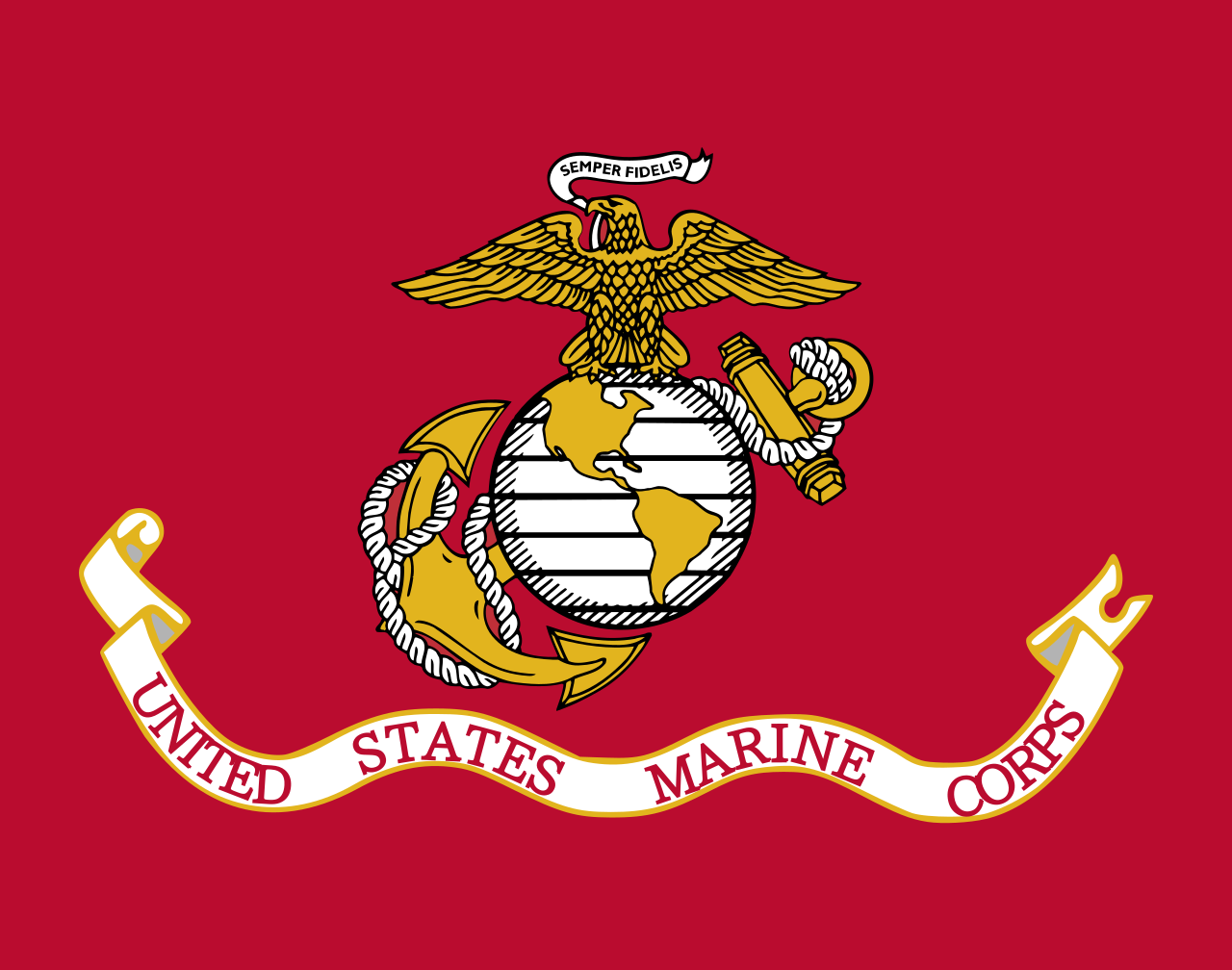


United States Air Force
U.S. Air Force (USAF) groups and above have the same National Color as the Army; the Organizational Color is ultramarine blue, with the group's coat of arms beneath the USAF crest, which is an eagle on a cloud background. The fringe is in gold. Wing and force colours have their heraldic emblem used instead of the eagle.
This is the same design for Air Force commands and educational institutions but with the eagle replaced by the emblem of the formation.
United States Army

In the Army, most regiments, battalions of regiments, and separate battalions also have a stand of colours. The first is the National Color, which is a 36 in × 48 in (91 cm × 122 cm) version of the national flag trimmed with a 2+1⁄2 in-wide (6.4 cm) gold fringe, and is the equivalent of the King's Colour in the British Army. The second is the Organizational Color, which is the equivalent of the regimental colour; this is the same dimensions as the National Color, but is of a single colour representing the branch of the service that the unit is from; each branch also has its own fringe colour, which the Organizational Color is trimmed with. In the centre of the colour, for regiments is the eagle from the Great Seal of the United States, but with the regimental coat of arms in the shield. The eagle has in its beak a scroll bearing the regimental motto, with the crest of the regiment's coat of arms above it and the regiment's name below. Attached to the Organizational Color are the campaign and unit citation streamers awarded to the individual unit – these are equivalent to the battle honours embroidered directly onto the colours of British and Commonwealth units. The Organizational Color was carried in lieu of a National Color until shortly before the American Civil War, when the Stars and Stripes became the National Color.[25] Civil War era units sometimes carried alternative Organizational Colors based on their home state flags or of other designs.
Brigade, division and corps colours, also gold fringed, are in the facing colour of the service branch, for brigades the colour is of a bicolour design. These colours have the command heraldic arms at the centre.
United States Marine Corps


In the Marine Corps, each battalion-sized unit or larger maintains a set of colours.[26][27] The organizational colour is identical to the Marine Corps battle colour, except that the scroll has the unit's name instead of "United States Marine Corps". It also bears the streamers authorized to the unit, or scarlet and gold tassels if none are authorized.
Fringe is never used on the national colors when carried by Marine Corps unit.[28] Instead, a red, white, and blue tassel can be used to decorate.
United States Navy
Prior to Executive Order 10812 of 24 April 1959, the United States Navy used the U.S. Naval Infantry Battalion Flag as its unofficial colours.[29] While the Navy uses a number of maritime flags, such as the Ensign and Jack of the United States, the Flag of the United States Navy is normally seen only at ceremonies and parades. The display of streamers and fringe is consistent with that of the Marine Corps.
United States Naval Construction Force
When Naval Construction Battalions (Seabees) were first formed in 1942 the Naval Infantry Battalion Flag was mandated by Naval Regulation as the colours of the Naval Construction Force.[29] Each battalion-sized unit or larger maintains a set of colours. The organizational colours of each unit is identical, excepting that each will have the unit's name and number in white on the flag.[29] The display of streamers authorized to the unit is consistent with that of the Marine Corps.
Other shore establishment units and commands of the Navy
Organizational colours of the US Navy's other shore establishment commands and units and all command formations are in navy blue with the arms of the unit or command, with appropriate displayed streamers attached if authorized.
South America
Argentina
Each unit of the Argentine Armed Forces, the Argentine National Gendarmerie, the Argentine Federal Police and the Argentine Naval Prefecture bears the national colours on flags, called the National War Flags, which are the national flag with the unit's name embroidered on it in gold lettering. The colours are carried by the unit's most junior officer, escorted by two armed NCOs, except in academies and schools, where it is carried by the top-ranked student of the senior course, and escorted by his or her second- and third-ranked classmates. If a decoration has been awarded to the unit, it is attached to the national colours' cravat. The national colours are never dipped in salute, except to salute another national colours which pass by or are being the subject of a special honour. Besides the national colours, each unit has its unique regimental colours, normally in the arm or service's colour background, with the unit's coat of arms on it. However not all units have such a common background. For example the Regiment of Patricians has the Cross of Burgundy as its official regimental colours because of its lineage dating back from 1806. Units which were made part of the Army of the Andes during Argentina's independence war also carry the Flag of the Army of the Andes as a 3rd Colour.
Brazil
Units of the Brazilian Armed Forces carry a stand of two Colours, differing per service.
The standard of the Brazilian Army measures 80 × 120 cm, white with the Army coat of arms in the centre, trimmed with gold fringe. The name of the service is inscribed in gold letters on a green scroll beneath the shield. Above the shield is a knight's helmet with red and sky blue mantling. The staff is topped by a nickel-plated lance-head finial, 32 cm high. Below the lance-head, there is a cravat (laço militar) divided lengthwise, sky blue and red, with a gold fringe at the end, tied in a bow and fastened with a cockade of blue with the Southern Cross in white stars, red, and blue. Ten red streamers with campaign honours inscribed in sky blue letters are also attached below the lance-head. The staff is 212 cm long, not including the lance-head, and 3.5 cm in diameter. It is covered in sky blue velvet with a red spiral strip. The colour belt is 10 cm in width, covered with sky blue velvet with red velvet stripes. The Brazilian Navy's flag uses dark blue colours; the Brazilian Air Force flag uses ultramarine blue.
Brazilian military units also carry the national flag as a National Colour. This is in the dimensions 90 × 128 cm. It is mounted on the same size staff and with the same finial as the Army standard, but the cravat is divided lengthwise yellow and green, with a gold fringe at the end, tied in a bow and fastened with a cockade of blue with the Cruzeiro do Sul in white stars, yellow, and green. The staff is covered in green velvet with a yellow spiral strip. The colour belt is 10 cm in width, covered with green velvet with yellow velvet stripes of width and number varying with the rank of the organization's commander.
Unit colours differ per service branch and speciality.
Chile
Units of the Chilean Army carry one main colour, known as the estandarte de combate (combat standard). This is the same as the national flag, but with an embroidered star and with the unit designation, honorific title, founding date and place, and, depending on the unit, other historic information and honours embroidered diagonally across the fly in gold. The flag is also trimmed with gold fringe. It is mounted on a staff with a gilt condor finial; below the finial is a cravat in the national colours with decorations attached. In addition to the military colour, particularly distinguished units, and long serving units may carry a second Colour known as a bandera coronela (colonel's colour). This is a red field with a large white five-pointed star. In the angles of the star are the names and dates of battle honours surrounded by laurel wreaths, all in gold, while in an arc above the star is the designation of the unit, also in gold. The flag is also surrounded by gold fringe. Since 2017, the 16th Infantry Regiment Talca became the first to sport a blue coloured bandera coronela in honour of its origins as a city guard battalion formed during the War of the Pacific.
The Chilean Air Force, the Chilean Navy, the Carabineros de Chile and the Chilean Gendarmerie all use the estandarte de combate as their main colour, and do not use the bandera coronela at all. The design is the same as in the Army's.
Colombia
The main state colours of the Military Forces of Colombia and the National Police of Colombia is the Flag of Colombia with the Coat of arms of Colombia in the centre inside a circle with a red border, used by all the services. These flags also carry medals and decorations attached to the flag. The MFC and the NPC also uses unit battle colours (brigade-level, regiment-level and battalion-level), that differ accordingly per service. All of them are gold fringed. Uniquely for Colombia, the battle colour tradition is mainly US-influenced. In addition, the service colour is used as a secondary color, also gold fringed, to denote service affiliation.
The Navy, given the British influence, uses the national flag as a State Colour for ships and commands, and few naval units have a full strand of colours.
Uruguay
Aside from the three state colours (the Flag of Uruguay, the Flag of Artigas and the Flag of the Treinta y Tres), the Uruguayan military also has regimental colours that differ per service and unit. The national colours have armed colour guards while the regimental colour has none at all. All are gold fringed.
Venezuela
In the National Bolivarian Armed Forces of Venezuela, aside from the Flag of Venezuela as the National Colour, there are also Organizational Colours for each of the 6 service branches and the Ministerial Colour of the Ministry of Defence and Unit Colours, which differ per service branch and arm. Every military unit from the Ministry of defence down to all individual units have a stand of colours like in the United Kingdom, but differ from the battalion to the service and the national level. The national flag, until the 1940s, served also as the unit state colour in the same manner as the National Colour of the United States Army and the State/Sovereign's Colour in the Commonwealth of Nations, and was based on the national flag but with the unit inscription replacing the stars in the centre in white lettering. The Venezuelan National Militia is the only service branch that uses a battle colour, similar to the flag of the Cuban July 26 Movement: the colour is red and black with the service name on it in white, and a separate colour is used for the service headquarters at the Montana Barracks in Caracas. Starting from July 2013 onward it was granted permission to use a 4th colour for its battalions: red with the eyes of the late President Hugo Chávez and the inscription Chavez Vive (Chavez Lives On) below, topped with a scarlet star.
Since 2014 the National Armed Forces uses two additional colours (the National Militia its 5th and 6th): that of the Supreme Commander's Colour, which is red bearing the portrait of the late President Chávez surrounded by a wreath and the Armed Forces Motto (Independence and Socialist Fatherland, we will live on and triumph!) below and the inscription Supreme Commander of the Bolivarian Revolution (Comandante Supremo de la Revolución Bolivariana) and the eight golden stars from the National Flag above it, plus the Memorial Colour of the Liberator and Father of the Nation (introduced in the summer of 2016), which is of the same colour facing but with the wreath containing the portrait of Simon Bolivar, the eight gold stars and his title above and the words Freedom, Sovereignty, Independence (Libertad, Soberania e Independencia) below the title, all in gold.
The colours used on the Unit Colours are as follows:
- Red: Ministry of Defence (formerly grey), Service units, Marine Corps, National Militia, Military Technical Academy, Presidential Honour Guard Brigade, Caracas HQ Battalion of the Ministry of Defence
- Dark blue and red: Venezuelan Army HQ and units directing to Army HQ, Division and Brigade Colours
- Yellow: Infantry, Jungle Infantry, Airborne Units
- Orange: Rangers
- Green: Army Engineers
- Dark blue: Venezuelan Army Special Forces
- Red and Black: Rapid Action (Infantry) Battalions
- Black: Armor
- Burgundy red: Artillery and Air Defence Artillery
- Grey: Logistics, National Armed Forces Communications and Electronics College
- Navy blue: Navy
- Ultramarine blue: Air Force (formerly light green)
- Maroon: National Guard
- Dark blue and white: Bolivarian Military University of Venezuela, Military Academy of the Bolivarian Army and Armed Forces Health Sciences Academy
- Light blue and white: Venezuelan Naval Academy
- White: Venezuelan Army military high schools
Guidons and standards
Commonwealth of Nations
The standard is the colours-equivalent for the heavy cavalry (e.g., horse guards and dragoon guards). At 27 by 30 in (69 by 76 cm), on an 8 ft 6 in-long (259 cm) pole, it is much smaller than infantry colours, so that it can be carried by a soldier on horseback. The guidon is the equivalent for the light cavalry (e.g., dragoons, light dragoons, hussars and lancers). It is swallow-tailed, 27 by 41 in (69 by 104 cm), with an 8 ft 6 in-long pole.
The word guidon is a corruption of the French guyde homme – 'the guide man'.[note 3] Originally each troop had its own, but this was quickly reduced to a single, regimental one. With the increased dispersion of troops required in the light cavalry role, their operational function had ceased by the 1830s and they were discontinued. The regiment's kettledrums, with the battle honours woven onto the drum banners (with the exception of 3rd The King's Own Hussars and its successors, where they are uncovered, with the battle honours engraved onto the kettledrums themselves) became the focal point of the regiment's loyalty. In 1952 King George VI reintroduced the guidons of the light cavalry for ceremonial purposes.
Both the standard and the guidon are usually of crimson trimmed in gold fringe and with the regiment's insignia in the centre. The regiment's battle honours are emblazoned on both the obverse and reverse, up to a maximum of 22 on each side.
Denmark

Cavalry (armour) units carry a standard (Danish: estandart), of similar design to the infantry colour, but smaller and square, with the cross centred on the field. The royal cypher is in the upper hoist and the initials of the regiment in the lower hoist. The Guard Hussar Regiment's standard is unique, as it has two monograms – with King Frederick VI's monogram in top right corner.[30]
France
In the French Army, mounted units carry étendards (standards). Mounted units include armoured corps and cavalry, artillery, transportation, army aviation, and supplies. The étendard is a 64 × 64 cm square flag similar to the drapeaux carried by the units of foot, with the same design: the regimental name at the obverse and the battle honours at the reserve.
Italy
In the Italian Army, cavalry units carry a stendardo (standard) of the same pattern as the bandiera di guerra, but which measures 60 cm × 60 cm.
Netherlands
The two hussar regiments of the Royal Netherlands Army carry a standaard (standard), of similar design to the infantry colour, but smaller (50 cm × 50 cm).
Portugal

Until the 1960s, the Portuguese Military followed the traditions of its foot units having colours (Portuguese: bandeiras, literally "flags"), while mounted units had standards (estandartes), the latter being smaller versions of the colours. Standards were also carried by naval and aviation units. In the 1960s, the traditional separation between colours and standards was abolished, with all being reclassified as "national standards" (estandartes nacionais). At the same time, a new type of standard, the heraldic standard, was introduced. Presently, the military units, commands, forces and establishments have both a national standard and an heraldic standard. While the design of the national standards reflects the National Flag, the designs of the heraldic standards reflect the individual heraldic symbology of each of the units.
In the Portuguese military parlance, a guidon (guião) is a small square flag of a battalion sized unit. Guidons of a very simple design were introduced in the 19th century, as the tactical field signs of the foot units that didn't carry colours, namely the second battalions of the infantry regiments and the independent caçadores (light infantry) battalions. In the early 20th century, the tactical role of the guidons was discontinued. The guidons assumed then a ceremonial role, coming to have a more elaborate design which incorporated the symbology of their respective units. Guidelines for the design of guidons accordingly with heraldic rules were introduced in the 1950s, these becoming mandatory and standardized in the 1960s. The present guidon design - similar in all branches of the Military - consists in the quadrature of the coat of arms of the corresponding unit or of its parent unit, framed by a bordure. The colours of the bordure can be used to identify a sub-unit inside its parent unit.
Besides heraldic standards and guidons, the Portuguese military units also use heraldic pennants (flâmulas). These are small swallow-tailed or triangular flags used to identify company sized units.
Some of the Portuguese uniformed security forces and civil emergency organizations also make use of heraldic standards, guidons and pennants, usually modelled after the military ones.
United States
In the United States armed forces, guidons are much more prevalent, with units below battalion size being authorized to use them. In the US Army, these are swallow tailed flags that are 20 in × 27 in, and are in the colour of the branch of the service the unit is from, with the branch's insignia the most prominent device. Also on the guidon is included the unit's identifying letter, and the number(s) of its parent unit. War service and campaign streamers are not attached to these guidons, but unit citation streamers can be.
Guns

In regiments of the (British) Royal Artillery, and artillery regiments of other Commonwealth countries, the guns are afforded the status of colours.[31] This is due to the difficulty of artillery regiments being able to carry flags onto the battlefield, and the fact that the guns themselves were the rallying points for the soldiers manning them. As a consequence, whenever artillery regiments parade, the etiquette that would normally be applied to the colours is applied to the guns. During the Battle of Balaclava gunners abandoned their guns, in effect abandoning their colours, causing disgrace.[citation needed]
Because the guns have the status of colours, gunners of commonwealth countries will attempt to prevent their guns falling intact into enemy hands both for practical reasons (so that the guns can not be turned and used against their own side) and for the honour of the regiment.[32] For example, the last action of gunners of the Royal Artillery during the fall of Singapore was to destroy their guns.[33][34]
The Honourable Artillery Company, the oldest regiment in the British Army, and not part of the Royal Artillery,[citation needed] is the only artillery regiment to have both colours and guns, which are treated with equal respect.
In Singapore, however, since its independence the Singapore Army's artillery arm (the Singapore Artillery) uses colours instead of guns; this is also the case for the Malaysian Army, Pakistan Army, Royal Cambodian Army and the Royal Thai Army, whose artillery units use colours and not guns on parade. This has been the same case for the Indian Regiment of Artillery, which presents colours in dismounted parades, and the Sri Lanka Artillery, which has a strand of colours similar to the HAC.
Etiquette
- The Regimental Colour (or Standard or Guidon) is always paraded whenever the regiment is on a formal parade. However, the Sovereign's (King's or Queen's)/Presidential Colour is only paraded on certain occasions.
- Compliments (for example saluting and presenting arms) are always paid to the (uncased) Colours.
- When the Colours are being paraded, they are carried either by a subaltern or warrant officer, dependent on the regiment. On parade, the Colours always have an armed escort, the Colour Party, who would normally be non-commissioned officers. In the infantry this role usually falls to Colour Sergeants.
- When the Colours are not being paraded, most regiments house them in their Officers' Mess. They are cased and secured every night.
- When a regiment is presented with new Colours, the old Colours, which will now never again be paraded, are laid up (i.e.: put on permanent display) in a place sacred to the Regiment (for example the Regimental Chapel).
Ceremonies of colours
Royal Navy
The British Royal Navy and other navies of the Commonwealth of Nations call the flag-raising ceremony that happens every morning when a ship is in harbour colours. In British home waters, colours is conducted at 0800 (eight bells in the morning watch) from 15 February to 31 October inclusive, and at 0900 (two bells in the forenoon watch) during the winter.
When sunset is at or before 2100, flags are lowered at sunset at the ceremony of sunset. When sunset is after 2100, the evening flag lowering ceremony is called evening colours and carried out at 2100.
United States Navy
The United States Navy performs the same ceremonies, called "Morning Colors" and "Evening Colors", at 0800 and sunset each day. When "Colors" is played aboard Navy and Marine Corps bases, those outdoors must stop to render proper courtesies by saluting if in uniform or, if out of uniform, by standing at attention, until "Carry On" is sounded. Marines and sailors driving on base during this time are expected to stop their vehicles and stand at attention until the ceremony is over.
Yacht clubs
Many traditional yacht clubs worldwide also conduct morning and evening colour ceremonies. At 0800 each morning and at sunset during the club's active sailing season the ceremony is performed by the launchmen or harbourmaster.
- First, a bell is sounded as an alert for all members and guests present to stand at attention.
- A cannon is then fired and the national ensign hoisted (or lowered if sunset).
- At the conclusion of the ceremony the most senior officer present says: "As you were" and members and guests may carry on.
In games
Capturing an enemy's flag was formerly a major goal in war, and it is still practised today, and so capturing the enemy flag also appears in several games:
- Capture the flag
- Stratego, a board game where the goal is to capture the enemy's flag
- Chess: In Estonian the queen is known as lipp ("standard"), while in Italian the bishop is called alfiere ("standard-bearer")
Notes
- ^ The modern fourragère of the French Army is awarded to all members of military units which have been awarded a mention in despatches. It should not be confused with unit awards of particular decorations, where the medal itself is hung on the colour of the unit. For example, there are many units wearing the fourragère of the Médaille militaire, whereas only six units wore the medal on their colours. See also the article dealing with the Croix de Guerre.
- ^ The ensign of the National Navy differs from the French national flag by its slightly darker blue shade, and by the dimensions of the stripes: while the stripes of the national flag has 1:1:1 proportions, the naval ensign has 30:33:37.
- ^ The medieval "guidon, a name derived from the Fr. Guyd-homme, was somewhat similar to the standard, but without the cross of St George, rounded at the end, less elongated and altogether less ornate. It was borne by a leader of horse, and according to a medieval writer 'must be two and a half yards or three yards long, and therein shall no armes be put, but only the man's crest, cognisance, and devyce.'" (Swinburne 1911, pp. 457, 458)
See also
- Glossary of vexillology
- Historical colours, standards and guidons
- Presentation of Colours
- Trooping the Colour
- Vexillum
- War flag
- With flying colours
References
Citations
- ^ "FULL LIVE STREAMING PRASPA TNI-POLRI 2019". Retrieved 29 June 2023 – via www.youtube.com.
- ^ a b Tertitskiy, Fyodor (10 April 2018). "What North Korea's army flags can teach us about its recent history". NK News. Retrieved 9 September 2018.
- ^ "Regimental Colours, Banners, and Flags Past and Present". Regimental website of the Lincoln and Wetland Regiment. Major A. D. Woolley. Archived from the original on 22 July 2011. Retrieved 22 July 2011.
- ^ "Cadet Instructors Cadre" (PDF). Department of National Defence. p. 33. Archived from the original (PDF) on 6 July 2011.
- ^ "New Colours for the RCAF". Royal Canadian Air Force. 17 August 2017. Retrieved 20 September 2017.
- ^ Australian Army (6 December 2016). "The Duntroon Colours". www.army.gov.au. Archived from the original on 8 July 2015. Retrieved 8 July 2015.
- ^ "Army Flags (Australia)". Flags of the World. Archived from the original on 3 April 2007. Retrieved 3 April 2007.
- ^ Williams, Simon, ed. (28 July 2017). "Blue is the colour". RAF News. No. 1424. Royal Air Force. p. 1. ISSN 0035-8614.
- ^ "Colours of the Royal Marines". Archived from the original on 7 October 2010.
- ^ "Gardehusarregimentets estandart og fane". Archived from the original on 10 October 2008.
- ^ "In January 1188 there was a meeting between Henry II and Phillip II under an old tree at Gisors on the border between France and Normandy. The meeting was attended also by Phillip of Alsace, the Count of Flanders. The two rivals agreed to stop the wars between them and swear to 'take the cross' (i.e. to go in a crusade). They also agreed to establish symbols to the different corps: white cross for the Plantagenet corps of Henry II, a red cross for the Capetian corps of Phillip II, and a green cross for the Flemish." Joshua Prawer, A history of the Latin Kingdom of Jerusalem (Hebrew, 3rd edition, vol. II, pp. 17–18)[unreliable source?]
- ^ Bulletin officiel des armées, 27, 9 novembre 2007
- ^ (A) NORDEF0452926A, by Minister of Defence Mme Michèle Alliot-Marie.
- ^ Les drapeaux de la Marine on the French Ministry of Defence and Veterans Affairs website (pdf download) Archived 10 October 2012 at the Wayback Machine
- ^ "• Flags Forum". Flags Forum. Archived from the original on 2 January 2014. Retrieved 4 May 2011.
- ^ Presidential Decree 348 /17-4-1980, On the war flags of the Armed Forces and the Gendarmerie Corps, Gazette issue A-98/1980, pp. 1486.
- ^ "3/1996. (IV. 12.) HM rendelet - 1.oldal - Hatályos Jogszabályok Gyűjteménye". Archived from the original on 23 February 2019.
- ^ "Nederlands Instituut voor Militaire Historie | Ministerie van Defensie". Nimh.nl. Retrieved 1 August 2012.
- ^ "Флаги России-VEXILLOGRAPHIA". www.vexillographia.ru.
- ^ a b c d Braunstein, Christian (2004). Svenska försvarsmaktens fälttecken efter millennieskiftet [The flags and standards of the Swedish armed forces after the turn of the millennium] (PDF). Skrift / Statens försvarshistoriska museer, 1101-7023 ; 7 [dvs 8] (in Swedish). Stockholm: Statens försvarshistoriska museer. pp. 8–9. ISBN 91-971584-7-X. SELIBR 9815350. Archived from the original (PDF) on 22 May 2018. Retrieved 9 November 2018.
- ^ наук, Однороженко Олег, доктор історичних. "Однороженко Олег. Козацька геральдика в Україні XVI-XVII ст". history.sumy.ua (in Ukrainian). Retrieved 22 August 2023.
{{cite web}}: CS1 maint: multiple names: authors list (link) - ^ "2. Мусульманская угроза - Ужасы на Западе". www.e-reading.club. Retrieved 22 August 2023.
- ^ "US ARMY CAMPAIGN STREAMERS". tmg110.tripod.com.
- ^ U.S. Army Press Release, Army to award campaign participation credit and streamers for global war on terror Archived 20 September 2006 at the Wayback Machine. Retrieved 16 August 2006.
- ^ "U.S. Army FM 3-21.5" (PDF). Archived from the original (PDF) on 16 August 2006.. Retrieved 16 August 2006.
- ^ "Flag Manual" (PDF). Mco P10520.3B. 15 September 1989.
- ^ McMillan, Joseph (2001). "Flags of the U.S. Marine C". Seaflags. Archived from the original on 10 October 2007. Retrieved 10 January 2008.
- ^ Marine corps drills and ceremony manual marines.mil
- ^ a b c FLAGS, PENNANTS & CUSTOMS,NTP 13 (B), NAVAL COMPUTER AND TELECOMMUNICATIONS COMMAND, 4401 MASSACHUSETTS AVE., N.W., WASHINGTON, D.C. 20394-5460, section 17.11, p. 17–5 [1]
- ^ Danish Defence. "INTRODUCTION TO THE GUARD HUSSAR REGIMENT`S MOUNTED SQUARDRON" (PDF). forsvaret.dk. p. 5. Retrieved 26 November 2018.
- ^ "[ARCHIVED CONTENT] The Royal Artillery – British Army Website". Army.mod.uk. Retrieved 1 August 2012.
- ^ "El Regimiento - Potencia de fuego - Museo de Artillería Real - Arsenal Real en Woolwich". Potencia de fuego. Archivado desde el original el 3 de diciembre de 2010. Consultado el 1 de agosto de 2012 .
- ^ "Historia 1919–1942". Fort Siloso . Consultado el 1 de agosto de 2012 .
- ^ Kevin Blackburn; Karl Hack (2004). ¿Tenía que caer Singapur?: Churchill y la fortaleza inexpugnable. Taylor & Francis. pág. 124. ISBN 978-0-203-40440-9.
Fuentes
- BR1834 – Manual de ceremonias y ejercicios navales de la Marina Real
- Swinburne, H. Lawrence (1911). . En Chisholm, Hugh (ed.). Encyclopædia Britannica . Vol. 10 (11.ª ed.). Cambridge University Press. págs. 457–458.
Enlaces externos
- Banderas del mundo
- Banderas de guerra