 Hispanopedia Wiki
.png/1280px-Map_Asia_physical_(continental).png)

Los escitas ( / ˈ s ɪ θ i ə n / o / ˈ s ɪ ð i ə n / ) o escitas ( / ˈ s ɪ θ / , pero tenga en cuenta que escita- ( / ˈ s aɪ θ ʊ / ) en la composición) y a veces también denominados escitas pónticos , [7] [8] eran un antiguo pueblo nómada ecuestre iraní oriental que había migrado durante los siglos IX al VIII a. C. desde Asia Central hasta la estepa póntica en la actual Ucrania y el sur de Rusia , donde permanecieron establecidos desde el siglo VII a. C. hasta el siglo III a. C.
Expertos en la guerra a caballo , los escitas reemplazaron a los agatirsos y a los cimerios como potencia dominante en la estepa euroasiática occidental en el siglo VIII a. C. En el siglo VII a. C., los escitas cruzaron las montañas del Cáucaso y atacaron con frecuencia el Asia occidental junto con los cimerios.
Después de ser expulsados de Asia occidental por los medos , los escitas se retiraron a la estepa póntica en el siglo VI a. C., y más tarde fueron conquistados por los sármatas en los siglos III y II a. C. En el siglo III d. C., los últimos restos de los escitas fueron abrumados por los godos , y a principios de la Edad Media , los escitas fueron asimilados y absorbidos por las diversas poblaciones sucesivas que se habían trasladado a la estepa póntica.
Tras la desaparición de los escitas, los autores de los períodos antiguo, medieval y moderno utilizaron su nombre para referirse a diversas poblaciones de las estepas no relacionadas con ellos.
Nombres
Etimología
El nombre se deriva del endónimo escita Skuδa , que significa literalmente ' arqueros ' [9] [2] que a su vez deriva de la raíz protoindoeuropea skewd- , que a su vez significa literalmente ' tirador, arquero ' . [10] Este nombre era semánticamente similar al endónimo de los sauromatianos, *Saᵘrumata , que significa "armado con dardos y flechas arrojadizas". [11]
De este término anterior se derivó Skuδa : [12] [13] [14]
- la denominación acadia de los escitas:
- Askuzāya ( 𒇽𒊍𒆪𒍝𒀀𒀀 [15] [16]
- Ašguzāya ( 𒇽𒀾𒄖𒍝𒀀𒀀 [15] [17] );
- Asguzaya ( 𒇽𒊍𒄖𒍝𒀀𒀀 [15] [18] );
- o Iškuzāya ( 𒇽𒅖𒆪𒍝𒀀� [19] )
- así como el antiguo nombre griego Skuthai ( Σκυθαι ), del que se derivó el nombre latino Scythae , que dio el nombre inglés Scythians . [20]
El nombre urartiano para los escitas podría haber sido Išqigulu ( 𒆳𒅖𒆥𒄖𒇻 [21] [22] ). [23]
Debido a un cambio de sonido de /δ/ ( / ð / ) a / l / comúnmente atestiguado en la familia de lenguas iraníes orientales a la que pertenecía el escita, el nombre Skuδa evolucionó a Skula , que fue registrado en griego antiguo como Skōlotoi ( Σκωλοτοι ), en el que se agregó el sufijo griego formador de plural -τοι al nombre. [24] [1]
El nombre del rey del siglo V a. C. Esciles ( griego antiguo : Σκυλης , romanizado : Skulēs ) representaba esta forma posterior, Skula . [12] [13]
Terminología moderna
Escitas propiamente dichos
El nombre "escitas" fue utilizado inicialmente por los autores antiguos para designar específicamente al pueblo iraní que vivía en la estepa póntica entre los ríos Danubio y Don. [25] [26] [27] [28]
En la arqueología moderna, el término "escitas" se utiliza en su sentido estricto original como nombre estrictamente para el pueblo iraní que vivió en las estepas pónticas y de Crimea, entre los ríos Danubio y Don, desde el siglo VII al III a. C. [29]
Designaciones más amplias
Sin embargo , en el período helenístico, autores como Hecateo de Mileto extendieron a veces la designación "escitas" indiscriminadamente a todos los nómadas esteparios y poblaciones de estepas forestales que vivían en Europa y Asia, y la utilizaron también para designar a los saka de Asia Central. [30]
Los primeros estudiosos modernos tendieron a seguir el ejemplo de los autores helenísticos y a extender el nombre "escitas" a un término general para las diversas culturas guerreras-nómadas ecuestres de la estepa euroasiática del período de la Edad de Hierro tras el descubrimiento en la década de 1930 en las partes orientales de la estepa euroasiática de elementos que formaban la "tríada escita", que consistía en armas distintivas, arneses para caballos y objetos decorados con el arte del "estilo animal", que hasta entonces se habían considerado marcadores de los escitas propiamente dichos. [31]
Sin embargo, este uso amplio del término "escita" ha sido criticado por agrupar a varias poblaciones heterogéneas pertenecientes a diferentes culturas, [32] y, por lo tanto, dar lugar a varios errores en la cobertura de las diversas culturas guerreras y nómadas de la estepa euroasiática del período de la Edad del Hierro. Por lo tanto, el uso restringido del término "escita" como denotación específica de los pueblos que dominaron la estepa póntica entre los siglos VII y III a. C. es preferido por los escitólogos como Askold Ivantchik . [20]
Dentro de este amplio uso, los escitas propiamente dichos que vivían en las estepas pónticas a veces son denominados escitas pónticos . [7] [33]
Los antropólogos modernos prefieren utilizar el término "escitasiberianos" para designar a este grupo cultural más amplio de pueblos nómadas que vivían en la estepa euroasiática y la estepa forestal que se extendía desde Europa central hasta los límites del Imperio Zhou chino, y del cual los escitas pónticos propiamente dichos eran sólo una sección. [34] Estos diversos pueblos compartían el uso de la "tríada escita", es decir, armas distintivas, arneses para caballos y el arte del "estilo animal". [35]
El término "escita-siberiano" también ha sido criticado, ya que a veces se usa ampliamente para incluir a todos los nómadas ecuestres de la Edad del Hierro, incluidos aquellos que no formaban parte de ninguna tribu escita o saka. [36] Los eruditos Nicola Di Cosmo y Andrzej Rozwadowski prefieren, en cambio, el uso del término "nómadas tempranos" para la designación amplia de los nómadas ecuestres de la Edad del Hierro. [37] [38]
Saka
Mientras que los antiguos persas usaban el nombre Saka para designar a todos los nómadas esteparios [39] [40] y se referían específicamente a los escitas pónticos como Sakā tayaiy paradraya ( 𐎿𐎣𐎠 𐏐 𐎫𐎹𐎡𐎹 𐏐 𐎱𐎼𐎭𐎼𐎹 ; lit. ' los Saka que habitan más allá del Mar (Negro) ' ), [41] el nombre "Saka" se usa en la erudición moderna para designar a los nómadas pastorales iraníes que vivían en las estepas de Asia Central y el Turquestán Oriental en el primer milenio a. C. [26] [32]
Cimerios
Los escribas babilónicos tardíos del Imperio aqueménida utilizaron el nombre de «cimerios» para designar a todos los pueblos nómadas de la estepa, incluidos los escitas y los saka. [42] [39] [43]
Sin embargo, aunque los cimerios eran un pueblo iraní [44] que compartía un idioma, orígenes y cultura comunes con los escitas [45] y son arqueológicamente indistinguibles de los escitas, todas las fuentes contemporáneas a sus actividades distinguieron claramente a los cimerios y a los escitas como dos entidades políticas separadas. [46]

Historia
Hay dos fuentes principales de información sobre los escitas históricos: [47]
- Textos cuneiformes acádios de Mesopotamia que tratan de la historia escita temprana del siglo VII a. C.;
- y fuentes grecorromanas que cubren toda la historia escita, más destacadamente las escritas por Heródoto de Halicarnaso , que son menos confiables porque la información que contienen está mezclada con cuentos populares y construcciones eruditas de historiadores. [48]
Período preescita
La llegada de los escitas a Europa fue parte de un proceso más amplio de movimiento hacia el oeste de los nómadas iraníes de Asia Central hacia el sudeste y centro de Europa que duró desde el primer milenio a. C. hasta el primer milenio d. C., y en el que también participaron otros nómadas iraníes como los cimerios , los saurómatas y los sármatas . [49] [50] [51]
Comienzo del nomadismo estepario
La formación del pastoreo nómada genuino ocurrió a principios del primer milenio a.C. debido a cambios climáticos que hicieron que el ambiente en las estepas de Asia Central y Siberia se volviera más frío y seco que antes. [52] Estos cambios hicieron que los agricultores mixtos sedentarios de la Edad del Bronce se convirtieran en pastores nómadas, de modo que hacia el siglo IX a.C. todos los asentamientos esteparios de las poblaciones sedentarias de la Edad del Bronce habían desaparecido, [53] y, por lo tanto, llevaron al desarrollo de la movilidad de la población y a la formación de unidades guerreras necesarias para proteger los rebaños y apoderarse de nuevas áreas. [54]
Estas condiciones climáticas a su vez provocaron que los grupos nómadas se convirtieran en pastores trashumantes que trasladaban constantemente sus rebaños de un pastizal a otro en la estepa, [53] y buscaban mejores pasturas al oeste, en Ciscaucasia y las regiones de estepas forestales de Eurasia occidental. [52]
El complejo de Chernogorovka-Novocherkassk
La primera ola [55] de poblaciones nómadas que se originaron en las partes de Asia Central correspondientes al este de Kazajstán o la región de Altai-Sayan , [56] comenzó en el siglo X a.C. y duró hasta los siglos IX a VIII a.C., [57] migrando hacia el oeste a las regiones de la estepa póntico-caspia y panónica , donde formaron nuevas confederaciones tribales que constituyeron el complejo Chernogorovka-Novocherkassk , entre los que se encontraban los agatirsos en la estepa póntica, así como los cimerios en la estepa del Caspio, [58] [50] [59] y posiblemente los sigynnae en la estepa panónica. [60] Sin embargo, los registros arqueológicos e históricos sobre estas migraciones son escasos y solo permiten esbozar un esquema muy amplio de este complejo desarrollo.
El complejo Chernogorovka-Novocherkassk se desarrolló de forma nativa en la región del norte del Ponto durante los siglos IX a mediados del VII a. C. a partir de elementos que habían llegado anteriormente desde Asia Central, por lo que exhibió similitudes con las otras culturas nómadas tempranas de la estepa euroasiática y la estepa forestal que existían antes del siglo VII a. C., como la cultura Aržan , de modo que estas culturas nómadas tempranas preescitas eran parte de una capa cultural Aržan-Chernogorovka unificada originaria de Asia Central. [61]
Período protoescita

Al igual que los nómadas del complejo Chernogorovka-Novocherkassk, los escitas se originaron, junto con los primeros sakas , en Asia central y Siberia [63] [64] en las estepas correspondientes a la actual Kazajstán oriental o la región de Altai-Sayan, lo que está atestiguado por la continuidad de los ritos funerarios y tipos de armas escitas con la cultura Karasuk, así como por el origen del arte de estilo animal típicamente escita en la región mongolo-siberiana. [65]
Por lo tanto, los escitas y los nómadas del complejo Chernogorovka-Novocherkassk eran poblaciones estrechamente relacionadas que compartían un origen, una cultura y un idioma comunes, [45] y los primeros escitas eran, por lo tanto, parte de una capa cultural común Aržan-Chernogorovka originaria de Asia Central, siendo la cultura escita temprana materialmente indistinguible del complejo Chernogorovka-Novocherkassk. [66]
Yendo más atrás, estos diversos nómadas esteparios compartían un origen centroasiático común con otros pueblos iraníes como los medos , los persas , los partos y los sogdianos . Estos diversos pueblos iraníes todavía compartían puntos en común importantes en términos de idioma y cultura que eran visibles en la forma en que compartían mitos comunes, así como estilos de vestimenta y adornos hasta al menos el siglo V a. C. [67] [68] [69]
Los escitas ya conocían la orfebrería de calidad y la fundición sofisticada del bronce en esa época, como lo atestiguan las piezas de oro encontradas en el túmulo Aržan-1 del siglo VIII a. C. [70] [71] Las puntas de flecha del primer túmulo de los enterramientos de Aržan también sugieren que las flechas con casquillo típicas de "tipo escita" hechas de aleación de cobre podrían haberse originado durante este período. [72] [73]
Migración desde Asia Central
La segunda ola de migración de nómadas iraníes correspondió a la llegada de los primeros escitas desde Asia central a la estepa del Cáucaso, [74] [75] [76] que comenzó en el siglo IX a. C., [77] cuando un movimiento significativo de los pueblos nómadas de la estepa euroasiática comenzó después de que los primeros escitas fueran expulsados de Asia central por los masagetas , que eran una poderosa tribu nómada iraní de Asia central estrechamente relacionada con ellos, [78] o por otro pueblo de Asia central llamado los issedones , [79] [80] forzando a los primeros escitas hacia el oeste, a través del río Araxes y hacia las estepas del Caspio y la Ciscaucasia. [81]
Esta migración occidental de los primeros escitas duró hasta mediados del siglo VIII a. C., [82] y arqueológicamente correspondió al movimiento hacia el oeste de una población originaria de Tuvá en el sur de Siberia a fines del siglo IX a. C. y que llegó entre los siglos VIII y VII a. C. a Europa, especialmente a Ciscaucasia, a donde llegó en algún momento entre c. 750 y c. 700 a. C. , [75] [83] siguiendo así el mismo camino general de migración que la primera ola de nómadas iraníes del complejo Chernogorovka-Novocherkassk. [76]
Desplazamiento de los cimerios
La migración hacia el oeste de los escitas los llevó a la estepa del Caspio, [84] en las tierras de los cimerios, [85] quienes se habían originado en la primera ola hacia el oeste de migraciones protoescitas [50] de poblaciones nómadas que habían llegado desde Asia Central [58] a las regiones de la estepa póntico-caspia durante el siglo X a. C. [50]
Los cimerios en ese momento estaban abandonando sus tierras natales en la estepa del Caspio para trasladarse a Asia occidental : [58] los cimerios podrían haber emigrado bajo la presión de los escitas, [86] aunque faltan fuentes de cualquier presión de este tipo sobre los cimerios por parte de los escitas o de cualquier conflicto entre estos dos pueblos en este período temprano. [87] Además, la llegada de los escitas a Asia occidental unos 40 años después de que lo hicieran los cimerios sugiere que no hay evidencia disponible para el relato grecorromano posterior de que fue bajo la presión de los escitas que migraron a sus territorios que los cimerios cruzaron el Cáucaso y se trasladaron al sur hacia Asia occidental. [88] [89]
Los restos de los cimerios en la estepa del Caspio fueron asimilados por los escitas, [90] siendo esta absorción de los cimerios por los escitas facilitada por sus antecedentes étnicos y estilos de vida similares, [91] transfiriendo así el dominio de esta región de los cimerios a los escitas quienes los estaban asimilando, [92] [50] después de lo cual los escitas se establecieron en la estepa ciscaucásica donde se encontraba la sede de su reino, [93] entre el río Araxes al este, las montañas del Cáucaso al sur y el mar de Maeotian al oeste. [94] [75]
La llegada de los escitas y su establecimiento en esta región en el siglo VII a. C. [45] correspondió a una perturbación del desarrollo del complejo Chernogorovka-Novocherkassk de los pueblos cimerios, [75] que fue reemplazado a través de un proceso continuo [66] en el transcurso de c. 750 a c. 600 a. C. en el sur de Europa por la cultura escita temprana que, sin embargo, todavía mostraba vínculos con el complejo Chernogorovka-Novocherkassk. [95] [20] Algunos aspectos de la cultura escita, como elementos de rituales funerarios, cerámica, equipo de caballos y algunos tipos de armas, también mostraban vínculos con la cultura de tumbas de madera más antigua que había existido en la región del norte del Póntico en la Edad del Bronce. [90]
Período escita temprano (o arcaico)
Reino ciscaucásico
Después de sus migraciones iniciales hacia el oeste, y comenzando alrededor de c. 750 a. C. , [96] [97] los escitas se establecieron en la estepa ciscaucásica entre el río Araxes al este, las montañas del Cáucaso al sur y el mar de Maeotia al oeste, [98] y se concentraron especialmente en el valle del río Kuban , [99] donde se ubicaría la sede de su reino hasta finales del siglo VII a. C.: [100] [93] [101] los escitas que llegaron por primera vez a Ciscaucasia no consistían en un gran número de personas y vivían en un área pequeña. [102] Durante estas primeras fases de la historia escita, Ciscaucasia fue donde se desarrolló el estado nómada y la cultura de los escitas, [103] y seguiría siendo el centro del reino escita hasta alrededor de c. 600 a. C. [ 104]
Varios enterramientos reales escitas del siglo VII a. C., como los de Krasnoye Znamya en Stavropol , Kelermesskaya, Ulsky Aul y Kostromskaya Stanitsa, datan de este período [105] [93] y constituyen evidencia de la existencia de una rica aristocracia escita que vivía en Ciscaucasia en este momento. [106] [99] Estos enterramientos de clase alta exhibieron diferencias significativas con respecto a los entierros plebeyos, lo que implica la existencia de importantes niveles de estratificación social entre la población del reino escita temprano. [107]
En Ciscaucasia, los escitas entraron en contacto con un grupo heterogéneo de tribus agrarias meciotas a las que subyugaron, [102] tras lo cual dominaron a los mecios gracias a su movilidad y a sus unidades militares que necesitaban para conquistar nuevas áreas y proteger sus rebaños. [54] [32] Había una diferenciación social significativa entre los escitas y sus súbditos nativos, especialmente los mecios, ya que la clase dirigente escita estaba enterrada en kurganes lujosamente equipados, mientras que los mecios estaban enterrados en cementerios planos pobremente amueblados. [108]
Como los escitas necesitaban productos agrícolas y artesanales de las poblaciones nativas, conquistaron a estos pueblos y establecieron sistemas de interdependencia: los escitas obtenían excedentes mediante la recaudación de tributos de las poblaciones de las culturas nativas koban y meotia de Ciscaucasia, [102] quienes proporcionaban diversos bienes a los escitas, como productos agrícolas y productos artesanales como vasijas de arcilla y bronce, diversas armas, bridas y equipos de arneses para caballos ; [109] los artesanos meotios fabricaban especialmente grandes ollas de cuello ancho, jarras, tazas y pequeñas palanganas para los clientes escitas. [110]
Estas interacciones entre los escitas y los meocios se profundizaron durante los siglos VIII y VII a. C., de modo que llevaron a la creación de una cultura mixta, [111] y algunas de las tribus locales fueron asimiladas por los escitas y, por lo tanto, contribuyeron al crecimiento de la población escita. [112] Durante este período también se produjeron intercambios significativos entre los escitas y los habitantes nativos de la región del Cáucaso:
- La cultura escita adoptó muchos elementos de las culturas nativas ciscaucáseas, [113] [75] de modo que la interacción con las diversas tribus meotianas contribuyó significativamente al desarrollo cultural de los escitas; [54]
- Los pueblos ciscaucásicos también fueron influenciados significativamente por los escitas, de modo que los enterramientos de las culturas kobana y colquiana contenían armas de tipo escita y equipo para caballos.
Esta fase más temprana de la cultura escita, llamada "pre-Kelermes" porque es anterior a los túmulos de Kelermes que contienen objetos de Asia occidental, se formó en la estepa ciscaucásica en el transcurso de c. 750 a c. 700 a. C. [ 114] La cultura escita temprana completó así su formación bajo la influencia parcial de las culturas nativas ciscaucásicas y, en menor grado, de la civilización de Asia occidental, [20] dando como resultado que el arte escita de Ciscaucasia muestre influencias de la cultura Koban. [115] Los escitas usarían especialmente cascos de origen ciscaucásico hasta el siglo VI a. C. [116]
Llegada a Asia occidental
Migración cimeria hacia Asia occidental
Durante la segunda mitad del siglo VIII a. C. y el siglo VII a. C., los nómadas esteparios ecuestres de Ciscaucasia se expandieron hacia el sur hasta Asia occidental, [117] [87] comenzando con los cimerios, quienes lo hicieron [88] [118] [58] cruzando las montañas del Cáucaso [119] [88] [58] a través de los pasos de Alagir , Darial y Klukhor , [120] después de lo cual finalmente se volvieron activos en Transcaucasia , la meseta iraní y Anatolia . [117]
Razones de la expansión nómada hacia el sur
La participación de los nómadas esteparios en Asia occidental ocurrió en el contexto del entonces crecimiento del Imperio neoasirio , que bajo sus reyes Sargón II y Senaquerib se había expandido desde su región central de los valles del Tigris y el Éufrates para gobernar y dominar un gran territorio que abarcaba desde Que (la llanura de Cilicia) y las montañas de Anatolia central y oriental en el norte hasta el desierto sirio en el sur, y desde los montes Tauro y el norte de Siria y la costa del mar Mediterráneo en el oeste hasta la meseta iraní en el este. [121] [122]
Alrededor del Imperio Neoasirio había varias entidades políticas más pequeñas: [123] [122]
- En Anatolia, al noroeste, estaban los reinos de:
- Babilonia , conquistada varias veces por los asirios, en el sur;
- Egipto en el suroeste;
- Elam , cuya capital era Susa , en el sudeste de Asia occidental y suroeste de la meseta iraní, donde eran la principal potencia, estando sus clases dirigentes divididas en facciones proasirias y probabilónicas;
- y al norte inmediato se encontraba el poderoso reino de Urartu (centrado alrededor de Ṭušpa ), que había establecido varias instalaciones, incluido un sistema de fortalezas y centros provinciales sobre comunidades regionales en el este de Anatolia y la meseta iraní del noroeste, y estaba disputando sus fronteras meridionales con el Imperio neoasirio;
- En las montañas orientales había varias entidades políticas más débiles:
Más allá de los territorios bajo el dominio asirio directo, especialmente en sus fronteras en Anatolia y la meseta iraní, había gobernantes locales que negociaban sus propios intereses vacilando entre las diversas grandes potencias rivales. [121]
Este estado de permanente perturbación social causado por las rivalidades de las grandes potencias de Asia occidental resultó ser una fuente muy atractiva de oportunidades y riqueza para los nómadas esteparios ; [124] [125] y, a medida que las poblaciones de los nómadas de la estepa ciscaucásica seguían creciendo, sus aristócratas conducirían a sus seguidores hacia el sur a través de las montañas del Cáucaso en busca de aventuras y botín en el volátil status quo que prevalecía entonces en Asia occidental, [99] no muy diferente de la posterior tradición osetia del saqueo ritual llamado balc ( балц ), [126] [14] con las incursiones ocasionales que eventualmente conducían a expediciones más largas, lo que a su vez conducía a grupos de nómadas a optar por permanecer en Asia occidental en busca de oportunidades como mercenarios o piratas. [127]
Así, los escitas y los cimerios se volvieron activos en Asia occidental en el siglo VII a. C., [90] donde vacilarían entre apoyar al Imperio neoasirio o a otras potencias locales, y servir a estas como mercenarios, dependiendo de lo que consideraran que era en sus intereses. [124] [128] [129] Sus actividades a lo largo de finales del siglo VIII y finales del VII a. C. alterarían el equilibrio de poder que había prevalecido entre los estados de Elam, Mannai, el Imperio neoasirio y Urartu por un lado y los pueblos montañeses y tribales por el otro, lo que eventualmente conduciría a cambios geopolíticos significativos en esta región. [130] [131]
Sin embargo, un kurgan del siglo IX u VIII a. C. de Paflagonia que pertenece a un guerrero y que contiene equipo típico de los nómadas esteparios, sugiere que los guerreros nómadas ya habían estado llegando a Asia occidental desde el siglo IX a. C. [46] [122] Estos entierros implican que algunos pequeños grupos de nómadas esteparios de Ciscaucasia podrían haber actuado como mercenarios, aventureros y grupos de colonos en Asia occidental, lo que sentó las bases para el posterior movimiento a gran escala de los cimerios y los escitas allí. [46]
Parece haber habido muy poca conexión directa entre la migración de los cimerios a Asia occidental y la posterior expansión de los escitas en esta misma región. [97] Por lo tanto, la llegada de los escitas a Asia occidental unos 40 años después de que lo hicieran los cimerios sugiere que no hay evidencia disponible para el relato grecorromano posterior de que fue bajo la presión de los escitas que migraban a sus territorios que los cimerios cruzaron el Cáucaso y se trasladaron al sur hacia Asia occidental. [88] [89] [87]
La expansión escita en Asia occidental
Después de haberse establecido en Ciscaucasia, los escitas se convirtieron en la segunda ola de nómadas esteparios en expandirse hacia el sur desde allí, siguiendo la costa occidental del mar Caspio [132] y evitando las montañas del Cáucaso hacia el este a través de las Puertas del Caspio [133] de manera similar a cómo los sármatas , alanos y hunos invadirían más tarde los imperios arsácida parto y persa sasánida , [88] con los escitas llegando por primera vez a Transcaucasia alrededor de c. 700 a. C. , [134] después de lo cual en consecuencia se volvieron activos en Asia occidental. [135] Sin embargo, esta expansión escita en Asia occidental nunca perdió el contacto con el reino escita central ubicado en la estepa ciscaucásica y fue simplemente una extensión del mismo, al igual que la expansión escita hacia el oeste que ocurrió simultáneamente en la estepa póntica. [20]

Una vez que finalmente cruzaron a Asia occidental, los escitas se establecieron en Transcaucasia oriental y la meseta iraní noroccidental, [138] entre el curso medio de los ríos Ciro y Araxes antes de expandirse a las regiones correspondientes a las actuales Gəncə , Mingəçevir y la llanura de Muğan [39] en las estepas de lo que actualmente es Azerbaiyán, que se convirtió en su centro de operaciones hasta c. 600 a. C. , [139] [113] y esta parte de Transcaucasia colonizada por los escitas en consecuencia llegó a ser conocida en las fuentes acádicas de Mesopotamia como la "tierra de los escitas" ( 𒆳𒅖𒆪𒍝𒀀� , māt Iškuzaya ) después de ellos. [140] Los vecinos de los escitas en Transcaucasia en este momento eran Urartu, Mannai, [140] y los medos. [141] [142]
Arqueológicamente, el movimiento escita en Transcaucasia está atestiguado en la forma de una expansión de su cultura arqueológica hacia el sur hasta las estribaciones septentrionales de las montañas del Cáucaso, y luego desde Ciscaucasia hacia el sur más al sur a lo largo de la costa occidental del Mar Caspio hasta Transcaucasia y la meseta iraní. [143] [83]
A diferencia de los cimerios, que para entonces se estaban dividiendo en un grupo occidental que se había trasladado a Anatolia y un grupo oriental que estaba migrando hacia la meseta iraní, los escitas en Asia occidental permanecieron organizados en un solo sistema político centrado en Transcaucasia y la meseta iraní del noroeste. [113] [123]
Una vez que los escitas se expandieron a Transcaucasia, los artesanos de esta región también se convirtieron en sus proveedores, de modo que tanto los talleres ciscaucásicos como los transcaucásicos producían vasos de bronce con asas zoomorfas, varios tipos de cuencos decorados con signos estampados y grabados, y calderos de bronce fundidos y remachados para los clientes escitas. [110]
Llegada a la estepa póntica
Desde su base en la estepa ciscaucásica, [93] los escitas durante los siglos VIII y VII a.C. conquistaron las estepas pónticas y de Crimea [144] al norte del mar Negro [93] hasta el río Istros , cuya desembocadura en adelante formó el límite sudoeste del territorio escita, [145] mientras que los Cárpatos orientales bloquearon su avance hacia el oeste, [146] de modo que los límites del reino escita antes de su expansión hacia Asia occidental fueron los Cárpatos al oeste y los Cáucaso al sur. [147] Esta población escita inicial que se asentó en la estepa póntica en los siglos VIII y VII a.C. era, sin embargo, pequeña, mientras que la mayor parte de la población escita permaneció en la estepa ciscaucásica. [101]
Desplazamiento de los Agathyrsi
La migración de los escitas a la estepa póntica afectó a las zonas de estepa y estepa forestal del suroeste de Europa y empujó a otras poblaciones de la región hacia regiones más remotas. [75]
Entre las muchas poblaciones desplazadas por la expansión escita estaban los agatirsos , [75] que eran otro pueblo nómada iraní que también se originó en la misma primera ola de nómadas de Asia Central que emigraron a las estepas occidentales como los cimerios, y por lo tanto pertenecían al mismo complejo de Chernogorovka-Novocherkassk que los cimerios, [50] convirtiendo así a los agatirsos en la más antigua de las poblaciones iraníes relacionadas con los escitas que dominaron la estepa póntica. [148]
La migración entrante de los escitas desde el este empujó a los agatirsos hacia el oeste, fuera de la estepa póntica, y los propios escitas los reemplazaron como la principal población de esta región, [148] [149] completando así el proceso de los escitas convirtiéndose en la principal población dominante de la estepa póntica [82] en el transcurso de c. 650 a c. 600 a. C. [ 90] A partir de entonces, los agatirsos se convirtieron en los vecinos inmediatos de los escitas al oeste y las relaciones entre estas dos tribus siguieron siendo hostiles. [148]
Los primeros restos de tipo escita encontrados en Europa Central, especialmente en las llanuras tracias y panónicas , [77] corresponden en parte a los agatirsos [100] [150] y a otros grupos más pequeños que también fueron desplazados desde la estepa póntica a la región de los Cárpatos. [77]
Actividades en Europa
Incursiones en Europa Central
Utilizando la estepa póntica como base, desde alrededor del año 700 a. C. los escitas realizaron frecuentes incursiones en Europa central y sudoriental, por lo que armas y equipos para caballos originarios de las estepas comenzaron a aparecer alrededor del año 700 a. C. en Europa central. [93]
Relaciones con la estepa forestal
Al norte de la estepa póntica se encontraba la estepa forestal de Europa del Este , que estaba dividida en varias zonas separadas por los grandes ríos que fluían hacia el sur a través de ella hasta el mar Negro. Esta región de estepa forestal estaba habitada por varios grupos culturales nativos diferentes, y las tribus más al norte estaban fuera del área de influencia escita. [101]
Mientras tanto, las tribus de las estepas forestales del sur se habían organizado desde la Edad del Bronce en grandes comunidades agrícolas mixtas que tenían estrechos vínculos con los escitas y comerciaban con ellos, lo que llevó a las clases dominantes de estas tribus forestales a copiar los estilos de entierro escitas; [53] [151] Durante el siglo VII a. C., estos agricultores mixtos de las estepas forestales estaban bajo la influencia escita, debido a lo cual su vida diaria comenzó a parecerse en cierta medida al estilo de vida nómada militarista de los escitas. [100] Sin embargo, gran parte de las culturas de estos pueblos de las estepas forestales continuaron muchos de sus rasgos locales tempranos, especialmente con respecto a las tradiciones funerarias de los plebeyos, la cerámica y las decoraciones locales, lo que significa que siguieron siendo distintos de la cultura de los escitas nómadas. [152]
A partir del siglo VII a. C., los escitas iniciaron un largo período de conflicto militar al intentar imponer su dominio sobre las tribus de las estepas forestales, en respuesta a lo cual estos últimos pueblos construyeron un gran número de asentamientos fortificados para repeler estos ataques. [100] [153]
Presencia en Asia occidental
Durante el siglo VII a. C., los escitas estaban presentes tanto en Ciscaucasia como en Trauscaucasia: [154] al sur de las montañas del Cáucaso, los escitas, junto con los cimerios, se vieron envueltos en los desarrollos de Asia occidental, [155] y sus actividades pronto se extenderían desde Transcaucasia hasta más al sur en Media . [20]
A lo largo del siglo VII a. C., fue desde Asia occidental desde donde llegarían las influencias externas más importantes a la cultura de los escitas asentados en Ciscaucasia, [156] [153] que, en consecuencia, evolucionó hacia una cultura escita "post-Kelermes" en el transcurso de c. 700 a c. 650 a. C. [ 114] Los movimientos escitas y cimerios en Anatolia y la meseta iraní actuarían como catalizadores para la adopción de equipos militares y ecuestres nómadas euroasiáticos por varios estados de Asia occidental: [128] fue durante los siglos VII y VI a. C. que las puntas de flecha con casquillo y los arcos sigmoideos "de tipo escita" ideales para el uso de guerreros montados, que eran el arma de tiro más avanzada de su tiempo y eran tanto técnica como balísticamente superiores al equipo de tiro con arco nativo de Asia occidental, se adoptaron en toda Asia occidental. [157]
Los puestos comerciales y asentamientos cimerios y escitas en las fronteras de los diversos estados de Asia occidental en ese momento también les suministraban bienes como productos de cría de animales, de manera no muy diferente a las relaciones comerciales que existían en el período medieval entre los nómadas esteparios orientales y el Imperio Tang chino . [158]

Con la victoria cimeria en Urartu y la exitosa campaña de Sargón II en esa ciudad, ambas en 714 a. C., que eliminaron a Urartu como amenaza contra el Imperio neoasirio, Mannai dejó de ser útil como zona de amortiguación para el poder neoasirio, mientras que los manneos comenzaron a ver las demandas imperiales neoasirias como una carga innecesaria. Por lo tanto, el rey manneo Aḫšeri ( r. c. 675 - c. 650 a. C. ) dio la bienvenida a los cimerios y los escitas como aliados útiles que podían ofrecer tanto protección como nuevas oportunidades favorables a Mannai, lo que a su vez le permitió convertirse en un oponente del Imperio neoasirio, y posteriormente siguió siendo un enemigo de Senaquerib y sus sucesores Asarhaddón y Asurbanipal. [159]
Durante el período correspondiente al reinado del rey neoasirio Esarhaddón ( r. 681 - 669 a. C. ), los escitas estuvieron activos solo en la meseta iraní occidental, [140] especialmente en Mannai y Media, [160] [142] y su primera mención registrada se encuentra en los registros neoasirios [90] [161] de c. 680 a. C. , que detallan las primeras actividades escitas en Asia occidental y hacen referencia al primer rey escita registrado, Išpakāya , como aliado de los mannaianos. [162]
En esa época, Aḫšēri obstaculizaba las operaciones del Imperio neoasirio entre su propio territorio y Mannai, [163] mientras que los escitas fueron registrados por los neoasirios junto con los cimerios orientales, manneos y urartianos como posiblemente amenazantes para la comunicación entre el Imperio neoasirio y su vasallo de Ḫubuškia , y los mensajeros que viajaban entre el Imperio neoasirio y Ḫubuškia corrían el riesgo de ser capturados por fuerzas hostiles cimerias, manneos, escitas o urartianas. [164] Los registros neoasirios también se referían a fuerzas conjuntas cimerias-escitas, junto con los medos y los manneos, como una posible amenaza contra la recaudación de tributos de Media. [165]
Durante estos ataques, los escitas, junto con los cimerios orientales que estaban ubicados en la frontera de Mannai, [166] [83] pudieron llegar mucho más allá de los territorios centrales de la meseta iraní y atacar las provincias neoasirias de Parsuwaš y Bīt-Ḫambān e incluso hasta Yašuḫ, Šamaš-naṣir y Zamuā en el valle del río Diyala. [167] Un ataque escita-cimerio que había invadido Ḫubuškia desde Mannai fue incluso capaz de amenazar los territorios neoasirios centrales al pasar por Anisus y Ḫarrāniya en el río Zab Inferior y saquear la pequeña ciudad de Milqiya cerca de Arbaʾil , cerca de las ciudades capitales del Imperio neoasirio, donde destruyeron la Bīt-Akītī (Casa del Festival de Año Nuevo) de esta ciudad, que más tarde tuvo que ser reconstruida por Esarhaddon. [168] [169] Estos ataques a sus territorios centrales conmocionaron a los asirios, que buscaban saber si iban a enfrentar más invasiones de este tipo a través de la adivinación. [163]
Mientras tanto, Mannai, que había podido crecer en poder bajo Aḫšēri, posiblemente porque adaptó e incorporó tecnologías de lucha de los nómadas esteparios prestadas de sus aliados cimerios y escitas, [170] pudo capturar los territorios, incluidas las fortalezas de Šarru-iqbi y Dūr-Illil del Imperio neoasirio y retenerlas hasta alrededor de los años 650 a . C. [171] [159]
El rey urartiano Rusa II ( r. 680 - 639 a. C. ) llevó a cabo importantes proyectos de construcción de fortificaciones alrededor del lago Van , como en Rusāipatari y en Teišebaini cerca de lo que actualmente es Ereván, [172] todas destinadas a monitorear las actividades de las fuerzas aliadas de los escitas, manneos y medos; otras fortificaciones construidas por Rusa II fueron Qale Bordjy y Qale Sangar al norte del lago Urmia , así como las fortalezas de Pir Chavush, Qale Gavur y Qiz Qale alrededor del centro administrativo de Haftavan Tepe al noroeste del lago. [173]
Estas fuerzas aliadas de los cimerios, manneos y escitas fueron derrotadas en algún momento entre c. 680 y c. 677 a. C. por el hijo de Senaquerib, Asarhaddón ( r. 681 - 669 a. C. ), que lo había sucedido como rey del Imperio neoasirio [174] [175] [20] y llevó a cabo una campaña de represalia que se adentró en el territorio medo hasta el monte Bikni y el país de Patušarra (Patischoria) en los límites del Gran Desierto de Sal . [176] [177] Išpakāya murió en batalla contra las fuerzas de Asarhaddón durante esta campaña, y fue sucedido como rey de los escitas por Bartatua , [178] con quien Asarhaddón podría haber iniciado negociaciones inmediatamente. [179]
Como los cimerios habían abandonado sus tierras natales ciscausianas y se habían trasladado a Asia occidental para buscar el botín, no tenían ningún interés en los asuntos locales de los estados de Asia occidental y, por lo tanto, luchaban por el mejor postor: por lo tanto, Asarhaddón se aprovechó de esto y, en algún momento antes de c. 675 a. C. , inició negociaciones secretas con los cimerios orientales, quienes confirmaron a los asirios que permanecerían neutrales y prometieron no interferir cuando Asarhaddón invadiera Mannai nuevamente en c. 675 a. C. No obstante, como los cimerios eran extranjeros lejanos con una cultura muy diferente y, por lo tanto, no temían a los dioses mesopotámicos, el adivino y consejero de Asarhaddón, Bēl-ušēzib, se refirió a estos cimerios orientales en lugar de a los escitas como posibles aliados de los manneos y le aconsejó a Asarhaddón que espiara tanto a ellos como a los manneos. [131] [180] [181]
Esta segunda invasión asiria de Mannai, sin embargo, tuvo poco éxito porque los cimerios con quienes Asarhaddon había negociado lo habían engañado al aceptar su oferta solo para atacar su fuerza de invasión, [181] y las relaciones entre Mannai y el Imperio neoasirio siguieron siendo hostiles mientras que los cimerios permanecieron aliados de Mannai [182] hasta el período que duró desde 671 a 657 a. C. [183] Como resultado de este fracaso, el Imperio neoasirio se resignó a esperar hasta que los cimerios ya no fueran una amenaza antes de montar cualquier otra expedición en Mannai. [181]
Entre el 674 y el 672 a. C. , los cimerios orientales se aliaron con los medos, que se habían rebelado contra el Imperio neoasirio, y con los escitas. Durante estos años, las posesiones asirias en Ellipi y Paršua estuvieron bajo constante amenaza de ataque por parte de los cimerios. [83] [184]
Alianza con el Imperio Neoasirio
El Imperio neoasirio bajo Asarhaddón vio al Egipto, entonces gobernado por los kushitas, como su principal preocupación militar y, por lo tanto, decidió evitar gastar recursos en las otras fronteras imperiales asegurando buenas relaciones con Tabal , Elam, Urartu y las ciudades-estado medas. [128]
Además, el Imperio neoasirio no se mantuvo a la defensiva en respuesta a las actividades de las fuerzas aliadas cimerias, maneas y escitas, y pronto emprendió iniciativas diplomáticas para separar a Aḫšeri de sus aliados: es en este contexto que Asarhaddon había iniciado negociaciones con el sucesor de Išpakāya, Bartatua, para formar lazos amistosos con los escitas, y que él aceptó cuando, [185] en 672 a. C., Bartatua había pedido la mano de la hija mayor de Asarhaddon, la princesa neoasiria Šērūʾa-ēṭirat , y prometió formar un tratado de alianza con el Imperio neoasirio en un acto de cuidadosa diplomacia. [186]
El matrimonio entre Bartatua y Šērūʾa-ēṭirat probablemente tuvo lugar: [187] El matrimonio de Bartatua con Šērūʾa-ēṭirat requería que él jurara lealtad a Asiria como vasallo , y de acuerdo con la ley asiria, los territorios gobernados por él serían su feudo otorgado por el rey asirio, lo que hizo que la presencia escita en Asia occidental fuera una extensión nominal del Imperio neoasirio y al propio Bartatua un virrey asirio . [188] [189] Bajo este acuerdo, los escitas se convirtieron en una de las principales fuerzas políticas y militares en Asia occidental, [161] [50] donde su fuerza dependía en gran medida de su cooperación con el Imperio asirio: de ahí en adelante, el reino escita siguió siendo un aliado neoasirio. [190]
El resultado de este matrimonio [20] fue que los escitas dejaron de ser mencionados como una fuerza enemiga en los registros neoasirios [191] y se concluyó la alianza entre el reino escita y el Imperio neoasirio, [192] [193] [20] después de lo cual el reino escita permaneció en términos amistosos con el Imperio neoasirio y mantuvo relaciones pacíficas con él. [194]
Las uniones entre escitas y asiáticos occidentales no se limitaron a la realeza, y la aparición de joyas decoradas con granulado y filigrana en el núcleo del territorio ciscaucásico del reino escita atestigua que los hombres escitas se casaron o tomaron como concubinas a mujeres asiáticas occidentales que los siguieron de regreso a Ciscaucasia. [99]
Parece que las tropas escitas también sirvieron en el ejército urartiano en esta época; el entierro de un señor escita junto con sus caballos bajo un edificio urartiano en Norşuntepe sugiere que las tropas escitas estaban protegiendo la frontera occidental de Urartu durante el reinado de Rusa II. [195] La presencia más temprana de seda en Asia occidental se encontró en una fortaleza urartiana, presumiblemente importada de China a través de la intermediación de los escitas, lo que implica que el comercio de seda con Eurasia occidental podría haber comenzado en esta época a través de la intermediación de los escitas durante su estancia en Asia occidental. [196]
Mientras tanto, los cimerios orientales permanecieron hostiles a Asiria, [197] y, junto con los medos, fueron aliados de Ellipi contra una invasión del Imperio neoasirio entre c. 672 y c. 669 a. C. [ 198] Los cimerios orientales atacaron la provincia asiria de Šubria en alianza con Urartu durante este tiempo. [83]
Y cuando el gobernante medo Kaštaritu se rebeló contra el Imperio neoasirio y fundó el primer reino independiente de los medos después de liberarlos con éxito del dominio neoasirio entre c. 671 y c. 669 a. C. , [199] los cimerios orientales se aliaron con él. [200]
Influencias de Asia occidental sobre los escitas
La alianza matrimonial entre el rey escita y la dinastía gobernante asiria, así como la proximidad de los escitas con los estados de influencia asiria de Mannai y Urartu, colocaron a los escitas bajo la fuerte influencia de la cultura asiria , [113] [189] y el contacto con la civilización de Asia occidental fue la influencia externa más importante en la formación de la cultura y la sociedad escitas a lo largo del siglo VII a. C.: [85] [20] [153]
La cultura y el arte escitas tomaron su forma definitiva para servir a los intereses de la aristocracia escita que estaba estableciendo su hegemonía en Asia occidental durante el transcurso de c. 650 a c. 600 a. C. , [201] cuando absorbió varios elementos de Asia occidental; [100] La vestimenta y la armadura escita de esta época, así como los artefactos, motivos, estilo y técnica de los ajuares funerarios utilizados en los kurganes del territorio central del reino escita en Ciscaucasia, reflejan fuertes influencias de Asia occidental y la meseta iraní en la cultura escita durante este período. [202]
Bajo la influencia de Asia occidental, los gobernantes escitas comenzaron a emular a los reyes asiáticos occidentales del Imperio neoasirio, Urartu y Media, y comenzaron a utilizar bienes de lujo como marcadores de estatus: [105] [112] [102] los escitas se beneficiaron especialmente de manera significativa en este sentido de sus actividades en Asia occidental, donde obtuvieron el botín adquirido como regalos diplomáticos o como botín, y que utilizaron para mejorar su estatus en el territorio central de su reino en la estepa ciscaucásica. [99] Los ajuares funerarios hechos por asirios y urartianos en los kurganes escitas ciscaucásicos reflejaban así la introducción de elementos culturales de Asia occidental en el sur. [203]
Así, durante este período, grandes cantidades de bienes, especialmente artículos de lujo, fluían desde Asia occidental hacia los territorios centrales escitas en la estepa, [99] habiendo sido fabricados por artesanos de Asia occidental para mecenas escitas, [204] y atestiguando el papel de las montañas del Cáucaso como una frontera porosa a través de la cual los escitas podían obtener bienes deseables de los pueblos de Asia occidental. [67] Ejemplos de estos bienes incluyen una vaina de espada, una cubierta de hacha, un par de copas de oro, un espejo de plata, todos de origen asiático occidental y encontrados en uno de los túmulos de Kelermes y el túmulo de Melhuniv , así como joyas de fabricación asiria, como pendientes en espiral, diademas decoradas con rosetas y otros objetos decorados con estampados, granulados y filigrana. [205] [20]
Además de los bienes de lujo importados de Asia occidental, los conceptos también fluyeron hacia el norte desde Asia occidental hasta la estepa ciscaucásica, donde continuaron mejorando la gama artística de los artesanos que servían a la aristocracia escita: [206] los escitas habían absorbido los gustos y costumbres de Asia occidental, [207] como el concepto del origen divino del poder real, [208] y a medida que su cultura material absorbía elementos de Asia occidental, también su arte absorbía los modos artísticos de Asia occidental de representarlos, [105] [100] lo que es visible en cómo algunos de los bienes de lujo disponibles para los aristócratas escitas combinaban motivos escitas nativos con los de Asia occidental, como a través de la mezcla de bestias nómadas y de estilo asiático occidental y representaciones del Árbol de la Vida en las vainas de espadas de oro escitas. [20] [209]
Estos artículos de lujo fueron fabricados por artesanos de Asia occidental para los gobernantes escitas, [20] con las superposiciones de oro de las dos espadas y el hacha de Kelermes y Melhuniv, lo que implica que los escitas estaban entonces bajo una fuerte influencia artística urartiana o que los artesanos urartianos estaban produciendo trabajos en metal para los patrones escitas. [154] Las partes de carros escitas, el atuendo ritual de los caballos, los cuencos, los taburetes, los elementos de la vestimenta, las joyas personales como diademas y aretes, especialmente, fueron tomados prestados de los asiáticos occidentales a través de la intermediación de artesanos de Asia occidental, [102] que podrían haber acompañado a los escitas de regreso a su territorio central ciscaucásico, donde sus habilidades eran muy apreciadas. [209]
Fue también cuando los escitas se expandieron hacia Asia occidental que se familiarizaron con la fundición y forja del hierro, antes de lo cual todavía eran una sociedad de la Edad del Bronce hasta finales del siglo VIII a. C. [210] Algunos herreros de Asia occidental podrían haber acompañado a los escitas durante su retirada hacia el norte y haber sido empleados por los reyes escitas. [210] Los escitas también tomaron prestado el uso de los carros de guerra [110] y de las armaduras de escamas de los asiáticos occidentales, [116] [211] y los propios guerreros escitas obtuvieron armas de hierro y experiencia militar durante su estancia en Asia occidental. [212]

Los equipos para caballos de estilo asirio y urartiano encontrados en kurganes escitas de esta época también dan testimonio de la importación de caballos de Asia occidental en Ciscaucasia durante el período de presencia escita en Asia occidental. [99]
Dentro de la religión escita , la diosa Artimpasa y la diosa de las piernas de serpiente fueron influenciadas significativamente por las religiones mesopotámica y sirio-cananea, y absorbieron respectivamente elementos de ʿAštart - Ištar - Afrodita para Artimpasa y de ʿAttarʿattā - Derketō para la diosa de las piernas de serpiente. [213] Las partes de los carros escitas de este período estaban decoradas con imágenes de la diosa Ištar estilizadas como las de los relieves neoasirios. [102]
Como reflejo de las influencias de Asia occidental en la religión escita, se construyó un templo del fuego cerca del primer kurgan de Krasnoye Znamya según las reglas de los templos del fuego medos, lo que sugiere que los constructores medos podrían haberse mudado a Ciscaucasia para construirlo. [102]
.jpg/1280px-The_Royal_lion_hunt_reliefs_from_the_Assyrian_palace_at_Nineveh,_the_king_is_hunting,_about_645-635_BC,_British_Museum_(12254914313).jpg)
Conquista de Mannai
En algún momento entre finales de la década de 660 o principios de la de 650 a. C., los cimerios orientales abandonaron la meseta iraní y se retiraron hacia el oeste, a Anatolia, para unirse a los cimerios occidentales que operaban allí. [214]
Aunque Mannai había sido poderoso bajo su rey Aḫšeri, este poder había dependido de su alianza con los cimerios y los escitas para proteger su reino de los ataques del Imperio neoasirio, y su partida por lo tanto proporcionó al hijo de Asarhaddon y sucesor al trono neoasirio, Ashurbanipal ( r. 669 - 631 a. C. ), la oportunidad de llevar a cabo una campaña contra Mannai en el transcurso de 660 a 659 a. C. y recuperar algunos de los asentamientos que los manneos habían capturado previamente. [215]
Aḫšeri intentó en vano detener el avance neoasirio, pero por lo demás fue capaz de resistir la invasión neoasiria. Aḫšeri también había dependido de los cimerios para reprimir la oposición interna a su gobierno, y su ausencia lo debilitó lo suficiente como para que pronto fuera derrocado por una rebelión popular y asesinado junto con la mayor parte de su dinastía por una revuelta campesina. El hijo superviviente de Aḫšeri, Uallî, solicitó ayuda a Asurbanipal, que le fue proporcionada a través del intermediario del cuñado de Asurbanipal, el rey escita Bartatua, [216] que anexó Mannai al reino escita [217] [193] mientras que Uallî reprimió la rebelión antes de ascender al trono de Mannai y someterse al Imperio neoasirio. [218] A pesar de esta derrota, Mannai siguió siendo una potencia importante hasta el surgimiento del Imperio Medo a finales del siglo VII a. C. [170]
Tras la conquista escita de Mannai, el centro del poder escita en Asia occidental se trasladó a la región del lago Urmia, [219] [220] entre el mar Caspio y los montes Zagros, al noroeste de la meseta iraní, donde los fértiles pastos alrededor del lago permitieron a los escitas criar las grandes manadas de caballos de las que dependían. [221] A partir de entonces, el sitio correspondiente a la actual Saqqez se convirtió en el centro político de los escitas en Asia occidental. [189]
El reinado de Madyes
Bartatua fue sucedido por su hijo con Šērūʾa-ēṭirat, [189] Madyes , [222] quien permaneció como aliado del Imperio Neoasirio. [128]
La conquista de los medios
En 652 a. C., el hijo mayor de Asarhaddón, Šamaš-šuma-ukin , que lo había sucedido como rey de Babilonia , se rebeló contra su hermano menor Asurbanipal: [223] Asurbanipal tardó cuatro años en reprimir por completo la rebelión babilónica en 648 a. C., y otro año en destruir el poder de Elam , que había apoyado a Šamaš-šuma-ukin, [170] y, aunque Asurbanipal, no obstante, sería capaz de mantener el control sobre Babilonia durante el resto de su reinado, el Imperio neoasirio finalmente emergió de esta crisis severamente desgastado. [224]
Hacia el año 625 a. C., los medos habían adquirido conocimiento de nuevas ideologías y tecnologías militares tanto de las potencias sedentarias como el Imperio neoasirio y Urartu, como de los nómadas esteparios como los cimerios y los escitas. [225] Gracias a la integración meda de estas influencias, el rey medo Fraortes había podido combinar las prácticas militares escitas y neoasirias y crear un ejército organizado compuesto por distintas divisiones de lanceros, arqueros y caballería, transformando así a Media en la potencia dominante de la meseta iraní. [225]
Cuando estalló la revuelta de Babilonia, Fraortes apoyó a Šamaš-šuma-ukin, y Madyes ayudó a Asurbanipal a reprimir la revuelta externamente [226] [227] [128] invadiendo a los medos e imponiendo la hegemonía escita en Media. [228]
Bajo el dominio escita, los medos adoptaron más armas y tácticas militares escitas, especialmente en el dominio del tiro con arco, y también adoptaron la caballería montada como la principal forma de guerra de caballería. [229] [230] [231]
La hegemonía escita en Asia occidental
La conquista escita de Media, a su vez, marcó el comienzo de un período de casi 30 años de hegemonía escita en Asia occidental [232] que los autores grecorromanos llamaron más tarde el "gobierno escita sobre la Alta Asia", [233] y durante el cual el reino escita mantuvo la hegemonía no sólo en Trauscaucasia y Mannai, sino que pronto extendería su gobierno también a Urartu y Anatolia, [234] y los diversos estados de estas regiones, como Mannai, Urartu y Media, continuaron existiendo bajo la soberanía del reino escita y tuvieron que pagarle tributo. [235]
Derrota de los cimerios

Actividades de los cimerios en Anatolia
Durante el siglo VII a. C., la mayor parte de los cimerios operaban en Anatolia, [236] donde controlaban un gran territorio [237] que limitaba con Lidia al oeste, cubría Frigia y llegaba a Cilicia y las fronteras de Urartu al este. [238] [239] [240]
Los disturbios que experimentó el Imperio Neoasirio como resultado de las actividades de los cimerios en Anatolia llevaron a muchos de los gobernantes de esta región a tratar de separarse del señorío neoasirio, [219] de modo que los cimerios habían terminado efectivamente con el control neoasirio en Anatolia para cuando Asurbanipal sucedió a Esarhaddon como rey del Imperio Neoasirio . [241] Para el 657 a. C., los registros neoasirios se referían a una amenaza cimeria contra las posesiones occidentales del Imperio Neoasirio en la provincia de Que o incluso parte del Levante . [242]
En el mismo año 657 a. C., los registros adivinatorios asirios llamaban al rey cimerio Dugdammî (el Lygdamis de los autores griegos) con el título de šar-kiššati ( lit. ' Rey del Universo ' ), [239] [170] que en la cosmovisión mesopotámica podría pertenecer al rey del Imperio neoasirio, y había sido usurpado por los cimerios y necesitaba ser recuperado por el Imperio neoasirio [243] Esta situación se mantuvo sin cambios durante el resto de la década de 650 y principios de la de 640 a. C. [244]
Alianza cimeria con los treres
Alrededor de la década de 660 a. C. , la tribu tracia de los treres migró a través del Bósforo tracio e invadió Anatolia desde el noroeste, [236] después de lo cual se aliaron con los cimerios, [83] y, desde alrededor de la década de 650 a. C. , los cimerios fueron nómadas en Anatolia junto con los treres. [245] [246]
El ataque cimerio a Lidia y la Grecia asiática

En el año 644 a. C., los cimerios y treres, bajo el mando del rey cimerio Dugdammî y del rey trerano Kōbos, [247] y en alianza con los licios o licaonios, atacaron Lidia por segunda vez en el año 644 a. C.: [248] esta vez derrotaron a los lidios y capturaron su ciudad capital, Sardis, excepto su ciudadela, y el rey lidio Giges murió durante este ataque. [249]
Después de saquear Sardes, Lydgamis y Kobos lideraron a los cimerios y a los treres en la invasión de las ciudades-estado griegas de Tróade , [250] [83] Eolia y Jonia en la costa occidental de Anatolia, [251] donde destruyeron la ciudad de Magnesia en el Meandro , así como la Artemision de Éfeso . [252]
Actividades cimerias en Cilicia
Los cimerios, que percibieron el agotamiento del poder neoasirio tras la represión de la revuelta de Šamaš-šuma-ukin, se trasladaron a Cilicia, en la frontera noroccidental del Imperio neoasirio, en torno al 640 a . C. , inmediatamente después de su tercera invasión de Lidia y del ataque a las ciudades griegas asiáticas. Allí, Dugdammî se alió con el entonces rebelde estado vasallo asirio de Tabal , Mussi, para atacar al Imperio neoasirio. [253]
Sin embargo, Mussi murió antes del ataque planeado contra el Imperio Neoasirio, mientras que Dugdammî lo llevó a cabo pero fracasó porque, según fuentes neoasirias, se produjo un incendio en su campamento. [254] Después de esto, Dugdammî se enfrentó a una revuelta contra sí mismo, después de lo cual puso fin a sus hostilidades contra el Imperio Neoasirio y envió tributo a Ashurbanipal para formar una alianza con él, mientras que Ashurbanipal obligó a Dugdammi a jurar no atacar al Imperio Neoasirio. [247] [255]
Muerte de Dugdammî
Dugdammî pronto rompió su juramento y atacó nuevamente al Imperio Neoasirio, pero durante su campaña militar contrajo una grave enfermedad cuyos síntomas incluían parálisis de la mitad de su cuerpo y vómitos de sangre, así como gangrena de los genitales, y en consecuencia se suicidó en 640 a. C. [256] en el mismo Ḫilakku. [257]
Dugdammî fue sucedido como rey de los cimerios occidentales en Ḫilakku por su hijo Sandakšatru , [258] quien continuó los ataques de Dugdammî contra el Imperio neoasirio [259] pero fracasó al igual que su padre. [250] [260]
La decadencia de los cimerios
El poder de los cimerios disminuyó rápidamente después de la muerte de Dugdammî, [261] aunque los reyes lidios Ardys y Sadyattes podrían haber muerto luchando contra los cimerios o haber sido depuestos por ser incapaces de luchar eficazmente contra ellos, respectivamente en c. 637 y c. 635 a. C. [ 262]
El ascenso del Imperio Lidio
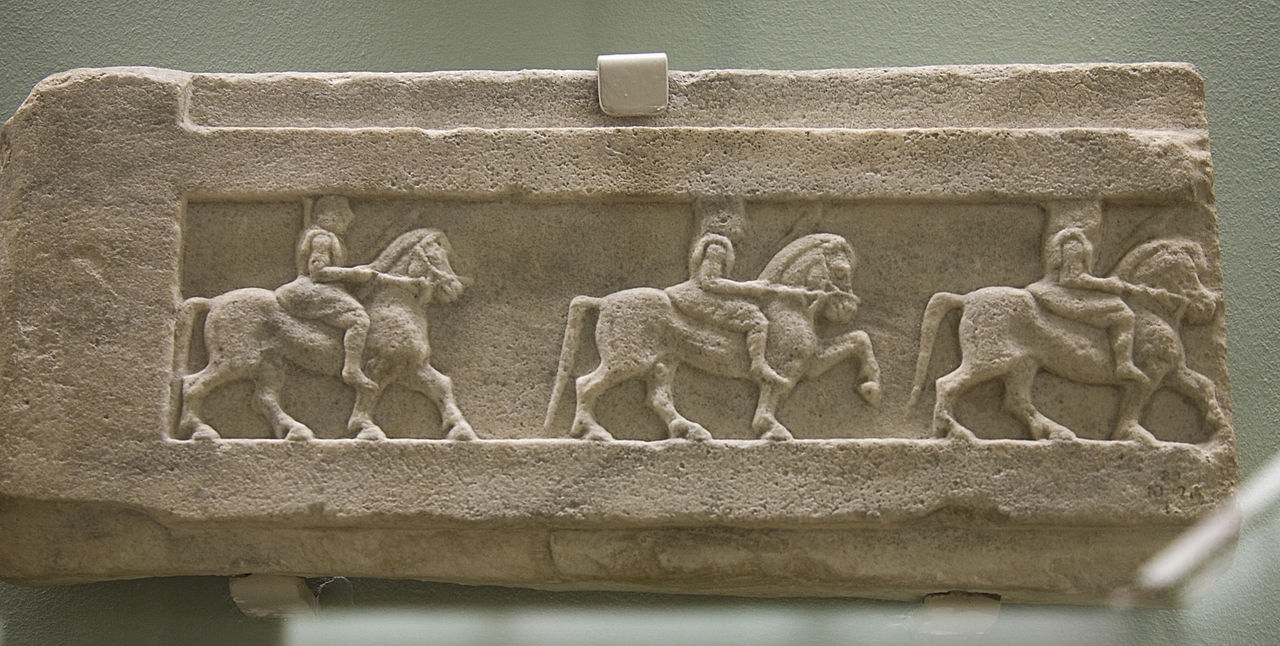
A pesar de estos reveses, el reino lidio logró crecer en poder, y los propios lidios parecen haber adoptado prácticas militares cimerias, como el uso de caballería montada, y los lidios luchaban utilizando lanzas largas y arqueros, ambos a caballo. [263]
Hacia el año 635 a. C. , [264] y con la aprobación neoasiria, [265] los escitas bajo el mando de Madyes conquistaron Urartu, [217] [266] entraron en Anatolia central [130] y derrotaron a los cimerios y a los treres. [267] Esta derrota final de los cimerios fue llevada a cabo por las fuerzas conjuntas de los escitas de Madyes, a quienes Estrabón de Amasia atribuye la expulsión de los treres de Asia Menor, y de los lidios liderados por su rey Aliates , [268] que era hijo de Sadiates, así como nieto de Ardis y bisnieto de Giges, a quien Heródoto de Halicarnaso y Polieno de Bitinia afirman que derrotó permanentemente a los cimerios de modo que ya no constituyeron una amenaza. [269]
En el relato de Polieno sobre la derrota de los cimerios, afirmó que Aliates utilizó "perros de guerra" para expulsarlos de Asia Menor, siendo el término "perros de guerra" una reinterpretación folclórica griega de los jóvenes guerreros escitas que, siguiendo el rito de paso indoeuropeo del kóryos , asumían ritualmente el papel de guerreros lobo o perro. [270]
Los cimerios desaparecieron completamente de la historia después de esta derrota final, [250] [20] y pronto fueron asimilados por las poblaciones de Anatolia. [245] También fue en esta época cuando los últimos estados sirio-hititas y arameos aún existentes en Anatolia, que habían sido independientes o vasallos del Imperio neoasirio, Frigia, Urartu o los cimerios, también desaparecieron finalmente, aunque las circunstancias exactas de su final son todavía muy inciertas. [224]
El poder escita en Asia occidental alcanzó su apogeo bajo Madyes, con los territorios de Asia occidental gobernados por el reino escita extendiéndose desde el río Halys en Anatolia en el oeste hasta el mar Caspio y las fronteras orientales de Media en el este, y desde Transcaucasia en el norte hasta las fronteras septentrionales del Imperio neoasirio en el sur. [271] Y, tras la derrota de los cimerios y la desaparición de los otros estados anatolios, fue el nuevo Imperio lidio de Aliates el que se convirtió en la potencia dominante de Anatolia. [236]
Arqueológicamente, el movimiento de los cimerios y escitas hacia Anatolia corresponde a la expansión de la cultura escita en esta región. [83]
Fue también en esta época cuando los escitas entraron en contacto por primera vez con los griegos , en Anatolia. [45] [20] [272]
Primera ola de colonización griega
Los antiguos griegos realizaron sus primeras expediciones al Mar Negro en el siglo VIII a. C., y los encuentros con poblaciones nativas amistosas estimularon rápidamente las relaciones comerciales y el desarrollo de tránsitos comerciales más regulares, lo que a su vez condujo a la formación de asentamientos comerciales. [273] [274]
Después de que las ciudades-estado griegas del mar Egeo comenzaran a experimentar tensiones sociales causadas por el crecimiento de sus poblaciones y las invasiones cimerias de Jonia a mediados del siglo VII a. C., las costas del mar Negro se convirtieron en un destino propicio para establecer asentamientos [275] [125] [276] ya que sus costas proporcionaban puertos seguros, ubicaciones defendibles y abundantes peces en los mares, estuarios y ríos. [277] Además, la población local de la región del norte del Póntico ya producía un excedente de bienes como el grano, lo que facilitó la formación pacífica de relaciones con los pueblos locales y el desarrollo temprano del comercio con los pueblos de la estepa forestal. [278]
El principal agente de la colonización griega de las costas del Mar Negro fue la ciudad de Mileto , de Jonia , en Anatolia occidental, que fue responsable de la fundación de alrededor de 90 colonias, [279] [280] y otras ciudades de Jonia, como Samos y Quíos, también fueron participantes importantes de este proceso. [281]
Así, poco después, alrededor del 625 a. C. , los escitas de la estepa póntica entraron en contacto con colonos griegos [20] procedentes de Mileto [282] que estaban empezando a fundar sus primeras colonias en las zonas bajo dominio escita de la costa norte del mar Negro. [282] [20] Este proceso de colonización puso el mundo nómada de las estepas de los escitas en contacto permanente con el mundo urbano de los griegos del Egeo durante el resto de su historia. [20]
Primeros puestos comerciales griegos
La primera ola de colonización griega de la costa norte del Mar Negro consistió en intentos de desarrollar el comercio con sus poblaciones nativas, [280] y por lo tanto implicó la formación de enclaves comerciales ( griego antiguo : εμπορια , romanizado : emporia ; latín : emporia ) [283] que debían establecerse en lugares que proporcionaran un acceso seguro y buenas instalaciones de atraque, así como otorgar acceso a los principales ríos de la estepa a través de los cuales se podía llegar a las regiones interiores de la estepa forestal; [280] estos ríos eran importantes en su papel como rutas a través de las cuales se podían enviar diversos bienes al sur a las colonias griegas. [284] Las poblaciones nativas y los colonos vieron este proceso, destinado a establecer conexiones comerciales en lugares que ya tenían una población escasa en lugar de obtener tierras, como mutuamente beneficioso, de ahí que fuera en gran medida pacífico. [277]
Por lo tanto, los primeros emporios del norte del Mar Negro se construyeron en Histria en la desembocadura del río Istros, en Tyras en un promontorio que dominaba el estuario del río Tyras , [280] y especialmente en la isla de Borysthenēs , cerca del estuario conjunto de los ríos Hypanis y Borysthenēs y por lo tanto otorgando acceso a ambos. [285] El emporio de Borysthenēs prosperaría a partir de entonces durante el resto del siglo VII a. C., y durante todo el siguiente siglo VI a. C. [280]
Estos emporios eran útiles para las empresas comerciales de sus ciudades madre al actuar como mercados a través de los cuales se podía intercambiar aceite , vino y productos manufacturados con las poblaciones nativas a cambio de alimentos y materias primas raras como granos , pescado , productos animales, metales , productos forestales, pieles y esclavos traídos a través de las redes comerciales del interior. [204] [277] [279] El éxito de este comercio, como resultado, se reforzó como una forma para que las colonias griegas, así como sus ciudades de origen, aumentaran su poder y riqueza. [277]
Declive en Asia occidental
A mediados de la década de 620 a. C., el Imperio neoasirio comenzó a desmoronarse después de la muerte de Asurbanipal: [286] [20] además de la inestabilidad interna dentro de la propia Asiria debido a las guerras civiles bajo sus sucesores Aššur-etil-ilāni ( r. 631 - 627 a. C. ) y Sîn-šar-iškun ( r. 627 - 612 a. C. ), [263] Babilonia también se rebeló contra los asirios en 626 a. C. bajo el liderazgo de Nabopolasar , [287] [194] y el general asirio Sîn-šumu-līšir también se rebeló contra Sîn-šar-iškun en 626 a. C. [287]
La rebelión de los medios

Para entonces, el rey medo Ciaxares se había vuelto poderoso y había iniciado negociaciones con los escitas. Al año siguiente, en 625 a. C., invitó a los líderes escitas a un banquete en su palacio, donde los emborrachó y los asesinó a todos, derribando así el yugo asirio-escita sobre los medos y convirtiéndolos en uno de los primeros pueblos en independizarse del Imperio neoasirio. [288]
El asesinato de los gobernantes escitas por parte de Ciaxares puso fin a la hegemonía del reino escita en Asia occidental, [289] después de lo cual sus actividades se limitaron a las fronteras orientales del Imperio neoasirio [20] y terminó la importación de productos de Asia occidental a los territorios centrales del reino escita en la estepa ciscaucásica. [20]
Los medos en esta época habían adquirido conocimiento de nuevas ideologías y tecnologías militares tanto de las potencias sedentarias como el Imperio neoasirio y Urartu, como de los nómadas esteparios como los cimerios y los escitas: [225] es decir, armas y tácticas militares, particularmente en tiro con arco. [290] [291] Gracias a la integración meda de estas influencias, Ciaxares pudo combinar las prácticas militares escitas y neoasirias y crear un ejército organizado compuesto por distintas divisiones de lanceros, arqueros y caballería, transformando así a Media en la potencia dominante de la meseta iraní de nuevo como Fraortes lo había hecho antes. [292] [225]
Tras las exitosas revueltas de Babilonia bajo Nabopolasar y de Media bajo Ciaxares, los diversos vasallos del Imperio neoasirio en Anatolia y en la meseta iraní comenzaron a separarse del gobierno neoasirio. [225]
Incursión a Egipto

Con el poder de sus antiguos aliados neoasirios desmoronándose a mediados de la década de 620 a. C., y los recién ascendidos imperios neobabilónico y medo aún no habiéndose consolidado, los escitas aprovecharon el vacío de poder para incursionar en el Levante [293] en algún momento entre c. 626 y c. 616 a . C. [294] [295] Se desconoce si esta incursión dañó el control del Imperio neoasirio sobre sus provincias occidentales, [296] aunque la última presencia neoasiria conocida en Fenicia data de esta época, en la forma de la mención del gobernador de Ṣumur , Mannu-kī-aḫḫē, en una lista de epónimos de c. 619 a. C. [ 297]
La incursión escita en el Levante llegó hasta Palestina, [193] y fue predicha por los profetas judíos Isaías , Jeremías y Sofonías , quienes predijeron un inminente "desastre del norte" que, según creían, resultaría en la destrucción de Jerusalén . [298] Sin embargo, la incursión escita no afectó a Jerusalén ni siquiera al reino de Judá , [299] lo que hizo que Jeremías perdiera el favor del rey judío Josías , quien en su lugar recurrió a la profetisa Hulda en busca de consejo, y llevó a Jeremías a dejar de profetizar temporalmente durante algunos años. [300]
La incursión escita llegó a las fronteras del reino egipcio saíta , [301] donde su avance fue detenido por las marismas del delta del Nilo , [299] después de lo cual el faraón Psamético I los encontró y los convenció de regresar ofreciéndoles regalos. [302]
Los escitas saquearon varias ciudades de Palestina mientras se retiraban, [20] incluido el templo de la diosa ʿAštart en Ascalón . [303] Según autores grecorromanos posteriores, este santuario de Ascalón se consideraba el más antiguo de todos los templos de esa diosa, como resultado de lo cual los perpetradores de este sacrilegio y sus descendientes fueron supuestamente maldecidos por ʿAštart con una "enfermedad femenina" que los hizo convertirse en una clase de adivinos travestis llamados Anarya ( lit. ' poco varonil ' en escita [20] ). [304]
Guerra contra el Imperio Neoasirio
Después de reorganizar su reino y aumentar su poder militar, Ciaxares atacó al Imperio neoasirio; [305] [306] mientras tanto, Nabopolasar había logrado tomar el control de toda Babilonia en 620 a. C., [305] y en 616 a. C. estaba militarmente lo suficientemente cómodo como para atacar los territorios centrales asirios; [263] y Nabopolasar y Ciaxares pronto se aliaron entre sí contra el Imperio neoasirio . [263]
En 615 a. C., el reino escita estaba operando como aliado de Ciaxares en su guerra contra el Imperio neoasirio, posiblemente por necesidad, y el abandono por parte de los escitas de su antigua alianza con los asirios para ponerse del lado de los neobabilónicos y los medos fue un factor crítico en el empeoramiento de la posición militar del Imperio neoasirio. [307] [190] [193] El reino escita apoyó las conquistas medobabilónicas de Aššur en 614 a. C., de Nínive en 612 a. C. y de los últimos restos neoasirios en Ḫarran en 610 a. C., que destruyeron permanentemente el Imperio neoasirio. [308]
La presencia de puntas de flecha de estilo escita en lugares donde se sabe que el Imperio neobabilónico llevó a cabo campañas militares, y que están asociadas con las capas de destrucción de estas campañas, sugiere que ciertos contingentes compuestos por escitas o medos que habían adoptado técnicas de tiro con arco escitas podrían haber sido reclutados por el ejército neobabilónico durante esta guerra. [309] Las propias divisiones de tiro con arco neobabilónicas estaban influenciadas por las técnicas de tiro con arco escitas porque los arcos escitas eran más poderosos que los acádios. [310]
Las figurillas de arcilla que representan jinetes escitas, así como un escudo jónico y un hacha de batalla neohitita similares a los encontrados en restos escitas en la estepa póntica, sugieren que tanto los contingentes como los mercenarios escitas reales también habían participado en la victoria neobabilónica final sobre los egipcios en Carchemish . [309] [73]
Los contingentes escitas o de estilo escita también participaron en las campañas neobabilónicas en el sur del Levante, incluida la anexión babilónica del reino de Judá en el 586 a. C. [309]
Comienzo de las actividades comerciales grecoescitas
De los asentamientos griegos en la costa del Mar Negro, la aristocracia escita compraba especialmente bienes de lujo que usaba ostentosamente durante sus vidas y en sus tumbas como marcadores de estatus: el vino y los diversos recipientes griegos utilizados para mezclarlo y beberlo se importaban especialmente en grandes cantidades e incluso se usaban como ajuar funerario , mientras que los artesanos de las colonias griegas fabricaban artículos hechos de oro o electrum para los mecenas escitas. [311]
Una vez que las actividades escitas comenzaron a declinar en Asia occidental en la década de 620 a. C. y los vínculos entre los escitas y las colonias griegas comenzaron a desarrollarse al mismo tiempo, los escitas comenzaron a comprar cerámica griega importada de las islas del Egeo, [312] y se creó una nueva y próspera fuente de comercio para el reino escita en la costa norte del Mar Negro. [67] Así terminó la importación a los territorios centrales del reino escita de la estepa ciscaucásica de productos de Asia occidental, que fueron reemplazados por productos comprados a las colonias griegas o encargados a artesanos griegos por mecenas escitas en el transcurso de c. 625 a c. 600 a. C. , [313] [20] lo que resultó en que las influencias griegas en los escitas reemplazaran a las de Asia occidental desde principios del siglo VI a. C. [156]
Por lo tanto, las relaciones entre el reino escita y las colonias griegas de la región póntica septentrional permanecieron inicialmente en gran medida pacíficas, gracias a lo cual las ciudades griegas no poseían murallas defensivas. [20]
Expulsión de Asia occidental
Hacia el año 590 a. C. , el Imperio medo de Ciaxares, que estaba en ascenso, anexó Urartu, [314] [315] después de haber anexado ya Mannai en el año 616 a. C. [292] Este ascenso del poder medo obligó al reino escita a abandonar Asia occidental y retirarse hacia el norte, a la estepa ciscaucásica, [316] después de lo cual las actividades escitas en Asia occidental, [161] [41] [20] así como los lazos entre los asiáticos occidentales y los escitas a lo largo del siglo VII a. C., [317] y las influencias asiáticas occidentales sobre los escitas, llegaron a su fin alrededor del año 610-600 a . C. [318]
Sin embargo, incluso después de la retirada de los escitas de Asia occidental, continuaron existiendo relaciones complejas entre los reinos medo y escita ubicados, respectivamente, al sur y al norte de las montañas del Cáucaso, y los escitas continuaron involucrados como socios y enemigos del reino medo en la región del Cáucaso. [319]
Restos en Asia occidental
Sin embargo, algunos grupos escitas escindidos permanecieron en Transcaucasia oriental, especialmente en el área correspondiente a la actual Azerbaiyán, y no se retiraron al norte. [85] Por lo tanto, el área donde vivían fue llamada Sakašayana ( lit. ' tierra habitada por los saka (es decir, por escitas) ' ) por los medos; este nombre fue registrado más tarde como Sakasēnē ( Σακασηνη ) por Ptolomeo , y sus habitantes fueron llamados Skythēnoi ( Σκυθηνοι ) por Jenofonte, Sakesinai ( Σακεσιναι ) por Arriano, y Sacassānī por Tito Livio. [39]
Estos escitas sirvieron en el ejército de Ciaxares, [240] donde participaron en la conquista meda de Urartu, [224] y fue una de esas divisiones escitas la responsable de la captura y destrucción de las fortalezas de Argištiḫinili y Teišebaini en el norte de Urartu. [320] El reino medo también podría haber empleado a los escitas como cazadores para proporcionar caza a la corte. [230]
Finalmente estallaron hostilidades entre Ciaxares y algunos de estos escitas que lo servían, probablemente como resultado de que el reino medo pusiera fin a la autonomía de estos escitas y los anexara por completo. [321] Fuentes grecorromanas posteriores afirmaron que estos escitas abandonaron el reino medo y huyeron al Imperio lidio, comenzando un conflicto entre Lidia y Media: [230] en las dos primeras décadas del siglo VI a. C., la expansión meda hacia el oeste desde la meseta iraní y la expansión lidia hacia el este desde Anatolia llegaron a las manos, lo que resultó en una guerra que duró desde aproximadamente el año 590 a. C. y terminó solo debido a un eclipse solar en el año 585 a. C., después de lo cual se hizo la paz entre Lidia y Media y se estableció un nuevo orden político en Asia occidental. [322] [323]
Estos escitas que habían permanecido en Asia occidental habían sido completamente asimilados a la sociedad y al estado medos hacia mediados del siglo VI a. C., de modo que ya no constituían un grupo independiente y ya no tenían una identidad propia. [324] [325]
Reino escita del norte del Póntico

Tras su expulsión de Asia occidental, la mayoría de los escitas regresaron a las partes de la estepa ciscaucásica [326] correspondientes a la actual Stavropol y al valle del río Kuban [105] [327] antes de trasladarse a la estepa póntica, [328] que sólo entonces comenzó a ser ocupada por los escitas en masa y a gran escala, [101] lo que dio lugar a que la estepa póntica se convirtiera en el centro del poder escita. [50] Entre los escitas que todavía habían permanecido en Ciscaucasia, la influencia de las poblaciones nativas de esta región se hizo más prominente durante este período. [329]
Este movimiento de los escitas hacia la estepa póntica estuvo motivado por dos factores principales: [67]
- Al sur del Cáucaso se encontraba el poderoso pero hostil Imperio Medo, que comprometía la seguridad del reino escita en Ciscaucasia;
- Las colonias griegas a orillas del Mar Negro al sur y los agricultores mixtos de la estepa forestal al norte eran una fuente esencial de comercio para los escitas, siendo así un lugar desde donde podían obtener importantes riquezas.
El asentamiento escita en la estepa póntica los había colocado en una posición extremadamente ventajosa: [101]
- Al norte, en la estepa forestal, vivían grandes poblaciones mixtas de agricultores sedentarios que producían una gran variedad de productos muy buscados, como hierro, carbón, pieles, miel, esclavos y cereales;
- Al sur, en la costa norte del Mar Negro, estaban las colonias griegas que buscaban materias primas y mano de obra para su propio consumo, así como para exportar a Grecia.
Esta situación permitió al reino escita mediar en el próspero comercio que las colonias griegas situadas al sur llevaban a cabo con los pueblos sedentarios de la estepa forestal situada al norte, [20] [101] y que se llevaba a cabo a través de los grandes ríos de la estepa escita que fluían hacia el sur hasta el mar Negro y formaban las principales rutas de acceso a estos mercados del norte. [20] Las relaciones entre el reino escita y los comerciantes griegos eran, por tanto, mutuamente beneficiosas e influyeron tanto en los escitas nómadas como en las poblaciones de la estepa forestal, y la aristocracia escita se benefició significativamente de este comercio. [330] [331]
Por lo tanto, la estepa póntica era un territorio particularmente atractivo para los escitas, no solo porque era un terreno ideal para su estilo de vida guerrero y pastoral, sino también porque les permitía obtener cereales para complementar su dieta de la población mixta de agricultores de la estepa forestal al norte, y bienes de lujo exóticos para que su aristocracia los usara como marcadores de estatus de las colonias griegas en la costa del Mar Negro. [97]
Como testimonio de este movimiento escita desde Ciscaucasia hacia la estepa póntica, así como de la profundización de sus conexiones con las colonias griegas, los cascos ciscaucásicos dejaron de ser utilizados por los escitas en el siglo VI a. C. y fueron reemplazados por cascos griegos, especialmente de tipo ático , [116] mientras que el entierro femenino del segundo kurgan de Kelermes contenía un espejo dorado de plata griega jónica fabricado entre los siglos VII y VI a. C. [332]
Formación política y social de los escitas pónticos
Dentro de la estepa póntica, los escitas iraníes que llegaron se establecieron en las regiones esteparias orientales en las orillas occidental y oriental de los ríos Hypanis y Borysthenēs e inmediatamente al norte del mar Meotio hacia el este hasta el río Tanais, mientras que en las partes occidentales del reino escita vivían varias tribus sedentarias tracias [333] y protoeslavas [334] : [335] los conquistadores escitas que llegaron se establecieron como la élite gobernante, conocida como los escitas reales, [40] sobre la población local y los asimilaron en una única identidad tribal al tiempo que les permitían continuar con sus diversos estilos de vida y organizaciones económicas. [336]
Así, en muchas partes de la región norte del Ponto bajo su dominio, los escitas se establecieron como una clase gobernante sobre las poblaciones tracias sedentarias ya presentes en las regiones occidentales: [333] algunas de las tribus escitas se casaron con las poblaciones tracias sedentarias ya presentes para formar nuevas tribus como los escitas nómadas y los alazones, compuestos por una población tracia con una clase gobernante iraní. [337] La capacidad de los escitas reales para dominar a estas poblaciones sedentarias se derivaba de sus métodos militares nómadas que habían desarrollado por primera vez en Ciscaucasia. [54] Por lo tanto, muchas de las poblaciones étnicamente no escitas de la estepa póntica fueron designadas con el término " escitas " en gran parte porque vivían bajo el dominio de los escitas propiamente dichos, [25] [43] después de los cuales la estepa póntica también llegó a ser conocida como Escitia . [338]
Durante esta fase temprana del reino escita póntico, los escitas reales se establecieron en la región inmediatamente al oeste del río Tanais , [339] siendo su dominio sobre la parte occidental de la estepa ubicada al oeste de Borysthenēs ligero, y estaban en gran medida satisfechos con el tributo que recaudaban de las poblaciones agrícolas sedentarias de esta región. [340]
En el Quersoneso Táurico , donde vivían los tauros , los escitas reales conquistaron a los miembros de esta población que vivían en las colinas y las estepas, ganando así el control de la mayor parte de la península y formando una población mixta escita-tauria. Debido a esta mezcla con los escitas, los sitios de la cultura tauriana Kizil-Koba en las estepas de las colinas eran diferentes de aquellos en los Montes Táuricos que permanecieron independientes de los escitas. [341] Durante el siglo VI a. C., los escitas eran pocos en número en el Quersoneso Táurico y, debido a que llevaban una vida nómada, su población en la península aumentó solo durante las migraciones estacionales. [342]
Desde el siglo VII al V a. C., el reino escita fue una sociedad de clases tribal preestatal constituida por tribus encabezadas por sus propios señores, siendo el rey el principal señor tribal de la tribu dominante de los escitas iraníes entrantes, conocidos como los escitas reales, y todas las demás tribus dentro del reino escita estaban sujetas a los escitas reales, a cuyo rey y aristocracia guerrera tenían que proporcionar sirvientes. [343]
Los talleres metalúrgicos que producían las armas y arneses para caballos de los escitas durante el período escita temprano estaban ubicados en la estepa forestal, [344] mientras que el centro de la industria en ese momento se encontraba en la región del grupo Tiasmyn de la cultura escita, que correspondía al país de los Arotēres, donde una élite escita iraní gobernaba sobre una población tracia sedentaria. [345]
Durante esta fase temprana de su reino póntico septentrional, entre los siglos VI y V a. C., la realeza escita enterraba a sus muertos en dos regiones principales: [105] [20] [346]
- en Ciscaucasia, en la región de Kuban, habitada por los mecios, donde las tumbas reales y aristocráticas eran las más suntuosas de todos los monumentos funerarios escitas del período escita temprano, e incluían los túmulos de Kelermesskaya, Ulsky Aul y Kostromskaya Stanitsa. Los enterramientos en estos túmulos consistían en fosas rectangulares o cuadradas cubiertas de madera, o en bóvedas de madera o piedra construidas sobre la superficie del suelo, en las que se colocaba a los difuntos en posición supina, acompañados de caballos de montar, así como caballos de tiro acompañados de carros y varios objetos de origen asiático occidental; [105] [20]
- En la estepa forestal, las tumbas se construían siguiendo un rito ligeramente diferente al de las de Ciscaucasia: consistían en fosas cubiertas con madera o bóvedas de madera construidas sobre la superficie del suelo o empotradas en fosas, en ocasiones las bóvedas se quemaban antes de ser cubiertas por el túmulo de tierra. De ellas, la más importante era el túmulo de Melhuniv, que contenía ajuares funerarios de origen asiático occidental comparables a los de las tumbas de Ciscaucasia. [20]
Sólo un número muy pequeño, alrededor de 20, de tumbas escitas de los siglos VI al V a.C. se encontraban en la estepa póntica: [347] [105] [93] estos patrones de enterramiento seguían una costumbre por la cual la realeza escita enterraba a sus muertos en los bordes de su territorio [20] para marcar los límites de su reino. [348]
Influencia escita en la estepa póntica
La migración hacia el oeste de los escitas fue acompañada por la introducción en la región póntica del norte de artículos originarios de la cultura siberiana Karasuk , como espadas y dagas distintivas, y que eran característicos de la cultura arqueológica escita temprana, que consistía en calderos de bronce fundido , dagas, espadas y arneses para caballos, [349] [154] que a su vez habían sido influenciados por el arte chino, con, por ejemplo, los "tubos cruciformes" utilizados para fijar los cruces de correas siendo de tipos que inicialmente habían sido modelados por artesanos Shang . [350]
Fue en esta época [350] cuando los escitas trajeron consigo el conocimiento del trabajo del hierro que habían adquirido en Asia occidental y lo introdujeron en la estepa póntica, cuyos pueblos eran todavía sociedades de la Edad del Bronce hasta entonces. [210] Algunos herreros de Asia occidental también podrían haber acompañado a los escitas durante su retirada hacia el norte y haber sido empleados por los reyes escitas, después de lo cual la práctica del trabajo del hierro pronto se extendió a las poblaciones vecinas. [210]
El establecimiento escita en la estepa póntica, y por lo tanto su sometimiento de las poblaciones nativas de esta región, fue facilitado especialmente por las armas de hierro y la experiencia militar que habían obtenido en Asia occidental. [212] En la estepa póntica durante este período, los escitas introdujeron el uso de armaduras de escamas, que la aristocracia real escita había tomado prestada de los pueblos de Asia occidental. [116] [211]
Expansión hacia Europa Central
Migración de los sindi
Como parte de la expansión de los escitas en Europa, una sección de la tribu escita de los sindi abandonó la región del mar de Maeotia y, a lo largo de los siglos VII al VI a. C., emigró hacia el oeste hasta la sección oriental de la estepa de Panonia, donde se establecieron junto a los sigynnae. [161]
La mayoría de los sindi, en cambio, permanecieron en Ciscaucasia, donde se asentaron en la península que llegó a ser conocida como el Quersoneso Síndico ( griego antiguo : Σινδικη Χερσονησος , romanizado : Sindikē Khersonēsos ) después de ellos, [161] y donde formaron una clase gobernante sobre los meotios nativos, quienes eran de origen caucásico nativo. [351] [313]
En la estepa forestal
La presencia de enterramientos aristocráticos escitas en la estepa forestal sugiere que el reino escita en el siglo VI a. C. todavía continuaba su política de intentar establecer su autoridad sobre las poblaciones nativas de la estepa forestal, como también lo atestigua el hecho de que estas últimas poblaciones todavía construían asentamientos fortificados para defenderse de los ataques escitas. [153]
Los escitas pudieron expandir su hegemonía a parte de la estepa forestal situada al este del río Borysthenēs a lo largo de finales del siglo VII y principios del VI a.C., poco después del final de sus actividades en Asia occidental, pero recién en ese momento estaban comenzando a ingresar a las partes de la estepa forestal al oeste del Borysthenēs. [100]
Una vez que los escitas reales se trasladaron de Ciscaucasia a la estepa póntica a finales del siglo VII a. C. y subyugaron la estepa forestal oriental, colaboraron estrechamente con las élites gobernantes de las tribus de la estepa forestal. Durante el siglo VI a. C., esta dependencia de la población sedentaria de la estepa forestal consistía en el ofrecimiento de tributos, a cambio de los cuales los escitas evitarían lanzar incursiones militares contra ellos y permitirían a los gobernantes locales preservar su organización política y presidir la producción de productos agrícolas que se entregarían como tributo a los escitas. [352]

Incursiones al oeste
Una vez que el centro del poder escita se había desplazado a la estepa póntica, desde alrededor de c. 600 a. C. los escitas a menudo atacaban las regiones adyacentes, siendo Europa central y sudoriental un objetivo frecuente de sus ataques. [93] [50] [77] Los ataques de los escitas no solo se dirigían a Transilvania , Podolia y la estepa de Panonia , [93] [97] [153] sino que también podrían haber estado dirigidos al sur de Germania , donde atacaron la cultura lusaciana y causaron su destrucción, y desde allí, hasta la Galia , [354] y posiblemente incluso la península Ibérica : [161] estas incursiones escitas no eran diferentes a las de los hunos y los ávaros durante el Período de Migración, y de los mongoles en la era medieval, y fueron registradas en figurillas de bronce etruscas que representan arqueros escitas montados. [355]
Durante este período, los escitas destruyeron numerosos asentamientos de la cultura lusaciana a causa de sus ataques [93] y se han encontrado puntas de flecha escitas en varios yacimientos ubicados en lo que hoy son Polonia y Eslovaquia , como en Witaszkowo , Wicina , Strzegom , Polanowice y Smolenice-Molpír . Los escitas también atacaron, saquearon y destruyeron muchos de los asentamientos ricos e importantes de la Edad del Hierro [356] ubicados al norte y al sur de la Puerta de Moravia y pertenecientes al grupo oriental de la cultura de Hallstatt , incluido el de Smolenice-Molpír, donde se encontraron flechas de tipo escita en los puntos de acceso de esta fortaleza fortificada en la puerta y en el lado suroeste de la acrópolis [357].
Influencias escitas hacia el oeste
Debido a estas incursiones escitas, nuevos objetos de tipo escita temprano originarios de las estepas, que consistían en armas de tipo escita y equipo de caballos, así como restos asociados con los primeros escitas, comenzaron a aparecer a partir de esta época en Europa Central, especialmente en Besarabia , Transilvania, las llanuras de Tracia y Panonia, y lo que actualmente es Eslovaquia. [358] El comercio y la migración de algunos grupos escitas escindidos a la cuenca de Panonia también contribuyeron a la aparición de estos objetos de tipo escita allí. [77]
Algunas de las poblaciones de la cultura lusaciana, así como los grupos orientales de la cultura de Hallstatt, también podrían haber sido influenciadas por los escitas y, por lo tanto, tomaron prestados de ellos tipos de armas y arneses para caballos: [359] las interacciones con los escitas llevaron a la adopción del arte de "estilo animal" de tipo escita y el tiro con arco montado por la población de estas regiones en el período posterior. [360] [356] También fue en esta época cuando los escitas introdujeron tipos de metalistería que seguían los modelos chinos Shang en Eurasia occidental, donde fueron adoptados por la cultura de Hallstatt . [350] Las influencias artísticas escitas también fueron absorbidas por el arte celta en esta época. [355]
El comercio entre el reino escita póntico y los nómadas de la cuenca de Panonia, así como la migración de grupos escitas escindidos a esa zona, contribuyeron a la transformación de la cultura de estos pueblos en una forma más parecida a la escita. Entre las poblaciones influenciadas estaban los agatirsos de Transilvania y los sigynnae del norte y noroeste de la cuenca de Panonia: [361] después de que los sigynnae se asentaran en la estepa de Panonia en el siglo VIII a. C., su cultura original de Chernogorovka-Novocherkassk evolucionó hacia el grupo Mezőcsát, que a su vez evolucionó hacia la cultura Vekerzug después de caer bajo la influencia escita. [60]
Segunda ola de colonización griega
El establecimiento del reino escita póntico fue un catalizador para el desarrollo de extensas conexiones comerciales, y fue solo después de que la mayor parte de los escitas se hubiera mudado a la estepa póntica que se fundaron colonias griegas más permanentes en esta región: [212] la segunda ola de colonización griega de la costa norte del Mar Negro, que comenzó poco después de c. 600 a. C. , implicó la formación de asentamientos que poseían tierras agrícolas ( griego antiguo : χωραι , romanizado : khōrai ) para migrantes de Mileto , Corinto , Focea y Megara [277] que buscaban establecerse para cultivar ( griego antiguo : αποικια , romanizado : apoikiai ) en estas regiones donde la tierra era fértil y el mar abundante. [283]
Las relaciones entre el reino escita y las colonias griegas de la región norte del Ponto fueron, por tanto, inicialmente en gran medida pacíficas, debido a lo cual las ciudades griegas no poseían murallas defensivas y estaban rodeadas de khōrai rurales no fortificadas en las que se producía el grano que se consumía en las ciudades o se exportaba. [20] La prosperidad de estas nuevas ciudades griegas dependía más de la producción agrícola de sus khōrai que del comercio que transitaba por ellas, ya que se localizaba en gran parte en las costas del Quersoneso Táurico. [280]
Sin embargo, las áreas más especialmente favorecidas por esta ola de colonización fueron los Quersoneso Traqueo y Síndico , que no solo controlaban el paso a través del Bósforo Cimerio que unía el Mar Negro con el Mar de Maeotia y, por lo tanto, también proporcionaban acceso a los ríos que desembocaban en él, [283] [280] sino también por la gran cantidad de peces que prosperaban en las aguas ricas en nutrientes del Mar de Maeotia. [280] El Bósforo Cimerio era, por lo tanto, tan particularmente atractivo para los colonos griegos [280] que se fundaron alrededor de nueve nuevas colonias tanto en los Quersoneso Traqueo como en los Síndicos en el transcurso de c. 580 a c. 560 a. C. , incluyendo Krēmnoi en el mar de Meocia cerca del estuario del río Tanais, y más tarde en Pantikapaion , [283] seguida por más lugares, [20] de modo que pronto se ubicaron alrededor de una docena de colonias griegas alrededor del Bósforo de Cimerio. [280] Todas estas colonias en el Bósforo de Cimerio eran ciudades portuarias, siendo el asentamiento de Pantikapaion, que dominaba directamente el estrecho, el más importante de ellos. [283] [280]
Entre estas colonias griegas, las más destacadas serían la Olbia póntica, que atendía las demandas de la aristocracia escita del valle del río Borysthenēs, y Pantikapaion, que abastecía a los aristócratas escitas en los Quersonesos Táurico y Síndico. [153]
Olbia, una de las ciudades más importantes fundadas durante esta segunda ola de colonización, fue la Olbia póntica , situada en tierra firme, junto al emporio de Borysthenēs. [331] [20] [283] El emporio se trasladó pronto a Olbia debido a la mala calidad de las instalaciones portuarias de la isla de Borysthenēs, [284] lo que llevó a que Olbia pronto eclipsara a la colonia Borysthenēs [280] para convertirse en un importante centro cultural y comercial. [362]
En la estepa póntica, los colonos griegos también encontraron oportunidades atractivas para comerciar con los escitas [283] vendiéndoles vino, aceite de oliva , textiles , vasijas de metal, cerámica de alta calidad y artículos de lujo a cambio de pieles, materias primas , pescado, productos animales, esclavos y granos: [363] La Olbia póntica suministró especialmente a los escitas artículos de lujo como adornos personales, jarrones de oro y plata, glípticas, vino y aceite, así como armas defensivas y ofensivas producidas en talleres ubicados en la propia Olbia o importadas de la Grecia continental. [312] El principal socio comercial de Olbia en Grecia durante este período fue la ciudad-estado de Atenas ; [330] Durante el siglo VI a. C., Olbia también importaba grandes cantidades de cerámica pintada de Rodas , Samos , Corinto y Jonia, así como vino en ánforas de Quíos y Tasos , y objetos de bronce como herramientas y espejos, que se vendían a los escitas, [330] quienes compraban especialmente cerámica corintia y ateniense. [312]
Una importante ruta comercial del oro también conectaba la Olbia póntica con las áreas del interior, adentrándose hacia el norte en el territorio de la tribu de los aroteres y desde allí hacia el interior de Asia: [364] las ciudades griegas pudieron crecer y prosperar rápidamente porque habían sido capaces de desarrollar amplias relaciones comerciales con regiones distantes gracias al dominio del reino escita sobre la estepa póntica y al establecimiento por sus reyes de una Pax Scythica que aseguraba que los comerciantes estuvieran a salvo de los ladrones. Esta próspera ruta comercial a su vez fue una importante fuente de beneficios para la realeza y la aristocracia escitas gracias a la cual obtuvieron una riqueza significativa. [365] Las relaciones entre el reino escita y los comerciantes griegos fueron, por lo tanto, mutuamente beneficiosas e influyeron tanto en los escitas nómadas como en las poblaciones de las estepas forestales, con la aristocracia escita beneficiándose significativamente de este comercio. [330] [331]
Olbia mantuvo en esta época relaciones especialmente amistosas con las poblaciones circundantes, [362] especialmente con los arotēres, con quienes tenía estrechos vínculos. [366]
Otro factor que obligaba a los colonos griegos a mantener relaciones comerciales, económicas y políticas amistosas con los escitas era el temor a posibles ataques escitas, en cuyo caso las fortificaciones griegas no serían capaces de resistir los ataques del fuerte y numeroso ejército escita. Por ello, los griegos de la costa póntica enviaban ricos regalos a los reyes y pequeños señores escitas como tributo a cambio de su neutralidad o incluso de su apoyo. La aristocracia escita correspondió a la actitud amistosa de las ciudades griegas adoptando la misma política amistosa hacia las ciudades griegas. [367]
Los contactos entre los escitas y los griegos llevaron a la formación de una cultura grecoescita mixta, como entre la tribu "escita helenizada" de los calípidos, los histrianos, los geloni al norte de Escitia y las poblaciones helenizadas en Crimea y sus alrededores. [368]
El ascenso del Imperio persa
Mientras tanto, en Asia occidental, los imperios medo, lidio y neobabilónico con los que los escitas habían interactuado durante su estancia al sur de las montañas del Cáucaso habían sido reemplazados durante el período de alrededor de 550 a alrededor de 539 a. C. por el Imperio aqueménida , fundado por Ciro II , el rey de los persas , que eran un pueblo iraní de Asia occidental lejanamente relacionado con los escitas. [265] [369]
La sociedad del Imperio aqueménida bajo Ciro II y sus sucesores anteriores en ese momento todavía conservaba muchos aspectos de la cultura iraní común anterior que compartían con los escitas. [69]
La formación del Imperio persa aqueménida supuso una nueva presión desde el sur que obligó a los escitas a permanecer al norte del Cáucaso y del mar Negro. Sin embargo, al igual que durante los siglos VIII y VII a. C., las influencias procedentes del Asia occidental gobernada por los aqueménidas fluirían hacia el norte a través de las montañas del Cáucaso e influirían en la cultura escita. [67]
Tercera ola de colonización griega
Hacia el año 547 a. C. , Ciro II había conquistado el Imperio lidio y puesto Anatolia bajo el gobierno de su recién fundado Imperio persa aqueménida, [370] lo que provocó una gran salida de refugiados griegos que huían de la conquista persa, muchos de los cuales huyeron a la costa norte del Mar Negro, iniciando así a su vez una tercera ola de colonización griega de esta región, que duró desde alrededor de c. 560 a. C. hasta c. 530 a. C. [ 371]

Aunque las ciudades griegas del mar Egeo seguían fundando nuevas colonias a lo largo de todas las costas del mar Negro, algunas de las colonias ya existentes también comenzaban a establecer sus propias colonias, lo que llevó al crecimiento de la población inmigrante griega en todos estos asentamientos. Esta tercera ola de colonización fue compleja, como lo atestigua el hecho de que el asentamiento de Quersoneso en el Quersoneso Táurico se fundó a finales del siglo VI a. C., pero luego sería repoblado por colonos de Heraclea póntica en el siglo V a. C. [372]
La importancia de las colonias griegas de la costa norte del Mar Negro aumentó drásticamente tras la conquista de Egipto por el Imperio persa aqueménida en 525 a. C. por Cambises II , hijo de Ciro II, que privó a los estados de Grecia propiamente dichos del grano egipcio del que dependían. [280]
Estos suministros de grano eran tan importantes para las ciudades-estado de Grecia, especialmente para la entonces potencia griega dominante de Atenas , que esta última ciudad comenzó a buscar nuevas ubicaciones para producir grano en la costa norte del Mar Negro. Por lo tanto, Atenas estableció nuevas colonias muy bien defendidas en la costa norte del Mar Negro cerca de los asentamientos ya existentes, incluyendo Nymphaion cerca de Pantikapaion, Athēnaion cerca de Theodosia y Stratokleia cerca de Phanagoreia, que actuarían como sitios donde se produciría grano de muy buena calidad para ser exportado a Atenas para alimentar a su ciudadanía. [373]
Las diversas ciudades-estado griegas del mar Egeo también importaban durante este período pescado, pieles y esclavos de Escitia, [374] y a mediados del siglo VI a. C. los griegos comenzaron a emplear mercenarios escitas en forma de destacamentos de arqueros montados para apoyar a sus propios ejércitos de hoplitas. [375]
Las relaciones entre los griegos y los escitas continuaron siendo en gran medida pacíficas durante el siglo VI a. C., [20] aunque la única colonia griega en la región del bajo río Tanais, Krēmnoi, fue destruida por los escitas entre c. 550 y c. 525 a. C. , y Pantikapaion podría haber sido destruida por los escitas alrededor de c. 550 a. C. [ 20]
Primera ola de inmigración sauromatiana
Al este del reino escita, al otro lado del río Tanais, vivían los sauromácios , una tribu iraní estrechamente relacionada con los escitas, que estaban organizados en una única confederación tribal. Este reino sauromácio mantuvo buenas relaciones con el reino escita durante toda su existencia, desde el siglo VI al IV a. C., gracias a lo cual existía una ruta comercial que comenzaba en Escitia y se extendía hacia el este a través del territorio de los sauromácios, [376] y el arte escita de la región media del río Tanais exhibe influencias de la cultura sauromácia y, en menor grado, de la cultura ananyino . [115]
Sin embargo, en el período de c. 550 a c. 500 a. C. , las diversas comunidades sauromatianas que vivían en la región que se extendía desde los Montes Urales hasta la estepa del Caspio sufrieron la presión de los masagetas de Asia Central [84] como resultado de las campañas de Ciro II contra este último pueblo. [363] Como resultado de estas presiones, los sauromatianos del territorio de la estepa de Araxes en el este a lo largo del siglo VI a. C. tomaron el control de Ciscaucasia del reino escita, comenzando con el territorio al este del río Laba , y luego todo el valle de Kuban. [313] [377] [20]
A finales del siglo VI a. C., los escitas habían perdido sus territorios en la estepa de Kuban a manos de los sauromáticos, y las fortificaciones escitas de esta región fueron abandonadas, [378] excepto las de su parte más occidental, que incluían el Quersoneso síndico, donde la tribu escita sindi formó una clase gobernante sobre los mecios nativos independientemente de la mayor parte de los escitas en la estepa póntica, [351] [313] por lo que este país recibió el nombre de Sindica. En el siglo V a. C., los escitas se habían retirado por completo de Ciscaucasia, [355] y Sindica era la única parte de esta región donde aún sobrevivía la cultura escita. [313]
Este proceso dio lugar a una ola de nómadas sauromatianos que cruzaron el río Tanais, inmigraron a Escitia, se asentaron cerca de los escitas reales en la región del mar Meotio en la orilla derecha del Tanais hasta el Borysthenēs, [339] [376] y se casaron con los habitantes nómadas locales de la estepa póntica. [379] La llegada de esta ola de inmigración sauromatiana destruyó varios asentamientos en los valles fluviales del Borysthenēs y de los otros ríos de Escitia, [313] [380] y posiblemente pudo haber causado el reemplazo de la antigua dinastía gobernante escita de Spargapeithes por una nueva, fundada por Ariapeithes . [381]
Los inmigrantes sauromáticos introdujeron en Escitia un nuevo rito funerario en el que los difuntos eran inhumados en "catacumbas" formadas por una o más cámaras funerarias que se ramificaban desde un pozo de entrada vertical. Estos entierros en "catacumbas" se usarían con más frecuencia para los entierros aristocráticos en los siglos V y IV a. C. [382] El arte escita de poco tiempo después de esta época también reflejó influencias de la tradición de Asia central y Siberia. [115]
Esta inmigración sauromatiana también introdujo nuevas normas sociales en Escitia gracias a las cuales ahora se permitía a las mujeres convertirse en guerreras. [383] Así, las tumbas de mujeres escitas de este período y posteriores contenían los entierros de mujeres armadas, en su mayoría pertenecientes a nómadas ordinarios, y más raramente a nómadas más ricos, con un 37% de entierros de mujeres escitas que contenían tumbas de mujeres armadas. [384] Los ajuares funerarios de estas tumbas reflejaban influencias de Oriente, como dagas de bronce características de la cultura Tagar , así como individuos humanos con rasgos del este de Asia, [351] y una mujer fallecida fue enterrada en una tumba cuya ubicación corresponde a la actual Novosilka cerca de Lypovets junto con un camello de Asia Central . [351] [385]
Anacarsis
El famoso sabio escita Anacarsis provenía de la dinastía real escita del siglo VI a. C., siendo hermano del entonces rey reinante Sauaios, y tanto Anacarsis como Sauaios eran hijos del precedente rey escita Gnouros. [20] [386]
En algún momento a finales del siglo VI a. C., Anacarsis abandonó Escitia para viajar a Grecia, donde se hizo lo suficientemente respetado como filósofo hábil como para que se le concediera la ciudadanía ateniense. [387] [388] Según Heródoto de Halicarnaso, Anacarsis recibió un disparo de flecha de su hermano, el rey Sauaios, como castigo por haber realizado un sacrificio a la Madre de los Dioses en el país boscoso de Hylaia, donde se encontraba un altar a esta diosa. [389] [390] [20] [388]
Aunque gran parte de la historicidad de Anacarsis es incierta, más tarde se hizo popular en la literatura griega antigua, en la que apareció como una especie de "hombre de la naturaleza" y "noble salvaje" encarnando la "sabiduría bárbara", por lo que se convirtió especialmente en una figura favorita de los cínicos . [20] [388]
En esa época, los escitas estaban gobernados por una triple monarquía, y los nombres de los reyes Skōpasis , Taxakis y el hijo de Sauaios , Idanthyrsus , se registran a finales del siglo VI a. C. [391] [20]
La invasión persa


A finales del siglo VI a. C., el Imperio persa aqueménida comenzó a expandirse por Europa, empezando por la anexión persa de toda Tracia, [33] tras lo cual el rey de reyes aqueménida Darío I cruzó el río Istro en el 513 a. C. [393] y atacó el reino escita con un ejército de 700.000 a 800.000 soldados, [394] posiblemente con el objetivo de anexarlo. [33]
En respuesta, el rey escita Idantirso convocó a los reyes de los pueblos que rodeaban su reino a un consejo para decidir cómo lidiar con la invasión persa. [395] Los budinos , gelinos y sauromáticos se unieron a la alianza liderada por los escitas para resistir la invasión persa, [396] e Idantirso lideró las fuerzas conjuntas de los escitas y sus vecinos aliados para resistir la invasión persa. [20] Mientras tanto, los agatirsos, andrófagos , melanquilos , neuros y tauros se negaron a apoyar a los escitas. [397] [398]
According to Herodotus of Halicarnassus, the Scythian-led alliance's strategy was to adopt the tactic of retreating before the Persian army and staying one day's march ahead of them instead of directly fighting them, while also employing scorched earth tactics so as to goad the Persian army deeper into the deserted parts of Scythian territory. The Persian army eventually crossed the Tanais river and built fortifications there,[105] but the Scythians continued their tactics until the Persian army was no longer at a safe distance from the Istros, allowing the Scythians to launch guerrilla attacks on it.[399][363][400]
The results of this campaign are unclear, with Darius I himself claiming that he had conquered the Sakā tayaiy paradraya (lit. 'the Saka who dwell beyond the (Black) Sea'[33]), that is the Pontic Scythians,[20] while the ancient Greek literary tradition, following the account of Herodotus of Halicarnassus, claimed that the Persian campaign had been defeated by the Scythians, due to which the Greeks started perceiving the Scythians as being invincible thanks to their nomadic lifestyle:[105][399][20] Herodotus's narrative is itself considered dubious by modern historians,[105] and his account of the failure of Darius appears to have been extremely exaggerated.[401] Some form of Achaemenid authority might have been established in Pontic Scythia as a result of this campaign without it having been annexed.[402]
According to Herodotus, soon after the Persian invasion, the Scythians sent a diplomatic mission to Sparta in Greece with the goal of establishing a military alliance against Darius I. Herodotus claims that, as a result of this embassy, the Scythians started drinking undiluted wine, which they called the "Scythian fashion" of drinking wine.[387] The planned attack against the Achaemenid Empire however never happened.[389]
Middle (or Classical) period
The retreat of the Scythians from Ciscaucasia[313] and the arrival of the Sauromatian incomers into the Pontic Steppe in the late 6th century BC caused significant cultural changes in Scythia, giving rise to the Middle or Classical Scythian period,[403] which itself was a hybrid culture originating from a combination of a continuation of the material culture reflected in the Ciscaucasian Scythian burials with Sauromatian elements.[355]
Among the changes in Scythia in this period was a significant increase in the number of monumental burials: it was from the Middle Scythian period that the largest number of Scythian burials in the Pontic Steppe were made, with the Scythian upper classes starting to bury their dead within the Pontic Steppe itself largely in the region of the rapids of the Borysthenēs river (possibly the country of Gerrhos mentioned by Herodotus), although some aristocratic burials were also located in the forest steppes.[404] These burials, which included horse sacrifices, were continuations of the Ciscaucasian burial traditions.[405][406] Scythian burials from this period include:[407]
- some significant sites in the region of the Borysthenēs river rapids, such as the Hostra Tomakivska mohyla, the 1st barrow of the Zavadska Mohyla, the 5th barrow of the Novohryhorivka mohyla, Baby mohyla, and Rozkopana mohyla;
- some in the Tauric Chersonese, such as the Zoloty kurhan and Kulakivsky kurhan.
Consolidation
As a result of the arrival of the Sauromatian incomers, and due to the need to resist Persian encroachment, the Scythian kingdom underwent political consolidation in the early 5th century BC,[408] during which it underwent the most significant of its economic, political, social, and cultural development by completing its evolution from a tribal confederation into an early state polity[409][410] capable of dealing with the polities threatening or trading with it in an effective way;[411] during this period, the Scythian kings increased their power and wealth by concentrating economic power under their authority.[412]
It was also during this period that the control of the Scythians over the western part of their kingdom became heavier and more coercive with respect to the sedentary agricultural peoples living to the west of the Borysthenēs.[340]
Expansionism
A consequence of this consolidation of the Scythian kingdom was an increase in its expansionism and militarism.[20]
In Thrace
In the west, nearby Thrace became a target of Scythian expansion following the complete Achaemenid retreat from Europe,[389][20] with the Scythians coming into conflict with the various Thracian peoples during the 5th century BC,[389] and gaining free access of the Wallachian and Moldavian Steppes[413] while also establishing a presence to the south of the Istros river, around Kallatis and Dionysopolis.[414]
In 496 BC, the Scythians launched a raid until as far south as the Thracian Chersonese on the Hellespont.[415]
The Scythians' inroads in Thrace were however soon stopped by the emergence of the Odrysian kingdom in this region, following which the Scythian and Odrysian kingdoms mutually established the Istros as their common border after concluding friendly and mutually advantageous relations with each other some time around c. 480 BC:[414][416] from then on, the contacts between the Scythians and Thracians deepened, with each borrowing from the other's art and lifestyle; marriage between the Scythian and Odrysian aristocracies were also concluded,[414] including between their respective royal dynasties, with the Scythian king Ariapeithes marrying a daughter of the Odrysian kingdom's founding king Tērēs I[389][20] some time between c. 480 and c. 460 BC.[416]
At some point between c. 475 and c. 460 BC,[416] Ariapeithes was killed by the Agathyrsian king Spargapeithes,[417] after which he was succeeded as king by his son Scyles,[381] whose mother was a Greek woman[418] from Histria.[419]
In Sindica
To the southeast, the Scythians came into conflict with their splinter tribe of the Sindi, with whom they fought by crossing the frozen Cimmerian Bosporus during the winter.[389]
In the forest steppe
A second direction where the Scythian kingdom expanded was in the north and north-west: the Scythian kingdom had continued its attempts to impose its rule on the forest steppe peoples throughout the 7th and 6th centuries BC, and by the 5th century BC, it was finally able to complete the process of subjugating the groups of these populations living to the west of the Borysthenēs after destroying their fortified settlements.[420] which were subsequently abandoned.[153]
With the completion of the subjugation of the forest steppe by the Scythians, the various ethnic groups inhabiting this region interacted to the point that their cultures fused with that of the Scythians, leading to the originally Scythian-type burials in kurgans which had originated in Ciscaucasia becoming widespread among the forest steppe populations.[421]
During the 5th century BC, Scythian rule over the forest steppe people became increadingly dominating and coercive, leading to a decline of their sedentary agrarian lifestyle, especially in the region of the right bank of the Borysthenēs, where their settlements disintegrated and became fewer in number.[422] This in turn resulted in a reduction in the importation of Greek goods by the peoples of the forest steppe in the 5th century BC.[423]
The presence of Scythian kurgans from the site corresponding to modern Boryspil attests that the Scythians also appear to have captured territories from the tribes of the forest steppe at this time.[424]
On the Pontic coast
The peaceful relations which had until then prevailed between the Scythian kingdom and the Greek colonies of the northern Pontic region came to an end during the period of expansionism in the early 5th century BC, when the Scythian kings for the first time started trying to impose their rule over the Greek colonies.[20] In response to hostility from the Scythian kingdom, the Greek cities erected defensive installations while their khōrai were destroyed or abandoned, meaning that they lost their agricultural production base, while burials of men killed by Scythian arrows started appearing in their nekropoleis.[425]
At the same time, because the Scythian kingdom still needed to trade with the Greeks in the lower Tanais region, in the early 5th century BC it replaced the formerly destroyed Greek colony of Krēmnoi with a Scythian settlement for this purpose, located at the site corresponding to present-day Yelizavetovskaya[20] in the delta of the Tanais river.[426] The population of this 40 hectare settlement was composed mostly of Scythians and a minority community of Greek merchants, with a smaller fortified section of this city being the residence of the local Scythian aristocrats, thus putting trade in this region directly under the control of the Scythian kingdom.[20][426]
The hold of the Scythian kingdom on the western part of the northern Pontic region became firmer under the reign of the king Scyles,[414] who was successfully able to impose Scythian rule on the Greek colonies in the northwestern Pontic coastal region and western Crimea, such as Nikōnion, Tyras, Pontic Olbia, and Kerkinitis, so that Scyles was minting coins at Nikōnion while Kerkinitis was paying tribute to the Scythian kingdom.[414][20]
There was consequently a considerable migration of Scythians into Pontic Olbia at this time,[427][414] and Scyles himself possessed a residence in Olbia which he would visit every year.[20] The Greek colonies of the Black Sea coast thus continued adhering to their Hellenic culture while their population was very mixed, with Scythians being active at all levels of these cities, which even attracted Scythian aristocrats.[418] During this period Greek influences also became more significant among the Scythians, especially among the aristocracy, while the inhabitants of the cities of the north shore of the Black Sea themselves borrowed the use of Scythian bows and akīnakēs swords.[156]
The control of Scyles over the city of Nikōnion corresponded to the period when it was a member of the Delian League, thus putting it under the simultaneous hegemony of both the Scythian kingdom and the Greek city of Athens. This, as well as the contacts established by Athens in the Tauric Chersonese during this period, allowed the Scythian kingdom to engage in indirect relations with Athens when it was at the height of its power.[414] In consequence, a community of Scythians also lived in Athens at this time and was active at all levels of society, as attested by the presence of graves of deceased Scythians in the cemetery of the Kerameikos, where a Scythian retainer had also been buried in the grave precinct of his master.[388]
In the region of the Cimmerian Bosporus, while the Scythian kingdom was initially able to capture Nymphaion, it was however less successful at conquering the other Greek colonies there, where around 30 cities, including Myrmēkion, Tyritakē, and Porthmeus, banded together into an alliance under the leadership of Pantikapaion, built or strengthened their city walls, and successfully defended their independence. After this, they united into the Bosporan kingdom with Pantikapaion as its capital so as to manage their trade ventures and to organise their common defence against the Scythians.[108][20][374] The Bosporan kingdom soon became a centre of production for Scythian customers living in the steppes, and, being a significant outpost of Greek culture, it therefore influenced both the Scythians and the Sindi by contributing to the development of Scythian art and style.[108]
Despite the conflicts between the Scythian kingdom and the Greek cities, mutually beneficial exchanges between the Scythians, Maeotians and Greeks continued, and, throughout the Pontic Steppe, Scythians and Greeks lived and died in the same communities,[204] with the presence of Scythian burials in this city's necropolis attesting of the presence of marriages between the ruling elite of Nymphaion and the Scythian aristocracy.[20]
Commercial activities
Grain trading
As result of these expansionist ventures, the Scythian kingdom, whose core population lived in the steppe between the forest steppe and the coastal region and therefore dominated these latter two regions, implemented an economic policy through a division of labour according to which:[362][410][20]
- the settled populations of the forest steppe produced grain, which until then they were allowed to freely sell, but were now obliged to offer to the Scythian aristocracy as tribute;
- this grain offered in tribute was then shipped through the Borysthenēs and Hypanis rivers to Pontic Olbia, Tyras, and Nikōnion;
- these latter Greek cities, who had to specialise in trading after having lost their agricultural lands, in turn acted as trading agents by selling the grain at a profit for themselves.
The outbreak of the Peloponnesian War in Greece proper in 431 BC to some extent further increased the importance of the Pontic Steppe in supplying grain to Greece, so that the Bosporan kingdom became the main supplier of grain to Greece, and the Scythian kingdom in turn became an important seller of grain to the Bosporan kingdom: the Scythian nomadic aristocracy thus became the main intermediary in providing to the Bosporan kingdom the grain produced from the fertile and traditionally agricultural regions of the forest steppe and obtained through cultivation within the Scythian kingdom itself.[409]
Slave trading
In the 5th century itself, the Greek cities in the Aegean Sea had started to import slaves from Scythia immediately after the end of the Persian invasions of Greece. The Greek cities acted as slave trade hubs but did not themselves capture slaves, and instead depended on the Scythian rulers to acquire slaves for them:[428][429] although Scythian society was not heavily dependent on slaves, unlike the Greeks, the Scythian aristocrats nonetheless still found it profitable to acquire slaves from their subordinate tribes or through military raids in the forest steppe, who were then brought to Pontic Olbia, where they were sold to Greek merchants.[428][429][430]

Among the Scythian slaves bought by the Greeks, one particular group was bought immediately after the Battle of Salamis by the city of Athens,[432] where they constituted an organisation of public slaves employed by the city itself as an urban police force who acted as watchmen and guards and maintained order among the general publics. These "Scythian archers" would round up unwilling citizens and kettle them to vote, could be called by the chairman of the Ekklēsia to remove anyone speaking for too long, and had the power to make arrests.[433]
Other Scythian exports
In addition to slaves, the Scythians sold cattle and animal products to the Greeks.[434]
Import of Greek goods
The Greek colonies during this time were the main suppliers of luxury goods and art to the Scythians,[365] and Greek-type gold objects from Scythian graves of this period may thus have originated as gifts from Greek dependants or Greek families allied to Scythian aristocrats which had been offered to these aristocrats as part of complex gifting traditions used to make and secure fealty bonds or form family ties through marriage.[204]
Trade with the Greeks especially created a thriving demand for wine in Scythia:[435] In exchange for slaves, the Greeks sold various consumer goods to the Scythians, the most prominent among these being wine. The island of Chios in the Aegean Sea, especially, produced wine to be sold to the Scythians, in exchange of which slaves from Scythia were sold in the island's very prominent slave market.[430]
Other commodities sold by the Greeks to the Scythians included fabrics, vessels, decorations made of precious metals, bronze items, and black burnished pottery.[434]
Economic prosperity
Under these conditions, the grain and slave trade continued, and Pontic Olbia not only did not decline, but instead experienced economic prosperity.[20][430]
The Scythian aristocracy also derived immense revenue from these commercial activities with the Greeks,[424] most expecially from the grain trade,[436][412][20] with Scythian coins struck in Greek cities bearing the images of ears of grain.[436] This prosperity of the Scythian aristocracy is attested by how Scythian art in this period largely celebrated the military success of the Scythian mounted warriors,[412][423] as well as by how the lavish aristocratic burials progressively included more relatives, retainers, and were richly furnished with grave goods, especially imported ones, consisting of gold jewellery, silver and gold objects, including fine Greek-made toreutics, vessels and jewellery, and gold-plated weapons.[437]
There was a very significant stratification in Scythia in terms of social and property among both the aristocratic and commoner the Scythians during this period, and Scythian commoners did not obtain any benefits from this trade, with luxury goods being absent from their tombs.[409] That this economic success was limited to the Scythian aristocracy is reflected by how Scythian art in this period largely portrayed elements of prestige, as well as the divinisation of royal power, the cults of ancestral heroes, and celebrated military valour.[384]
Greek influence
_marble_with_red_paint_and_gold_leaf.jpg/1280px-Scythian_Warrior_with_Axe,_Bow,_and_Spear_Possibly_Greek_Sculptor_4th-2nd_century_BCE_(Archaic)_marble_with_red_paint_and_gold_leaf.jpg)
A consequence of the Scythians' close contacts with the Greek cities and of their import of Greek-manufactured art and luxury goods was that Greek art significantly influenced Scythian art and artistic preferences, in turn causing a progressive Hellenisation of the Scythian aristocracy.[365][20]
The Greek supply of luxury goods in turn influenced Scythian art,[365] so that the vegetal motifs which the Greek artisans used to decorate these goods were organically integrated into the "Animal Style" art of the Scythians and became used in works produced by both Greek and Scythian craftsmen.[331][20]
Greek influence thus became a factor which shaped the evolution of Scythian weapons and horse harnesses, which were developed following Scythian norms and slowly perfected so they could be used more effectively: the Scythian composite armour, for example, was fitted with Greek-type shoulder guards in the 5th century BC.[331]
Early sedentarisation
Beginning the 6th century BC, a period of deepening ties and the intensification of trade with the already sedentary Greeks led to the development of sedentary forms of economy in the more nomadic parts of the Scythian kingdom;[153][438] the climate of the steppe around this time also became warmer and wetter, which caused grass which the nomads to rear their large herds of animals to grow abundance, thus allowing them to settle down in the steppe itself;[52][439][440] these factors acted as catalysts for the process of sedentarisation of many nomadic Scythians which started during the Middle Scythian period in the late 5th century BC.[441]
The Scythian aristocracy, who played an important role in the grain trade and were its primary profiters,[436] were investing in increasing the grain production within the Scythian kingdom,[409] and therefore expanded cereal cultivations to the regions adjacent to the Bosporan kingdom through which they exported their grain, especially in the Tauric Chersonese.[436] This policy acted as a catalyst for the intensification of the process of sedentarisation of the Scythians, especially along the reaches of the lower Borysthenēs where the terrain was propitious for agriculture.[409]
This process of sedentarisation was especially concentrated in the eastern part of the Tauric Chersonese, near the cities of the Bosporan Kingdom, but it was also occurring elsewhere in Scythia, with several village-sites forming on the left bank of the estuary of the Tyras near Nikōnion, and nomadic Scythians who had settled down had founded along the banks of the Borysthenēs and the smaller rivers of the steppe small settlements where were cultivated large amounts of crops such as wheat, millet and barley.[424][153]
Consequently, part of the nomadic Scythians were adopting a settled lifestyle during the 5th century BC, especially along the reaches of the lower Borysthenēs where the terrain was propitious for agriculture, and where they formed small unfortified settlements. Part of the population of the khōrai of Pontic Olbia at this time was also composed of settled Scythians.[442][20] The archaeological evidence suggests that the population of the Tauric Chersonese, most of whom were Scythians who had settled down to farm, during this time increased by 600%, especially in the Trachean Chersonese.[440][443][423]
The development sedentarisation and settlement-formation finally led to the foundation in the late 5th and early 4th centuries BC of several new city-sites:[444][445][20] among these settlements were important city-sites located on major routes which provided access to the major rivers of Scythia,[446] and corresponding to present-day Yelizavetovskaya at the mouth of the Tanais, Traxtemyriv on the upper Borysthenēs, Nadlymansʹke near the estuary of Tyras, Bilsk on the Vorskla river,[438] and Kamianka at the confluence of the Borysthenēs and its tributary of the Konka river.[20]
Despite this significant sedentarisation of the nomads, the majority of Scythians during this time and until the 3rd century BC however still remained composed of nomads.[424][442]
The city of Kamianka
Internal tribal migrations within the Scythian kingdom during the 5th century BC appear to have caused central power to move to the region of the bend of the Borysthenēs,[447] so that much of the Scythian settlements of the 5th and 4th centuries BC were located in the valley of the Borysthenēs and of its tributaries until the coastal region:[355] the site of Kamianka, located in the Borysthenēs bend region and built in the late 5th century BC, was the largest and most important of the Scythian city-sites,[448][449] measuring 12 square kilometres, and was protected by earthen ramparts, moats, the rivers and the salt lake of Bilozerka.[450]
The "acropolis" of Kamianka was located high above the Konka river and was separated from the outer city by double-shell earthworks and a rampart topped by a Greek-style mudbrick wall. Large amounts of Greek red-figure pottery, wine amphorae, black lacquerware, krātēres for mixing wine and water, imported jewellery, and bones of game animals killed during hunts have been found in the "acropolis" of Kamianka by archaeologists,[153][451][452] implying that it was the location of the seasonal royal Scythian headquarters;[453] much of the goods from the "acropolis" of Kamianka, such as the Greek pottery, were Bosporan-imported, attesting of the close links between the Scythian and Bosporan kingdoms at this time.[444]
By the Middle Scythian period, the centre of Scythian metallurgy had shifted into the steppe,[442] in the "outer city" of Kamianka, which was considerably larger than the acropolis,[438] and was the residence of an agriculturalist population as well as of the metalsmiths who manufactured objects from copper, lead and zinc, gold- and silverwork, such as tools, simple jewellery, as well as weapons and armour and horse trappings used by the nomadic population of the steppe.[454] Kamianka contained several blacksmiths' workshops which were contentrated into craftsmens' quarters,[455] with 900 hectares of the city being dedicated to industrial scale metal production.[446]
An open tract in was also located in the southeast of the "outer city," and was perhaps used for grazing cattle, sheep and goats[438] or for defensive purposes.[445]
Thus, the city of Kamianka had become the economic, political and commercial capital of the Scythian kingdom in the late 5th century BC.[424][442]
The city of Yelizavetovskaya
During this period, in the 5th to early 4th centuries BC, the site corresponding to present-day Yelizavetovskaya had become a well-fortified city where resided the local Scythian clan and tribal lords, and which functioned as the Scythian kingdom's administrative, commercial and manufacturing centre for the lower Tanais and northern Maeotian sea region.[424][442]
Succession struggle
Some time around c. 440 BC,[416] Scyles was overthrown by his half-brother Octamasadas, who was himself the son of Ariapeithes and of the daughter of the Odrysian king Tērēs I.[389][381][20] Scyles fled to the Odrysian kingdom, but Tērēs I's son and successor to the Odrysian kingship, Sitalkēs, met his nephew Octamasadas on the Odrysian-Scythian border on the Istros river, where Sitalkēs handed to him his half-brother Scyles, was executed by Octamasadas, while Octamasadas himself handed to Sitalkēs one of his uncles, a brother of Sitalkēs who had fled to Scythia.[456]
Nothing is known about the third son of Ariapeithes, Oricus, other than that his mother was a Scythian woman and that he was likely the youngest son of Ariapeithes.[381][416] Oricus might have even never become king,[20] and some time after Octamasadas ousted Scyles, coins were minted in Pontic Olbia bearing the name of one Eminakos, who was either a governor of Olbia for Octamasadas or a successor of his.[427][20]
External relations
As a result of the Scythian kingdom's prosperity during this period, neighbouring populations borrowed elements of Scythian culture.[156]
With Central and Western Europe
The populations of Central and Western Europe were still borrowing from the Scythians at this time, and Scythian-type arrowheads were found in these regions.[156]
With Thrace
.jpg/1280px-Beker_van_Voronezj_Voronezh_drinking_vessel_(4e_eeuw_v._Chr._4th_century_BC).jpg)
Thanks to the close family connections of Octamasadas to the Thracian Odrysian dynasty through his mother, contacts between the Scythian kingdom and Odrysian-ruled Thrace intensified during the period from c. 440 to c. 400 BC.[457]
Significant Thracian influence consequently appeared in the grave goods of Scythian kurgans made of precious metals,[156] with the art of Scythian bridle trappings from this period exhibiting influences from Thracian art.[115] Thracian influence on Scythian culture was also visible in the 5th century BC in the form of Scythian production of single-bladed swords based on Thracian battle knives which had handles and crosspieces typical of the Scythian akīnakai.[331]
And, due to the influential position of the Scythian kingdom at this time, the Thracian Getae of the Carpathian and Balkan regions were importing large amounts of Scythian-manufactured weapons and horse equipment.[156]
With the Bosporan kingdom
Soon after the accession of Octamasadas around c. 440 BC, a Thracian aristocrat residing in Pantikapaion named Spartocus seized leadership of the Bosporan kingdom in c. 438 BC,[458][374] becoming the first member of the Spartocid dynasty to rule the Bosporan kingdom.[458] with the rise of the Thracian Spartocus I being possibly connected to the assumption of the pro-Odrysian Octamasadas as king of Scythia.[457]
These changes in the Bosporan Kingdom also led to cultural changes within it in the late 5th century BC, so that the Greek customs which had until then been normative there gave way to more Scythian ones.[459]
Under the Spartocid dynasty, the Bosporan kingdom would thrive and maintain stable military, political and economic relations with the Scythian kingdom[460] which allowed it, with Scythian support, to be able expand its rule to the whole Trachean and Sindic Chersoneses and conquer several non-Greek territories on the Asian side of the Cimmerian Bosporus[443][20] so that it soon covered a wide territory stretching across the whole eastern coast of the Maeotian Sea till the mouth of the Tanais river in the north.[374]
This process transformed the Bosporan kingdom into a cosmopolitan realm whose populations consisted of Greeks descended not only from the original settlers in the region as well as more recently arrived Athenian colonists, but also of Hellenised Thracians; members of this population in turn intermarried with Scythians from the Tauric Chersonese and Sauromatians living to the east of the Tanais river, which further added to the ethnic diversity of the Bosporan Kingdom.[461]
It was then that Pontic Olbia started declining, partly due to the instability within the Scythian steppe to its north, but also because most of the trade, including the grain exports of the Scythian kingdom,[436] passing through Oblia until then shifted to transiting through the cities of the Cimmerian Bosporus constiting the Bosporan Kingdom at this time.[330][438]
The Scythians instead started importing ornaments, expensive weapons, horse harness decorations, cultic vessels made of previous metals, and pottery mostly manufactured in Pantikapaion in the Bosporan kingdom, and much of the grave goods, such as finely decorated vases, rhyta, toreutics, headgear and footwear for the Scythian aristocracy, jewellery, and decorative plaques for gōrytoi and to decorate clothing, had been made in Bosporan Greek workshops,[312][331] whose products thus replaced Olbian ones.[462]
Thus, while Pontic Olbia was slowly declining, the trade between the Scythian and Bosporan kingdom continued to thrive, with the cities of the Cimmerian Bosporus being the main transit point through which Pontic Scythia was importing luxury goods from Thrace and fine tableware and wine from Greece, and where were located the workshops of the Greek craftsmen who produced luxurious goldwork for the new Scythian aristocracy.[380]
Around that same time, Athenian commercial influence in the Bosporan Kingdom started declining, and, despite Athens sending someone as renowned as Pericles to negotiate, its influence in the Bosporan Kingdom had fully come to an end by the time that it had lost the Peloponnesian War in 404 BC.[459]
With Athens
However, following Athens's defeat in the Peloponnesian War, the Greeks living on the north shore of the Black Sea started buying more grain from the Scythians to export to Athens to end the food shortage there, resulting in the growth of trade with the Greek cities of the northern Black Sea.[410]
Second wave of Sauromatian immigration
With the pressure of groups of the Massagetae moving into the countries of the Sauromatians in the regions between the Ural Mountains and the Tanais river continuing,[84] sometime between c. 430 and c. 400 BC, a second wave of migration of Sauromatians from the Araxes Steppe entered Scythia, where these newcomers intermarried with the Scythian tribes already present there[444][20] after which they may possibly have established themselves as the new ruling aristocracy of the Scythian kingdom.[449][380]
The Royal Scythians might possibly left the Borysthenēs river valley under pressure from the new Sauromatian incomers and moved to the west, where they consolidated themselves on the coastal area to the west of the Hypanis river, and established their new headquarters in the northwestmost part of Thracian coast located immediately to the south of the Istros river.[444][380] The sedendary communities of the forest steppe also came under pressure from this new wave of nomadic incomers.[410]
Period of instability
The immigration into Scythia of the new wave of Sauromatian arrivants as well as the internal conflicts among the Scythians themselves, caused a temporary destabilisation of the Scythian kingdom[20] which caused it to lose control of the Greek cities on the north shores of the Black Sea. Thus, the Greek colonies no longer faced any military threats from the Scythians, as evidenced by how Pontic Olbia, Nikōnion, and Tyras started to not only rebuild their khōrai, but even expanded them during the late 5th and early 4th centuries BC.[20] It was also at this time that the Scythian kingdom lost control over Nymphaion, which was annexed by the Bosporan kingdom, which had itself been expanding its territories on the Asian side of the Cimmerian Bosporus.[20]
The second wave of Sauromatian immigration had however also brought an end to the earlier trade routes of Scythia linking Olbia to the rich region of the middle Borysthenēs river where were located the markets it served, thus reducing its influence to a small coastal area between the Tyras and Borysthenēs rivers and initiating a period of slow decline for this city.[380][438]
Golden Age
The period of instability ended soon, and Scythian culture experienced a period of prosperity during the 4th century BC,[389][20] which was an unusually calm period in the broader Pontic and Danubian regions.[423]

About 3,000 Scythian funerary monuments from the 4th century BC, and, out of those 2,300 already excavated by archaeologists in the 1980s, nearly 2,000 dated from this period while a smaller number dated from the preceding 5th century BC:[463] with most Scythian monuments and the richest Scythian royal burials dating from this period,[20] as exemplified by the lavish Čortomlyk mohyla.[423]
Most of the Scythian royal tombs of the 5th and 4th centuries BC were largely located in the country of Gerrhos, which corresponds to Borysthenēs river valley within a 45 kilometre wide radius from the river's rapids that prevent further northwards navigation on the river.[348] It is from the 4th century BC itself that can be dated two of the most lavishly furnished groups of Scythian burials in the region of the Borysthenēs rapids:[464][20]
- the "royal" burials, which were the richest group, consisted of the Solokha mohyla, Velyka Cymbalka, Čortomlyk mohyla, Ohuz mohyla, Oleksandropil, and Kozel mohyla;
- the "aristocratic" burials were the second richest group, and included the Berdyansky kurhan, Tovsta, Čmyreva mohyla, 8th barrow of the Five Brothers kurgan, Melytopolsky kurhan, Zhovtokamianka, and Krasnokutsky kurhan;
- in addition to these, several Scythian burials were also present in the territories of the Greek colonies of the north shore of the Black Sea, such as several rich tombs from the necropolis of Nymphaion, and the very lavish Kul-Oba kurgan near Pantikapaion.
Trade with the Greeks
This height of Scythian power corresponded to a time of unprecedented prosperity for the Greek colonies of the northern Black Sea, with whom the relations of the Scythian kingdom remained peaceful during this period: there was high demand for the Greek cities' trade goods, grains, slaves, and fish, thanks to which the relations between the Pontic and Aegean regions, especially with Athens, were flourishing.[414]

Although the Greek cities of the coast extended their territories considerably at this time, this did not infringe on the Scythians, who still possessed abundant pastures and whose settlements were still thriving.[423] A large number of the toreutics used by the Scythians themselves as aristocratic and royal grave goods were during this period being made by Greek craftsmen, attesting of the strong Greek influence that the Scythians were then coming under and of the increasingly pronounced Hellenisation of the Scythian upper classes.[20] Consequently, Scythian culture, especially that of the aristocracy, experienced rapidly-occurring extensive Hellenisation as a result of these extensive contacts with the Greek colonies on the Black Sea shore in the 4th century BC.[20]
Scytho-Bosporan relations
The rule of the Spartocid dynasty in the Bosporan Kingdom under the kings Leukon I, Spartocus II and Pairisadēs I was also favourable for the Scythian kingdom because they provided stability which allowed both the Scythian and Bosporan kingdoms to flourish.[423] Leukon employed Scythians in his army,[423] and he was able to capture Theodosia with the help of Scythian horse cavalry, which he claimed to trust more than his own army.[460]
Extensive contacts existed between the Scythian and Bosporan nobilities,[423] possibly including dynastic marriages between the Scythian and Bosporan royalty:[20] the rich burial of Kul-Oba belonged to one such Scythian noble who had close family ties to a member of the Bosporan aristocracy or even the ruling Spartocid dynasty, and who therefore chose to be buried at Kul-Oba following Scythian rites in a Greek-style tomb carved from stone.[20][418]
During this time, and with the support of the Scythian kings, the sedentarised Scythian farmers sold large amounts of grain reaching up to 16,000 tonnes to Pantikapaion, who in turn sold this grain to Athens in mainland Greece.[460] The dealings between mainland Greece and the northern Pontic region were significant enough that the Athenian Dēmosthenēs had significant commercial endeavours in the Bosporan kingdom, from where he received a 1000 medimnoi of wheat per year, and he had the statues of the Bosporan rulers Pairisadēs I, Satyros I and Gorgippos insalled in the Athenian market.[423]
Dēmosthenēs himself had had a Scythian maternal grandmother,[386] and his political opponents Dinarchus and Aeschines went so far as to launch racist attacks against Dēmosthenēs by referring to his Scythian ancestry to attempt discrediting him.[423][386]
Early Sarmatian immigration
The Scythian kingdom experienced an early wave of immigration by a related Iranic nomadic people, the Sarmatians, during the 4th century BC,[423][465] with the Sarmatian tribe of the Siraces moving into Ciscaucasia, while the tribe of the Syrmatae moved into Pontic Scythia proper.[348] This slow flow of Sarmatian immigration continued during the late 4th and early 3rd centuries BC,[348][465] but these small and isolated groups did not negatively affect its hegemony.[423]
The reign of Ateas
Between c. 360s and 339 BC, the Scythians were ruled by their most famous king, Ateas,[466] whose reign coincided with the growth of the kingdom of Macedonia under its king Philip II into a powerful kingdom capable of annexing much of Thrace until the Istros river.[388] Estimates for the extent of the power of Ateas range from him having united all of Scythia from the Istros to the Tanais under his power[409][389] to him being a leader of a group of Scythians who had retreated westwards under Sauromatian pressure and ruling only the western part of the Scythian kingdom.[467][20][388]
By this period, Scythian tribes had already settled permanently on the lands to the south of the Istros corresponding to the region now called the Dobruja,[380] and possibly in what is presently the Ludogorie region as well, where the people of Ateas lived with their families and their livestock. Consequently, the Tauric Chersonese and the region between the lower Istros and the Black Sea in northeastern Thrace both started being called "Little Scythia" (Ancient Greek: Μικρα Σκυθια, romanized: Mikra Skuthia; Latin: Scythia Minor).[468]
The main activities of Ateas were directed towards the Scythian border with Thrace on the Istros, so that by around c. 350 BC he had captured lands from the Getae and expanded Scythian hegemony to the lands south of the Istros[384][389] and to the Greek cities of the coast of the Black Sea and the parts of Thrace immediately south of the Istros, where he captured Kallatis and issued coins there.[416][423][20] Ateas also successfully battled the Thracian Triballi and the Dacian Histriani,[467][423][20] as well as threatened to conquer the city of Byzantion,[423] where he may also have struck his coins.[384]
Since both Ateas and Philip had been interested in the region to the immediate south of the Istros, the two kings formed an alliance against the Histriani.[469] However, this alliance soon fell apart after Ateas refused to support Philip II's advance on Byzantion, and war broke out between the Scythian and Macedonian kingdoms, ending in 339 BC in a battle at the estuary of the Istros where died the then 90 year old Ateas while Philip II was wounded,[470] after which the Macedonians captured 20,000 Scythian women and children, a large number of cattle and more than 20,000 thoroughbred horses.[471]
The Scythian kingdom had lost its new territories in Thrace and to the north of the Istros due to this defeat,[20] which allowed the Getae to cross the Istros and settle between the Pyretos and the Tyras rivers.[384] The power of Scythian kingdom was however not harmed by the death of Ateas, and it did not experience any weakening or disintegration as a result of it:[468] the Kamianka city continued to prosper and the Scythian burials from this time were still as lavishly-furnished as those of the most prosperous periods of the 4th century BC,[472][389] and a Scythian population continued to live in northeast Thrace.[384][20]
The late 4th century BC
The defeat against Philip II would however be followed by a series of military defeats of the Scythian kingdom which would lead to it experiencing a very significant decline during the late 4th century BC.[473]
Although the experience of Philip II's military dealings with the Scythians led his son Alexander III to choose to avoid attacking the then still powerful Scythians,[474] in 335 BC Alexander III crossed the Istros into Scythian territory during his campaign against the Getae, which harmed the remaining trade networks that Pontic Olbia could still depend on.[438]
Between 339 and 329 BC, a Scythian king whose name has not been recorded fought a war against the king Pairisadēs I of the Bosporan kingdom.[416]
In 331 or 330 BC, Alexander III's general Zopyrion, who was then acting as the governor of Thrace, campaigned against the Getae and the Scythian kingdom. Although Zōpyriōn's army of 30,000 men was able to reach Pontic Olbia and besiege it, they failed to capture it, and were defeated by the Scythians, with Zopyrion himself getting killed.[475] Despite Zopyrion's defeat, his attack initiated the final decline of Olbia, and various tribes from the West such as the Celts started moving into its territories.[438]
Nevertheless, in 329 BC, the Scythian kingdom sent an embassy to Alexander at the time of his campaign in Bactria and Sogdia, after which Alexander sent an ambassador of his own to go to Pontic Scythia with the returning Scythian embassy. Alexander's ambassador came back with another Scythian embassy after he had spent the winter in Bactria. During this time, the king of Scythia died and was succeeded by his brother, Agaros, in c. 328 BC.[476]
In 313 BC, the Agaros attempted to invade the territory to the south of the Istros again, but was defeated by the Macedonian king of Thrace, the diadoch Lysimachus.[473]
In 309 BC, Agaros participated in the Bosporan Civil War on the side of Satyros II, son of Pairisadēs I, against his half-brother Eumēlos.[389] Agaros provided Satyros with 20,000 infantrymen and 10,000 cavalrymen,[460] and after Satyros was defeated and killed, his son, also named Paerisades, fled to Agaros's realm for refuge.[477]
In the early 3rd century BC, the Scythian kingdom started declining economically as a result of competition from Egypt, which under the Ptolemaic dynasty had again become a supplier of grain to Greece.[436]
End of Pontic Scythia
In the early 3rd century BC, the Scythian kingdom faced a number of interlocking unfavourable conditions, such as climatic changes in the steppes and economic crises from overgrazed pastures and a series of military setbacks, as well as the intensifiation of the arrival from the east of the Sarmatians,[478] who launched ravaging atttacks against the Scythians,[465] defeated them,[479] and captured their pastures,[480] with the smaller and more active Sarmatian groups overwhelming and subjugating the more numerous but politically static Scythians[465][479][480] With the deprivation of its pastures, which were its most important resource,[480] the Scythian kingdom suddenly collapsed,[472][20] Scythian rule over the Pontic Steppe ended,[473][481] and the Scythian capital of Kamianka was abandoned.[444][448][455]
The Sarmatian tribe responsible for most of the destruction of the Pontic Scythian kingdom were the Roxolani, who had in the 4th century BC lived the trans-Araxes region, and from there crossed the Tanais river and captured the Pontic Steppe up to the Borysthenēs,[448][348] where they may have become a mixed Scytho-Sarmatian tribe at this time.[482]
As a consequence of the sudden end of the Pontic Scythian kingdom, the material culture of the Scythians also disappeared in the early 3rd century BC,[20] with the large Scythian kurgans stopping being built and the large cities, such as the one at Gelonus, being abandoned at that time,[480] and there being no known Scythian or Sarmatian monuments from this period.[20][348] With the end of the Scythian kingdom, the peoples of the forest steppe became independent again returned to their original mixed farmer sedentary lifestyle while all Scythian elements disappeared from their culture.[483]
With the end of the Pontic Scythian kingdom, grain exports from from the northern Pontic region declined drastically,[428] while Greek inscriptions stopped mentioning names of Scythian slaves, which were instead replaced by slaves of Sarmatian, Maeotian and other northern Pontic origins.[432]
Following the invasion, the Sarmatian tribes became the new dominant force of the Pontic Steppe,[473] resulting in the name "Sarmatia Europa" (lit. 'European Sarmatia') replacing "Scythia" as the name of the Pontic Steppe,[481] and the name "Sarmatians" replacing that of "Scythians" as the generic designation of the peoples of the Pontic-Caspian Steppes until the invasion of the Huns.[319]
Sarmatian pressure against the Scythians continued in the 3rd century BC,[473] so that the Sarmatians had reached as far as the city of Chersonesus in the Tauric Chersonese by 280 BC,[20] and most native and Greek settlements on the north shore of the Black Sea were destroyed by the Sarmatians over the course of the c. 270s to c. 260s BC,[484] causing the Greek cities of the north shore of the Black Sea to decline, sometimes even into desolate ruins.[485]
Around this time, the Scythians of the Tauric Chersonese had already become vassals of a Sarmatian tribe whose queen Amage allied with the city of Chersonesus. At one point, Amage intervened against these Scythian vassals of hers and executed their king for being rebellious.[486] The historicity of Amage is however unclear.[480]
In the regions to the west of the Borysthenēs, some Celtic groups crossed the Carpathians and settled down in the valleys of the Tyras and Pyretus rivers.[348] These Celts, along with the Thracian Getae and the Germanic Bastarnae from the west, were also putting the Scythians under pressure by seizing their lands to expand their own territories.[487]
By around some time between c. 220 and c. 210 BC, the Protogenes inscriptions recorded the Scythians as one of the minor groups who, along with the Sarmatian tribes of the Thisamatae and Saudaratae, were seeking shelter from the allied forces of the Celtic Galatae and the Germanic Sciri in the region of the Borysthenēs river near Pontic Olbia.[486][481]
By the early 2nd century BC, the Bastarnae had grown powerful enough that they were able to stop the southward advance of the Sarmatians along the line of the Istros river.[488]
Late period
_(29608182661).jpg/1280px-Simferopol,_Scythian_Neapolis,_2016.06.17_(04)_(29608182661).jpg)
With the Sarmatian invasion and the collapse of the Pontic Scythian kingdom, the Scythians were pushed to the fringes of the northern Pontic region where urban life was still possible, and they retreated to a series of fortified settlements along the major rivers and fled to the two regions both known as "Little Scythia,"[480] which remained the only places where the Scythians could still be found in by the 2nd century BC were:[489]
- the first Little Scythia, whose capital was Scythian Neapolis, was composed of the territories of the Tauric Chersonese and the lower reaches of the Borysthenēs and Hypanis rivers;
- the second Little Scythia was located in the northeast of Thrace immediately to the south of the mouth of the Istros river and the west of the Black Sea, in the territory corresponding to present-day Dobruja.

By this time, although the Scythians living in the Tauric Chersonese had managed to retain some of their nomadic lifestyle, the limited area of their polity forced them to become more and more sedentary and to primarily engage in stockbreeding in far away pastures, as well as in agriculture, and they also acted as trading intermediaries between the Graeco-Roman world and the peoples of the steppes.[449][20]
With sedentarisation, both fortified and unfortified settlements replaced the older nomadic camps in the basin of the lower Borysthenēs river, which prevented the remaining Scythians from continuing to maintain a steppe economy.[490] Therefore, the number of fortified settlements in the Tauric Chersonese increased with the retreat into this territory and away from the steppe of the Scythian aristocracy, who was then rapidly embracing a Hellenistic lifestyle.[449][491] By the 1st century BC, these Scythians living in the Tauric Chersonese had fully become sedentary farmers.[492]
These later Scythians slowly intermarried with the native Tauri and the infiltrating Sarmatians,[467] and their culture had little to do with the earlier classical Scythian culture, instead consisting of a combination of those with the traditions of the Tauroi from the mountains of the Tauric Chersonese and of the Greeks of the coasts, and exhiting Sarmatian and La Tène Celtic influences.[20]
In the 1st century BC, both Little Scythias were destroyed and their territories annexed by the king Mithridates VI Eupator of the kingdom of Pontus[449][492][20] despite the Scythians' alliance with their former enemies, the Roxolani, against him.[493][494]
End
The Scythian populations in both Little Scythias continued to exist after the end of Mithridates's empire, although they had become fully sedentary by then and were increasingly intermarrying with the native Tauri, hence why Roman sources often referred to them as "Tauro-Scythians" (Ancient Greek: Ταυροσκυθαι, romanized: Tauroskuthai; Latin: Tauroscythae).[493][492][20]
These late Scythians were slowly assimilated by the Sarmatians over the course of c. 50 to c. 150 AD,[20] although they continued to exist as an independent people throughout the 2nd century AD until around c. 250 AD:[495] in the settled regions of the lower Borysthenēs, lower Hypanis, and the Tauric Chersonese, an urbanised and Hellenised Scythian society continued to develop which also exhibited Thracian and Celtic influences.[156]
The Scytho-Sarmatian Iranic nomads' dominance of the Pontic Steppe finally ended with the invasion of the Goths and other Germanic tribes around c. 200 AD,[448][496][497] which was when the Scythian settlements in Crimea and the lower Borysthenēs were permanently destroyed.[495][493]
The Scythians nevertheless continued to exist until the invasion of the Huns in the 4th century BC, and they finally ceased to exist as an independent group after becing fully assimilated by the other populations who moved into the Pontic Steppe at the height of the Migrations Period in the 5th century BC.[495][498][493]
Legacy
The Graeco-Roman peoples were profoundly fascinated by the Scythians. This fascination endured in Europe even after both the disappearance of the Scythians and the end of Graeco-Roman culture, and continued throughout Classical and Late Antiquity and the Middle Ages, lasting till the 18th century in the Modern Period.[499]
Antiquity
In West Asia
The inroads of the Cimmerians and the Scythians into West Asia over the course of the 8th to 7th centuries BC, which were early precursors of the later invasions of West Asia by steppe nomads such as the Huns, various Turkic peoples, and the Mongols, in Late Antiquity and the Mediaeval Period,[500] had destabilised the political balance which had prevailed in the region between the dominant great powers of Assyria, Urartu, and Phrygia,[323] and also caused the decline and destruction of several of these states' power, consequently to the rise of multiple new powers such as the empires of the Medes and Lydians,[225] thus irreversibly changing the geopolitical situation of West Asia.[501]
These Cimmerians and Scythians also influenced the developments in West Asia through the spread of the steppe nomad military technology brought by them into this region, and which were disseminated during the periods of their respective hegemonies in West Asia.[323]

* the Sakā tayai paradraya ("beyond the sea", presumably the Scythians between the Greeks and the Thracians on the Western side of the Black Sea),
* the Sakā tigraxaudā (Massagetae, "with pointed caps"),
* the Sakā haumavargā ("who lay down Hauma", furthest East).
Soldiers in the service of the Achaemenid army, Xerxes I tomb detail, circa 480 BC.[502]
The inroads of the Cimmerians and Scythians in West Asia over the course of the late-8th to late-7th century BC led to significant changes in this region.[87]
The Achaemenid Persian Empire indiscriminately referred to the steppe nomads as Sakā: within this scheme, the Scythians of the northern Pontic region were labelled in Old Persian texts as Sakā tayaiy paradraya ((𐎿𐎣𐎠 𐏐 𐎫𐎹𐎡𐎹 𐏐 𐎱𐎼𐎭𐎼𐎹; lit. 'the Saka who dwell beyond the (Black) Sea', in contrast to the Sakā tigraxaudā (𐎿𐎣𐎠 𐏐 𐎫𐎡𐎥𐎼𐎧𐎢𐎭𐎠; lit. 'Saka who wear pointed hats' and Sakā haumavargā (𐎿𐎣𐎠 𐏐 𐏃𐎢𐎶𐎺𐎼𐎥𐎠; lit. 'Sakas who lay hauma (around the fire)' who lived in Central Asia.[41]
The ancient Israelites called the Scythians ʾAškūz (אשכוז), which through a scribal error was corrupted to ʾAškənāz (אשכנז), appears in the Hebrew Bible, where ʾAškənāz is closely linked to Gōmer (גֹּמֶר), that is to the Cimmerians.[503][12][140][504]
The Hebrew Bible also mentions ʾAškənāz together with Minni (מני), that is Mannai, and ʾArārāṭ (אררט), that is Urartu, reflecting how the Scythian core territory in West Asia was located close to these two states.[39][140][505]
In ancient art
The ancient Greeks from Anatolia who had witnessed the wars between the Scythians and Cimmerians symbolically depicted Scythian warriors during the 6th to 5th centuries BC as hunting dogs in the midst of battle. This was a Greek folkloric reinterpretation of young Scythian warriors who, following the Indo-European passage rite of the kóryos, would ritually take on the role of wolf- or dog-warriors.[506]
In Graeco-Roman literature
The first mention of the Scythians in ancient Greek literature is in Hesiod's Catalogue of Women, which refers to them as the "mare-milking Scythians" (Ancient Greek: Σκυθας ιππημολγους, romanized: Skythas hippēmolgous) and as the "milk-drinkers who have wagons for houses" (Ancient Greek: γλακτοφαγων εις γαιαν απηναις οικι εχοντων, romanized: glaktophagōn eis gaian apēnais oiki ekhontōn)[507] Hesiod also referred to the Scythians along with the Ethiopians and Libyans as peoples "whose mind is over their tongue," that is who approve of prudent reserve.[508]
According to Herodotus of Halicarnassus
Herodotus of Halicarnassus wrote a legendary account of the arrival of the Scythians into the lands of the Cimmerians:[509]
- after the Scythians were expelled from Central Asia by the Massagetae, they moved to the west across the Araxes, and took possession of the Cimmerians' lands after chasing them away;
- the approach of the Scythians led to a civil war among the Cimmerians because the "royal tribe" wanted to remain in their lands and defend themselves from the invaders, while the rest of the people saw no use in fighting and preferred to flee;
- since neither side could be persuaded by the other, the "royal tribe" divided themselves into two equally numerous sides that fought each other till death, after which the commoners buried them by the Tyras river.
According to Herodotus, the Cimmerians fled to the south by following the shore of the Black Sea, and passed through Colchis before arriving in Anatolia. Meanwhile, the Scythians followed them, but missed the Cimmerians and instead followed the shore of the Caspian Sea, which led them into the lands of the Medes who were then besieging Nineveh under their king Cyaxares, who was defeated by the Scythians who then imposed their rule on Media and on all of Upper Asia for 28 years.[510]
According to Herodotus's account of the Cimmerians' flight, they moved south by following the shore of the Black Sea, while their Scythian pursuers followed the Caspian Sea's coast, thus leading the Cimmerians into Anatolia and the Scythians into Media.[125][511][512] While Cimmerian activities in Anatolia and Scythian activities in Media are attested, the claim that the Scythians arrived in Media while pursuing the Cimmerians is unsupported by evidence,[125] and the arrival of the Scythians in West Asia about 40 years after that of the Cimmerians suggests that there is no available evidence to the later Graeco-Roman account of the Cimmerians crossing the Caucasus and moving south into West Asia under pressure from the Scythians migrating into their territories.[88][89]
Herodotus's narrative also contracted the events of the Scythians' arrival into West Asia by portraying Madyes as the king led them from the steppes into West Asia.[513]
Herodotus also exaggerated the power of the Scythians in West Asia by claiming that they dominated all of it, which is a claim that finds no evidence for it in the Neo-Assyrian and Neo-Babylonian sources of the 7th century BC.[514]
Herodotus's narrative depicted Scythia as an opposite of Africa, especially Egypt, which was a theme continued by other ancient Greek authors,[508] such as Pseudo-Hippocrates, who represented Greece as being the mean situated between these two extremes.[515]
In later Graeco-Roman literature
By the 5th century BC, the image of the Scythians in Athens had become the quintessential stereotype used for Barbarians, that is for non-Greeks.[430] Following the Greeks' caricatural representation of foreigners as being unmoderated drinkers, they moreso associated the Scythians with drunkenness, which is a caricature that the later Greeks and the Romans also applied to the Celtic and Germanic peoples.[386]
Ancient Greek authors consequently considered the Scythians and Persians, not as related Iranic peoples, but in opposition to each other:[69]
- Greek authors held the Scythians as representing "savagery" and linked them to the Thracians;
- Greek authors meanwhile held the Persians as representing "refined civilisation" and connected them to the Assyrians and Babylonians.
This notion was reinforced by the Achaemenid invasion of Scythia, which the Greek authors interpreted as a model of the clash between "nomadic savagery" and "sedentary civilisation."[69]
Later Graeco-Roman tradition transformed the Scythian prince Anacharsis into a legendary figure as a kind of "noble savage" who represented "Barbarian wisdom," due to which the ancient Greeks included him as one of the Seven Sages of Greece[516] and he became a popular figure in Greek literature.[20]
The 4th century BC Greek historian, Ephorus of Cyme, described the Scythians as one of the "four great barbarian peoples" of the known world, along with the Celts, Persians, and Libyans.[517] Ephorus used the perception of Anacharsis as a personification of "Barbarian wisdom" to create an idealised image of the Scythians being as an "invincible" people, which became a tradition of Greek literature.[20]
Ephorus created a fictitious account of a legendary Scythian king, named Idanthyrsos or Iandysos, who, 1500 years before the reign of the mythical first Assyrian king Ninus and 3000 years before the first Olympiad, allegedly defeated the equally legendary pharaoh Sesostris and became the ruler of all Asia. This story was a continuation of Ephorus of Cyme's idealisation of the Scythians as an "invincible" people, and was drawn from Herodotus of Halicarnassus's accounts of the Scythian invasion of Asia and the campaign of Darius in Scythia.[518] This legend of the war between Idanthyrsos and Sesostris was itself based on Herodotus's account of the Scythians' raid until the borders of Egypt, where the Saite king Psamtik I bribed them into turning back.[519]
The Ancient Greeks included the Scythians in their mythology, with Herodorus of Heraclea making a mythical Scythian named Teutarus into a herdsman who served Amphitryon and taught archery to Heracles. Herodorus also portrayed the Titan Prometheus as a Scythian king, and, by extension, described Prometheus's son Deucalion as a Scythian as well.[520]
Strabo of Amasia in the 1st centuries BC and AD idealised the Scythians as leading a nomadic life founded on simplicity, thanks to which, according to him, they were the most simple, independent and honest, and the least perfidious people. According to Strabo's narrative, the Scythians became "corrupted" and lost their simple and honest life because of the influence of the Greeks' "love of luxury and sensual pleasures."[521] Following Strabo, the Scythians continued to be represented as an idealised freedom-loving and truthful people Graeco-Roman literature.[449]
The 1st century AD Jewish historian Flavius Josephus identified the Biblical Gog and Magog with the Scythians, or more generally with nomadic peoples from the north who were held back by the Caucasus Mountains and by the Gates of Alexander the Great.[522]
The Romans confused the peoples whom they perceived as archetypical "Barbarians," namely the Scythians and the Celts, into a single grouping whom they called the "Celto-Scythians" (Latin: Celtoscythae) and supposedly living from Gaul in the west to the Pontic steppe in the east.[523]
As general designation
Herodotus also used the term "Scythians" to designate a number of non-Scythian ethnic groups of the Pontic Steppe as a result of them being dominated by the Scythians proper.[43]
By the Roman period, the name of the Scythians was so widely used as a general designation for various peoples of the steppes that it was applied to various non-Scythian Sarmatian and Germanic tribes.[499]
In Late Antiquity itself, as well as in and the Middle Ages, the name "Scythians" was used in Greco-Roman and Byzantine literature for various groups of nomadic "barbarians" living on the Pontic-Caspian Steppe who were not Scythians, like the Sarmatians and the Alans, or who were not related to the actual Scythians at all, such as the Huns, Goths, Ostrogoths, Gokturks, Pannonian Avars, Slavs, Pechenegs and Khazars.[449][524][525]
For example, Byzantine sources referred to the Rus' raiders who attacked Constantinople in 860 AD in contemporary accounts as "Tauroscythians" because of their geographical origin, and despite their lack of any ethnic relation to Scythians.[526]
Ancient grave robbing
The richness of Scythian burials was already well known in Antiquity, and, by the time the power of the Scythians came to an end in the 3rd century BC, the robbing of Scythian graves started[527] and was initially carried out by Scythians themselves.[528][529]
During Late Antiquity itself, another wave of grave robbery of Scythian burials occurred at the time of the Sarmatian and Hunnish domination of the Pontic Steppe, when these peoples reused older Scythian kurgans to bury their own dead.[529]
Mediaeval period
Although the Scythians themselves had disappeared by the Middle Ages, the complex relations between their nomadic groupings and the settled populations of Southeast and Central Europe were continued by the Hungarians, the Bulgars, Rus and Poles.[530]
Mediaeval authors followed the use of the name of the Scythians as an archaising term for steppe nomads to designate the Mongols.[449]
In Mediaeval European literature
Following the Christianisation of Europe, the view that the peoples of this continent originated in West Asia as the descendants of Japheth became the normative historiography.[531]

At the same time, drawing on the Classical authors' lumping together of the ancient Celts and Scythians under the label of "Barbarians," whereby these peoples, who were the other for the Graeco-Romans, were pictured as sharing traits and resemble each other in how "strange" they were, the various cultures of North Europe started claiming ancestry from the "Celto-Scythians" and adopted the Graeco-Roman vision of the "barbarity" of ancient peoples of Europe as legitimate records of their own ancient cultures.[532]
In this context, the similarity of the name Scythia with the Latin name of the Irish, Scotti,[533] led to the flourishing of speculations of a Scythian ancestry of the Irish, as recorded in the Historia Brittonum of Nennius,[531] and consequently the 8th century text, the Auraicept na n-Éces, claimed that a Scythian named Fénius Farsaid (lit. 'Irishman the Pharisee') presided over 27 scholars using the best parts of the new confused languages at Babel to create the Irish language.[534]
Drawing on the confusion of the Scotti with both Scythia and the Picti, as well as on the late antique conceptualisation of Scythia as a typical "barbarian land" which had persisted into the Middles Ages, Bede in the 8th century itself invented a Scythian origin for the Picts in his Historia ecclesiastica gentis Anglorum.[535]
The Irish mythological text titled the Lebor Gabála Érenn repeated this legend, and claimed that these supposed Scythian ancestors of the Irish had been invited to Egypt because the pharaoh admired how Nel, the son of Fénius, was knowledgeable on the world's many languages, with Nel marrying the pharaoh's daughter Scota.[536] According to the Lebor Gabála Érenn, the Scythians fled from Egypt when pharaoh drowned after Moses parted the Red Sea during the flight of the Israelites, and went back to Scythia, and from there to Ireland via Africa and Spain[536] while Nel's and Scota's son, Goídel Glas, became the eponym the Gaelic people.[537]
Russian Chronicles
Continuing the Graeco-Roman tradition of referring to eastern peoples as "Scythians," the 12th century Primary Chronicle referred to Kyivan Rus as "Great Scythia" (Old East Slavic: великаꙗ скуфь, romanized: Velikaja Skufĭ).[524]
Mediaeval grave robbery
Little is known of the situation of Scythian tombs during the Mediaeval period, when Turkic tribes had moved into the regions formerly inhabited by the Scythians,[529] although the earliest recorded cases of Scythian burials being robbed date from the 15th century BC.[538]
Modern period
.jpg/1280px-Eug%C3%A8ne_Delacroix_-_Ovide_chez_les_Scythes_(1862).jpg)
Modern pseudohistory
Drawing on the Biblical narrative and the Graeco-Roman conflation of the Scythians and Celts, early modern European scholars believed that the Celts were Scythians who were descended from Japheth's son Magog, and that they were related to the Gauls, whom they believed were descended from Japheth's other son Gomer. It therefore became popular among pseudohistorians of the 15th and 16th centuries who drew on this historiography to claim that the Irish people were the "truest" inheritors of Scythian culture so as both to distinguish and denigrate Irish culture.[540]

During the early modern era itself, colonial ethnographers used the narrative of Herodotus of Halicarnassus to create an image of the Scythians as a notorious and "savage" people chauvinistically attached to their own customs and opposed to outside influences. Fascinated by this imagery, these ethnographers drew on it to claim populations who were completely unrelated to the Scythians, such as the Irish, Tatars, Mongols, Turks, and Indigenous peoples of the Americas, as being alleged descendants of the Scythians.[541]
While claims of Scythian and Japhethic ancestry in much of Europe were abandoned during the Reformation and Renaissance, British works on Ireland continued to emphasise the alleged Scythian ancestry of the Irish to confirm their "barbaric" nature; these endeavours were further reinforced by 17th century proto-linguistic hypotheses about "Scytho-Celtic" languages and enjoyed enthusiastic popularity during the 18th century, until these origin hypotheses were finally discredited by early 19th century advances in philology[542] and by the discovery of features common to the cultures of the ancient continental Celts and the Irish.[540]
During the early modern period itself, Hungarian scholars identified the Hungarians with the Huns, and claimed that they descended from Scythians.[543] Therefore, the image of the Scythians among Hungarians was shaped into one of "noble savages" who were valorous and honest, uncouth and hostile to "Western refinement," but at the same time defended "Christian civilisation" from aggression from the East, such as from the Pechenegs, Cumans, and Tatars in the Middle Age, and from the Ottomans in the early modern period.[544] This view was later superseded by the now established scientific consensus that the Hungarians are a Finno-Ugric people.[545]
The 17th century Irish historian Roderick O'Flaherty continued the claim of the Lebor Gabála Érenn that the Irish descended from the Scythians in his history of Ireland titled Ogygia: seu Rerum Hibernicarum Chronologia & etc., in which he identified Fénius Farsaid with the figure of Phoenix, who in Greek mythology was believed to have created the Phoenician alphabet. O'Flaherty elaborated on this by claiming that Fénius Farsaid also invented the Ogham script and the early Greek alphabet from which the Latin alphabet evolved.[546]
In the 18th to 20th centuries, the racialist British Israelist movement developed a pseudohistory according to which, after population of the historical kingdom of Israel had been deported by the Neo-Assyrian Empire in 721 BC and became the Ten Lost Tribes, they fled to the north to the region near Sinope, from where they migrated into East and Central Europe and became the Scythians and Cimmerians, who themselves moved to north-west Europe and became the supposed ancestors of the white Protestant peoples of North Europe; being an antisemitic movement, British Israelists claim to be the most authentic heirs of the ancient Israelites while rejecting Jews as being "contaminated" through intermarriage with Edomites or adhere to the antisemitic conspiracy theory claiming that Jews descend from the Khazars.[547][548] According to the scholar Tudor Parfitt, the proof cited by adherents of British Israelism is "of a feeble composition even by the low standards of the genre."[549]
Early modern grave robbery
Large scale robbery of Scythian tombs started when the Russian Empire started occupying the Pontic steppe in the 18th century:[550] in 1718 the Russian Tsar Peter I issued decrees overseeing the collection of "right old and rare" objects to Saint Petersburg in exchange for compensation, and the material thus obtained became the basis of the Saint Petersburg State Hermitage Museum's collection of Scythian gold. This resulted in significant grave robbery of Scythian burials, due to which most of the Scythian tombs of the Russian Empire had been sacked by 1764.[538]
In the 19th century, Scythian kurgans in Ukraine, Kuban, and Crimea had been looted, so that by the 20th century, more than 85% of Scythian kurgans excavated by archaeologists had already been pillaged.[538] The grave robbers of the 18th and 19th centuries were experienced enough that they almost always found the burial chambers of the tombs and stole the treasures contained within them.[550]
Russian Scythianism

In the later 19th century, a cultural movement called Skifstvo (‹See Tfd›Russian: Скифство, lit. 'Scythianism') emerged in Russia whose members unreservedly referred to themselves and to Russians as a whole as Skify (‹See Tfd›Russian: Скифы, lit. 'Scythians').[551] Closely affiliated to the Left Socialist-Revolutionaries, the Skify were a movement of Russian nationalist religious mysticists who saw Russia as a sort of Messiah-like figure who would usher in a new historical era of the world,[552] and their identification with the ancient Scythians was a positive acceptance of Dostoevsky's view that Europe had always seen Russians as being Asiatic. The Skify therefore used this image to distinguish Russia from the West, although they nevertheless did not see Russia as being a part of Asia, and their ideas were instead a revival of the old conceptualisation of Russia as being the bridge linking Europe and Asia.[553]
The culmination of Skifstvo was the famous poem written in 1918 by Aleksandr Blok, titled Skify (‹See Tfd›Russian: Скифы, lit. 'The Scythians'), in which he presented "Scythia," that is Russia, as being different from the rest of Asia while also being closer to Europe. In Skify, Blok depicted Russia as a barrier between the "warring races" of Europe and Asia, and he made use of the racist Yellow Peril ideology by threatening that Russia was capable of stopping its "protection" of Europe and allow East Asians to overrun it.[554]
The scholar Adrienne Mayor hypothesised over the course of 1993 to 2011 that the legend of the griffin originated among the Scythians, who came across fossilised skeletons of the dinosaur Protoceratops in Mongolia while mining for gold, and retold this discovery to the ancient Greeks, who interpreted them as mythical beings, thus creating the myth of the griffin. This hypothesis was contested by the palaeontologist Mark P. Witton, who argued that the imagery of the griffin originated in early Bronze Age West Asia and was transmitted from there into ancient Greek art during the Orientalising period.[555][556] The imagery of griffins in Scythian art itself was borrowed from the artistic traditions of West Asia and ancient Greece.[20]
The scholar David Anthony has also hypothesised that the martial role of women among Scytho-Sarmatians had given rise to the Greek myths about Amazons.[557] However, according to the Scythologist Askold Ivantchik, the imagery of the Amazons was already known to Homer and was originally unrelated to the Scythians, with the link between Scythians and Amazons in Greek literature beginning only later in the 5th century BC.[558]
Culture and society
.jpg/1280px-%D0%A1%D0%BA%D1%96%D1%84%D1%81%D1%8C%D0%BA%D0%B8%D0%B9_%D1%81%D1%82%D0%B0%D0%BD_%D0%BD%D0%B0_%D0%A5%D0%BE%D1%80%D1%82%D0%B8%D1%86%D1%96._%D0%9A%D0%B0%D0%BC'%D1%8F%D0%BD%D0%B0_%D0%B1%D0%B0%D0%B1%D0%B0_%D0%B7_%D0%97%D0%BE%D1%80%D0%BE%D0%B2%D0%BE%D1%97_%D0%9C%D0%BE%D0%B3%D0%B8%D0%BB%D0%B8_(cropped).jpg)
The Scythians were a member of the broader cultures of nomadic Iranic peoples living throughout the Eurasian steppe and possessed significant commonalities with them, such as similar weapons, horse harnesses and "Animal Style" art.[331]
The Scythians were a people from the Eurasian steppe, whose conditions required them to be pastoralists, which required mobility to find natural pastures, which in turn shaped every aspect of the Scythian nomads' lives, ranging from the structure of their habitations and the style of their clothing to how they cooked.[559]
This nomadic culture depended on a self-sufficient economy whose own resources could provide for its sustainance, and whose central component was the horse, which could be used peacefully to barter for commodities and services or belligerently in a form of warfare which provided nomadic fighters superiority until the creation of firearms.[559]
Since the Scythians did not have a written language, their non-material culture can only be pieced together through writings by non-Scythian authors, parallels found among other Iranic peoples, and archaeological evidence.[20]
Location
Early phase in the western steppes
After migrating out of Central Asia and into the western steppes, the Scythians first settled and established their kingdom in the area between the Araxes, the Caucasus Mountains and the Maeotian Sea.[560]
In West Asia
In West Asia, the Scythians initially settled in the area between the Araxes and Kura rivers before further expanding into the region to the south of the Kuros river in what is present-day Azerbaijan, where they settled around what is today Mingəçevir, Gəncə and the Muğan plain, and Transcaucasia remained their centre of operations in West Asia until the early 6th century BC,[561] although this presence in West Asia remained an extension of the Scythian kingdom of the steppes,[20] and the Scythian kings' headquarters were instead located in the Ciscaucasian steppes.[562][349]
During the peak of the Scythians' power in West Asia after they had conquered Media, Mannai and Urartu and defeated the Cimmerians, the Scythian kingdom's possessions in the region consisted of a large area extending from the Halys river in Anatolia in the west to the Caspian Sea and the eastern borders of Media in the east, and from Transcaucasia in the north to the northern borders of the Neo-Assyrian Empire in the south.[563][564][565]
In the Pontic steppe
The territory of the Pontic Scythians extended across the Pontic steppe from the Don river in the east to the Danube river in the west and the Prut river in the northwest.[566][45][53][100][567][27][377] To the south, the territory of the Scythians included the steppe regions of Crimea[74] and the Black Sea Lowland, and it was bounded in this direction by the Black and Maeotian Seas[568] from the mouths of the Istros to the Tanais rivers.[100]
To the north of the steppe proper were the forest steppes, which covered the area of the Dnipro hills, the middle reaches of the Dnipro river itself, and stretched from part of the Dnipro Lowland up to the middle Don river. The characteristic features of the forest steppe were the large forest tracts and woodless tracts of meadow steppe.[53]
The Scythian kingdom covered the territory of the treeless steppe immediately north of the Black Sea's coastline, which was inhabited by nomadic pastoralists, as well as the fertile black-earth forest steppe area to the north of the treeless steppe, which was inhabited by an agricultural population,[569] and the northern border of this Scythian kingdom were the mixed deciduous woodlands laying to the north of the forest steppe.[52][74][53]
Until the late 6th century BC, the Scythians' territory also included the Ciscaucasian steppe around the Kuban river, although by the 5th century BC the Scythian kingdom no longer included Ciscaucasia and had become limited by the Don river to its east.[100][377]
Several rivers flowed southwards across this region and emptied themselves into the Black Sea, of which the largest one was the Borysthenēs (Dnipro), which was the richest river in Scythia, with most of the fish living in it, and the best pastures and most fertile lands being located on its banks, while its water was the cleanest; due to this, the Borysthenēs was the central axis of Scythia, and Graeco-Roman authors compared it to the Nile in Egypt. Other important rivers of Scythia were the:[52][53][570]
- Istros (Danube),
- Tyras (Dnister),
- Hypanis (Southern Buh),
- Panticapes (Inhulets),
- Hypacyris (Kalanchak[571]),
- Gerrhus (either Molochna or Konka[464]),
- and Tanais (Don).
Climate
The Pontic Steppe at this time was dominated by a temperate climate, with cold winters and summers which were warmer, wetter and damper compared to present-day Ukraine, due to which Graeco-Roman writers wrote exaggerated reports claiming that Scythia was either eternally cold and covered in frost[572] or damp and foggy.[52][439][573]
Pontic Scythia was part of the Eurasian Steppe and was therefore covered by a largely treeless grassland inhabited by the pastoralist nomadic tribes.[40][574][284] To the north of the steppe was a forest steppe zone growing on a distinctly fertile type of black soil, which was inhabited by an agricultural population,[40] and was itself was bordered on the north by mixed coniferous woodlands, then the coniferous taiga, and finally the treeless tundra.[52]
Beginning in the 9th century BC, the climate of the Pontic Steppe became cooler and drier, which led various nomadic groups to move into the forest steppe and the northern foothills of the Caucasus to search for better pastures. By the 5th cenury BC, the climate became warmer and wetter, allowing the nomads to move southwards into the steppe itself.[52]
This wetter and damper environment of the Sub-Atlantic climate was very favourable for settlement in the 1st millennium BC, with the boundary between the steppe and forest steppe being further to the south than the present one, and there was abundance of grass thanks to which the nomads could rear large herds of horses and cattle.[40][575]
The region within the Scythian Pontic realm which was covered with forests was named by the Greeks as the country of Hylaea (Ancient Greek: Υλαια, romanized: Hulaia, lit. 'the Woodland'), and consisted of the region of the lower Dnipro river along the territory of what is modern-day Kherson.[40][575]
In these favourable climatic conditions, the ranges of beavers and elk extended further south than presently, with beavers then being present in the lower Dnipro and lower Southern Buh river valleys, and elk living until the environs of Olbia, and the bones both these animals have been found in kitchen refuse dating from the Scythian period.[40]
Neighbouring populations
The neighbours of the Scythians in the Pontic Steppe included:[576]
- the Thracian Getae, who lived to the west of Scythia, across the Danube and Pyretos rivers.
- the Melanchlaeni and the Androphagi, who lived to the east of the middle Dnipro river, in the forest steppe bordering the territory of the Royal Scythians to the north, respectively in the valleys of the Donets and Sula rivers. These populations were either of Scythic or of mixed Scythic and native origin.
- the Sauromatians, who lived to the east of the Scythians, in the steppe between the Don and the Volga, were another Scythic people. They were the immediate neighbours of the Royal Scythians to the east, across the Don river.
- the Neuri, who were a Baltic population of the region of the forest steppe corresponding to modern-day Belarus, lived to the north of the Aroteres. They corresponded to the Milograd culture.
- the Agathyrsi lived to the west of the Aroteres and of the Neuri.
- the Budini, to the east of the Neuroi and in the valley of the Vorskla river, were either a Scythic tribe,[577] or one of the many Finno-Ugric populations living in the eastern forest steppe until the Ural Mountains.
- the Gelonians, to the east of the Dnipro, in the valley of the Vorskla river.
- the Maeotians lived on the eastern coast of the Maeotian Sea.
- the Tauri lived in the Crimean Mountains.
Little Scythia
After the 3rd century BC, Scythian territory became restricted to two small states, each called "Little Scythia," respectively located in Dobruja and Crimea:
- in Dobruja, the Scythian kingdom's territory stretched from Tyras or even Pontic Olbia in the north to Odessus in the south;[492]
- in Crimea, the Scythian kingdom covered a limited a territory which included the steppes and foothills of the Tauric Chersonese until Taurida, the lower Borysthenēs, and the lower Hypanis rivers.[472]
Ethnicity
Central Asian Iranic origins
The originally nomadic Scythians who migrated out of Central Asia were an Eastern Iranic people[578] who shared a common language, origins and culture with the Iranic nomads of the Chernogorovka-Novocherkassk complex, such as the Cimmerians.[90]
This origin from Central Asia, which was also ultimately the case with other Iranic peoples such as the Medes, Persians, Parthians, and Sogdians, was visible until at least the 5th century BC in how these various peoples shared common myths as well as styles of dress and ornaments such as the wearing of tunics and trousers.[579][67][68]
Later tribal confederation
Within the Pontic Steppe, the incoming Scythian conquerors became known as the Royal Scythians[40][580] after establishing themselves as the ruling elite over the local population[336] and assimilating them into a single tribal identity while allowing them to continue their various lifestyles and economic organisations,[581][336] so that not all populations of Pontic Scythia were themselves Scythians, with some being under Scythian hegemony and others being independent.[580]
The consequence of this political structure under the suzerainty of the Royal Scythians was many of the non-Scythian populations of the Pontic Steppe becoming designated by the term "Scythians" largely because they lived under the domination of the Iranic Scythian ruling class.[43]
Constituent tribes
The population of the North Pontic Scythian kingdom was a complex political structure composed of both Scythian and non-Scythian peoples:[335][7][582]
- the Scythians proper, who were a group of Iranic nomadic pastoralist tribes,[583] were located primarily in the steppe regions of the northern Tauric Chersonese and in the steppes of eastern Scythia, to the north of the Maeotian Sea, and between the rivers Tanais and Borysthenēs for the Royal Scythians, and betweeen the Borysthenēs and the Hypanis for the Nomad Scythians;
- various Proto-Slavic and Thracian sedentary farmer tribes[584] populations between the Borysthenēs and the Istros;
- the populations of the Borysthenēs-Hypanis interfluve were Proto-Slavs, while those in the region of the mid-Tyras and Pyretos rivers were Thracians;[585]
- some of these sedentary farmers later moved into the Tauric Chersonese.
The Borysthenēs river thus marked a cultural boundary between the sedentary farmers in the west and the pastoral nomads in the east:[449][586] these various populations constituting the overarching Scythian political structure were furthermore organised into tribes which were themselves headed by local lords. These tribes were in turn subject to the dominant tribe of the Royal Scythians, who formed the tribal aristocracy of the Scythians and whose ruling lord was the king of all Scythians.[424]
The Scythians were composed of a number of tribal units,[566] including:[587]
- the Royal Scythians were an Iranic tribe who nomadised in the Pontic Steppe, in an area limited by the Dnipro river in the west, and the Don river and the port of Krēmnoi in the east, as well in the Tauric Chersonese up to the Cimmerian Bosporus in its east. Herodotus of Halicarnassus called them the "bravest of the Scythian tribes."
- The Royal Scythians were the main Scythian tribe as well as the ruling dominant tribe of the whole of Scythia[588] to whom all the other tribes were subjects, with the high king of all the Scythians coming from the tribe of the Royal Scythians.[424]
- the various tribes being each led by their own lords were all subservient to the lord of the Royal Scythians, and they all paid tribute to the Royal Scythians and provided them and the high king with servants.[424]
- the Royal Scythians were also known by two other names:
- Paralatai (Παραλαται (Scythian: Paralāta) corresponds to the Young Avestan name Paraδāta (𐬞𐬀𐬭𐬀𐬜𐬁𐬙𐬀), meaning "placed at the front."[589]
- Skōlotoi (Σκωλοτοι) is the Greek form of the Scythian endonym Skulatā, formed by the addition of the plural suffix -tā to the Scythian endonym Skula[20][590]
- The Royal Scythians and the Nomad Scythians were the only fully nomadic tribes within Scythia.
- The Royal Scythians were the main Scythian tribe as well as the ruling dominant tribe of the whole of Scythia[588] to whom all the other tribes were subjects, with the high king of all the Scythians coming from the tribe of the Royal Scythians.[424]
- the Nomad Scythians, who lived to the west of the Royal Scythians, between the Inhul and the bend of the Dnipro, were a mixed Thracian and Iranic Scythian nomadic tribe. The Nomad Scythians and the Royal Scythians were the only fully nomadic tribes in Scythia.
- the Free Scythians, who were a tribe of mixed Scythian-Sauromatian origin, lived in the southeastern Pontic Steppe, between the port of Krēmnoi and the Don or the Donets river.
- the Alazones (Ancient Greek: Αλαζονες) or Alizōnes (Ancient Greek: Αλιζωνες), who were the westernmost Scythian tribe, were semi-nomads who occupied the steppe between the Inhul and the Dnister around the region where the Dnister and the Southern Buh flow the closest to each other.
- The Alazones led semi-nomadic lives, with those of them who lived in the steppe being pastoral nomads and those who lived in the valleys of the Southern Buh and nearby rivers being farmers who cultivated wheat, onions, garlic, lentils and millet. The Alazones were the southern neighbours of the Aroteres and, like them, might have been of mixed Thracian and Iranic origins. The Alazones were themselves in turn the northern neighbours of the Callipidae.
- the Scythian Ploughmen or Scythian Husbandmen, or Arotēres (Ancient Greek: Αροτηρες) who were the northern neighbours of the Alazones, were sedentary agriculturists who lived in a region with fertile black earth corresponding to the modern-day part of Ukraine which lies to the west of the Dnipro river until the region of Vinnytsia. Their neighbours to the north were the Baltic Neuri, and to the south were the Alazones.
- The Aroteres were large sedentary Thracian population of Scythia who descended from the Late Bronze Age Sabatynivka Culture, over whom had established themselves an Iranic Scythian ruling class during the 6th century BC.
- the Callipidae (Ancient Greek: Καλλιπιδαι, romanized: Kallipidai) were a semi-nomadic population of mixed Greek-Scythian origin who lived across a wide section of land adjacent to the shores of the Black sea ranging from the estuary of the Southern Buh river to the area of modern-day Odesa or even until the estuary of the Dnister. The western neighbours of the Callipadae across the Dnister river were Thracian tribe of the Getae in Bessarabia, while Thracian populations under Scythian rule lived on the coast. Their northern neighbours were the Alazones.
- The Callipidae were a considerably Hellenised tribe consisting of a large settled Thracian population with a Scythian ruling class who had significantly intermarried with Greek settlers.
- the Scythian Agriculturalists or Geōrgoi (Ancient Greek: Γεωργοι) were another population of Thracian origin. The Geōrgoi lived in the valley of the lower Dnipro river, in the wooded country of Hylaea, and they may have been sedendary or semi-nomadic.
- a tribe not named by the Greek authors lived on the north-west shore of the Maeotian Sea, and corresponded to the archaeological "Obytichna 12 type" settlements.
Of the many tribes constituting the Scythian kingdom, the nomadic tribes lived on the steppes immediately to the north of the Maeotian Sea and on the right and left banks of the Borysthenēs river.[591]
In addition to the Scythians themselves, as well as the Thracians who had inhabited the region since the Bronze Age, the population of the Pontic Scythian kingdom consisted of Greeks living in colonies on the northern shore of the Black Sea.[592]
There were initially few differences within the many Scythian tribes and tribal groupings in the early period of the Pontic Scythian kingdom, which later became more pronounced as these eventually conquered various native populations.[593]
Related populations
The Scythians were closely related to other Iranic nomads who occupied the Eurasian steppe during Antiquity, such as:[594]
- the Cimmerians of the Caspian Steppe;
- the Sauromatians of the Volga-Ural region;
- the Saka of Central Asia, including:
- the Massagetae around the Oxus and the Aral Sea;
- other Saka groups in the steppe and montane steppe of what is presently East Kazakhstan;
- the Pazyryk culture in what is presently the Altai Republic;
- the Tagar culture in the Minusinsk Hollow;
- the Aldy-Bel and Sagly cultures in Tuva;
- the Chandman culture on the northern and central Mongolian Plateau;
- the Xiongnu of the Mongolian Plateau;
- the Yuezhi.
These various steppe nomads were themselves members of the eastern group of Iranic peoples, whose other member populations included the Bactrians, the Chorasmians, and the Sogdians, while the western group of Iranic peoples included the Medes, Parthians and Persians.[595]
These common Iranic origins of Medes, Persians, Parthians, Scythians and Sogdians were visible until at least the 5th century BC in how these various peoples shared common myths as well as styles of dress and ornaments.[67][68]
Language
The Scythians as well as the Saka of Central Asia spoke a group of languages belonging to the Iranic family,[596] more specifically to the eastern branch of the Iranic language family.[597][589]
A specific feature of the language of the Pontic Scythians was the transformation of the sound /δ/ (/ð/) into /l/.[597]
The Scythian languages may have formed a dialect continuum: "Scytho-Sarmatian" in the west and "Scytho-Khotanese" or Saka in the east.[598] The Scythian languages were mostly marginalised and assimilated as a consequence of the late antiquity and early Middle Ages Slavic and Turkic expansions. The western (Sarmatian) group of ancient Scythian survived as the medieval language of the Alans and eventually gave rise to the modern Ossetian language.[599]
Social organisation
Class system
Scythian society was stratified along class lines.[600] Herodotus of Halicarnassus named the three classes of Scythians only once in his writings,[147] where he described them as descended from the three sons of the Scythian ancestor-god Targitaos:[601][602][239]
- the Auchatae (Ancient Greek: Αυχαται, romanized: Aukhatai), who were the priestly class, descended from Targitaos's eldest son, Lipoxais, occupied the middle position;
- the Catiari (Ancient Greek: Κατιαροι, romanized: Katiaroi) and Traspies (Ancient Greek: Τρασπιες, romanized: Traspies), who were the farmer-and-peasant class, descended from Targitaos's middle son, Arpoxais, and occupied the lowest social position;
- the Royal Scythians, also called the Scoloti (Σκωλοτοι) and the Paralatae (Παραλαται), who were the warrior-aristocracy, descended from Targitaos's youngest son, Kolaxais occupied the highest social position and dominated the other two classes,[603] with the Scythian kings belonging to this dominant class.[604]
By the 5th to 4th centuries BC, the Scythian population was stratified into five different class groups:[605]
- the aristocracy;
- very wealthy commoners;
- moderately wealthy commoners;
- the peasantry, who were the producer class and formed the mass of the populace;
- the poor.
The aristocracy
The Scythian aristocracy were an elite class dominating all aspects of Scythian life[606] consisting of property owners who possessed landed estates large enough that it sometimes took a whole day to ride around them.[607] These freeborn Scythian rulers used the whip as their symbol.[608]
The burials of the deceased from the aristocracy and royalty were the largest ones, varying from 14 to 21 metres in height, and were the most elaborate and luxurouusly-equipped ones: their contents included between 3 and 11 human sacrifices, between 4 and 16 horse sacrifices, the presence of gold on the horse harnesses, and the lavishness and large range of the grave goods.[609]
The Scythian kings, especially, were buried along with servants, cupbearers, grooms, and their entourage from their subordinate tribes, who were killed when the king died and buried in his grave to follow him in the afterlife.[429]
Commoners
The commoners were free but still depended to some extent on the aristocracy.[429] They were allowed to own some property, usually a pair of oxen needed to pull a cart,[68][610] hence why they were called oktapodes (Ancient Greek: οκταποδες, lit. 'eight-feeters') in Greek.[77] By the 4th century BC, the economic exploitation of these free commoners became the main economic policy of Scythia.[409]
Within this system of commoner dependency on the aristocrats and royalty, these elite classes rewarded their dependants' loyalty through presents consisting of metal products whose manufacture was overseen by the elites themselves in the industrial centre located in the Scythian capital city at Kamianka.[446]
The burials of these commoners were largely simple, and contained simpler furnishings and fewer grave goods, although the tombs of commoner warriors could contain weapons, horse gear and sometimes a horse as well.[429][609]
The commoners were buried in fewer kurgans compared to the upper classes, and were sometimes instead inhumated as the sacrificed retinue of in secondary burials of Scythian aristocrats. Similarly, the commoner buried in one of the smaller barrows around the Solokha royal kurgan belonged to a warrior accompanied with five horses, but did not contain much wealth[429]
Serfdom
Serfs belonged to the poorest sections of the native populations of Scythia, and, being tied to the land and not possessing cattle, they were not free and did not own cattle or wagons. Stablemen and farmers were recruited from the serf class.[610]
Slavery
Although Scythian society was not dependent on slavery,[430] A rudimentary form of it was nevertheless practised in Scythia according to which slaves performed only domestic tasks.[343]
However, the Scythian ruling class nevertheless still used a large number of slaves to till the land and tend to the cattle.[607] Slaves were also assigned to the production of dairy products. The Greek author Herodotus of Halicarnassus claimed that the Scythians used to blind their slaves to prevent them from eating the most valuable of these dairy products. He also claimed that the Scythian kings considered the inhabitants of Crimea to be their slaves.[607]
Class hierarchies
The class stratification of Scythian society corresponded to a hierarchy of social standing and property ownership which is visible in how export of the grain cultivated by the common freemen profited only the aristocracy but not these commoners, whose graves lacked the lavish furnishing of the aristocratic burials,[409] although rings, clothing plaques and gold-covered wood handles could still be present in their burials.[611]
This drastic difference between the aristocracy and the commoners is also visible in how Scythian art only represented the interested of the Scythian ruling classes.[612]
Clan structures
Scythian society was constituted of kinship structures where clan groups formed the basis of the community[419] and of political organisation.[580]
Clan elders wielded considerable power, and were able to depose kings, such as when the Scythian army overthrew the king Scyles and the Scythians demanded his extradition from the Thracians, after which he was executed. Following the deposition of Scyles, the power of both the king and the warrior-aristocracy became further entrenched.[391]
As an extension of clan-based relations, a custom of blood brotherhood existed among the Scythians, whereby the blood of the sworn blood brothers was poured in a cup of wine in which their swords, arrows, battle-aces, and spears were lowered before they drank it.[419]
Gender roles
Patriarchy
Scythian society was a patriarchal one where women were subordinate to men, although women from the upper classes were free to ride horses, while women from the lower classes may have not been free to do so and may have spent most of their time indoors.[613] Among the more nomadic tribes, the women and children spent most of their time indoors in the wagons,[579][583] with Herodotus of Halicarnassus having recorded that women held a higher status among the Sauromatians than among the Scythians.[614]
With immigration into Scythia in the late 6th century BC of a wave of Sauromatians, among whom women held high social status,[615][616] the standing of women improved in Scythian society enough that they were allowed to become warriors as from the Middle Scythian period.[617]
Marriage customs
Polygamy was practised among the Scythian upper classes, and kings had harems in which both local women and woman who had been bought lived. Some of these women were the kings' legal wives and others were their concubines. After the deaths of Scythian men, their main wives or concubines would be killed and buried alongside them.[613]
Reflecting the patriarchal structure of Scythian society, the wives and concubines could be passed down as inheritance, as when the Scythian king Scyles married Opoea, who had been one of his father's wives.[613]
Gender non-conformity
Within Scythian priesthood there existed a group of transgender soothsayers, called the Anarya (lit. 'unmanly'), who were born and lived their early lives as men, and later in their lives assumed the mannerisms and social roles role of women.[618]
Administrative structure
The Scythians, like the Cimmerians, were organised into a tribal nomadic state with its own territorial boundaries, and comprising both pastoralist and urban elements. Such nomadic states were managed by institutions of authority presided over by the rulers of the tribes, the warrior aristocracy, and ruling dynasty.[123]
Kingship
The Scythians were monarchical, and the king of all the Scythians was the main tribal chief,[340][239] who was from the dominant tribe of the Royal Scythians.[424][239]
Power among the Scythian kings was passed down a single dynasty,[412][239] and the historian and anthropologist Anatoly Khazanov has suggested that the Scythians had been ruled by the same dynasty from the time of their stay in West Asia until the end of their kingdom in the Pontic Steppe,[619] while the Scythologist Askold Ivantchik has instead proposed that the Scythians had been ruled by at least three dynasties, including that of Bartatua, that of Spargapeithes, and that of Ariapeithes.[20]
Although the kings' powers were limited by the popular [412] and warrior assemblies,[424] royal power itself was held among the Scythians to be divinely ordained: this conception of royal power, which is well documented in the ritual symbols depicted on 5th to 3rd century BC Scythian toreutics, was initially foreign to Scythian culture and originated in West Asia during the period of Scythian presence there in the 7th century BC.[340][188]
The Scythian kings were later able to further increase their position through the concentration of economic power in their hands because of their dominance of the grains trade with the Greeks, which made them and the Scythian warrior-aristocracy as a whole, very wealthy.[412]
After their death, the Scythian kings were buried along with one or some of their wives.[613] The kings also chose servants, cupbearers, courtiers, and members of the royal entourage from the tribes under his authority, who were to be killed and buried along with him to follow and serve him in the afterlife. Warriors belonging to the entourage of Scythian rulers were also buried in smaller and less magnificent tombs surrounding the tombs of the rulers.[429]
By the 4th century BC, the Scythian kingdom had developed into a rudimentary state after the king Ateas had united all the Scythian tribes under his personal authority.[409]
Popular and warrior assemblies
The Scythians were organised into popular and warrior assemblies that limited the power of the kings.[424][412] The gatherings of these assemblies were held in the nomes, such as the one at which the overthrow of the king Scyles was decided.[412]
Dependancy
Scythian aristocrats had dependants: these could be lower-class Scythians, to whom they offered metal products as rewards for their loyalty,[446] or Greeks, from whom they obtained gifts such as objects made of precious metals.[204]
Administrative divisions
The Scythians were ruled by a triple monarchy, with a high king who ruled all of the Scythian kingdom, and two younger kings who ruled in sub-regions. The kingdom composed of three kingdoms which were in turn made of nomes headed by local lords,[620] not unlike the Great Chiefs of ancient Egypt and the Satraps of the Achaemenid Empire.[621]
Ceremonies were held in each nome on a yearly basis.[622]
The Scythians thus possessed a complex political organisation arising from their agro-pastoralist lifestyle and economy. Such structures were also present among:[623]
- the ancient Xiongnu, where a supreme ruler presided over several commanders and governors who ruled over different districts at various locations;[621]
- and the late nomadic Huns, who possessed a complex system of sub-kings and a complex bureaucracy who served the supreme king.[621]
Economy
Within the Pontic Steppe, the incoming Scythian conquerors established themselves as the ruling elite over the local population and assimilated them into a single tribal identity while allowing them to continue their various lifestyles and economic organisations.[336]
The peoples of Scythia were thus agro-pastoralists[621] consisting of a mix of sedentary farmer populations and nomads,[449][580][336] with the tribes living in the steppes remaining primarily nomadic and having lifestyles and customs inextricably linked to their nomadic way of life.[583]
The dominant tribe of the Royal Scythians, especially, originally led a transhumant warrior-pastoralist nomadic way of life[624] by spending the summer northwards in the steppes and moving southwards towards the coasts in the winter.[625]
With the integration of Scythia with the Greek colonies on the northern shore of the Black Sea, the Scythians also soon became involved in activities such as cultivating grain, fishing, trading and craftsmanship.[7]
Pastoralism
The Scythians practised animal husbandry,[449] and their society was highly based on nomadic pastoralism,[583][411][626] which was practised by both the sedendary and nomadic Scythian tribes, with their herds being made up of about 40% horses, 40% cattle, and 18% sheep, but no pigs, which the Scythians refused to keep in their lands.[627][7][583] Horse rearing was especially an important part of Scythian life, not only because the Scythians rode them, but also because horses were a source of food.[411]
During the 1st millennium BC, the wet and damp climate prevailing in the Pontic Steppe constituted a propitious environment which caused grass to grow in abundance, in turn allowing the Scythians to rear large herds of horse and cattle.[628]
Scythian pastoralism followed seasonal rhythm, moving closer to the shores of the Maeotian Sea in winter and back to the steppe in summer, with the grazing location often changing due to the herds and flocks moving on to search for new pastures once the already occupied pastures had been grazed. The Scythians appear to have not stored food for their animals, who therefore likely foraged under the snow during winter.[627]
The strong reliance of the Scythians on pastoralism itself ensured the self-sufficiency of the Scythians, and was conducive towards the nomadic lifestyle.[629] This importance of pastoralism for the Scythians is visible in how representations of pastoral activities formed the predominant theme of Scythian petroglyphic art.[74]
The nomadic Scythians were able to rear large flocks and herds because of the grass growing abundantly on the treeless steppe thanks to the propitious climate then prevailing to the north of the Black Sea,[40][628] and they especially grew barley to provide feed for their animals.[153]
Hunting
Hunting among the Scythians was primarily done for sport and entartainment rather than for procuring meat,[583] although it was occasionally also carried out for food.[411]
Agriculture
Conditions in the southern lands near the shores of the Black Sea, such as in Hylaea and the valleys further north along the Dnipro, were propitious for agriculture[575] and for cultivating cereals, orchards and vineyards.[572] In addition to the sedentary Scythian tribes, the nomadic Scythians themselves also complemented their mobile pastoralism with agriculture.[622]
The settlements in the valley of the Borysthenēs river especially grew wheat, millet, and barley, which grew abundantly thanks to the fertile black soil of the steppe.[284][153] This allowed the Scythians to, in addition of being principally reliant on domesticated animals, also complement their source of food with agriculture,[411] and the Scythian upper classes owned large estates in which large numbers of slaves and members of the tribes subordinate to the Royal Scythians were used to till the land and rear cattle.[607]
Among the tribes subordinate to the nomadic Iranic Scythian, the sedendary Scythian tribes of the Callipidae, Aroteres, Georgoi, and Alizones, engaged in agriculture, and grew crops for their own use as well as to be exported to the Greeks on the northern shores of the Black Sea. These tribes were able to cultivate large quantities of crops thanks to the use of wooden ploughs.[584] The ancient Greek author Herodotus of Halicarnassus recorded that these sedendary Scythian tribes grew wheat, barley, millet, lentils, beans, onions, and garlic; and an oven used to dry grains of wheat, barley, and rye was located at the site of Shyroka Balka, near Pontic Olbia.[584][333]
The Callipidae cultivated crops including wheat and millet, and also engaged in animal husbandry and fishing at sea.[366]
Crafts and materials
Aside from the consumed milk and meat, other parts of the animals reared by the Scythians were used to make skins and wool:[627]
- felts made of sheep's wool and sewn sheepskins were used to make caps and tents;
- wool, hide, and fur was used to make clothing and blankets;
- leather was used to make armour, helmets, trousers, shoes, pendants, velts, and quivers;
- horse hair was used to make ropes used to cut animals from the herds and tether, laden, and bridle them;
- hemp from cannabis plants was used to make lariats used to herd horses and lassoes used in warfare;[630]
- bone was a light and accessible material:
- bone was easily worked into many types of tools and ornaments;
- bone was also used as fuel because it produced higher temperatures when burnt.
The native sedentary Thracians populations who lived in Scythia manufactured products such as pottery, woodwork, and weaving, as well as bronze metal-working made out of raw materials imported from Transylvania. From this practice of handicraft, the peoples of Scythia obtained simple tools and ornaments, as well as certain types of weapons:[116]
- wood was a light, important, and accessible material:
- it was easy to work into many types of tools and ornaments, such as spear shafts, arrows, battle-axes, tools, composite bows, ploughs, wagons, tents, and other objects used in daily life;
- it was also used as fuel;
- wood was obtained from the extensive woodlands on the well-watered lands of the lower Dnipro;[631][40][446]
Metalworking
The populations of Scythia practised both metal casting and blacksmithing, with the same craftsmen usually both casting copper and bronze and forging iron:[632][116]
- cast bronze bronze and iron were used to produce weapons and heavy tools;
- Scythian bronze-working products included:
- large bronze semi-spheric cauldrons with truncated cones as their stands, and which were decorated in cast and had either two or four animal-shaped handles on their rims;
- socketed bronze finials which were placed at the top of poles and decorated with various animal figures;
- The ores from which copper and tin were smelted were likely mined in the region of the Donets Ridge, and metal might also have been imported from the Ural Mountains and the Caucasus. Iron was meanwhile smelted out of bog iron ores obtained from the swampy regions on the lower Dnipro.[632]
The Scythians and the peoples of the Pontic steppe were still Bronze Age societies until the 8th century BC, and it was only after the Scythians had expanded into West Asia that they acquired knowledge of ironworking, which they then brought with them into the Pontic Steppe[210] after they had been expelled from West Asia around c. 600 BC.[350]
Goldsmithing
The Scythians had practised goldsmithing from an early date, with remains from the 2nd Aržan kurgan attesting that the Scythians were already skilled in working gold before their migration out of Central Asia.[71] This tradition of goldsmithing continued until the times of the Pontic Scythian kingdom.[449]
Industrial organisation
The metallurgical workshops which produced the weapons and horse harnesses of the Scythians during the Early Scythian period were located in the forest steppe,[344] with the centre of industry at that time being located in the region of the Tiasmyn group of the Scythian culture, which corresponded the country of the Arotēres, where an Iranic Scythian elite ruled over a sedentary Thracian population.[345]
By the Middle Scythian period, its principal centre was at a site corresponding to present-day Kamianka, where bog iron ores from the Kryvyi Rih region were smelted and forged to produce iron, and various tools, ornaments, and weapons were made: the whole process of manufacturing iron, from the initial smelting to the final forging, were carried out there[312][446] Other metals, such as copper, lead, and zinc were also smelted at Kamianka, while gold- and silversmiths also worked there.[446] This large-scale industrial operation consumed large amounts of timber which was obtained from the river valleys of Scythia, and metalworking might have developed at Kamianka because timber was available nearby.[446]
Kamianka was the location where the Scythian king oversaw metal production on an industrial scale: some of the city's products were used by the Scythian aristocracy itself or offered by them to their dependants and their descendants in exchange for their loyalty;[446] and Kamianka appears to have also been the main supplier of metal items, especially made of iron and bronze, to the Scythian nomads living in the steppes;[424][20] meanwhile, the surplus of the metal was turned into ingots and shipped to Pontic Olbia to be traded.[446]
Textiles
Textiles used to produce Scythian garments included
The Scythians manufactured textiles using spindles,[633] and wool, hemp, ramie, and mixed fibres that were made into cloth through plain, twill and tapestry weaving,[634] while silk appears to have been imported from China.[635]
Trade
The Pontic Scythians practised trade extensively,[312] with the substantial trade relations existed between the Scythians and the Greeks which continued the long-established exchanges of goods between the northern Pontic and Aegean region that had already existed since the 3rd and 2nd millennia BC. These trade relations became more intense after the Greeks established colonies on the shores of the Black Sea, as a consequence of which the Scythians engaged in trade with both European and Asian Greece.[436]
The ancient Greeks had first been starting to make expeditions in the Black Sea in the 8th century BC, and encounters with friendly native populations quickly stimulated trade relations and the development of more regular commercial transits.[274] The first Greek colonies of the north coast of the Black Sea attempted to develop trade with its native populations,[280] and therefore they had set up trading enclaves (Ancient Greek: εμπορια, romanized: emporia; Latin: emporia) in the 7th century BC.[283] These colonies were themselves useful for the commercial ventures of their mother cities by acting as markets through which manufactured goods could be exchanged with the native populations in exchange for foodstuffs and rare raw materials such as metals, furs, and slaves brought through the inland trading networks.[279]
The location of the Scythians in the Pontic Steppe had thus placed them in an extremely advantageous position:[101]
- to the north, in the forest steppe, lived large settled farmer populations who produced a large variety of highly sought-after commodities such as iron, charcoal, furs, honey, slaves, and grain;
- to the south, on the north shore of the Black Sea, were the Greek colonies which were seeking raw materials and manpower for their own use, as well as to export to Greece.
This situation therefore allowed the Scythian kingdom to mediate the thriving trade that the Greek colonies to their south were carrying out with the sedentary peoples of the forest steppe to their north,[20][101] and which was carried out via the large rivers of the Scythian steppe flowing southwards into the Black Sea, which formed the main access routes to these northern markets.[20]
Scythian exports
The Scythians exported iron, grain and slaves to the Greek colonies,[636] and animal products, grain, fish, honey, wax, forest products, furs, skins, wood, horses, cattle, sheep, and slaves[637] to mainland Greece on both sides of the Aegean Sea.[374] Also sold to the Greeks by the Scythians were beavers and beaver-skins, and rare furs that the Scythians had themselves bought from the populations living to their north and east such as the Thyssagetae and Iurcae of the Ural Mountains who hunted rare animals and sewed their skins into clothing.[638]
Other Scythian exports to Greece included various metals smelted from ores and processed into ingots by the Scythians themselves at their industrial centre in their capital city of Kamianka. Ingots of these metals were shipped down the rivers of Scythia till Pontic Olbia, where they were sold to the Greeks.[446]
The Greeks were also especially interested in buying Scythian horses,[639] and in the mid-6th century BC the Greeks started employing Scythian mercenaries in the form of detachments of mounted archers to support their own hoplite armies.[375]
The grain trade
The most important of these export goods was grain, and most especially wheat,[449][582] with the Scythians on the lower Dnipro river cultivating crops principally for export,[582] and the tribes of the Callipidae, Aroteres, Georgoi, and Alizones selling part of their large crop yields to the Greeks; an oven used to dry grain such as wheat, barley, and rye, was located at Shyroka Balka.[582]
Athenian commercial ventures
The importance of the Greek colonies of the north Black Sea coast drastically increased in the later 6th century BC following the Persian Empire's conquest of Egypt, which deprived the states of Greece proper of the Egyptian grain that they depended on.[280] These grain supplies were so important to the city-states of Greece, most especially of the then dominant Greek power of Athens, that this latter city started seeking new locations for producing grain on the north shore of the Black Sea. Therefore Athens established very well defended new colonies on the north Black Sea coast near the already existing settlements which would act as sites where grain of very good quality was produced to be exported to Athens to feed its citizenry.[373]
Scythian-managed grain trade
The relations between the Scythians and the Greek colonies became more hostile in the early 5th century BC, with the Scythians destroying the Greek cities' khōrai and rural settlements, and therefore their grain-producing hinterlands. The result was that the Scythians instituted an economic policy under their control whereby the sedentary peoples of the forest steppe to their north became the primary producers of grain, which was then transported through the Buh and Dnipro rivers to the Greek cities to their south such as Tyras, Niconium and Pontic Olbia, from where the cities exported it to mainland Greece at a profit for themselves.[20]
The Scythian monopoly over the trade of grain imported from the forest steppe to the Greek cities came to an end sometime between 435 and 400 BC, after which the Greek cities regained their independence and rebuilt their khōrai.[20]
Bosporan grain trade
Beginning in the 5th century BC, the grain trade with Greece was carried out through the intermediary of the Bosporan kingdom, due to which the Scythians expanded their agricultural activities to the areas adjoining the Bosporan Kingdom, including in Crimea,[436] resulting in some of the sedentary Scythian farmers moving into Crimea so as to cultivate their crops in close proximity to these clients.[582] As a consequence of the Peloponnesian War, the Bosporan Kingdom became the main supplier of grain to Greece in the 4th century BC, which resulted in an increase of the trade of grain between the Scythians and the Bosporans.[409]
Scythian profits
The Scythian aristocracy played an important role in this grain trade by becoming the main intermediary in providing grain, obtained both through from the agriculturalist peoples of the forest steppe and cultivation within Scythia itself, to the Bosporan Kingdom.[409][436] The Scythian aristocracy was the main beneficiary of these commercial activities,[436] from which it derived immense revenue[409] and was able to significantly enrich itself,[365] hence why it sought to increase the amount of grain produced in Scythia.[409]
The rich aristocratic burials richly furnished with imported grave goods and gold silver objects, including fine Greek-made toreutics and jewellery, attest of the Scythian aristocracy's economic power derived from the grain trade, due to which the coins minted by Scythian kings at Pontic Olbia were struck with depictions of ears of grain.[436] Scythian commoners did however not obtain any benefits from this trade, and luxury goods were absent from their tombs.[409]
Inscriptions from the Greek cities on the northern Black Sea coast also show that upper class Greek families also derived wealth from this trade,[436] and as a consequence of these flourishing trade relations, which were themselves possible only thanks to the protection and cooperation of the Scythian kings, the Greek colonies on the northern shores of the Black Sea rapidly grew during the 6th century BC.[365]
The slave trade
In the 5th century, the Greek cities in the Aegean Sea had started to import slaves from Scythia immediately after the end of the Persian invasions of Greece. Although Scythian society was not heavily dependent on slaves, unlike the Greeks, the Scythian aristocrats nonetheless still found it profitable to organise raids in the forest steppe to obtain slaves, who were then brought to Pontic Olbia, where they were sold to Greek merchants.[436][430]
The Scythians also sold slaves to the Greeks, with the slaves to be sold being acquired from neighbouring or subordinate tribes during military campaigns,[607] and the Greek colonies on the northern Black Sea coast being hubs of slave trafficking. After the Greek city-state of Athens had defeated the Persians at Salamis in 480 BC, it bought 300 Scythian slave archers who acted as a police force in the city and who lived in tents. When the Greek city of Mytilene broke away from the Delian League in 428 BC, it also bought a similar force of Scythian warriors.[640][641][610]
Scythian imports
Beginning in the 7th and 6th centuries BC, the Scythians had been importing craft goods and luxuries such as vessels, decorations made from previous metals, bronze items, personal ornaments, gold and silver vases, black burnished pottery, carved semi-precious and gem stones, wines, fabrics, oil, and offensive and defensive weapons made in the workshops of Pontic Olbia or in mainland Greece, as well as pottery made by the Greeks of the Aegean islands.[642]
The Scythians also imported large amounts of Scythian-type precious metal items decorated in the "Animal-style" type of art made mainly by Greek craftsmen in the Greek colonies.[449]
Among the Greek colonies, the Pontic Olbia served the demands of the Scythian aristocracy of the Borysthenēs river valley, and Pantikapaion supplied the Scythian aristocrats in the Tauric and Sindic Chersoneses,[153] although Pontic Olbia started declining in the late 5th century BC due to most of the trade passing through it then shifting to transiting through the cities of the Cimmerian Bosporus constuting the Bosporan Kingdom.[438]
Importation of wine
In exchange for their many exports, especially of slaves and metals, to Greece the Scythians bought various Greek products, especially amphorae of wine, and the pottery used to consume said wine, such as oinokhoai and kylikes.[432][430][446] The Scythian aristocrats and royalty residing in the acropolis of the city of Kamianka shipped the surplus of metal produced in that city to Pontic Olbia to be traded in exchange for the wine and fine pottery that they consumed.[446]
The island of Chios in the Aegean Sea, especially, produced wine to be sold to the Scythians, in exchange of which slaves from Scythia were sold in the island's very prominent slave market.[430]
The Scythians also bought olive oil, perfumes, ointments, and other luxury goods from the Greeks,[273][419] such as Scythian-style objects crafted by Greek artisans.[643]
Scythian trade relations
The Pontic Steppe was thus a particularly attractive territory for the Scythians to occupy because it allowed them to obtain grain to supplement their diet from the mixed farmer population of the forest steppe to their north, and exotic luxury goods for their aristocracy to use as status markers from the Greek colonies on the shore of the Black Sea:[97] the Scythian aristocracy especially bought luxury goods which they used flauntingly during their lives and in their tombs as status markers: wine and the various Greek vessels used to mix and drink it were especially imported in large quantities and were even used as grave goods, while craftsmen in the Greek colonies manufactured items made of gold or electrum for Scythian patrons.[311]
Pottery importation
During the earlier Middle Scythian period of the 5th century BC, the Scythians were importing Corinthian and Athenian pottery; and by the later Middle Scythian period of the 4th to 3rd centuries BC the market for Pontic Olbia was limited to a small part of western Scythia, while the rest of the kingdom's importations came from the Bosporan kingdom, especially from Pantikapaion, from where came most of Scythia's imported pottery, as well as richly decorated fine vases, rhyta, and decorative toreutic plaques for gōrytoi.[312]
Hellenisation as consequence of trade
A consequence of the Scythian import of Greek-manufactured art and luxury goods was that Greek art significantly influenced Scythian art and artistic preferences, and, by the Middle and Late Scythian periods, most of the artwork in the Scythian tombs consisted of Scythian motifs and scenes representing Scythian life which had been done by Greek artisans.[365]
The gold trade route
An important trade route existed in Scythia during the Early Scythian period which started in Pontic Olbia and followed the course of the Inhul river and crossed the Dnipro, after which it turned east until the country of the Gelonians and, after crossing the Don and the Volga, passed through the Ural Mountains and continued into Asia until the Altai Mountains.[312][362][449]
Herodotus of Halicarnassus claimed that the Scythians frequently went to the eastern of this route, where they required the use of seven interpreters who knew seven different languages to be able to conduct trade.[312][362]
Gold was traded from eastern Eurasia until Pontic Olbia through this route, and the Scythian tradesmen went to the distant regions on its course to carry out commerce. The conquest of the north Pontic region by the Scythians and their imposition of a "Pax Scythica" created the conditions of safety for traders which enabled the establishment of this route.[644] Olbian-made goods have been found at multiple locations lying on this route till the Ural Mountains.[447]
This trade route was another significant source of revenue for the Scythian rulers,[447] and its location also provided to Pontic Olbia the important position of being a commercial and cultural centre in the northern Pontic region for at least two centuries, and the city itself maintained friendly relations with the populations neighbouring it.[362]
Coinage
Although the Scythians adopted the use of coinage as a method of payment for trade with the Greeks, they never used it for their own domestic market.[645]
Lifestyle
Equestrianism
Being equestrian nomads, the Scythians excelled at horsemanship,[646] with Scythian horses being the most high quality ones in Europe in the time of the Scythians,[449] and Scythian men spent most of their lives on horseback.[579][583]
During the 1st millennium BC, the wet and damp climate prevailing in the Pontic Steppe constituted a propitious environment which caused grass to grow in abundance, in turn allowing the Scythians to rear large herds of[628] a small but very swift breed of horse that they rode directly and also used for drawing carts. Graeco-Roman authors claimed that the Scythians and Sarmatians would castrate their horses because these were otherwise too turbulent to handle.[411]
Saddles
The saddle was invented by the Scythians in the 7th century BC, and consisted of two felt cushions stuffed with stag hair and mounted on felt sweatbands; in some cases, the cushions were attached to wooden saddle frames placed to their back and front.[647] Scythian saddles had four raised bolsters at each corner, which, at a time when the stirrup had not yet been invented, allowed the riders to lean into the forward bolsters and raise themselves without being encumbered by the bouncing of their running horses.[648]
Scythian saddles very colourful and dyed in red, yellow, dark blue, black, and white; they were also wholly decorated with wool, appliqué leather, and felt, as well as wooden carvings decorated in gold leaf.[647]
Nomadism and sedentarisation
The peoples of Scythia consisted of a mix of sedentary farmer populations and nomads,[580][336] with the tribes living in the steppes remaining primarily nomadic and having lifestyles and customs inextricably linked to their nomadic way of life.[583]
During these early periods, the nomadic Scythians did not build settlements, but instead lived in wagons and temporary tents while leading a mobile pastoral life with their herds and wagon trains.[579][649] The dominant tribe of the Royal Scythians, especially, originally led a transhumant pastoralist nomadic way of life[411][77] by spending the summer northwards in the steppes and moving southwards towards the coasts in the winter.[625]
Due to their nomadic lifestyle, the Scythians had many customs in common with other nomads like the Xiongnu, Göktürks and Mongols, such as the wearing of trousers and boots instead of the long flowing clothing of the Mediterranean and Chinese peoples.[119]
With the integration of Scythia with the Greek colonies on the northern shore of the Black Sea, the Scythians soon became involved with deepening ties with the already sedentary Greeks, the development of sedentary forms of economy such as cultivating grain, fishing and craftsmanship, as well as the intensification of trade in the more nomadic parts of the Scythian kingdom beginning the 6th century BC,[7][153] due to which some of the nomadic Scythians started to settle down,[153] so that they had already started becoming semi-nomads and sedentary farmers by the 5th century BC[492] during the Middle period,[153] and they had largely become settled farmers by the 3rd century BC.[492]
Habitations
Among the various Scythian tribes, the sedentary farmer tribes lived in western Scythia between the Danube and the Dnipro, while the nomadic pastoralist tribes lived in eastern Scythia between the Dnipro and the Don. Some of these sedentary farmers later moved into Crimea.[582]
Tents
The more nomadic Scythians lived in habitations suited for nomadic lifestyles, such as tents of the same type as the more recent yurt of the Turkic peoples and the ger of the Mongolic peoples that could easily be assembled and disassembled to be transported to different locations, as well as covered wagons that functioned as tents on up to six wheels.[74][650] The walls and floors of these portable habitations were made of felt and the tents themselves were bound together using ropes made from horse hair.[74]
The division of Scythian burial chambers into weapon-arsenals, kitchen areas, stables, and living rooms for the deceased family members and their servants, as well as their furnishings, were modelled on the habitations in which the Scythians dwelt during their lives.[651]
Owing to their nomadic lifestyle, the early Scythians organised their dwellings into wagon trains which were constantly on the move according to the rhythm of their pastoralist movements.[579][649]
Sedentary settlements
Scythian settlements
Beginning in the 5th and 4th centuries BC, the Scythians started building fortified sedentary settlements,[20][445] of which the most important ones were located on major routes which provided access to the major rivers of Scythia,[446] and corresponding to present-day Jelizavetovskaja at the mouth of the Tanais, Trakhtemyriv on the upper Borysthenēs, Nadlimans'ke near the estuary of Tyras, Bilsk on the Vorskla river,[438] and Kamianka at the confluence of the Borysthenēs and one of its tributaries.[20]
The largest and most important of these was the settlement of Kamianka,[445] built in the late 5th century BC and protected by ramparts and steep banks of the Borysthenēs river.[20] The Kamianka site was the location of the seasonal royal headquarters and the aristocrats and royalty residing in the city's acropolis,[20][446] which contained stone houses[445] and buildings built over stone foundations.[446]
Kamianka was also the location of a city where the Scythian king oversaw metal production on an industrial scale,[451] being therefore the residence of a farmer population and of metalsmiths.[20] The houses of these farmers and metalsmiths were single-storeyed, with gable-rooves, ranged from 40 to 150 metres square in size and could include multiple rooms, and had clay-painted and felt-fabric adorned walls made of beams buried vertically in the ground; Kamianka also contained square pit houses made of pole constructions with recessed surfaces.[455]
Blacksmiths' workshops in Scythian settlements from this time were located in both the ground-level and pit houses, where they formed groups of craftsmen's quarters.[455]
Smaller Scythian settlements also existed, where were cultivated large amounts of crops such as wheat, millet, and barley.[153]
Vehicles
In addition to horse-riding and wagons, the Scythians also used carts which could cover large distances.[445]
Diet
The Scythians ate the meat from the horses, cattle, and sheep they reared.[627][411]
Milk, especially that of mares, was also an important part of the Scythians' diet, and it was both consumed and used to make cheese and an alcoholic drink made from milk similar to the kumys still widely consumed by Eurasian steppe nomads.[411][652]
The Scythians also consumed wheat and millet in the form of a porridge.[153]
The Scythians also supplemented, to varying extents depending on the regions where they lived, their diets by hunting deer, steppe antelopes, beavers, and other wild animals, as well as by fishing from the large rivers flowing through Scythia.[411][632]
Cooking was mainly done in cauldrons[653] and over fires using dried dung as fuel.[559]
Wine consumption
In addition to these, the Scythians consumed large amounts of wine, which they bought from the Greeks. Unlike the Greeks, who diluted wine with water before drinking it, the Scythians drank it undiluted, due to which undiluted wine was called "Scythian-style wine" among the Greeks,[432] who also equated the drinking of wine "in the Scythian way" with immoderate and unrestrained binge drinking.[654]
During the earlier phase of the Scythian Pontic kingdom, wine was primarily consumed by the aristocracy, and its consumption became more prevalent among the wealthier members of the populace only after the 5th century BC.[583]
Clothing and grooming
Scythian garments were sewn together from several pieces of cloth, and generally did not require the use of fibulae to be held in place, unlike the clothing of other ancient European peoples.[655] Scythian dress consisted of combination of various leathers and furs designed for efficiency and comfort on horseback, and was expensively and richly decorated with brightly coloured embroidery and applique work as well as facings of pearl and gold.[656]
The Scythians wore clothing typical of the steppe nomads, which tended to be soft, warm, and close-fitting, made from wool and leather and fur and felts, and decorated with appliquéd and golden ornaments:[657]
- the clothing of Scythian men consisted of:
- long-sleeved jacket made of embroidered leather;
- these jackets were belted and had lapels on the chest, trimmed with fur at the edges;
- the jackets also possessed long flaps at their bottom that would have waved up and down during horse riding;
- long and wide trousers (called šarabāra in the Scythian language[658][659]) that could be either narrow or wide;
- Scythian trousers were elaborately decorated with patterned textiles and appliqués;
- the jackets and trousers were decorated with curved lines and other patterns and trimmed with decorated strips along the seams;
- half-boots into which the trousers were tucked or ankle-boots;
- the boots were either tied to the feet with narrow laces under the ankle or around the foot itself;
- Scythian men wore pointed caps with flaps on the side and on the back that could be tied at the front during earlier periods;[660]
- Scythian men went bareheaded in later times.
- long-sleeved jacket made of embroidered leather;
- Scythian women wore:[661]
- shoes or short boots;
- long dresses that could be pleated or have furbelows on the lower edges;
- mantles;
- the dresses and mantles were decorated with triangular or round metallic plates, which were made of gold for wealthier women and of bronze for poorer women;
- women belonging to the upper classes wore:
Scythian dress was brightly coloured using resist painting and embroidery, and was decorated with gold appliqués sewn into the clothing.[662]
Scythians wore jewellery usually made of gold, but sometimes also of bronze:[663][664]
- both men and women wore:
- earrings;
- bracelets made of silver and bronze wire;
- neck rings and torcs made of gold with animal figure-shaped or animal head-shaped terminals;
- torcs were especially worn by members of the warrior aristocracy and was a necessary attribute of this class;[205]
- necklaces made of gold beads and various imported semi-precious stones;
- Scythian women wore:
Hairstyle
Scythian men grew their hair long and their beards to significant sizes.[665][579][340] Nothing is known about the hairstyles of Scythian women.[664]
Grooming
The Scythians were acquainted with the use of soap, which they used to wash their heads.[630]
According to Herodotus of Halicarnassus, Scythian men however did not wash their bodies with water, and instead cleaned themselves in a steam bath in a small tent where the flower buds of cannabis were thrown on hot stones to induce intoxication.[666][667]
Scythian women meanwhile used to clean and beautify themselves by using a paste made from the wood of cypress and cedar, ground together with frankincense, and water on a stone until it acquired a thick consistency. The women then applied this paste over themselves and removed it after a day, leaving their skin clean, glossy, and sweet-smelling.[645][668][669] Scythian women also used cosmetics such as scented water and various ointments.[664]
These cleaning practices were especially performed after funerals.[668]
Scythian men and women both used mirrors, and bronze mirrors made in Pontic Olbia and whose handles were decorated with animal figures such as those of stags, panthers, and rams, were popular during the early Scythian periods.[670][664]
Medicine
A group of Scythian shaman-priests called the Agaroi (Αγαροι, Latin: Agari) was knowledgeable in the use of snake venom for medicinal purposes.[671][672] During the Third Mithridatic War, these Agaroi used snake venom to stop a thigh wound received by Mithridates VI of Pontus from haemorrhaging.[673]
Cannabis was used by the Scythians as a way to relieve pain from daily activities, arthritis, and constant warfare.[674]
The Scythians applied the oil of wild cabbage, which has analgesic, circulation-stimulating, and anti-bacterial properties, on their bodies to help them withstand the cold in winter and to repel insects in the summer.[675]
The paste made of cypress and cedar wood, frankincense, and water used by Scythian women to clean themselves also had medicinal properties since cedar and cypress oil and frankincense possess antiseptic properties useful for fighting infection, with cedar and cypress oil also being astringents capable of ameliorating oily and flaky skin and treat acne and dermatitis, while frankincense has anti-inflammatory, anti-anxiety, and anti-depressant properties.[674]
In addition to human medicine, the Scythians were adept at veterinary medicine and were especially knowledgeable in treating the health problems of their horses.[676]
Pets
The Scythians had domestic dogs.[608]
Art
Literary art
The Scythians might have had bards who composed and recited oral poetry.[653]
Physical art

The "Animal Style"
The art of the Scythians was part of specific zoomorphic style called the "Animal Style," which was typical of the Eurasian steppe nomads and represented a limited and specific range of animals in very specific canonical poses.[20]
Development
The "Animal Style" art of the Scythians was a variant of the art of the Eurasian Steppe nomads, which itself initially developed in eastern Eurasian steppes of Central Asia and Siberia during the 9th century BC[52] under the partial influence of ancient Chinese art[20] and of the "static" naturalistic art of the inhabitants of the Siberian woodlands,[201] after which it arrived westward into eastern Europe during the 8th century BC.[20]
The distinctive style of art characteristic of the Scythians proper emerged during their stay in Western Asia during the 7th century BC,[677] and especially during their occupation of Media, when the Scythian upper class came under the influence of West Asian culture,[201] as a consequence of which the art of the Scythians absorbed many West Asian motifs and themes.[105]
Beginning in the 5th century BC, Scythian art experienced the influence of arriving Sauromatians from the east,[20] the borrowing of elements from Thracian art[201] as well as the incorporation of elements from Greek[337][156][20] and Achaemenid Persian art.[20]
This Scythian art formed out of various influences later spread to the west, in the region which corresponds to present Romania, and eventually it brought influences from Iranic and West Asian art into Celtic art,[337] and also introduced metalwork types which followed Shang Chinese models, such as "cruciform tubes" used in harnesses, into Western Eurasia, where they were adopted by the Hallstatt culture.[350]
Scythian art stopped existing after the end of the Pontic Scythian kingdom in the early 3rd century BC, and the art of the later Scythians of Crimea and Dobruja was completely Hellenised, with their paintings and sculptures belonging to the Greek artistic tradition and having probably been made by Greek sculptors.[20]
Religion
The religion of the Scythians was a variant of the Pre-Zoroastrian Iranic religion which differed from Zoroastrian and the post-Zoroastrian Iranic religions, and instead belonged to a more archaic stage of Indo-Iranic religious development than the Zoroastrian and Hindu systems.[678] The use of cannabis to induce trance and divination by soothsayers was a characteristic of the Scythian belief system.[678]
Unlike the Persians and the Medes, the Iranic peoples of the steppe such as the Scythians and the Sarmatians were not affected by the Zoroastrian reforms of ancient Iranic religion.[579]
Within the Scythian religion there existed a genealogical myth which the Scythian kings used as justification for their divine right to rule.[621]
Warfare
.jpg/1280px-Scythian_warriors_(reconstruction).jpg)
The Scythians were a people with a strong warrior culture,[679] and fighting was one of the main occupations of Scythian men, so that war constituted a sort of national industry for the Scythians, and was especially one through which they could meet their society's demands and their aristocracy could obtain luxuries.[680] Scythian men were all trained in war exercises and in archery from a young age,[583] hence why the furnishings of Scythian burial chambers included weapons, thus reflecting the martial nature of their society which was made of mounted warriors.[651] The Aroteres were an especially war-like Scythian tribe.[681][682]
However, the mostly small number of depictions of warfare compared to the larger number of representations of peaceful pastoralist activities in Scythian petroglyphic art suggests that the war-like tendencies of the Scythians might have been exaggerated by Herodotus of Halicarnassus and the modern authors who drew on him as a source.[74]
Weapons
The Scythians used weapons made from cast iron and bronze.[74]
Archery
Mounted archery was the main form of Scythian warfare.[648] Scythian saddles had four raised bolsters at each corner, which, at a time when the stirrup had not yet been invented, allowed the riders to lean into the forward bolsters and raise themselves so they could use shoot their arrows from horseback. This type of saddle preserved the mounted archer from the bouncing of the running horses, thus allowing Scythian mounted archers to operate at very high performance levels.[648]


The main Scythian armament were the bow and arrows:[684]
- the typical weapon of the Scythians was the very recurved or reflex composite bow that was easy to use for mounted warriors. Scythian bows were the most complex composite bows in both their recurved profiles and their cross-sections, highly engineered and made from wood, horn, sinew, and sturgeon fish glue through laborious craftsmanship, and were capable of delivering military draw weights;:[449][685][686]
- although the shape of Scythian arrows changed with time, they maintained a basic structure. Scythian arrows had shafts made of reed or birch wood, with arrowheads mostly of bronze, and more rarely iron and bone.[449][687][688]
- Scythian trilobate arrowheads possessed propeller twists that made them spin, thus making them more aerodynamically efficient;
- Scythian arrows sometimes made with a single barb on one side: these caused star wounds that were more difficult to sew together, therefore increasing the risk of haemorrhage among those shot, which terrorised those who received such wounds;
- arrowheads were likely fitted on detachable foreshafts, ensuring the arrowheads remained in the body thanks to the detachability of the foreshafts, which made them especially useful when using poisoned arrows;
- the shape of Scythian bows and the shape of their bronze arrowheads made them the most powerful firing weapon of their time, due to which they were adopted by West Asian armies in the 7nd century BC.[20][309]
When not used, Scythian bows and arrows were kept in a combined quiver-bowcase called a gōrytos which was made of leather or bark and was decorated with gold or bronze plates and could each contain up to 300 arrows. Unlike quivers that were set at the right hip among all other cultures, Scythian gōrytoi were hanged from belts at the left hip, with the arrowd being usually taken from the gōrytoi using the bow hand and drawn on the bowstring using the right hand, although the Scythians were skilled at ambidextrous archery.[671][689][690]
Scythian bows and arrows might have required the use of thumb rings to be drawn, although none have been found yet, possibly because hey might have been made of perishable materials.[691]
Poisons
The Scythians coated their arrows with a potent poison referred to in Greek as skythikon (Ancient Greek: σκυθικον, romanized: skuthikon). To prepare this poison, the Scythians captured small adders that had recently given birth, which they left to decompose, while the Scythian priests filled leather bags with human blood and buried them in dung to putrefy it, after which they mixed decomposed matter in the blood with the decomposed remains of the snakes.[671][692][693]
In addition to the snakes' venom retaining its effect in their decomposed bodies, the human blood was propitious for the growth of bacterial populations such as tetanus- and gangrene-causing germs from the dung. Thus, if an individual initially survived being shot with a poisoned Scythian arrow, they would still experience the effects of the snake poison, including the disintegration of blood cells, shock, and respiratory paralysis, with the gangrening of the wound starting the next day, followed by tetanus after around a week.[671]
The skythikon was crafted to cause lasting harm so that even the most minor wounds from arrows coated with it had a high likeliness to be lethal,[671] and the unlikely possible survivors of skythikon poisoning would have been incapacitated for life.[694] The skythikon was used only against human enemies and was not used for hunting since the meat of animals contaminated with the toxins would not have been proper for consumption.[695]
The stench of the skythikon-coated arrows also functioned as stench weapons because the near-unanimous revulsion by human cultures for smell of rotting and faeces, and the belief in ancient periods that such foul miasmas caused disease.[692]
The skythikon was also referred to in Greek as toxikon pharmakon (Ancient Greek: τοξικον φαρμακον), meaning lit. 'poison for arrows'. The adjective toxikon (τοξικον), meaning lit. 'of the bow', was borrowed into Latin as toxicum, to which the meaning of the Greek term pharmakon (φαρμακον), meaning lit. 'poison' was transferred. From Latin toxicum is derived the modern word toxic, referring to something poisonous.[696][697]
Another poison used by the Scythians to coat their arrows was hemlock.[671]
The shafts and foreshafts of Scythian poisoned arrows were painted with zigzag and diamond patterns emulating the scaly designs of snake skins.[673][698]
Other weapons
In addition to the bow and arrow, the Scythians also used weapons such as:[670][689][20]
- iron spears measuring between 1.70 and 2.20 metres long with bay leaf-shaped spearheads that sometimes had a ferrule at the bottom;
- long swords in the early period;
- 50 to 70 centimetre-short iron swords and daggers called akīnakēs:
- although considered "typically Scythian" weapons, the akīnakai had been borrowed by the Scythians from Transcaucasian peoples, more specifically from Georgian Bronze Age weaponry.
- bimetallic pickaxes, called sagaris, made of an iron blade and a bronze socket;
- shaft-hole war-axes;
- pole-axes;[699]
- other sorts of battle-axes;
- lances;
- darts;
- lassoes;
- and slings.
Armour
Some Scythian warriors wore rich protective armour and belts made of metal plates,[663] including:[700]
- commoner warriors used leather or hide armour;
- aristocrats used scale armour made of scales of bone, bronze, and iron sewn onto leather along the top edge;
- scale armour had been borrowed by the Scythians from the peoples of West Asia during the 7th century BC and then made into a prevalent aspect of the Scythian culture of the northern Pontic region;
- scale armour was also used to protect horses, especially in the chest area;
- sometimes, instead of armour, the Scythians used composite battle-belts, which were made of scales sewn onto wide strips of either iron sheet, hide, or leather;


- helmets:
- cast bronze helmets with an opening for the face, called of the "Kuban type," were made by the native Caucasian peoples in the 6th and early 5th centuries BC for Scythians;
- Greek-made Attic, Corinthian, Chalcidic, and Thracian helmets replaced the Caucasian-made "Kuban type" helmets in the 6th century BC;
- composite scale helmets made of iron or bronze plates started being used in the later 6th century BC;
- Greek-made greaves were imported from the 5th century BC.
The Scythians used locally-made small hide or wicker or wooden shields reinforced with iron strips, with the shields of Scythian aristocrats often being decorated with decorative central plaques.[670][699][701]
Command structure
The high king had the supreme authority over the armies of the Royal Scythians and their subordinate tribes; the local lords were in charge of the army of a nome; the heads of clans were in charge of war bands.[702]
The nomes of the Scythian kingdom were in charge of spreading information about the war at the time of the Persian invasion of Scythia.[412]
Mounted archery was the mode of fighting of the free commoners of Scythia, who were called hippotoxotai (Ancient Greek: ιπποτοξοται, lit. 'horse-archers'[671]) in Greek.[648][610]
Serfs and slaves were subordinate to the warriors and accompanied them unarmed, and would be armed with spears only in extremely severe situations.[610]
Tactics
The Scythians fought in mass formations of mounted archers and were adept at using feigned flight tactics.[449]
War customs
The Scythians had several war-related customs meant to transfer the power of defeated enemies to Scythian warriors:[703][704]
- every Scythian warrior would drink the blood of the first enemy they would kill;
- the Scythians would collect the severed heads of their enemies and bring them to their king;
- the war spoils would be divided among the warriors depending on the number of heads they brought;
- it was also on the number of severed heads that a warrior had brought to the king that depended the rank of honour given on the warriors at the annual ceremony where the local lords of the nomes would pour wine into a large vessel for the warriors who had been successful in battle by killing at least one enemy;
- it was considered the worst disgrace possibly by the Scythians to sit to one side due to having killed no enemies;
- the heads of enemies were scalped, and the scalps themselves were tanned and used as:
- decorative handkerchiefs tied to the bridles of horses;
- as towels to be shown off;
- the ancient Greeks associated the practice of scalping so closely with the Scythians that they used the term aposkuthizein (αποσκυθιζειν), literally meaning "to Scythianise away," as name for scalping;
- the Scythians would fashion the tops of their enemies' skulls into drinking bowls which were covered in leather, and would be gilded on the inside if they belonged to rich Scythians;
- this custom was likely derived from the belief that this was a way of absorbing the power of an enemy;
- the corpses of enemies would be flayed, after which the skin would be tanned, and the warriors would:
- either stretch them on wooden frames and carried by the warriors;
- or made into saddles;
- the skin and fingernails from the enemies' right hands was used to make gōrytoi.[705]
Physical appearance
The Scythians looked similar to the populations of Europe,[706][701] and depictions of Scythian men in Persian sculptures and on Scythian gold objects show them as stocky and powerfully built, with strong facial features and long and thick wavy hair.[7]
Upper class Scythians were particularly tall, with the men usually being over 1.80 metres tall, and sometimes reaching 1.90 metres, and on some rarer occasions being even more than 2 metres tall.[707]
The difference in height between these upper class Scythians and the Scythian commoners was of around 10 to 15 centimetres, with the height difference being a symbol of status among the upper-class men. Analysis of skeletons shows that Scythians had longer arm and leg bones and stronger bone formation than present-day people living in their former territories.[707]
Due to his unfamiliarity with Scythian dress, Pseudo-Hippocrates innacurately claimed that the Scythians suffered from hypermobility of the joints.[656]
In Histories, the 5th-century BC Greek historian Herodotus describes the Budini of Scythia as red-haired and grey-eyed.[708] In the 5th century BC, Greek physician Hippocrates argued that the Scythians were light skinned.[708] In the 3rd century BC, the Greek poet Callimachus described the Arismapes (Arimaspi) of Scythia as fair-haired.[708] The 2nd-century BC Han Chinese envoy Zhang Qian described the Sai (Saka), an eastern people closely related to the Scythians, as having yellow (probably meaning hazel or green) and blue eyes.[708] In the late 2nd century AD, the Christian theologian Clement of Alexandria says that the Scythians and the Celts have long auburn hair.[708] The 2nd-century Greek philosopher Polemon includes the Scythians among the northern peoples characterised by red hair and blue-grey eyes.[708] In the late 2nd or early 3rd century AD, the Greek physician Galen writes that Scythians, Sarmatians, Illyrians, Germanic peoples and other northern peoples have reddish hair.[708] The fourth-century bishop Gregory of Nyssa wrote that the Scythians were fair skinned and blond haired. The 5th-century physician Adamantius, who often followed Polemon, describes the Scythians as fair-haired.[708]
Archaeology

Scythian archaeology can be divided into three stages:[331][20]
- Early Scythian – from the mid-8th or the late 7th century BC to c. 500 BC
- Classical Scythian or Mid-Scythian – from c. 500 BC to c. 300 BC
- Late Scythian – from c. 200 BC to the mid-3rd century AD, in the Crimea and the Lower Dnipro, by which time the population was settled.
Archaeological remains of the Scythians include barrow grave tombs called "kurgans" (ranging from simple exemplars to elaborate "Royal kurgans" containing the "Scythian triad" of weapons, horse-harness, and Scythian-style wild-animal art), gold, silk, and animal sacrifices, in places also with suspected human sacrifices.[709][538]
Mummification techniques and permafrost have aided in the relative preservation of some remains. Scythian archaeology also examines the remains of cities and fortifications.[710][711][712]
Genetics

The Scythians (specifically Western or Pontic Scythians, as in differentiation from Eastern Scythian Saka) primarily emerged out of the Bronze and Iron Age population of the Pontic-Caspian and Central Asian Steppe (Western Steppe Herders or "Steppe_MLBA").[713] The (Western or Pontic) Scythians (such as Sarmatians) fall in or close to the European-related cluster, while Eastern Scythians (such as the Pazyryk culture) are more heterogeneous, both genetically and culturally.[714]
Maternal haplogroups
Western Scythians carried diverse West Eurasian and East Eurasian maternal lineages. Initially, the Western Scythians carried only West Eurasian maternal haplogroups, however the frequency of East Eurasian haplogroups rises to 26% in samples dated from the 6th-2nd centuries BCE.[715] Among the Western Scythians discovered at Rostov-on-Don, in European Russia, East Eurasian maternal haplogroups make up 37.5% of the total. These results suggest that there was increasing marriages to women of East Eurasian origin among the Western Scythians.[716] The East Eurasian maternal lineages were likely brought by individuals sharing affinities with modern-day Nganasan people, as well as the ancient Okunevo culture.[717]
Paternal haplogroups
In terms of paternal haplogroups, almost all Western Scythians carried West Eurasian-associated haplogroups. Western Scythian remains have been observed to carry a specific clade of haplogroup R1b, characteristic of the Northern Pontic-Caspian steppe, which distinguishes them from Eastern Scythians, who most commonly carried haplogroup haplogroup R1a.[718]
List of rulers
The relationships of the various Scythian kings with each other are not known for certain, although the historian and anthropologist Anatoly Khazanov suggests that the Scythians had been ruled by the same dynasty from the time of their stay in West Asia until the end of their kingdom in the Pontic steppe, and that Madyes and the later Scythian kings Spargapeithes and Ariapeithes belonged to the same dynasty,[619] and Ellis Minns suggested in 1913 that Idanthyrsus was probably the father of Ariapeithes.[719]
Meanwhile, the scholar Askold Ivantchik instead considers Madyes, Spargapeithes, and Ariapeithes to have each belonged to a different dynasty.[20]
Kings of Early Scythians
- Išpakāya (Scythian: *Spakāya[720]), r. unknown – 679 BC
- Bartatua (Scythian: *Pr̥ϑutavah[721] or *Pr̥tatavah[722]), r. 679 – c. 665 BC
- Madyes (Median: *Mādava[723]), r. c. 650 – 625 BC
Kings of Pontic Scythians
- Spargapeithes (Scythian: *Spargapaiϑah[724]), r. c. 610 BC[725]
- Lykos (Scythian: *Lū̆ka[726]), r. c. 600 BC[725]
- Gnouros, r. c. 575 BC[725]
- Sauaios or Saulios, r. c. 550 BC[725]
- Idanthyrsus (Scythian: *Hiϑāmϑrauša[727]), r. c. 530 – c. 510 BC[725]
- Sub-kings:
- Scopasis, r. c. 513 BC
- Taxacis (Scythian: *Taxšaka[728]), r. c. 513 BC
- Argotas ?, r. c. 510 – c. 490 BC[725]
- Ariapeithes (Scythian: *Aryapaiϑah[729]), r. c. 490 – c. 460 BC[725]
- Scyles (Scythian: *Skula[20]), r. c. 460 – c. 450 BC[725]
- Octamasadas (Scythian: *Uxtamazatā[730]), r. c. 450 – c. 430 BC[725]
- Eminakes ? (Scythian: *Aminaka[731]), r. c. 420 BC ?
- Ateas or Ataias (Scythian: *Haϑaiya[732][733]), r. c. 360s – 339 BC
- king with unrecorded name, r. c. 325 BC[725]
- Agaros, r. c. 310 BC[725]
See also
- Scythia
- Andronovo culture
- Scythian art
- Scythian languages
- Eurasian nomads
- Nomadic empire
- Early Slavs
References
- ^ a b c Tokhtasyev 2005a, p. 68-84.
- ^ a b Tokhtasyev 2005b, p. 296.
- ^ Davis-Kimball, Jeannine; Bashilov, Vladimir A.; Yablonsky, Leonid T. [in Russian], eds. (1995). Nomads of the Eurasian Steppes in the Early Iron Age (PDF). Berkeley: Zinat Press. p. IX, Map 1. ISBN 978-1-885979-00-1.
- ^ O'Brien, Patrick K.; et al., eds. (2007) [2002]. Concise Atlas of World History (Revised ed.). Oxford University Press. p. 51. ISBN 978-0-19-521921-0.
- ^ Fauve, Jeroen (2021). The European Handbook of Central Asian Studies. Ibidem Press. p. 403. ISBN 978-3-8382-1518-1.
- ^ Haywood, John (1997). Atlas of World History. New York: Barnes & Noble Books. Map 22. ISBN 978-0-7607-0687-9.
- ^ a b c d e f g Jacobson 1995, p. 32.
- ^ Cunliffe 2019, p. 42.
- ^ Szemerényi 1980, p. 16.
- ^ Szemerényi 1980, p. 20-21.
- ^ Tokhtasyev 2005, p. 296. sfn error: no target: CITEREFTokhtasyev2005 (help)
- ^ a b c Diakonoff 1985, p. 96.
- ^ a b Ivantchik 1999a, p. 500-501.
- ^ a b Ivantchik 2006, p. 150.
- ^ a b c Parpola 1970, p. 178.
- ^ "Asguzayu [SCYTHIAN] (EN)". Q Catalogue. Open Richly Annotated Cuneiform Corpus. Ludwig Maximilian University of Munich. Retrieved 20 June 2024.
- ^ "Asguzayu [SCYTHIAN] (EN)". Q Catalogue. Open Richly Annotated Cuneiform Corpus. Ludwig Maximilian University of Munich. Retrieved 20 June 2024.
- ^ "Asguzayu [SCYTHIAN] (EN)". Q Catalogue. Open Richly Annotated Cuneiform Corpus. Ludwig Maximilian University of Munich. Retrieved 20 June 2024.
- ^
- ^ a b c d e f g h i j k l m n o p q r s t u v w x y z aa ab ac ad ae af ag ah ai aj ak al am an ao ap aq ar as at au av aw ax ay az ba bb bc bd be bf bg bh bi bj bk bl bm bn bo bp bq br bs bt bu bv bw bx by bz ca cb cc cd ce cf cg ch ci cj ck cl cm cn co cp cq cr cs ct cu cv cw cx cy cz da db dc dd de df dg dh di dj dk dl dm dn do dp dq Ivantchik 2018.
- ^ "Išqigulu [(A LAND)] (GN)". Electronic Corpus of Urartian Texts. Open Richly Annotated Cuneiform Corpus. Ludwig Maximilian University of Munich. Retrieved 20 June 2024.
- ^ "Išqigulu [(A LAND)] (GN)". Electronic Corpus of Urartian Texts. Open Richly Annotated Cuneiform Corpus. Ludwig Maximilian University of Munich. Retrieved 20 June 2024.
- ^ Sulimirski & Taylor 1991, p. 558.
- ^ Szemerényi 1980, p. 22.
- ^ a b Sulimirski & Taylor 1991, p. 555.
- ^ a b Dandamayev 1994, p. 37.
- ^ a b West 2002, p. 439.
- ^ Yablonsky 2006, p. 25.
- ^
- ^
- ^
- ^ a b c Yablonsky 2006, p. 26.
- ^ a b c d Cunliffe 2019, p. 42.
- ^
- ^ Unterländer 2017.
- ^ Di Cosmo 1999, p. 890-891.
- ^ Di Cosmo 1999, p. 886.
- ^ Rozwadowski 2018, p. 156.
- ^ a b c d e Diakonoff 1985, p. 100.
- ^ a b c d e f g h i j Sulimirski 1985, p. 150.
- ^ a b c Parzinger 2004, p. 22.
- ^ Diakonoff 1985, p. 94.
- ^ a b c d Olbrycht 2000a, p. 93.
- ^
- ^ a b c d e Melyukova 1990, p. 98.
- ^ a b c Adalı 2017, p. 61.
- ^
- ^ Sulimirski 1985, p. 149.
- ^ Olbrycht 2000b, p. 101.
- ^ a b c d e f g h i Olbrycht 2000b, p. 130.
- ^ Parzinger 2004, p. 24.
- ^ a b c d e f g h i Sulimirski & Taylor 1991, p. 552.
- ^ a b c d e f g Melyukova 1995, p. 27.
- ^ a b c d Petrenko 1995, p. 5.
- ^
- ^ Cunliffe 2019, p. 104-106.
- ^ Cunliffe 2019, p. 105.
- ^ a b c d e Olbrycht 2000b, p. 102.
- ^ Batty 2007, p. 202.
- ^ a b Olbrycht 2000b, p. 105.
- ^ Jacobson 1995, p. 35-37.
- ^ Impact of the environment on human migration in Eurasia. Dordrecht: Kluwer Academic. 2004. pp. 1–7. doi:10.1007/1-4020-2656-0_1. ISBN 1-4020-2655-2.
p.24 "Figure.2. Royal barrow Arzhan 1: funeral artifacts. 36-39"
- ^
- ^ Amir, Saltanat; Roberts, Rebecca C. (2023). "The Saka 'Animal Style' in Context: Material, Technology, Form and Use". Arts. 12: 23. doi:10.3390/arts12010023.
The Iron Age Saka population of eastern Eurasia is considered the earliest of the Scythian groups to emerge in the 1st millennium BCE, as well as being the most substantial part of the Eastern group of the pan-Scythian family, occupying almost the entire territory of modern Kazakhstan, Kyrgyzstan, Tajikistan, northern Afghanistan, north-west China and northern Mongolia, and substantial parts of western and eastern Siberia (...) Among the earliest securely dated Iron Age Eurasian pastoralist sites of the whole region are the burial mounds (kurgans) located on the territory of western Siberia and East Kazakhstan, including Arzhan-1 and 2, and Baigetobe (...) It is highly probable that these two regions gave an initial spark of emergence and development of the whole Saka-Scythian world that expanded and flourished for almost a millennium.
- ^ Cunliffe 2019, p. 112.
- ^ a b Jacobson 1995, p. 36.
- ^ a b c d e f g Jacobson 1995, p. 38.
- ^ a b c d Parzinger 2004, p. 78.
- ^ a b c d Ivantchik 2006, p. 147.
- ^ Jacobson 1995, p. 5-6.
- ^ a b Armbruster 2009, p. 187-188.
- ^ Dugaw, Lipschits & Stiebel 2020, p. 65.
- ^ a b Dugaw, Lipschits & Stiebel 2020, p. 72.
- ^ a b c d e f g h Jacobson 1995, p. 31.
- ^ a b c d e f g Olbrycht 2000b, p. 103.
- ^ a b Cunliffe 2019, p. 112-113.
- ^ a b c d e f g Batty 2007, p. 205.
- ^
- ^ Olbrycht 2000a, p. 81.
- ^ Olbrycht 2000a, p. 76.
- ^ Olbrycht 2000b, p. 108-109.
- ^ a b Cunliffe 2019, p. 111.
- ^ a b c d e f g h Tokhtas’ev 1991.
- ^ a b c Cunliffe 2019, p. 123.
- ^ a b c Olbrycht 2000b, p. 108.
- ^ Olbrycht 2000a, p. 94.
- ^ a b c d Adalı 2017, p. 60.
- ^ a b c d e f Olbrycht 2000a, p. 83.
- ^ a b c Olbrycht 2000a, p. 96.
- ^ a b c d e f Melyukova 1990, p. 99.
- ^ Bouzek 2001, p. 43.
- ^ Olbrycht 2000a, p. 95.
- ^ a b c d e f g h i j Olbrycht 2000b, p. 109.
- ^ Olbrycht 2000a, p. 84.
- ^ Ivantchik 2001, p. 333.
- ^ Grousset 1970, p. 6-7.
- ^ a b c d e Cunliffe 2019, p. 113.
- ^
- ^ a b c d e f g Cunliffe 2019, p. 114.
- ^ a b c d e f g h i j Melyukova 1995, p. 32.
- ^ a b c d e f g h Cunliffe 2019, p. 117.
- ^ a b c d e f g Petrenko 1995, p. 18.
- ^ Petrenko 1995, p. 6-9.
- ^ Jacobson 1995, p. 34-35.
- ^ a b c d e f g h i j k Melyukova 1990, p. 100.
- ^ Jacobson 1995, p. 34.
- ^ Sulimirski & Taylor 1991, p. 563.
- ^ a b c Sulimirski & Taylor 1991, p. 573.
- ^ Petrenko 1995, p. 9.
- ^ a b c Petrenko 1995, p. 16.
- ^ Petrenko 1995, p. 7.
- ^ a b Melyukova 1995, p. 31.
- ^ a b c d Sulimirski 1985, p. 169.
- ^ a b Petrenko 1995, p. 7-8.
- ^ a b c d Jacobson 1995, p. 3.
- ^ a b c d e f Sulimirski 1985, p. 156.
- ^ a b Olbrycht 2000b, p. 114.
- ^ Olbrycht 2000a, p. 95-96.
- ^ a b Grousset 1970, p. 8.
- ^
- ^ a b Adalı 2017, p. 65-66.
- ^ a b c Cunliffe 2019, p. 107.
- ^ a b c Adalı 2017, p. 65.
- ^ a b Grayson 1991a, p. 128.
- ^ a b c d Cunliffe 2019, p. 31.
- ^ Ivantchik 1999a, p. 503-504.
- ^ Cunliffe 2019, p. 113-114.
- ^ a b c d e Adalı 2017, p. 69.
- ^ Kõiv 2022, p. 265. sfn error: no target: CITEREFKõiv2022 (help)
- ^ a b Phillips 1972, p. 129.
- ^ a b Diakonoff 1985, p. 91.
- ^ Diakonoff 1985, p. 93.
- ^
- ^ Diakonoff 1985, p. 97.
- ^
- ^ Baumer 2021, p. 98.
- ^ Manoledakis 2021, p. 13.
- ^
- ^ Sulimirski 1954, p. 282.
- ^ a b c d e Adalı 2017, p. 62.
- ^ Ivantchik 1999a, p. 517.
- ^ a b Ivantchik 2006, p. 148.
- ^ Sulimirski & Taylor 1991, p. 560.
- ^
- ^
- ^ Cunliffe 2019, p. 147.
- ^ a b Sulimirski 1985, p. 167.
- ^ a b c Olbrycht 2000b, p. 104.
- ^ Batty 2007, p. 202-203.
- ^ Olbrycht 2000b, p. 105-106.
- ^ Cunliffe 2019, p. 117-119.
- ^ Melyukova 1995, p. 33.
- ^ a b c d e f g h i j k l m n o p q r Cunliffe 2019, p. 119.
- ^ a b c Jacobson 1995, p. 35.
- ^
- ^ a b c d e f g h i Melyukova 1990, p. 109.
- ^
- ^ Adalı 2017, p. 69-70.
- ^ a b Fuchs 2023, p. 747.
- ^ Ivantchik 1999a, p. 508.
- ^ a b c d e f Olbrycht 2000b, p. 107.
- ^
- ^ a b Fuchs 2023, p. 748.
- ^
- ^
- ^ Barnett 1982, p. 358. sfn error: no target: CITEREFBarnett1982 (help)
- ^
- ^ Ivantchik 1993a, p. 87.
- ^ Fuchs 2023, p. 748-749.
- ^ a b c d Adalı 2017, p. 71.
- ^ Diakonoff 1985, p. 102-103.
- ^ Adalı 2017, p. 67.
- ^ Barnett 1991, p. 360-361.
- ^ Ivantchik 1993a, p. 78-79.
- ^ Adalı 2017, p. 68.
- ^ Diakonoff 1985, p. 103-104.
- ^ Dandamayev & Medvedskaya 2006.
- ^
- ^ Diakonoff 1985, p. 103.
- ^ Ivantchik 1993a, p. 76-77.
- ^ a b c Fuchs 2023, p. 751.
- ^ Ivantchik 1993a, p. 80.
- ^ Ivantchik 1993a, p. 88-89.
- ^ Ivantchik 1993a, p. 65.
- ^
- ^
- ^
- ^ a b Sulimirski 1985, p. 172.
- ^ a b c d Sulimirski & Taylor 1991, p. 565.
- ^ a b Sulimirski & Taylor 1991, p. 567.
- ^ Ivantchik 1993a, p. 92-93.
- ^ Grousset 1970, p. 8-9.
- ^ a b c d Melyukova 1995, p. 28.
- ^ a b Cunliffe 2019, p. 33.
- ^ Barnett 1991, p. 362.
- ^ Barnett 1991, pp. 356–365.
- ^ Ivantchik 1993a, p. 94.
- ^ Ivantchik 1993a, p. 90-91.
- ^ Ivantchik 1993a, p. 83-84.
- ^
- ^ a b c d Sulimirski 1985, p. 161.
- ^
- ^ Sulimirski & Taylor 1991, p. 571.
- ^ a b c d e Jacobson 1995, p. 11.
- ^ a b Petrenko 1995, p. 17.
- ^ Cunliffe 2019, p. 115.
- ^ Jacobson 1995, p. 37.
- ^ Sulimirski & Taylor 1991, p. 569.
- ^ a b Cunliffe 2019, p. 114-115.
- ^ a b c d e Jettmar 1971, p. 8.
- ^ a b Sulimirski & Taylor 1991, p. 581.
- ^ a b c Sulimirski 1985, p. 174.
- ^ Ustinova 1999, pp. 79–80.
- ^ Fuchs 2023, p. 752-.
- ^
- ^ Diakonoff 1985, p. 116.
- ^ a b Sulimirski & Taylor 1991, p. 564.
- ^ Fuchs 2023, p. 752-754.
- ^ a b Phillips 1972, p. 132.
- ^ Barnett 1991, p. 359.
- ^
- ^
- ^ Diakonoff 1985, p. 117.
- ^ a b c Adalı 2017, p. 72.
- ^ a b c d e f Adalı 2017, p. 73.
- ^ Diakonoff 1985, p. 117-118.
- ^ Diakonoff 1993.
- ^
- ^ Diakonoff 1985, p. 92.
- ^ a b c Parzinger 2004, p. 21.
- ^ Olbrycht 2000b, p. 114-115.
- ^
- ^
- ^ Diakonoff 1985, p. 118.
- ^
- ^ a b c Diakonoff 1985, p. 95.
- ^ Parzinger 2004, p. 23.
- ^ Ivantchik 1993a, p. 69.
- ^ a b c d e f Adalı 2017, p. 63.
- ^ a b Adalı 2017, p. 70.
- ^ Grayson 1991c, p. 145.
- ^
- ^ Ivantchik 1993a, p. 100.
- ^ Ivantchik 1993a, p. 105.
- ^ a b Olbrycht 2000a, p. 92.
- ^ de Boer 2021, p. 20.
- ^ a b Spalinger 1978a, p. 407.
- ^ Spalinger 1978a, p. 405-406.
- ^
- ^ a b c Sulimirski & Taylor 1991, p. 559.
- ^
- ^
- ^
- ^
- ^ Fuchs 2023, p. 758-759.
- ^
- ^
- ^
- ^ Ivantchik 1993a, p. 115.
- ^ Ivantchik 1993a, p. 124.
- ^ Ivantchik 1993a, p. 107.
- ^ Dale 2015, p. 160-161.
- ^ a b c d Adalı 2017, p. 74.
- ^ Spalinger 1978a, p. 408.
- ^ a b Grousset 1970, p. 9.
- ^ Bouzek 2001, p. 39.
- ^
- ^ Parzinger 2004, p. 23-24.
- ^
- ^
- ^
- ^ Cunliffe 2019, p. 35.
- ^ a b Jacobson 1995, p. 38-39.
- ^ a b Cunliffe 2019, p. 29-30.
- ^ de Boer 2006, p. 46. sfn error: no target: CITEREFde_Boer2006 (help)
- ^ Cunliffe 2019, p. 35-37.
- ^ a b c d e Jacobson 1995, p. 40.
- ^ Jacobson 1995, p. 49.
- ^ a b c Cunliffe 2019, p. 37.
- ^ a b c d e f g h i j k l m n o Cunliffe 2019, p. 124.
- ^ Jacobson 1995, p. 39-40.
- ^ a b Olbrycht 2000a, p. 86.
- ^ a b c d e f g h Cunliffe 2019, p. 38.
- ^ a b c d Jacobson 1995, p. 41.
- ^
- ^ Adalı 2017, p. 72-74.
- ^ a b Diakonoff 1985, p. 119.
- ^
- ^
- ^ Ivantchik 1999a, p. 507.
- ^ Olbrycht 2000b, p. 115.
- ^ a b Diakonoff 1985, p. 122.
- ^
- ^ Spalinger 1978b, p. 49-50.
- ^ Ivantchik 1999a, p. 516.
- ^ Hawkins 1991, p. 452-453.
- ^ Lipiński 2006, p. 197.
- ^
- ^ a b Phillips 1972, p. 134.
- ^ Ivantchik 1999a, p. 514.
- ^
- ^
- ^
- ^ Phillips 1972, p. 1972.
- ^ a b Diakonoff 1985, p. 121.
- ^ Adalı 2017, p. 73-74.
- ^ Oates 1991, p. 180.
- ^
- ^ a b c d Dugaw, Lipschits & Stiebel 2020, p. 81.
- ^ Dandamaev 1991, p. 262.
- ^ a b Cunliffe 2019, p. 128-129.
- ^ a b c d e f g h i Sulimirski 1985, p. 157.
- ^ a b c d e f g Sulimirski & Taylor 1991, p. 572.
- ^ Diakonoff 1985, p. 124.
- ^ Jacobson 1995, p. 33.
- ^
- ^ Petrenko 1995, p. 21.
- ^
- ^ a b Olbrycht 2000b, p. 116.
- ^
- ^ Diakonoff 1985, p. 125.
- ^ Diakonoff 1985, p. 126.
- ^ a b c Adalı 2017, p. 75.
- ^ Young 1988a, p. 20.
- ^ Petrenko 1995, p. 8.
- ^
- ^ Sulimirski & Taylor 1991, p. 568.
- ^
- ^ Petrenko 1995, p. 19-21.
- ^ a b c d e Jacobson 1995, p. 43.
- ^ a b c d e f g h i Melyukova 1995, p. 34.
- ^ Sulimirski 1985, p. 170.
- ^ a b c Sulimirski 1985, p. 152.
- ^ Mallory & Adams 1997, p. 523.
- ^ a b Melyukova 1990, p. 102-103.
- ^ a b c d e f Cunliffe 2019, p. 49.
- ^ a b c Sulimirski 1985, p. 173.
- ^ Jacobson 1995, p. 2.
- ^ a b Sulimirski 1985, p. 175.
- ^ a b c d e Sulimirski 1985, p. 154.
- ^ Olkhovsky 1995, p. 64-65.
- ^ Olkhovsky 1995, p. 65.
- ^ a b Melyukova 1990, p. 104-105.
- ^ a b Melyukova 1995, p. 34-35.
- ^ a b Sulimirski 1985, p. 156-157.
- ^ Cunliffe 2019, p. 143-144.
- ^ Sulimirski & Taylor 1991, p. 573-574.
- ^ a b c d e f g Cunliffe 2019, p. 144.
- ^ a b Sulimirski & Taylor 1991, p. 560-590.
- ^ a b c d e Jettmar 1971, p. 13.
- ^ a b c d Sulimirski 1985, p. 195.
- ^ Melyukova 1995, p. 54.
- ^ "Bronze statuette of a Scythian mounted archer Etruscan, Campanian Classical". The Metropolitan Museum of Art.
- ^ Sulimirski 1985, p. 191.
- ^ a b c d e Sulimirski 1985, p. 193.
- ^ a b Kramberger 2014, p. 30.
- ^ Kramberger 2014, p. 15-16.
- ^
- ^ Olbrycht 2000b, p. 109-110.
- ^ Kramberger 2014, p. 25.
- ^ Cunliffe 2019, p. 151.
- ^ a b c d e f Sulimirski & Taylor 1991, p. 583.
- ^ a b c Jacobson 1995, p. 39.
- ^
- ^ a b c d e f g Sulimirski 1985, p. 158.
- ^ a b Sulimirski & Taylor 1991, p. 584.
- ^ Olkhovsky 1995, p. 65-66.
- ^ Batty 2007, p. 197.
- ^ Cunliffe 2019, p. 39.
- ^ Cunliffe 2019, p. 44.
- ^ Olbrycht 2000a, p. 38.
- ^ Olbrycht 2000a, p. 38-39.
- ^ a b Cunliffe 2019, p. 124-125.
- ^ a b c d e Cunliffe 2019, p. 125.
- ^ a b Cunliffe 2019, p. 53.
- ^ a b Melyukova 1990, p. 111.
- ^ a b c Parzinger 2004, p. 68.
- ^
- ^
- ^ a b c d e f Cunliffe 2019, p. 121.
- ^ a b c d Alekseyev 2005, p. 42.
- ^
- ^ Cunliffe 2019, p. 141-142.
- ^ a b c d e f Melyukova 1990, p. 106.
- ^ Cunliffe 2019, p. 141.
- ^ a b c d Cunliffe 2019, p. 54.
- ^ a b Zaikov 2004, p. 69.
- ^ a b c d e f Cunliffe 2019, p. 55.
- ^ a b c d e f g h i j k l Melyukova 1995, p. 29.
- ^ Parzinger 2004, p. 97.
- ^ a b Parzinger 2004, p. 89.
- ^ Hartley, Yazicioğlu & Smith 2012, p. 83.
- ^
- ^
- ^ Herodotus & Godolphin 1973, p. 143.
- ^
- ^ Herodotus & Godolphin 1973, p. 145.
- ^ Fol & Hammond 1988, p. 241.
- ^ a b Melyukova 1990, p. 101.
- ^ Cunliffe 2019, p. 43.
- ^ Fol & Hammond 1988, p. 234.
- ^ Young 1988b, p. 67.
- ^
- ^
- ^ Sulimirski 1985, p. 172-173.
- ^ Sulimirski & Taylor 1991, p. 579.
- ^
- ^
- ^ a b c d e f g h i j k l m n Melyukova 1990, p. 105.
- ^ a b c d Melyukova 1995, p. 55.
- ^ a b c d e f g h i j Jacobson 1995, p. 30.
- ^ a b c d e f g h i Parzinger 2004, p. 91.
- ^ Batty 2007, p. 208.
- ^ a b c d e f g h Batty 2007, p. 209.
- ^
- ^ a b c d e f g Alekseyev 2005, p. 44.
- ^ Sherwin-White & Kuhrt 1993, p. 145.
- ^ a b c Cunliffe 2019, p. 128.
- ^ a b c d Parzinger 2004, p. 88.
- ^
- ^ Melyukova 1995, p. 51-52.
- ^ Melyukova 1995, p. 54-55.
- ^ a b c d e f g h i j k l m n o p Batty 2007, p. 210.
- ^ a b c d e f g h i j k l m Melyukova 1990, p. 104.
- ^
- ^ a b Cunliffe 2019, p. 127.
- ^ a b Batty 2007, p. 198.
- ^ a b c Parzinger 2004, p. 86.
- ^ a b c d e f g Parzinger 2004, p. 92.
- ^ a b c d e f g h Cunliffe 2019, p. 52.
- ^ Slater, William J. (1991). Dining in a Classical Context. University of Michigan Press. p. 61. ISBN 978-0-472-10194-8.
- ^ a b c d Parzinger 2004, p. 87.
- ^ Cunliffe 2019, p. 52-53.
- ^ a b Olkhovsky 1995, p. 66.
- ^ West 2002, p. 441.
- ^ a b c d e f g h i j k l m Parzinger 2004, p. 85.
- ^
- ^ a b c d e f g h i j Cunliffe 2019, p. 129.
- ^ a b Sulimirski & Taylor 1991, p. 577.
- ^ a b Melyukova 1995, p. 65.
- ^
- ^ a b c d e Melyukova 1995, p. 35.
- ^ a b Olkhovsky 1995, p. 68.
- ^ a b c d e Sulimirski 1985, p. 197.
- ^ a b c d e f Parzinger 2004, p. 79.
- ^ a b c d e f g h i j k l m n o p Cunliffe 2019, p. 131.
- ^ a b c Sulimirski 1985, p. 181.
- ^ a b c d Sulimirski 1985, p. 199.
- ^ a b c d e f g h i j k l m n o p q r s t Harmatta 1996, p. 182.
- ^
- ^ a b Cunliffe 2019, p. 129-131.
- ^ Parzinger 2004, p. 79-81.
- ^
- ^
- ^ a b c d Parzinger 2004, p. 81.
- ^ Alekseyev 2005, p. 42-43.
- ^ a b Alekseyev 2005, p. 43.
- ^ a b Jacobson 1995, p. 48.
- ^ a b Cunliffe 2019, p. 126.
- ^ a b c d Olkhovsky 1995, p. 72.
- ^ Cunliffe 2019, p. 125-126.
- ^ Sulimirski 1985, p. 196.
- ^
- ^ a b Melyukova 1990, p. 103.
- ^ a b c d Olbrycht 2000b, p. 117.
- ^
- ^ a b c Sulimirski 1985, p. 198.
- ^ a b Batty 2007, p. 211.
- ^
- ^
- ^
- ^ a b c Melyukova 1990, p. 107.
- ^ a b c d e Olbrycht 2000b, p. 118.
- ^ Cunliffe 2019, p. 56.
- ^
- ^ Alekseyev 2005, p. 44-45.
- ^
- ^
- ^ a b Olbrycht 2000b, p. 131.
- ^ a b c d e f Batty 2007, p. 213.
- ^ a b c Batty 2007, p. 212.
- ^ Olbrycht 2000b, p. 122.
- ^ Melyukova 1995, p. 55-56.
- ^ Olbrycht 2000b, p. 119.
- ^ Cunliffe 2019, p. 57.
- ^ a b Olbrycht 2000b, p. 120.
- ^
- ^ Cunliffe 2019, p. 145.
- ^
- ^ Melyukova 1995, p. 56-57.
- ^ Cunliffe 2019, p. 132.
- ^ a b c d e f Batty 2007, p. 214.
- ^ a b c d Olkhovsky 1995, p. 73.
- ^ Olbrycht 2000b, p. 121-122.
- ^ a b c Melyukova 1990, p. 108.
- ^ Olbrycht 2000b, p. 129.
- ^ Olbrycht 2000b, p. 131-132.
- ^ Melyukova 1995, p. 30.
- ^ a b Batty 2007, p. 204.
- ^ Fuchs 2023, p. 761.
- ^ Adalı 2017, p. 75-76.
- ^ Schmitt 2003a.
- ^ Phillips 1972, p. 133.
- ^ Cunliffe 2019, p. 34.
- ^ Adalı 2023, p. 219.
- ^ Ivantchik 1993b, p. 314-316.
- ^ Sulimirski 1954, p. 284.
- ^ a b West 2002, p. 444.
- ^
- ^ Vaggione 1973, p. 525-526.
- ^ Cunliffe 2019, p. 106.
- ^ Kõiv 2022, p. 267. sfn error: no target: CITEREFKõiv2022 (help)
- ^ Kõiv 2022, p. 270-271. sfn error: no target: CITEREFKõiv2022 (help)
- ^ Fuchs 2023, p. 750.
- ^ West 2002, p. 445.
- ^ Ivantchik 2016, p. 314.
- ^ Cunliffe 2019, p. 48.
- ^ Ivantchik 1999a, p. 498.
- ^ Spalinger 1978b, p. 50.
- ^ Braund 2021, p. 179.
- ^ Jacobson 1995, p. 16.
- ^ Jacobson 1995, p. 18.
- ^ Burns 2003, p. 65.
- ^ a b Melyukova 1995, p. 57.
- ^ Dickens 2018, p. 1346.
- ^ Vasilʹev 1946, p. 187.
- ^ Sulimirski & Taylor 1991, p. 551.
- ^ West 2002, p. 452.
- ^ a b c Parzinger 2004, p. 111.
- ^ Olbrycht 2000b, p. 132.
- ^ a b Irslinger 2017, p. 178-179.
- ^ Lennon 2008, p. 13-15.
- ^ Williams 2016, p. 139.
- ^ Lennon 2008, p. 7.
- ^ Merrills 2005, p. 283-286.
- ^ a b Lennon 2008, p. 11.
- ^ Williams 2016, p. 135.
- ^ a b c d Sulimirski & Taylor 1991, p. 550.
- ^ Lomazoff & Ralby 2013, p. 63.
- ^ a b Lennon 2008, p. 9.
- ^ Hashhozheva 2020, p. 71-73.
- ^ Lennon 2008, p. 8.
- ^ Klaniczay 2011, p. 183.
- ^ Klaniczay 2011, p. 192.
- ^ Klaniczay 2011, p. 196-198.
- ^ Irslinger 2017, p. 180-181.
- ^ Cottrell-Boyce 2021.
- ^ Parfitt 2003, p. 54.
- ^ Parfitt 2003, p. 61.
- ^ a b Parzinger 2004, p. 111-112.
- ^ Bassin 2012, p. 75.
- ^ Maslenikov 1952, p. 88.
- ^ Bassin 2012, p. 76.
- ^ Bassin 2012, p. 77.
- ^ Witton 2016.
- ^ Witton & Hing 2024.
- ^ Anthony 2007, p. 329.
- ^ Ivantchik 1999c, p. 499-500.
- ^ a b c West 2002, p. 447.
- ^
- ^
- ^ Olbrycht 2000b.
- ^ Phillips 1972.
- ^ Sulimirski 1954, p. 294.
- ^ Vaggione 1973.
- ^ a b Sulimirski & Taylor 1991, p. 547.
- ^ Petrenko 1995, p. 6.
- ^ Melyukova 1995, p. 27-28.
- ^
- ^ Parzinger 2004, p. 69.
- ^ Stolba 2004, p. 51.
- ^ a b Parzinger 2004, p. 70.
- ^ West 2002, p. 443.
- ^ Sulimirski & Taylor 1991, p. 551-552.
- ^ a b c Sulimirski & Taylor 1991, p. 578.
- ^
- ^ Sulimirski & Taylor 1991, p. 588.
- ^
- ^ a b c d e f g Grousset 1970, p. 7.
- ^ a b c d e Batty 2007, p. 206.
- ^ Sulimirski & Taylor 1991, p. 554.
- ^ a b c d e f Parzinger 2004, p. 82.
- ^ a b c d e f g h i j Sulimirski 1985, p. 153.
- ^ a b c Parzinger 2004, p. 82-83.
- ^ Melyukova 1995, p. 33-34.
- ^ Parzinger 2004, p. 10.
- ^
- ^ Sulimirski & Taylor 1991, p. 573-577.
- ^ a b Schmitt 2018.
- ^ Novák 2013, p. 10.
- ^ Melyukova 1990, p. 102.
- ^ Sulimirski 1985, p. 150-153.
- ^ Sulimirski & Taylor 1991, p. 589-590.
- ^
- ^ Diakonoff 1985, p. 48-49.
- ^
- ^ a b Ivantchik 1999a, p. 501.
- ^ Lubotsky 2002, pp. 189–202
- ^ Testen 1997, p. 707.
- ^ Melyukova 1990, pp. 104–105.
- ^ Sulimirski 1985, p. 165-168.
- ^ Ivantchik 1999b, p. 159.
- ^ Ivantchik 1999b, p. 161-164.
- ^ Ivantchik 1999b, p. 148-151.
- ^ Melyukova 1995, p. 44.
- ^ Cunliffe 2019, p. 135.
- ^ a b c d e Parzinger 2004, p. 93.
- ^ a b Parzinger 2004, p. 94.
- ^ a b Cunliffe 2019, p. 136.
- ^ a b c d e Parzinger 2004, p. 92-93.
- ^ Jacobson 1995, p. 13.
- ^ Melyukova 1990, pp. 105–106.
- ^ a b c d Parzinger 2004, p. 94-95.
- ^ Cunliffe 2019, p. 50.
- ^ Olbrycht 2000b, p. 111.
- ^ Cunliffe 2019, p. 122.
- ^ Cunliffe 2019, p. 140.
- ^ Ustinova 1999, p. 76-78.
- ^ a b Khazanov 1975, pp. 191–192.
- ^
- ^ a b c d e Adalı 2017, p. 64.
- ^ a b West 2002, p. 449.
- ^ Adalı 2017, p. 62-63.
- ^
- ^ a b Batty 2007, p. 269.
- ^ West 2002, p. 440.
- ^ a b c d Parzinger 2004, p. 83.
- ^ a b c Sulimirski & Taylor 1991, p. 577-578.
- ^ Jacobson 1995, p. 30-31.
- ^ a b Mayor 2022, p. 176.
- ^ Parzinger 2004, p. 84-85.
- ^ a b c Parzinger 2004, p. 84.
- ^ Gleba 2008, p. 26-27.
- ^ Gleba 2008, p. 25.
- ^ Gleba 2008, p. 26.
- ^ Batty 2007, p. 288.
- ^
- ^
- ^ Kramberger 2014, p. 28.
- ^ West 2002, p. 446-447.
- ^ Parzinger 2004, p. 86-87.
- ^
- ^ Batty 2007, p. 287-288.
- ^ Sulimirski 1985, p. 157-158.
- ^ a b Parzinger 2004, p. 87-88.
- ^
- ^ a b Cunliffe 2019, p. 232.
- ^ a b c d Loades 2019, p. 224-225.
- ^ a b Parzinger 2004, p. 71.
- ^ Parzinger 2004, p. 78-79.
- ^ a b Kramberger 2014, p. 2.
- ^ Parzinger 2004, p. 83-84.
- ^ a b West 2002, p. 451.
- ^ Parzinger 2004, p. 99.
- ^ Gleba 2008, p. 21.
- ^ a b Rolle 1989, p. 59.
- ^
- ^ Cheung 2016, p. 25.
- ^ Cheung 2017, p. 329.
- ^ Gleba 2008, p. 14.
- ^ Rolle 1989, p. 60-61.
- ^ Gleba 2008, p. 25-26.
- ^ a b Gleba 2008, p. 19.
- ^ a b c d Rolle 1989, p. 61.
- ^ Minns 1913, p. 8.
- ^ Parzinger 2004, p. 110.
- ^ Mayor 2022, p. 176-177.
- ^ a b MacLeod 2013, p. 123.
- ^ Mayor 2022, p. 178-179.
- ^ a b c Sulimirski 1985, p. 155.
- ^ a b c d e f g Rolle 1989, p. 65.
- ^ Mayor 2003, p. 62.
- ^ a b Campbell 2014, p. 285.
- ^ a b Mayor 2022, p. 178.
- ^ Mayor 2022, p. 174-175.
- ^ Batty 2007, p. 275.
- ^ Melyukova 1990, p. 105-106.
- ^ a b Harmatta 1996, pp. 181–182.
- ^ British Museum 2007.
- ^ West 2002, p. 447-448.
- ^ Sulimirski 1985, p. 180.
- ^ Sulimirski & Taylor 1991, p. 580.
- ^ Potts 1999, p. 345.
- ^
- ^ Loades 2019, p. 162-163.
- ^ Loades 2019, p. 217-219.
- ^ Loades 2019, p. 222-223.
- ^ Kramberger 2014, p. 5-9.
- ^ a b Parzinger 2004, p. 75-77.
- ^ Loades 2019, p. 219-220.
- ^ Loades 2019, p. 221.
- ^ a b Mayor 2003, p. 71-72.
- ^ Loades 2019, p. 223-224.
- ^ Mayor 2003, p. 74.
- ^ Mayor 2003, p. 73-74.
- ^ Healey 2016.
- ^ Ardestani et al. 2017, p. 11-12.
- ^ Loades 2019, p. 223.
- ^ a b Melyukova 1995, p. 45.
- ^
- ^ a b Parzinger 2004, p. 77.
- ^ Parzinger 2004, p. 90.
- ^ Rolle 1989, p. 82.
- ^ Parzinger 2004, p. 105.
- ^ Loades 2019, p. 219.
- ^ Rolle 1989, p. 56.
- ^ a b Rolle 1989, p. 55-56.
- ^ a b c d e f g h Day 2001, pp. 55–57
- ^ Hughes 1991, pp. 64–65, 118
- ^ Sulimirski & Taylor 1991, pp. 547–591
- ^ Tsetskhladze 2002
- ^ Tsetskhladze 2010
- ^ Gnecchi-Ruscone, Guido Alberto; Khussainova, Elmira; Kahbatkyzy, Nurzhibek; Musralina, Lyazzat; Spyrou, Maria A.; Bianco, Raffaela A.; Radzeviciute, Rita; Martins, Nuno Filipe Gomes; Freund, Caecilia; Iksan, Olzhas; Garshin, Alexander; Zhaniyazov, Zhassulan; Bekmanov, Bakhytzhan; Kitov, Egor; Samashev, Zainolla (26 March 2021). "Ancient genomic time transect from the Central Asian Steppe unravels the history of the Scythians". Science Advances. 7 (13). Bibcode:2021SciA....7.4414G. doi:10.1126/sciadv.abe4414. ISSN 2375-2548. PMC 7997506. PMID 33771866.
Genetic ancestry modeling of the IA groups performed with qpWave and qpAdm confirmed that the steppe_MLBA groups adequately approximate the western Eurasian ancestry source in IA Scythians while the preceding steppe_EBA (e.g., Yamnaya and Afanasievo) do not (data file S4). As an eastern Eurasian proxy, we chose LBA herders from Khovsgol in northern Mongolia based on their geographic and temporal proximity. Other eastern proxies fail the model because of a lack or an excess of affinity toward the Ancient North Eurasian (ANE) lineage (25).
- ^ Järve, Mari; Saag, Lehti; Scheib, Christiana Lyn; Pathak, Ajai K.; Montinaro, Francesco; Pagani, Luca; Flores, Rodrigo; Guellil, Meriam; Saag, Lauri; Tambets, Kristiina; Kushniarevich, Alena; Solnik, Anu; Varul, Liivi; Zadnikov, Stanislav; Petrauskas, Oleg (2019). "Shifts in the Genetic Landscape of the Western Eurasian Steppe Associated with the Beginning and End of the Scythian Dominance". Current Biology. 29 (14): 2430–2441.e10. doi:10.1016/j.cub.2019.06.019. ISSN 0960-9822. PMID 31303491. S2CID 195887262.
...and most of the Eastern Scythians [3], who are themselves a very heterogeneous group both culturally and genetically. On the other hand, the Chernyakhiv samples overlapped with modern Europeans, representing the most "western: range of variation among the groups of this study (Figure 2).
- ^ Unterländer 2017, p. 4: "The eastern Scythians display nearly equal proportions of mtDNA lineages common in east and west Eurasia, whereas in the western Scythian groups, the frequency of lineages now common in east Eurasia is generally lower, even reaching zero in four samples of the initial Scythian phase of the eight to sixth century BCE (group #1 in Fig. 2), and reaches 18–26% during later periods (sixth to second century BCE; #2 and #3) (Supplementary Table 7)."
- ^ Juras 2017, p. 8/10: "Mitochondrial haplogroup analyses of the NPR Scythians from this study and those from Rostov-on-Don and Pazyryks from Altai and Inner Mongolia, reveal that, for the most part, the same lineages are found in all three groups and are often singularly represented in each group. Noteworthy, comparing the frequencies of east and west Eurasian haplogroups in all three groups of the Scythian horizon, an east-west mtDNA lineage cline is visible, for east Eurasian lineages going west-east is from 26.3% (in present study) through 37.5% (in Scythians from Rostov-on-Don) to 46.7% (in Pazyryks) with the opposite trend for west Eurasian lineages." [...] "The genetic influx of East Eurasian haplotypes might be the result of establishing relationships between migrants with European ancestry and women of east Eurasian origin as was previously proposed by66 in case of Iron Age south Siberian populations. However, more detailed studies of autosomal DNA are needed to clearly resolve this issue."
- ^ Unterländer 2017: "Another ancestral component that is maximized in the north Siberian Nganasan population becomes visible from the 2nd millennium BCE onwards in the eastern steppe (Okunevo, Karasuk, Mezhovskaya). This component appears later in all Iron Age populations but with significantly higher levels in the eastern steppe zone than in the West. These findings are consistent with the appearance of east Eurasian mitochondrial lineages in the western Scythians during the Iron Age, and imply gene-flow or migration over the Eurasian Steppe belt carrying East Asian/North Siberian ancestry from the East to the West as far as the Don-Volga region in southern Russia."
- ^ Mary 2019.
- ^ Minns 1913, p. 116.
- ^
- ^
- ^
- ^ Bukharin 2013, p. 61-64.
- ^
- ^ a b c d e f g h i j k Alekseyev 2005, p. 40.
- ^
- ^ Schwartz & Manaster Ramer 2019, p. 359-360.
- ^ Kullanda & Raevskiy 2004, p. 94.
- ^
- ^
- ^ Kullanda & Raevskiy 2004, p. 91-92.
- ^ Kullanda & Raevskiy 2004, p. 92-93.
- ^ Tokhtasyev 2005a, p. 74-75.
Sources
Ancient
- Callimachus (1921). Callimachus, Hymns and Epigrams. Lycophron. Aratus. Translated by Mair, A. W.; Mair, G. W. Heinemann.
- Camden, William (1701). Camden's Britannia. J. B.
- Clement (1885). "The Instructor: Book 1". In Roberts, Alexander; Donaldson, James (eds.). The Instructor. Ante-Nicene Christian Library. Translated by Wilson, William. T&T Clark.
- Galen (1881). Galeni pergamensis de temperamentis, et de inaequali intemperie (in Latin). Translated by Linacre, Thomas. Cambridge University Press.
- Gregory (1995). "Book II". Against Eunomius. Nicene and Post-Nicene Fathers: Second series. Translated by Wilson, Rev. H. A. Hendrickson. pp. 101–135. ISBN 1-56563-121-8.
- Herodotus (1910). The History of Herodotus. Translated by Rawlinson, George. J. M. Dent.
- Herodotus (2003). The Histories. Translated by De Selincourt, Aubrey. London: Penguin Books. ISBN 9780140449082.
- Hippocrates (1886). Περί αέρων, υδάτων, τόπων [Airs, Waters, Places]. Translated by Jones, W. H. S. Harvard University Press.
- Marcellinus, Ammianus (1862). Roman History. Translated by Yonge, Charles Duke. Bohn.
- Pliny (1855). The Natural History. Translated by Bostock, John. Taylor & Francis.
- Spenser, Edmund (1970). A View of the Present State of Ireland. Clarendon Press. ISBN 978-0-19-812408-5.
Modern
- Adalı, Selim Ferruh (2017). "Cimmerians and the Scythians: the Impact of Nomadic Powers on the Assyrian Empire and the Ancient Near East". In Kim, Hyun Jin; Vervaet, Frederik Juliaan; Adalı, Selim Ferruh (eds.). Eurasian Empires in Antiquity and the Early Middle Ages Contact and Exchange between the Graeco- Roman World, Inner Asia and China. Cambridge: Cambridge University Press. pp. 60–82. ISBN 978-1-107-19041-2.
- Adalı, Selim Ferruh (2023). "The Phantom Menace? The Chronology of Cimmerian Expeditions, Territories and Zones of Influence in Anatolia". In Draycott, Catherine M.; Branting, Scott; Lehner, Joseph W.; Özarslan, Yasemin (eds.). From Midas to Cyrus and Other Stories: Papers on Iron Age Anatolia in Honour of Geoffrey and Françoise Summers. BIAA Monograph Series. London, United Kingdom: British Institute at Ankara. pp. 209–228. ISBN 978-1-912-09011-2.
- Alekseyev, Andrey Yu. (2005). "Scythian Kings and 'Royal' Burial-Mounds of the Fifth and Fourth Centuries BC". In Braund, David (ed.). Scythians and Greeks: Cultural Interaction in Scythia, Athens and the Early Roman Empire (sixth Century BC - First Century AD). Exeter, United Kingdom: University of Exeter Press. pp. 39–56. ISBN 978-0-859-89746-4.
- Anthony, David W. (2007). The Horse, the Wheel, and Language How Bronze-Age Riders from the Eurasian Steppes Shaped the Modern World. Princeton, United States; Oxford, United Kingdom: Princeton University Press. ISBN 978-0-691-14818-2.
- Ardestani, Mozhgan M.; Rahimi, Roja; Esfahani, Mohammad M.; Habbal, Omar; Abdollahi, Mohammad (2017). "The Golden Age of Medieval Islamic Toxicology". In Wexler, Philip (ed.). Toxicology in the Middle Ages and Renaissance. London, United Kingdom: Academic Press. pp. 11–30. doi:10.1016/B978-0-12-809554-6.00002-0. ISBN 978-0-128-09554-6.
- Armbruster, Barbara (2009). "Gold technology of the ancient Scythians – gold from the kurgan Arzhan 2, Tuva". ArchéoSciences - Revue d'Archéométrie [ArchaeoSciences - Journal of Archaeometry] (in French). 33 (33): 187–193. doi:10.4000/archeosciences.2193. ISSN 1960-1360. Retrieved 4 June 2023.
- Barnett, R. D. (1991). "Urartu". In Boardman, John; Edwards, I. E. S.; Hammond, N. G. L.; Sollberger, E. (eds.). The Prehistory of the Balkans; and the Middle East and the Aegean world, tenth to eighth centuries B.C. The Cambridge Ancient History. Vol. 3. Cambridge, United Kingdom: Cambridge University Press. pp. 314–371. ISBN 978-1-139-05428-7.
- Bassin, Mark (2012). "Asia". In Rzhevsky, Nicholas (ed.). The Cambridge Companion to Modern Russian Culture. Cambridge, United Kingdom: Cambridge University Press. pp. 57–84. ISBN 978-1-139-03035-9.
- Batty, Roger (2007). Rome and the Nomads: The Pontic-Danubian Realm in Antiquity. Oxford: Oxford University Press. ISBN 978-0-198-14936-1.
- Baumer, Christoph (26 August 2021). At the Crossroads of Empires. History of the Caucasus. Vol. 1. Bloomsbury Publishing. ISBN 978-0-7556-3969-4.
- Beckwith, Christopher I. (2009). Empires of the Silk Road: A History of Central Eurasia from the Bronze Age to the Present. Princeton University Press. ISBN 978-1-4008-2994-1.
- Belfiglio, Valentine J. (2023). "Women and the Ancient Roman Army" (PDF). Journal of Clinical Research and Case Studies. 1 (1). Retrieved 3 June 2023.
- Belier, Wouter W. (1991). Decayed Gods: Origin and Development of Georges Dumézil's "Idéologie Tripartie". BRILL. ISBN 9004094873.
- Bouzek, Jan [in Hungarian] (2001). "Cimmerians and Early Scythians: the Transition from Geometric to Orientalising Style in the Pontic Area". In Tsetskhladze, G.R. (ed.). North Pontic Archaeology: Recent Discoveries and Studies. Leiden, Netherlands: Brill Publishers. pp. 33–44. ISBN 978-9-004-12041-9.
- Braun, T. F. R. G. (1982). "The Greeks in Egypt". In Boardman, John; Hammond, N. G. L. (eds.). The Expansion of the Greek World, Eighth to Sixth Centuries B.C. The Cambridge Ancient History. Vol. 3. Cambridge, United Kingdom: Cambridge University Press. pp. 32–56. ISBN 978-0-521-23447-4.
- Braund, David (2021). "Heracles' Footprint by the River Tyras: Immortality and Acculturation on the Geto-Scythian Frontier". In Braund, David; Stolba, Vladimir F.; Peter, Ulrike (eds.). Environment and Habitation around the Ancient Black Sea. Berlin, Germany: De Gruyter. pp. 177–194. doi:10.1515/9783110715972-010. ISBN 978-3-110-71570-5. S2CID 236581183.
- Brinkman, J. A. (1991). "Babylonia in the Shadow of Assyria". In Boardman, John; Edwards, I. E. S.; Hammond, N. G. L.; Sollberger, E.; Walker, C. B. F. (eds.). The Assyrian and Babylonian Empires and other States of the Near East, from the Eighth to the Sixth Centuries B.C. The Cambridge Ancient History. Vol. 3. Cambridge, United Kingdom: Cambridge University Press. pp. 1–70. ISBN 978-1-139-05429-4.
- "What do false beards, weed saunas and cheese have in common?". British Museum Blog. British Museum. 2017. Archived from the original on 21 June 2021. Retrieved 3 June 2023.
- Brzezinski, Richard; Mielczarek, Mariusz (2002). The Sarmatians 600 BC–AD 450. Bloomsbury USA. ISBN 1-84176-485-X.
- Bukharin, Mikhail Dmitrievich [in Russian] (2013). "Колаксай и его братья (античная традиция о происхождении царской власти у скифов" [Kolaxais and his Brothers (Classical Tradition on the Origin of the Royal Power of the Scythians)]. Аристей: вестник классической филологии и античной истории [Aristaeus: Journal of Classical Philology and Ancient History] (in Russian). 3: 20–80. Retrieved 13 July 2022.
- Burns, Thomas S. (2003). Rome and the Barbarians, 100 B.C.–A.D. 400. Baltimore, United States: Johns Hopkins University Press. ISBN 978-0-801-87306-5.
- Campbell, Gordon Lindsay (2014). The Oxford Handbook of Animals in Classical Thought and Life. Oxford, United Kingdom: Oxford University Press. ISBN 978-0-199-58942-5.
- Cernenko, E. V. (2012). The Scythians 700–300 BC. Bloomsbury Publishing. ISBN 978-1-78096-773-8.
- Cheung, Johnny (2016). "On the (Middle) Iranian borrowings in Qur'ānic (and pre-Islamic) Arabic". HAL open science. Centre pour la communication scientifique directe. Retrieved 13 July 2023.
- Cheung, Johnny (2017). "On the (Middle) Iranian borrowings in Qur'ānic (and pre-Islamic) Arabic". In al-Jallad, Ahmad (ed.). Arabic in Context: Celebrating 400 Years of Arabic at Leiden University. Leiden, Netherlands: Brill Publishers. pp. 317–334. ISBN 978-9-004-34303-0.
- Cottrell-Boyce, Aidan (2021). "British Israelism". In Crossley, James; Lockhart, Alastair (eds.). Critical Dictionary of Apocalyptic and Millenarian Movements. Centre for the Critical Study of Apocalyptic and Millenarian Movements; Panacea Charitable Trust. Retrieved 8 June 2023.
- Cook, J. M. (1982). "The Eastern Greeks". In Boardman, John; Hammond, N. G. L. (eds.). The Expansion of the Greek World, Eighth to Sixth Centuries B.C. The Cambridge Ancient History. Vol. 3. Cambridge, United Kingdom: Cambridge University Press. pp. 196–221. ISBN 978-0-521-23447-4.
- Cook, J. M. (1985). "The Rise of the Achaemenids and Establishment of Their Empire". In Gershevitch, Ilya (ed.). The Median and Achaemenian Periods. The Cambridge History of Iran. Vol. 2. Cambridge, United Kingdom: Cambridge University Press. pp. 200–291. ISBN 978-0-521-20091-2.
- Cunliffe, Barry (2019). The Scythians: Nomad Warriors of the Steppe. Oxford: Oxford University Press. ISBN 978-0-198-82012-3.
- Dandamayev, Muhammad (1994). "Media and Achaemenid Iran". In Harmatta, János Harmatta (ed.). History of Civilizations of Central Asia: The Development of Sedentary and Nomadic Civilizations, 700 B. C. to A. D. 250. Vol. 1. UNESCO. pp. 35–64. ISBN 9231028464.
- Dandamaev, Muhammad (1991). "28a. Neo-Babylonian society and economy". In Boardman, John; Edwards, I. E. S.; Hammond, N. G. L.; Sollberger, E.; Walker, C. B. F. (eds.). The Assyrian and Babylonian Empires and other States of the Near East, from the Eighth to the Sixth Centuries B.C. The Cambridge Ancient History. Vol. 3. Cambridge, United Kingdom: Cambridge University Press. pp. 252–275. ISBN 978-1-139-05429-4.
- Dandamayev, M.; Medvedskaya, Inna [in Russian] (2006). "Media". Encyclopædia Iranica. New York City, United States: Encyclopædia Iranica Foundation; Brill Publishers. Retrieved 14 October 2023.
- Rozwadowski, Andrzej [in Polish] (2018). David, Bruno; McNiven, Ian J. (eds.). The Oxford Handbook of the Archaeology and Anthropology of Rock Art. Oxford University Press. pp. 151–176. ISBN 978-0-19-060735-7.
- Dale, Alexander (2015). "WALWET and KUKALIM: Lydian coin legends, dynastic succession, and the chronology of Mermnad kings". Kadmos. 54: 151–166. doi:10.1515/kadmos-2015-0008. S2CID 165043567. Retrieved 10 November 2021.
- Dandamaev, M.A. (1991a). "Neo-Babylonian Society and Economy". In Boardman, John; Edwards, I. E. S.; Hammond, N. G. L.; Sollberger, E.; Walker, C. B. F. (eds.). The Assyrian and Babylonian Empires and other States of the Near East, from the Eighth to the Sixth Centuries B.C. The Cambridge Ancient History. Vol. 3. Cambridge, United Kingdom: Cambridge University Press. pp. 252–275. ISBN 978-1-139-05429-4.
- Day, John V. (2001). Indo-European Origins: The Anthropological Evidence. Institute for the Study of Man. ISBN 0-941694-75-5.
- de Boer, Jan (2021). "The 'Western Cimmerians' and the first Greek settlers in the Troad". In Tsetskhladze, Gocha R.; Avram, Alexandru; Hargrave, James (eds.). The Greeks and Romans in the Black Sea and the Importance of the Pontic Region for the Graeco-Roman World (7th century BC - 5th century AD): 20 Years On (1997-2017): Proceedings of the Sixth International Congress on Black Sea Antiquities (Constanța - 18-22 September 2017). Oxford, United Kingdom: Archaeopress Publishing Limited. pp. 20–26. ISBN 978-1-789-69759-9.
- Diakonoff, I. M. (1985). "Media". In Gershevitch, Ilya (ed.). The Median and Achaemenian Periods. The Cambridge History of Iran. Vol. 2. Cambridge, United Kingdom: Cambridge University Press. ISBN 978-0-521-20091-2.
- Diakonoff, I. M. (1993). "Cyaxares". Encyclopædia Iranica. New York City, United States: Encyclopædia Iranica Foundation; Brill Publishers. Retrieved 8 August 2022.
- Dickens, Mark (2018). "Scythians (Saka)". In Nicholson, Oliver (ed.). The Oxford Dictionary of Late Antiquity. Oxford University Press. pp. 1346–1347. ISBN 978-0-19-174445-7. Retrieved 27 April 2020.
- Di Cosmo, Nicola (1999). "The Northern Frontier in Pre-Imperial China (1,500 – 221 BC)". In Loewe, Michael; Shaughnessy, Edward L. (eds.). The Cambridge History of China. Cambridge, United Kingdom: Cambridge University Press. pp. 885–996. ISBN 0-521-47030-7.
- Dolukhanov, Pavel Markovich (1996). The Early Slavs: Eastern Europe from the Initial Settlement to the Kievan Rus. Longman. ISBN 0-582-23618-5.
- Dugaw, Sean; Lipschits, Oded; Stiebel, Guy D. (2020). "A New Typology of Arrowheads from the Late Iron Age and Persian Period and Its Historical Implications". Israel Exploration Journal. 70 (1): 64–89. JSTOR 27100276. Retrieved 6 June 2023.
- Fol, Alexander; Hammond, N. G. L. (1988). "Persia in Europe, Apart from Greece". In Boardman, John; Hammond, N. G. L.; Lewis, D. M.; Ostwald, M. (eds.). Persia, Greece and the Western Mediterranean, c. 525 to 479 B.C. The Cambridge Ancient History. Vol. 4. Cambridge: Cambridge University Press. pp. 234–253. ISBN 978-0-521-22804-6.
- Francfort, Henri-Paul (1988). "Central Asia and Eastern Iran". In Boardman, John; Hammond, N. G. L.; Lewis, D. M.; Ostwald, M. (eds.). Persia, Greece and the Western Mediterranean, c. 525 to 479 B.C. The Cambridge Ancient History. Vol. 4. Cambridge, United Kingdom: Cambridge University Press. pp. 165–193. ISBN 978-0-521-22804-6.
- Frederici, Georg (2008) [1906]. Griffin, Anastasia M. (ed.). "Scalping and Similar Warfare Customs in America" with a critical introduction. ISBN 9780549562092.
- Fuchs, Andreas (2023). "The Medes and the Kingdom of Mannea". In Radner, Karen; Moeller, Nadine; Potts, Daniel T. (eds.). The Age of Assyria. The Oxford History of the Ancient Near East. Vol. 4. New York City, United States: Oxford University Press. pp. 674–768. ISBN 978-0-190-68763-2.
- Gleba, Margarita (2008). "You Are What You Wear: Scythian Costume as Identity". In Gleba, Margarita; Nosch, Marie-Louise; Munkholt, Cherine (eds.). Dressing the Past (PDF). Oxford, United Kingdom: Oxbow Books. pp. 13–28. ISBN 978-1-782-97472-7.
- Graham, A. J. (1982). "The colonial expansion of Greece". In Boardman, John; Hammond, N. G. L. (eds.). The Expansion of the Greek World, Eighth to Sixth Centuries B.C. The Cambridge Ancient History. Vol. 3. Cambridge, United Kingdom: Cambridge University Press. pp. 83–162. ISBN 978-0-521-23447-4.
- Grayson, A. K. (1991a). "Assyria: Sennacherib and Esarhaddon". In Boardman, John; Edwards, I. E. S.; Hammond, N. G. L.; Sollberger, E.; Walker, C. B. F. (eds.). The Assyrian and Babylonian Empires and other States of the Near East, from the Eighth to the Sixth Centuries B.C. The Cambridge Ancient History. Vol. 3. Cambridge, United Kingdom: Cambridge University Press. pp. 103–141. ISBN 978-1-139-05429-4.
- Grayson, A. K. (1991b). "Assyria 668-635 B.C.: The Reign of Ashurbanipal". In Boardman, John; Edwards, I. E. S.; Hammond, N. G. L.; Sollberger, E.; Walker, C. B. F. (eds.). The Assyrian and Babylonian Empires and other States of the Near East, from the Eighth to the Sixth Centuries B.C. The Cambridge Ancient History. Vol. 3. Cambridge, United Kingdom: Cambridge University Press. pp. 142–161. ISBN 978-1-139-05429-4.
- Grayson, A. K. (1991c). "Assyria 668-635 B.C.: the reign of Ashurbanipal". In Boardman, John; Edwards, I. E. S.; Hammond, N. G. L.; Sollberger, E.; Walker, C. B. F. (eds.). The Assyrian and Babylonian Empires and other States of the Near East, from the Eighth to the Sixth Centuries B.C. The Cambridge Ancient History. Vol. 3. Cambridge, United Kingdom: Cambridge University Press. pp. 142–161. ISBN 978-1-139-05429-4.
- Grousset, René (1970). The Empire of the Steppes: A History of Central Asia. Translated by Walford, Naomi. New Brunswick, United States: Rutgers University Press. ISBN 978-0-813-51304-1.
- Hashhozheva, Galena (2020). "From 'Custom is King' to 'Custom is Metal': The Early Modern Afterlife of Ancient Scythian Culture". In Grogan, Jane (ed.). Beyond Greece and Rome: Reading the Ancient Near East in Early Modern Europe. Oxford, United Kingdom: Oxford University Press. pp. 70–92. ISBN 978-0-198-76711-4.
- Healey, John (2016). "Letter: Bring me my arrows of desire..." New Scientist. No. 3079. London, United Kingdom: Daily Mail and General Trust. Retrieved 18 June 2024.
- Herodotus; Godolphin, Francis R. B. (1973). "Herodotus: On the Scythians". The Metropolitan Museum of Art Bulletin. 32 (5): 129–149. doi:10.2307/3269235. JSTOR 3269235. Retrieved 26 November 2021.
- Harmatta, János (1996). "10.4.1. The Scythians". In Hermann, Joachim; Zürcher, Erik; Harmatta, János; Litvak, J. K.; Lonis, R. [in French]; Obenga, T.; Thapar, R.; Zhou, Yiliang (eds.). From the Seventh Century B.C. to the Seventh Century A.D. History of Humanity. Vol. 3. London, United Kingdom; New York City, United States; Paris, France: Routledge; UNESCO. pp. 181–182. ISBN 978-9-231-02812-0.
- Harmatta, János (1999). "Alexander the Great in Central Asia". Acta Antiqua Academiae Scientiarum Hungaricae. 39 (1–4): 129–136. doi:10.1556/aant.39.1999.1-4.11. S2CID 162246561. Retrieved 4 July 2022.
- Hartley, Charles W.; Yazicioğlu, G. Bike; Smith, Adam T. (2012). The Archaeology of Power and Politics in Eurasia: Regimes and Revolutions. Cambridge University Press. ISBN 978-1-107-01652-1.
- Hawkins, J. D. (1982). "The Neo-Hittite States in Syria and Anatolia". In Boardman, John; Edwards, I. E. S.; Hammond, N. G. L.; Sollberger, E. (eds.). The Prehistory of the Balkans; and the Middle East and the Aegean world, tenth to eighth centuries B.C. The Cambridge Ancient History. Vol. 3. Cambridge, United Kingdom: Cambridge University Press. pp. 372–441. ISBN 978-1-139-05428-7.
- Hawkins, J. D. (1991). "The Neo-Hittite States in Syria and Anatolia". In Boardman, John; Edwards, I. E. S.; Hammond, N. G. L.; Sollberger, E. (eds.). The Prehistory of the Balkans; and the Middle East and the Aegean world, tenth to eighth centuries B.C. The Cambridge Ancient History. Vol. 3. Cambridge, United Kingdom: Cambridge University Press. pp. 372–441. ISBN 978-1-139-05428-7.
- Hughes, Dennis D. (1991). Human Sacrifice in Ancient Greece. Psychology Press. ISBN 0-415-03483-3.|
- Irslinger, Britta (2017). "Geographies of Identity: Celtic Philology and the Search for Origins in Ireland and Germany". In Grage, Joachim; Mohnike, Thomas (eds.). Geographies of Knowledge and Imagination in 19th Century Philological Research on Northern Europe. Newcastle upon Tyne, United Kingdom: Cambridge Scholars Publishing. pp. 174–218. ISBN 978-1-527-50043-3.
- Ivantchik, Askold (1993a). Les Cimmériens au Proche-Orient [The Cimmerians in the Near East] (PDF) (in French). Fribourg, Switzerland; Göttingen, Germany: Editions Universitaires (Switzerland); Vandenhoeck & Ruprecht (Germany). ISBN 978-3-727-80876-0.
- Ivantchik, Askold (1993b). "LES GUERRIERS-CHIENS: Loups-garous et invasions scythes en Asie Mineure" [The Dog Warriors: Werewolves and Scythian invasions in Asia Minor]. Revue de l'histoire des religions [Review of the History of Religions]. 210 (3): 305–330. doi:10.3406/rhr.1993.1478. JSTOR 23671794. Retrieved 26 April 2023.
- Ivantchik, Askold (1999a). "The Scythian 'Rule Over Asia': the Classical Tradition and the Historical Reality". In Tsetskhladze, G.R. (ed.). Ancient Greeks West and East. Leiden, Netherlands: Brill. pp. 497–520. ISBN 978-9-004-11190-5.
- Ivantchik, Askold I. (1999b). "Une légende sur l'origine des Scythes (HDT. IV 5-7) et le problème des sources du Scythicos logos d'Hérodote" [A Legend on the Origin of the Scythians (Hdt. IV 5-7) and the problems of the sources of Herodotus's Scythicos logos]. Revue des Études Grecques [Review of Greek Studies]. 112 (1): 141–92. doi:10.3406/reg.1999.4355. JSTOR 44260011.
- Ivantchik, Askold (1999c). "The Scythian 'Rule Over Asia': the Classical Tradition and the Historical Reality". In Tsetskhladze, G.R. (ed.). Ancient Greeks West and East. Leiden, Netherlands: Brill. pp. 497–520. ISBN 978-9-004-11190-5.
- Ivantchik, Askold (2001). "The Current State of the Cimmerian Problem". Ancient Civilizations from Scythia to Siberia. 7 (3): 307–339. doi:10.1163/15700570152758043. Retrieved 17 August 2022.
- Ivantchik, Askold I. (2005). Накануне колонизации. Северное Причерноморье и степные кочевники VIII – VII вв. до н.э. в античной литературной традиции: фольклор, литература и история [On the eve of Colonisation. The Northern Black Sea Region and the Steppe Nomads of the 8th - 7th centuries BC in the Ancient Literary Tradition: Folklore, Literature and History]. Berlin, Germany; Moscow, Russia: Eurasien-Abteilung des Deutschen Archäologischen Instituts (Germany); Центр сравнительного изучения древних цивилизаций Института всеобщей истории РАН (Russia); Paleograph Press. ISBN 978-5-895-26015-9.
- Ivantchik, Askold (2006). "Reconstructing Cimmerian and Early Scythian History: The Written Sources". In Aruz, Joan; Farkas, Ann; Fino, Elisabetta Valtz (eds.). The Golden Deer of Eurasia: Perspectives on the Steppe Nomads of the Ancient World. New Haven, Connecticut, United States; New York City, United States; London, United Kingdom: The Metropolitan Museum of Art; Yale University Press. pp. 146–153. ISBN 978-1-588-39205-3.
- Ivantchik, Askold I. (2016). "L'idéologie royale des Scythes et son expression dans la littérature et l'iconographie grecques : l'apport de la numismatique" [The Royal Ideology of the Scythians and its Expression in Greek Literature and Iconography: the Contribution of Numismatics]. Dialogues d'histoire ancienne [Dialogues of Ancient History] (in French). 42 (1): 305–329. Retrieved 17 May 2023.
- Ivantchik, Askold (2018). "Scythians". Encyclopædia Iranica. New York City, United States: Encyclopædia Iranica Foundation; Brill Publishers. Retrieved 8 August 2022.
- Jacobson, Esther (1995). The Art of the Scythians: The Interpenetration of Cultures at the Edge of the Hellenic World. Handbuch der Orientalistik. Leiden, Netherlands: Brill Publishers. ISBN 978-9-004-09856-5.
- Järve, Mari; Saag, Lehti; Scheib, Christiana Lyn; Pathak, Ajai K.; Montinaro, Francesco; Pagani, Luca; Flores, Rodrigo; Guellil, Meriam; Saag, Lauri; Tambets, Kristiina; Kushniarevich, Alena; Solnik, Anu; Varul, Liivi; Zadnikov, Stanislav; Petrauskas, Oleg (2019). "Shifts in the Genetic Landscape of the Western Eurasian Steppe Associated with the Beginning and End of the Scythian Dominance". Current Biology. 29 (14): 2430–2441.e10. doi:10.1016/j.cub.2019.06.019. ISSN 0960-9822. PMID 31303491. S2CID 195887262.
- Jettmar, Karl (1971). "Metallurgy in the Early Steppes" (PDF). Artibus Asiae. 33 (1): 5–16. doi:10.2307/3249786. JSTOR 3249786. Retrieved 3 June 2023.
- Juras, Anna (7 March 2017). "Diverse origin of mitochondrial lineages in Iron Age Black Sea Scythians". Nature Communications. 7: 43950. Bibcode:2017NatSR...743950J. doi:10.1038/srep43950. PMC 5339713. PMID 28266657.
- Khazanov, Anatoly (1975). "Социальная История Скифов: Основные Проблемы Развития Древних Кочевников Евразийских Степей" [The Social History of the Scythians: Main Problems of the Development of the Ancient Nomads of the Eurasian Steppes]. The Social History of the Scythians: Main Problems of the Development of the Ancient Nomads of the Eurasian Steppes (in Russian). Moscow, Soviet Union: Nauka.
- Klaniczay, Gábor (2011). "The Myth of Scythian Origin and the Cult of Attila in the Nineteenth Century". In Klaniczay, Gábor; Werner, Michael [in German]; Gecser, Ottó (eds.). Multiple Antiquities - Multiple Modernities: Ancient Histories in Nineteenth Century European Cultures. Frankfurt, Germany: Campus-Verlag. pp. 183–210. ISBN 978-3-593-39101-4.
- Kramberger, Anja Hellmuth (2014). "Horse, Bow and Arrow - A Comparison between the Scythian Impact on the Mediterranean and on the Eastern Middle Europe". Mediterranean Review. 7 (1): 1–38. Retrieved 5 June 2023.
- Krzewińska, Maja (3 October 2018). "Ancient genomes suggest the eastern Pontic-Caspian steppe as the source of western Iron Age nomads". Science Advances. 4 (10): eaat4457. Bibcode:2018SciA....4.4457K. doi:10.1126/sciadv.aat4457. PMC 6223350. PMID 30417088.
- Kullanda, S. V. [in Russian]; Raevskiy, D. S. [in Russian] (2004). "Эминак в ряду владык Скифии" [Eminakes, King of Scythia] (PDF). Вестник древней истории [Journal of Ancient History] (in Russian). 248 (1): 79–95. Retrieved 1 May 2023.
- Kullanda, Sergei [in Russian] (2014). "External relations of Scythian". Journal of Language Relationship. 11 (1). Piscataway, United States: Gorgias Press: 81–90. doi:10.31826/jlr-2014-110110. Retrieved 20 June 2024.
- Lendering, Jona (1996). "Scythians / Sacae". Livius.org. Retrieved 4 October 2019.
- Lennon, Joseph (2008). Irish Orientalism: A Literary and Intellectual History. Syracuse, United States: Syracuse University Press. ISBN 978-0-815-63164-4.
- Lipiński, Edward (2006). On the Skirts of Canaan in the Iron Age: Historical and Topographical Researches. Leuven, Belgium; Paris, France; Dudley, United States: Peeters Publishers. ISBN 978-9-042-91798-9.
- Loades, Mike (2019). War Bows: Longbow, crossbow, composite bow and Japanese yumi. Oxford, United Kingdom: Osprey Publishing. ISBN 978-1-472-82553-7.
- Loehr, Max (1955). "The Stag Image in Scythia and the Far East". Archives of the Chinese Art Society of America. 9. Chinese Art Society of America: 63–76. JSTOR 20066973. Retrieved 4 April 2023.
- Lomazoff, Amanda; Ralby, Aaron (2013). "Scythians and Sarmatians". The Atlas of Military History: An Around-the-World Survey of Warfare Through the Ages. San Diego, United States: Thunder Bay Press. ISBN 978-1-60710-985-3.
- Lubotsky, Alexander (2002). "Scythian Elements In Old Iranian" (PDF). Proceedings of the British Academy. 116 (2). Oxford University Press: 189–202.
- MacLeod, Sharon Paice (2013). The Divine Feminine in Ancient Europe: Goddesses, Sacred Women and the Origins of Western Culture. Jefferson, United States: McFarland. ISBN 978-1-476-61392-5.
- Mallory, J. P. (1991). "The Iranians". In Search of the Indo-Europeans: Language Archeology and Myth. Thames & Hudson. pp. 48–56.
- Mallory, J. P.; Adams, Douglas Q. (1997). Encyclopedia of Indo-European Culture. Taylor & Francis. ISBN 1-884964-98-2.
- Manoledakis, Manolis (20 May 2021). Peoples in the Black Sea Region from the Archaic to the Roman Period: Proceedings of the 3rd International Workshop on the Black Sea in Antiquity held in Thessaloniki, 21-23 September 2018. Archaeopress Publishing Ltd. ISBN 978-1-78969-868-8.
- Mary, Laura (28 March 2019). "Genetic kinship and admixture in Iron Age Scytho-Siberians". Human Genetics. 138 (4). Springer Science and Business Media: 411–423. doi:10.1007/s00439-019-02002-y. ISSN 0340-6717. PMID 30923892. S2CID 253977564.
- Maslenikov, Oleg A. (1952). The Frenzied Poets: Andrey Biely and the Russian Symbolists. Berkeley, United States; Los Angeles, United States: University of California Press.
- Mayor, Adrienne (2003). Greek Fire, Poison Arrows, and Scorpion Bombs: Unconventional Warfare in the Ancient World. New York City, United States; London, United Kingdom: Overlook Duckworth. ISBN 978-0-715-63257-4.
- Mayor, Adrienne (2022). Flying Snakes and Griffin Claws: And Other Classical Myths, Historical Oddities, and Scientific Curiosities. Princeton, United States: Princeton University Press. ISBN 978-0-691-21118-3.
- Melikov, Rauf (2016). "Скифские этнонимы и антропонимы в древневосточных клинописных текстах" [Scythian Ethnonyms and Anthroponyms in Ancient Eastern Cuneiform Texts]. Вопросы эпиграфики [Questions of Epigraphy]. 9: 74–96. Retrieved 20 June 2024.
- Mellink, M. (1991). "The Native Kingdoms of Anatolia". In Boardman, John; Edwards, I. E. S.; Hammond, N. G. L.; Sollberger, E.; Walker, C. B. F. (eds.). The Assyrian and Babylonian Empires and other States of the Near East, from the Eighth to the Sixth Centuries B.C. The Cambridge Ancient History. Vol. 3. Cambridge, United Kingdom: Cambridge University Press. pp. 619–665. ISBN 978-1-139-05429-4.
- Merrills, A. H. (2005). History and Geography in Late Antiquity. Cambridge, United Kingdom: Cambridge University Press. ISBN 978-1-139-44616-7.
- Melyukova, A. I. (1990). "The Scythians and Sarmatians". In Sinor, Denis (ed.). The Cambridge History of Early Inner Asia. Cambridge, United Kingdom: Cambridge University Press. pp. 97–117. ISBN 978-0-521-24304-9.
- Melyukova, Anna I. (1995). "2. Scythians of Southeastern Europe". In Davis-Kimball, Jeannine; Bashilov, Vladimir A.; Yablonsky, Leonid T. [in Russian] (eds.). Nomads of the Eurasian Steppes in the Early Iron Age. Berkeley, United States: Zinat Press. pp. 27–61. ISBN 978-1-885979-00-1.
- Minns, Ellis Hovell (1913). Scythians and Greeks: A Survey of Ancient History and Archaeology on the North Coast of the Euxine from the Danube to the Caucasus. Cambridge, United Kingdom: Cambridge University Press. ISBN 978-1-108-02487-7.
- Moshkova, Marina G. (1995). "4. A Brief Review of the History of the Sauromatian and Sarmatian Tribes". In Davis-Kimball, Jeannine; Bashilov, Vladimir A.; Yablonsky, Leonid T. [in Russian] (eds.). Nomads of the Eurasian Steppes in the Early Iron Age. Berkeley, United States: Zinat Press. pp. 85–89. ISBN 978-1-885979-00-1.
- Novák, Ľubomír (2013). Problem of Archaism and Innovation in the Eastern Iranian Languages. Prague, Czech Republic: Charles University. Retrieved 28 August 2024.
- Oates, J. (1991). "The Fall of Assyrian (635-609 B.C.)". In Boardman, John; Edwards, I. E. S.; Hammond, N. G. L.; Sollberger, E.; Walker, C. B. F. (eds.). The Assyrian and Babylonian Empires and other States of the Near East, from the Eighth to the Sixth Centuries B.C. The Cambridge Ancient History. Vol. 3. Cambridge, United Kingdom: Cambridge University Press. pp. 162–193. ISBN 978-1-139-05429-4.
- Olbrycht, Marek Jan (2000a). "The Cimmerian Problem Re-Examined: the Evidence of the Classical Sources". In Pstrusińska, Jadwiga [in Polish]; Fear, Andrew (eds.). Collectanea Celto-Asiatica Cracoviensia. Kraków: Księgarnia Akademicka. pp. 71–100. ISBN 978-8-371-88337-8.
- Olbrycht, Marek Jan (2000b). "Remarks on the Presence of Iranian Peoples in Europe and Their Asiatic Relations". In Pstrusińska, Jadwiga [in Polish]; Fear, Andrew (eds.). Collectanea Celto-Asiatica Cracoviensia. Kraków: Księgarnia Akademicka. pp. 101–140. ISBN 978-8-371-88337-8.
- Olbrycht, Marek Jan (2021). Early Arsakid Parthia (ca. 250-165 B.C.): At the Crossroads of Iranian, Hellenistic, and Central Asian History. Leiden, Netherlands ; Boston, United States: Brill. ISBN 978-9-004-46076-8.
- Olkhovsky, Valery S. (1995). "3. Scythian Culture in the Crimea". In Davis-Kimball, Jeannine; Bashilov, Vladimir A.; Yablonsky, Leonid T. [in Russian] (eds.). Nomads of the Eurasian Steppes in the Early Iron Age. Berkeley, United States: Zinat Press. pp. 63–81. ISBN 978-1-885979-00-1.
- Parfitt, Tudor (2003). The Lost Tribes of Israel: The History of a Myth. Phoenix. ISBN 1-84212-665-2.
- Parpola, Simo (1970). Neo-Assyrian Toponyms. Kevaeler: Butzon & Bercker.
- Parzinger, Hermann (2004). Die Skythen [The Scythians] (in German). Munich, Germany: Verlag C.H.Beck. ISBN 978-3-406-50842-4.
- Petrenko, Vladimir G. (1995). "1. Scythian Culture in the North Caucasus". In Davis-Kimball, Jeannine; Bashilov, Vladimir A.; Yablonsky, Leonid T. [in Russian] (eds.). Nomads of the Eurasian Steppes in the Early Iron Age. Berkeley, United States: Zinat Press. pp. 5–25. ISBN 978-1-885979-00-1.
- Phillips, E. D. (1972). "The Scythian Domination in Western Asia: Its Record in History, Scripture and Archaeology". World Archaeology. 4 (2): 129–138. doi:10.1080/00438243.1972.9979527. JSTOR 123971. Retrieved 5 November 2021.
- Potts, Daniel T. (1999). The Archaeology of Elam: Formation and Transformation of an Ancient Iranian State. Cambridge University Press. ISBN 0-521-56496-4.
- Rogers, Michael (2001). "Gibbon, Edward". Encyclopædia Iranica. New York City, United States: Encyclopædia Iranica Foundation; Brill Publishers.
- Rolle, Renate [in German] (1989). The World of the Scythians. Berkeley, United States: University of California Press. ISBN 978-0-520-06864-3.
- Rostovtzeff, Michael (1922). Iranians & Greeks In South Russia. Clarendon Press.
- Schmitt, Rüdiger (2000). "Protothyes". Encyclopædia Iranica. New York City, United States: Encyclopædia Iranica Foundation; Brill Publishers. Retrieved 20 June 2024.
- Schmitt, Rüdiger (2003a). "Haumavargā". Encyclopædia Iranica. New York City, United States: Encyclopædia Iranica Foundation; Brill Publishers. Retrieved 20 June 2024.
- Schmitt, Rüdiger (2003b). "Die skythischen Personennamen bei Herodot" [Scythian Personal Names in Herodotus] (PDF). Annali dell'Università degli Studi di Napoli l'Orientale [Journal of the University of Naples "L'Orientale"] (in German). 63. University of Naples "L'Orientale": 1–31. Retrieved 20 June 2024.
- Schmitt, Rüdiger (2009). Iranisches Personennamenbuch [Book of Iranian Personal Names]. Iranische Onomastik (in German). Vol. 7.1a. Verlag der Österreichischen Akademie der Wissenschaften. ISBN 978-3-700-16608-5.
- Schmitt, Rüdiger (2011). Iranisches Personennamenbuch [Book of Iranian Personal Names]. Iranische Onomastik (in German). Vol. 5.5a. Verlag der Österreichischen Akademie der Wissenschaften. pp. 341–342. ISBN 978-3-700-17142-3.
- Schmitt, Rüdiger (2018). "Scythian language". Encyclopædia Iranica. New York City, United States: Encyclopædia Iranica Foundation; Brill Publishers. Retrieved 9 August 2022.
- Schwartz, Martin; Manaster Ramer, Alexis (2019). "Some Interlinguistic Iranian Conundrums". In Hintze, Almut; Durkin, Desmond; Naumann, Claudius (eds.). A Thousand Judgements: Festschrift for Maria Macuch. Wiesbaden, Germany: Harrassowitz Verlag. pp. 357–362. ISBN 978-3-447-11094-5.
- Sherwin-White, Susan M.; Kuhrt, Amélie (1993). From Samarkhand to Sardis: A New Approach to the Seleucid Empire. Berkeley, United States: University of California Press. ISBN 978-0-520-08183-3.
- Spalinger, Anthony J. (1978a). "The Date of the Death of Gyges and Its Historical Implications". Journal of the American Oriental Society. 98 (4): 400–409. doi:10.2307/599752. JSTOR 599752. Retrieved 25 October 2021.
- Spalinger, Anthony (1978b). "Psammetichus, King of Egypt: II". Journal of the American Research Center in Egypt. 15: 49–57. doi:10.2307/40000130. JSTOR 40000130. Retrieved 2 November 2021.
- Stolba, Vladimir (2004). "Karkinitis and the Bay of Karkinitis: towards an Evaluation of the Classical Literary Tradition". Ancient Civilizations from Scythia to Siberia. 1–2 (1–2): 47–66. doi:10.1163/1570057041963976. Retrieved 8 October 2023.
- Sulimirski, T. (1954). "Scythian Antiquities in Western Asia". Artibus Asiae. 17 (3). Ascona, Switzerland: Artibus Asiae Publishers: 282–318. doi:10.2307/3249059. JSTOR 3249059. Retrieved 4 April 2023.
- Sulimirski, T. (1985). "The Scyths". In Gershevitch, I. (ed.). The Median and Achaemenian Periods. The Cambridge History of Iran. Vol. 2. Cambridge, United Kingdom: Cambridge University Press. pp. 149–199. ISBN 978-1-139-05493-5.
- Sulimirski, Tadeusz; Taylor, T. F. (1991). "The Scythians". In Boardman, John; Edwards, I. E. S.; Hammond, N. G. L.; Sollberger, E.; Walker, C. B. F. (eds.). The Assyrian and Babylonian Empires and other States of the Near East, from the Eighth to the Sixth Centuries B.C. The Cambridge Ancient History. Vol. 3. Cambridge, United Kingdom: Cambridge University Press. pp. 547–590. ISBN 978-1-139-05429-4.
- Szemerényi, Oswald (1980). Four old Iranian ethnic names: Scythian – Skudra – Sogdian – Saka (PDF). Verlag der Österreichischen Akademie der Wissenschaften. ISBN 0-520-06864-5.
- Testen, David (1997). "Ossetic Phonology". In Kaye, Alan S. (ed.). Phonologies of Asia and Africa: (including the Caucasus). Vol. 2. Eisenbrauns. pp. 707–733. ISBN 1-57506-019-1.
- Tokhtas’ev, Sergei R. [in Russian] (1991). "Cimmerians". Encyclopædia Iranica. New York City, United States: Encyclopædia Iranica Foundation; Brill Publishers.
- Tokhtasyev, Sergey [in Russian] (2005a). "Проблема Скифского Языка в Современной Науке" [The Problem of the Scythian Language in Contemporary Studies]. In Cojocaru, Victor (ed.). Ethnic Contacts and Cultural Exchanges North and West of the Black Sea from the Greek Colonization to the Ottoman Conquest: Proceedings of the International Symposium Ethnic contacts and Cultural Exchanges North and West of the Black Sea, Iaşi, June 12-17, 2005. Iași, Romania: Trinitas Publishing House; Iași Institute of Archaeology. pp. 59–108. ISBN 978-9-737-83450-8.
- Tokhtasyev, Sergey [in Russian] (2005b). "Sauromatae - Syrmatae - Sarmatae". Херсонесский сборник [Chersonesian Collection] (in Russian). 14: 291–306. Retrieved 4 September 2023.
- Tsetskhladze, Gocha R. (17 December 2002) [1998]. "Who Built the Scythian and Thracian Royal and Elite Tombs?". Oxford Journal of Archaeology. 17 (1). Wiley: 55–92. doi:10.1111/1468-0092.00051.
- Tsetskhladze, Gocha R. (2010). North Pontic Archaeology: Recent Discoveries and Studies. BRILL. ISBN 978-9004120419.
- Unterländer, Martina (2017). "Ancestry and demography and descendants of Iron Age nomads of the Eurasian Steppe". Nature Communications. 8: 14615. Bibcode:2017NatCo...814615U. doi:10.1038/ncomms14615. PMC 5337992. PMID 28256537.
- Ustinova, Yulia (1999). The Supreme Gods of the Bosporan Kingdom: Celestial Aphrodite and the Most High God. Leiden, Netherlands; Boston, United States: BRILL. ISBN 978-9-004-11231-5.
- Vaggione, Richard P. (1973). "Over All Asia? The Extent of the Scythian Domination in Herodotus". Journal of Biblical Literature. 92 (4): 523–530. doi:10.2307/3263121. JSTOR 3263121. Retrieved 22 August 2022.
- van Loon, Maurits Nanning (1966). Urartian Art: Its Distinctive Traits in the Light of New Excavations. Istanbul, Turkey: Nederlands Historisch-Archaeologisch Instituut.
- Vasilʹev, Aleksandr Aleksandrovich (1946). The Russian Attack on Constantinople in 860. Cambridge, United States: Mediaeval Academy of America.
- Vitchak, K. T. (1999). "Скифский язык: опыт описания" [The Scythian Language: Attempt at Description]. Вопросы языкознания (in Russian). 5: 50–59. Retrieved 27 August 2022.
- Watson, William (October 1972). "The Chinese Contribution to Eastern Nomad Culture in the Pre-Han and Early Han Periods". World Archaeology. 4 (2). Taylor & Francis, Ltd.: 139–149. doi:10.1080/00438243.1972.9979528. JSTOR 123972.
- Waśko, Andrzej [in Polish] (April 1997). "Sarmatism or the Enlightenment: The Dilemma of Polish Culture". Sarmatian Review. XVII (2). Oxford University Press.
- West, Stephanie (2002). "Scythians". In Bakker, Egbert J.; de Jong, Irene J. F.; van Wees, Hans (eds.). Brill's Companion to Herodotus. Brill. pp. 437–456. ISBN 978-90-04-21758-4.
- Williams, Mark (2016). Ireland's Immortals: A History of the Gods of Irish Myth. Princeton, United States; Oxford, United Kingdom: Princeton University Press. ISBN 978-1-400-88332-5.
- Witton, Mark P. (2016). "Why Protoceratops almost certainly wasn't the inspiration for the griffin legend". Mark P. Witton's Blog: Palaeontological artist, consultant, and author. Retrieved 6 June 2023.
- Witton, Mark P.; Hing, Richard A. (2024). "Did the horned dinosaur Protoceratops inspire the griffin?". Interdisciplinary Science Reviews (10.1177/03080188241255543). doi:10.1177/03080188241255543. Retrieved 24 September 2024.
- Xydopoulos, Ioannis K. (2015). "The Cimmerians: their origins, movements and their difficulties". In Tsetskhladze, Gocha R.; Avram, Alexandru; Hargrave, James (eds.). The Danubian Lands Between the Black, Aegean and Adriatic Seas (7th Century BC-10th Century AD): Proceedings of the Fifth International Congress on Black Sea Antiquities (Belgrade - 17-21 September 2013). Oxford, United Kingdom: Archaeopress Publishing Limited. pp. 119–123. ISBN 978-1-784-91192-8.
- Yablonsky, Leonid T. [in Russian] (2006). "Reconstructing Cimmerian and Early Scythian History: The Written Sources". In Aruz, Joan; Farkas, Ann; Fino, Elisabetta Valtz (eds.). The Golden Deer of Eurasia: Perspectives on the Steppe Nomads of the Ancient World. New Haven, Connecticut, United States; New York City, United States; London, United Kingdom: The Metropolitan Museum of Art; Yale University Press. pp. 24–31. ISBN 978-1-588-39205-3.
- Young, T. Cuyler (1988a). "The early history of the Medes and the Persians and the Achaemenid empire to the death of Cambyses". In Boardman, John; Hammond, N. G. L.; Lewis, D. M.; Ostwald, M. (eds.). Persia, Greece and the Western Mediterranean, c. 525 to 479 B.C. The Cambridge Ancient History. Vol. 4. Cambridge, United Kingdom: Cambridge University Press. pp. 1–52. ISBN 978-0-521-22804-6.
- Young, T. Cuyler (1988b). "The Consolidation of the Empire and its Limits of Growth under Darius and Xerxes". In Boardman, John; Hammond, N. G. L.; Lewis, D. M.; Ostwald, M. (eds.). Persia, Greece and the Western Mediterranean, c. 525 to 479 B.C. The Cambridge Ancient History. Vol. 4. Cambridge, United Kingdom: Cambridge University Press. pp. 53–111. ISBN 978-0-521-22804-6.
- Zaikov, A. V. (2004). "Alcman and the Image of Scythian Steed". In Tuplin, Christopher (ed.). Pontus and the Outside World: Studies in Black Sea History, Historiography, and Archaeology. Colloquia Pontica. Leiden, Netherlands: Brill Publishers. pp. 69–84. ISBN 978-9-004-12154-6.
Further reading
- Baumer, Christoph (2012). The History of Central Asia: The Age of the Steppe Warriors. I.B.Tauris. ISBN 978-1-78076-060-5.
- Davis-Kimball, Jeannine (2003). Warrior Women: An Archaeologist's Search for History's Hidden Heroines. Grand Central Publishing. ISBN 0-446-67983-6.
- Drews, Robert (2004). Early Riders: The Beginnings of Mounted Warfare in Asia and Europe. Taylor & Francis. ISBN 0-203-07107-7.
- Gamkrelidze, Thomas V.; Ivanov, Vjaceslav V. (2010). Indo-European and the Indo-Europeans: A Reconstruction and Historical Analysis of a Proto-Language and Proto-Culture. Walter de Gruyter. ISBN 978-3-11-081503-0.
- Humbach, Helmut; Faiss, Klauss (2012). Herodotus's Scythians and Ptolemy's Central Asia: Semasiological and Onomasiological Studies. Reichert Verlag. ISBN 978-3-89500-887-0.
- Jaedtke, Wolfgang (2008). Steppenkind: Ein Skythen-Roman (in German). Piper. ISBN 978-3-492-25146-4.
- Johnson, James William (April 1959). "The Scythian: His Rise and Fall". Journal of the History of Ideas. 20 (2). University of Pennsylvania Press: 250–257. doi:10.2307/2707822. JSTOR 2707822.
- Lebedynsky, Iaroslav (2001). Les Scythes (in French). Ed. Errance. ISBN 2877722155.
- Rostovtzeff, Michael (1993). Skythien und der Bosporus (in German). Vol. 2. Franz Steiner Verlag. ISBN 3-515-06399-4.
- Torday, Laszlo (1998). Mounted Archers: The Beginnings of Central Asian History. Durham Academic Press. ISBN 1-900838-03-6.